
How to Set Up a UK Subsidiary in 2026: Step-by-Step Guide

How to Set Up a UK Subsidiary for an Overseas Company in 2026
An overseas company can establish a UK subsidiary without relocating its owners to Britain or appointing a UK-resident director. The usual structure is a UK private limited company owned by the existing foreign parent.
But incorporating a company is only one part of establishing a functioning UK business.
Before registration, the overseas parent must decide who will own the shares, who will manage the UK company, which entity will sign customer contracts, how the subsidiary will be funded and what tax and compliance responsibilities will follow.
These decisions matter whether the parent is based in Germany, France, the United States, India, the UAE, Singapore or another jurisdiction.
A UK subsidiary can provide a distinct legal entity for British operations. It does not automatically guarantee a UK bank account, create UK tax substance, authorise regulated activities or remove the overseas parent’s home-country obligations.
This guide explains how to set up a UK subsidiary in 2026, including the corporate documents, Companies House registration process, ownership disclosures, costs and practical steps required before the company becomes operational.
Quick Answer: How Does an Overseas Company Set Up a UK Subsidiary?
An overseas company can generally establish a UK subsidiary by incorporating a UK private company limited by shares and registering the foreign parent as a shareholder.
The principal steps are:
- Confirm that a separate UK subsidiary is appropriate.
- Agree the corporate ownership, shares and directors.
- Assess the ownership chain and applicable PSC/RLE reporting.
- Prepare the overseas parent’s corporate information and verification documents.
- Choose the company name, registered office and incorporation details.
- Complete the applicable Companies House identity-verification requirements.
- Submit the incorporation application.
- Establish the subsidiary’s banking, tax, accounting, contracts and operational arrangements.
A UK private company limited by shares needs at least one director and one shareholder. The shareholder may be an overseas company.
The standard digital Companies House incorporation fee is currently £100, and standard online registration is usually completed within 24 hours once a valid application is submitted.
That timeframe does not include corporate preparation, provider due diligence or operational setup.
Incorporation creates the UK legal entity. It does not automatically make the subsidiary ready to trade.
For the official registration procedure, see Companies House guidance on registering a private limited company.
1. What Is a UK Subsidiary?
A UK subsidiary is a company incorporated in the United Kingdom that is owned or controlled by another company, known as its parent.
For international market entry, the subsidiary commonly takes the form of a UK private company limited by shares.
Example: A foreign parent owning a UK subsidiary
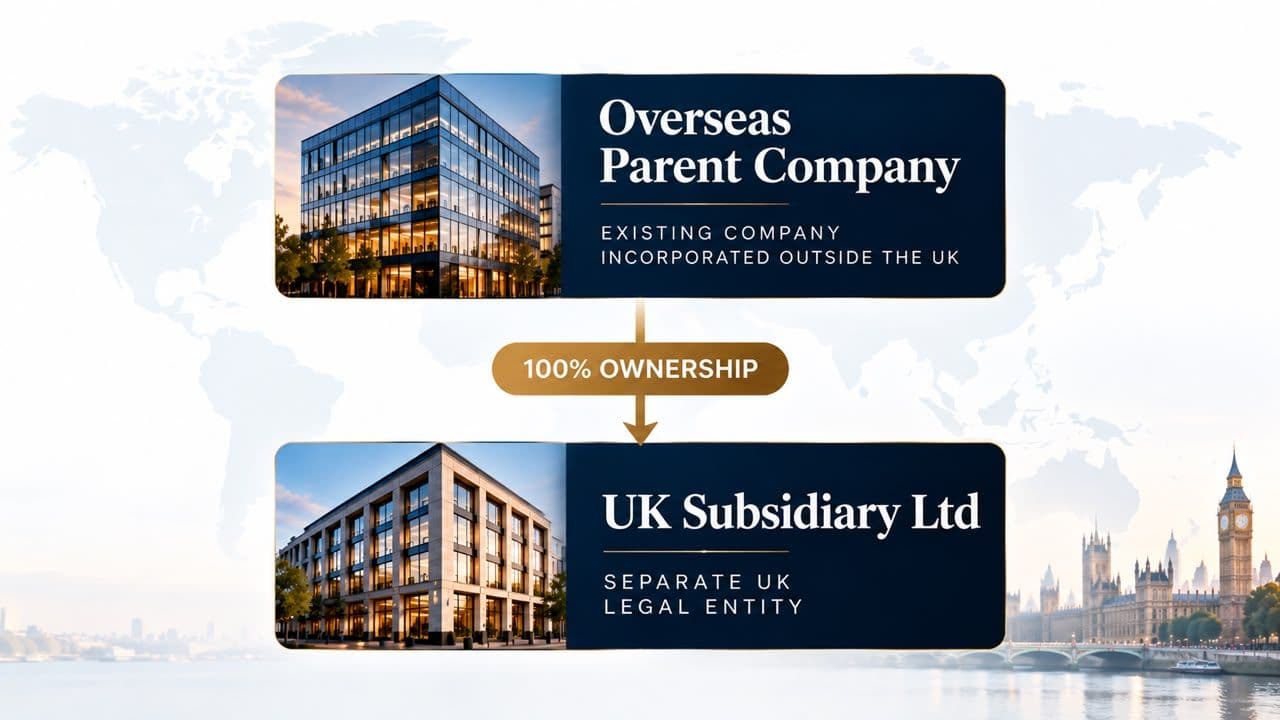
For example, an established German GmbH may own all the shares in a newly incorporated UK Ltd.
The German company remains the parent. The UK Ltd becomes its subsidiary.
The subsidiary has its own legal personality, company registration number, directors, corporate records and statutory responsibilities.
It may enter contracts, employ staff, own assets and conduct business in its own name, subject to applicable laws and authorisations.
Does a subsidiary protect the overseas parent from liability?
A separate company can help distinguish the liabilities of the UK operation from those of the parent.
However, this separation is not an absolute guarantee against parent-company exposure.
Liability may arise through parent guarantees, contractual commitments, unlawful conduct, applicable group liabilities or other legal circumstances.
The intended separation should be reflected in the subsidiary’s contracts, financial records, management and operational arrangements.
Practical point: If the overseas parent continues signing every UK customer contract itself, the group should examine whether the subsidiary is fulfilling its intended commercial purpose.
2. Do You Need a UK Subsidiary, Branch or Neither?
An overseas company does not automatically need a UK subsidiary simply because it sells to British customers.
Three approaches may be relevant.
Direct trading from overseas
The existing foreign company may be able to supply UK customers without creating a separate British entity.
UK VAT, customs, tax, contractual or regulatory obligations may nevertheless arise depending on the activity.
UK establishment or branch
An overseas company with a qualifying UK place of business may need to register a UK establishment with Companies House.
A branch is not a separate UK legal entity. The overseas company remains the underlying business.
UK subsidiary
A subsidiary may be appropriate where the parent wants a distinct UK company for local contracts, staff, distribution, investment or sustained commercial operations.
The choice should reflect the actual operating model.
For the full structural comparison, read UK Subsidiary vs Branch: A Decision Guide for Overseas Companies.
3. Five Decisions to Make Before Incorporating
A subsidiary application should begin with the intended business model, not simply the company-name form.
Decision 1 — What will the UK company actually do?
Will the subsidiary:
- Sell goods or services directly to British customers?
- Employ UK staff or engage contractors?
- Import, hold or distribute inventory?
- Sign local contracts?
- Provide services to other group companies?
- Own assets or intellectual property?
These activities may create different accounting, tax, regulatory and operational requirements.
Decision 2 — Who will own the UK shares?
The overseas parent may own 100% of the subsidiary.
Alternatively, ownership may be shared with another group company, investor or joint-venture partner.
If the existing overseas business is intended to own the UK operation, registering the shares personally in a founder’s name may create unnecessary restructuring questions.
For further guidance, read UK Company Shares and Directors for Non-Resident Founders.
Decision 3 — Who will manage the subsidiary?
The parent should identify the proposed directors, their decision-making responsibilities and the matters requiring parent-company approval.
A UK-resident director is not generally required.
However, directors owe statutory duties to the UK company, even when appointed by the parent.
For a fuller explanation, see UK Company Director Duties for Non-Residents.
Decision 4 — Which entity will receive revenue and incur costs?
The group should determine which company will sign contracts, issue invoices, own inventory, employ staff and incur expenses.
Where the overseas parent provides services, assets or financing, the arrangement may require appropriate intercompany documentation.
Decision 5 — How will the subsidiary be funded?
Funding may involve share capital, a properly documented parent-company loan or another appropriate arrangement.
The parent should consider working-capital needs, currency exposure and relevant legal and tax consequences.
Seven Oak establishment principle: ownership, management, contracting and funding should be considered before filing the incorporation application.
4. What Documents Does an Overseas Parent Company Need?
The precise requirements depend on the parent’s jurisdiction, ownership chain, proposed directors and the organisations involved.
It is important to distinguish information required for Companies House incorporation from additional documents requested for KYC, anti-money-laundering checks, banking or specialist legal review.
Parent-company information
An overseas corporate shareholder should be prepared to provide:
- Registered legal name.
- Jurisdiction of incorporation.
- Corporate registration number.
- Registered address.
- Details of directors and authorised representatives.
- Information about the intended UK shareholding.
Supporting evidence may include a certificate of incorporation, current company-register extract, constitutional documents or ownership chart.
Not every document is automatically a statutory attachment to the Companies House incorporation application.
Ownership and control information
Where the parent belongs to a wider corporate group, information about intermediate holding companies, voting rights, ownership percentages and ultimate control may be required.
Authority to establish the subsidiary
The parent should consider whether its constitutional documents or home-country law require board approval or another corporate authorisation.
A board resolution may be appropriate, but it is not universally required as an incorporation attachment.
Proposed director information
The incorporation application requires director details.
Relevant individuals must meet the applicable Companies House identity-verification requirements.
Formation providers may separately require identification and address evidence for their own due diligence.
Complex structures
Trusts, nominee arrangements, multiple share classes, unusual control rights, regulated activities and multilayered ownership may require additional review.
Foreign-language documents may need translation or authentication depending on the recipient’s requirements.
5. How to Register a UK Subsidiary: Step by Step
Once the corporate structure is agreed and the relevant information is available, the incorporation can be prepared.
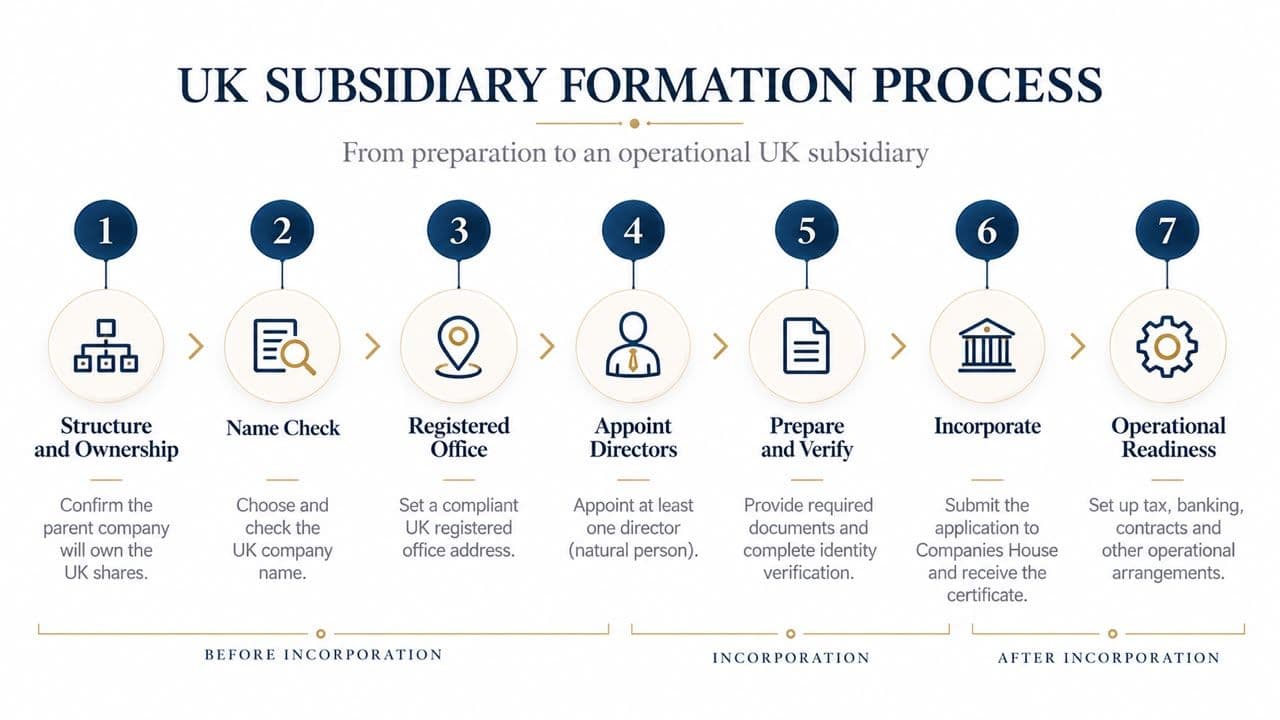
Step 1 — Choose the company name
Check that the proposed name complies with Companies House rules and is available.
Restricted or sensitive words may require approval.
The parent should also consider trade marks and relevant commercial naming rights.
Step 2 — Choose the incorporation jurisdiction
A UK company is incorporated in a particular jurisdiction, such as England and Wales, Scotland or Northern Ireland.
Its registered office must be in the relevant jurisdiction.
Step 3 — Appoint the directors
A private limited company needs at least one individual director.
The overseas parent should agree who will manage the company and how decisions will be made.
A company secretary is not generally compulsory for an ordinary private limited company.
Step 4 — Establish the shareholding
The foreign parent can be registered as a corporate shareholder.
The application must accurately reflect the shares issued and relevant shareholder information.
For example, the parent might subscribe for 100 ordinary shares and own all 100.
This is illustrative, not a universal recommendation.
Different share classes, special voting rights or joint-venture arrangements may require bespoke documentation.
Step 5 — Determine PSC and RLE reporting
The UK company must assess its ownership and control information.
A foreign corporate shareholder is not automatically a registrable relevant legal entity (RLE).
The analysis may involve intermediate entities, voting rights, board appointment powers, significant influence or control, and the statutory registrability conditions.
The UK subsidiary must identify and report its registrable PSCs or RLEs under the applicable statutory rules. Where no registrable individual or entity can be identified after the required enquiries, the appropriate statutory statement must be considered rather than inventing an individual PSC.
For the official requirements, consult Companies House guidance on people with significant control and its detailed guidance for legal entities.
Step 6 — Arrange the Registered Office and incorporation details
The company needs an appropriate Registered Office in its jurisdiction of incorporation.
It must also provide a registered email address and other required incorporation information, including suitable SIC codes.
A Registered Office serves a statutory address function. It does not automatically establish physical operations, effective management or VAT establishment.
For the address requirements, read UK Company Formation Without Your Own UK Address.
Step 7 — Complete identity verification and prepare the constitution
Relevant directors and PSCs must comply with the applicable Companies House identity-verification requirements.
Individuals who successfully verify their identity receive a personal code, which must be provided for the relevant Companies House roles in accordance with the applicable rules.
The official Companies House personal-code guidance explains how the code is issued and used.
For the practical process when living abroad, read Companies House Identity Verification for Non-Residents: 2026 Guide.
The incorporation also involves the company’s constitutional documents, including its articles of association.
Standard model articles may suit straightforward companies. Complex group governance or investor rights may require specialist drafting.
Step 8 — Submit the application and review the documents
The application is submitted through an available Companies House registration route or appropriate formation provider.
Once accepted, Companies House issues a Certificate of Incorporation.
The parent should review the registered details and retain the company’s ownership and constitutional records.
The subsidiary now legally exists, but its banking, tax, contracts and operational arrangements may still require further work.
For the official incorporation process, see Companies House — Register your company.
6. How Much Does It Cost to Set Up a UK Subsidiary in 2026?
There is no universal all-inclusive price for establishing a fully operational UK subsidiary.
The total depends on the ownership structure, required professional support and planned activities.
Companies House statutory fees
The current Companies House statutory fee schedule lists:
Standard digital incorporation: £100.
Online confirmation statement: £50, payable with the first confirmation statement in the applicable 12-month payment period.
These are government filing fees, not the complete cost of preparing and operating a UK subsidiary.
Professional establishment costs
Depending on the project, additional work may involve:
- Corporate-shareholder documentation and KYC.
- Ownership and PSC/RLE analysis.
- Identity-verification assistance.
- Registered Office and Director Service Address.
- Bespoke articles or shareholder arrangements.
- Banking-readiness assistance.
- Accounting and tax-registration coordination.
- Specialist legal or international tax advice.
Not every service is compulsory in every case.
Seven Oak Prestige formation packages
Seven Oak Prestige’s standard formation packages currently start at £199, with broader packages priced at £299 and £399.
These packages cover defined formation and support services.
They should not automatically be treated as a complete fixed-price solution for every overseas-parent subsidiary.
Complex ownership, bespoke documentation, multiple directors and specialist requirements may change the service scope.
The appropriate route is to assess the proposed structure before confirming the final quotation.
For a detailed breakdown of statutory and professional costs, read UK Company Formation Cost for Non-Residents: Real 2026 Fees.
Ongoing costs
The subsidiary may also incur recurring expenses for statutory filings, accounting, tax compliance, address services, payroll, premises and other operational requirements.
A realistic budget should distinguish:
Incorporation costs → Establishment costs → Recurring compliance costs → Operating costs
7. How Long Does It Take to Establish a UK Subsidiary?
The timeframe depends on what the parent means by establish.
Corporate preparation
The parent must agree the ownership, directors, governance, documentation and verification arrangements.
Complex groups may require additional preparation.
Companies House incorporation
Companies House states that standard online registration is usually completed within 24 hours.
This is a government processing timeframe, not a guarantee for every application or third-party onboarding process.
Operational readiness
The subsidiary may still need banking, tax registrations, contracts, accounting systems, payroll, VAT arrangements or sector-specific authorisations.
Some tasks can progress in parallel. Others require the incorporated company or further evidence.
A subsidiary can be legally incorporated before it is ready to trade.
8. What Happens After the UK Subsidiary Is Incorporated?
The parent should establish who will coordinate each UK compliance and operational responsibility.
Corporation Tax
The UK subsidiary must manage its applicable Corporation Tax obligations.
Online incorporation usually includes initial Corporation Tax setup, but the company must ensure HMRC has accurate information about its activities.
Where the relevant notification has not already been completed, HMRC generally requires notification within three months of the company becoming active for Corporation Tax purposes.
For the official rules, see HMRC guidance on registering for Corporation Tax.
VAT
The standard UK domestic VAT registration threshold is currently £90,000 of taxable turnover.
However, the standard threshold does not apply in the same way to non-established taxable persons.
A UK-incorporated company and its Registered Office do not, by themselves, settle whether the business is established in the UK for VAT purposes.
Imports, stockholding, e-commerce and cross-border supplies may require specific VAT analysis.
For the applicable rules, including non-established taxable persons, consult HMRC VAT Notice 700/1 — Who should register for VAT.
Employees and PAYE
Where the subsidiary employs staff and PAYE registration is required, it should establish the appropriate employer arrangements.
Employment contracts, payroll, pensions, right-to-work checks and other obligations may also apply.
Official reference: Register as an employer — GOV.UK.
Banking and payments
A UK company number does not guarantee a business bank account.
Providers may assess the overseas parent’s jurisdiction, ownership, directors, business activity, source of funds and expected transactions.
The group should assess banking readiness before assuming a particular bank or payment service will be available.
Accounting and statutory filings
The UK subsidiary must maintain appropriate financial records and meet its Companies House and HMRC obligations.
For a newly incorporated private company, first accounts are commonly due 21 months after incorporation.
Where the first accounts cover more than 12 months, the deadline is generally the later of 21 months after incorporation or three months after the accounting reference date. Different rules apply where the first accounting period is shorter or the accounting reference date changes.
Subsequent annual accounts and Corporation Tax returns follow separate deadlines.
The official Companies House guidance on preparing and filing accounts explains how filing deadlines are calculated.
For the practical timetable, read UK Company Compliance Calendar for Non-Resident Directors.
Where the subsidiary belongs to an overseas group, additional accounting, consolidation and intercompany reporting considerations may arise. See Do I Need an Accountant for a UK Company If I Live Abroad?.
For overseas parent companies, ongoing accounting can also involve group reporting, intercompany loans, management fees and transfer-pricing considerations. Our UK subsidiary accounting, tax and compliance guide explains how these responsibilities should be managed alongside UK statutory obligations.
9. Parent–Subsidiary Transactions: What Overseas Groups Should Plan
A UK subsidiary may enter transactions with its overseas parent from the beginning.
These should reflect genuine business arrangements between separate legal entities.
Management and support services
The parent may provide administration, marketing, software, finance or other services.
The group should establish what services are provided, how costs are allocated and which company is responsible for payment.
Intercompany funding
The parent may finance the subsidiary through equity, loans or other appropriate arrangements.
Loan terms, interest, repayments and relevant accounting or tax treatment should be considered.
Intellectual property
The subsidiary may use trademarks, software or other intellectual property owned by the parent.
The group should determine whether the UK company receives a licence, owns the relevant rights or operates under another arrangement.
Transfer pricing
Transactions between connected companies may be subject to UK transfer-pricing rules.
UK legislation generally applies the arm’s-length principle, subject to applicable exemptions and exceptions.
The small and medium-sized enterprise exemption may be relevant, but it is not universal.
SME status must be assessed by reference to the relevant group, not merely the UK subsidiary in isolation. Exceptions can apply, including certain transactions involving non-qualifying territories.
Complex cross-border arrangements should be reviewed by appropriately qualified advisers.
For further information, consult HMRC’s International Manual on transfer pricing.
10. Four Illustrative UK Subsidiary Scenarios
These examples are hypothetical and are not representations of individual Seven Oak Prestige client cases.
German manufacturer establishing UK distribution
A German manufacturer wants to hold inventory in Britain and sell to UK business customers.
A subsidiary may provide a separate contracting and distribution entity.
Before incorporation, the group should determine stock ownership, importer-of-record responsibilities, customs arrangements, VAT treatment and intercompany supplies.
For country-specific considerations, read UK Company Formation from Germany.
US technology company hiring in Britain
A US software company wants to employ UK staff and contract with British enterprise customers.
The parent should assess intellectual-property ownership, intercompany service charges and the allocation of commercial responsibilities.
See How to Set Up a UK Company from the United States.
Indian company expanding procurement and sales
An Indian company wants a UK subsidiary to access procurement opportunities and manage local commercial relationships.
The structure should reflect the parent’s intended ownership and applicable Indian outbound-investment obligations.
For the jurisdiction-specific considerations, read UK Subsidiary for Indian Companies: Setup, Tax and FEMA.
UAE group establishing a British operating company
A UAE-based group wants a separately incorporated UK business for continuing operations.
Corporate ownership may be appropriate, but banking, management, tax residence, intercompany transactions and governance require consideration.
These scenarios demonstrate why subsidiary establishment should be scoped around the business model rather than treated as an identical formation exercise for every overseas company.
11. Seven Common Mistakes When Establishing a UK Subsidiary
Mistake 1 — Incorporating personally when the parent should own the shares
If the UK company is intended to belong to an established overseas business, personal ownership by the founder may not reflect the intended group structure.
Correcting the arrangement later may involve share transfers, legal documentation and tax analysis.
Mistake 2 — Treating the foreign parent as an automatic PSC or RLE
Corporate shareholding and PSC/RLE registration are related but distinct matters.
The statutory registrability conditions must be assessed.
Mistake 3 — Assuming a Registered Office proves UK operations
A Registered Office serves a statutory function.
It does not automatically establish physical operations, effective management or VAT establishment.
Mistake 4 — Expecting immediate banking approval
A newly incorporated subsidiary may need to demonstrate its commercial purpose, group ownership, funding and expected transactions.
Approval remains the provider’s decision.
Mistake 5 — Failing to identify the contracting entity
Contracts, invoices, accounting and operational arrangements should reflect the intended role of the UK company.
Mistake 6 — Ignoring the parent’s home-country obligations
A UK subsidiary does not remove the overseas parent’s obligations under its own jurisdiction’s corporate, tax or investment rules.
Mistake 7 — Treating incorporation as the end of the project
A Certificate of Incorporation establishes the company.
It does not automatically complete tax, banking, employment, contractual or compliance arrangements.
12. Seven Oak Prestige — Parent-to-Subsidiary Readiness Framework
Before submitting an incorporation application, the overseas parent should be able to answer seven questions.
01 — Commercial purpose
Can we explain what the UK subsidiary will actually do?
02 — Corporate ownership
Do we know which entity will hold the UK shares?
03 — Control and management
Have we identified the directors and relevant ownership/control chain?
04 — Documentation
Can we provide the necessary parent-company information and verification evidence?
05 — Contracts and funding
Do we know which entity will contract with customers and how the UK business will be financed?
06 — Operational requirements
Have we considered banking, VAT, payroll, import/export and sector-specific requirements?
07 — Ongoing compliance
Have we identified who will coordinate UK accounting, statutory filings and group reporting?
If any answers remain unclear, resolve the relevant issues before treating the project as incorporation-ready.
This framework is a practical preparation tool. It is not a certification or an officially recognised assessment and does not replace specialist professional advice.
13. Frequently Asked Questions
Can a foreign company own 100% of a UK subsidiary?
Yes. An overseas company can generally own all the shares in a UK private limited company, subject to the applicable incorporation and ownership-reporting requirements.
Does a UK subsidiary need a British director?
No. An ordinary UK private limited company does not generally require a UK-resident director. Eligibility and identity-verification requirements still apply.
Does the overseas parent need to register a UK branch first?
No. A foreign company can generally incorporate a separate UK subsidiary without first registering a UK establishment. Any separate establishment-registration obligation depends on its actual activities.
What documents are required from the overseas parent?
Relevant information includes the parent’s registered identity, jurisdiction, corporate shareholder details and ownership/control information. Additional evidence may be required for provider due diligence or specialist review.
How much does it cost to incorporate a UK subsidiary?
The standard digital Companies House incorporation fee is currently £100. Professional support, corporate documentation, address services and operational requirements may increase the total.
Can the UK subsidiary be incorporated before trading begins?
Yes. The company may be incorporated before trading, but its Companies House, accounting and HMRC responsibilities must still be managed.
Does a UK subsidiary automatically receive a bank account?
No. Banks and payment providers make independent onboarding decisions based on eligibility, ownership, activity and risk.
Is the overseas parent responsible for all subsidiary debts?
Not automatically. The subsidiary is a separate legal entity, but guarantees, contractual commitments and other legal circumstances may create parent-company exposure.
14. How Seven Oak Prestige Supports Overseas Companies
Establishing a UK subsidiary requires more than choosing a company name and submitting an incorporation application.
The company should reflect the overseas parent’s commercial objectives, ownership structure and intended operating model.
Seven Oak Prestige Ltd assists international founders and overseas companies with defined UK establishment services, including:
- UK company formation.
- Registered Office and Director Service Address arrangements.
- Companies House identity-verification assistance.
- Corporate onboarding documentation and KYC preparation.
- Banking-readiness support.
- Relevant post-incorporation compliance coordination.
For an overseas corporate parent, the first step is to assess the proposed ownership, directors, UK activities, documentation and establishment requirements.
Complex corporate structures, bespoke documents, specialist tax matters and regulated legal services may require separate professional involvement or provider confirmation.
The service scope and price should be agreed before proceeding.
Planning a UK Subsidiary for Your Overseas Company?
If your business is already incorporated outside the UK, tell us where the parent company is registered, what the UK subsidiary will do, who will own its shares and when you expect operations to begin.
We can review the initial requirements and confirm the appropriate next step.
Discuss Your UK Subsidiary Establishment
Final Perspective
A UK subsidiary can be a useful structure for an overseas company establishing a distinct British business.
But its value comes from how it supports the group’s commercial objectives, not merely from obtaining a UK company number.
Ownership should reflect the parent’s intentions. Management and contracts should reflect the operating model. Funding, accounting and compliance should reflect the actual activities.
The subsidiary should follow the business strategy — not the other way around.
About the Author
Isaac Jackson
Founder & Managing Director — Seven Oak Prestige Ltd
Isaac Jackson supports international founders and overseas businesses with UK company establishment, Companies House processes, statutory-address arrangements, compliance preparation and banking readiness.
His work focuses on the practical requirements of establishing and managing UK companies from overseas.
Editorial Methodology
Last reviewed: 9 October 2026
This guide draws on Companies House guidance concerning incorporation, corporate ownership, identity verification and statutory fees, together with HMRC guidance on relevant tax and VAT obligations.
It distinguishes statutory incorporation requirements from provider due diligence, specialist professional advice and the wider work required to establish an operational UK business.
Important Notice
This guide provides general information about UK subsidiary establishment. It is not individual legal, tax, accounting, investment, immigration or regulatory advice.
The appropriate structure and obligations depend on the overseas parent’s circumstances, relevant jurisdictions and proposed UK activities. Specialist professional advice should be obtained where necessary.