
Companies House Identity Verification for Non-Residents : 2026 Guide

Companies House Identity Verification for Non-Residents: 2026 Guide
If you live outside the UK and want to form, own or manage a UK company, Companies House identity verification is now part of the process.
Since 18 November 2025, identity verification has been a legal requirement for relevant directors and People with Significant Control (PSCs). The requirement applies whether you live in the UK or overseas.
For a non-resident founder, the important point is simple: living outside the United Kingdom does not prevent you from forming or managing a UK company. But if you are a director or PSC, you need to understand when to verify your identity, how to obtain your Companies House personal code, and when that code must be provided.
This guide explains the process from a non-resident founder’s perspective, including directors, PSCs, personal codes, verification routes, deadlines and what happens if you do not comply.
Quick answer for non-UK residents
Do non-resident directors need Companies House identity verification?
Yes. The requirement is based on your role in the company, not simply where you live. Directors and PSCs are among the individuals currently required to verify.
Can you verify your identity while living outside the UK?
Yes. Companies House provides an online verification route through GOV.UK One Login, and verification can also be completed through an Authorised Corporate Service Provider (ACSP), depending on the route and documents available to you.
What happens after successful verification?
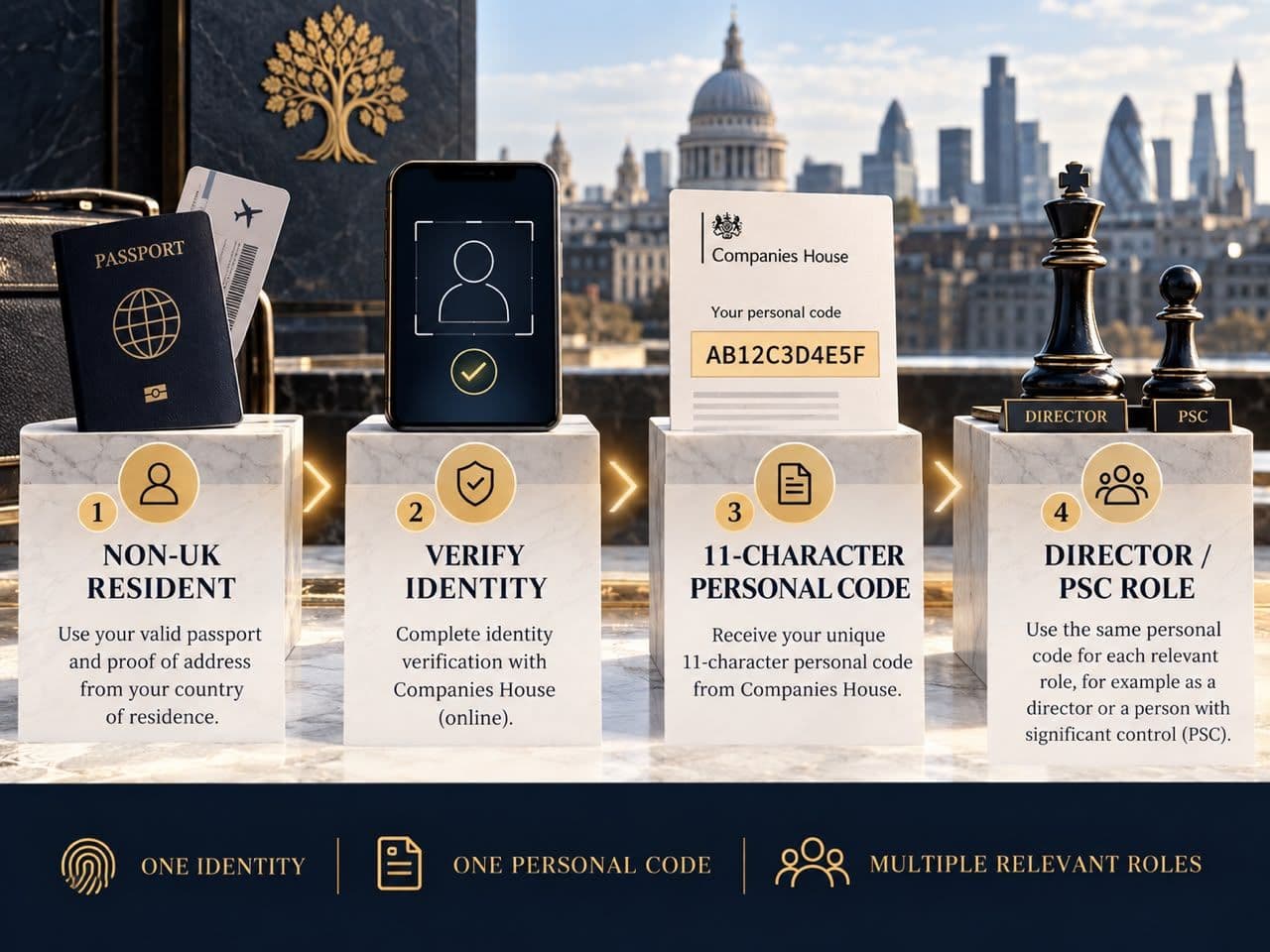
You receive a unique 11-character Companies House personal code. The code belongs to you as an individual, not to one particular company.
Do you need a different personal code for every UK company?
No. You normally verify once and use the same personal code for your relevant appointments and roles.
What if you are both a director and PSC?
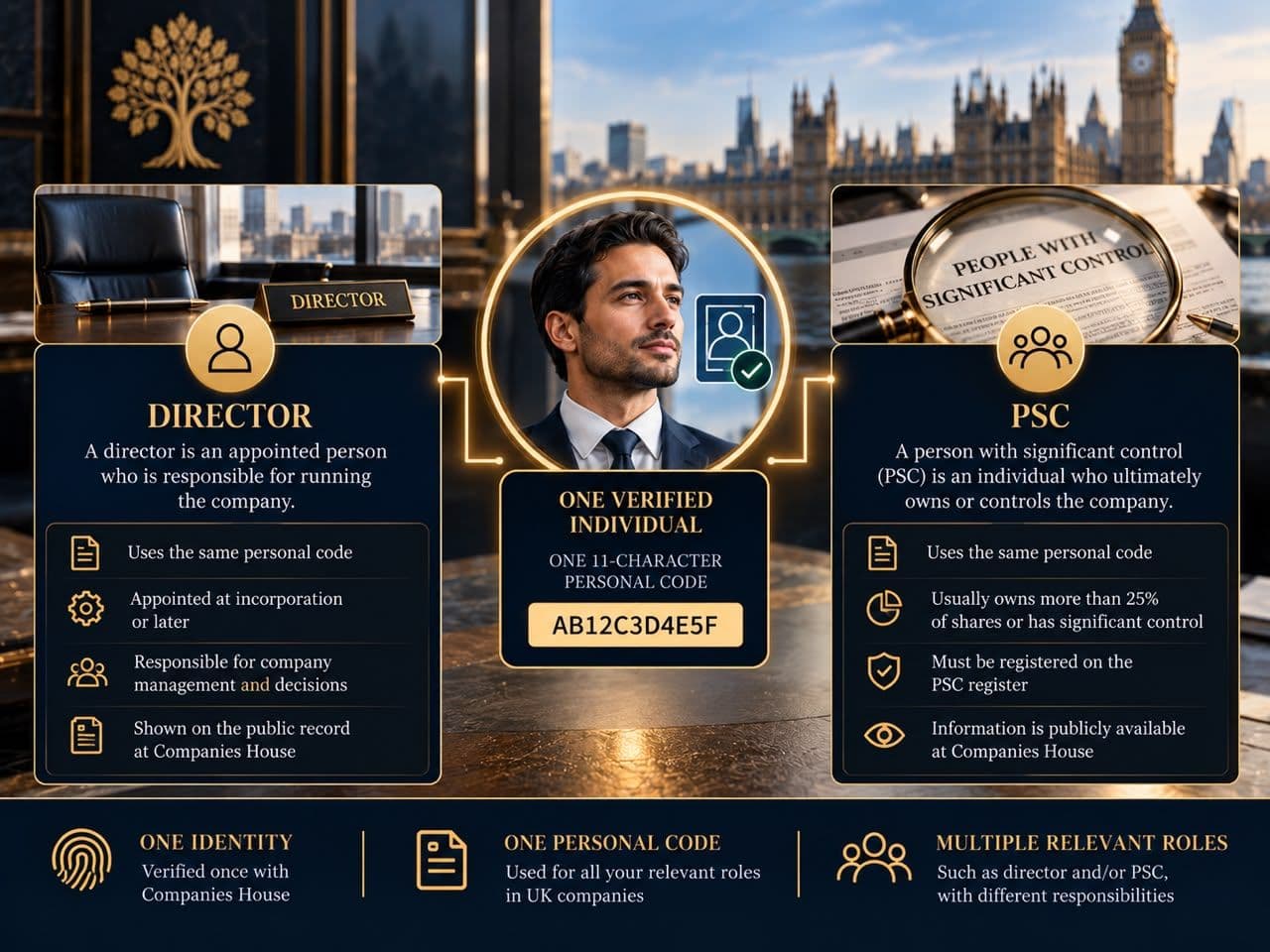
You use the same personal code, but Companies House requires your verified identity to be connected separately to the relevant roles you hold.
If you need practical assistance navigating the verification process, Seven Oak Prestige provides a dedicated Companies House Identity Verification Assistance service for directors, PSCs and non-UK residents.
1. Is Companies House identity verification mandatory in 2026?
Yes.
Companies House identity verification is no longer simply a future reform or voluntary preparation measure.
Identity verification became a legal requirement on 18 November 2025 for the current mandatory regime. Companies House states that individuals who need to verify include:
- company directors;
- director equivalents, including relevant members, general partners and managing officers;
- directors of overseas companies registered in the UK;
- People with Significant Control;
- Authorised Corporate Service Providers.
Companies House says identity verification for some other categories will be introduced later. These include people filing at Companies House, limited partnerships, corporate directors, corporate LLP members and officers of corporate PSCs.
This distinction matters. Older guidance sometimes describes all these categories as if the same verification requirement already applies to everyone. It does not.
For most individual non-resident founders establishing an ordinary private limited company, the immediate questions are usually whether they will be a director, a PSC, or both.
2. Can a non-resident still form a UK company?
Yes.
You do not need to become a UK resident simply because you want to be a director or shareholder of a UK limited company.
Identity verification changes the compliance process; it does not create a general UK-residency requirement for overseas founders.
A founder living in India, the UAE, Saudi Arabia, Singapore, Hong Kong, Ghana, Nigeria, France, Germany, Australia, the United States or another country may still be able to establish a UK company, subject to the applicable company-law, identity, KYC and other requirements relevant to the case.
The key is to distinguish several different concepts:
Nationality and residence identify who you are and where you live.
Companies House identity verification confirms your identity for relevant company roles.
KYC and AML checks may be carried out separately by formation agents, banks, payment providers and other regulated businesses.
A UK Registered Office is the company’s statutory address and does not mean the director personally lives in the UK.
For a wider explanation of the address requirements, see our guide to Registered Office and Director Service Address requirements.
3. Who needs to verify their identity?
Company directors
If you are a director of a UK company, identity verification applies to you even if your normal residence is outside the United Kingdom.
For someone becoming a director from 18 November 2025 onwards, the personal code is required as part of the appointment filing or when incorporating a company.
People with Significant Control
A PSC is not simply another name for a shareholder.
For a company limited by shares, an individual may be a PSC where, for example, they hold more than 25% of the shares or voting rights, have the right to appoint or remove a majority of directors, or otherwise meet one of the statutory control conditions.
Many owner-managed companies have one individual who is both a director and PSC.
If you are uncertain about the difference between these roles, our guide to UK company shares, directors and PSCs for non-resident founders explains how they fit together.
Director equivalents
The current Companies House guidance also covers certain director-equivalent roles, including members, general partners and managing officers.
The exact obligation should therefore be checked against the type of UK entity and role involved rather than assuming every structure follows the standard private limited company process.
4. How can a non-resident verify their identity?
Companies House currently provides two principal routes.
Route 1: GOV.UK One Login
Individuals can use the official Companies House identity-verification service through GOV.UK One Login.
The service checks your identity using the available verification methods and information applicable to your circumstances.
Companies House expressly says that identity documents should not simply be posted or emailed to it for verification.
You can access the official guidance through Verifying your identity for Companies House — GOV.UK.
Route 2: an Authorised Corporate Service Provider
An ACSP, also known as a Companies House authorised agent, can verify identities where it is authorised and able to accept the case.
The agent will require evidence from the approved identity-document framework and may charge for its service.
The appropriate route for a non-resident can depend on the identity documents held, the applicant’s circumstances and whether the available digital verification route can successfully verify them.
5. What is the Companies House personal code?
Successful identity verification results in a Companies House personal code.
It is an 11-character code issued to an individual after identity verification.
The most important point is that the code belongs to you, not to your company.
If you are a director of several UK companies, you do not normally complete a fresh identity verification simply to obtain a different code for every company.
Instead, you use the same personal code when Companies House requires you to confirm that your verified identity relates to the relevant appointment or role.
Keep the code secure. Companies House says it may be shared with a trusted person who files on your behalf, such as an agent or accountant, where necessary.
Where do you find your personal code?
If you verified through GOV.UK One Login, the code can be viewed through your Companies House account.
Companies House also states that people who verified through GOV.UK One Login after 8 July 2026 were sent their personal code by email.
If you verified through an ACSP, Companies House sends the code to the email address supplied for you by the ACSP.
6. When does a new non-resident director need the personal code?
If you are registering a new company, Companies House requires the personal code for each director as part of the registration filing.
If you are being appointed as a director of an existing company, the code is required as part of the appointment process.
For a new non-resident founder, this means identity verification should not be treated as something to think about only after incorporation.
A practical sequence is:
- decide the proposed company structure;
- identify the directors and shareholders;
- establish who will be a PSC;
- complete the required identity-verification steps;
- obtain the relevant personal code or codes;
- prepare the incorporation filing;
- submit the company registration;
- complete the company’s post-incorporation requirements.
If you are planning to form a UK company but do not have your own UK address, see our guide to forming a UK company without your own UK address
7. What must existing directors do?
Existing directors are also within the identity-verification regime.
Companies House states that a current director must provide their personal code as part of the company’s next confirmation statement filing under the applicable transition arrangements.
If you are a director of several companies, the same personal code is used, but the verification requirement needs to be connected to each relevant appointment.
This is an important distinction:
One person does not mean one company.
Your identity is verified as an individual, while Companies House still needs to connect that verified identity to the company roles you actually hold.
8. PSC verification and the 14-day period
PSC verification has its own process and should not be confused with the director requirement.
Every PSC has a 14-day period during which they must provide their Companies House personal code and the required verification statement. The dates of that period depend on the PSC’s circumstances, including whether they were registered before 18 November 2025 and whether they are also a director of the company.
Companies House provides a dedicated service for this process.
Provide identity verification details for a PSC — GOV.UK
Where a PSC cannot provide the required information before the deadline, the official service also provides a mechanism to request a 14-day extension, provided the request is made before the verification deadline has passed.
Do not assume that the PSC deadline is automatically the same as a director’s confirmation-statement requirement.
9. What if you are both a director and a PSC?
This is common in small owner-managed UK companies.
Suppose you live outside the UK, own 100% of your UK Ltd and are its sole director.
You may therefore hold two relevant roles:
Director
and
PSC
You do not need two different personal codes merely because you hold both roles.
You use the same personal code, but Companies House requires your verified identity to be connected to each relevant role.
That means completing the director requirement does not necessarily mean that the separate PSC requirement can simply be ignored.
For non-resident founders, this is one of the most important practical distinctions to understand.
10. What information and documents might you need?
The exact verification requirements depend on the verification route and the applicant’s circumstances.
For non-residents, an eligible identity document such as a passport may be particularly relevant, but applicants should follow the requirements of the route they actually use rather than assuming that every passport or national identity document will work through every verification method.
You should also ensure that your personal information is accurate and consistent.
This can include:
- full legal name;
- date of birth;
- current residential address;
- accessible email address;
- information required by the chosen verification route.
If you use an agent, additional information or documents may be requested as part of that agent’s own identity, KYC or AML obligations.
Those checks should not be confused with Companies House identity verification itself.
11. Companies House verification and KYC are not the same thing
This distinction is particularly important for international founders.
When Seven Oak Prestige onboards a client, we may need to carry out KYC and compliance checks relating to the client and proposed company.
Those checks serve a different purpose from the statutory Companies House identity-verification requirement.
Similarly, a bank may carry out its own identity, KYC, AML, source-of-funds and business-risk checks.
Completing one process does not automatically complete all the others.
A founder could therefore have:
Companies House identity verification — confirming identity for the relevant Companies House role;
formation-provider KYC — satisfying the provider’s onboarding and compliance obligations;
banking KYC/AML — satisfying the bank or payment provider’s own onboarding requirements.
Keeping these processes separate helps prevent one of the most common misunderstandings among overseas founders.
12. What if your personal details do not match?
A personal code does not solve incorrect Companies House records automatically.
Companies House explains that a verified identity may fail to connect to its records if, for example:
- the personal code was entered incorrectly;
- the date of birth on the Companies House record is wrong;
- an ACSP supplied incorrect verification details.
Where the underlying Companies House information is incorrect, the relevant record may need to be corrected before the verified identity can be connected successfully.
This is one reason founders should avoid using different versions of their names or inaccurate personal information across incorporation and compliance processes.
13. What happens if you do not verify?
Identity verification is a legal requirement, not an optional trust badge.
Companies House states that failure to comply with the identity-verification requirements on time may constitute an offence and can result in prosecution, court fines or financial penalties.
Companies House also states that a person who does not comply may be unable to:
- be appointed as a new director of an existing company;
- register a new company or entity;
- register as an ACSP.
For existing directors, a company can also be unable to file its confirmation statement unless all directors have met the applicable verification requirement.
The consequences therefore go beyond simply having an incomplete administrative task.
14. Does Companies House identity verification guarantee a business bank account?
No.
This is an important boundary for non-resident founders.
Companies House identity verification confirms identity for the purposes of the Companies House regime. It does not require a bank, EMI or payment provider to approve your business account.
Financial providers make their own decisions and may assess factors such as:
- director and shareholder residence;
- business activity;
- expected transactions;
- customer and supplier locations;
- source of funds;
- company documentation;
- website and commercial evidence;
- the provider’s own country and industry risk appetite.
A Companies House personal code should therefore never be presented as a banking approval mechanism.
Likewise, no legitimate company-formation provider can guarantee approval from a particular bank or payment provider.
15. Do you need to travel to the UK to verify?
Not simply because you are a non-resident.
Companies House provides an online route through GOV.UK One Login, and an ACSP route is also available. The practical verification route depends on the applicant and the evidence available.
However, founders should avoid treating “remote verification” as a promise that every individual will successfully complete every stage online using any document they happen to hold.
If the initial verification method cannot establish the applicant’s identity, additional steps or a different available route may be necessary.
The correct question is therefore not simply:
“Can non-residents verify?”
They can.
The better question is:
“Which available verification route works for my documents and circumstances?”
16. Where identity verification fits into UK company formation
Identity verification is important, but it is only one part of establishing a properly structured UK company.
A non-resident founder may also need to consider:
Company structure
Who will be the directors, shareholders and PSCs?
Registered Office
Every UK company needs an appropriate registered office in the relevant UK jurisdiction.
Director Service Address
Directors need a service address for the public register.
Residential information
Companies House may require a director’s genuine usual residential address even where a separate public service address is used.
Business activity and SIC codes
The incorporation filing should accurately reflect the intended activities.
KYC and compliance
Formation providers and other businesses may have separate onboarding requirements.
Business banking
Banking is a separate provider decision and should be approached with realistic expectations.
Tax and accounting
The company will have ongoing accounting and filing responsibilities, and international founders may also need to consider obligations in the country where they live or manage the business.
Identity verification should therefore be integrated into the formation process rather than treated as an isolated administrative exercise.
17. Companies House identity-verification assistance for non-residents
Some international founders are comfortable completing the available verification route independently.
Others want assistance because they are unsure about their documents, the personal-code process, director and PSC requirements, or how verification fits into their planned incorporation.
Seven Oak Prestige provides a dedicated Companies House Identity Verification Assistance service for directors, PSCs and international applicants.
The current assisted service is £74 and includes an initial eligibility and document review, guidance through the verification process, verification-process coordination and support on how the personal code is used following successful verification.
The personal code is issued following successful identity verification and remains subject to the applicable verification checks and any additional evidence required.
Get help with Companies House identity verification
Frequently Asked Questions
Can a non-UK resident verify their identity for Companies House?
Yes. Being resident outside the United Kingdom does not by itself prevent you from completing Companies House identity verification. The available route depends on the applicant’s circumstances and the verification method used.
Is Companies House identity verification mandatory?
Yes, for individuals currently within the mandatory regime. Identity verification became a legal requirement from 18 November 2025 for the relevant categories, including directors and PSCs.
What is a Companies House personal code?
It is a unique 11-character code issued after successful identity verification. It belongs to the individual rather than a particular company.
Do I need a different personal code for every company?
No. If you hold appointments in multiple companies, you normally use the same personal code to connect your verified identity to the relevant appointments.
I am both director and PSC. Do I need two codes?
No. You use the same personal code, but your verified identity must be connected to the relevant director and PSC roles as required.
Does a new director need the personal code before incorporation?
For a new company registration, Companies House requires the personal code for each director as part of the registration filing.
What does an existing director need to do?
An existing director must provide their personal code through the company’s applicable confirmation-statement process. If the person is a director of multiple companies, the requirement needs to be satisfied for the relevant appointments.
How long does a PSC have to provide their personal code?
Every PSC has a 14-day period in which to provide their personal code and verification statement. The dates of that period depend on the PSC’s circumstances.
Can a PSC obtain an extension?
Companies House provides a mechanism for requesting a 14-day extension in applicable circumstances, but the request must be made before the existing verification deadline has passed.
Can I use GOV.UK One Login from outside the UK?
GOV.UK One Login is one of the official verification routes. Whether a particular applicant can complete the process successfully through that route depends on the available verification method and evidence. An ACSP is the alternative authorised route described by Companies House.
Does identity verification mean Companies House has approved my business?
No. Identity verification confirms the individual’s identity for the relevant Companies House requirement. It is not an approval of the company’s business model, tax position, banking eligibility or commercial activity.
Will verification help me obtain a UK business bank account?
It may form part of having accurate company records, but it does not guarantee banking approval. Banks and payment providers conduct their own KYC, AML and risk assessments independently of Companies House.
Is Companies House verification the same as the KYC completed by my formation provider?
No. They are separate processes serving different compliance purposes.
Can Seven Oak Prestige help me obtain my personal code?
Seven Oak Prestige provides identity-verification assistance for directors, PSCs and non-UK residents who need practical support navigating the process. Completion remains subject to successful verification and the applicable checks.
View Companies House Identity Verification Assistance
Final considerations for non-resident founders
Companies House identity verification has changed the mechanics of forming and managing a UK company, but it has not closed the UK company structure to genuine overseas entrepreneurs.
For a non-resident founder, the practical approach is to establish your roles first.
Determine who will be a director, who will be a shareholder and who qualifies as a PSC. Complete the applicable identity-verification requirement, obtain the Companies House personal code, and make sure it is used for each relevant role at the correct time.
Most importantly, do not confuse identity verification with the rest of the company journey.
A personal code does not replace incorporation, KYC, a compliant Registered Office, accounting obligations or banking due diligence. It confirms one important thing: the verified identity behind the relevant Companies House role.
When that distinction is understood from the beginning, identity verification becomes a manageable part of establishing and maintaining a compliant UK company from overseas.
About the Author
Isaac Jackson
Founder & Managing Director — Seven Oak Prestige Ltd
Isaac Jackson works with international founders and overseas businesses establishing and operating UK companies, including company formation, statutory address services, Companies House requirements, KYC preparation, compliance coordination and business banking preparation.
Seven Oak Prestige Ltd
Company No.: 16903092
Registered Office: 124 City Road, London EC1V 2NX, United Kingdom
ICO Registration: ZC181349
Last reviewed: 4 October 2026
This guide provides general information about Companies House identity verification and UK company administration. It does not constitute legal, tax or financial advice. Requirements can depend on the individual, company structure and circumstances. For statutory requirements and deadlines, refer to the current Companies House guidance.