
UK Company Formation for Non-Residents: Complete 2026 Step-by-Step Guide

UK Company Formation for Non-Residents: Complete 2026 Step-by-Step Guide
Yes. A non-UK resident can generally form, own and direct a UK private limited company without moving to Britain, becoming a UK citizen or appointing a UK-resident director.
A private company can have one shareholder who owns 100% of the shares and also acts as its sole individual director. Companies House does not generally require that director to live in the UK.
The company must still meet the normal UK incorporation requirements, including an appropriate UK Registered Office, a registered email address, accurate director, shareholder and PSC information, and the applicable Companies House identity-verification requirements.
You normally do not need British citizenship, a UK-resident shareholder or director, a UK business bank account before incorporation, or a UK visa merely to own and manage the company while remaining overseas.
But incorporation and operational readiness are different things.
Registering a UK company does not automatically give the founder UK immigration permission, remove tax obligations in the founder’s country of residence, create substantive UK operations, or guarantee approval from a bank, EMI, fintech or payment provider.
Four questions should therefore be kept separate:
Company formation: Can the company legally be incorporated?
Tax: Where can the company and its owners have tax obligations?
Immigration: What is the founder permitted to do physically in the UK?
Banking and payments: Which providers are willing to support the actual company profile?
This guide explains the complete 2026 UK company formation process for non-residents, from ownership and Companies House identity verification through UK addresses, incorporation, banking readiness, tax considerations and post-incorporation compliance.
UK Company Formation for Non-Residents: At a Glance
Can a non-UK resident form a UK company?
Yes, generally.
UK residency required?
No.
UK-resident director required?
No.
Can one person be the sole director and 100% shareholder?
Yes, provided the director is an eligible individual.
UK visa required to incorporate while remaining overseas?
No.
UK Registered Office required?
Yes.
Registered email address required?
Yes.
Minimum directors
One individual director.
Minimum shareholders
One.
Companies House identity verification
Required for relevant directors and PSCs under the current identity-verification regime.
UK bank account required before incorporation?
No.
Current standard digital Companies House incorporation fee
£100.
Does incorporation guarantee a UK business account or payment-provider approval?
No. Banks, EMIs, fintechs and payment providers apply their own eligibility, KYC, AML and risk requirements.
The Companies House incorporation fee is a statutory filing fee. It should not be confused with the wider cost of establishing and operating a UK company from overseas.
Need Support Forming Your UK Company?
Seven Oak Prestige supports international founders with UK company formation, statutory UK addresses, Companies House identity-verification assistance and operational-readiness support.
Starter — £199
For founders who already have suitable UK address arrangements.
Prestige — £299
Includes company formation, Registered Office and Director Service Address.
Elite — £399
Adds a Virtual Business Address, Companies House identity-verification assistance for one director, business-profile review and enhanced banking/application support.
The current £100 Companies House incorporation fee is included in all three package prices.
View UK Company Formation Packages →
1. Can a Non-Resident Legally Form a UK Company?
Generally, yes.
A UK private company must have at least one director, and at least one director must be an individual. Companies House does not impose a general rule requiring that director to live in Britain.
A company limited by shares must also have at least one shareholder. The shareholder and director can be the same person.
A straightforward founder structure can therefore look like:
Non-resident founder
↓
100% shareholder
↓
sole individual director
↓
PSC where the statutory control conditions are met
That structure is legally simple, but simple does not automatically mean suitable.
A different structure may be preferable where:
- there are genuine co-founders;
- investment is expected;
- a foreign parent company will own the UK company;
- management and ownership need to be separated;
- different share rights are required.
For deeper ownership planning, use our guide to structuring shares and directors in a UK Ltd as a non-resident founder.
2. What You Need Before Incorporating
Before submitting the company, settle the core structure.
Company name
The name must comply with Companies House rules and should be checked for:
- availability;
- restricted or sensitive words;
- potential brand conflicts;
- commercial suitability.
Director
A private company needs at least one eligible individual director.
Shareholder
At least one shareholder is required.
The shareholder and director can be the same person.
Shares
Decide:
- how many shares will be issued;
- nominal value;
- who owns them;
- whether ordinary shares are sufficient.
For a straightforward sole-founder company, one ordinary share may be enough. More complicated share structures should exist for a genuine reason.
Persons with significant control
The company must identify relevant PSCs.
For many one-person companies, the sole owner/director will also be the PSC.
Registered office
Every company needs an appropriate UK registered office in the jurisdiction in which it is incorporated.
Registered email
Companies House also requires a registered email address. It is not displayed publicly.
SIC code
Choose the code or codes that genuinely describe the company’s intended activity.
Do not choose unrelated SIC codes simply because someone claims they are more attractive to banks.
Your SIC code should reasonably reflect what the company will actually do. Do not select unrelated codes because somebody claims they are more attractive to banks or payment providers. For the detailed classification process, read our guide to UK SIC Codes for Non-Resident Companies.
UK Company Formation From Abroad: The Process
For a straightforward non-resident formation, the process usually follows this sequence:
Ownership and directors
↓
Company name and SIC code
↓
UK Registered Office and service-address arrangements
↓
Companies House identity verification
↓
Shares and PSC information
↓
Incorporation filing
↓
Companies House approval
↓
Banking, tax and operational setup
↓
Accounting and ongoing compliance
The sections below explain each stage in detail.
3. Companies House Identity Verification in 2026
Identity verification is now a legal part of UK company administration.
Mandatory identity-verification requirements began to take effect on 18 November 2025, with different filing requirements depending on whether the person is a new director, an existing director or a Person with Significant Control.
New directors
A person becoming a director from 18 November 2025 must provide their Companies House personal code as part of the appointment filing or when incorporating a company.
Existing directors
An existing director must provide their personal code through the company’s next relevant Confirmation Statement during the transition process.
Persons with Significant Control
PSCs must also verify their identity and provide their personal code to Companies House.
Every PSC has an applicable 14-day period for providing the code. The timing depends on the person’s circumstances, including whether they were already registered as a PSC before 18 November 2025 and whether they are also a director.
After successful identity verification, Companies House provides the individual with a personal code. The same code is reused when that person needs to confirm their verified identity for different relevant company roles.
KYC and Companies House identity verification are not the same process.
A formation provider may check a passport and residential address for AML/KYC purposes without that automatically completing the individual’s Companies House identity-verification requirement.
For the complete process, read Companies House Identity Verification for Non-Residents — 2026 Guide.
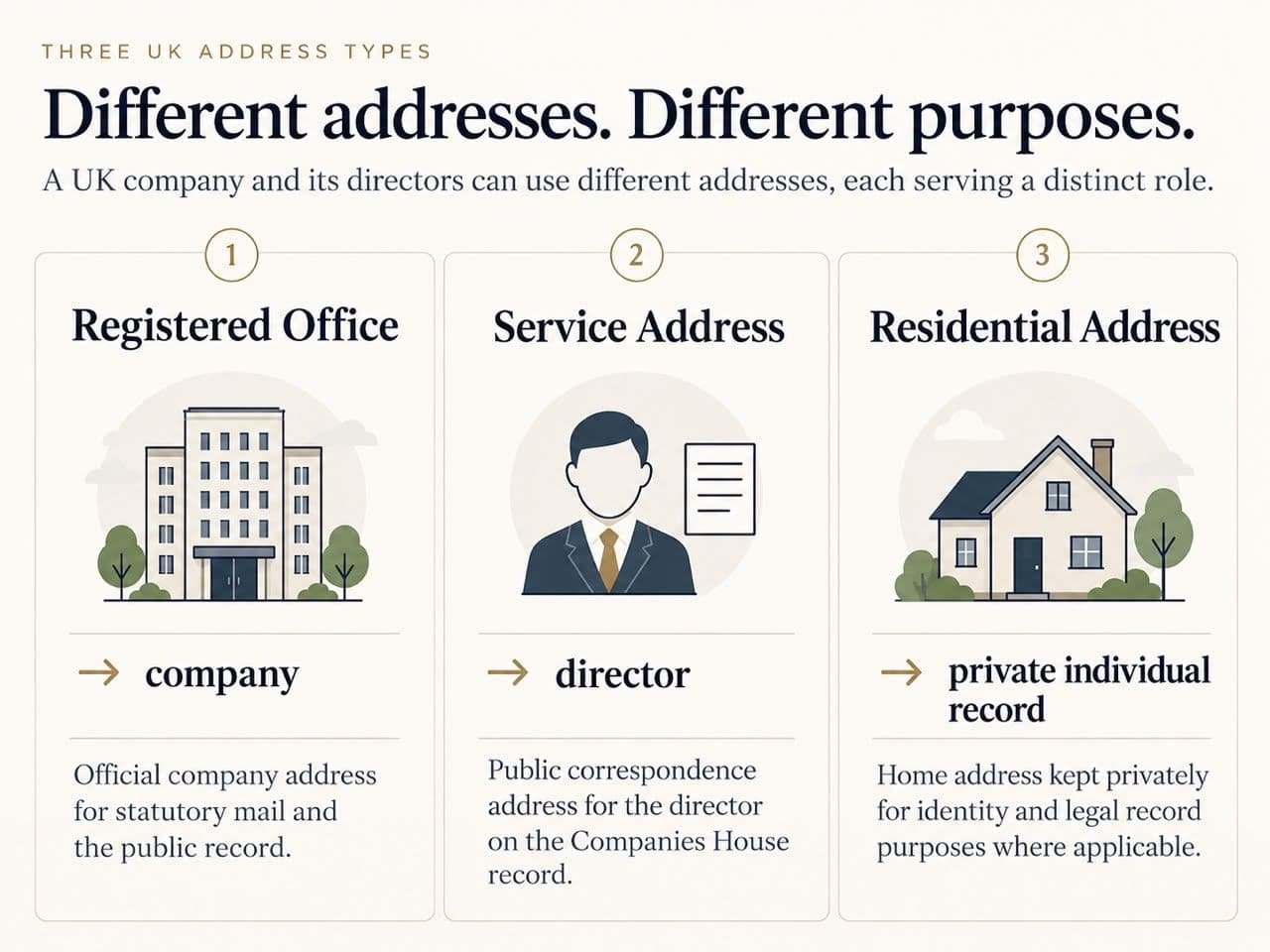
4. Registered Office, Service Address and Residential Address
These addresses serve different purposes.
Registered office
The registered office belongs to the company.
Companies House requires it to:
- be a physical UK address;
- be in the same UK jurisdiction in which the company is registered;
- be an appropriate address, meaning company correspondence can come to the attention of somebody acting for the company and delivery can be acknowledged.
Royal Mail PO Boxes cannot be used as the registered office.
Important distinction
A registered office is a statutory correspondence address.
It does not, by itself, prove that the company has:
- employees at that location;
- staffed operational premises;
- a trading office;
- tax residence there;
- banking eligibility;
- substantive UK operations.
This distinction is particularly important for non-resident founders.
Director service address
This is the public correspondence address associated with the director.
It can sometimes be the same address as the registered office.
Residential address
Companies House also records the director’s usual residential address.
That information is generally protected from ordinary public display.
For the full distinction between Registered Office, Director Service Address, residential address and business address, read UK Registered Office vs Director Service Address for Non-Residents.
Which UK Address Does a Non-Resident Founder Need?
5. Step-by-Step: How to Register a UK Company From Abroad
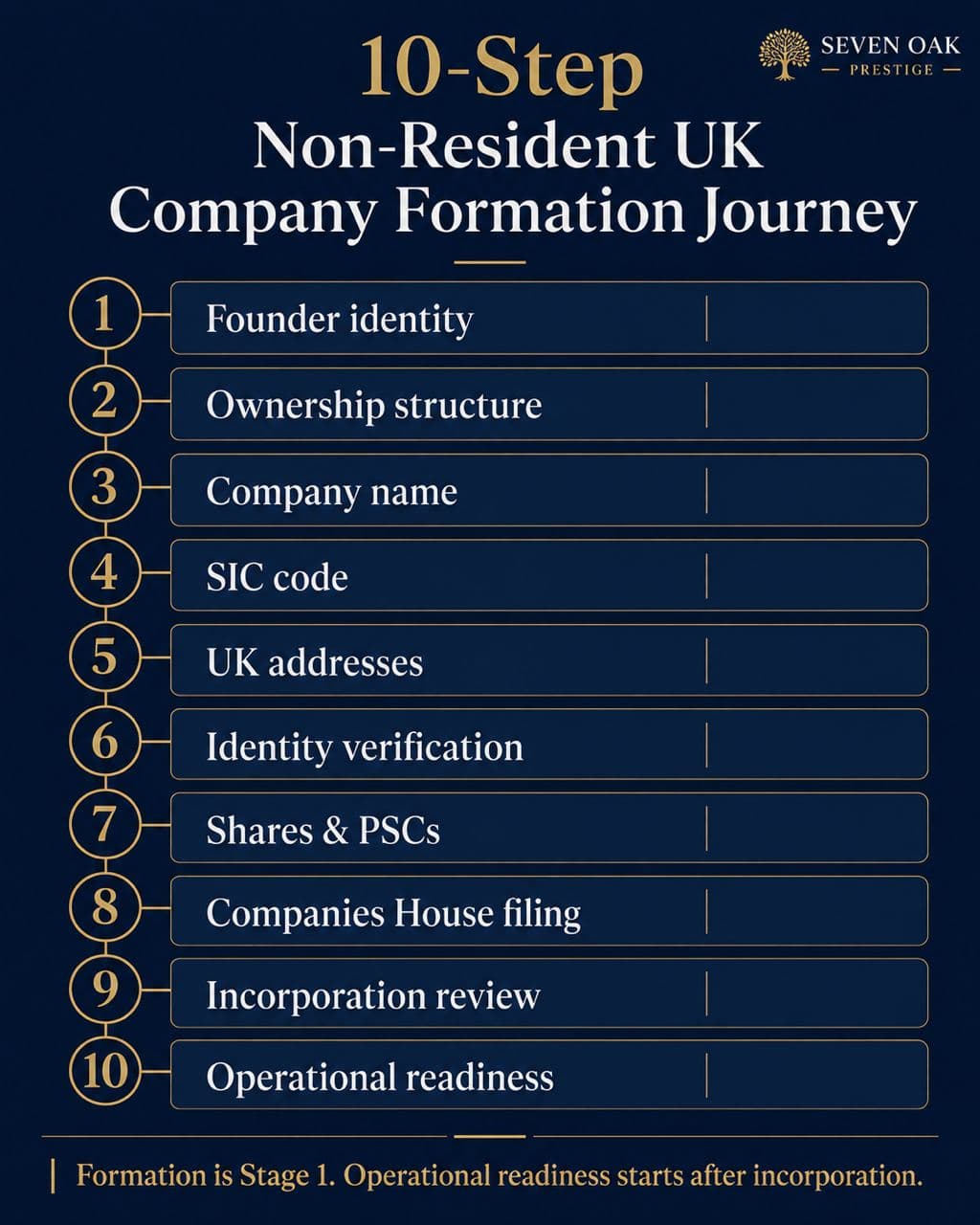
Step 1 — Decide ownership and control
Confirm:
- shareholders;
- directors;
- PSCs;
- share percentages;
- share classes where relevant.
Make these decisions before incorporation rather than immediately restructuring the company afterwards.
Step 2 — Choose the company name
Check Companies House availability and whether any restricted wording requires approval.
Step 3 — Select the SIC code
Use the classification that best reflects what the company genuinely intends to do.
Step 4 — Arrange the UK address structure
Confirm:
- registered office;
- director service address;
- commercial correspondence address if required.
Step 5 — Complete identity verification
Relevant directors and PSCs should complete the applicable process and obtain their personal codes before the filing stage requires them.
Step 6 — Prepare the share structure
Keep the structure simple where appropriate.
More complex rights should reflect genuine ownership, investor or governance requirements.
Step 7 — Prepare and review the filing
The incorporation application generally includes:
- company name;
- registered office;
- registered email;
- SIC code;
- director information;
- shareholder information;
- shares;
- PSC information;
- required statutory statements.
Step 8 — Submit the Incorporation
Once the company structure, addresses, identity-verification requirements and filing information are ready, the incorporation application can be submitted to Companies House.
The current standard digital Companies House incorporation fee is £100.
Incorporation is complete only when Companies House accepts the application and issues the Certificate of Incorporation.
Step 9 — Check the incorporated record
Once accepted, verify:
- company name;
- number;
- registered office;
- directors;
- PSCs;
- SIC codes;
- shares.
A small filing mistake can later become a larger KYC or banking inconsistency.
Step 10 — Move into operational readiness
After incorporation, consider:
- accounting records;
- Corporation Tax;
- banking;
- VAT;
- EORI;
- payroll;
- website disclosures;
- contracts;
- annual accounts;
- confirmation statements.
For the complete sequence after registration, read What Happens After You Register a UK Company as a Non-Resident?
Which Type of Non-Resident Founder Are You?
The incorporation rules may be similar, but the practical setup is not the same for every international founder.
Solo Consultant or Agency Founder
A straightforward structure may be enough:
- one shareholder;
- one director;
- UK statutory addresses;
- invoicing;
- accounting;
- appropriate business banking.
Do not add unnecessary ownership complexity.
SaaS, Software or Technology Founder
Formation may be simple, but the structure should also make sense for:
- founder ownership;
- future investors;
- intellectual property;
- subscription revenue;
- payment processing;
- international development teams;
- customer contracts.
E-Commerce Founder
The company is only one part of the setup.
You may also need to consider:
- supplier location;
- inventory;
- VAT;
- EORI;
- customs;
- fulfilment;
- marketplaces;
- banking;
- payment processing.
For that specialist setup, use our UK E-Commerce Company for Non-Residents — 2026 Guide.
Existing Overseas Company Entering the UK
Do not automatically create a personally owned UK Ltd.
An established foreign business should first consider whether the UK activity should be:
- direct cross-border trading;
- a UK establishment / branch;
- or a wholly owned UK subsidiary.
Founder Mainly Seeking Banking or Payment Processing
A UK company should have a genuine commercial role.
Do not incorporate purely because somebody has promised access to:
- Stripe;
- Wise;
- Revolut;
- Airwallex;
- Payoneer;
- or a UK bank account.
UK company eligibility does not equal financial-provider eligibility.
For the banking-led founder, use: UK Business Banking for Non-Residents .
Common Mistakes Non-Resident Founders Make
Treating a UK Registered Office as Their Residential Address
A professional UK address does not change where the founder actually lives.
The founder’s genuine residential information should remain accurate across KYC, compliance and banking records.
Adding a UK-Resident Director Without a Genuine Reason
A standard private company does not generally require a UK-resident director simply because its owner lives abroad.
Do not add somebody merely to make the company appear more “British”.
Choosing a Vague Business Description
Descriptions such as:
“general trading”
or:
“online services”
can create unnecessary ambiguity when the real activity can be described more precisely.
Your Companies House information, website, KYC profile and banking explanation should be consistent.
Choosing an Inaccurate SIC Code Because It “Looks Better to Banks”
A SIC code should reflect the actual activity.
Do not select an unrelated code because somebody claims it will improve banking eligibility.
Assuming Incorporation Guarantees Banking
Companies House decides whether the company can be incorporated.
Financial providers make separate risk and eligibility decisions.
Ignoring the Founder’s Home Country
A UK company does not remove:
- local tax;
- foreign-company reporting;
- overseas-investment rules;
- exchange controls;
- management-and-control issues;
- personal reporting obligations.
Treating Incorporation as the Finish Line
The Certificate of Incorporation creates the legal entity.
The business may still need:
- accounting;
- banking;
- HMRC administration;
- VAT;
- EORI;
- contracts;
- website disclosures;
- ongoing Companies House compliance.
For the full operational sequence, use our post-incorporation checklist for non-resident founders.
6. How Much Does UK Company Formation Cost for a Non-Resident?
The current Companies House fee for standard digital incorporation is £100.
That fee increased from £50 to £100 on 1 February 2026.
But the government filing fee and the realistic setup cost for an overseas founder are not necessarily the same thing.
Seven Oak’s current formation packages are:
Starter — £199
Companies House incorporation fee included.
Designed for founders who already have suitable UK address arrangements and mainly need professional incorporation support.
Prestige — £299
Companies House incorporation fee included.
Includes:
- UK company formation;
- Registered Office;
- Director Service Address;
- banking guidance;
- formation support.
For many non-resident founders who do not already have appropriate UK address infrastructure, Prestige is the more natural starting point.
Elite — £399
Companies House incorporation fee included.
Adds:
- Virtual Business Address;
- Companies House identity-verification assistance for one director;
- business-profile review;
- direct banking/application assistance;
- provider-readiness support.
The appropriate package depends on what you already have and what the company actually needs.
Accounting, VAT and EORI remain separate where relevant.
For a complete breakdown of first-year costs, address renewals, accounting and activity-specific expenses, read our UK Company Formation Cost for Non-Residents — 2026 Guide.
7. UK Tax and Home-Country Tax Are Separate
A UK company and its overseas owner are separate taxpayers.
HMRC’s current position is that, subject to specified exceptions, a company incorporated in the UK is UK tax resident. A company can also be dual resident under another country’s domestic rules, in which case an applicable tax treaty may affect the final residence position.
The founder’s country of residence may separately consider:
- salary;
- dividends;
- foreign shareholdings;
- company management;
- permanent establishment;
- controlled-foreign-company rules;
- foreign-asset reporting;
- double-taxation relief.
Therefore:
Living abroad does not automatically make a UK company tax-free.
Likewise:
Paying UK Corporation Tax does not automatically settle the owner’s personal tax obligations abroad.
For the detailed framework, read UK Company Tax for Non-Residents.
8. Corporation Tax After the Company Becomes Active
A company can exist legally before it begins meaningful business activity.
The point at which it becomes active for Corporation Tax purposes should be assessed based on what the company is actually doing.
A founder should not simply wait until the first year-end before considering:
- bookkeeping;
- tax registration;
- trading activity;
- expenses;
- invoices;
- tax deadlines.
For a non-resident founder, early accounting discipline is particularly valuable because company funds and personal funds should remain clearly separated.
9. VAT and EORI Depend on the Business Model
VAT
A UK company is not automatically VAT registered just because it has been incorporated.
VAT can depend on:
- where the business is established;
- what is supplied;
- where the supply takes place;
- customer location;
- goods location;
- B2B vs B2C transactions;
- marketplace involvement;
- imports.
Important for non-resident businesses
The standard UK VAT turnover threshold is not a universal safe harbour for every international business.
A non-established taxable person making taxable supplies in the UK can face VAT-registration requirements even where ordinary domestic threshold assumptions would suggest otherwise.
Therefore:
UK company incorporation ≠ automatic VAT registration
but equally:
being below the standard domestic threshold ≠ automatic exemption for every non-resident structure.
EORI
An EORI becomes relevant primarily where the business moves goods through customs.
A SaaS company may never need one.
An importer, Amazon seller or trading company may.
The registration should follow the business activity, not be purchased automatically with every company formation.
10. Banking for Non-Resident Directors
A UK company does not automatically receive a UK business bank account.
The Certificate of Incorporation proves the company exists.
It does not require a bank, EMI or fintech to accept it.
Providers may independently assess:
- director residence;
- shareholder residence;
- beneficial owners;
- business activity;
- trading location;
- website;
- customers;
- suppliers;
- expected turnover;
- transaction size;
- countries involved;
- source of funds;
- source of wealth;
- regulatory exposure.
That is why statements such as:
“Digital banks are always the best option for non-residents”
are too broad.
A solo consultant, e-commerce company and established multinational subsidiary may need very different financial infrastructure.
Is a UK bank account required before incorporation?
No.
Can a non-resident obtain UK business banking?
Potentially.
But the provider must fit the real company profile.
The strongest banking application is normally one where:
Companies House information
- ●
ownership
- ●
website
- ●
business description
- ●
expected transactions
- ●
supporting evidence
all tell the same story.
For the detailed eligibility and banking-readiness framework, read UK Business Banking for Non-Residents.
11. Immigration: Owning a Company Is Not Permission to Work in Britain
A non-resident can generally own or direct a UK company while remaining abroad without needing a UK visa merely because of the ownership or directorship.
But that does not give the person automatic permission to:
- relocate to Britain;
- work physically in Britain;
- use repeated visits as a substitute for immigration permission.
Corporate law and immigration law answer different questions.
Similarly, a UK Right to Work share code is not a requirement merely to own shares or manage the company remotely from another country.
For the full distinction between company ownership and UK immigration permission, read Do You Need a UK Visa to Own or Run a UK Limited Company as a Non-Resident?
12. What Happens After Incorporation?
The Certificate of Incorporation begins the company’s compliance lifecycle.
Depending on the company, ongoing requirements can include:
Companies House
- annual accounts;
- confirmation statements;
- updates to directors/PSCs;
- address changes;
- identity-verification compliance.
HMRC
- Corporation Tax;
- Company Tax Returns;
- PAYE where relevant;
- VAT where registered.
Internal records
- accounting records;
- share information;
- company decisions;
- supporting financial documentation.
Commercial requirements
- invoices;
- website disclosures;
- contracts;
- banking;
- payment processing.
The complete sequence is covered in our What Happens After You Register a UK Company as a Non-Resident? checklist.
13. Is a UK Ltd the Only Structure?
No.
A private company limited by shares is common, but it is not the only option.
Keep the LLP paragraph.
Then replace everything from “UK establishment / branch” through the subsidiary discussion with:
UK Establishment / Branch
An existing overseas company does not automatically need to register with Companies House simply because it has UK customers.
Companies House states that registration generally becomes relevant where an overseas company establishes a degree of physical presence in the UK, such as a place of business or branch from which it carries on business.
A UK establishment is not a separate legal company from the overseas parent.
UK Subsidiary
An overseas business can instead establish a separate UK limited company owned by the foreign parent.
For example:
Indian parent company
↓
UK subsidiary
or:
US parent company
↓
UK subsidiary
A subsidiary may be appropriate where the overseas group wants a separate UK legal entity for local contracts, employees, investment, distribution, banking or longer-term UK operations.
The correct route depends on what the overseas business will actually do in Britain.
Companies House registration, tax, VAT, employment, permanent-establishment exposure and banking are separate questions. The answer under one regime does not automatically determine the others.
For the detailed comparison, read UK Subsidiary vs Branch: How Overseas Companies Enter the UK Market .
14. When You Should Reconsider Forming a UK Company
A UK Ltd should solve a genuine business problem.
Reconsider the structure where:
Your only objective is Wise, Revolut or Stripe
Financial-provider eligibility can change and incorporation does not guarantee access.
Your real objective is immigration
A company does not itself grant the right to live or work in Britain.
Your home-country treatment makes the structure inefficient
Foreign-company reporting, taxation or management rules may materially change the economics.
The activity is regulated
Some industries require permissions beyond Companies House registration.
Another structure better reflects the business
An existing foreign company may sometimes trade directly, register a UK establishment, or create a subsidiary depending on its actual UK presence and objectives.
You cannot maintain ongoing compliance
Cheap incorporation is not useful if the company cannot maintain:
- accounting;
- statutory mail;
- annual filings;
- tax records;
- compliance deadlines.
The advisory principle is simple:
Form a UK company because the UK entity has a genuine commercial role — not merely because incorporation is easy.
15. Your Home Country Still Matters
Companies House rules determine whether the UK company can be incorporated.
They do not remove the law of the country where the founder actually lives or where an existing parent company is based.
That jurisdiction can separately affect:
- tax residence;
- foreign investment;
- foreign-asset reporting;
- company management;
- banking;
- exchange-control rules.
For example, Indian founders may need to consider FEMA/ODI and Indian taxation. Our UK Company Formation from India guide covers those India-specific questions.
US founders can face separate foreign-corporation reporting and tax analysis, covered in our UK Company Formation from the United States guide.
UAE residents should separately examine UAE tax residence, management location and banking considerations; see our UK Company Formation from the UAE guide.
The lesson is:
UK company-law eligibility can be universal while cross-border consequences remain country-specific.
16. Non-Resident UK Company Formation Checklist
Identity
☐ Legal identity details consistent
☐ Residential address accurate
☐ Identity verification completed where required
☐ Personal code available
Company
☐ Company name checked
☐ SIC code reflects real activity
☐ Registered email ready
☐ Registered office arranged
Ownership
☐ Directors confirmed
☐ Shareholders confirmed
☐ PSCs identified
☐ Share quantity/value understood
Addresses
☐ Registered office
☐ Director service address
☐ Commercial correspondence arrangements if required
Commercial readiness
☐ Business activity clearly explained
☐ Customer geography understood
☐ Website/business evidence planned
☐ Banking requirements considered
Tax and compliance
☐ UK Corporation Tax position considered
☐ Home-country position reviewed
☐ VAT relevance checked
☐ EORI relevance checked
☐ Accounting process planned
☐ Filing calendar understood
If several of these remain unclear, resolve them before incorporation rather than restructuring or correcting the company immediately afterwards.
Frequently Asked Questions
Can a non-resident register a UK company?
Yes, generally. A director of a UK private limited company does not have to live in the UK, although the company must maintain an appropriate UK Registered Office.
Can a foreigner own 100% of a UK Ltd?
Yes. A company limited by shares can have one shareholder, and that person can also act as its sole individual director where eligible.
Do I need a UK-resident director?
No general UK-residency requirement applies to directors of ordinary private limited companies.
Can I register a UK company from abroad?
Yes. A non-resident founder can generally complete the UK incorporation process without relocating to Britain simply to form the company.
Do I need to travel to the UK to form the company?
Normally not merely to complete incorporation.
How much does Companies House charge to incorporate a company?
The current standard digital incorporation fee is £100.
Does Seven Oak add the £100 Companies House fee to its package prices?
No. The current Companies House incorporation fee is included in Seven Oak’s Starter (£199), Prestige (£299) and Elite (£399) packages.
Do I need a UK Registered Office?
Yes. Every UK company must maintain an appropriate registered office in the UK jurisdiction in which it is incorporated.
Do non-resident directors need Companies House identity verification?
The applicable Companies House identity-verification requirements apply regardless of whether the director lives in the UK or overseas. New directors and existing directors have different personal-code filing stages, while PSCs have separate submission requirements.
Do I need a UK bank account before incorporation?
No.
Does a UK company guarantee a UK business account, Stripe or another payment provider?
No. Incorporation and financial-provider approval are separate processes. Each bank, EMI, fintech or payment provider applies its own eligibility, verification and risk requirements.
Do I need a UK visa to own the company?
Not merely to own shares or act as a director while remaining overseas. Immigration becomes a separate issue if you intend to live or work physically in the UK.
Does forming a UK company remove my home-country tax obligations?
No. The founder’s country of residence can impose separate tax, reporting, management or foreign-company obligations.
What happens after incorporation?
Depending on the company, the next stage can include accounting records, Corporation Tax administration, banking, VAT, EORI, payroll, website disclosures, annual accounts and Confirmation Statements.
The Seven Oak Non-Resident Readiness Framework
A non-resident company should pass seven practical tests before it is treated as operationally ready.
1. Identity
Can every relevant director and PSC satisfy the applicable Companies House identity-verification and future KYC requirements?
2. Ownership
Are the directors, shareholders, PSCs and share rights structured correctly and consistently?
3. Address infrastructure
Does the company have appropriate statutory addresses and reliable arrangements for receiving relevant correspondence?
4. Regulatory fit
Does the activity require licences, permissions or regulatory approvals beyond ordinary company incorporation?
5. Tax position
Have the relevant UK and home-country tax questions been identified?
6. Banking readiness
Can the company clearly explain and evidence its ownership, business model, markets, expected transactions and source of funds where required?
7. Ongoing compliance
Is there a reliable process for accounting records, annual accounts, Corporation Tax, Confirmation Statements and other recurring obligations?
A Certificate of Incorporation answers one question:
Does the company legally exist?
Operational readiness asks a broader one:
Is the company structured and prepared to operate coherently?
How Seven Oak Prestige Supports Non-Resident Founders
Seven Oak Prestige supports international founders and overseas businesses with UK company formation, statutory-address infrastructure, Companies House administration, identity-verification assistance, KYC preparation, banking readiness and the ongoing accounting and compliance requirements that can follow incorporation.
Depending on the engagement, support can include company formation, Registered Office and Director Service Address services, Virtual Business Address services, ownership and PSC preparation, Companies House identity-verification assistance, VAT and EORI registration support, banking-readiness preparation and ongoing accounting and compliance support.
The objective is not simply to obtain a Certificate of Incorporation. It is to help ensure that the company’s ownership, Companies House information, address structure, identity verification and business profile are coherent from the beginning.
Banks, payment providers, Companies House, HMRC and other third parties retain their own decision-making authority where applicable.
For founders considering the ongoing accounting requirements, read Do I Need an Accountant for a UK Company If I Live Abroad?
How Seven Oak Handles a Non-Resident Formation
Our standard formation process is:
1. Select the appropriate package
Starter, Prestige or Elite according to the support and address infrastructure required.
2. Complete payment
Payment is completed before substantive onboarding begins.
3. Provide the company information
This includes:
- proposed company name;
- business activity;
- directors;
- shareholders;
- ownership;
- address requirements.
4. Complete KYC
Each relevant director and shareholder provides the required identity and residential-address documentation.
5. Complete Companies House identity verification
Relevant directors complete the applicable verification process and provide their personal code where required.
6. Review the company structure
Before submission, we review:
- ownership;
- directors;
- share structure;
- PSCs;
- SIC code;
- address setup;
- incorporation information.
7. Submit the incorporation
Once the required information and checks are complete, the company is submitted to Companies House.
8. Move into post-incorporation readiness
Depending on the company and package, this may include:
- statutory-address administration;
- banking readiness;
- accounting coordination;
- VAT/EORI;
- compliance planning.
Companies House, banks, payment providers and other third parties retain their own final approval and onboarding decisions.
Ready to Establish Your UK Company?
Start My UK Company
For international founders who have already decided that a UK Ltd fits their business and want professional support with formation and establishment.
Review My UK Company Setup
For founders or overseas businesses that first need to clarify ownership, directors, PSCs, UK addresses, identity verification, banking readiness or post-incorporation requirements before filing.
View UK Company Formation Packages
Final Takeaway
A non-resident can generally form, own and manage a UK private limited company without moving to Britain or appointing a UK-resident director.
The incorporation itself is only one stage.
A properly planned international setup aligns:
Founder identity
↓
Ownership and control
↓
Companies House identity verification
↓
UK statutory addresses
↓
Company incorporation
↓
Tax and regulatory requirements
↓
Banking and payment readiness
↓
VAT or EORI where relevant
↓
Accounting and ongoing compliance
The objective should not simply be to register a UK company quickly.
It should be to establish a company whose ownership, compliance arrangements and operating model make sense for the business it is intended to run
Recommended Next Guides
Companies House Identity Verification for Non-Residents
For directors and PSCs who need to understand verification, personal codes and filing stages.
UK Registered Office vs Director Service Address for Non-Residents
For founders deciding which UK addresses they need and what each address actually does.
UK Company Formation Cost for Non-Residents
For statutory fees, Seven Oak packages and realistic first-year costs.
UK Business Banking for Non-Residents
For banking eligibility, KYC and application readiness.
What Happens After You Register a UK Company as a Non-Resident?
For the complete post-incorporation compliance and operational checklist.
UK Subsidiary vs Branch for Overseas Companies
For established foreign businesses entering the UK rather than individual founders simply incorporating a new company.
About the Author
Isaac Jackson
Founder & Managing Director — Seven Oak Prestige Ltd
Isaac Jackson supports international founders and overseas businesses establishing and operating UK companies, including founders requiring support with company formation, statutory addresses, Companies House administration, KYC preparation, compliance coordination and banking readiness.
Seven Oak Prestige Ltd
Company Registration No. 16903092
Registered Office: 124 City Road, London EC1V 2NX, United Kingdom
Editorial Methodology
This guide is prepared using primary UK regulatory sources, current regulatory information, practical international-founder experience and ongoing editorial review.
We prioritise official information from Companies House, GOV.UK and HMRC when confirming incorporation requirements, statutory fees, identity verification, address rules, taxation and ongoing compliance.
We also review recurring questions raised by international founders so that the guide addresses the practical decisions involved in establishing and operating a UK company from overseas.
This guide is periodically reviewed against current Companies House, GOV.UK and HMRC information. Specialist subjects such as taxation, identity verification, banking, statutory addresses and post-incorporation compliance are covered in greater detail in the relevant supporting guides.
Last reviewed: 7 October 2026
Editorial Disclaimer
This guide provides general company-formation and business-establishment information.
It does not constitute personalized:
- legal advice;
- tax advice;
- immigration advice;
- banking or financial-services advice.
Cross-border consequences can vary according to residence, ownership, management location, business activity, customers, employees and transaction flows.
Where a proposed structure involves material cross-border tax, legal, immigration or regulated-business issues, advice from appropriately qualified professionals may be required.
Primary Official Sources Reviewed
Companies House — Identity verification
confirms the current director and PSC framework.
Companies House — personal codes for identity verification — confirms new/existing director and PSC personal-code requirements.
Companies House — Current fees
Confirms the current £100 standard digital incorporation fee and other statutory filing fees following the February 2026 fee changes.