
UK Company for Indian Residents: Rules, FEMA & Process (2026)

Can an Indian Resident Own and Run a UK Company?
Yes, under UK company law an Indian resident can generally own shares in and act as a director of a UK private limited company without moving to Britain.
UK private-company directors do not have to live in the UK. The company must, however, have an appropriate UK Registered Office, and Companies House identity-verification requirements apply to directors and relevant people with significant control.
But for somebody resident in India, that is only half of the answer.
Acquiring and funding a UK company can also fall within India’s Foreign Exchange Management Act (FEMA) and Overseas Investment framework. A resident individual’s overseas investment is generally subject to the Liberalised Remittance Scheme, including its overall USD 250,000 per financial year limit.
So the important question is not simply:
Can an Indian citizen register a UK company?
It is:
Can this particular founder own, fund and operate this particular UK company correctly from India?
That is what this guide explains.
Already decided to incorporate?
This article explains the rules and decision framework.
For current packages, document requirements and setup assistance, use Seven Oak Prestige’s UK Company Formation for Indian Residents service page.
Quick Answer for Founders in India
Can an Indian resident own 100% of a UK company?
UK law generally permits it.
However, where a person resident in India acquires shares in an unlisted foreign company, that investment can fall within India’s ODI framework. Funding and reporting therefore need to be considered separately from the Companies House incorporation.
Can an Indian resident be the only director?
Generally, yes. A UK private company needs at least one director, but the director does not have to live in the UK.
Do I need to travel to the UK?
Not normally for a straightforward remote incorporation.
Do I need a UK address?
The company needs an appropriate UK Registered Office. That does not mean the director must live there.
Do new directors need Companies House identity verification?
Yes. For a new company, Companies House asks for the personal code of each director as part of the incorporation filing.
Does forming the UK company automatically satisfy FEMA?
No.
Companies House registration and Indian overseas-investment compliance are separate processes.
Does a UK company guarantee Wise, Revolut, Stripe or a UK bank account?
No.
Those providers apply their own eligibility, KYC and risk rules.
1. Think in Two Layers: UK Company Law and Indian Overseas-Investment Rules
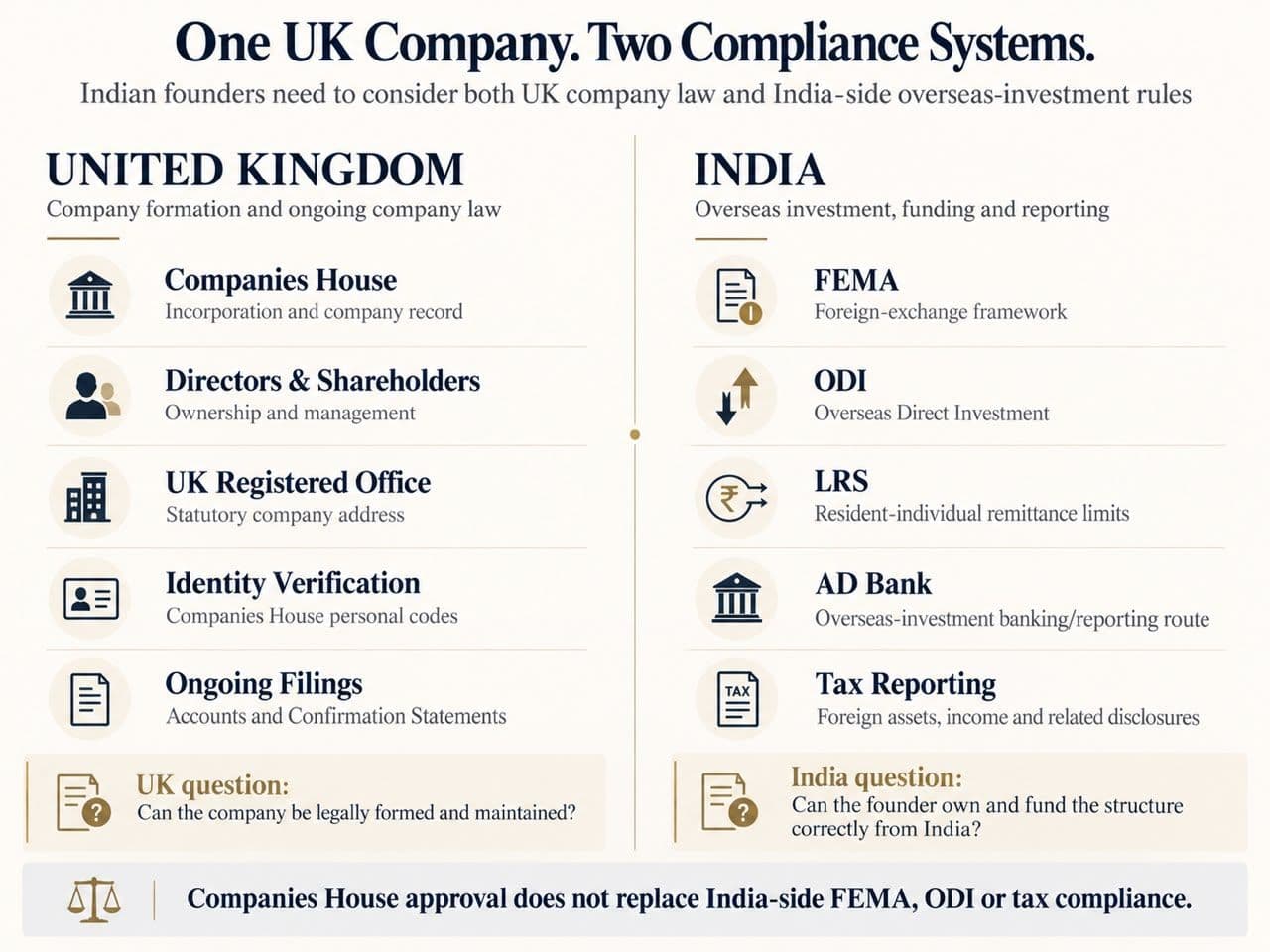
This is the most important framework for Indian founders.
Layer 1 — United Kingdom
The UK side determines matters such as:
Incorporation
How the company is registered.
Directors and shareholders
Who owns and manages it.
Registered Office
Where statutory correspondence is received.
PSC information
Who ultimately owns or controls the company.
Identity verification
Who must verify and provide Companies House personal codes.
Ongoing compliance
Accounts, Confirmation Statements and company records.
Layer 2 — India
For somebody resident in India, separate questions can arise around:
Overseas Direct Investment (ODI)
How the foreign company shares are acquired.
Liberalised Remittance Scheme (LRS)
How an individual sends money overseas.
Authorised Dealer bank procedures
Overseas-investment reporting
Indian income-tax reporting
Foreign assets and foreign income
Place of Effective Management
Foreign tax credit
Companies House approving the company does not confirm that every India-side requirement has been completed.
For the detailed India-side rules, read our FEMA & RBI Rules for Indian Founders with a UK Company.
2. When Can a UK Limited Company Make Sense for an Indian Founder?
A UK company should have a genuine commercial purpose.
It may deserve consideration where the business is genuinely international by design.
SaaS, AI and Technology
A UK entity may be relevant where it genuinely contracts with international customers, owns or licenses technology, or plays a defined role in the group’s international structure.
Read our UK Company for Indian SaaS, AI & Technology Founders.
E-Commerce, Amazon and Export
The structure may be useful where the UK entity has a genuine role in sales, importing, distribution or international e-commerce.
Read our UK Company for Indian Amazon, E-Commerce & Exporters.
Existing Indian Business Expanding to Britain
An Indian company may establish a UK subsidiary instead of the founder personally owning the UK company.
Read our UK Subsidiary for an Indian Company guide.
International Consulting and Professional Services
A UK company may have a genuine role where international contracts, customers and operations support the structure.
But this does not mean a UK Ltd is automatically better than an Indian Private Limited Company.
If most management, employees, customers and economic activity remain in India, an Indian entity may remain the more coherent primary structure.
See our Indian Pvt Ltd vs UK Limited Company guide.
3. What Do You Need on the UK Side?
For a straightforward UK private company limited by shares, the main building blocks are relatively simple.
At Least One Director
The company needs at least one director.
Directors must generally be at least 16 and do not have to live in the UK.
Shareholder Information
The company needs shareholders and a statement of capital.
The same individual can commonly be both shareholder and director.
An Appropriate UK Registered Office
The company must have a physical UK address in the jurisdiction where it is registered.
Companies House requires the address to be appropriate for receiving company correspondence.
For the address distinctions, see our Registered Office vs Director Service Address guide
A Registered Email Address
Companies House also requires a registered email address. It is not displayed on the public register.
Business Activity and SIC Code
The company must identify its activity using the appropriate SIC classification.
Use our UK SIC Codes for Non-Resident Companies guide.
Companies House Identity Verification
New directors need the appropriate Companies House personal code when the company is incorporated.
4. Companies House Identity Verification for Indian Founders
Companies House identity verification is now part of the normal UK company lifecycle.
Once an individual verifies successfully, they receive an 11-character personal code.
That code belongs to the individual rather than to one company. A director with several companies generally verifies once and uses the same personal code for the relevant appointments.
Verification can be completed through the relevant government route or through an Authorised Corporate Service Provider where appropriate.
For the full process, use our Companies House Identity Verification for Indians guide.
5. The India Question: Does Owning the UK Company Count as ODI?
For many Indian-resident founders, this is the point where a generic UK formation guide becomes insufficient.
Under RBI’s current Overseas Investment framework, acquiring unlisted equity capital in a foreign entity falls within the definition of Overseas Direct Investment.
A newly incorporated private UK Ltd is normally unlisted.
That means an Indian-resident individual subscribing for its shares can be entering the ODI framework even where the UK share capital is small.
The practical lesson is:
Do not assume a £1 or £100 share subscription is too small to matter under FEMA.
The classification of the overseas investment is more important than the nominal share value.
6. LRS, ODI and the USD 250,000 Limit
For a person resident in India, overseas investment by an individual sits within the Liberalised Remittance Scheme framework.
The current overall LRS limit is:
USD 250,000 per financial year
That is an aggregate limit across permitted LRS transactions, not a separate USD 250,000 allowance for every overseas company.
So if an individual has already used part of the LRS limit for other permitted remittances during the financial year, the amount available for other LRS transactions can be reduced accordingly.
Resident individuals and foreign companies
RBI’s current Overseas Investment directions permit resident individuals to make overseas investment in accordance with Schedule III of the OI Rules.
But the structure is not unrestricted.
For resident individuals, the foreign entity and investment must fit the applicable overseas-investment rules.
Important restrictions can arise where:
- the foreign entity is not carrying on a bona fide business activity;
- the entity is engaged in financial-services activity;
- prohibited activities under the Overseas Investment Rules are involved;
- subsidiaries or step-down subsidiaries are introduced;
- the resident individual has control over the foreign entity.
RBI’s current directions specifically recognise the restriction on resident individuals making ODI in foreign entities engaged in financial-services activity and provide special rules where the foreign entity later acquires or establishes a subsidiary or step-down subsidiary.
Subsidiaries need particular care
This point is often oversimplified.
Where a resident individual has ODI without control in a foreign entity and that foreign entity later acquires or establishes a subsidiary or step-down subsidiary, RBI states that the resident individual must not subsequently acquire control in the foreign entity.
So do not assume that every founder-owned UK company can later become a multi-layer group without revisiting the India-side analysis.
7. Does TCS Apply When You Fund the UK Company?
Potentially, yes.
For current LRS remittances, the Income Tax Department states that no TCS is required where aggregate remittances do not exceed ₹10 lakh.
For LRS remittances for purposes other than education or medical treatment, TCS is currently 20% of the amount above ₹10 lakh.
This is important for founders because it can affect cash flow when significant amounts are remitted from India.
But TCS should not be described as an automatic permanent 20% additional tax on your investment.
It is tax collected at source and can generally be taken into account as tax credit subject to the applicable income-tax rules.
Simple illustration
If an Indian resident sends a relatively small amount to subscribe for initial UK company shares, the ₹10 lakh threshold may not be reached.
But if the founder subsequently transfers significantly more money overseas for investment or other LRS purposes during the same financial year, TCS can become relevant.
This is one reason the founder should plan how the UK company will be capitalised, not merely how it will be incorporated.
Need Help Structuring the UK Setup Before You Proceed?
If you are resident in India and planning a UK company, Seven Oak Prestige can help coordinate the UK company-formation side, including structure, Companies House requirements, addresses, identity-verification preparation and banking readiness.
For India-side FEMA, tax or ODI advice, appropriate Indian professional advice may also be required.
Discuss My India–UK Setup on WhatsApp
8. Already Formed a UK Company From India?
Do not panic.
A common situation is that a founder first creates the UK company and only later learns about FEMA, ODI or Indian tax-reporting requirements.
The sensible response is not to hide the company or create another entity.
Instead, establish what actually happened.
Review:
When was the UK company incorporated?
Who subscribed for the shares?
Was the founder resident in India at that time?
How much money was remitted?
How was it remitted?
Which bank handled the transfer?
Was ODI reporting completed?
Has further money been transferred to the company?
Does the UK company now own another company?
Has the foreign asset been reported appropriately in India?
RBI’s current Overseas Investment directions provide a mechanism for delayed reporting through a Late Submission Fee, and AD banks are instructed not to facilitate certain further commitments or transfers while reportable delays remain unregularised.
So an historic reporting problem should be reviewed and regularised appropriately rather than ignored.
This is a situation where India-qualified FEMA/CA advice can be particularly valuable.
9. Founder-Owned UK Ltd or Indian Parent With a UK Subsidiary?
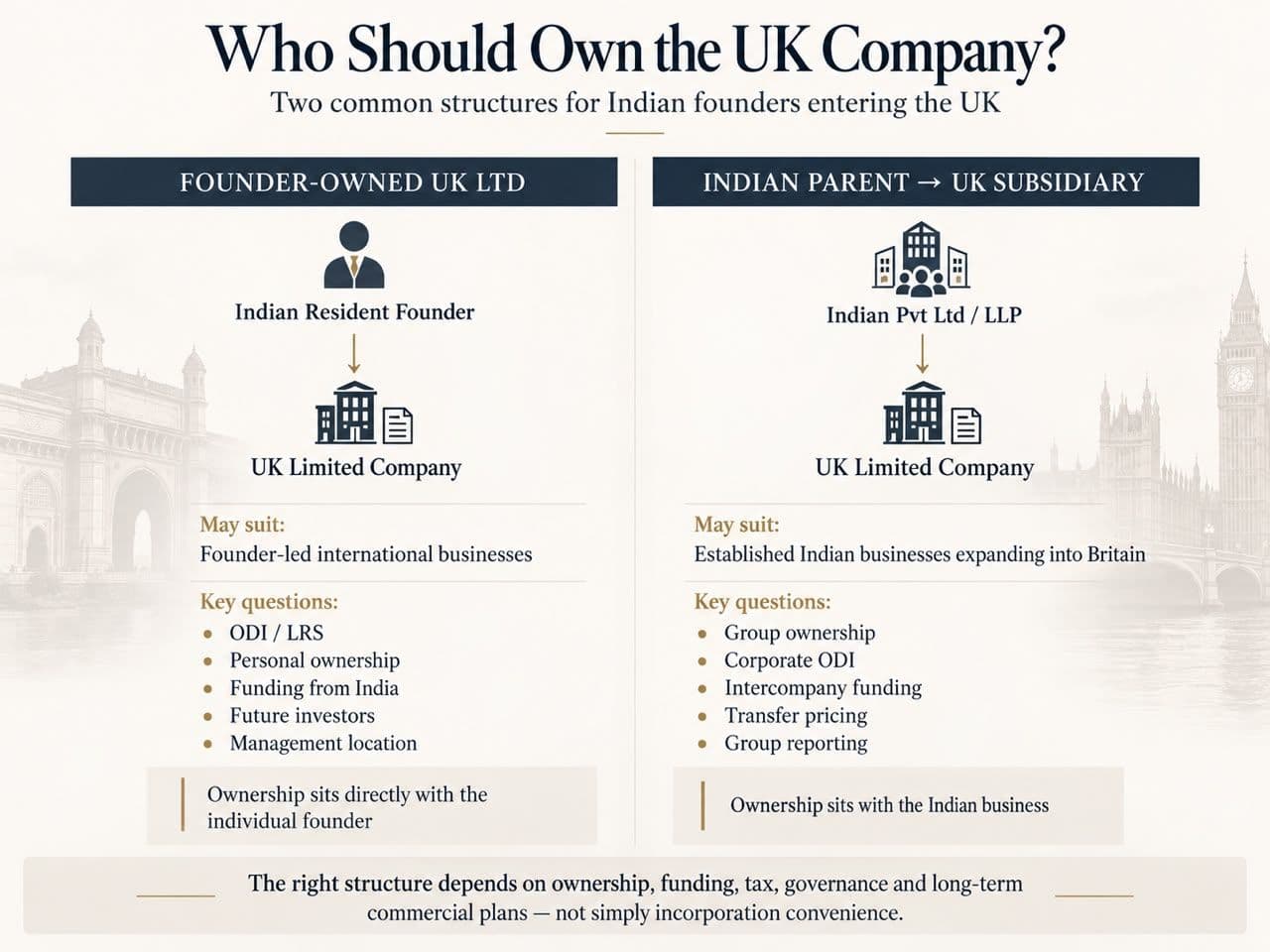
These structures may look similar from London but are very different commercially.
Structure A — Founder-Owned UK Company
Indian resident individual
↓
UK Limited Company
This may suit some genuinely international founder-led businesses.
Structure B — Indian Parent With UK Subsidiary
Indian Private Limited Company / LLP
↓
UK Limited Company
This may suit an established Indian company expanding into Britain.
The choice can affect:
- ownership;
- ODI treatment;
- funding;
- accounting;
- group reporting;
- transfer pricing;
- intellectual property;
- future investors;
- taxation.
For an established Indian business, read our UK Subsidiary for Indian Companies guide.
10. What If You Are an NRI or Live Outside India?
This guide is primarily for a person resident in India.
That distinction matters.
FEMA treatment depends heavily on residential status under Indian foreign-exchange law; it is not determined simply by holding an Indian passport.
An Indian citizen living in:
- UAE;
- UK;
- USA;
- Singapore;
- another country
may therefore have a materially different overseas-investment analysis from somebody ordinarily resident in India.
So do not assume:
Indian citizen = Indian-resident FEMA treatment.
If you are an NRI, OCI holder or Indian national based overseas, establish your actual FEMA residential status before applying the resident-individual ODI/LRS rules described in this article.
11. How Much Does a UK Company Cost From India?
Companies House currently charges:
£100 for online incorporation
The current standard online service usually registers a company within 24 hours, although complex applications can take longer.
That £100 is only the government incorporation fee.
An Indian founder may separately need to budget for:
- Registered Office;
- Director Service Address;
- identity-verification assistance;
- formation support;
- accounting;
- tax filings;
- Confirmation Statement;
- VAT or EORI where relevant;
- India-side professional advice.
For the complete cost breakdown, use our UK Company Formation Cost from India guide.
12. Can an Indian Founder Get a UK Business Account?
Potentially.
But incorporation and financial-provider approval are separate decisions.
A bank, EMI or payment provider may review:
- residence;
- nationality;
- ownership;
- business activity;
- customer countries;
- expected transactions;
- website;
- commercial evidence;
- source of funds;
- sanctions exposure.
A UK company therefore does not guarantee:
Wise
Revolut
Payoneer
Stripe
or a traditional UK bank account.
For this subject, use our UK Business Bank Account for Indian Residents guide.
For provider-specific comparisons, see Stripe, Wise & Airwallex for Indian Founders.
13. Does a UK Company Give an Indian Founder a UK Visa?
No.
Owning shares in or directing a UK company while living in India is a company-law question.
Physically moving to Britain to live or work there is an immigration question.
Creating a UK company does not by itself grant immigration permission.
Read our UK Visa and UK Company Ownership guide.
14. What About Indian Tax, POEM and Foreign-Asset Reporting?
This deserves attention, but it should not be reduced to slogans.
A UK-incorporated company and an India-resident founder can create several separate tax questions.
Place of Effective Management — POEM
India’s POEM rules look at where the key management and commercial decisions necessary for the business as a whole are actually made.
This can become relevant where a UK-incorporated business is effectively directed from India.
CBDT has clarified that its POEM guidelines do not apply to companies with turnover or gross receipts of ₹50 crore or less in the financial year.
That does not mean small founders should ignore all Indian tax issues. It simply means the POEM guidance contains this important threshold.
A London Registered Office is not proof that management takes place in London.
Schedule FA and Foreign Assets
Indian resident taxpayers can have foreign-asset reporting obligations.
The Income Tax Department specifically provides guidance on Schedule FA for foreign assets and foreign income.
Owning shares in a UK company can therefore have personal Indian tax-reporting implications separate from the company’s UK filings.
Foreign Tax Credit and Form 67
Where an Indian resident is claiming credit for qualifying foreign tax paid, the Income Tax Department uses Form 67 for the foreign-tax-credit process.
These issues are fact-specific.
For the deeper analysis, read our UK Company Tax for Indian Residents — POEM & Double Taxation guide.
15. What Happens After the Company Is Incorporated?
The Certificate of Incorporation is the beginning, not the end.
The company may then need to deal with:
- statutory records;
- Companies House personal codes;
- HMRC;
- accounting records;
- Corporation Tax;
- annual accounts;
- Confirmation Statements;
- VAT;
- PAYE;
- banking;
- address renewals;
- changes to directors or shareholders.
Directors remain responsible for running the company and ensuring accounts and reports are properly prepared even when professionals assist them.
Use our What to Do After UK Company Formation guide.
16. Indian Founder Decision Framework
Before incorporating, answer these questions.
Where Will the Business Actually Operate?
If the team, management, work and customers are predominantly in India, do not pretend that a London registration alone moves the economic centre of the business.
Why Do You Need the UK Entity?
Strong reasons can include:
- genuine UK market entry;
- international customer contracting;
- group expansion;
- international investment structure;
- UK distribution;
- genuine commercial operations.
A weak reason is simply:
“I need a UK company so Stripe or Wise will approve me.”
Who Should Own the Company?
The founder personally?
Or an existing Indian company?
That decision should happen before incorporation where possible.
How Will the Company Be Funded?
Initial share capital may be small.
Later capitalisation is the bigger question.
Plan how future money will lawfully move into the business.
Will the UK Company Own Other Entities Later?
That can materially affect the Indian-resident ODI analysis.
Where Will Strategic Decisions Be Made?
A registered address is administrative.
Real governance should reflect the way the company is actually managed.
Will the Structure Still Make Sense in Three Years?
Consider:
- employees;
- intellectual property;
- investors;
- subsidiaries;
- customer geography;
- tax;
- banking;
- regulation.
The right structure should remain coherent after the first fintech application.
17. Pre-Incorporation Checklist for Indian Residents
UK Side
Company name selected
Business activity clearly defined
Appropriate SIC code identified
Director(s) confirmed
Shareholder(s) confirmed
PSC position understood
Share structure decided
Registered Office arranged
Registered email arranged
Companies House personal codes obtained
India Side
FEMA residential status confirmed
Ownership route reviewed
ODI treatment considered
LRS capacity checked
Funding route planned
AD bank process considered
Reporting requirements reviewed
TCS cash-flow effect considered where relevant
India-side tax advice obtained where appropriate
Business Side
Target countries
Customer profile
Expected turnover
Management location
Employee/contractor location
Intellectual-property ownership
Banking needs
Payment-provider needs
VAT/EORI relevance
18. When a UK Ltd May Not Be the Right Choice
Pause before incorporating if:
- the business is almost entirely Indian in substance;
- the UK company has no clear commercial role;
- the only objective is access to one fintech provider;
- the ODI/LRS route has not been considered;
- you do not know whether the founder or Indian company should own the UK entity;
- the proposed foreign activity creates restrictions under India’s overseas-investment framework;
- you expect the UK company to eliminate Indian tax or reporting obligations automatically.
Sometimes the coherent structure is:
Indian Pvt Ltd
Sometimes:
Founder-owned UK Ltd
Sometimes:
Indian parent → UK subsidiary
There is no universal answer.
What Seven Oak Prestige Handles — and What Requires India-Side Advice
Seven Oak Prestige can assist with the UK side of the setup, including:
- incorporation preparation;
- Companies House administration;
- UK statutory addresses;
- identity-verification preparation/support;
- business-activity and SIC review;
- KYC preparation;
- banking-readiness coordination;
- post-incorporation support.
Seven Oak Prestige does not replace an Indian CA, FEMA specialist or Indian tax adviser for matters requiring India-qualified professional advice.
Where appropriate, the UK setup should be coordinated with India-side advice rather than treating the two systems separately.
Ready to Form the UK Company?
If you have completed the decision stage and want to move to incorporation, use our dedicated India service page:
UK Company Formation for Indian Residents — Packages & Setup Support
Or message Seven Oak Prestige directly:
Discuss My India–UK Company Setup on WhatsApp
Reference: INDIA-FORMATION-PILLAR
Frequently Asked Questions
Can an Indian citizen register a UK company?
Yes under UK company law, but somebody resident in India must also consider the Indian overseas-investment rules that may apply to acquiring and funding the foreign company.
Can an Indian resident own 100% of a UK Ltd?
UK company law generally permits full foreign ownership. India-side ODI/LRS requirements must still be considered separately.
Can I be the only director while living in India?
Generally, yes. UK private-company directors do not need to live in the UK.
Do I need a UK-resident director?
Not generally for an ordinary UK private company.
Do I need a UK Registered Office?
Yes. The company needs an appropriate UK Registered Office.
How much does Companies House charge to incorporate?
The current online incorporation fee is £100.
Is forming a UK company ODI?
For an Indian-resident individual, acquiring unlisted equity capital in a foreign company can fall within the ODI definition. The specific facts and funding route should be reviewed.
What is the LRS limit?
The current overall LRS limit for a resident individual is USD 250,000 per financial year for permitted current and capital-account transactions.
Does TCS apply to funding a UK company?
For current LRS rules, remittances above the ₹10 lakh aggregate threshold can attract TCS depending on the purpose. For non-education/non-medical LRS remittances, the current rate is 20% on the amount above ₹10 lakh.
Can a founder-owned UK Ltd later create subsidiaries?
Possibly, but resident-individual ODI rules around control and subsidiaries/step-down subsidiaries need to be reviewed before doing so.
Does a UK company guarantee a UK bank account?
No.
Does it guarantee Stripe?
No.
Does it give me a UK visa?
No.
What if I already formed the UK company without ODI reporting?
Review the original investment and remittance history with your AD bank and an appropriate India-side adviser. RBI provides a late-reporting framework, including Late Submission Fees in relevant cases.
What if I am an NRI?
Do not automatically apply the resident-individual rules in this guide. FEMA treatment depends on residential status, not simply Indian nationality.
About the Author
Isaac Jackson
Founder & Managing Director — Seven Oak Prestige Ltd
Isaac Jackson supports international founders and overseas businesses with UK company formation, Companies House administration, statutory-address arrangements, KYC preparation, compliance coordination and banking readiness.
His work includes India–UK company matters involving founders, technology businesses, e-commerce companies and overseas businesses establishing a UK corporate presence.
Seven Oak Prestige Ltd
Company Registration No. 16903092
Registered Office: 124 City Road, London EC1V 2NX, United Kingdom
Editorial Methodology
Last reviewed: 24 September 2026
This guide was checked against current primary guidance from:
- Companies House;
- GOV.UK;
- Reserve Bank of India;
- Income Tax Department of India;
- current RBI Overseas Investment directions;
- current LRS and TCS guidance.
Date-sensitive claims such as Companies House fees, identity-verification requirements, LRS limits and TCS thresholds should be periodically reviewed.
For India-side FEMA or tax conclusions relating to a specific founder, India-qualified professional advice may be required.
Important Disclaimer
This guide provides general educational information.
It is not personalised:
- FEMA advice;
- Indian legal advice;
- RBI advice;
- tax advice;
- investment advice;
- immigration advice;
- banking advice.
Seven Oak Prestige provides UK company-establishment and related support. India-specific legal, tax and foreign-exchange matters may require advice from an appropriately qualified Indian professional.
Related India Guides
FEMA & RBI Rules for Indian Founders
Owns the detailed ODI/FEMA/LRS compliance intent.
UK Company Formation Cost from India
Owns formation fees and ongoing costs.
Indian Pvt Ltd vs UK Limited Company
Owns the jurisdiction/structure comparison.
UK Business Bank Account for Indian Residents
Owns banking eligibility and preparation.
UK Company Tax for Indian Residents — POEM & Double Taxation
Owns the India/UK tax analysis.
UK Company for Indian SaaS, AI & Technology Founders
Owns sector-specific technology intent.
UK Company for Indian Amazon, E-Commerce & Exporters
Owns e-commerce/export/VAT/EORI intent.
UK Subsidiary for Indian Companies
Owns established Indian-company expansion intent.