
UK Ltd vs US LLC for Non-Residents: 2026 Comparison
UK Ltd vs US LLC for Non-Residents: Which Structure Is Better in 2026?
Last reviewed : 6 October 2026
A UK Limited Company and a US Limited Liability Company can both be used by international founders.
But they are not equivalent structures.
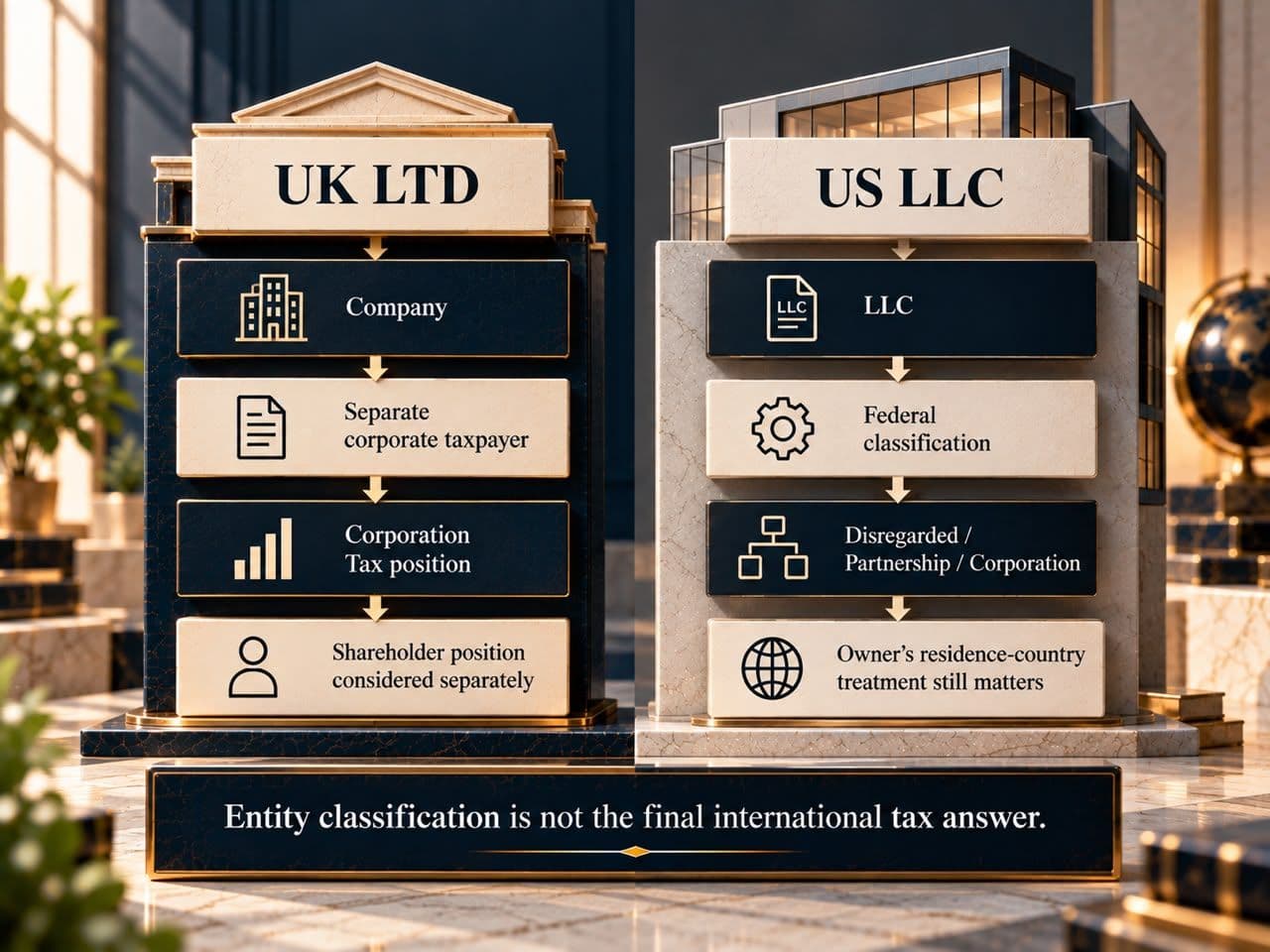
A UK Ltd is a conventional company with shareholders and directors and is normally treated as a separate corporate taxpayer. A US LLC is created under state law and can have different US federal tax classifications depending on its ownership and elections.
For a non-resident founder, the more useful question is therefore not:
“Which structure is better?”
It is:
“Which structure fits where I live, where I operate, where my customers are, how the entity will be taxed, how I need to bank and what I intend the business to become?”
If you have already decided that Britain is the right jurisdiction, Seven Oak Prestige’s UK Company Formation for Non-Residents resources explain the wider UK incorporation, ownership, address, banking and post-incorporation framework.
Quick Answer: UK Ltd or US LLC?
There is no universal winner.
Consider a UK Ltd first when Britain has a genuine commercial role in the business, UK customers or contracts matter, UK operations are planned, you want a conventional company with shares and directors, or the UK forms part of a longer-term market-entry or investment strategy.
Consider a US LLC first when the United States has genuine commercial relevance, the LLC’s federal tax classification suits the intended structure, US customers or operations are important, and you understand how your country of residence treats the LLC.
Analyse the position more carefully before choosing either when you operate the business mainly from a third country, have little genuine connection to the UK or US, or are choosing primarily because somebody promised “0% tax”, Stripe, a bank account or greater privacy.
If you are comparing more than these two structures, read UK Ltd vs LLC vs LLP: Which Structure Should a Non-Resident Founder Choose?

1. UK Ltd vs US LLC: The Core Difference
A UK private company limited by shares is a separate legal entity incorporated under UK company law and registered with Companies House.
Its ownership and management are normally straightforward:
Shareholders own the company.
Directors manage the company.
One non-resident founder can generally be the company’s sole shareholder, sole individual director and PSC where the statutory control conditions are met.
For more complex ownership, our guide to shares and directors for non-resident founders explains share allocation, directors, PSCs and different ownership structures.
A US LLC works differently.
It is formed under the law of an individual US state and is owned by members rather than shareholders. Depending on the state and operating agreement, management can be member-managed or manager-managed.
There is another important distinction: an LLC does not have one universal US federal income-tax classification.
A domestic single-member LLC is generally disregarded as separate from its owner for federal income-tax purposes unless it elects corporate treatment. A domestic LLC with at least two members is generally classified as a partnership unless it elects corporate treatment.
So:
UK Ltd ≠ British version of a US LLC
and:
US LLC ≠ American version of a UK Ltd.
They are different legal and tax architectures.
2. Does the US State Matter?
Yes.
There is no single state-law version of a “US LLC”.
An LLC formed in Wyoming, Delaware or another state can face different filing costs, annual obligations, registered-agent requirements, disclosure rules and legal frameworks.
That does not mean a non-resident founder should simply ask:
“Which state is cheapest?”
A founder considering Wyoming because of its particular state framework is solving a different problem from a technology company considering Delaware because of future investment plans.
And if institutional US venture capital is the objective, the relevant US structure may be a Delaware C-Corporation rather than an LLC.
Choose the entity first.
Then determine which jurisdiction appropriately supports it.
3. UK Ltd and US LLC Are Not Tax Equivalents
This is where many comparisons become unreliable.
A UK Ltd sits within a conventional corporate-tax architecture.
A UK-incorporated company is generally UK tax resident under UK domestic law. In some dual-residence cases, an applicable double-tax treaty can result in the company being treated as treaty non-resident for UK tax purposes.
A US LLC can instead be classified federally as a disregarded entity, partnership or corporation depending on ownership and elections.
That flexibility can be useful.
It can also create complexity when the owner lives outside the United States.
The IRS classification of an LLC does not determine how every other country will classify it.
That is why the founder’s residence can matter as much as the entity’s place of formation.
4. UK Corporation Tax in 2026
A common online shorthand is:
“UK Ltd = 19% tax.”
That is incomplete.
For ordinary non-ring-fence companies, the current UK framework includes:
19% small-profits rate for qualifying companies with profits of £50,000 or less;
25% main rate for profits above £250,000;
and Marginal Relief can potentially apply between those levels.
The thresholds can be reduced where the company has associated companies or an accounting period shorter than 12 months, and other rules can also affect the calculation.
So neither of these statements is sufficient:
UK Ltd = 19% tax
US LLC = 0% tax
The actual structure and facts matter.
A non-resident shareholder can also have separate taxation and reporting obligations where they live. The company-level position and the shareholder’s personal position should not be collapsed into one question.
5. Is a Foreign-Owned US LLC Really 0% Tax?
Not automatically.
A foreign-owned single-member LLC may be disregarded for US federal income-tax purposes.
But:
disregarded does not mean automatically tax-free.
Depending on the facts, a proper analysis can require consideration of:
- the source and character of income;
- where services are physically performed;
- whether the owner is engaged in a US trade or business;
- effectively connected income;
- US employees or other activities;
- state taxation;
- applicable tax treaties;
- elections made by the LLC;
- the tax rules where the owner actually resides.
Some non-resident LLC structures can result in little or no US federal income-tax liability.
That is very different from saying:
“Foreign founder + US LLC = 0% tax.”
The latter is a marketing claim, not a reliable international tax analysis.
6. Your Country of Residence Can Change the Answer
Imagine two founders owning identical US LLCs.
Same state.
Same ownership.
Same business model.
Same revenue.
One founder lives in Country A.
The other lives in Country B.
The United States may classify their LLCs in the same way, while the founders’ residence countries treat those entities differently.
One country may recognise the LLC as fiscally transparent.
Another may treat it more like a separate foreign entity.
That can affect the treatment of business profits, distributions, foreign-company reporting, controlled foreign companies, foreign assets and other cross-border obligations.
This is why a founder should ask:
“How does the country where I actually live treat this LLC?”
before asking:
“How cheap is it to form one?”
The same principle applies to a UK Ltd.
7. Incorporating Abroad Does Not Necessarily Move the Business Abroad
A founder can form a Wyoming LLC while working every day from another country.
A founder can own a UK Ltd while managing it from Dubai, Mumbai, Accra or Singapore.
The incorporation certificate tells you where the entity was incorporated.
It does not necessarily settle every question concerning:
- corporate tax residence;
- management and control;
- place of effective management;
- permanent establishment;
- local business taxation;
- payroll;
- CFC rules;
- foreign-company reporting.
This distinction is particularly important for online businesses because the company can be incorporated in one country while its people, management, customers and economic activity are spread across several others.
The entity should reflect the business reality rather than attempt to disguise it.
8. Which Structure Is Better for Retaining Profits?
A UK Ltd is a separate corporate entity.
Subject to its liabilities and applicable tax position, profits can remain within the company for purposes such as working capital, product development, inventory, hiring, marketing and expansion.
The shareholder does not automatically receive every pound of company profit personally simply because they own the shares.
A disregarded single-member US LLC has a different federal income-tax architecture because the LLC is generally not treated as separate from its owner for that purpose.
Whether that is advantageous depends partly on how the owner’s residence country recognises and taxes the arrangement.
Founders planning to accumulate substantial capital inside a business should therefore examine the full structure rather than assume that pass-through or disregarded treatment is inherently better.
9. Formation Costs: UK Ltd vs US LLC
The UK has a national Companies House fee schedule.
As of October 2026, standard online incorporation costs £100, paper incorporation costs £124, and qualifying same-day software incorporation costs £156. The digital Confirmation Statement fee is £50 with the first statement in the relevant 12-month payment period.
But £100 is the government incorporation fee.
It is not necessarily the complete cost of establishing and operating a UK company from overseas.
A non-resident founder may also need UK address infrastructure, accounting, tax compliance, Companies House identity-verification assistance, VAT or EORI support, banking preparation or other services depending on the business.
Our UK Company Formation Cost for Non-Residents guide explains the difference between the statutory incorporation fee and the wider first-year budget.
There is no equivalent single nationwide price for forming a US LLC.
US costs depend on the state and can include the initial filing, registered agent, annual or periodic state filings, franchise or licence charges, tax reporting and professional support.
A comparison stating simply:
“US LLC costs $X”
is incomplete unless it identifies the state and recurring obligations.
10. Annual Compliance: UK Ltd vs US LLC
A UK Ltd has recurring company and tax administration.
Depending on its circumstances, that can include:
- maintaining accounting records;
- annual accounts;
- Confirmation Statements;
- Corporation Tax compliance;
- Company Tax Returns;
- VAT where applicable;
- PAYE where relevant;
- Companies House updates.
For an overseas director, these obligations do not disappear because the company is being managed remotely.
Our post-incorporation checklist for non-resident founders explains what happens after the Certificate of Incorporation is issued.
For founders who want ongoing administration organised properly, our UK Company Compliance Support for Non-Resident Directors guide explains the relationship between Companies House, HMRC, accounting and ongoing company administration.
A US LLC can sometimes appear administratively lighter, but foreign ownership can introduce reporting obligations that are easy to miss.
Depending on the structure and activity, there may be federal information reporting, state filings, state fees, franchise or licence taxes, tax returns, payroll, sales-tax filings and other obligations.
Less corporate formality does not necessarily mean less cross-border compliance.
11. Form 5472: A Critical Issue for Foreign-Owned US LLCs
A foreign-owned US disregarded entity can have Form 5472 reporting obligations where it has reportable transactions within the applicable rules.
Where required, Form 5472 is filed with a pro forma Form 1120.
This creates an important distinction:
No US federal income tax due does not necessarily mean no IRS filing obligation.
That is one reason a foreign founder should not form an LLC solely because a promotional page describes it as “tax-free”.
Tax liability and information reporting are separate questions.
12. US BOI Reporting Changed
US Beneficial Ownership Information reporting is another reason old comparison articles should be treated cautiously.
As of 6 October 2026, under FinCEN’s current federal BOI regime, entities created in the United States are exempt from Corporate Transparency Act BOI reporting. Certain entities formed under foreign law and registered to do business in the United States can remain within the reporting framework, subject to the applicable exemptions.
So older articles stating that every domestic US LLC must submit BOI information to FinCEN no longer reflect the current position.
The wider lesson is important:
Never choose an international structure from an article that has not been maintained as the rules change.
13. UK Ltd vs US LLC for Banking
Neither structure guarantees banking.
A Certificate of Incorporation proves that an entity exists.
It does not compel a bank, EMI, fintech or payment company to accept it.
Providers can assess matters such as:
- founder residence;
- beneficial-owner residence;
- business activity;
- customer geography;
- transaction geography;
- expected turnover and transaction profile;
- source of funds;
- source of wealth;
- website;
- suppliers;
- regulatory exposure;
- sanctions risk.
The better question is therefore not:
“Which company gets a bank account?”
It is:
“Which financial providers support this particular entity, owner, residence and business model?”
When a UK Ltd can fit the banking model
A UK Ltd can be commercially useful where GBP collection, British customers, UK contracts or genuine UK operations are important.
But UK incorporation does not guarantee approval from any particular bank, EMI or payment provider.
When a US LLC can fit the banking model
A US LLC can make commercial sense where USD receipts, US customers or genuine US operations are central and suitable providers support the founder’s residence and activity.
Again, the entity does not guarantee the account.
Structure first. Provider fit second. Application third.
14. UK Ltd vs US LLC for Stripe, PayPal and Payments
Do not establish either structure solely because someone says:
“UK Ltd gets Stripe.”
or:
“US LLC gets US payment processing.”
Payment providers assess the underlying business.
That can include ownership, founder residence, website, activity, customers, fulfilment, expected transactions, operating address and verification evidence.
The application should therefore reflect reality.
Using a company merely to create the appearance that a business operates from a jurisdiction where it has little genuine commercial connection can create avoidable compliance problems.
A good structure should still make sense even if your preferred payment provider declines the application.
15. Privacy: Is a US LLC More Private Than a UK Ltd?
Sometimes, in terms of public-register disclosure.
But:
privacy is not anonymity.
Companies House makes significant UK company information publicly available.
Depending on the filing and company, that can include directors, registered office, PSC information, filing history and accounts.
A director’s residential address is generally protected from ordinary public display, while the director’s service address is normally public.
Our Registered Office vs Director Service Address guide explains the distinction between the company’s statutory address, the director’s public service address and the residential address.
US public disclosure varies by state.
Some states disclose less ownership information publicly than the UK register.
That does not mean banks, tax authorities, registered agents, payment companies or other regulated parties cannot require ownership information.
The accurate proposition is therefore:
Some US states can offer greater public-register privacy than a UK Ltd. A US LLC should not be presented as anonymous.
16. UK Ltd vs US LLC for SaaS and Technology Companies
There is no automatic SaaS winner.
A UK Ltd deserves consideration where UK enterprise customers matter, UK contracting has genuine commercial value, British operations are planned, UK investment is expected or the founders want a conventional share-company structure.
A US LLC deserves consideration where the business has genuine US commercial relevance, the LLC’s tax classification fits the founders and the required US infrastructure is realistically accessible.
But founders planning institutional US venture capital should ask a different question.
Are You Comparing the UK Ltd With the Wrong US Entity?
For a venture-backed technology company, the relevant comparison may be:
UK Ltd vs Delaware C-Corporation
rather than:
UK Ltd vs US LLC.
Investment structure, preferred shares, option arrangements, financing rounds and investor expectations can matter more than the initial filing cost.
For Indian technology founders, our UK Company for Indian SaaS & AI Founders guide examines ownership, IP, development teams, FEMA, banking, payments, tax and investment together.
17. UK Ltd vs US LLC for E-Commerce
For e-commerce, the supply chain often tells you more than the company label.
A UK Ltd can become commercially relevant where inventory is stored in Britain, goods are imported into the UK, Amazon UK or another British marketplace is important, UK fulfilment is central or UK VAT and customs obligations arise.
A US structure may deserve stronger consideration where customers, inventory, fulfilment and marketplace activity are predominantly US-based.
But neither structure automatically solves:
- VAT;
- sales tax;
- customs;
- marketplace approval;
- product safety;
- importer responsibilities;
- consumer obligations;
- payment processing.
Our UK E-Commerce Company for Non-Residents guide covers the UK side of stock, fulfilment, VAT, EORI, marketplaces, banking and payments.
For founders using Amazon fulfilment specifically, the Amazon FBA UK Company for Non-Residents guide addresses inventory, importer responsibilities, VAT, EORI and Amazon verification in greater depth.
For a dropshipping model, see UK Dropshipping Company for Non-Residents.
18. UK VAT and US Sales Tax Are Not Equivalent
UK VAT and US sales tax should not be treated as two versions of the same system.
UK VAT can depend on matters including the type of supply, customer location, goods location, establishment, imports, marketplaces and place-of-supply rules.
US sales-tax exposure can depend on state-specific physical or economic nexus, fulfilment locations, thresholds and marketplace rules.
That means an entity can be incorporated in one jurisdiction while indirect-tax obligations arise elsewhere.
Entity jurisdiction and indirect-tax jurisdiction are separate questions.
19. UK Ltd vs US LLC for Consultants and Agencies
For consultants, agencies and professional-service businesses, the decision often turns on commercial and operating geography.
Ask:
Where do you physically perform the work?
Where are your customers?
Which entity signs the contracts?
Which currencies do you invoice in?
Where is management located?
Which financial providers support the founder and activity?
Will profits be retained?
Will employees be hired?
A UK Ltd can fit where British clients, contracts or expansion have genuine importance and the UK corporate structure suits the owner.
A US LLC can fit where the business is genuinely US-oriented and both the US classification and the founder’s home-country treatment make sense.
Neither structure is inherently “more credible” in every market.
Credibility should support the commercial structure. It should not determine it.
20. What If You Need Both a UK and US Entity?
Some businesses genuinely need both.
An established US business expanding into Britain may use a UK subsidiary.
An established UK company expanding into America may establish an appropriate US subsidiary.
A founder may sometimes operate separate UK and US entities performing distinct commercial functions.
But every additional company can introduce additional accounting, tax, governance and intercompany questions.
These can include:
- transfer pricing;
- intercompany agreements;
- management charges;
- loans;
- royalties;
- intellectual-property allocation;
- withholding taxes;
- permanent-establishment issues.
Every entity should therefore solve a real commercial problem.
“Looking international” is not a sufficient reason to create another company.
For an existing American business entering Britain, see How to Set Up a UK Company from the United States.
For an established overseas company more generally, the decision may instead be between direct cross-border trading, a UK establishment and a UK subsidiary.
21. Indian Founders Have an Additional Decision Layer
For an Indian resident, the decision may be more complex than:
UK Ltd vs US LLC.
It could be:
Indian founder → UK Ltd
Indian founder → US entity
Indian company → UK subsidiary
or another cross-border arrangement.
India’s foreign-exchange and overseas-investment framework can therefore become relevant alongside the UK or US rules.
Depending on the facts, considerations can include FEMA, ODI, funding routes, authorised-dealer bank processes, reporting, Indian taxation, foreign assets and POEM.
Our FEMA & RBI Rules for Indian Residents with a UK Company explains the India-side overseas-investment framework.
Our UK Company Tax for Indian Residents addresses the separate Corporation Tax, POEM and double-taxation layer.
UK company law permitting the ownership does not remove the founder’s obligations in India.
22. UK Ltd vs US LLC: The Practical Decision Framework
Investigate a UK Ltd First When
The UK has a genuine commercial role.
British customers or contracts matter.
UK operations, fulfilment or investment are planned.
You want a conventional share company.
You expect to retain profits within a separate corporate entity.
The ownership model fits shareholders and directors.
Investigate a US LLC First When
The United States has genuine commercial relevance.
US customers or operations are central.
LLC federal classification suits the intended structure.
The founder’s residence-country treatment has been understood.
The required US financial and operating infrastructure is realistically accessible.
Compare a UK Ltd With a Delaware C-Corp Instead When
Institutional US venture capital is a serious objective.
Future financing architecture matters.
Investor expectations make an LLC an unsuitable comparison.
Analyse Residence Before Choosing Either When
The business is run almost entirely from a third country.
Neither Britain nor the United States has meaningful operational relevance.
The founder has not established how their residence country treats the proposed entity.
Choose Neither Yet When the Principal Reason Is
“0% tax.”
“Stripe.”
“A guaranteed bank account.”
“Privacy.”
“A cheap incorporation fee.”
Those are not sufficient foundations for an international company structure.
23. Ten Mistakes Non-Resident Founders Should Avoid
1. Assuming a US LLC means 0% tax.
Federal classification alone does not determine the final international tax outcome.
2. Assuming every UK Ltd pays 19%.
The current UK Corporation Tax framework includes the 19% small-profits rate, 25% main rate and Marginal Relief where applicable.
3. Ignoring the founder’s residence country.
The home jurisdiction can materially change the tax and reporting outcome.
4. Assuming every country recognises US pass-through treatment.
The same LLC can be classified differently across jurisdictions.
5. Forming solely for banking.
Financial-provider approval is separate from incorporation.
6. Forming solely for Stripe or another payment processor.
Provider eligibility can change and remains subject to independent assessment.
7. Comparing only formation fees.
The initial filing cost tells you little about the complete annual compliance burden.
8. Ignoring US information reporting.
A structure with little or no US federal income-tax liability can still have filing obligations.
9. Following outdated BOI information.
US BOI rules have changed materially.
10. Choosing an LLC when the relevant US alternative is actually a corporation.
This is particularly important for venture-backed startups.
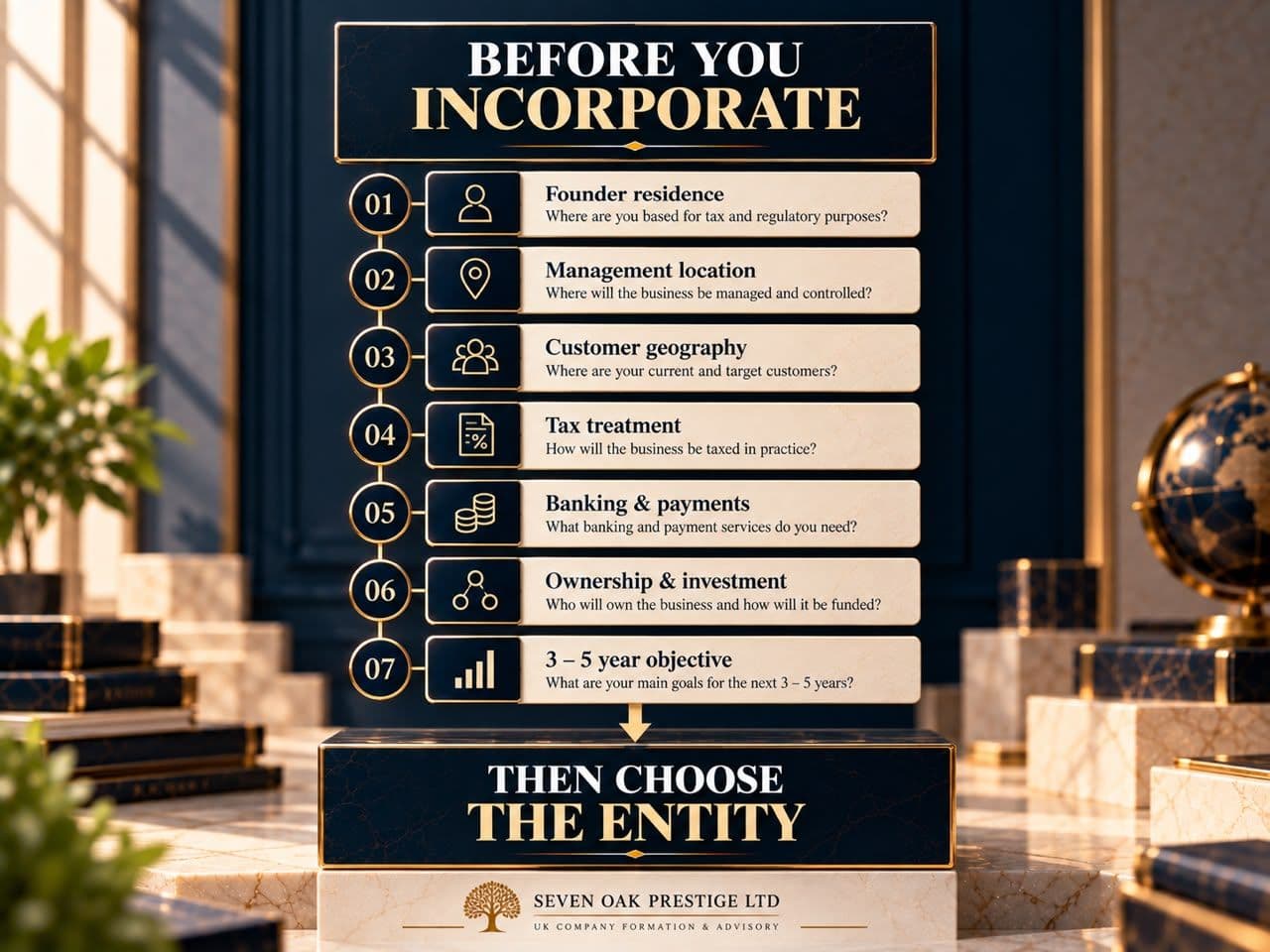
24. The Pre-Incorporation Test
Before paying to establish either structure, answer seven questions.
1. Where Do You Live and Work?
Identify your personal tax residence and where you physically perform the business activity.
2. Where Is the Business Actually Managed?
Consider where strategic and day-to-day decisions are made.
3. Where Are the Customers?
Distinguish between UK, US and genuinely global customer bases.
4. How Will the Entity and Owner Be Taxed?
Consider company tax, owner taxation, entity classification, dividends or distributions, permanent establishment, CFC rules and applicable treaties.
5. What Financial Infrastructure Do You Genuinely Need?
Identify currencies, banking requirements, payment providers and whether they support the actual founder and business profile.
6. What Ownership and Investment Structure Is Required?
A solo founder, several founders, an overseas parent and a venture-backed company can require very different structures.
7. What Should the Business Look Like in Three to Five Years?
A profitable owner-managed consultancy and a venture-backed SaaS company should not necessarily begin with the same entity.
If these questions cannot yet be answered, incorporation may be premature.
25. If the UK Ltd Is the Better Fit
Once the analysis points toward Britain, the next step is not merely to submit a company name.
The ownership, directors, PSC position, SIC code, statutory addresses, identity verification and business description should form one coherent structure.
Seven Oak Prestige supports international and non-resident founders through UK company formation, business establishment and the ongoing accounting and compliance requirements that can follow incorporation.
If you do not have your own UK address, read UK Company Formation Without Your Own UK Address.
If you need to understand the ownership before filing, use our UK Company Shares & Directors for Non-Resident Founders guide.
Before budgeting, review the real cost of UK company formation for a non-resident.
And once the company has been incorporated, work through our post-incorporation checklist for non-resident founders.
Frequently Asked Questions
Can a Non-Resident Own a UK Limited Company?
Generally, yes.
A non-UK resident can generally own shares in a UK private limited company and can generally act as its director while remaining overseas.
A UK-resident director is not generally required simply because the owner lives abroad.
Ownership and immigration are separate issues. If you intend to work physically in Britain, read Do You Need a UK Visa to Own or Run a UK Limited Company as a Non-Resident?.
Can a Non-US Resident Own a US LLC?
Foreign ownership is generally possible, but state requirements, federal tax classification, information reporting and the founder’s residence-country treatment still need to be considered.
Is a US LLC Tax-Free for Non-Residents?
Not automatically.
A single-member domestic LLC can be disregarded for US federal income-tax purposes, but that classification does not itself establish that the owner has no US or home-country tax liability.
Is a UK Ltd Taxed if Its Shareholder Lives Abroad?
A UK company has its own corporate-tax position.
The shareholder’s residence is a separate layer and can create additional personal taxation or reporting obligations.
What Are the UK Corporation Tax Rates in 2026?
For ordinary non-ring-fence companies, the current framework includes:
- 19% small-profits rate for qualifying companies with profits of £50,000 or less;
- 25% main rate for profits above £250,000;
- Marginal Relief between those limits.
The thresholds can be reduced for associated companies and shorter accounting periods, and other rules can affect the calculation.
Which Is Cheaper to Form: a UK Ltd or US LLC?
Companies House currently charges £100 for standard online UK incorporation.
US LLC filing costs depend on the state, so there is no single national LLC formation price that provides a fair comparison.
For the wider UK budget, see UK Company Formation Cost for Non-Residents.
Does a Foreign-Owned US LLC Need Form 5472?
A foreign-owned US disregarded entity can have Form 5472 reporting obligations where it has reportable transactions within the applicable rules.
Where required, Form 5472 is filed with a pro forma Form 1120.
Does a Domestic US LLC Need Federal BOI Reporting in 2026?
As of 6 October 2026, entities created in the United States are exempt from federal Corporate Transparency Act BOI reporting under FinCEN’s current regime.
Certain entities formed under foreign law and registered to do business in the United States can remain within the reporting framework, subject to applicable exemptions.
Is Wyoming Better Than Delaware for a Non-Resident?
Not universally.
The appropriate state depends on why the entity exists, its ownership, activities, future investment plans and the legal and tax framework required.
Which Is Better for Stripe: UK Ltd or US LLC?
Neither guarantees approval.
The payment provider assesses the actual business, ownership, founder residence and compliance profile.
Which Is Better for SaaS?
A UK Ltd can fit a SaaS business with genuine UK commercial, operational or investment relevance.
A US structure can fit a genuinely US-centred business.
For institutional US venture capital, compare the UK Ltd with the appropriate US corporate structure rather than automatically assuming an LLC.
Indian technology founders considering the UK can also read UK Company for Indian SaaS & AI Founders.
Which Is Better for Amazon or E-Commerce?
Follow the supply chain.
Customer geography, inventory, imports, fulfilment, marketplaces, VAT or sales tax, customs and payment infrastructure are generally more useful decision factors than the entity name alone.
For UK operations, read UK E-Commerce Company for Non-Residents.
For Amazon specifically, read Amazon FBA UK Company for Non-Residents.
Is a US LLC More Private Than a UK Ltd?
Some US states disclose less information publicly than Companies House.
That can provide greater public-register privacy in certain circumstances, but it does not create anonymity from banks, tax authorities, registered agents or other regulated parties.
For the UK address and privacy structure, see Registered Office vs Director Service Address.
Can I Own Both a UK Ltd and US LLC?
Potentially.
But each entity should perform a genuine commercial function. Multiple companies can create additional accounting, tax, transfer-pricing, governance and intercompany requirements.
If you already operate a US business and are considering Britain, read How to Set Up a UK Company from the United States.
Final Takeaway: UK Ltd or US LLC?
A UK Ltd and US LLC can both be useful structures for international founders.
They solve different problems.
A UK Ltd is generally the more natural structure to investigate where Britain has genuine commercial relevance and the founder wants a conventional company with shares, directors and separate corporate taxation.
A US LLC deserves serious consideration where the United States has genuine commercial relevance and the LLC’s legal and tax characteristics fit both the business and the founder’s residence-country treatment.
But the decision should begin before either entity is selected:
Founder residence
↓
Actual management location
↓
Customer geography
↓
Business model
↓
Entity classification
↓
Tax treatment
↓
Banking and payments
↓
Ownership and investment
↓
Annual compliance
↓
Long-term expansion
↓
Then choose the entity
The biggest mistake is starting with:
“UK Ltd = 19% tax.”
or:
“US LLC = 0% tax.”
Neither statement tells you enough to structure an international business.
The company should fit the business.
The business should not be forced to fit a company chosen from an internet headline.
Comparing a UK Ltd With a US LLC?
Seven Oak Prestige specialises in the UK side of international company establishment.
We can review whether a UK company has a genuine commercial role in your proposed structure and, where the UK is appropriate, support the formation, ownership setup, statutory addresses, Companies House requirements, banking readiness and ongoing accounting and compliance requirements.
Where the decision requires personalised US or home-country tax or legal advice, the appropriate qualified professional should be involved before implementation.
Explore Seven Oak Prestige
About the Author
Isaac Jackson
Founder & Managing Director — Seven Oak Prestige Ltd
Isaac Jackson supports international founders and overseas businesses establishing and operating UK companies, including founders requiring support with company formation, statutory addresses, Companies House administration, KYC preparation, compliance coordination and banking readiness.
Seven Oak Prestige Ltd
Company Registration No. 16903092
Registered Office: 124 City Road, London EC1V 2NX, United Kingdom
Last reviewed: 6 October 2026
Disclaimer
This guide provides general comparative and educational information. It is not personalised UK, US or international tax, legal, investment or banking advice.
Cross-border treatment can change materially according to residence, ownership, activities, entity classification, elections and applicable treaties. Where more than one jurisdiction is involved, appropriately qualified professional advice may be required before implementation