
UK Company Formation from Algeria | 2026 Guide for Algerian Founders

How to Start a UK Company from Algeria in 2026
Written by Isaac Jackson, Founder & Managing Director — Seven Oak Prestige Ltd
Last reviewed: 27 September 2026
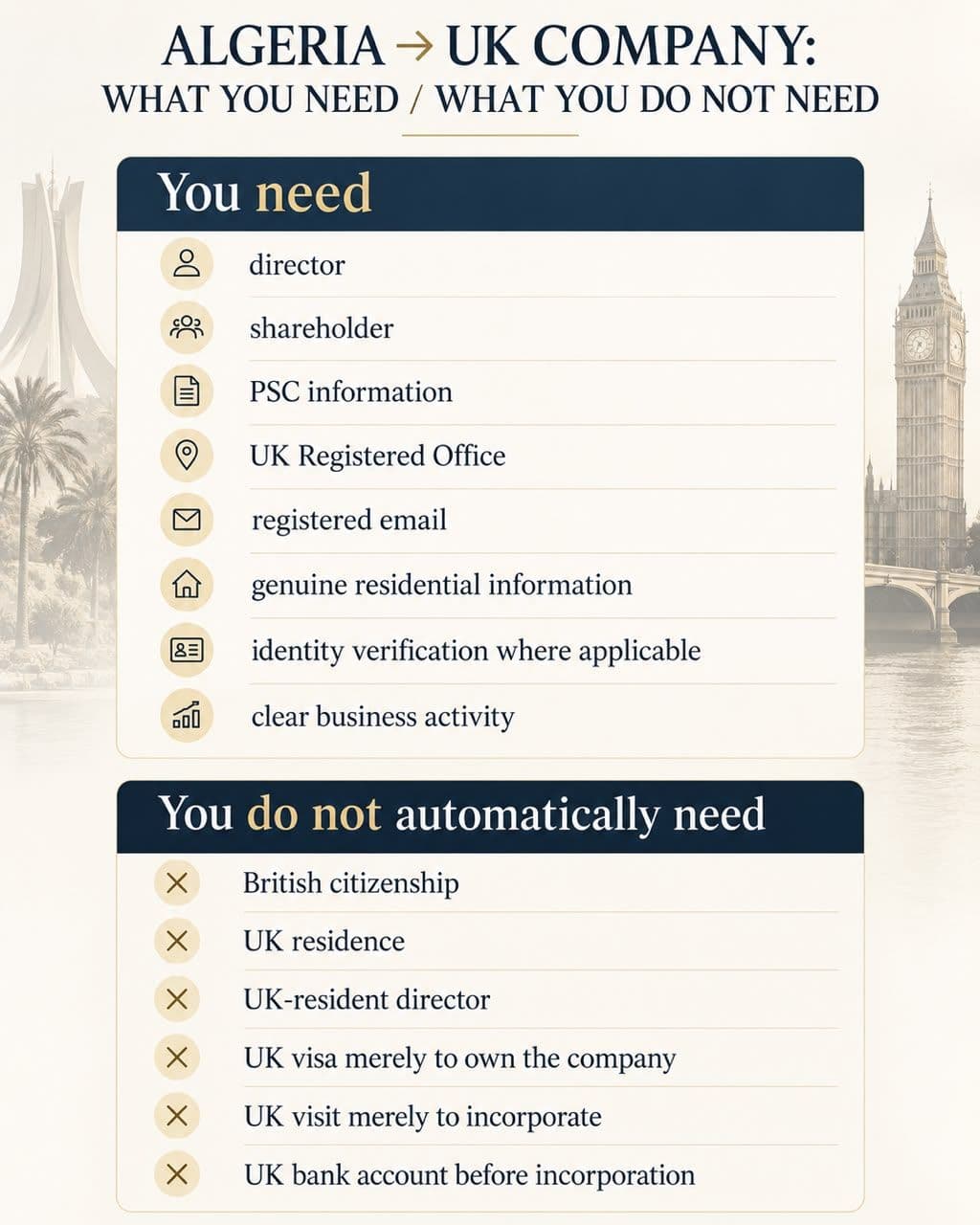
Yes. An Algerian resident can generally form, own and direct a UK private limited company without moving to Britain, becoming a UK citizen or appointing a UK-resident director.
Companies House confirms that a private company needs at least one director, that directors must be at least 16, and that directors do not have to live in the UK.
A single founder can also be the company’s sole shareholder and sole director.
For an Algerian founder, however, company formation is only the first step.
Before incorporating, you should understand:
- what the UK company will actually do;
- who will own and control it;
- which UK addresses are required;
- how Companies House identity verification works from Algeria;
- how the company will be funded;
- what Algerian exchange-control rules may affect transfers abroad;
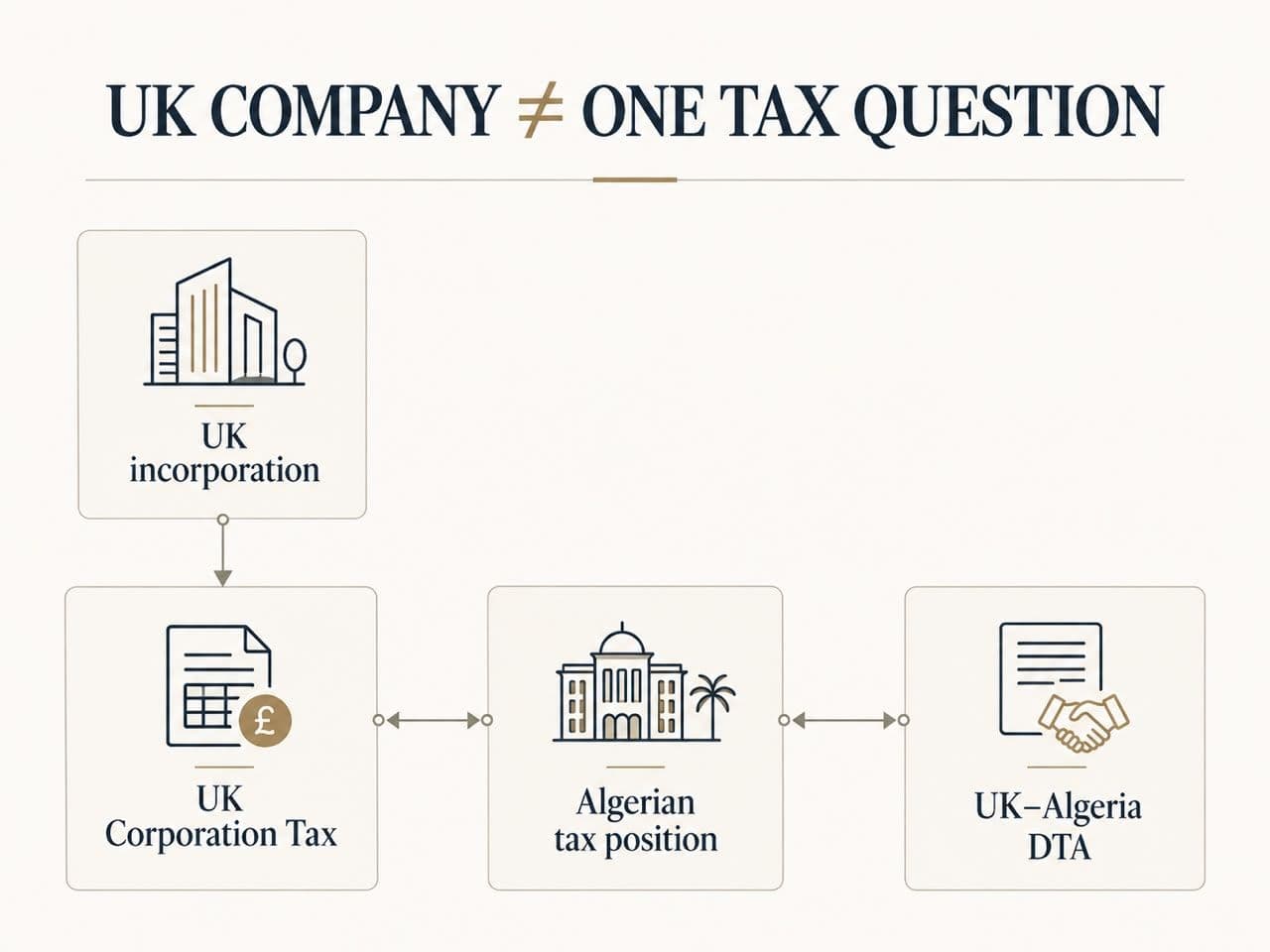
- how UK and Algerian tax interact;
- whether the UK–Algeria tax treaty may be relevant;
- and whether banking and payment-provider applications are realistic for the actual business profile.
The central principle of this guide is:
Being eligible to form a UK company is not the same thing as being ready to operate one internationally.
This guide covers both.
UK Company Formation from Algeria — Quick Answer
Can an Algerian resident register a UK company?
Yes, generally.
Can an Algerian founder own 100% of the shares?
Yes.
Can the same person be sole shareholder and sole director?
Yes.
Do directors need to live in Britain?
No.
Do you need a UK Registered Office?
Yes.
Do you need to travel to the UK simply to incorporate?
Not generally.
Do you need a UK bank account before incorporation?
No.
Does incorporation guarantee banking or payment-provider approval?
No.
Is Companies House identity verification relevant?
Yes.
What is the current standard online Companies House incorporation fee?
£100.
1. When Does a UK Ltd Make Sense for an Algerian Founder?
A UK company should solve a genuine commercial problem.
It can make sense where the founder is building an international business and the UK entity has a clear role in contracts, customers, investment, payments, or market entry.
International consulting and professional services
For example:
- technology consulting;
- engineering;
- design;
- digital marketing;
- management services;
- professional advisory work.
A UK Ltd can provide a recognised company structure for international contracts and invoices.
SaaS, software and technology
A UK company may be relevant where the founder is:
- building subscription software;
- serving UK or international customers;
- licensing technology;
- seeking future investment;
- contracting with larger overseas customers.
The decision should still consider ownership, intellectual property, banking and tax.
E-commerce and international trade
A UK company can play a genuine role in:
- supplier contracts;
- marketplace activity;
- stock or fulfilment;
- import/export;
- customer sales;
- payment flows.
But the company should not be formed simply because somebody says:
“A UK company will automatically give you Stripe or banking.”
That is not a reliable basis for incorporation.
Existing Algerian company expanding into Britain
An established Algerian business may consider a UK entity for:
- UK contracts;
- local customers;
- distribution;
- employees;
- investment;
- a separate UK subsidiary.
The UK Department for Business and Trade states that it supports Algerian companies looking to set up and invest in the UK.
The stronger question is therefore:
What commercial role will the UK company perform?
not simply:
Can it be registered?
2. When Should You Reconsider Forming a UK Company?
A UK Ltd may be premature or inappropriate where:
You only have an idea
If there is no defined service, product, supplier, customer strategy or commercial model, incorporation may be too early.
Your only objective is banking
Do not create the company purely because somebody has promised:
- Wise;
- Revolut;
- Stripe;
- Airwallex;
- Payoneer;
- or a UK bank account.
Financial-provider onboarding is separate from Companies House incorporation.
You already operate an Algerian company
Do not automatically create a new UK company personally.
First decide whether the UK operation should be:
- founder-owned;
- owned by the Algerian company;
- established as a UK subsidiary;
- or handled through another UK market-entry structure.
You have not considered how funds will leave Algeria
Companies House can answer whether the company can be incorporated.
It does not determine how capital may lawfully be transferred out of Algeria.
That is a separate legal and exchange-control question.
3. What Do You Need Before Incorporating?
Before filing, prepare the basic corporate structure.
Company name
The name should:
- comply with Companies House requirements;
- be available;
- avoid restricted terminology unless permission exists;
- make sense commercially.
Director
A private company needs at least one individual director.
The director must be at least 16 and does not need to live in the UK.
Shareholder
At least one shareholder is required.
The shareholder and director may be the same person.
Share structure
For a straightforward founder company, the share structure can remain simple.
Do not create unnecessary shareholders, classes or complexity merely to make the company appear more substantial.
PSC information
The company must identify relevant Persons with Significant Control.
A founder owning and controlling the company may also be its PSC.
Registered Office
Every UK company needs an appropriate Registered Office.
The address must be:
- a physical UK address;
- in the same UK jurisdiction in which the company is registered;
- capable of bringing correspondence to the attention of someone acting for the company;
- capable of acknowledging delivery.
A Royal Mail PO Box alone cannot be used.
Registered email
A registered email address is also required.
It is not published on the public register but should be actively monitored.
SIC code
Choose the code that genuinely describes what the company will do.
Do not select an unrelated activity merely because somebody claims it will make banking easier.
4. Can an Algerian Founder Own 100% of the UK Company?
Yes.
A straightforward structure may look like:
Algerian founder
↓
100% shareholder
↓
sole director
↓
PSC where the statutory control conditions apply
↓
UK Limited Company
That can be entirely legitimate.
But it is not automatically the correct structure where there are:
- co-founders;
- investors;
- an existing Algerian company;
- family ownership;
- planned future investment.
For detailed ownership planning:
UK Company Shares & Directors for Non-Resident Founders
5. Companies House Identity Verification from Algeria
Identity verification is now part of UK company administration.
When incorporating, you may need the personal code issued following Companies House identity verification. GOV.UK states that where a company has more than one director, each relevant director must have their own code.
For an Algerian founder, distinguish two separate processes.
KYC with your formation provider
This is the provider’s own customer-identification and AML process.
It may include:
- passport;
- residential address;
- ownership;
- business activity;
- source of funds where relevant.
Companies House identity verification
This is the statutory verification process.
After successful verification, the person receives their Companies House personal code.
The code belongs to the individual.
Important distinction
Provider KYC and Companies House statutory identity verification are not the same process.
Seven Oak provides assisted identity-verification support for international directors and PSCs.
Current assisted service: £74
The service includes guidance through the applicable route, documentation coordination and assistance obtaining the personal code following successful verification.
Companies House Identity Verification Assistance
6. What Documents Should an Algerian Founder Prepare?
The exact evidence depends on the applicant and verification route.
For a standard file, prepare:
Identity
A valid passport or another accepted identity document.
Residential address
Use your genuine residential address.
Do not use a UK Registered Office as though you personally live there.
Business activity
Be able to explain:
- what the company sells;
- how it makes money;
- where customers are;
- where suppliers are;
- where work is performed;
- expected payment flows.
“General business” is not a useful commercial description.
Neither is “online services” if the activity can be explained more precisely.
Ownership
Confirm:
- directors;
- shareholders;
- ownership percentages;
- PSCs.
Source of funds where relevant
In banking or more complex onboarding, you may need to explain the origin of the company’s initial funds.
A strong file is not necessarily the largest one.
It is the one where the facts are:
clear
truthful
consistent
7. Which UK Address Does an Algerian Founder Need?
An Algerian founder does not need to personally live in Britain.
The company does need an appropriate UK Registered Office.
Registered Office
The statutory company address.
Director Service Address
The public correspondence address of the director.
Residential Address
The director’s genuine home address.
Virtual Business Address
A commercial correspondence service where appropriate.
A Virtual Business Address should not be described as staffed operating premises when no operations genuinely take place there.
For detailed address planning:
read our UK Company Formation Without Your Own UK Address
For address comparison : Registered Office vs Director Service Address
8. Algeria’s FATF Status Changed in June 2026
This is one area where older online articles about Algeria can now be wrong.
Algeria had been subject to FATF increased monitoring.
At its June 2026 plenary, FATF removed Algeria from its list of jurisdictions under increased monitoring following a successful on-site visit and completion of its action plan. FATF said Algeria had made significant progress and would continue working with MENAFATF to sustain those improvements.
This is a positive development.
But it does not mean:
- every bank must accept an Algerian founder;
- every payment provider must onboard an Algerian-owned company;
- source-of-funds checks disappear;
- KYC disappears;
- every Algeria-linked application receives identical treatment.
The practical conclusion is:
Algeria is no longer subject to FATF increased monitoring, but individual providers still apply their own risk assessment and onboarding rules.
That distinction is more useful than simply saying:
“Algeria is no longer grey-listed.”
9. Banking and Payment Providers: Prepare Before You Apply
For many Algerian founders, incorporation is not the difficult part.
Financial-provider onboarding may require more preparation.
A bank, EMI or payment provider may consider:
- residence;
- ownership;
- beneficial owners;
- source of funds;
- source of wealth where relevant;
- customer countries;
- supplier countries;
- business activity;
- website;
- contracts;
- expected turnover;
- currencies;
- transaction corridors.
A Certificate of Incorporation proves the company exists.
It does not compel any provider to approve the business.
That makes both of these claims too broad:
“Algerian residents cannot obtain UK business banking.”
and:
“Once the UK company exists, banking is straightforward.”
The company profile matters.
read our UK Business Banking Readiness Assessment
10. Funding a UK Company from Algeria: Exchange-Control Rules Matter
This is one of the most important Algeria-specific differences.
UK company law may allow the company to be incorporated.
Algerian law separately regulates certain foreign-exchange transactions and transfers of capital abroad.
The Bank of Algeria publishes a specific exchange-control framework that includes:
- Regulation No. 07-01, as amended, dealing with current transactions with foreign countries and foreign-currency accounts;
- Regulation No. 2014-04 of 29 September 2014, dealing with transfers of capital abroad for foreign investment by economic operators established under Algerian law.
Regulation 2014-04 is particularly relevant where an Algerian-law economic operator is investing abroad.
The Bank of Algeria states that the regulation governs capital transfers abroad for foreign investment by Algerian-law economic operators and is linked to prior authorisation requirements under the applicable framework.
That means:
Companies House eligibility does not itself determine whether or how funds can be transferred from Algeria into the UK company.
An Algerian individual founder and an existing Algerian company may also have very different local considerations.
Pay particular attention where:
- substantial capital is being transferred;
- an existing Algerian company will finance the UK entity;
- the founder expects dividends or salary back into Algeria;
- the UK company is part of a wider Algerian group;
- local reporting or authorisation may be relevant.
Seven Oak can support the UK-side company establishment.
For Algerian exchange-control, overseas-investment and local tax obligations, use an appropriately qualified Algerian adviser.
Official source: Bank of Algeria — Foreign Exchange Regulations
Bank of Algeria exchange-control framework
Official source: Bank of Algeria — Capital Transfers Abroad
Bank of Algeria foreign-investment transfer rules
11. UK–Algeria Double Taxation Treaty: What Founders Should Know
The UK and Algeria have a comprehensive Double Taxation Convention in force.
The treaty was:
Signed: 18 February 2015
Entered into force: 16 June 2016
It applies in Algeria from 1 January 2017.
In the UK, it applies:
- to withholding taxes from 1 January 2017;
- to Corporation Tax from 1 April 2017;
- to Income Tax and Capital Gains Tax from 6 April 2017.
This is materially different from jurisdictions where the UK has no comprehensive treaty.
However, the treaty does not mean:
- all income is automatically exempt from double taxation;
- every payment receives the same treatment;
- every dividend has one fixed rate;
- company residence becomes irrelevant;
- Algerian domestic tax obligations disappear.
HMRC’s treaty summary confirms that treaty rates and relief depend on the income type and on relevant conditions being satisfied.
The useful distinction is:
UK incorporation, UK Corporation Tax, Algerian taxation and treaty relief are four related but separate questions.
Where the structure involves:
- significant dividends;
- group-company payments;
- intellectual-property income;
- intercompany charges;
- management across both countries;
obtain proper UK and Algerian tax advice.
Official source: UK–Algeria Double Taxation Convention
Read the UK–Algeria treaty information
12. Existing Algerian Company vs Personally Owned UK Ltd
If you already own or manage an Algerian company, do not automatically create a UK Ltd personally.
First identify what the UK operation actually represents.
New independent founder venture
Personal founder ownership may be appropriate.
Existing Algerian company expanding into Britain
Corporate ownership may be more natural.
UK subsidiary
A separate UK Ltd owned by the Algerian company may make sense where the group wants:
- separate legal personality;
- local contracts;
- defined UK operations;
- UK investment;
- local employees;
- clearer liability separation.
UK establishment / branch
A branch may be more appropriate where the overseas company itself establishes a UK place of business rather than creating a separate subsidiary.
The correct question is:
Which structure reflects the real commercial relationship between Algeria and the UK operation?
Read the UK Subsidiary vs Branch for Overseas Companies .
13. How Much Does UK Company Formation from Algeria Cost?
Companies House currently charges £100 for standard online incorporation. GOV.UK states that online companies are usually registered within 24 hours for straightforward applications.
The government filing fee is not necessarily the founder’s full setup cost.
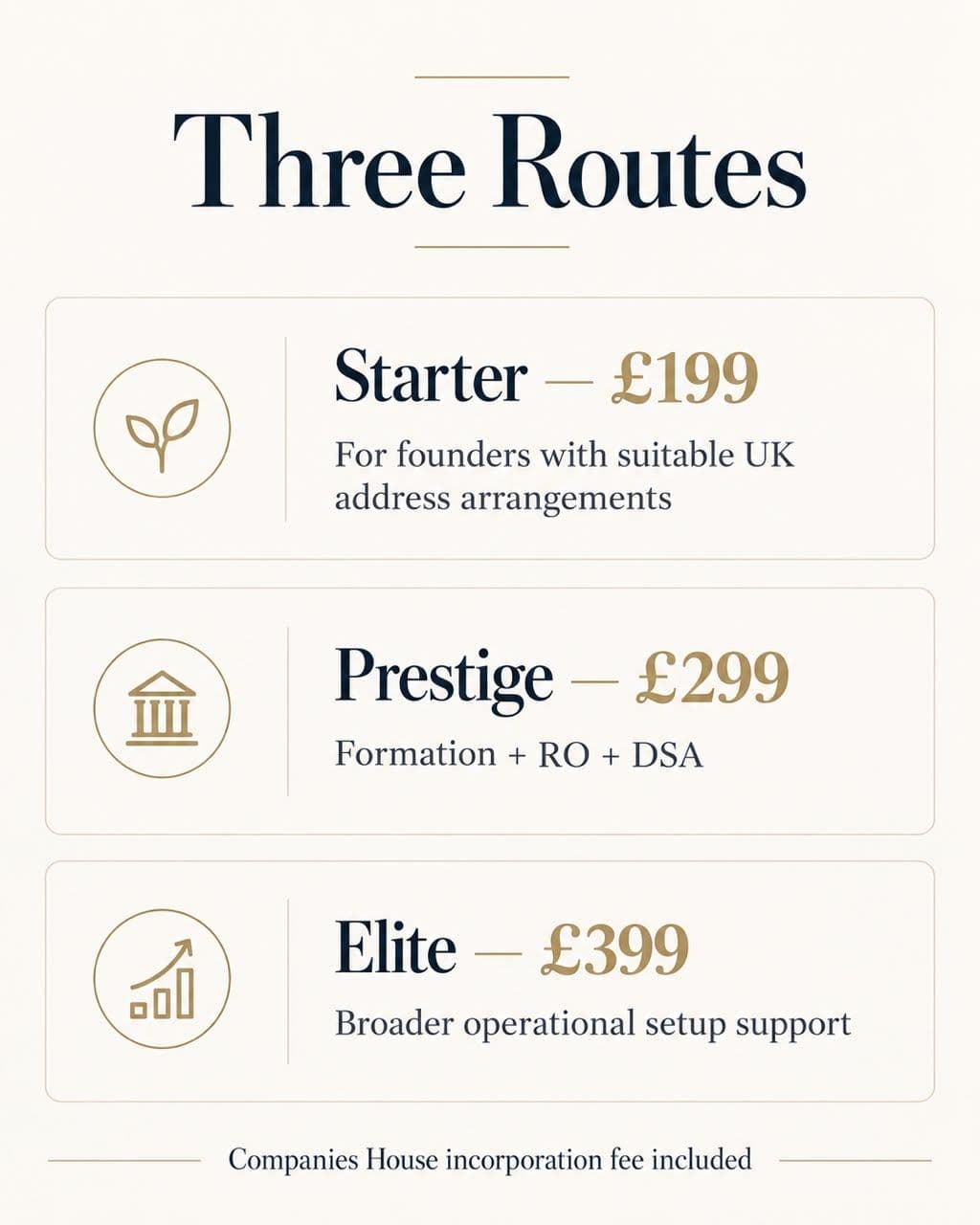
Seven Oak’s current formation packages are:
Starter — £199
Companies House incorporation fee included.
Designed for founders who already have suitable UK address arrangements and mainly require formation support.
Prestige — £299
Companies House incorporation fee included.
Includes:
- company formation;
- Registered Office;
- Director Service Address;
- banking guidance;
- formation support.
For many non-resident founders without existing UK address infrastructure, this is the more practical starting point.
Elite — £399
Companies House incorporation fee included.
Adds:
- Virtual Business Address;
- Companies House identity-verification assistance for one director;
- business-profile review;
- enhanced banking/application support.
Accounting, VAT, EORI and other activity-specific services remain separate where relevant.
For detailed first-year costs and renewals:
Read our : UK Company Formation Cost for Non-Residents .
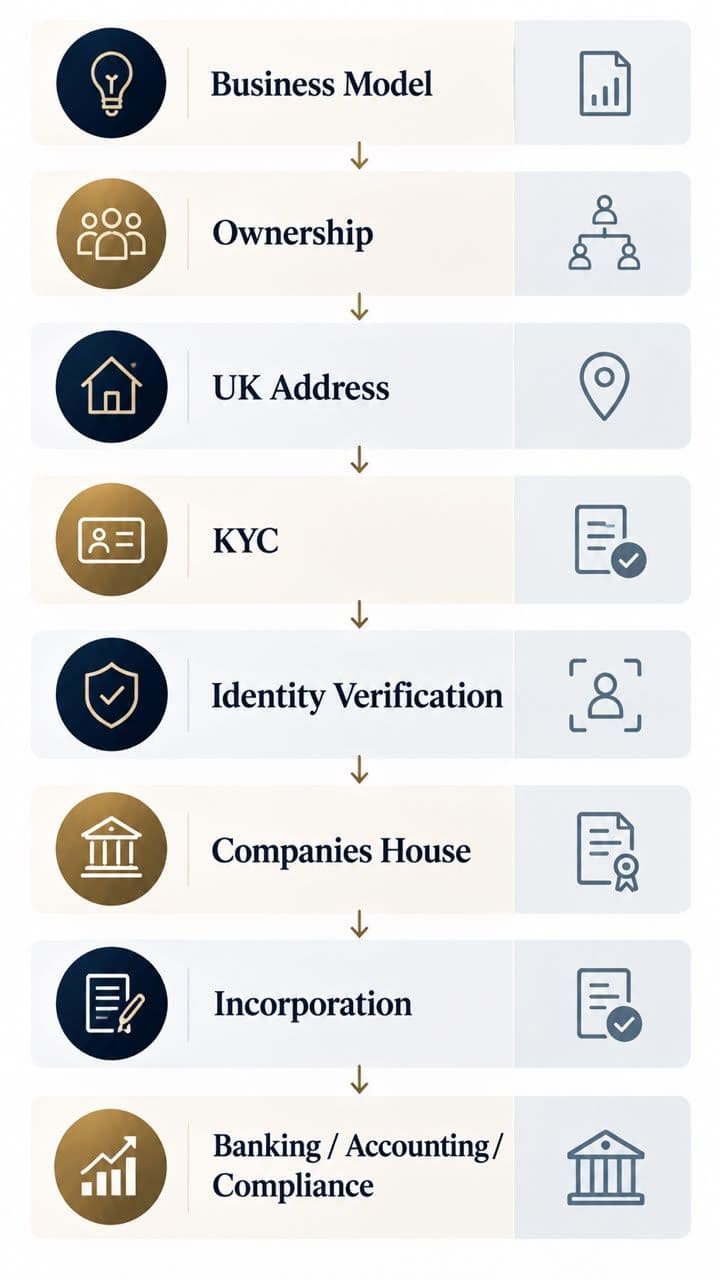
14. How to Start a UK Company from Algeria — Step by Step
Step 1 — Define the business activity
Be able to explain what the company will actually sell or provide.
Step 2 — Decide ownership
Confirm:
- directors;
- shareholders;
- PSCs;
- ownership percentages.
Step 3 — Decide whether the founder or an Algerian company should own it
Do this before filing, not after incorporation.
Step 4 — Choose the company name
Check availability and restricted wording.
Step 5 — Select the SIC code
Use the code that genuinely matches the intended activity.
Step 6 — Arrange the UK Registered Office
The address must be ready before registration.
Step 7 — Complete provider KYC
Provide the required identity, residential-address, ownership and business information.
Step 8 — Complete Companies House identity verification
Relevant directors obtain their personal code where required.
Step 9 — Review the incorporation data
Check:
- name;
- Registered Office;
- registered email;
- directors;
- shareholders;
- PSCs;
- share capital;
- SIC codes.
Step 10 — Submit to Companies House
Standard digital registration currently costs £100 and straightforward online applications are usually processed within 24 hours.
Do not confuse this with the provider’s full end-to-end timeframe.
KYC and identity verification happen before submission.
Step 11 — Review the public company record
Check the incorporated company yourself once Companies House accepts it.
Step 12 — Move into operational readiness
Depending on the business, this may include:
- accounting;
- Corporation Tax;
- business banking;
- VAT;
- EORI;
- contracts;
- invoices;
- website disclosures;
- payment providers.
Read our guide What Happens After UK Company Formation?
15. Which Algerian Founder Are You?
The legal incorporation process may be similar, but the practical structure can differ considerably.
Independent consultant in Algiers, Oran or Constantine
A simple founder-owned company may be enough where the business has:
- clearly defined professional services;
- international customers;
- straightforward ownership;
- modest transaction complexity.
Priorities usually include:
- address infrastructure;
- banking;
- accounting;
- invoicing.
SaaS or technology founder
Think beyond incorporation.
Consider:
- intellectual property;
- subscriptions;
- payment processing;
- development teams;
- future investors;
- founder ownership.
Engineering or specialist consultant
International consulting can involve larger contracts, corporate customers, technical services and multiple countries.
Banking and contractual evidence may therefore matter as much as incorporation.
E-commerce or trading founder
Consider:
- supplier countries;
- imports;
- stock;
- fulfilment;
- VAT;
- EORI;
- marketplaces;
- payment processing.
Read our UK E-Commerce Company for Non-Residents
Existing Algerian company entering Britain
Review subsidiary vs branch vs direct trade before deciding ownership.
16. Algeria → UK Readiness Check
Before paying for formation, answer these seven questions.
1. What will the UK company sell?
If you cannot explain the activity simply, clarify it first.
2. Who are the customers?
UK?
EU?
Gulf?
North America?
International?
3. Who should own the company?
Individual founder?
Co-founders?
Existing Algerian company?
4. Where will the first funds come from?
Founder savings?
Existing business?
Investment?
Revenue?
The explanation should be genuine and documentable.
5. How will funds lawfully move from Algeria?
If the project involves outward investment or material capital transfers, review Algerian exchange-control requirements before assuming the transfer can be made.
6. What banking functions does the business actually need?
GBP collection?
EUR?
Supplier payments?
Subscriptions?
Card processing?
Marketplace payouts?
7. What happens after incorporation?
Accounting?
Tax?
VAT?
EORI?
Contracts?
Provider onboarding?
If those answers are clear before filing, the company is easier to explain later.
17. Common Mistakes Algerian Founders Should Avoid
Mistake 1 — Forming only for a bank or payment account
A UK company should have a genuine business role.
Mistake 2 — Describing a UK statutory address as your personal residence
Your real residential location should remain accurate.
Mistake 3 — Choosing an inaccurate SIC code
The code should reflect genuine activity.
Mistake 4 — Assuming FATF removal guarantees banking
Algeria’s removal from increased monitoring is positive, but providers still make independent decisions.
Mistake 5 — Ignoring Algerian exchange-control rules
UK company-law eligibility does not itself authorise a capital transfer from Algeria.
Mistake 6 — Assuming the UK–Algeria treaty removes every tax issue
Treaty relief depends on the facts and relevant conditions.
Mistake 7 — Creating unnecessary ownership complexity
Do not add shareholders or directors without a commercial reason.
Mistake 8 — Treating incorporation as the finish line
The Certificate of Incorporation creates the legal entity.
It does not create its banking, accounting, tax or compliance infrastructure.
18. What Seven Oak Will Not Promise an Algerian Founder
Seven Oak will not tell you that a UK company automatically removes Algerian tax obligations.
We will not guarantee:
- a bank account;
- Wise;
- Revolut;
- Stripe;
- Airwallex;
- Payoneer;
- VAT registration;
- immigration rights.
We will not recommend hiding your Algerian residence.
We will not describe a statutory address as staffed UK premises where it is not one.
We will not tell an Algerian company that UK incorporation automatically means it can freely transfer investment capital abroad.
And we will not create artificial ownership structures merely to make an application appear lower risk.
A credible international setup should be:
accurate
consistent
commercially explainable
19. How Seven Oak Handles an Algeria → UK Formation
Our standard process is:
1. Choose the appropriate package
Starter, Prestige or Elite according to the support and UK address infrastructure required.
2. Complete payment
Payment is completed before substantive onboarding begins.
3. Provide the company information
Including:
- proposed name;
- business activity;
- directors;
- shareholders;
- ownership;
- address requirements.
4. Complete KYC
Relevant directors and shareholders provide the required identity and residential-address documentation.
5. Complete Companies House identity verification
Relevant directors complete the applicable verification process and provide their personal code where required.
6. Review the company structure
We review:
- ownership;
- directors;
- shares;
- PSCs;
- SIC code;
- address setup;
- filing information.
7. Submit to Companies House
Once the file is complete and the required checks are cleared.
8. Move into post-incorporation readiness
Depending on the company, this may include:
- statutory-address administration;
- banking readiness;
- accounting coordination;
- VAT/EORI;
- ongoing compliance planning.
Companies House, banks, payment providers and other third parties retain their own final decision-making authority.
Ready to Review Your Algeria → UK Company Setup?
If you live in Algeria and are considering a UK company, send Seven Oak Prestige:
City of residence
Where you actually live.
Business activity
What the company will sell or provide.
Target markets
Where your customers will be.
Ownership
Who will own and direct the company.
Existing business
Whether you already operate an Algerian company.
Funding route
Whether the founder or an existing business will fund the UK company.
Banking requirement
What currencies and payment functions the business actually needs.
Review My Algeria → UK Company Setup
Frequently Asked Questions
Can an Algerian resident register a UK company?
Yes, generally.
UK private-company directors do not have to live in the UK.
Can an Algerian founder own 100% of the company?
Yes.
A single founder can own all the shares and can also act as sole director.
Do I need a UK-resident director?
No general rule requires one for an ordinary private UK company.
Do I need to travel to Britain?
Not generally for standard incorporation.
Do I need a UK Registered Office?
Yes.
It must satisfy Companies House’s physical-address, jurisdiction and appropriate-address requirements.
Do I need to own UK property?
No.
A qualifying professional address may be used with the provider’s permission.
Do I need a UK bank account before forming the company?
No.
Banking is separate from incorporation.
Does incorporation guarantee business banking?
No.
Financial providers make independent onboarding decisions.
Do Algerian directors need Companies House identity verification?
Relevant directors must comply with the applicable identity-verification requirements and provide their personal code when required.
Is Algeria still on the FATF grey list in 2026?
No.
FATF removed Algeria from increased monitoring at its June 2026 plenary following successful completion of its action plan and on-site assessment.
Does FATF removal mean banking approval is easy?
No.
Individual institutions continue to assess residence, ownership, activity, source of funds and transaction profile.
Is there a UK–Algeria Double Taxation Treaty?
Yes.
The current comprehensive convention entered into force on 16 June 2016 and has applied in Algeria since January 2017 and to UK Corporation Tax since April 2017.
Does the tax treaty mean I cannot be taxed twice?
Not automatically.
The treaty provides mechanisms and limits in relevant circumstances, but actual relief depends on the type of income and whether applicable conditions are met.
Can an Algerian company invest in a UK subsidiary?
Potentially, but Algeria’s exchange-control rules may be relevant.
Bank of Algeria Regulation 2014-04 governs transfers of capital abroad for foreign investment by Algerian-law economic operators.
How much does Companies House charge?
Standard online incorporation currently costs £100.
How long does incorporation take?
Companies House says online companies are usually registered within 24 hours for straightforward applications. Provider onboarding, KYC and identity verification are separate stages.
Can I use the company for consulting, SaaS or e-commerce?
Potentially, yes, where that is the company’s genuine activity and the overall structure makes commercial sense.
What if I already own an Algerian company?
Review whether the UK entity should be personally owned, a subsidiary, a UK establishment, or whether direct cross-border trade is more appropriate.
Does Seven Oak guarantee Wise, Stripe, Revolut, Airwallex or Payoneer?
No.
Seven Oak can support company formation and operational readiness. Financial providers make their own decisions.
Related Guides
UK Company Formation Without Your Own UK Address
For founders who do not personally own or rent UK premises.
Registered Office vs Director Service Address
For the legal distinction between statutory, public and residential addresses.
Companies House Identity Verification Assistance
For international directors and PSCs who need practical help obtaining their personal code.
UK Company Shares & Directors for Non-Resident Founders
For ownership, sole-founder structures and multi-founder companies.
UK Company Formation Cost for Non-Residents
For first-year costs, packages and renewals.
UK Business Banking Readiness Assessment
For preparation before approaching financial providers.
UK Subsidiary vs Branch for Overseas Companies
For Algerian companies establishing a formal UK presence.
UK E-Commerce Company for Non-Residents
For stock, VAT, EORI, marketplaces and payment infrastructure.
What Happens After UK Company Formation?
For accounting, HMRC, banking, VAT, EORI and ongoing compliance.
About the Author
Isaac Jackson
Founder & Managing Director — Seven Oak Prestige Ltd
Isaac Jackson supports international founders and overseas businesses establishing and operating UK companies, including founders requiring assistance with company formation, statutory addresses, Companies House administration, KYC preparation, compliance coordination and banking readiness.
Seven Oak Prestige Ltd
Company Registration No. 16903092
Registered Office: 124 City Road, London EC1V 2NX, United Kingdom
Editorial Methodology
This guide was prepared specifically around the question:
How can an Algerian resident or Algerian business establish a UK company correctly in 2026?
The page was reviewed against:
- current Companies House incorporation requirements;
- UK Registered Office requirements;
- current Companies House identity-verification rules;
- current Companies House fees;
- FATF’s June 2026 Algeria update;
- HMRC’s current UK–Algeria Double Taxation Convention guidance;
- the Bank of Algeria’s published exchange-control and outward-investment regulations;
- UK government Algeria–UK trade and investment information;
- practical issues raised by international founders involving ownership, KYC, banking and operational readiness.
This article deliberately separates different legal and commercial questions.
UK company-law eligibility does not determine:
- Algerian exchange-control treatment;
- Algerian tax treatment;
- treaty relief;
- business-banking eligibility;
- payment-provider approval.
Those questions should be assessed independently where relevant.
The page also hands detailed subjects to specialist Seven Oak owner pages rather than reproducing banking, cost, identity-verification, e-commerce and post-incorporation guidance in full.
Last reviewed: 27 September 2026
Primary Official Sources Reviewed
GOV.UK — Directors and Company Secretaries
Used to verify that directors must be at least 16 and do not have to live in the UK.
View GOV.UK director requirements
GOV.UK — Register Your Company
Used to verify the current £100 online incorporation fee, the personal-code requirement and the current standard processing statement.
View Companies House registration guidance
GOV.UK — Registered Office and Registered Email
Used to verify the physical-address, jurisdiction, appropriate-address and registered-email requirements.
View company-address requirements
FATF — June 2026 Plenary
Used to verify Algeria’s removal from increased monitoring in June 2026.
View FATF June 2026 plenary outcomes
HMRC — Algeria: Agreements in Force
Used to verify the current UK–Algeria Double Taxation Convention, signing date, entry into force and effective dates.
View HMRC Algeria treaty guidance
HMRC — Algeria Treaty Summary
Used to verify that treaty treatment depends on income type and applicable relief conditions.
Bank of Algeria — Exchange-Control Regulations
Used to verify the published Algerian regulatory framework governing foreign exchange and overseas capital transfers.
View Bank of Algeria exchange regulations
Bank of Algeria — Regulation 2014-04
Used to verify the framework for transfers of capital abroad for foreign investment by Algerian-law economic operators.
View Bank of Algeria outward-investment rules
Editorial Disclaimer
This guide provides general information about UK company formation and international business establishment.
It does not constitute personalised:
- legal advice;
- Algerian legal advice;
- tax advice;
- accounting advice;
- foreign-exchange advice;
- investment advice;
- immigration advice;
- banking or financial-services advice.
Cross-border consequences can depend on:
- residence;
- ownership;
- management location;
- source of funds;
- whether the investor is an individual or an Algerian legal entity;
- business activity;
- customer and supplier countries;
- Algerian exchange-control rules;
- UK and Algerian taxation;
- applicable treaty provisions;
- transaction flows.
Where the proposed structure involves significant Algeria–UK tax, foreign-exchange, overseas-investment, legal or regulated-business issues, advice from appropriately qualified professionals may be required.
Companies House, HMRC, Algerian authorities, banks and payment providers make their own decisions.