
Registered Office vs Director Service Address UK: 2026 Guide

Registered Office vs Director Service Address for Non-Residents: What’s the Difference?
Last reviewed: 6 October 2026
A UK company’s registered office and a director’s service address can be the same physical address.
But legally, they are not the same thing.
The simplest distinction is:
A registered office belongs to the company. A director service address belongs to the individual director.
For a non-resident founder, this matters because the company needs an appropriate registered office in the UK jurisdiction where it is registered, while the director may genuinely live and operate the business from another country.
Understanding that distinction helps founders keep their residential address off the ordinary public register where permitted, receive statutory correspondence correctly and avoid misrepresenting where the business actually operates.
Quick Answer: Registered Office vs Director Service Address
A registered office is the company’s official statutory address. It appears on the Companies House public register and must be an appropriate address in the same UK jurisdiction in which the company is registered.
A director service address is the public correspondence address of an individual director. It also appears on the public register, but it does not generally have to be the director’s home address or a UK address.
A director must separately provide their usual residential address to Companies House. This is normally kept off the public register.
For many non-resident founders, a practical arrangement therefore looks like this:
Registered Office
Professional UK address — public
Director Service Address
Professional correspondence address, often the same UK address — public
Usual Residential Address
Founder’s genuine overseas home — normally private
Operating or Trading Address
Where the business actually operates, where relevant
The physical address used for the first two can be identical. Their legal functions remain different.
If you are forming a company from overseas and do not have your own suitable UK premises, our UK Company Formation Without Your Own UK Address guide explains the wider setup.

1. What Is a UK Registered Office?
Every UK limited company must maintain a registered office.
This is the company’s official address for statutory purposes and an important point of contact for official correspondence.
The registered office is public.
It must also be located in the appropriate UK jurisdiction.
For example, a company registered in England and Wales must maintain its registered office within that jurisdiction. A company registered in Scotland must maintain its registered office in Scotland.
This requirement is different from the director’s residence.
A founder can therefore live in India, France, the UAE, Ghana, the United States or another country while their UK company maintains its registered office in England and Wales.
The registered office does not mean the director lives there.
It also does not automatically mean the business physically operates there.
2. What Makes a Registered Office an “Appropriate Address”?
A registered office must be an appropriate address.
In practical terms, documents delivered there by hand or post should be expected to reach someone acting for the company, and delivery must be capable of being acknowledged.
That means a registered office should not simply be an address placed on the Companies House register and then ignored.
For a non-resident director, this is particularly important because the founder may be thousands of miles away from the address.
If you use a professional provider, you should understand:
- what official correspondence it accepts;
- how that correspondence reaches you;
- whether mail is scanned or forwarded;
- how quickly important correspondence is communicated;
- what happens when the service expires.
A professional address is useful only if the underlying mail-handling system works.
3. Can You Use a PO Box as a Registered Office?
A PO Box address that does not satisfy Companies House’s appropriate-address requirements cannot be used as the registered office.
The company needs an appropriate physical address where documents delivered by hand or post would be expected to reach someone acting for the company and where delivery can be acknowledged.
This does not prevent a company from using a legitimate professional registered-office provider.
The important distinction is between an address service that properly supports the statutory registered-office function and a mailbox arrangement that does not satisfy the applicable requirements.
For non-resident founders, the cheapest address is therefore not necessarily the most useful.
The company needs an address it is entitled to use and through which important correspondence can actually reach it.
4. What Is a Director Service Address?
A director service address is the public correspondence address associated with an individual director.
Companies House requires a director to provide both:
- a service address; and
- a usual residential address.
They serve different purposes.
The service address is public and can be used for communications relating to the director’s role in the company.
The usual residential address identifies where the director actually lives and is normally kept off the public register.
This distinction is particularly useful for directors who manage UK companies from overseas.
5. Does a Director Service Address Have to Be in the UK?
No general Companies House rule requires a director’s service address to be in the UK.
It can be:
- the company’s registered office;
- the director’s residential address; or
- another suitable correspondence address the director is entitled to use.
This is one of the most important differences between the two address types.
The registered office is subject to the company’s UK jurisdiction requirement.
The director service address is not generally subject to that same geographical restriction.
That does not mean any arbitrary address should be used. The address should be genuine, accurate and available for correspondence intended for the director.
6. Is a Director Service Address Public?
Yes.
The director service address appears on the Companies House public register.
That is why a director who wants to keep their home address off the ordinary public register should think carefully before using it as their service address.
For example, a director living in Dubai could legitimately have:
Residential address: Dubai
Director service address: London
Company registered office: London
The London addresses do not change the fact that the director genuinely lives in Dubai.
They perform different functions.
7. Registered Office vs Director Service Address vs Residential Address
There are three distinctions every non-resident director should understand.
Registered Office
Belongs to the company.
It is public and must satisfy the company’s UK jurisdiction and appropriate-address requirements.
Director Service Address
Belongs to the director in their capacity as a company officer.
It is public and is used as a correspondence address.
Usual Residential Address
The director’s genuine home address.
Companies House requires it, but it is normally withheld from the public register.
The residential address should not be replaced with a London address merely because the company uses a London registered office.
If the director genuinely lives overseas, their residential information should reflect that reality.
For the wider relationship between directors, shareholders and PSCs, read How to Structure Shares and Directors in a UK Ltd as a Non-Resident Founder.
8. Can the Registered Office and Director Service Address Be the Same?
Yes.
This is common, particularly for non-resident founders.
For example:
Registered Office
124 Example Street, London
Director Service Address
124 Example Street, London
Residential Address
Founder’s genuine home in California
The first two entries use the same physical location, but they still represent two different legal functions.
This distinction also matters when buying an address service.
Do not assume that purchasing a registered-office service automatically gives every director permission to use the same address as their service address.
Check what the provider actually includes and whether the service is priced per company, per director or under another arrangement.

9. Why Non-Resident Founders Often Use a Professional Address
A non-resident founder may have no personal premises in the UK.
That does not prevent them from forming and directing a UK company.
A professional address arrangement can provide a practical way to maintain the company’s statutory address while keeping the founder’s overseas home address off the public-facing registered-office and director-service-address records.
It can also simplify correspondence where the same provider legitimately supplies both services.
The important point is accuracy.
A professional London address can be the company’s registered office and the director’s service address without becoming:
- the director’s residence;
- the company’s warehouse;
- its trading premises;
- its actual management location; or
- its physical headquarters.
Each fact should be represented for what it actually is.
For founders who need both addresses as part of a new company setup, Seven Oak’s current Prestige and Elite formation packages include a Registered Office and Director Service Address for 12 months. Current scope and pricing are available through Seven Oak Prestige.
10. Registered Office vs Business, Trading and Operating Address
These terms are often mixed together, but they answer different questions.
The registered office answers:
What is the company’s official statutory address?
A business or correspondence address may answer:
Where should customers, suppliers or general commercial correspondence be sent?
A trading or operating address may answer:
Where does the company actually conduct or manage its business?
Sometimes one address performs several of these functions.
Sometimes they are completely different.
Consider a software founder living in India:
Registered Office: London
Director Service Address: London
Director Residence: Bengaluru
Actual management: Bengaluru
That structure is not inherently contradictory.
What would create a problem is representing the London registered office as genuine operating premises when it is only being used as a statutory address service.
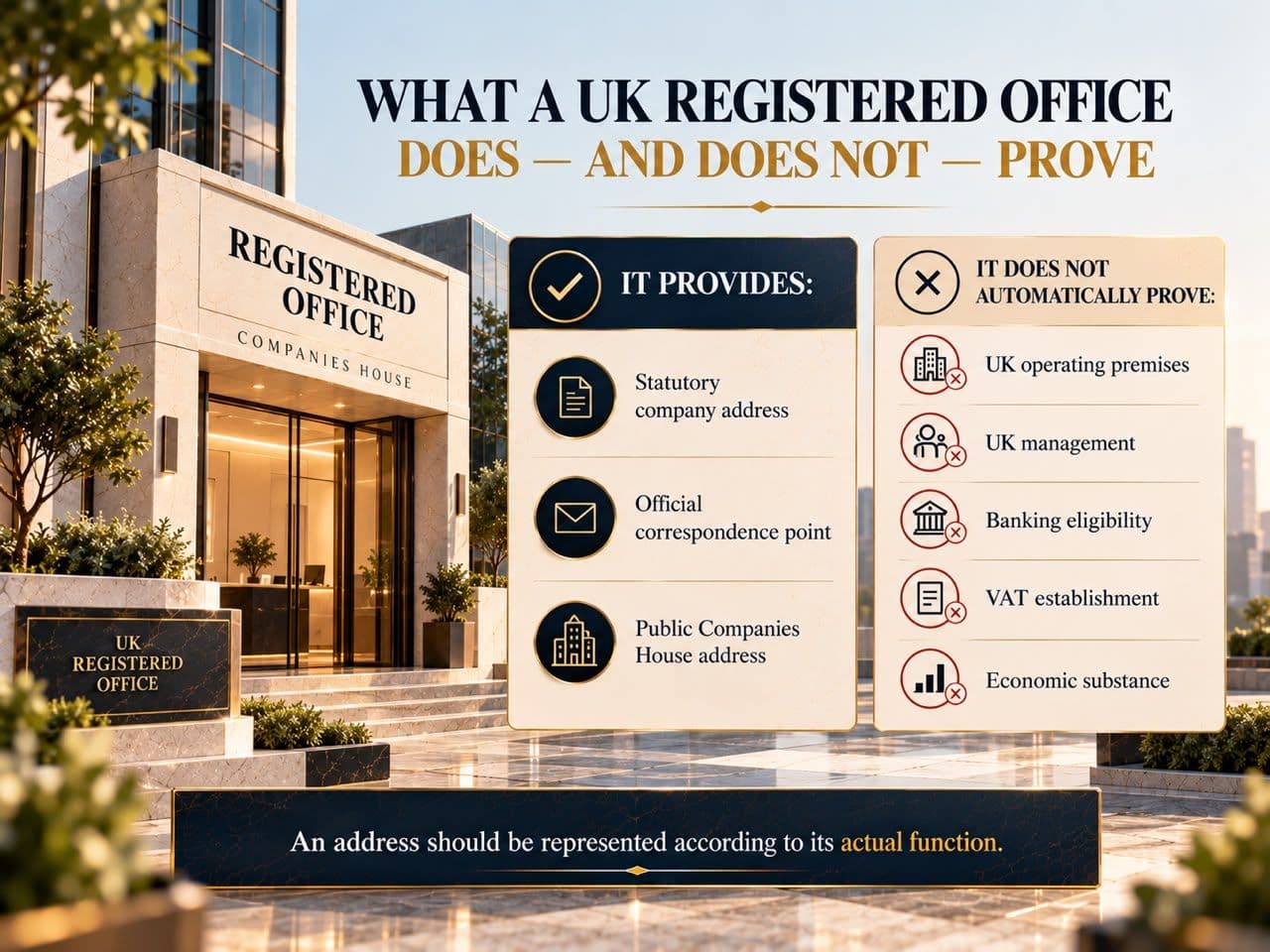
11. What Does a UK Address Not Prove?
A registered office is important statutory infrastructure.
It should not be treated as evidence of facts it does not establish.
It does not guarantee banking approval
A bank or payment provider can separately consider the director’s residence, operating location, business model, customers, suppliers, source of funds and expected transactions.
A London registered office does not replace that assessment.
For the wider preparation process, see our UK Business Banking Guide for Non-Resident Companies.
It does not automatically establish where the business operates
A company can have a London registered office while being managed operationally from another country.
It does not by itself determine every tax question
Company incorporation, registered office, management, business activity and the founder’s personal residence are separate facts that can have different tax consequences.
It does not by itself prove UK VAT establishment
VAT treatment depends on the relevant facts and applicable rules, not simply the postcode appearing at Companies House.
This distinction is particularly important for e-commerce businesses holding stock, importing goods or selling across borders. Our UK E-Commerce Company for Non-Residents guide covers the wider VAT, EORI, stock and operational framework.
12. What Happens If Your Address Service Ends?
Do not ignore an expired or terminated registered-office service.
If you no longer have permission to use an address, arrange an appropriate replacement and update the relevant company records.
This matters because the registered office is not merely decorative information on the Companies House register.
It is part of the company’s statutory infrastructure.
The same principle applies to director and PSC information where an address arrangement changes.
For an overseas director, maintaining reliable access to official correspondence should form part of the company’s wider compliance system. Our UK Company Compliance Support for Non-Resident Directors guide explains the wider post-incorporation responsibilities.
13. How Do You Change a Registered Office or Director Service Address?
A company must notify Companies House of a change to its registered office within 14 days.
The new address must satisfy the applicable requirements, and the registered office does not officially change until Companies House registers the change.
A director’s service-address details can also be updated through Companies House.
Where the same individual is also a PSC, do not assume that changing one record automatically corrects every other relevant record. Review the company, director and PSC information that actually needs updating.
The same principle applies when moving from a home address to a professional address: make sure the correct records are changed rather than assuming one filing solves everything.
14. What Is a SAIL Address?
SAIL means Single Alternative Inspection Location.
It allows a company, where applicable, to keep certain company records available for inspection at a location other than its registered office.
A SAIL is optional and must be in the same part of the UK as the company’s registered office.
It is not another name for:
- a registered office;
- a director service address;
- a residential address; or
- a trading address.
Many straightforward small companies will never need a separate SAIL.
For most non-resident founders establishing a simple UK Ltd, the immediate priorities are the registered office, director service address and accurate residential information.
15. Privacy: What Actually Stays Off the Public Register?
The key privacy distinction is between the director’s service address and usual residential address.
The service address is public.
The residential address is normally withheld from the ordinary public register, although access or disclosure can occur in circumstances provided for by law.
If a director voluntarily uses their home as the service address, that address becomes public in that capacity.
Likewise, using a home address as the company’s registered office makes it publicly visible as the company’s official address.
For that reason, privacy should ideally be considered before incorporation, rather than after a residential address has already appeared publicly.
Using a separate service address helps keep the director’s residential address off the ordinary public register.
It does not make the director anonymous.
The director’s other public Companies House information remains subject to the applicable disclosure rules, and PSC information is a separate transparency issue.
16. Address Services and Companies House Identity Verification Are Different
A Registered Office or Director Service Address does not replace Companies House identity verification.
They solve different problems.
The address framework determines where the company and director can receive relevant correspondence and what address information appears on the public register.
Identity verification concerns verification of the relevant individual’s identity under the Companies House regime.
A founder may therefore have the correct UK address infrastructure and still need to complete the applicable identity-verification requirements.
For the current process, read our Companies House Identity Verification for Non-Residents guide.
17. Common Address Mistakes Non-Resident Founders Should Avoid
Treating the registered office as the director’s residential address
They are different records. If the director lives overseas, their residential information should accurately reflect where they live.
Assuming a Director Service Address must be in the UK
It does not generally have the same UK-location requirement as the registered office.
Buying a Registered Office and assuming Director Service Address use is included
Provider permission and service scope matter.
Describing an address service as a physical headquarters
If the company does not genuinely operate there, do not represent it as though it does.
Assuming a London postcode solves banking
Banking and payment providers make their own eligibility, KYC and risk decisions.
Forgetting the address after incorporation
Address services expire, businesses move and directors change details. Companies House records should remain accurate.
18. Address Checklist for a Non-Resident UK Company
Before incorporating or changing your company’s addresses, confirm:
Registered Office
Is it in the correct UK jurisdiction?
Are you entitled to use it?
Does it satisfy the appropriate-address requirements?
How will statutory correspondence reach you?
Director Service Address
Which address will appear publicly for each director?
Do you have permission to use it?
Are you comfortable with it being public?
Residential Address
Does Companies House have the director’s genuine home address where required?
Has it been kept separate from the public service address where privacy is wanted?
Operating Position
Where is the business genuinely managed or operated?
Is that being described accurately to banks, payment providers and counterparties?
Renewals
When does the address service expire?
Who is responsible for renewing it or replacing it?
A good address structure is not about making an overseas-managed company look artificially British.
It is about making every address perform the correct function.
Which Address Structure Is Usually Suitable for a Non-Resident Founder?
For many international founders without their own UK premises, a straightforward arrangement is:
UK Registered Office
For the company.
↓
Director Service Address
For the director’s public correspondence, often using the same professional UK location where permitted.
↓
Genuine Overseas Residential Address
For the director’s private residential information.
↓
Truthful Operating or Trading Address
Where the business genuinely operates, where relevant.
That creates a much clearer separation between company address, public director correspondence, private residence and actual operations.
If you already understand the distinction but are trying to calculate the wider setup budget, our UK Company Formation Cost for Non-Residents guide explains address services alongside incorporation and other relevant first-year costs.
Frequently Asked Questions
What is the difference between a registered office and a director service address?
The registered office is the company’s official statutory address. A director service address is the public correspondence address of an individual director. They can use the same physical location, but they perform different functions.
Does a Director Service Address have to be in the UK?
No general Companies House rule requires a director’s service address to be in the UK. It can be the company’s registered office, the director’s residential address or somewhere different.
Can the Registered Office and Director Service Address be the same?
Yes. This is common where a professional provider supplies both services. The company and director must still be entitled to use the address for the relevant purposes.
Is the Director Service Address public?
Yes. It appears on the Companies House public register.
Is a director’s residential address public?
The usual residential address supplied to Companies House is normally withheld from the ordinary public register, although statutory access or disclosure can apply in certain circumstances.
If the director uses their home as a public service address or registered office, however, that address will appear publicly in that capacity.
Does a non-resident director need a UK home address?
No. A director of a UK private limited company does not generally have to live in the UK. The company’s registered-office requirement is separate from the director’s country of residence.
Can I use my overseas home as the company’s Registered Office?
Not where that address falls outside the UK jurisdiction in which the company is registered. The registered office must satisfy the applicable jurisdiction and appropriate-address requirements.
Can I use a professional Registered Office provider?
Yes, provided you have permission to use the address and the service satisfies the applicable registered-office requirements.
Is a Virtual Business Address the same as a Registered Office?
No. “Virtual Business Address” is a commercial service description. A registered office has a specific statutory function. A provider may offer both, but one should not automatically be treated as the other.
Does a London Registered Office improve banking approval?
It does not guarantee or determine approval. Banks and payment providers can assess the founder, operating location, business activity, customers, transaction profile and other information separately.
Does a Registered Office prove UK business substance?
No. It establishes the company’s statutory address. It does not by itself prove employees, physical operations, management, warehousing or other economic activity in the UK.
What happens if my Registered Office service expires?
Do not continue using an address you are no longer entitled to use. Arrange an appropriate replacement and update Companies House and any other relevant records promptly.
Need a Registered Office and Director Service Address for Your UK Company?
Seven Oak Prestige supports international and non-resident founders who need the UK address infrastructure surrounding company formation.
Our current Prestige — £299 package includes UK company formation, the Companies House filing fee, a Registered Office for 12 months and a Director Service Address for 12 months, alongside eligible mail handling and formation support.
Our Elite — £399 package includes the same statutory-address infrastructure plus a Virtual Business Address and additional formation, identity-verification and banking-readiness assistance within the stated service scope.
For founders who already have suitable UK address arrangements, Starter — £199 remains available without Registered Office or Director Service Address services.
Current year-two address renewals are:
Registered Office — £59/year
Director Service Address — £35/year
Banking and payment-provider approval remains subject to each provider’s own eligibility, verification and risk requirements.
Review the Seven Oak Prestige UK company formation options
Need a Registered Office and Director Service Address?
Seven Oak Prestige supports non-resident founders who need a compliant UK company setup with the appropriate address services.
Discuss My UK Company Address Setup
Important Notice
This guide provides general business information and does not constitute legal, tax or financial advice.
The correct address arrangement depends on the company’s jurisdiction, directors, PSCs, actual operations and the terms of the address provider being used. Companies House requirements and procedures can also change.
Any address submitted to Companies House should be accurate, suitable for its stated purpose and used with the necessary permission.
About the Author
Isaac Jackson
Founder & Managing Director — Seven Oak Prestige Ltd
Isaac Jackson supports international founders and overseas businesses establishing and operating UK companies, including company formation, statutory address arrangements, Companies House administration, KYC preparation, compliance coordination and banking readiness.
Seven Oak Prestige Ltd
Company Registration No. 16903092
Registered Office: 124 City Road, London EC1V 2NX, United Kingdom