How to Start an E-commerce Business with a UK Limited Company as a Non-Resident: Complete 2026 Guide

Updated: August 2026
The UK is one of the world’s most established e-commerce markets.
But for an international founder, starting a UK e-commerce business involves much more than registering a company and connecting Stripe to a Shopify store.
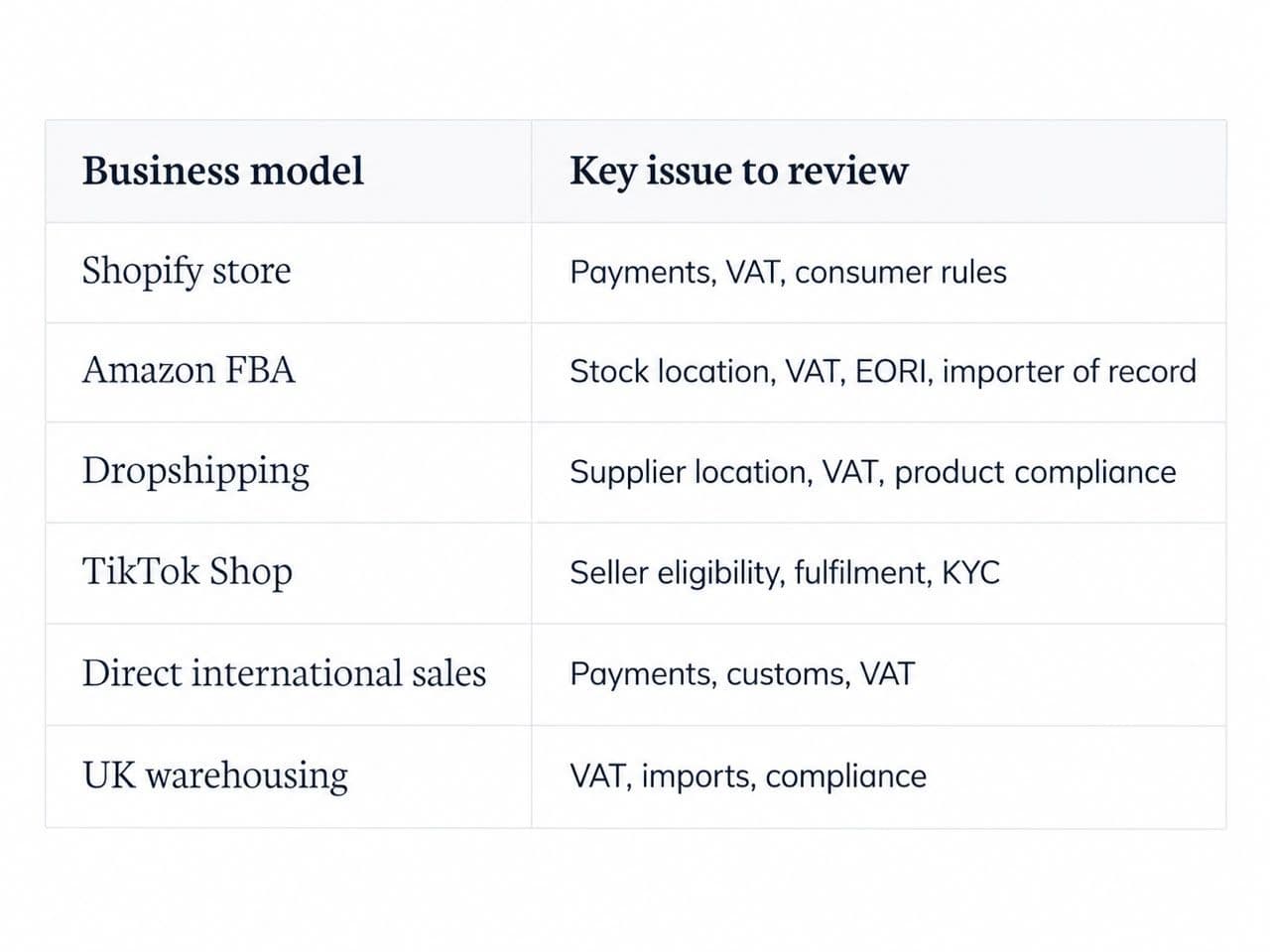
You need to answer a wider set of questions:
Can a non-resident own the UK company?
Which e-commerce business model should you use?
Where will your products come from?
Will you hold inventory or dropship?
Where will goods be stored?
Will you sell through Shopify, Amazon, TikTok Shop, eBay or your own website?
Which payment providers can support the business?
What VAT rules apply?
Do you need an EORI number?
Who is responsible for product safety?
What happens when customers ask for refunds?
How do you make the company banking-ready?
And what tax obligations can arise when the owner lives outside the UK?
Those questions are connected.
A strong UK e-commerce business is not simply:
UK company + website + payment processor.
It is an operating system made up of:
company structure
→ products
→ suppliers
→ fulfilment
→ website
→ payments
→ banking
→ VAT & customs
→ consumer compliance
→ accounting
→ tax
This guide explains that entire system.
Quick Answer: Can a Non-Resident Start a UK E-commerce Business?
Yes.
A non-resident can generally establish and own a UK private limited company without living in Britain, provided the normal Companies House requirements are satisfied.
A UK Ltd can potentially be used for:
- Shopify stores;
- Amazon and Amazon FBA;
- TikTok Shop;
- eBay;
- direct-to-consumer brands;
- B2B e-commerce;
- private label;
- wholesale;
- subscription commerce;
- print-on-demand;
- dropshipping;
- international online retail.
But incorporation does not automatically guarantee:
- Stripe;
- PayPal;
- Shopify Payments;
- Revolut;
- Wise;
- Airwallex;
- Amazon seller approval;
- TikTok Shop eligibility;
- VAT registration;
- a bank account.
Each provider and regulator applies its own rules.
If you are still at the company-formation stage, first read:
UK Company Formation for Non-Residents: Complete 2026 Guide
1. What Is an E-commerce Business?
An e-commerce business sells goods or services through digital channels.
That can include:
- physical products;
- digital products;
- subscriptions;
- software;
- online services;
- wholesale products;
- marketplace sales.
The transaction normally begins online, even if the physical fulfilment happens elsewhere.
A UK e-commerce company might sell:
from the UK to UK customers
from the UK internationally
or
from overseas suppliers directly to customers in the UK or elsewhere
Those models can have very different VAT, customs and fulfilment consequences.
2. E-commerce Is Not the Same as Dropshipping
Dropshipping is one type of e-commerce.
In dropshipping:
customer places an order
↓
your company receives the sale
↓
supplier fulfils directly to the customer
You do not normally hold the inventory yourself.
But an e-commerce company could instead use:
- own inventory;
- warehouse fulfilment;
- Amazon FBA;
- private-label manufacturing;
- print-on-demand;
- wholesale;
- subscription fulfilment.
For the dedicated dropshipping model, read:
3. Why Use a UK Limited Company for E-commerce?
A UK Ltd can provide:
- separate legal personality;
- limited liability;
- a recognised corporate structure;
- clear share ownership;
- easier separation between personal and company finances;
- an entity capable of entering commercial contracts;
- a framework for future employees, partners or investors;
- a vehicle for international expansion.
For some founders, a UK company also fits better with international clients and suppliers.
But it should have a commercial reason.
Do not establish one solely because someone on social media says:
“UK company = Stripe.”
That is not how provider approval works.
4. UK Ltd Company for E-commerce Sellers: Is It a Good Structure?
It can be.
A UK Ltd can be particularly useful where an international seller wants to:
- build a UK-facing brand;
- sell into the UK market;
- contract through a recognised international company;
- separate business risks from personal activity;
- operate multiple marketplaces;
- build a company that could later be sold or invested into.
But the company still needs to fit the actual business.
A founder with purely local operations and no meaningful UK or international requirement may find that a local company is simpler.
The correct structure depends on:
- founder residence;
- customers;
- inventory;
- suppliers;
- tax;
- banking;
- payment providers;
- fulfilment.
5. Can a Non-Resident Own 100% of the Company?
Yes, in a typical UK private limited company.
A simple structure could be:
Founder
↓
100% shareholder
↓
Director
↓
UK Ltd
More complex ownership can also be used where commercially appropriate.
For detailed guidance:
How to Structure Shares and Directors in a UK Ltd as a Non-Resident Founder
6. Companies House Identity Verification
UK company directors and Persons with Significant Control now fall within the Companies House identity-verification framework.
That process is separate from banking or payment-provider verification.
Completing Companies House verification does not mean Stripe, Revolut or Amazon have verified you.
Likewise, completing fintech KYC does not automatically satisfy Companies House.
Read:
Companies House Identity Verification for Non-Residents — Complete 2026 Guide
7. Choose the E-commerce Model Before Building the Company Around It

One of the biggest mistakes is incorporating first and figuring out the business model afterwards.
Before formation, understand how products will move.
Ask:
- What are we selling?
- Physical or digital?
- B2C or B2B?
- Where are suppliers?
- Where is inventory?
- Who fulfils orders?
- Which markets?
- Which platforms?
- Who receives payment?
- Who handles returns?
That operating model affects almost everything else.
8. Direct-to-Consumer E-commerce
DTC means selling directly to the end customer, often through:
- Shopify;
- WooCommerce;
- custom websites.
Advantages include:
- greater control over branding;
- customer data;
- pricing;
- customer experience;
- potentially stronger margins.
But you also take responsibility for:
- traffic acquisition;
- website conversion;
- payments;
- customer service;
- returns;
- compliance.
9. B2B E-commerce
Not all e-commerce is consumer retail.
A UK Ltd can also sell products online to other businesses.
Typical examples include:
- wholesale;
- specialist equipment;
- commercial supplies;
- software subscriptions;
- industry-specific goods.
B2B e-commerce often involves:
- higher order values;
- invoices;
- payment terms;
- VAT documentation;
- purchase orders;
- repeat business.
It can be commercially attractive because customer relationships may be longer-term.
10. Subscription E-commerce
Subscription commerce generates recurring revenue.
Examples include:
- monthly product boxes;
- replenishment products;
- memberships;
- recurring digital services.
The attraction is predictable revenue and potentially stronger customer lifetime value.
But subscription businesses need particular care around:
- recurring billing;
- cancellation;
- transparent renewal terms;
- failed payments;
- refunds.
Avoid hidden renewal terms or unnecessarily difficult cancellation processes.
11. Marketplace Selling
Marketplaces provide built-in audiences.
Examples include:
- Amazon;
- eBay;
- TikTok Shop;
- Etsy.
Advantages:
- existing traffic;
- consumer trust;
- platform infrastructure.
Disadvantages:
- marketplace fees;
- limited control;
- policy dependency;
- reduced direct customer ownership.
A marketplace can be useful, but relying entirely on one platform creates concentration risk.
12. Dropshipping
Dropshipping reduces the need to hold inventory.
It can lower initial capital requirements.
But control is also lower.
The seller depends heavily on:
- supplier quality;
- delivery times;
- tracking;
- product accuracy;
- stock availability.
A customer bought from your store.
They normally do not care that your supplier caused the problem.
For the detailed model:
13. Private Label and Own Brand
Private label means selling products under your own brand, even though manufacturing is outsourced.
This can create:
- differentiation;
- stronger pricing;
- repeat customers;
- brand equity.
But it also creates greater responsibility for:
- quality;
- trademarks;
- packaging;
- labelling;
- safety;
- manufacturing specifications.
For serious long-term businesses, private label can be more defensible than selling generic products available to everyone.
14. Print-on-Demand

Print-on-demand allows products to be manufactured only after a sale.
Common categories include:
- clothing;
- posters;
- mugs;
- stationery;
- custom products.
It reduces inventory risk.
However, the seller remains responsible for customer communication, refunds, product descriptions and intellectual-property issues.
15. Amazon FBA
With Fulfilment by Amazon, inventory can be stored in Amazon fulfilment centers.
Amazon may handle:
- picking;
- packing;
- shipping;
- part of the returns process.
But placing stock in the UK can materially affect the VAT analysis.
For non-established sellers, holding UK inventory is particularly important because the ordinary domestic £90,000 VAT threshold cannot simply be assumed to protect the business.
HMRC distinguishes overseas sellers from UK-established sellers for VAT purposes. (GOV.UK)
16. Shopify
Shopify provides the commerce infrastructure.
It does not replace:
- legal compliance;
- tax;
- banking;
- fulfilment;
- consumer protection;
- payment eligibility.
A Shopify business still needs a properly structured operating model.
17. TikTok Shop
TikTok Shop connects content and commerce.
It can work particularly well for:
- beauty;
- fashion;
- home products;
- accessories;
- creator-led products.
But a platform’s popularity does not remove normal business obligations.
Eligibility can also change over time.
18. eBay
eBay can be particularly relevant for:
- electronics;
- spare parts;
- collectibles;
- specialist products;
- refurbished goods.
Again, UK company incorporation and marketplace approval are separate processes.
19. Where Can You Find E-commerce Suppliers?
Finding a supplier is easy.
Finding the right supplier is harder.
Common sourcing routes include:
Alibaba
Useful for:
- manufacturers;
- private-label suppliers;
- bulk sourcing;
- custom manufacturing.
Global Sources
Often used to discover manufacturers and exporters across Asia.
Faire
More relevant for wholesale products and established brands.
European and UK wholesalers
Potential benefits include:
- shorter delivery;
- easier returns;
- reduced customs friction.
Specialist sourcing agents
Useful where the founder wants assistance with:
- factory sourcing;
- quality control;
- negotiations;
- inspections.
Trade shows
Still highly valuable for serious product businesses because founders can meet suppliers directly and physically inspect products.
The platform is only the introduction.
Do not confuse marketplace presence with supplier quality.
20. Supplier Due Diligence
Before placing significant orders, assess:
- legal identity;
- manufacturing capacity;
- minimum order quantity;
- samples;
- lead time;
- quality-control process;
- certifications;
- packaging;
- payment terms;
- return terms;
- scalability.
For private-label products, obtain clear written manufacturing specifications.
A supplier offering the lowest unit price is not always the cheapest supplier.
The better measure is:
reliable delivered cost
after:
- defects;
- shipping;
- delays;
- returns;
- customs;
- complaints.
21. China vs UK vs European Suppliers
There is no universally correct choice.
China / Asia
Can provide:
- deep manufacturing capability;
- competitive pricing;
- product customisation.
Potential disadvantages:
- longer shipping;
- customs;
- quality-control complexity;
- larger MOQs.
UK / Europe
Can provide:
- faster delivery;
- easier communication;
- local returns;
- reduced customs complexity.
But unit cost can be higher.
Compare total economics, not supplier invoice price.
22. Unit Economics: Know the Real Profit Before Selling
A common beginner calculation is:
Selling price – supplier price = profit.
That is incomplete.
A proper calculation could be:
selling price
minus product cost
minus freight
minus import duty
minus import VAT where applicable
minus payment fee
minus marketplace fee
minus fulfilment
minus advertising
minus refunds
minus chargebacks
minus packaging
= contribution margin
Then subtract overheads.
Only then do you know whether the business is economically viable.
23. Building a Credible E-commerce Brand
Compliance alone does not create demand.
Customers still need a reason to buy from you.
A strong e-commerce brand usually has:
- clear positioning;
- consistent visual identity;
- professional domain;
- professional email;
- high-quality product photography;
- clear product descriptions;
- transparent policies;
- genuine reviews;
- reliable customer service.
As the company grows, trademark protection may also become relevant.
A store that looks temporary can create hesitation for:
- customers;
- payment providers;
- banking institutions.
24. Website Requirements for a UK E-commerce Business
A customer should be able to understand:
- who the seller is;
- what is being sold;
- total price;
- delivery cost;
- delivery terms;
- returns;
- cancellation;
- contact information.
UK distance-selling rules require businesses to provide important pre-contract information before customers buy online. (Stripe)
Your website is therefore both:
a marketing asset
and
part of your compliance profile.
25. Secure Checkout: Where Trust Becomes Revenue

A strong checkout should feel simple.
Customers typically expect:
- cards;
- familiar digital wallets;
- clear pricing;
- clear delivery costs;
- secure payment;
- mobile compatibility.
Where applicable, payment infrastructure must also deal with requirements such as Strong Customer Authentication.
The checkout should clearly show the final commercial commitment before payment.
Hidden charges increase:
- abandonment;
- complaints;
- disputes;
- chargebacks.
26. Payment Methods
Depending on market and provider, businesses may consider:
- Visa;
- Mastercard;
- American Express;
- Apple Pay;
- Google Pay;
- PayPal;
- local payment methods.
Do not add 25 payment methods simply because they exist.
Choose what customers in your target markets actually use.
27. Stripe
Stripe is relevant to many online businesses because it provides payment-processing infrastructure.
But Stripe approval is not a consequence of Companies House incorporation.
It can independently consider:
- company;
- founder;
- residence;
- website;
- products;
- business activity.
A UK Ltd therefore does not equal automatic Stripe access.
Your business should remain commercially viable even if one particular payment provider is unavailable.
28. PayPal
PayPal can offer additional customer familiarity.
But merchants still need to manage:
- disputes;
- proof of delivery;
- refunds;
- chargebacks;
- business verification.
Poor fulfilment can eventually become a payments problem.
29. Shopify Payments
Shopify Payments can simplify checkout for eligible stores.
Again:
UK Ltd ≠ automatic eligibility.
Platform and processor rules are separate from UK corporate law.
30. Banking for E-commerce Companies
Banks and financial institutions may want to understand:
- products;
- founder residence;
- supplier countries;
- customer countries;
- expected revenue;
- inventory;
- fulfilment;
- website;
- transaction profile.
E-commerce can involve many small consumer transactions, international suppliers and chargebacks.
That can make the business profile different from a simple consulting company.
Read:
UK Business Banking Readiness Assessment
31. What a Banking-Ready E-commerce Company Looks Like
A strong application can usually explain:
We operate a UK Ltd selling branded home accessories through Shopify to UK customers. Products are manufactured in China, imported in bulk, stored with a UK third-party fulfilment partner and dispatched domestically.
That is understandable.
Compare:
We do e-commerce globally.
The second description raises more questions than it answers.
Prepare:
- website;
- supplier contracts;
- fulfilment explanation;
- ownership structure;
- transaction forecasts;
- customer markets;
- source of funds.
32. Revolut, Wise, Airwallex and Other Providers
Different providers can be useful for different purposes.
Potential needs include:
- GBP account;
- EUR/USD receiving;
- FX;
- supplier payments;
- corporate cards;
- merchant processing.
Do not build the entire business around one provider.
Policies change.
The business should remain operationally understandable regardless of which provider serves it.
33. Why E-commerce Applications Get Rejected
Common risk areas can include:
- unclear products;
- unsupported products;
- very long delivery times;
- mismatched website and application;
- excessive chargebacks;
- founder-residence restrictions;
- fake UK operating presence;
- weak supplier evidence;
- unclear transaction flows.
If one provider rejects the business, do not invent a new business description.
Understand the underlying issue.
34. Chargebacks
Chargebacks should be treated as a KPI.
Drivers include:
- fraud;
- late delivery;
- poor product quality;
- misleading descriptions;
- weak customer service;
- subscription confusion.
Keep:
- tracking;
- customer communication;
- proof of fulfilment;
- refund evidence.
Good customer service is also a payments-risk control.
35. Consumer Protection
UK e-commerce businesses serving consumers must consider distance-selling and consumer-protection rules.
Consumers buying remotely generally have statutory cancellation rights for many types of purchases, including a 14-day cancellation period after delivery in many situations. (Stripe)
Your store should clearly communicate:
- delivery;
- returns;
- cancellation;
- pricing;
- contact information.
36. Returns and Refunds
Returns are not merely customer service.
They affect margins.
Before launching, decide:
- return destination;
- process;
- shipping responsibility;
- defective-product procedure;
- refund timing;
- supplier reimbursement.
International returns can be expensive enough to destroy the economics of low-margin products.
37. Product Safety
If you sell physical goods, determine which product-safety rules apply.
Higher-sensitivity categories may include:
- toys;
- children’s products;
- electronics;
- cosmetics;
- batteries;
- food;
- supplements;
- health-related products.
The phrase:
“My supplier said it is compliant”
is not sufficient due diligence.
38. UK VAT: The Most Important Tax Issue for Many E-commerce Sellers
The familiar UK domestic VAT threshold does not tell the whole story for international e-commerce.
HMRC’s treatment depends on:
- whether the seller is established in the UK;
- where goods are located;
- customer location;
- direct sale or marketplace;
- consignment value.
For a non-established taxable person making taxable UK supplies, VAT registration can arise without the standard domestic turnover threshold. (GOV.UK)
This is one area where international founders should be particularly careful.
39. The £135 Rule
For certain goods located outside the UK and sold directly to customers in Great Britain, consignments up to £135 are treated under special VAT rules.
HMRC states that qualifying low-value goods can be subject to UK VAT at the point of sale, while consignments over £135 generally return to normal import VAT/customs treatment. (GOV.UK)
The analysis is based on the consignment, not simply one individual product.
This matters greatly for:
- dropshipping;
- direct international fulfilment;
- overseas warehouses.
40. Marketplace VAT
Selling through Amazon, eBay or another online marketplace can change who accounts for VAT.
HMRC applies deemed-supplier rules in certain circumstances involving overseas sellers and online marketplaces. (GOV.UK)
Do not assume:
Amazon collects VAT, therefore I have no VAT responsibilities.
That conclusion can be wrong.
41. UK Stock and Overseas Sellers

Inventory location is extremely important.
An overseas business selling UK-located inventory can fall into UK VAT obligations that differ from those of a genuinely UK-established seller.
This is particularly important for:
- Amazon FBA;
- UK warehouses;
- third-party fulfilment centers.
HMRC also expects online marketplaces to assess whether sellers are genuinely UK-established rather than relying solely on a Companies House address. (GOV.UK)
So:
UK company registration ≠ automatic UK establishment for VAT purposes.
42. EORI
Businesses importing or exporting physical goods may require an EORI number.
This is particularly relevant when the company becomes involved in customs declarations.
43. Customs and Import Duty
Import duty depends on issues including:
- product classification;
- customs value;
- origin;
- applicable tariff.
Decide who is the importer of record.
Also decide whether the customer receives:
landed pricing
or
unexpected import charges.
Surprise customs bills are bad for customer experience.
44. Digital Products
E-commerce is not limited to physical goods.
You can also sell:
- courses;
- downloads;
- templates;
- software;
- digital memberships.
Digital products can eliminate shipping and inventory.
But they introduce different:
- VAT;
- licensing;
- intellectual-property;
- subscription issues.
Do not automatically apply physical-goods rules to digital commerce.
45. International Sales Beyond the UK
If the business sells into:
- EU;
- USA;
- Canada;
- Australia;
- Middle East;
- Asia,
additional local requirements can arise.
A UK company does not make UK tax rules the only relevant rules worldwide.
International growth should therefore be intentional.
46. Corporation Tax
A UK Ltd can have UK Corporation Tax obligations.
For a founder living abroad, there may also be separate personal or corporate tax issues in their country of residence.
Read:
How UK Company Tax Works for Non-Residents — 2026 Guide
47. Permanent Establishment and Management
A UK Ltd can be operated by an overseas founder.
But international tax can consider where:
- management occurs;
- employees operate;
- contracts are negotiated;
- real economic activity happens.
For e-commerce, HMRC also has specific international guidance dealing with internet trading and permanent establishment concepts. (GOV.UK)
This is another reason not to pretend the company is physically UK-operated when it is not.
48. Paying Yourself
Founders can potentially extract money through legitimate routes such as:
- salary;
- dividends;
- expense reimbursement.
But the correct approach depends on:
- company finances;
- tax residence;
- local rules;
- payroll circumstances.
Never treat the business account as a personal wallet.
49. Bookkeeping
E-commerce bookkeeping can become complicated quickly.
One month might contain:
- thousands of orders;
- refunds;
- marketplace fees;
- Stripe fees;
- PayPal settlements;
- advertising;
- shipping;
- FX;
- VAT;
- stock purchases.
Set up systems from the beginning.
Do not reconstruct the year from screenshots at filing time.
50. Accounting Records
Businesses should maintain sufficient supporting records for the applicable statutory period.
Relevant e-commerce records can include:
- sales;
- refunds;
- supplier invoices;
- payment fees;
- stock;
- VAT;
- import documentation;
- marketplace reports.
A payment dashboard is not the same as proper accounting records.
51. Marketplace Reports vs Revenue
If Shopify shows £50,000 in sales, your bank may not receive £50,000.
Money can be deducted for:
- refunds;
- fees;
- disputes;
- reserves;
- FX.
Accounting should reconcile:
gross sales
↓
refunds
↓
fees
↓
settlements.
52. Customer Service
Before your first sale, establish:
- support email;
- response standards;
- returns procedure;
- refund procedure;
- tracking communication;
- complaint escalation.
Poor communication converts small issues into chargebacks.
53. Reviews and Social Proof
Customers compare stores.
Genuine reviews help build trust.
But do not:
- buy fake reviews;
- manufacture testimonials;
- suppress legitimate negative feedback dishonestly.
Long-term brands benefit from authentic proof.
54. Intellectual Property and Trademarks
As the brand grows, consider protecting:
- brand name;
- logo;
- packaging;
- designs.
Also avoid infringing:
- trademarks;
- copyrights;
- design rights.
A profitable product copied from another brand can become a legal liability.
55. Data Protection and Privacy
Online stores collect:
- names;
- addresses;
- email;
- payment-related information;
- browsing data.
Your privacy practices need to reflect applicable UK data-protection requirements.
Depending on the business, ICO registration/data protection fee requirements may also need consideration.
56. Security
A credible store should use:
- HTTPS;
- secure payment infrastructure;
- strong account controls;
- controlled staff access;
- fraud prevention.
Never store unnecessary sensitive payment data yourself when reputable payment infrastructure can handle it.
57. E-commerce Insurance
Depending on risk, consider:
- product liability;
- cyber insurance;
- stock cover;
- public liability.
Not every business needs every policy.
But physical product businesses should understand their exposure.
58. Do Not Fake UK Substance
Do not create artificial evidence merely to improve banking or marketplace eligibility.
Avoid falsely claiming:
- UK employees;
- UK warehouse;
- UK residence;
- UK physical headquarters.
A professional registered office or business address can be legitimate.
Misrepresenting its purpose is not.
59. Own Your Customer Relationship
Marketplace-only businesses are vulnerable.
A stronger long-term strategy can include:
Amazon/TikTok/eBay
- ●
own website
- ●
email list
- ●
brand
- ●
repeat customers.
The objective is to reduce dependence on a single platform.
60. The Stronger 2026 E-commerce Model
Weak model:
trend product
↓
random supplier
↓
copied website
↓
paid ads
↓
long shipping
↓
refunds
↓
chargebacks.
Stronger model:
validated market
↓
clear positioning
↓
reliable supplier
↓
credible company
↓
strong website
↓
appropriate payment infrastructure
↓
compliant fulfilment
↓
good customer service
↓
repeat purchases
↓
brand equity.
That is how a store becomes a business.
61. How Much Does It Cost?
Costs can include:
- company incorporation;
- registered office;
- service address;
- Companies House identity verification;
- website;
- domain;
- e-commerce platform;
- supplier samples;
- inventory;
- marketing;
- banking;
- payment fees;
- VAT;
- EORI;
- accounting;
- fulfilment;
- insurance.
For the wider company cost:
How Much Does It Cost to Register a UK Company as a Non-Resident in 2026?
62. Pre-Incorporation Checklist
Before establishing the company, confirm:
Business model
- DTC?
- B2B?
- Marketplace?
- Subscription?
- Dropshipping?
- Private label?
Product
- Physical?
- Digital?
- Regulated?
- Branded?
Supplier
- Country?
- MOQ?
- Samples?
- Compliance?
Fulfilment
- Supplier-direct?
- UK warehouse?
- FBA?
- Overseas warehouse?
Markets
- UK?
- EU?
- USA?
- Worldwide?
Payments
- Stripe?
- PayPal?
- Shopify Payments?
Tax
- VAT?
- import VAT?
- founder-country tax?
63. E-commerce Readiness Checklist
Before launch:
- company structure confirmed
- directors/shareholders correct
- Companies House verification complete
- UK registered office arranged
- SIC/business activity accurate
- supplier checked
- product samples reviewed
- product safety assessed
- margins calculated
- fulfilment confirmed
- return process documented
- customer support established
- website complete
- delivery terms clear
- privacy/terms reviewed
- banking strategy prepared
- payment providers identified
- VAT position reviewed
- EORI requirement reviewed
- customs route understood
- bookkeeping system ready
Frequently Asked Questions
Can a non-resident start a UK e-commerce company?
Yes, generally.
Can a foreigner own 100%?
Yes, in a typical UK private limited company.
Is UK Ltd good for e-commerce sellers?
It can be where there is a genuine commercial reason for using a UK company.
Do I need to live in the UK?
Not simply to own the company.
Can I use Shopify?
Potentially, yes.
Can I use Amazon?
Potentially, subject to seller eligibility.
Can I use Amazon FBA?
Yes where eligible, but storing stock in the UK can create important VAT consequences.
Can I use TikTok Shop?
Potentially, subject to its current rules.
Can I use eBay?
Potentially, subject to its current rules.
Is dropshipping e-commerce?
Yes. It is one e-commerce fulfilment model.
Can I run B2B e-commerce through a UK Ltd?
Yes.
Can I run subscriptions?
Potentially, subject to payment and consumer-law requirements.
Can I source from Alibaba?
Yes, but supplier due diligence remains essential.
Is a supplier on Alibaba automatically reliable?
No.
Should I use a UK supplier or Chinese supplier?
It depends on product, margin, delivery, customs and customer experience.
Do I need Stripe?
No. Stripe is one payment-provider option, not the business itself.
Does a UK company guarantee Stripe?
No.
Does a UK company guarantee Revolut or Wise?
No.
What is the UK VAT threshold?
For ordinary UK-established businesses, the domestic threshold is relevant, but international/non-established sellers can face different rules and should not assume the standard threshold applies to them.
Does a non-resident seller have a VAT threshold?
Not necessarily. A non-established taxable person making taxable UK supplies can be required to register without the normal domestic turnover threshold. (GOV.UK)
What is the £135 rule?
Special VAT rules apply to certain consignments not exceeding £135 sold to UK consumers from outside the UK. (GOV.UK)
Does Amazon collect VAT?
In some circumstances online marketplaces are treated as the deemed supplier and account for VAT, but this does not eliminate every seller obligation. (GOV.UK)
Do I need EORI?
Potentially, if the business imports or exports goods.
Can I store stock in the UK?
Yes, but VAT and customs consequences need review.
Does a registered office make me UK-established for VAT?
Not automatically. HMRC considers wider evidence of where the business is genuinely established. (GOV.UK)
Do I need a warehouse?
No. It depends on fulfilment.
Can I sell digital products?
Yes. Their tax and compliance rules differ from physical goods.
Can I operate the company remotely?
Often yes, but tax and operational consequences can arise in the founder’s country.
Do I need an accountant?
The complexity of e-commerce generally makes proper bookkeeping and tax management important.
Can Seven Oak Prestige guarantee my bank or payment account?
No. All providers make independent decisions.
Continue the UK E-commerce Knowledge Hub
This article is the central pillar.
UK Dropshipping for Non-Resident Founders
UK Company Formation for Non-Residents
Shares and Directors for Non-Resident Founders
Companies House Identity Verification
UK Company Formation Cost
UK Company Tax for Non-Residents
Business Banking Readiness
VAT Registration
EORI Registration
Ready to Build Your UK E-commerce Company?
A successful international e-commerce business needs more than incorporation.
The strongest structure combines:
company
- ●
business model
- ●
supplier
- ●
fulfilment
- ●
banking
- ●
payments
- ●
VAT/customs
- ●
consumer compliance
- ●
financial control.
Seven Oak Prestige supports international entrepreneurs with the UK establishment side of that process, including:
- UK company formation;
- Companies House compliance;
- address services;
- VAT registration support;
- EORI registration;
- banking readiness;
- broader UK business establishment guidance.
Discuss My UK E-commerce Setup
Important Notice
This article provides general business information and is not legal, tax, customs or financial advice.
VAT, customs, product-safety, consumer-law and international tax obligations depend on the precise products, markets, inventory location, fulfilment structure and circumstances of the business.
Banking institutions, marketplaces and payment providers make independent eligibility and risk decisions.
Requirements can change. Current official guidance should always be checked before acting.
About the Author
Isaac Jackson is Founder & Managing Director of Seven Oak Prestige Ltd, supporting international entrepreneurs with UK company formation, Companies House compliance and business banking readiness.
Email: contact@sevenoakprestige.com
UK Office: +44 20 4578 0726
WhatsApp: +44 7447 488755