
Amazon FBA UK for Non-Residents: Do You Need a UK Company? (2026)

UK Limited Company, Amazon seller verification, inventory, VAT, EORI, customs, banking and accounting for international Amazon sellers
A non-UK resident can sell through Amazon UK without living in Britain, and a UK Limited Company can be used as the legal entity behind an Amazon FBA business where that structure genuinely fits the operation.
But you do not automatically need a UK company simply because you want to use Amazon FBA.
The more important questions come first:
Who will be the legal seller?
Which entity will own the inventory?
Where will that inventory be stored?
Who will import the goods?
Those decisions can affect Amazon verification, VAT, EORI, customs, banking, accounting and tax.
A founder who incorporates before answering them can end up with a company that does not match the way the Amazon business actually operates.
Company formation should follow the Amazon operating model. It should not be used to invent one.
For the wider company, payment and e-commerce structure beyond Amazon, read our UK E-Commerce Company for Non-Residents guide .
Quick Answer: Does a Non-Resident Need a UK Company for Amazon FBA?
No. A non-UK resident does not automatically need to form a UK Limited Company simply to sell through Amazon UK.
Amazon accepts different seller and business structures, subject to its current eligibility and verification requirements. A UK Ltd becomes relevant when it has a genuine role in the business, such as operating the seller account, owning inventory, contracting with suppliers or carrying out the UK-facing e-commerce operation.
Before incorporating, establish:
- who the legal seller will be;
- who will own the inventory;
- where the inventory will be stored;
- who will import the goods;
- what VAT and customs obligations follow;
- which entity will receive Amazon settlements;
- which entity will account for the sales, inventory, costs and taxes.
An existing overseas company may be more appropriate where it already performs those functions.
The correct question is therefore not simply:
“Can I form a UK company for Amazon FBA?”
It is:
“What genuine role would the UK company perform in my Amazon business?”
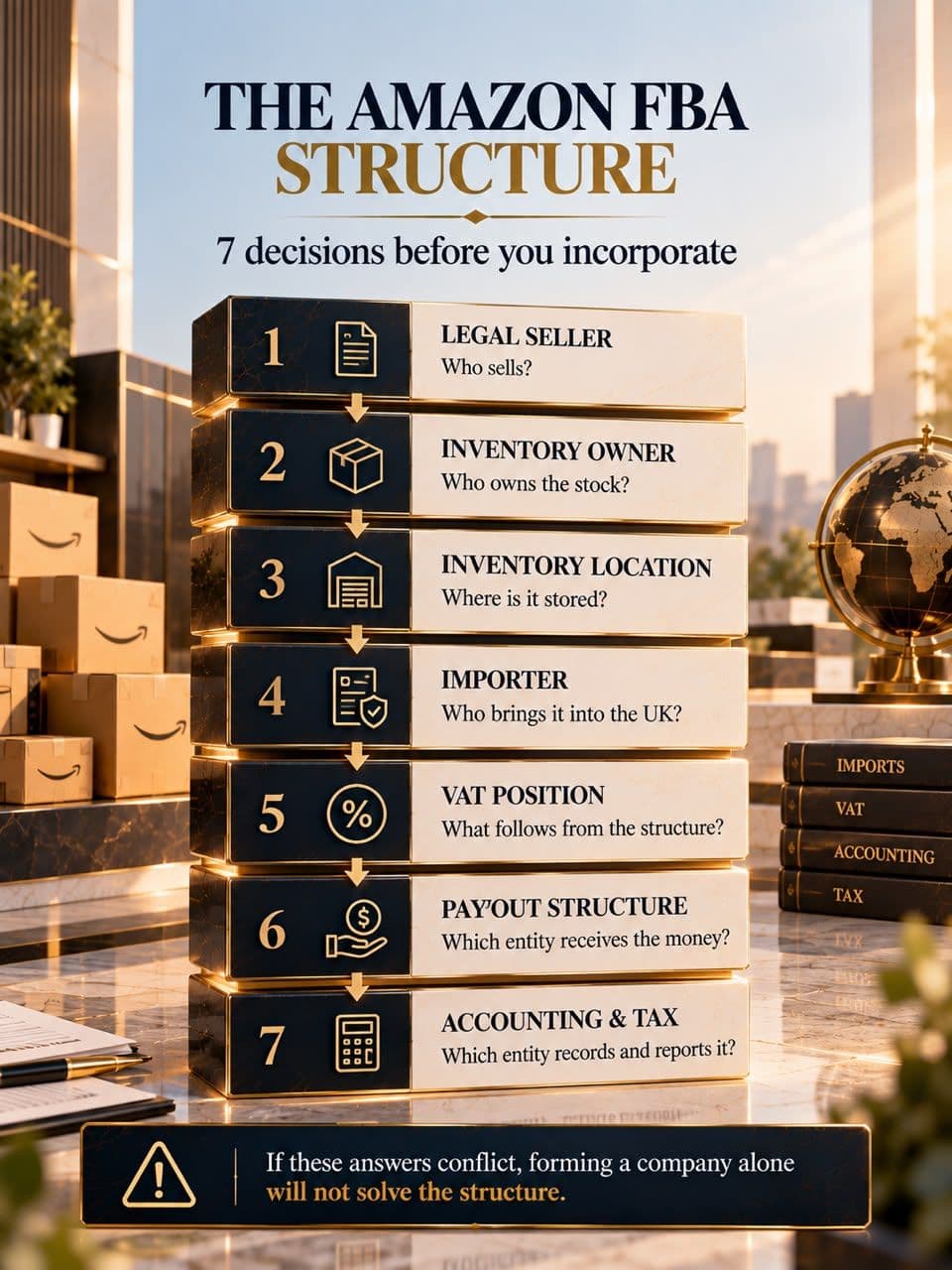
1. The Seven Decisions to Make Before Structuring an Amazon FBA Business
Before incorporating a company or sending inventory to an Amazon fulfilment centre, map these seven points.
1 — Legal Seller
Which individual or company will operate the Amazon seller account and sell the goods?
2 — Inventory Owner
Which entity will purchase and legally own the stock?
3 — Inventory Location
Where will the products physically be stored before they are sold?
Great Britain?
Northern Ireland?
An EU country?
Several countries?
Outside the UK until each order is placed?
4 — Importer
Who will be responsible for importing the inventory into Great Britain where an import takes place?
5 — VAT Position
What VAT obligations follow from the seller’s establishment, inventory location, imports and marketplace transactions?
6 — Payout and Account Structure
Which entity receives the Amazon proceeds, and does the payout arrangement fit the business operating the seller account?
7 — Accounting and Tax
Which entity records:
- Amazon sales;
- marketplace and FBA fees;
- supplier purchases;
- inventory;
- advertising;
- refunds;
- freight;
- import costs;
- VAT;
- foreign-currency transactions;
- taxable profits?
If those seven answers contradict one another, forming a company alone will not solve the structure.
That is why the entity decision should come before the incorporation application.
2. What Does Amazon FBA Actually Change?
FBA means Fulfilment by Amazon.
Under an FBA model, sellers can send inventory into Amazon’s fulfilment network. Amazon then performs specified fulfilment functions such as storage, picking, packing and delivery under the applicable service arrangements.
That can simplify logistics.
It does not mean Amazon automatically becomes responsible for every legal, tax or commercial obligation connected with the business.
The operating chain can look broadly like this:
Seller
↓
Supplier
↓
Importer
↓
Inventory
↓
Amazon fulfilment
↓
Customer
The same company may perform several of those roles, but that should be established deliberately.
FBA can solve an important fulfilment problem.
It does not, by itself, decide:
- which company you should use;
- who owns the stock;
- who imports the products;
- your VAT position;
- your EORI requirements;
- your Corporation Tax position;
- your banking eligibility;
- your product-compliance obligations.
3. When Can a UK Limited Company Make Sense for Amazon FBA?
A UK Ltd can be commercially useful where the company has a genuine role in the Amazon operation.
For example, it may be appropriate where:
- the UK is a principal target market;
- the founder wants a separate legal entity for the Amazon venture;
- the UK company will genuinely operate the seller account;
- the company will purchase or own the inventory;
- the UK entity will contract with suppliers or other commercial partners;
- imports into Britain are being structured around the company;
- the business may later expand beyond Amazon into Shopify, wholesale or other channels;
- there is another genuine commercial reason for establishing a UK entity.
A UK company provides a defined legal entity with its own company number, ownership structure and corporate records.
But it should not be formed because someone claims that a UK Ltd automatically guarantees:
- Amazon seller approval;
- VAT registration;
- a bank account;
- payment-provider acceptance;
- access to a particular Amazon marketplace;
- a particular tax outcome.
Those are separate matters.
If you conclude that a UK entity has a genuine role in the business, our UK Company Formation Services for Non-Residents guide explains the different formation routes and what to compare before choosing one.
4. When Might Your Existing Overseas Company Be Better?
A UK company is not automatically the best choice merely because the target marketplace is Amazon UK.
Suppose you already operate a company outside Britain.
That company may already have:
- business banking;
- accounting records;
- supplier contracts;
- commercial history;
- employees or management;
- tax registrations;
- working capital;
- established ownership;
- other e-commerce operations.
Creating another company can introduce additional accounting, tax, banking and administrative obligations.
The commercial question becomes:
What problem does the additional UK company solve?
If the answer is unclear, the existing business may deserve consideration before another entity is created.
Conversely, if Britain is becoming a genuine operating market and a UK company will perform a defined commercial function, establishing one may be justified.
The objective is not to maximise the number of companies.
It is to use a structure that fits the actual business.
5. Where Will Your Amazon FBA Inventory Be Stored?
This is one of the most important questions in the structure.
A seller should distinguish between at least three scenarios.
Stock Stored in Great Britain
Inventory may be imported in bulk and stored in an Amazon fulfilment centre before individual customer orders are placed.
This can create customs, import VAT, VAT-registration and accounting considerations depending on the seller’s circumstances.
Stock Outside the UK When the Customer Buys It
This is a different transaction.
Specific VAT rules can apply to certain goods sold to UK customers through online marketplaces where the goods are outside the UK at the point of sale.
Stock Stored in Other Countries
If the business holds inventory in EU countries or other jurisdictions, additional local VAT, customs and reporting questions can arise.
This is why:
“I sell on Amazon UK.”
is not enough information to determine the tax structure.
A better question is:
“Where is my stock physically located when the relevant transaction takes place?”
Inventory location is an operational fact with potential tax consequences.
Do not assume that selling through one Amazon account means inventory will remain in one tax jurisdiction. Before enabling an Amazon programme that may place or move stock into additional countries, establish where the inventory may be stored and review the VAT and compliance consequences of those locations.
Detailed European FBA expansion is a separate issue and should not be treated as an automatic extension of a UK-only setup.
6. Who Should Import the Amazon FBA Inventory?
If products are manufactured abroad and sent in bulk to Britain, somebody needs to take responsibility for the import process.
A simplified chain might look like:
Overseas supplier
↓
International freight
↓
UK customs
↓
Amazon fulfilment centre
But using a freight forwarder does not remove the need to establish the importer and customs arrangements.
Relevant matters can include:
- the importer of record;
- customs declarations;
- EORI;
- import VAT;
- Customs Duty where applicable;
- commodity classification;
- customs valuation;
- commercial invoices;
- freight documentation.
Amazon’s current cross-border shipping guidance states that Amazon, including its fulfilment centres, will not act as importer of record for FBA inventory shipments. The importer and customs arrangements therefore need to be established before inventory is shipped.
For a non-resident founder, the legal seller, inventory owner and importer should make commercial sense together.
They do not necessarily have to be the same party in every possible structure, but differences should be deliberate, documented and appropriate to the actual supply chain.
7. Does an Amazon FBA Seller Need a GB EORI Number?
An EORI number is commonly relevant when goods are moved into or out of Great Britain, but the correct arrangement depends on who is carrying out the customs activities and whether that business is established in the UK for customs purposes.
A business established in the UK that imports goods into England, Scotland or Wales will generally need a GB EORI for the relevant customs activities.
The position can be different for a business that is not established in the UK.
A non-established economic operator can obtain an EORI for certain customs activities under HMRC’s rules. In other circumstances, the business may need to appoint an appropriate customs representative.
This means a non-resident Amazon seller should not treat a GB EORI as simply another registration to obtain after forming a UK company.
The better questions are:
- Who will be the importer?
- Who will make the customs declaration?
- Is that business established in the UK for customs purposes?
- Will a customs agent or representative be used?
- Which EORI is required for the actual movement?
Northern Ireland has separate considerations, and an XI EORI may be required for relevant movements.
The customs model should therefore be established before inventory is shipped to an Amazon fulfilment centre.
8. UK VAT for Amazon FBA: Avoid the Wrong Shortcut
VAT is one of the areas where non-resident Amazon sellers most need to avoid simple rules.
Four concepts should be kept separate:
UK incorporation
UK VAT establishment
inventory location
marketplace VAT treatment
They are related, but they are not interchangeable.
A UK Company Does Not Automatically Settle the VAT-Establishment Question
Registering a UK Ltd at Companies House does not, by itself, answer every question about where the business is established for VAT purposes.
Likewise, having a UK Registered Office, serviced office or virtual business address does not by itself prove substantive UK VAT establishment.
The actual circumstances matter.
This distinction is particularly important for overseas-managed businesses.
A company can therefore be legally incorporated in Britain while its VAT establishment still requires a separate factual analysis.
For the corporate-address distinction itself, read Registered Office vs Director Service Address.
Do Not Apply the £90,000 VAT Threshold Automatically
The ordinary UK VAT-registration threshold does not answer every non-resident e-commerce case.
Where a business is a non-established taxable person — NETP — the ordinary UK VAT-registration threshold does not generally apply in the same way.
An NETP making taxable supplies in the UK can be required to register regardless of turnover. However, marketplace rules, place-of-supply rules and the nature of the transaction can affect whether the seller itself is making the relevant taxable supply.
That means neither of these statements is safe as a universal rule:
“I am below £90,000, so I do not need VAT registration.”
or:
“Amazon accounts for VAT, so I do not need VAT registration.”
The seller’s establishment, inventory location, imports and transactions need to be considered together.
9. If Amazon Accounts for VAT, Does the Seller Have Nothing Else to Do?
No.
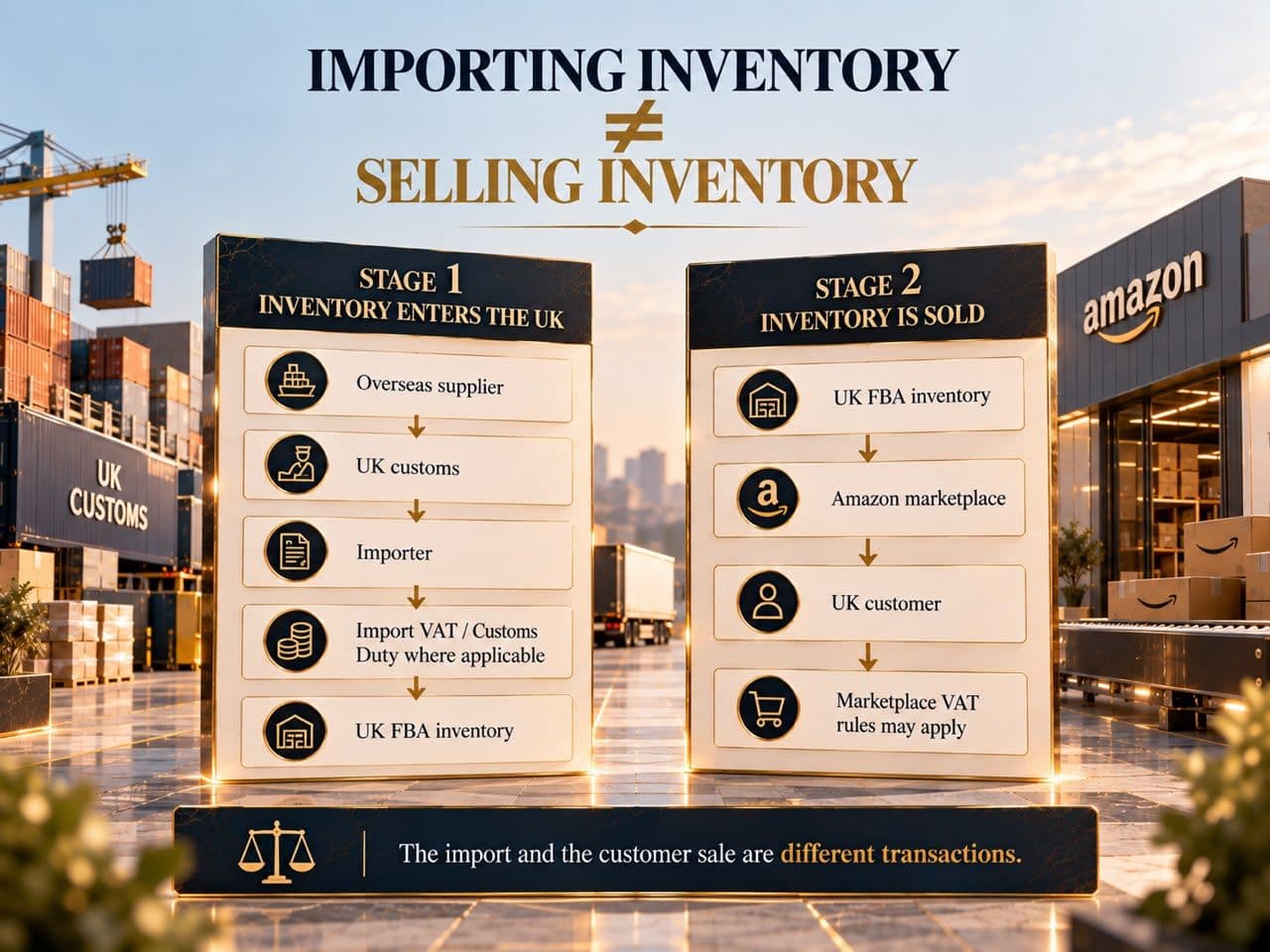
This is where two different stages of an Amazon FBA model must be separated.
Stage 1 — Bringing Inventory into the UK
Where an overseas seller imports goods into the UK for later sale, the seller can remain responsible for relevant import VAT and Customs Duty when the goods first enter the UK.
Stage 2 — Selling the Goods Through the Marketplace
For qualifying transactions where goods are already located in the UK and are sold through an online marketplace by an overseas seller, UK marketplace deemed-supplier rules can make the marketplace responsible for accounting for VAT on the customer sale.
Those are not the same transaction.
Importing the inventory
is different from:
selling the inventory to the final customer.
Marketplace deemed-supplier treatment should therefore not be interpreted as meaning that every overseas Amazon seller has no UK VAT-registration, import or reporting obligations.
The complete position depends on the facts.
Where the VAT treatment is material or unclear, the individual structure should be reviewed by an appropriately qualified VAT adviser.
10. How Does the £135 VAT Rule Apply to Amazon Sellers?
The £135 rules are frequently oversimplified.
They do not mean:
“Every Amazon order below £135 follows one VAT rule and everything above £135 follows another.”
The relevant framework concerns qualifying consignments of goods that are outside the UK at the point of sale and supplied to UK customers under the applicable rules.
The £135 test applies to the value of the total consignment, not separately to every individual product inside it.
Where the relevant consignment exceeds £135, the normal import VAT and customs framework generally becomes relevant.
This is different from inventory that has already been imported into Great Britain and is sitting in a UK fulfilment centre when the customer places the order.
So before applying the £135 rule, ask:
Where are the goods at the point of sale?
That question comes before the number.
11. Amazon Seller Verification: Keep the Structure Consistent
Company incorporation and Amazon seller verification are separate processes.
A Companies House Certificate of Incorporation does not guarantee Amazon approval.
Amazon applies its own seller onboarding and verification requirements. Its current registration process includes checks relating to the seller’s identity, business information, address, relationship to the business, payment card and bank-account information.
For a company seller, information should therefore be prepared consistently across areas such as:
- legal company name;
- company registration details;
- directors and beneficial owners;
- identity documentation;
- registered business address;
- seller-account information;
- payout-account information;
- VAT details where applicable.
Consider this structure:
Company A owns the stock
but:
Company B appears on supplier documentation
while:
the Amazon account is operated by Company C.
That does not automatically mean the arrangement is prohibited. Legitimate multi-entity structures can exist.
But there should be a commercial rationale, appropriate documentation and a clear explanation of the role each entity performs.
A collection of disconnected registrations is not a structure.
12. Do You Need Your Own UK Address?
A UK private limited company must have an appropriate Registered Office in the part of the UK in which it is registered.
That does not mean the overseas founder personally needs to own or rent a physical UK office.
A third-party address service can be used, provided the address satisfies the Companies House requirements for an appropriate registered office address.
The Registered Office belongs to the company.
A director’s service address belongs to the individual director.
These can sometimes use the same physical address while performing different legal functions.
If the absence of your own UK premises is part of the decision, read How to Form a UK Company Without Your Own UK Address.
A UK statutory address should be represented according to what it actually is.
It should not be used to create a false impression that the company has substantive operating premises, staff or management in Britain where it does not.
13. Amazon Banking and Payouts for a Non-Resident-Owned UK Ltd
An Amazon business needs workable financial infrastructure.
Depending on the structure, this can involve:
- receiving Amazon settlements;
- paying suppliers;
- paying freight and customs costs;
- paying Amazon fees;
- funding advertising;
- handling refunds;
- paying VAT or other liabilities;
- managing several currencies.
But a UK company does not automatically guarantee acceptance by a UK bank, EMI, payment provider or other financial institution.
Providers conduct their own onboarding and risk assessments.
Factors can include:
- director and shareholder residence;
- business activity;
- expected turnover;
- countries involved;
- suppliers;
- customers;
- transaction flows;
- supporting documentation.
The appropriate sequence is:
Business model
↓
Company structure
↓
Financial requirements
↓
Provider fit
↓
Application
rather than forming a company and assuming every provider will accept it.
For the wider framework, read our UK Business Banking Guide for Non-Resident Founders.
14. Amazon FBA Does Not Remove Product-Compliance Responsibilities
Fulfilment by Amazon should not be confused with transferring every legal responsibility for the product to Amazon.
Businesses that manufacture, import, distribute or sell consumer products in the UK can have responsibilities under applicable product-safety and labelling rules, with additional requirements applying to particular product categories.
Depending on what is being sold, matters can include:
- product safety;
- labelling;
- intellectual-property rights;
- consumer requirements;
- product-specific regulation;
- recalls;
- responsible-person requirements where applicable;
- restrictions applying to particular categories.
The supplier saying:
“We already sell this product in Europe.”
does not by itself establish that every requirement relevant to the UK market has been satisfied.
The compliance position should be assessed for the actual product and supply chain.
This is particularly important before committing substantial capital to inventory.
15. Accounting for a UK Amazon FBA Company
If a UK Ltd becomes the Amazon seller, accounting should not be treated as an annual afterthought.
An Amazon business can generate accounting activity across several sources.
Typical records can include:
- gross sales;
- Amazon settlements;
- marketplace fees;
- FBA fees;
- advertising costs;
- refunds;
- reimbursements;
- supplier invoices;
- inventory purchases;
- freight;
- Customs Duty;
- import VAT;
- VAT on sales where applicable;
- foreign-currency transactions;
- other operating expenses.
An Amazon bank deposit is therefore not necessarily the same as the company’s sales revenue for accounting purposes.
Amazon may deduct fees, refunds or other amounts before sending a net settlement. The underlying transactions still need to be accounted for correctly.
Inventory also matters.
Purchasing inventory is not necessarily equivalent to treating the entire purchase as an ordinary expense without considering the relevant accounting treatment.
Transaction volume, sales channels, inventory, currencies and VAT status can therefore materially affect the accounting workload.
For the broader accounting position, read Do I Need an Accountant for a UK Company If I Live Abroad?.
16. Corporation Tax for the UK Amazon Company
Where the Amazon business operates through a UK-resident company, its taxable profits generally enter the UK Corporation Tax framework.
Corporation Tax should be distinguished from VAT.
VAT concerns the tax treatment of relevant supplies and transactions.
Corporation Tax concerns the company’s taxable profits.
A company can therefore have both Corporation Tax and VAT considerations, but they are not interchangeable.
The founder can also have a separate personal tax position for salary, director fees, dividends or other payments received from the company.
For an international founder, another country may need to be considered depending on matters such as:
- the founder’s personal tax residence;
- where the company is managed;
- where business activities take place;
- permanent establishments;
- applicable tax treaties.
These are broader tax questions and should not be solved from the Amazon structure alone.
For the detailed framework, read UK Company Tax for Non-Residents: Corporation Tax, Dividends & International Tax (2026) in the Seven Oak Prestige tax guides.
17. What Happens After the UK Company Is Formed?
Incorporation is the beginning of the company lifecycle, not the end.
An active Amazon company can need to manage matters such as:
- Companies House records;
- accounting records;
- annual accounts;
- Confirmation Statements;
- Corporation Tax;
- VAT where applicable;
- statutory addresses;
- changes to directors, shareholders or company details;
- Amazon and banking records.
The company should therefore be designed for ongoing operation rather than merely for passing an incorporation stage.
If you are preparing to operate a newly formed company, read What Happens After You Register a UK Company as a Non-Resident?.
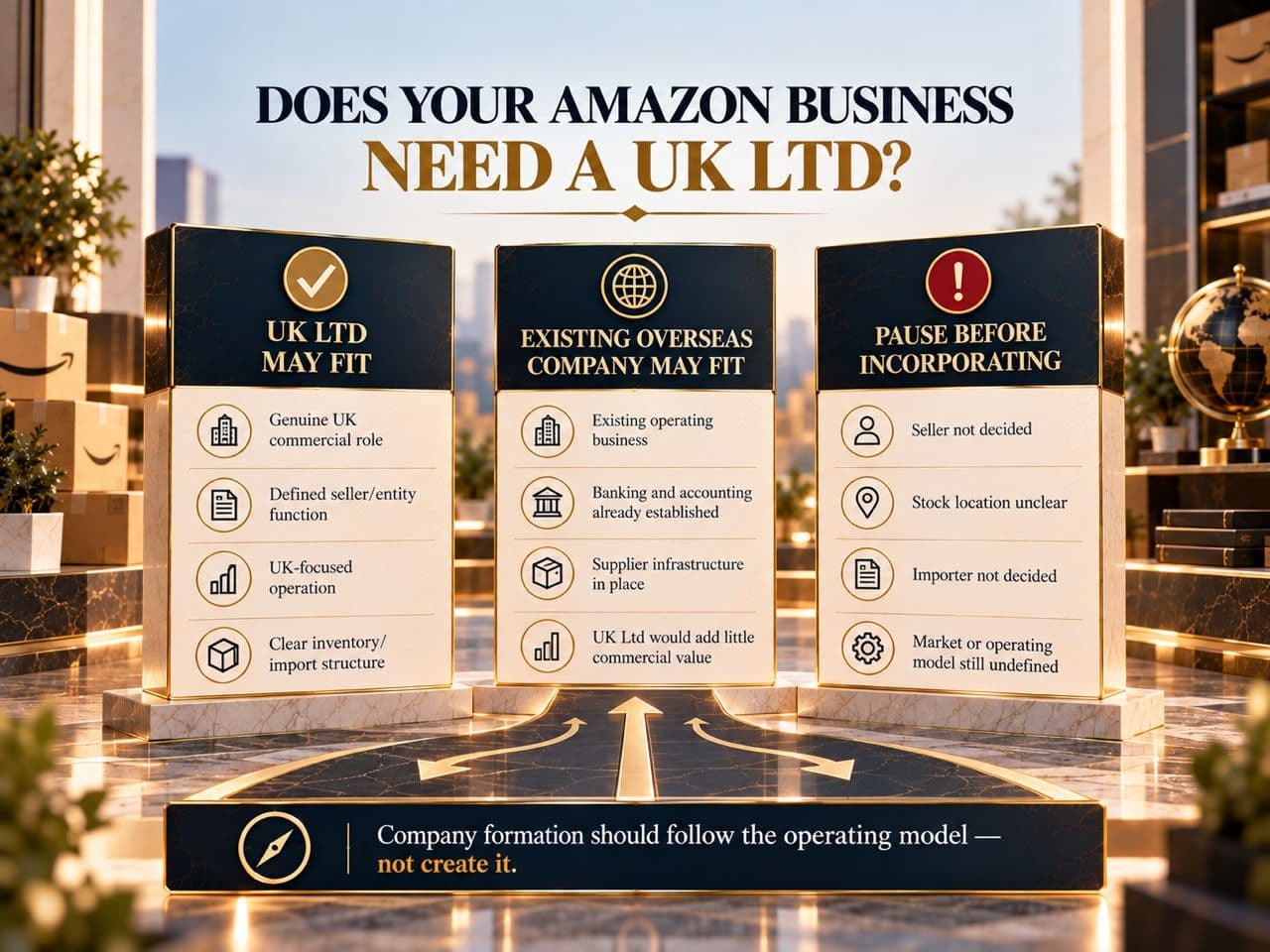
18. Should You Use a UK Ltd for Amazon FBA?
There is no universal answer.
A UK Ltd May Fit Well When
The company has a genuine role in the operating model.
For example:
- Britain is a meaningful target market;
- the company will operate the seller account;
- it will contract with suppliers;
- it will own or purchase inventory;
- it has a defined role in imports or UK distribution;
- it will support wider UK or international e-commerce activity.
Your Existing Overseas Company May Be Better When
You already have an established business with:
- appropriate banking;
- accounting;
- supplier relationships;
- operating history;
- tax infrastructure;
- sufficient commercial capacity to sell internationally.
If adding a UK company creates duplication without solving a genuine problem, another company may not be the best first step.
Pause Before Incorporating When
You have not yet determined:
- what product you will sell;
- who the legal seller will be;
- where the stock will be held;
- who will buy and own the inventory;
- who will import it;
- which marketplace you are entering;
- how the business will receive its proceeds.
A company cannot compensate for an undefined operating model.
Company formation should follow the Amazon operating model. It should not be used to invent one.
Common Amazon FBA Structure Mistakes
Forming a UK Ltd Simply Because You Want to Sell on Amazon UK
A UK company can be useful, but it is not automatically required merely because Britain is the target marketplace.
Sending Stock Before Deciding Who the Importer Is
Amazon will not act as importer of record for inbound FBA inventory. The customs structure needs to be established before the goods are shipped.
Assuming a UK Company Automatically Settles the VAT Position
UK incorporation and UK VAT establishment are different questions.
Applying the £90,000 VAT Threshold to Every Structure
The ordinary domestic threshold does not generally apply in the same way to an NETP making taxable UK supplies.
Assuming Amazon Accounting for VAT Means the Seller Has No VAT Obligations
Marketplace VAT treatment does not answer every VAT-registration, import or reporting question.
Treating £135 as a General Amazon Threshold
The location of the goods, nature of the transaction and value of the total consignment matter.
Assuming Amazon FBA Handles Product Compliance
Fulfilment does not automatically transfer all regulatory responsibilities away from the seller.
Choosing Banking After Everything Else Has Been Built
Financial infrastructure should be considered as part of the operating model.
Recording Only Amazon’s Net Bank Deposits as Sales
Amazon settlements can contain multiple components requiring appropriate accounting treatment.
Frequently Asked Questions
Can a non-UK resident use a UK Limited Company for Amazon FBA?
Yes, potentially.
A non-resident can generally own and direct a UK private limited company, subject to the applicable Companies House requirements. Amazon separately applies its own seller eligibility and verification requirements.
Do I need a UK company to sell on Amazon UK?
No, not automatically.
Amazon supports different seller and business structures, subject to its current requirements. A UK Ltd should have a genuine commercial role if one is created.
Does a UK company guarantee Amazon seller approval?
No.
Company incorporation and Amazon seller verification are separate processes. Amazon controls its own onboarding and approval requirements.
Do I automatically need UK VAT if I use Amazon FBA?
Not simply because you use FBA.
The VAT position can depend on establishment, inventory location, imports, the nature of the supplies and applicable marketplace rules.
Does the £90,000 UK VAT threshold protect every Amazon seller?
No.
Where a seller is an NETP, the ordinary domestic VAT-registration threshold does not generally apply in the same way. Marketplace and place-of-supply rules can also affect whether the seller itself is making the relevant taxable supply.
Does Amazon accounting for VAT mean I do not need VAT registration?
Not necessarily.
Marketplace deemed-supplier rules can affect who accounts for VAT on particular customer sales, while the seller can still have separate VAT-registration, import or reporting considerations.
Do I need an EORI for Amazon FBA?
Potentially.
The answer depends on who is undertaking the customs activities, whether that business is established in the UK for customs purposes, the movement involved and whether a customs representative is used.
Can Amazon be my importer of record for FBA inventory?
No for inbound FBA inventory under Amazon’s stated shipping rules.
Amazon states that it will not act as importer of record for FBA inventory shipments. The importer and customs arrangements should therefore be established before inventory is shipped.
Can I use a UK Registered Office as proof that my company is established in the UK for VAT?
A Registered Office by itself does not determine substantive VAT establishment.
The actual facts of the business need to be considered.
Does a UK Ltd guarantee a UK business bank account?
No.
Banks, EMIs and payment providers apply their own eligibility, verification and risk requirements.
Do I need accounting for an Amazon FBA UK Ltd?
An active UK company has accounting and filing responsibilities regardless of where its owner lives.
For an Amazon business, inventory, settlements, marketplace fees, refunds, advertising, imports, VAT and multiple currencies can materially increase the accounting workload.
How Seven Oak Prestige Supports Amazon Sellers
Seven Oak Prestige supports international and non-resident founders establishing and operating UK companies.
Where a UK Ltd is appropriate for the Amazon operating model, support can include company formation, statutory UK address services, Companies House requirements, VAT and EORI support where applicable, banking readiness and ongoing accounting requirements according to the agreed scope.
The first question should still be:
Does the UK company have a genuine role in the Amazon business?
If the answer is yes, the company should then be structured consistently with the seller account, inventory, imports, VAT position, financial infrastructure and accounting.
If the answer is no, forming another company simply because the target marketplace is Amazon UK may create complexity rather than solve it.
Final Takeaway
For a non-resident founder, the Amazon FBA structure should be built in this order:
Legal seller
↓
Inventory owner
↓
Inventory location
↓
Importer
↓
VAT and customs position
↓
Amazon verification and payouts
↓
Accounting and tax
Only then should the founder decide whether a new UK Limited Company is the appropriate entity.
The company is one part of the operating model. It is not the operating model itself.
Planning an Amazon FBA Business Through a UK Company?
Seven Oak Prestige can help scope the UK company and establishment requirements and, where a UK Ltd is appropriate, support the formation and related UK setup.
Review My UK Amazon Business Setup
About the Author
Isaac Jackson
Founder & Managing Director — Seven Oak Prestige Ltd
Isaac Jackson supports international founders and overseas businesses establishing and operating UK companies, including company formation, statutory-address arrangements, Companies House administration, compliance preparation, banking readiness and ongoing business support.
His work focuses particularly on the practical challenges faced by founders establishing and managing UK companies while living overseas.
Seven Oak Prestige Ltd
Company Registration No. 16903092
Registered Office: 124 City Road, London EC1V 2NX, United Kingdom
Editorial Methodology
Last reviewed: 7 October 2026
This guide was reviewed against current primary guidance from HMRC, GOV.UK, Companies House and Amazon’s current seller/FBA documentation.
Particular attention was given to:
- Amazon seller and business verification;
- FBA inventory and importer-of-record responsibilities;
- EORI rules for established and non-established operators;
- UK VAT establishment;
- non-established taxable persons;
- online-marketplace deemed-supplier rules;
- the £135 consignment rules;
- UK Registered Office requirements;
- product-compliance responsibilities;
- accounting and post-incorporation obligations.
HMRC guidance was treated as the primary authority for UK VAT and customs conclusions. Amazon documentation was used for Amazon-specific operational requirements rather than as the primary authority for UK tax law.
This article provides general information for international Amazon sellers. Individual VAT, customs, tax and cross-border circumstances can require specialist professional advice.