
Best UK Company Formation Services for Non-Residents in 2026: How to Choose

If you live outside the UK, choosing a company formation provider should not begin with:
“Who is cheapest?”
A better question is:
“What will I actually need before and after the company is incorporated?”
That distinction matters.
In 2026, registering a private limited company online directly with Companies House costs £100. Companies House says online applications are usually processed within 24 hours, although individual applications can take longer.
So why do formation providers charge £150, £200, £300 or more?
Because the service may include much more than the Companies House filing:
- UK address services
- identity-verification support
- company documents
- mail handling
- compliance support
- accounting
- VAT assistance
- banking or payment-readiness support
For an international founder, the cheapest incorporation is therefore not always the cheapest complete business setup.
Quick Answer
There is no single best UK company formation provider for every non-resident founder.
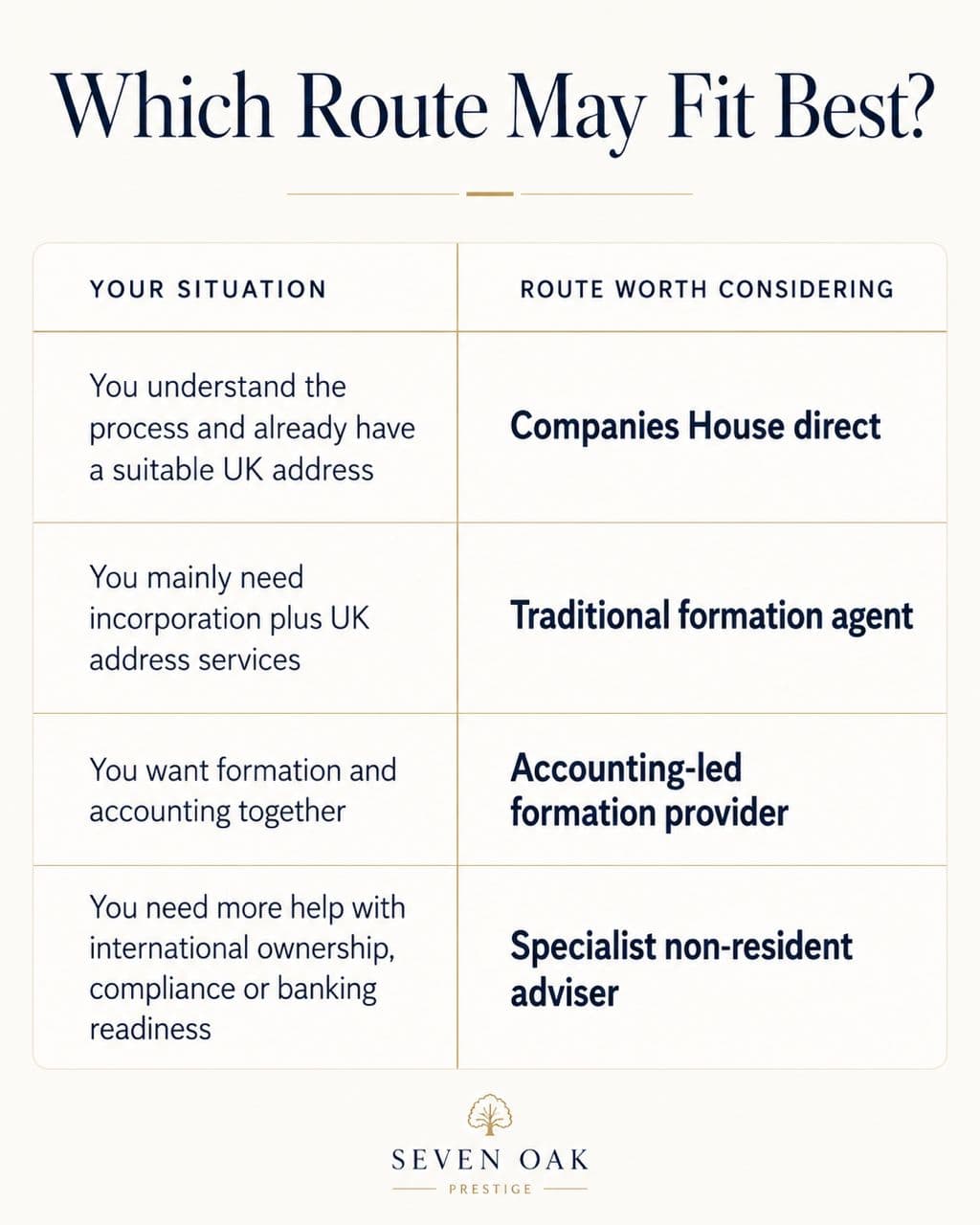
The best provider is the one whose service actually matches your circumstances.
1. Companies House Direct
For an experienced founder, filing directly with Companies House may be perfectly reasonable.
The current digital incorporation fee is:
£100
The £100 government fee creates the legal company.
It does not automatically provide:
- a professional registered office
- a director service address
- business mail handling
- accounting
- tax advice
- banking assistance
- post-incorporation administration
Companies House also charges £50 for a digital confirmation statement under the current 2026 fee schedule.
Direct filing therefore works best where the founder already understands what needs to be arranged separately.
For the complete formation process, see our UK Company Formation for Non-Residents — Complete 2026 Guide.
2. Seven Things Non-Residents Should Compare
1. Does the Provider Accept Your Country?
“Non-resident formation” does not necessarily mean every nationality or country of residence will be accepted.
Formation eligibility, KYC and banking eligibility are separate questions.
A provider should understand:
- your nationality
- your genuine country of residence
- your business activity
- company ownership
- applicable sanctions or compliance considerations
Check this before paying.
2. Which UK Addresses Are Included?
This is one of the most common areas of confusion for overseas founders.
Registered Office
The company’s statutory address.
It appears on the public Companies House register and must be in the appropriate UK jurisdiction for the company.
Director Service Address
The public correspondence address used for a director.
This helps keep the director’s residential address off the public register where the requirements are met.
Business Address
An address used for commercial correspondence.
It does not automatically perform the same legal function as a registered office or director service address.
Registered Office ≠ Director Service Address ≠ Business Address
Before purchasing a package, check exactly which address services are included and what they cost to renew.
Read our UK Registered Office vs Director Service Address for Non-Residents guide for the full explanation.
3. How Is Identity Verification Handled?
Companies House identity verification is now an important part of forming and managing UK companies.
Depending on the individual and route used, verification may be completed directly through GOV.UK or through an authorised provider.
For a non-resident founder, useful questions include:
Is identity verification included?
Is there a separate service fee?
Which documents will I need?
How will I receive my Companies House personal code?
Do not assume every formation package includes the same verification service.
For the complete process, read our Companies House Identity Verification for Non-Residents — 2026 Guide.
4. What Does “Banking Support” Actually Mean?
This deserves particular attention.
Some formation companies offer a:
banking referral
Others provide more detailed:
banking-readiness support
They are not the same thing.
A referral may simply introduce the founder to a banking or fintech provider.
A banking-readiness service may additionally review matters such as:
- residence
- ownership
- business activity
- website
- source of funds
- expected transactions
- supporting company information
Neither guarantees approval.
A UK company does not automatically guarantee access to:
- a UK business bank account
- Wise
- Revolut
- Payoneer
- Stripe
Each financial provider applies its own eligibility, KYC and risk assessment.
Be cautious of any formation company advertising a guaranteed bank account or guaranteed Stripe approval.
5. What Happens After Incorporation?
The Certificate of Incorporation is the beginning of the company, not the end of its compliance obligations.
Depending on the company, future requirements can include:
- Confirmation Statements
- annual accounts
- Corporation Tax
- statutory record keeping
- VAT
- PAYE
- company changes
- address renewals
Some formation providers stop after incorporation.
Others continue providing company administration, accounting or compliance services.
Neither model is automatically better.
What matters is understanding what you are purchasing.
For the next steps, read What Happens After You Register a UK Company as a Non-Resident?
6. First-Year Cost vs Year-Two Cost
A cheap first-year package can become much more expensive once address and administration services renew.
Use this framework when comparing providers:
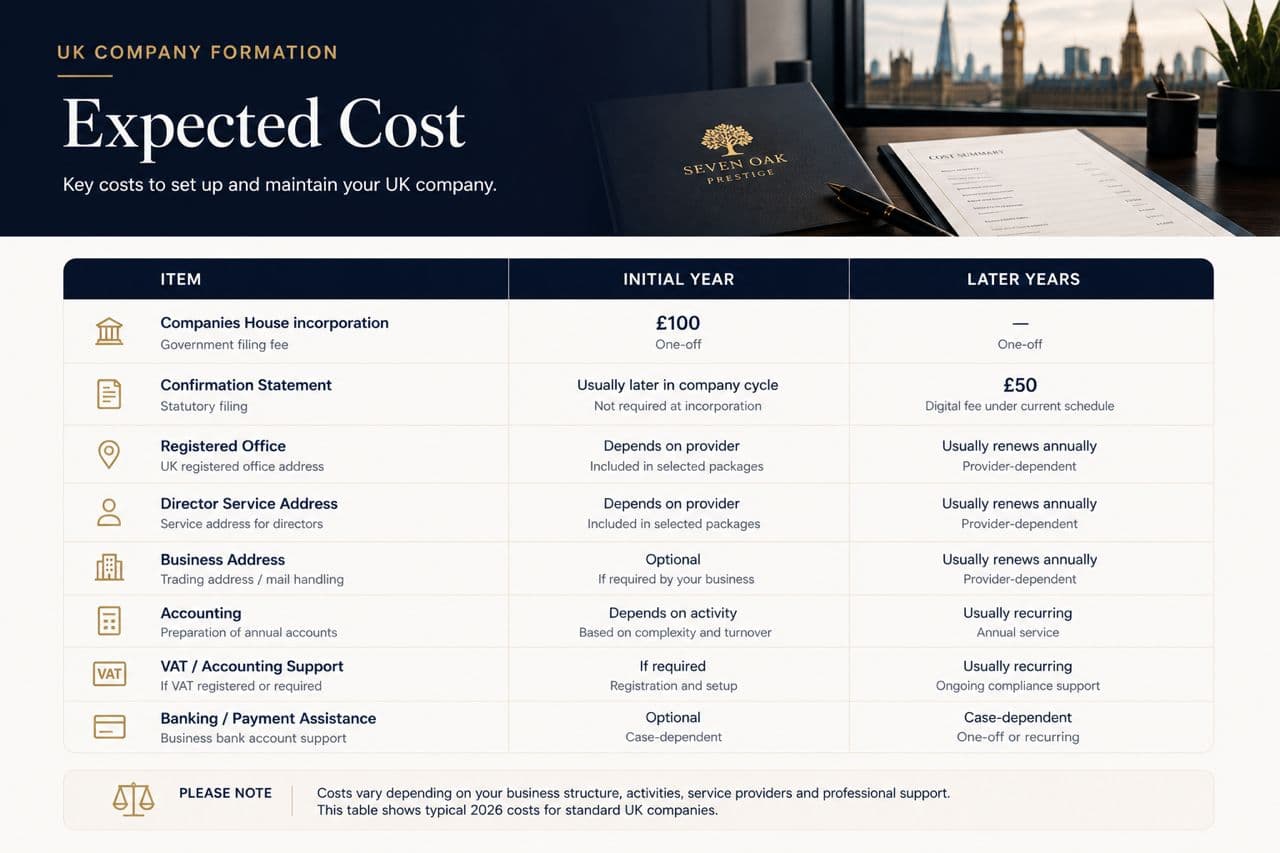
The important questions are:
What do I pay today?
and:
What will I pay to maintain the setup next year?
That is often more useful than comparing headline incorporation prices.
7. Who Actually Reviews Your Case?
Some founders simply need software to submit a straightforward company.
Others may have:
- two or more shareholders
- international ownership
- founders living in different countries
- unusual business activities
- VAT considerations
- regulated activities
- banking concerns
- cross-border tax questions
For a straightforward case, automation may be enough.
For a more complex non-resident structure, access to somebody who can review the case before submission may be more valuable.
UK Company Formation Options Compared
Instead of pretending there is one universal “best” provider, it is more useful to compare the different service models.
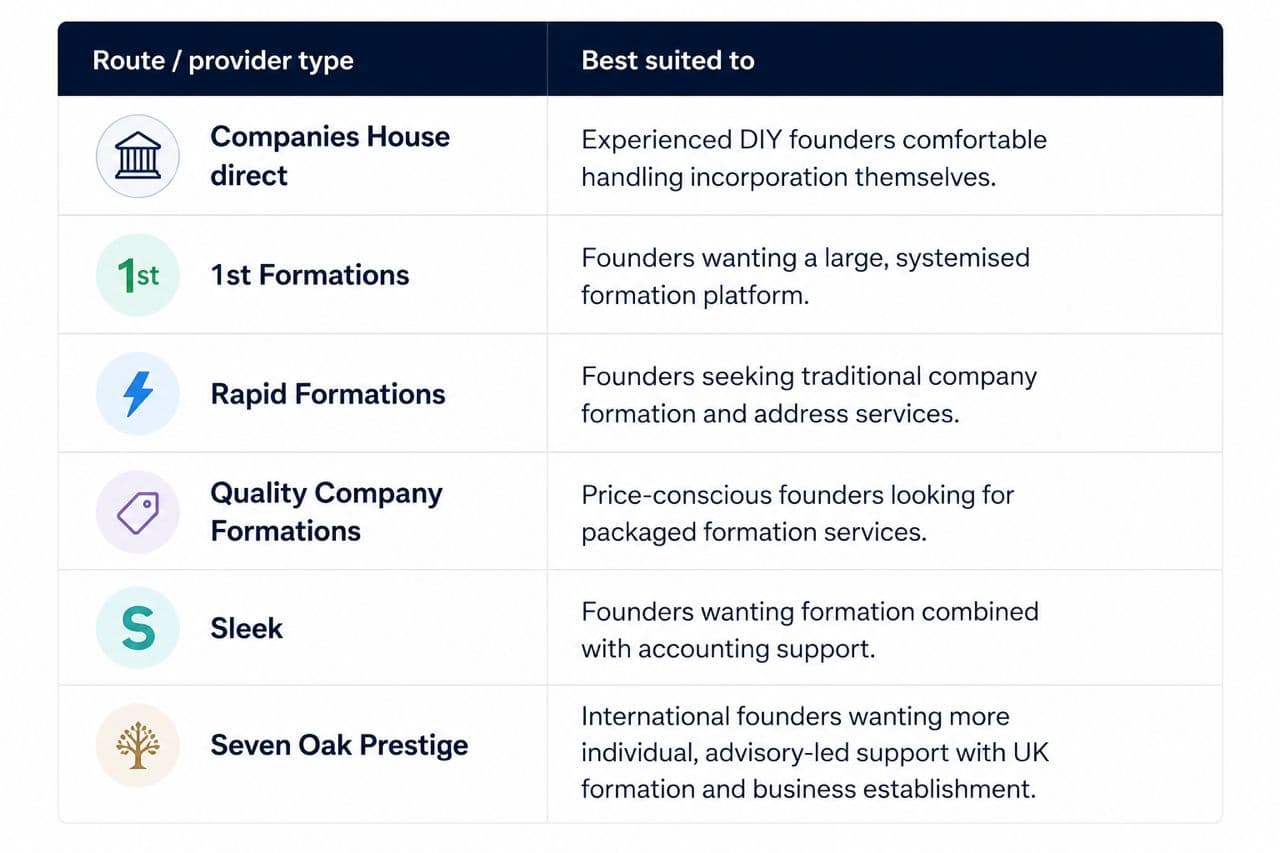
Prices and package inclusions change regularly. Check each provider’s current terms, address renewals and eligibility before purchasing.
Disclosure: Seven Oak Prestige publishes this guide and is therefore an interested provider. We do not claim that Seven Oak is the best option for every founder. This comparison is intended to help non-residents understand the different service models available.
Companies House Direct: Best for DIY Formation
Direct registration is often appropriate where the founder:
- understands the UK company structure
- already has an appropriate UK registered office
- is comfortable handling identity verification
- has separate accounting arrangements
- does not need banking or compliance assistance
If that describes you, paying an adviser may be unnecessary.
That is an important point because a useful comparison should also explain when not to buy a professional formation package.
Traditional Formation Agents
Providers such as 1st Formations, Rapid Formations and Quality Company Formations operate highly systemised company-formation platforms.
They can be useful where the founder wants:
- incorporation
- address services
- digital documents
- mail handling
- additional administrative services
Their scale and automation can make them attractive for relatively straightforward formations.
The main areas to compare are:
first-year price, address inclusions, renewal costs, identity verification and post-incorporation support.
Formation Plus Accounting
Some providers combine incorporation and accounting from the beginning.
Sleek, for example, currently markets its UK service around formation, registered-office and director-address services, with higher packages adding bookkeeping, annual accounts and Corporation Tax support. Its current Essential Formation offer is advertised from £245 + VAT including government fees.
This model can make sense for a company that expects to begin trading immediately and wants one provider handling formation and accounting.
It may be unnecessary for a founder whose company will remain dormant or who already has an accountant.
Where Seven Oak Prestige Fits
Seven Oak Prestige focuses primarily on international and non-resident founders.
Our model is intended for founders who want more than an automated Companies House submission.
Current formation packages start at:
Starter — £199
For founders who mainly require incorporation and already have suitable UK address arrangements.
Prestige — £299
For non-resident founders requiring additional UK address infrastructure, including registered-office and director-service-address support according to the package scope.
Elite — £399
For founders who require broader establishment and banking-readiness assistance.
That does not mean Seven Oak is automatically the right provider for every founder.
If you only need a £100 Companies House filing and already understand everything else, direct filing may make more sense.
If you need someone to review your structure, addresses, compliance requirements and operational readiness, a more advisory service may be more appropriate.
Cheap Formation vs Best Value
Consider two founders.
Founder A
Lives outside the UK but already has:
- a suitable UK registered office
- an accountant
- experience with Companies House
- no need for banking assistance
This founder may reasonably choose Companies House direct.
Founder B
Lives outside the UK and needs:
- a UK registered office
- a director service address
- identity-verification support
- help structuring two shareholders
- assistance preparing for banking
- guidance after incorporation
Comparing these founders purely on the £100 filing fee makes little sense.
They are purchasing completely different levels of support.
Claims to Be Careful With
“Guaranteed UK Bank Account”
No formation provider controls a bank’s final approval decision.
“Guaranteed Stripe”
The same applies to Stripe and other payment processors.
“Free Company Formation”
It may be a genuine offer, but understand how the service is funded and what other product, subscription or account may be attached.
“Guaranteed 24-Hour Formation”
Companies House says online applications are usually processed within 24 hours. That is not an unconditional guarantee.
“Thousands of Reviews Means Best for Me”
Large review volumes can demonstrate scale and customer history.
They do not establish whether the provider is the best fit for your nationality, residence, ownership structure or banking requirements.
Seven Questions to Ask Before Paying
Before choosing any UK formation provider, ask:
- Does the provider accept my actual country of residence?
- Is the £100 Companies House fee included?
- Which UK addresses are included and what do they cost to renew?
- How will my identity verification be completed?
- Does banking support mean a referral or an actual case review?
- What happens after the company is formed?
- Can somebody review my structure before submission?
Those seven answers usually tell you more than a headline package price.
Which Route Should You Choose?
Choose Companies House direct if:
You understand the process and only need the company incorporated.
Choose a traditional formation agent if:
You want incorporation plus practical UK address or administrative services.
Choose an accounting-led provider if:
You want accounting and tax administration integrated from the beginning.
Choose a specialist non-resident adviser if:
Your residence, ownership, business activity, compliance requirements or banking needs require more individual review.
There is no universal winner.
The better choice is the provider whose scope matches your situation.
Frequently Asked Questions
Can a non-UK resident form a UK limited company?
Yes. UK residency is not generally required to own shares in or act as a director of a UK private limited company, subject to the applicable company, director, address and identity-verification requirements.
Is Companies House cheaper than using a formation agent?
For incorporation alone, yes.
Direct online incorporation currently costs £100.
A provider becomes relevant where you need services beyond the government filing.
Do I legally need a formation agent?
No.
You can incorporate directly with Companies House if you meet the requirements and are comfortable managing the process yourself.
Does a formation company guarantee a UK bank account?
No.
Banking approval remains with the relevant financial institution.
What costs should I compare besides incorporation?
Look at:
- address renewals
- Confirmation Statement fees
- accounting
- mail handling
- identity-verification assistance
- VAT or tax support
- banking assistance
The lowest initial price does not necessarily produce the lowest ongoing cost.
Final Takeaway
The UK company-formation market is highly competitive.
That gives international founders plenty of choice, but it also makes comparison difficult because very different businesses can all advertise the same outcome:
“Form a UK Ltd.”
The £100 Companies House filing creates the company.
Everything beyond that depends on what you need.
For an experienced founder who only needs incorporation, filing directly may be enough.
For a non-resident operating remotely, the more useful comparison is:
incorporation + address + identity + compliance + operational readiness + ongoing cost
Compare the complete setup.
Not just the first number you see.
Need Help Choosing the Right UK Setup?
If you are a non-UK resident and are unsure whether you need basic incorporation, UK address services or broader establishment support, Seven Oak Prestige can review your requirements before you choose a package.
Speak to a Seven Oak Prestige Adviser
We will explain the available setup and scope before you decide.
Related Guides for Non-Resident Founders
UK Company Formation for Non-Residents — Complete 2026 Guide
The complete incorporation process, ownership, directors, addresses and compliance requirements.
UK Company Formation Cost for Non-Residents
Understand statutory fees, professional costs and ongoing expenses.
Companies House Identity Verification for Non-Residents
Understand personal codes, directors, PSCs and verification routes.
UK Registered Office vs Director Service Address
Understand which UK addresses your company and directors actually need.
What Happens After UK Company Formation?
Understand Confirmation Statements, accounts, tax and post-incorporation responsibilities.
About the Author
Isaac Jackson
Founder & Managing Director — Seven Oak Prestige Ltd
Isaac Jackson has more than three years of hands-on experience supporting international entrepreneurs with UK company formation and business-establishment matters.
Seven Oak Prestige has supported international founders with company structure, UK address arrangements, Companies House requirements, KYC preparation and operational readiness.
Editorial Methodology
This guide was prepared using:
- current Companies House information
- primary UK government guidance
- current publicly available provider information
- practical experience supporting international founders
- ongoing editorial review
Provider pricing and package features can change. Where a provider is mentioned, readers should confirm the current offer directly before purchasing.
Seven Oak Prestige is itself a UK company-formation and advisory provider. We therefore disclose our commercial interest rather than presenting this article as an independent ranking.
Last reviewed: 3 September 2026
Editorial Disclaimer
This guide provides general educational and business-establishment information.
It does not constitute personalised legal, tax, accounting, banking or regulated financial advice.
Eligibility for banking, payment processors and other third-party services is determined by the relevant provider.
Company-formation prices, Companies House fees and third-party service terms may change.
Primary Official Sources Reviewed
Companies House — Register a Company
Used to verify the current digital incorporation process and Companies House requirements.
Companies House — Current Fees
Used to verify the current £100 digital incorporation fee and £50 digital confirmation-statement fee.
Companies House — Identity Verification
Used for the current identity-verification framework applying to people setting up, running, owning or controlling UK companies.