
UK Business Banking for Non-Residents: 2026 Guide

UK Business Banking for Non-Residents: Banks, Fintechs & Eligibility Explained (2026)
Opening a UK limited company as a non-resident is possible. Opening the right business account for that company is a separate decision.
This distinction catches many international founders by surprise.
Companies House registration establishes the company. It does not require a bank, Electronic Money Institution (EMI) or payment provider to accept it.
A financial provider may separately consider where the directors and beneficial owners live, what the company does, where customers and suppliers are located, how money will move through the account, the source of funds, ownership structure and whether the business fits its current eligibility and risk framework.
That is why a perfectly legitimate UK company can be incorporated successfully and still find that some banking providers are unsuitable.
For a non-resident founder, the useful question is therefore not simply:
“Which is the best UK business bank account?”
A better question is:
“Which type of provider is compatible with my company, my residence, my business model and the way I need to receive and send money?”
This guide explains how to make that assessment before you apply.
If you have not yet incorporated, start with our UK Company Formation for Non-Residents: Complete 2026 Guide so that the company structure, ownership, addresses and banking requirements are considered together rather than as separate decisions.
Quick Answer: Can a Non-Resident Open a UK Business Account?
Yes, there are banking and payment options available to some non-resident owners of UK companies, but eligibility varies significantly between providers.
A UK company registration does not automatically entitle the company to an account.
Traditional banks may have residence, operating-presence or other requirements that make particular accounts unsuitable for some overseas founders. Digital banks, EMIs and payment providers may support different international structures, but they also maintain their own restrictions around residence, business activity, ownership, geography and account usage.
The strongest approach is usually:
Define what you need → check eligibility → prepare the evidence → choose the appropriate provider → apply accurately.
Submitting applications indiscriminately is not a banking strategy.
1. Incorporating a UK Company and Opening a Business Account Are Different Processes
A Certificate of Incorporation proves that your company has been registered.
It does not prove that a financial institution must open an account for it.
During onboarding, a provider may need to understand the directors and beneficial owners, their countries of residence, the company’s ownership and control, business activity, customers, suppliers, expected turnover, transaction values, currencies, source of funds and the countries involved in incoming and outgoing payments.
UK government business guidance also explains that limited companies may be asked for incorporation documents, director information, the company registration number, registered address and financial information. Businesses based outside the UK can face additional checks on directors, owners and foreign investors.
The practical implication is important:
Do not choose a UK company structure on the assumption that incorporation automatically solves banking.
If you are still deciding how the company itself should be structured, our guide to shares, directors and ownership for non-resident founders explains how ownership and control fit together before incorporation.
2. Start With the Banking Requirement, Not the Provider Name
Founders often begin with questions such as:
“Can I get Wise?”
“Can I open Revolut?”
“Which fintech accepts non-residents?”
Those questions come too early.
First define what the business actually needs.
A UK consulting company invoicing three European corporate clients has a very different financial profile from an e-commerce company receiving hundreds of customer payments, an import/export business paying Asian suppliers, or a SaaS company collecting recurring international subscriptions.
Before comparing providers, establish the commercial requirement.
Currencies: Which currencies will you receive, hold and send?
Incoming payments: Will customers pay by bank transfer, card, marketplace settlement, payment processor or another method?
Outgoing payments: Where are suppliers, contractors and employees located?
Volume: How many transactions do you reasonably expect?
Value: What is the expected monthly turnover and typical transaction size?
Functionality: Do you need local account details, international transfers, cards, direct debits, foreign exchange, API access or accounting integrations?
Future requirements: Could the business later need lending, trade finance or other services associated with a traditional banking relationship?
Once these questions are clear, provider selection becomes much more rational.
3. Bank, EMI or Payment Provider: Understand What You Are Applying For
The words bank, fintech, business account, payment account and EMI are frequently used as though they mean the same thing.
They do not.
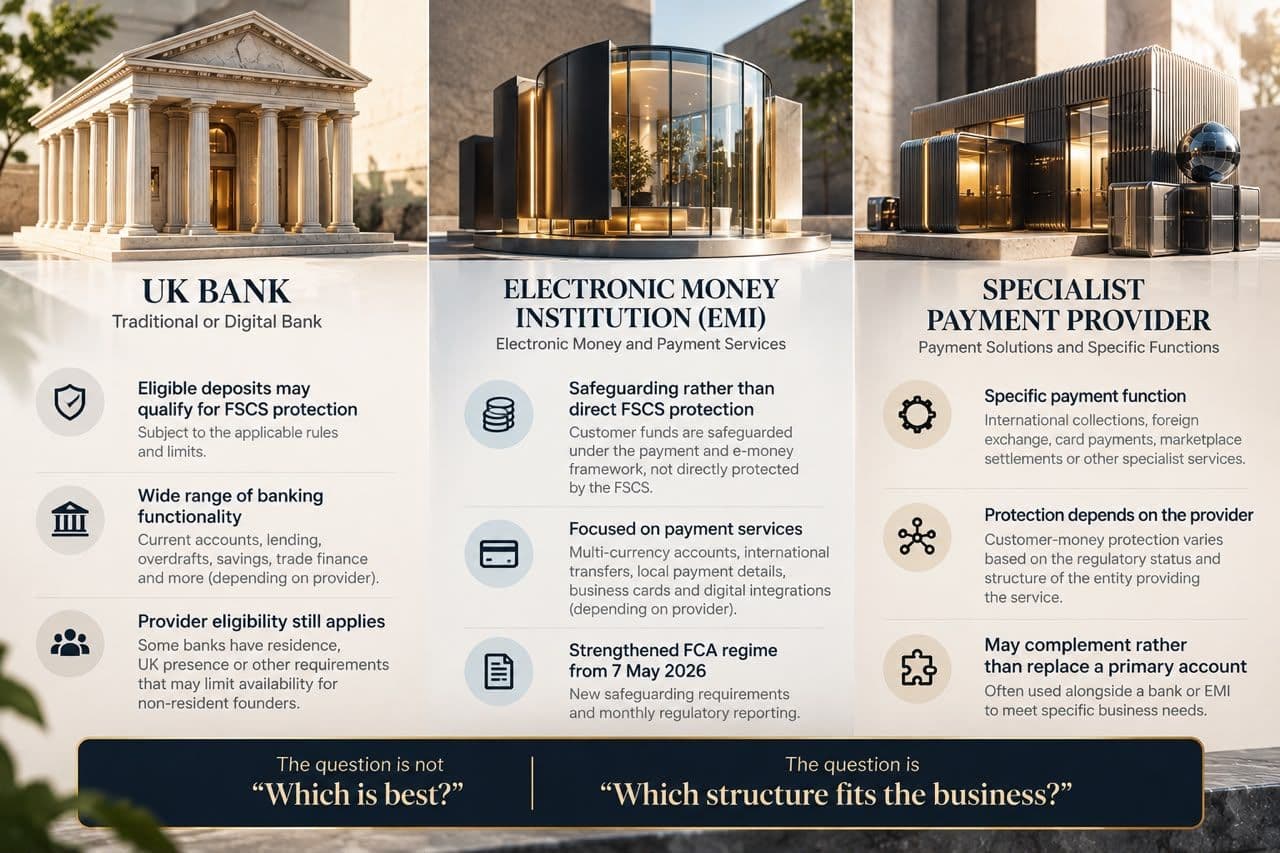
UK Bank
A bank is authorised to conduct banking activities under the relevant regulatory framework.
Depending on the institution and product, a business bank may provide a current account alongside services such as lending, overdrafts, savings, trade finance or other banking products.
For some non-resident founders, the difficulty is not functionality. It is eligibility.
A bank may have residence, operating-presence or other onboarding requirements that make a particular account unavailable to an overseas-managed company.
Electronic Money Institution
An Electronic Money Institution can provide electronic-money and payment services, including account-like functionality used by many businesses, but an EMI is not the same thing as a bank.
That distinction matters when considering how customer money is protected.
Funds held by payment and e-money firms are not directly protected by the Financial Services Compensation Scheme in the same way as eligible deposits held with participating banks and building societies. Instead, relevant payment and e-money firms are subject to safeguarding requirements intended to protect customer funds. The FCA explicitly distinguishes safeguarding from FSCS deposit protection.
The regulatory framework was strengthened on 7 May 2026, when the FCA’s Supplementary Safeguarding Regime came into force. The changes include enhanced safeguarding requirements and monthly safeguarding reporting. FCA: Changes to the safeguarding regime for payments and e-money firms.
This does not mean that an EMI is inherently a poor choice.
For some international businesses, an EMI may provide exactly the multi-currency, payment and cross-border functionality required.
It does mean that founders should understand what type of institution is actually providing the service rather than assuming that every product marketed as a “business account” is legally a bank account.
Specialist Payment Provider
Some businesses also use specialist providers for international collections, foreign exchange, card acquiring, marketplace settlements or other payment functions.
These services may complement the company’s primary operating account rather than replace every banking function.
The practical rule is:
Understand the institution, the protection framework, the functionality and the eligibility before deciding whether the account fits your business.
4. UK Business Banking Options for Non-Residents: What Actually Changes?
There is no single account type that is automatically best for every overseas founder.
The important differences are the institution behind the account, how relevant customer funds are protected, the services available and whether your particular company is eligible.
UK Bank
Institution type: Bank
Customer-money protection: Eligible deposits may qualify for FSCS protection, subject to the applicable rules and limits.
Potential strengths: Traditional banking relationship and, depending on the institution, access to services such as lending, overdrafts, savings, trade finance and other banking products.
Main issue for non-residents: Some banks impose residence, UK-presence or other eligibility requirements that can exclude particular overseas-managed companies.
Question to ask: Does this bank currently accept a company with directors and beneficial owners resident in my country?
Electronic Money Institution
Institution type: EMI
Customer-money protection: Relevant customer funds are safeguarded under the applicable payment and e-money framework rather than directly protected by the FSCS. The FCA strengthened its safeguarding regime from 7 May 2026.
Potential strengths: Depending on the provider, multi-currency functionality, international transfers, local payment details, business cards, foreign exchange and digital integrations can be useful for internationally managed companies.
Main issue for non-residents: Eligibility can still depend on residence, ownership, business activity, transaction geography and the individual provider’s policies.
Question to ask: Does this EMI support my actual business model and transaction geography, rather than UK companies generally?
Specialist Payment Provider
Institution type: Depends on the provider and service.
Customer-money protection: Depends on the regulatory status and structure of the entity actually providing the service.
Potential strengths: International collections, foreign exchange, marketplace settlements, card payments or other specialist payment functions.
Main issue for non-residents: A specialist service may solve one part of the company’s payment infrastructure without replacing everything required from a primary operating account.
Question to ask: What exact function will this provider perform in my company’s payment flow?
The Decision Rule
Do not compare providers only by asking which one appears easiest to open.
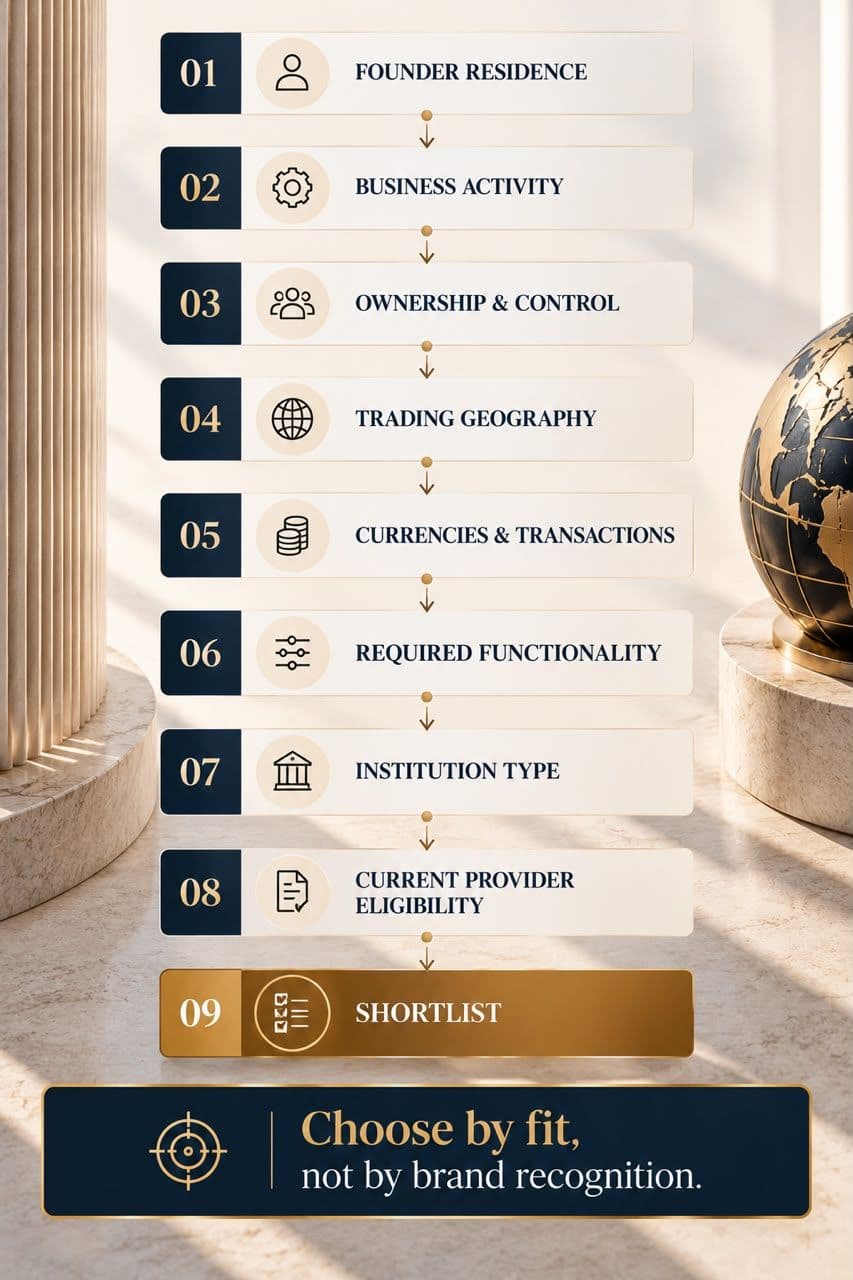
Compare them in this order:
Founder residence → Business activity → Ownership → Trading geography → Required currencies → Required functionality → Institution type → Current eligibility
Only providers that survive those checks belong on your shortlist.
5. Why Non-Resident Founders Face Different Banking Questions
Consider a company incorporated in England and Wales whose sole director lives in India, whose customers are mainly in the United States and Europe, and whose contractors are based in India.
The company is registered in the UK.
Its economic relationships are international.
A provider therefore needs more than the Companies House registration to understand how the account will be used.
This does not mean an international structure is inherently problematic.
It means the application should explain the real commercial model clearly enough for the provider to assess it.
For many non-resident companies, banking readiness comes down to one word:
coherence.
The ownership, business activity, founder residence, website, expected transactions and supporting evidence should describe the same genuine business.
6. Founder Residence Can Determine Which Providers Are Worth Considering
A UK company’s place of incorporation and a director’s place of residence are separate facts.
Providers can consider both.
Some support applicants living in a relatively broad range of countries. Others maintain narrower eligibility policies.
Those policies can change.
That is why a provider should not simply be described as “good for non-residents.”
The more useful question is:
Does this provider currently support a founder living in my particular country, operating this particular UK company and carrying on this particular activity?
Check that before beginning the application.
For founders whose residence or transaction profile involves jurisdictions receiving additional compliance scrutiny, our UK Company Formation for Higher-Risk Countries guide explains the important distinction between nationality, residence, sanctions exposure, geographic risk and an individual provider’s own risk decision.
Not Sure Which Banking Route Fits Your Situation?
If you already have a UK company, Seven Oak Prestige can review your country of residence, business activity, ownership structure and expected transactions before you approach another banking or payment provider.
CHECK MY BANKING READINESS
7. Your Business Activity Matters as Much as Your Company Registration
Providers do not assess every legitimate business in the same way.
A straightforward consulting company and a regulated financial business can both be legitimate companies while presenting very different onboarding considerations.
Even an ordinary business can become difficult to assess when its description is vague.
Compare:
“Online services.”
with:
“The company develops subscription-based inventory-management software for independent retailers in the UK and EU. Customers pay monthly subscriptions through the company’s website.”
The second description gives a reviewer something concrete to understand.
A useful business description should make clear:
What does the company sell?
Who buys it?
How does the company earn revenue?
Where are customers located?
How will customers pay?
The objective is not to make the activity sound lower risk than it really is.
It is to describe the real business accurately.
Your Companies House SIC code should also reasonably reflect the company’s genuine activity. A SIC code is not a banking workaround. If this part of the company profile is unclear, read our UK SIC Codes for Non-Resident Companies guide.
8. Ownership and Control Need to Be Clear
Providers commonly need to identify the people who ultimately own and control a business.
For a company with one individual director and shareholder, this can be straightforward.
Additional explanation may be required where the structure involves multiple shareholders, corporate shareholders, overseas parent companies, holding companies, trusts or layered ownership across jurisdictions.
The objective should never be to simplify the structure by omitting relevant people.
Make the real structure easy to understand.
Where a UK company is owned by another company, the provider may require documents concerning the parent entity and the individuals who ultimately own or control it.
A complex but transparent structure is fundamentally different from a structure whose ownership cannot be satisfactorily established.
9. Registered Office, Trading Address and Residential Address Are Not the Same Thing
This distinction matters particularly for non-resident founders.
Every UK company needs an appropriate Registered Office in the relevant UK jurisdiction.
That does not automatically make the address:
the director’s residential address;
the company’s physical operating premises;
evidence that management takes place there;
evidence that the company has UK employees;
or evidence that the company has operational substance in Britain.
A professional Registered Office can be entirely legitimate while the director lives overseas and the business operates remotely.
If a provider asks where the business actually operates, answer that question accurately.
If it asks for the director’s residential address, provide the genuine residential address.
Do not try to make one address perform a role it does not perform.
Our Registered Office vs Director Service Address guide explains the distinction between Registered Office, Director Service Address, residential address, business address and operating address in more detail.
10. What Documents May Be Required?
Requirements vary between providers and according to the company profile, but an international founder should normally be prepared to evidence several different things.
Identity and Residence
A provider may request an accepted identity document, genuine residential address evidence and additional identity verification where required.
Company
Depending on the provider, relevant documents and information can include the Certificate of Incorporation, company registration number, Registered Office, Articles of Association, directors, shareholders and beneficial owners.
UK government guidance confirms that business-account providers may request incorporation documents, director information, company registration details, registered-address information and financial information.
Business Activity
Depending on the stage and nature of the business, supporting evidence could include a professional website, business plan, customer agreements, supplier agreements, invoices, proposals, marketplace information, product information or relevant licences.
A newly incorporated company will naturally have less trading evidence than an established company.
That is not a reason to manufacture evidence.
It means the company should use genuine evidence appropriate to its actual stage.
11. Source of Funds: What Is the Provider Trying to Understand?
“Source of funds” is frequently misunderstood.
The provider may need to understand where money entering the company or funding its operations originates.
For a new founder-funded company, that may involve the founder’s own legitimate funds.
For an established company, it may involve trading income or another genuine commercial source.
Depending on the circumstances, supporting evidence could include relevant bank statements, contracts, invoices, sale documentation or other records explaining the origin of the funds.
The appropriate evidence depends on what has actually been declared.
The principle is simple:
The explanation and the evidence should describe the same source.
Do not invent a cleaner source of funds because you think it will make the application easier.
12. Your Expected Transactions Matter
A provider is not only assessing who owns the company.
It may also need to understand how the account is expected to be used.
Be prepared to explain:
Expected monthly turnover: What is commercially reasonable for the company’s current stage?
Typical transaction size: Are transactions normally £100, £5,000 or £50,000?
Incoming countries: Where will customers and counterparties pay from?
Outgoing countries: Where are suppliers, contractors and other recipients?
Currencies: Will the business operate only in GBP, or also EUR, USD or other currencies?
Frequency: Will the company receive a few invoices each month or hundreds of customer payments?
There is no advantage in exaggerating projected turnover simply to make a new company look larger.
A realistic early-stage forecast that can be explained is more useful than an impressive number with no commercial basis.
13. Geographic Risk Is More Than Nationality
International founders sometimes assume their passport determines whether a provider will accept them.
The position is more nuanced.
A provider may separately consider nationality, country of residence, location of beneficial owners, customer countries, supplier countries, source and destination of funds, sanctions exposure and the jurisdictions involved in the wider business model.
A founder’s nationality therefore does not describe the entire geographic profile.
Equally, incorporating a UK company does not erase the relevance of overseas operations.
The application should reflect the business as it genuinely operates.
14. Does a Professional Website Help?
Often, yes, but not because a website guarantees approval.
A credible website can help a reviewer understand what the company actually does.
For an operating or pre-launch business, it may provide useful evidence of products or services, target customers, commercial positioning, contact information and the relationship between the company and its stated activity.
But the website should agree with the application.
If an application describes a software company while the website advertises unrelated financial services, the website may create questions rather than answer them.
A website is supporting commercial evidence.
It is not a substitute for eligibility.
15. How to Evaluate a Provider as a Non-Resident Founder
Instead of beginning with a list of brands, use a provider-fit sequence.
Founder Residence
Does the provider currently accept applicants resident in your country?
Business Activity
Does it support what the company actually does?
Ownership
Can it onboard your genuine ownership and control structure?
Trading Geography
Does it support the countries from which you expect to receive and send money?
Currency Requirements
Does it offer the currencies and payment routes your business genuinely needs?
Functionality
Do you need transfers and collections only, or also cards, direct debits, integrations, foreign exchange, lending or trade finance?
Institution Type
Are you dealing with a bank, EMI or another type of payment provider, and do you understand the difference?
Evidence
Can you substantiate the material information you will provide during onboarding?
Only after those questions should the provider’s brand become the deciding factor.
Need Help Assessing Your UK Banking Options?
For non-resident founders, the right route depends on more than the company registration. Seven Oak Prestige can review your founder residence, company activity, ownership, transaction geography and banking requirements, then help you assess realistic provider routes.
TALK TO AN ADVISER
16. What About Wise Business?
Wise Business is frequently considered by international founders because of its cross-border and multi-currency functionality.
But it should not be treated as a guaranteed account for every UK company with an overseas owner.
The useful question is not simply:
“Does Wise accept non-residents?”
It is:
“Does the provider currently support this company, this activity, this ownership structure and the people behind it?”
The same reasoning applies to every provider.
Eligibility policies, supported countries and acceptable business activities can change, so current provider requirements should be checked before an application is submitted.
17. What About Revolut Business?
Revolut Business can also be relevant to internationally managed companies, but eligibility should be checked against its current requirements before applying.
Again, the company registration itself does not answer the eligibility question.
Residence, business jurisdiction, activity, ownership and other requirements can matter.
This illustrates why static lists of “non-resident-friendly banks” age quickly.
Your company facts should remain truthful. Your provider shortlist should change when necessary.
18. What About Airwallex and Other International Payment Platforms?
International payment platforms can be useful where the business needs multi-currency collections, international transfers, foreign exchange or other cross-border functionality.
But functionality and eligibility are separate questions.
A provider may offer exactly the features the company needs while not supporting the founder’s residence, industry, ownership structure or transaction geography.
Evaluate both dimensions:
Can the provider do what the business needs?
and
Is the business actually eligible?
A strong product that cannot onboard your company is not a strong route for your company.
19. Do You Need a Traditional UK Bank?
Not necessarily at the beginning.
Some internationally managed businesses can operate effectively using regulated payment or e-money services appropriate to their requirements.
Other companies need, or eventually develop a need for, services more commonly associated with a traditional banking relationship.
The correct structure may also involve more than one provider.
A company could, for example, use one provider for its core operating funds and another specialist service for international collections or foreign exchange.
The objective should not be to accumulate accounts.
It should be to build financial infrastructure that supports the way the company genuinely operates.
20. Do Not Confuse a Payment Processor With Your Business Account
A company accepting card payments online may also need a payment processor or acquiring solution.
That is a different layer of the financial structure.
A simplified commercial flow might be:
Customer → Payment processor → Business account → Supplier / operating expenses
For an e-commerce or SaaS company, the question is therefore not merely whether it can obtain a business account.
The company may also need to establish whether its intended payment processor supports its legal entity, founder location, business model, website, products or services and transaction geography.
Approval from one provider does not guarantee approval from another.
For e-commerce founders specifically, our UK E-Commerce Company for Non-Residents guide goes deeper into the relationship between the UK company, VAT, stock, marketplaces, banking and payment processing.
21. The Seven Oak Banking Readiness Test
Before applying, test the company against seven questions.
1. Can the ownership be explained clearly?
The directors, shareholders and ultimate beneficial owners should be identifiable.
2. Can the business be explained in two or three sentences?
A reviewer should be able to understand what the company sells, who buys it and how revenue is generated.
3. Is the founder’s residence supported?
Check the provider’s current policy rather than relying on an old article, forum post or another founder’s experience.
4. Do the documents support the application?
Identity, residence, ownership and commercial evidence should support the material facts being declared.
5. Do the expected transactions make commercial sense?
Turnover, currencies, customer countries and supplier countries should fit the business model.
6. Does the public business presence tell the same story?
Companies House information, the website, commercial documents and the application should not materially contradict one another.
7. Does the provider fit the business?
A well-prepared application cannot overcome a fundamental eligibility mismatch.
If one of those questions is unclear, resolve it before submitting the application where possible.
For a more detailed pre-application review, use the Seven Oak Prestige UK Business Banking Readiness Assessment, which takes the preparation process further without turning this guide into a duplicate readiness manual.
22. A Strong Banking-Readiness File Is About Clarity, Not Volume
Sending twenty documents does not automatically make an application stronger.
A useful banking-readiness file gives a reviewer enough evidence to understand the company without creating unnecessary contradictions.
Think in six evidence categories.
Identity & Residence
Who are the people behind the company, and where do they genuinely live?
Ownership & Control
Who ultimately owns and controls the business?
Business Activity
What does the company genuinely sell, and who buys it?
Source of Funds
Where will the company’s initial or operating money come from?
Expected Transactions
How much money is expected to move, in which currencies and between which countries?
Commercial Evidence
What genuine documents or public information support the explanation?
A pre-revenue startup will not have the same evidence as a company that has traded for three years.
That is normal.
A stronger banking-readiness file is not necessarily a larger file. It is one in which the evidence supports a clear, truthful and internally consistent business profile.
23. What Not to Do When Applying
Do not claim UK residence when you genuinely live overseas.
Do not present a Registered Office as your residential address.
Do not claim UK employees, premises or customers that do not exist.
Do not choose a misleading activity description because you believe another activity is easier to approve.
Do not choose an inaccurate SIC code simply for banking.
Do not hide shareholders or beneficial owners.
Do not remove genuine transaction countries or materially change expected activity simply to make the company appear easier to onboard.
Do not fabricate invoices, contracts, customers or trading history.
And do not submit the same poorly prepared application to multiple providers because the first provider declined it.
Banking readiness is about making a legitimate business understandable. It is not about manufacturing a different business.
24. What If Your Business Account Application Has Already Been Rejected?
Do not immediately repeat the application elsewhere.
First establish whether you are dealing with one of three situations.
Fixable Application Issue
The business may fit the provider, but information was inaccurate, inconsistent, incomplete or insufficiently supported.
The next step may be to correct the genuine issue and determine whether reconsideration or a properly corrected application is possible.
Provider-Fit Issue
The information may be completely accurate, but the provider may not support the founder’s residence, activity, ownership, transaction geography or required functionality.
Changing the facts is not the solution.
The next step is to identify a provider whose current framework is more compatible with the real business.
Reason Unknown
Sometimes the provider gives insufficient information to determine why the application was declined.
Do not invent the reason.
Review the application, eligibility, public information and supporting evidence before deciding what to do next.
Our dedicated UK Business Bank Account Rejected guide explains the post-rejection process in detail.
If you are still trying to identify the underlying weaknesses rather than deciding what to do after a rejection, read 7 Reasons UK Business Bank Account Applications Are Unsuccessful.
The distinction matters:
This guide helps you choose and prepare for business banking.
The reasons guide explains why applications become weak.
The rejection guide explains what to do once a decline has already happened.
25. How Seven Oak Prestige Supports Banking Readiness
Seven Oak Prestige supports international founders who need to prepare a UK company for business-banking and payment-provider onboarding.
Our work can include reviewing founder residence, ownership and control, business activity, expected customers and suppliers, transaction geography, expected currencies and volumes, supporting documents, website and public commercial information, and potential provider fit.
Where appropriate, we can also assist with application preparation and coordination.
The purpose is not to promise approval.
It is to help the founder approach the process with a clearer, more coherent and better-prepared business profile.
Every bank, EMI, payment institution, fintech and payment provider remains responsible for its own eligibility, KYC/KYB, AML, sanctions, compliance and risk decisions.
If you want professional assistance rather than only the educational framework, see our UK Business Banking & Fintech Guidance service.
Frequently Asked Questions
Can a non-UK resident open a business account for a UK company?
Potentially, yes.
The important issue is the eligibility policy of the individual provider. Some providers support certain overseas-resident directors and owners, while others impose stricter residence, operating-presence or business requirements.
Does forming a UK Ltd guarantee a UK business bank account?
No.
Company incorporation and banking approval are separate processes. A financial provider conducts its own eligibility, identity, business and compliance assessment.
Do I need to live in the UK?
Not simply to own or direct a UK limited company while remaining overseas.
Individual banking providers can, however, impose their own residence requirements for particular accounts.
Do I need a UK residential address?
Not simply because you own a UK company as a non-resident.
The company requires an appropriate UK Registered Office, but that is different from the director’s residential address. A financial provider may request the director’s genuine overseas residential address.
Does a UK Registered Office improve banking eligibility?
A valid Registered Office satisfies an important company requirement.
It does not turn an overseas founder into a UK resident or prove that the company physically operates from that address.
Is an EMI the same as a bank?
No.
Banks and Electronic Money Institutions operate under different regulatory frameworks.
Relevant funds held by payment and e-money institutions are subject to safeguarding requirements rather than being directly protected by the FSCS in the same way as eligible bank deposits. The FCA’s strengthened Supplementary Safeguarding Regime came into force on 7 May 2026.
Which UK business account is easiest for a non-resident to open?
There is no provider that should be described as universally easiest.
Eligibility depends on the founder’s residence, business activity, ownership, transaction geography, documentation and the provider’s current policies.
A provider that is straightforward for one founder may be unavailable to another.
Which provider is best for international payments?
That depends on the currencies, countries, payment types, transaction volumes and functionality the business requires.
International-payment capability should be assessed alongside eligibility rather than in isolation.
Can I use Wise Business for a UK company if I live overseas?
Potentially, depending on Wise’s current eligibility and verification requirements and the particular company profile.
Do not rely on the fact that another non-resident founder obtained an account. Check the current requirements against your own residence, company, ownership and business activity.
Can I use Revolut Business if I am not a UK resident?
Potentially, subject to Revolut’s current eligibility requirements.
The answer depends on factors including the company, applicant, residence, activity and applicable provider policies. Check current eligibility before applying.
Does having a website help with a business-account application?
It can.
A credible website can help a provider understand the company’s activity, customers and commercial model.
It does not override eligibility rules, and it should remain consistent with the information provided in the application.
Can a newly formed company apply without invoices?
Potentially.
A genuinely new company will naturally have less trading history than an established company. Depending on the provider, other genuine evidence may help explain the intended business, such as a website, business plan, proposals, contracts, supplier relationships or product information.
Do not fabricate trading evidence simply because the company is new.
Will a provider ask about source of funds?
It may.
The nature and extent of the evidence requested depend on the provider and circumstances. Any explanation should be truthful and supported by appropriate evidence where requested.
Does Companies House identity verification guarantee banking approval?
No.
Companies House identity verification and financial-provider onboarding are separate processes. Banks and payment providers still conduct their own KYC, KYB, AML, sanctions, business and risk assessments.
For the company-law process itself, see our Companies House Identity Verification for Non-Residents guide.
Should I apply to several providers at the same time?
Submitting multiple applications without checking eligibility does not solve a fundamental provider mismatch.
A more deliberate approach is to establish what the business needs, assess provider fit, prepare the evidence and then apply selectively.
What should I do if my application is declined?
Determine whether the issue appears to be a correctable application problem, a provider-fit problem or an unknown reason.
Then decide whether correction, reconsideration or another provider is appropriate rather than automatically repeating the same application.
Choose Banking by Fit, Not by Brand Recognition
For an international founder, the strongest banking decision rarely starts with the most familiar logo.
It starts with the business.
Where does the founder live?
What does the company sell?
Who owns and controls it?
Where are its customers and suppliers?
Which countries and currencies will its transactions involve?
What banking or payment functionality does it actually need?
Which type of institution provides that functionality?
And which providers currently support that combination?
Answer those questions first.
Then prepare evidence that supports the real business and approach an appropriate provider deliberately.
A UK company does not need to look artificially simple to be banking-ready.
It needs to be truthful, coherent, properly documented and matched with a provider capable of supporting the way it genuinely operates.
Prepare Your UK Company Before You Apply
If you already have a UK company and want to identify weaknesses before approaching a provider, use the UK Business Banking Readiness Assessment.
If you want Seven Oak Prestige to assist with the preparation and provider-fit process, review our Business Banking & Fintech Guidance service.
If your application has already been declined, go directly to our UK Business Bank Account Rejected guide rather than repeating the same application elsewhere.
Banking or payment-provider approval is never guaranteed. Every application remains subject to the relevant provider’s current eligibility, verification, compliance and risk assessment.
Ready to Prepare Your UK Company for Business Banking?
A strong application starts before you choose the provider.
If you already have a UK company, Seven Oak Prestige can review your ownership, business activity, founder residence, expected transactions and supporting evidence before you apply.
If you have not yet formed the company, we can also help you establish the UK company with the structure, addresses and compliance preparation considered from the beginning.
We cannot guarantee approval by any bank, EMI or payment provider. The objective is to help you approach the process with a legitimate, coherent and better-prepared business profile.
TALK TO AN ADVISER
About the Author
Isaac Jackson
Founder & Managing Director — Seven Oak Prestige Ltd
Isaac Jackson supports international founders and overseas businesses establishing and operating UK companies, including founders requiring support with company formation, statutory addresses, Companies House administration, KYC preparation, compliance coordination and banking readiness.
Seven Oak Prestige Ltd
Company Registration No. 16903092
Registered Office: 124 City Road, London EC1V 2NX, United Kingdom
Editorial Methodology
Last reviewed: 3 October 2026
This guide was reviewed against current UK business-banking search results, Seven Oak Prestige’s existing banking and non-resident company content, UK government business-banking guidance and current Financial Conduct Authority material.
The regulatory review included the FCA’s strengthened safeguarding regime for payment and e-money firms, which came into force on 7 May 2026.
The article deliberately distinguishes between:
company incorporation and banking approval;
a bank and an Electronic Money Institution;
Registered Office and genuine residential or operating address;
provider functionality and provider eligibility;
nationality, residence and wider geographic exposure;
banking preparation and post-rejection recovery;
Seven Oak Prestige’s support and the independent decision of a financial institution.
Provider eligibility, supported countries, restricted activities, product features and onboarding requirements can change. Current requirements should therefore be checked before an application is submitted.
Important Disclaimer
This guide provides general information only. It does not constitute legal, tax, financial, investment or regulated banking advice.
Seven Oak Prestige Ltd provides company-formation, corporate-support, compliance-preparation and banking-readiness assistance. Seven Oak Prestige is not a bank or regulated financial institution and does not make account-opening decisions.
Formation of a UK company does not guarantee approval by any bank, Electronic Money Institution, payment institution, fintech, payment processor or other financial provider.
Applications remain subject to each provider’s current eligibility requirements, KYC/KYB procedures, anti-money-laundering and sanctions controls, internal risk policies and independent approval decisions. Specialist professional advice should be obtained where required.