
UK Company Formation Cost for Non-Residents | 2026 Fees

How Much Does UK Company Formation Cost for Non-Residents in 2026?
The official Companies House fee to register a UK private limited company online is:
£100
For a non-resident founder, that is usually only the starting point.
Your real first-year budget may also include:
- a UK Registered Office;
- Director Service Address;
- mail handling;
- Companies House identity-verification assistance;
- accounting and annual compliance;
- banking or payment-readiness support;
- VAT or EORI where actually required.
The cost of registering the company and the cost of establishing a usable UK business from overseas are therefore not always the same.
For the complete incorporation journey, read our UK Company Formation for Non-Residents — Complete 2026 Guide.
Quick Answer: UK Company Formation Costs in 2026
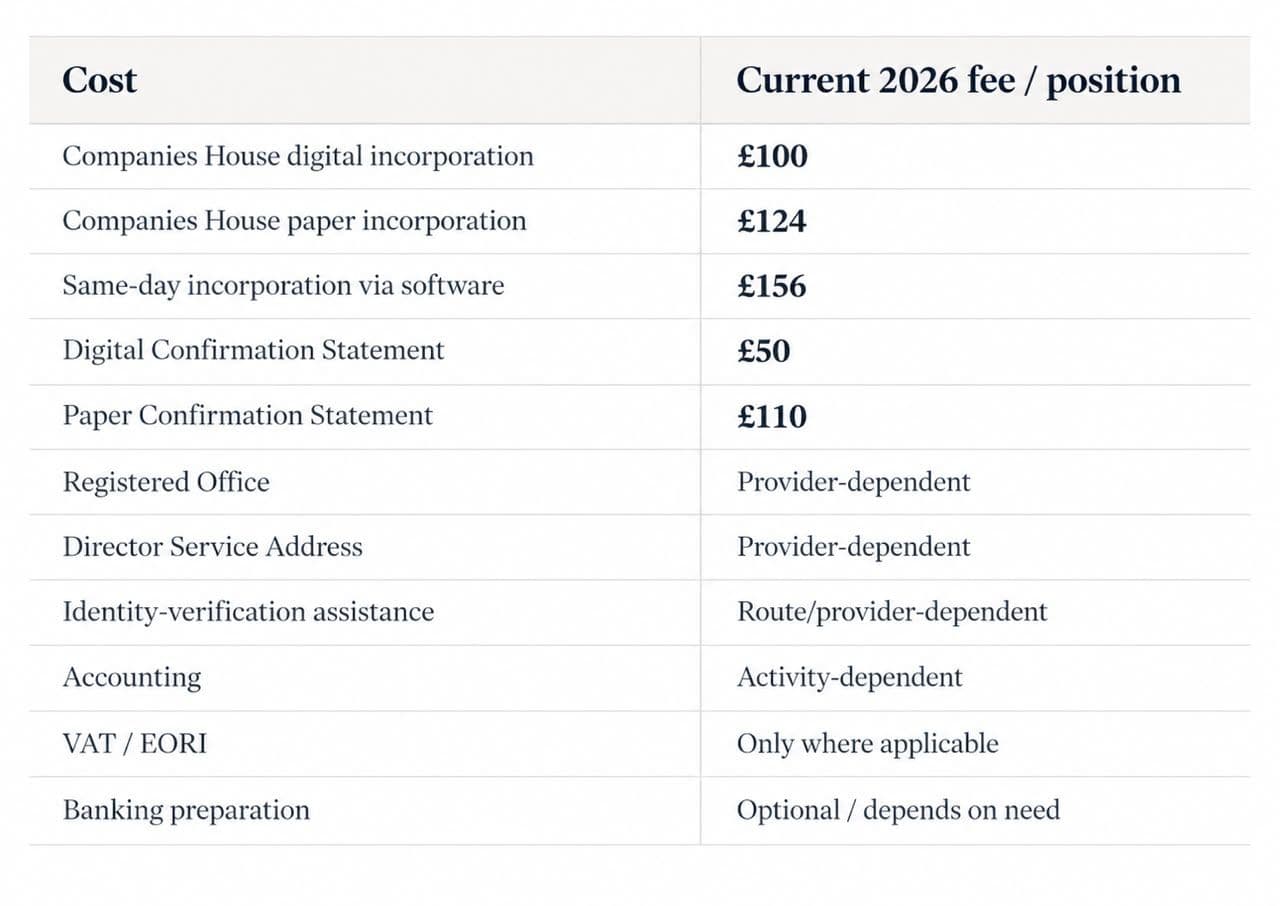
£100 creates the legal company. It does not automatically provide the infrastructure a non-resident founder may need to operate it.
Need more than direct Companies House filing?
Seven Oak Prestige offers non-resident formation packages from £199, depending on the level of UK address, compliance and operational support required.
View UK Company Formation Packages →
https://www.sevenoakprestige.com/
Have a question?→ Talk to an expert
1. The Official Companies House Cost: £100
The standard online incorporation fee is currently £100.
Companies House also offers:
- £124 paper incorporation;
- £156 same-day incorporation through qualifying software.
The incorporation fee covers the legal registration of the company.
It does not automatically include:
- a Registered Office service;
- Director Service Address;
- mail handling;
- identity-verification assistance;
- banking support;
- accounting;
- VAT;
- EORI;
- ongoing professional support.
This is why two providers can both advertise “UK company formation” while including very different services.
2. What Does a Non-Resident Usually Need Beyond £100?
For most overseas founders, there are five areas to examine.
Registered Office
Every UK company needs an appropriate Registered Office in the correct UK jurisdiction.
If you do not already have a suitable UK address, you may need a professional address service.
Director Service Address
Every director has a service address that appears publicly.
Many non-resident founders use a professional service address rather than publishing their overseas residential address.
Registered Office and Director Service Address perform different functions even if the same physical location is used.
Read our UK Registered Office vs Director Service Address for Non-Residents.
Companies House Identity Verification
Companies House identity verification is now part of the statutory framework for relevant directors and PSCs.
The direct GOV.UK route may be free where available. Professional or authorised-provider assistance may involve a separate fee.
Read our Companies House Identity Verification for Non-Residents — Complete 2026 Guide.
Accounting and Annual Compliance
After incorporation, the company still has ongoing obligations.
These may include:
- annual accounts;
- Confirmation Statement;
- accounting records;
- Corporation Tax compliance;
- HMRC correspondence.
The digital Confirmation Statement currently costs £50.
Banking and Payments
A UK company does not automatically guarantee:
- a bank account;
- Wise;
- Revolut;
- Stripe;
- Airwallex;
- Payoneer;
- or another financial provider.
Providers make their own decisions based on residence, activity, ownership, expected transactions and KYC/KYB.
For a deeper explanation, see our UK Business Banking for Non-Residents — Banks, Fintechs & Eligibility.
3. Seven Oak Prestige Packages
Not every founder needs the same level of support.
Starter — £199
Best suited to founders who mainly need professional incorporation support and already have suitable UK address arrangements.
Typical scope includes:
- UK company formation;
- Companies House filing;
- digital company documents;
- core compliance guidance.
Prestige — £299
Designed primarily for non-resident founders who also require UK address infrastructure.
Typical scope includes:
- everything in Starter;
- Registered Office;
- Director Service Address;
- eligible mail handling/scanning;
- additional compliance support according to the package scope.
Recommended for Non-Resident Founders
Elite — £399
Designed for founders requiring broader operational support.
Typical scope includes:
- everything in Prestige;
- Virtual Business Address;
- Companies House Identity Verification for one director;
- priority support;
- banking and payment-account preparation;
- best-fit provider recommendations;
- document preparation and review;
- application assistance.
Most Comprehensive
Banking or payment-provider approval is never guaranteed.
For a broader comparison of direct filing and formation providers, read Best UK Company Formation Services for Non-Residents in 2026.
4. First-Year Cost vs Renewal Cost
One of the biggest mistakes is comparing only the first payment.
Some costs are one-off.
Others recur.
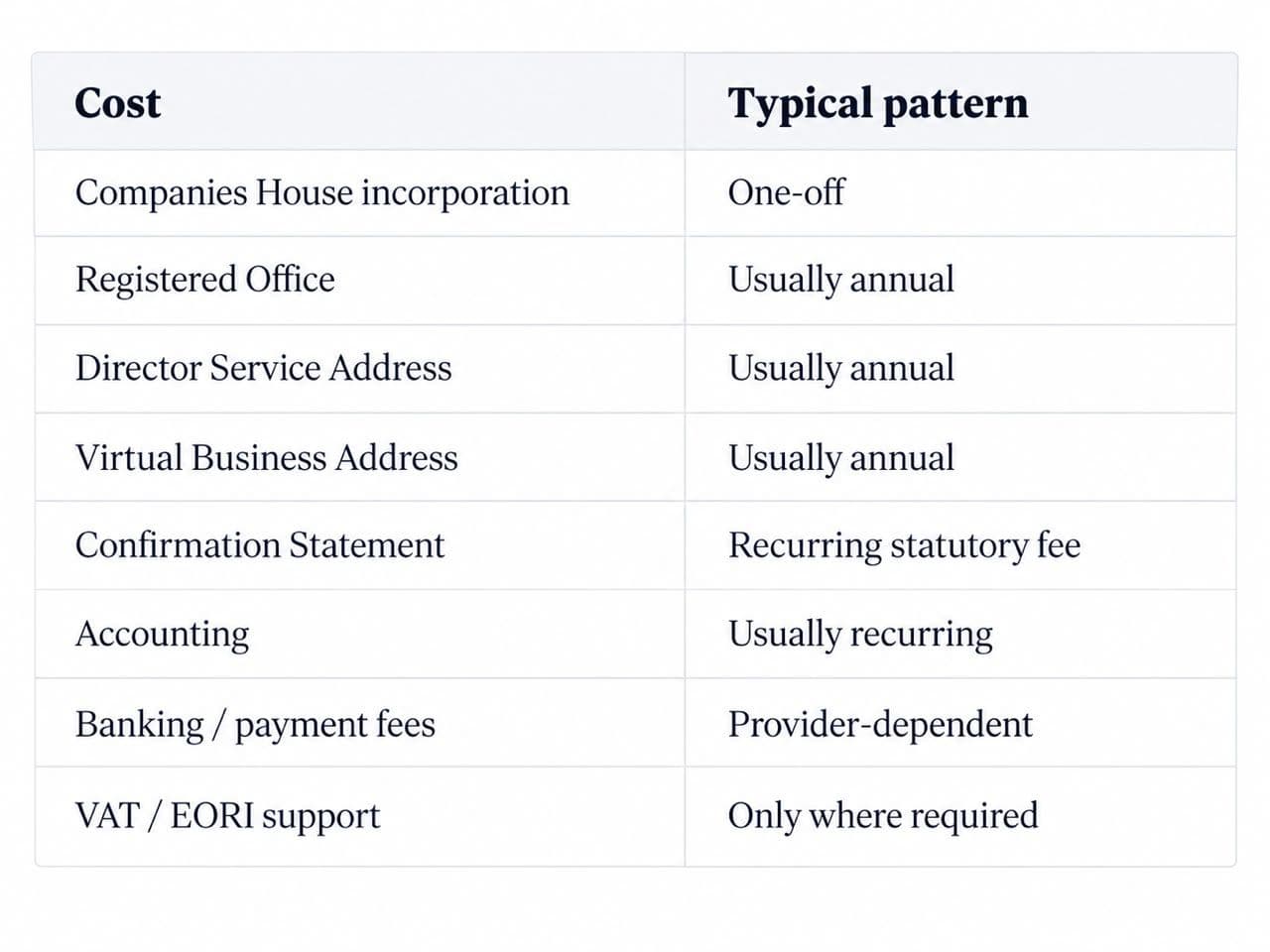
Before purchasing, check:
- what is included in year one;
- which services renew;
- whether renewals are optional;
- which statutory fees are separate;
- whether forwarding or scanning creates additional charges.
The cheapest headline price is not always the lowest total cost of ownership.
5. What Does a Cheap UK Company Formation Offer Really Include?
A low-cost formation service is not automatically poor value.
For some founders, direct filing or a very basic service is exactly what they need.
The important point is to compare like-for-like.
For example:
£100 Companies House filing only
is different from:
£199 formation package
and both are different from:
£299 formation + UK address infrastructure
Before paying, check whether the price includes:
- Companies House fee;
- Registered Office;
- Director Service Address;
- mail handling;
- identity-verification assistance;
- company documents;
- compliance support;
- banking preparation;
- renewals.
The comparison should be based on scope, not just the headline price.
6. Realistic Cost by Founder Profile
Different businesses need different infrastructure.
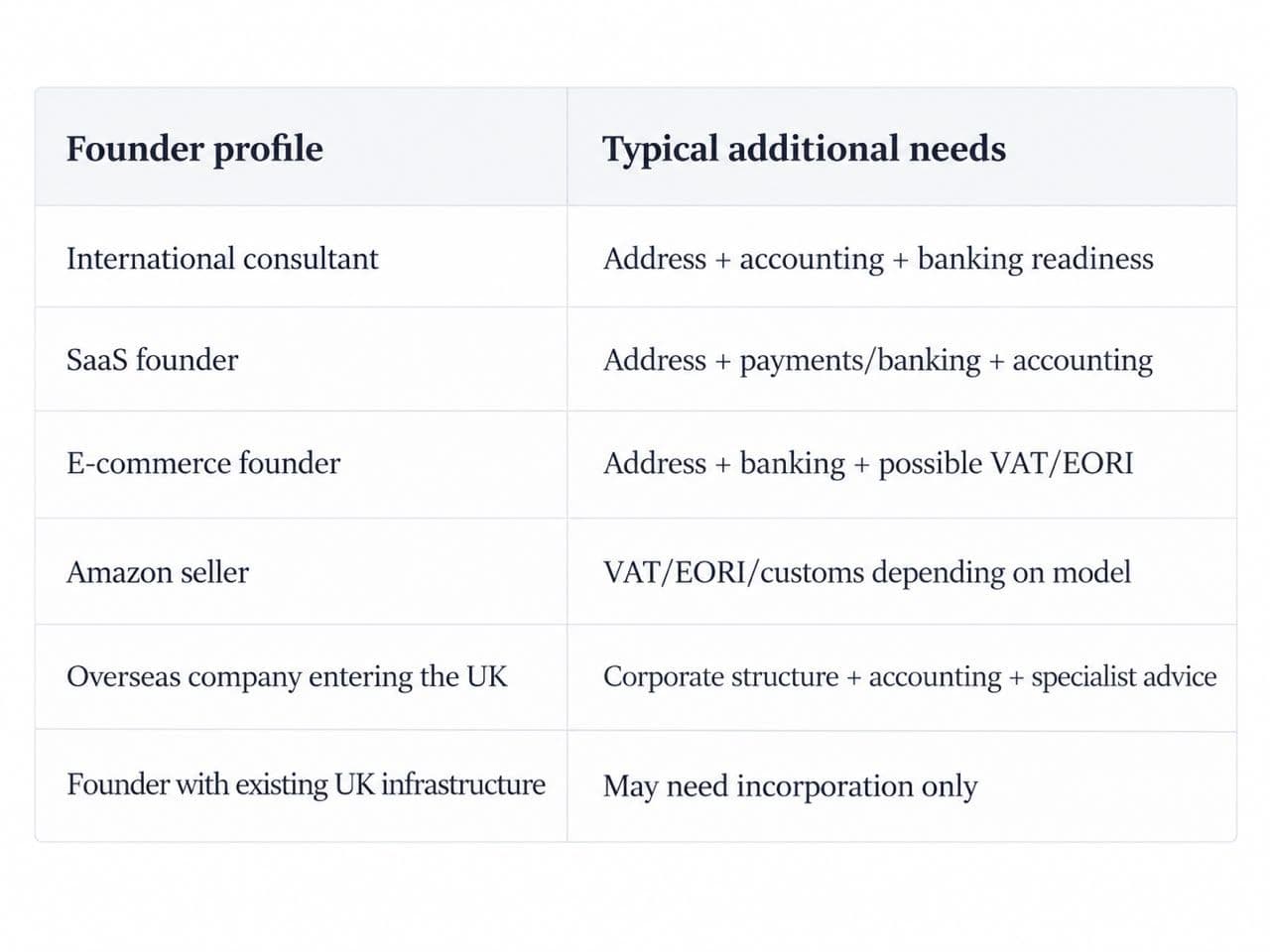
There is therefore no single “true cost” for every non-resident.
An international consultant should not be budgeted in the same way as an importer holding stock in the UK.
For e-commerce specifically, read our UK E-Commerce Company for Non-Residents — 2026 Guide
7. Do You Need VAT?
Not automatically.
VAT depends on factors such as:
- what you sell;
- where customers are located;
- whether customers are businesses or consumers;
- where inventory is stored;
- applicable registration rules.
A consultant and an e-commerce importer should not receive the same VAT answer.
Do not add VAT registration to every formation budget by default.
8. Do You Need EORI?
Not simply because you own a UK company.
An EORI is mainly relevant to customs-related activities such as importing or exporting goods.
A digital consultancy may never need one.
An importer or Amazon seller may.
9. How Much Does Banking Add?
There is no universal amount.
A provider may charge:
- no monthly fee;
- a monthly subscription;
- transfer fees;
- FX margins;
- card charges;
- receiving fees.
For many international founders, the bigger issue is eligibility and preparation, not the account fee itself.
A properly prepared application should clearly explain:
- business activity;
- ownership;
- source of funds;
- expected transactions;
- markets;
- website;
- clients and suppliers where relevant.
For a broader explanation, read UK Business Banking for Non-Residents — 2026 Guide
10. Costs After Incorporation
The company continues to create obligations after Companies House issues the Certificate of Incorporation.
Potential ongoing costs include:
- accounting;
- Confirmation Statement;
- Registered Office renewal;
- Director Service Address renewal;
- mail handling;
- Corporation Tax compliance;
- VAT where applicable;
- payroll where applicable;
- banking and payments;
- specialist cross-border advice.
For the complete post-incorporation sequence, read What Happens After You Register a UK Company as a Non-Resident?
11. Can You Form a UK Company for Only £100?
Yes.
Direct Companies House filing can make sense if you already:
- have an appropriate UK Registered Office;
- understand directors, shareholders and PSCs;
- can handle identity verification;
- understand your filing obligations;
- do not need professional formation support.
For an experienced founder, that can be perfectly reasonable.
For a founder operating entirely from overseas without UK address infrastructure or familiarity with Companies House, the practical setup cost may be higher.
Neither route is automatically better.
12. What Should You Compare Before Paying?
Before purchasing a formation package, check the following.
Companies House filing
Is the government filing fee included?
Registered Office
Is it included, and for how long?
Director Service Address
Is it included separately?
Mail handling
What is scanned, forwarded or charged separately?
Identity Verification
Does the package include statutory Companies House identity-verification assistance, or is it separate?
Renewal pricing
What happens after the first 12 months?
Banking support
Does “banking support” mean:
- guidance;
- provider recommendations;
- document preparation;
- introduction;
- application assistance?
It should never be interpreted as guaranteed approval.
Post-incorporation compliance
What happens after the Certificate of Incorporation is issued?
A package is good value when the scope matches what the founder actually needs.
Frequently Asked Questions
How much does it cost to register a UK company in 2026?
The standard Companies House digital incorporation fee is £100.
Paper incorporation costs £124, while qualifying same-day software incorporation costs £156.
Is £100 the total cost of setting up a UK company?
Not necessarily.
Non-resident founders may also need UK address services, accounting, compliance support, identity-verification assistance or banking preparation.
Do non-residents pay a higher Companies House incorporation fee?
No separate higher standard digital incorporation fee applies simply because the founder lives overseas.
The standard digital incorporation fee is £100.
How much is the Confirmation Statement in 2026?
It costs £50 digitally or £110 on paper.
Is a Registered Office included in the £100?
No.
The Companies House fee is the statutory filing fee. It does not provide an address service.
Do I need a Director Service Address?
Every director has a service address.
You do not necessarily need to purchase a separate professional service, but many overseas founders use one rather than showing their residential address publicly.
Is Companies House identity verification an extra cost?
The direct Companies House route may be free where available.
A professional or authorised-provider service may charge for assistance.
Do I automatically need VAT?
No.
VAT depends on your business model and the applicable rules.
Do I automatically need an EORI?
No.
EORI is mainly relevant where your company carries out customs activities involving goods.
Does a formation package guarantee a UK business bank account?
No.
Banks and payment providers make independent onboarding and risk decisions.
Which Route Makes Sense?
Direct Companies House Filing — £100
Best where you already understand the process and have the infrastructure required.
Starter — £199
Best where you mainly require professional incorporation support.
Prestige — £299
Best for many non-resident founders who also require UK Registered Office and Director Service Address infrastructure.
Elite — £399
Best where incorporation is part of a broader operational and banking-readiness project.
The best-value option is the one that matches your actual requirements — not automatically the cheapest or the most expensive.
Ready to Set Up Your UK Company?
Seven Oak Prestige focuses primarily on international and non-resident founders.
We can help you understand the likely formation and first-year setup cost before you choose a package.
View UK Company Formation Packages →
https://www.sevenoakprestige.com/
Have a question? →Talk to an expert
Related Guides
UK Company Formation for Non-Residents — Complete 2026 Guide
Complete incorporation process, directors, shareholders, addresses and Companies House requirements.
Best UK Company Formation Services for Non-Residents in 2026
Compare direct Companies House filing with professional formation providers.
UK Registered Office vs Director Service Address for Non-Residents
UK address requirements, privacy and public-register considerations.
Companies House Identity Verification for Non-Residents
Identity verification, directors, PSCs and personal codes.
UK Business Banking for Non-Residents
Banks, fintechs, eligibility, KYC and banking readiness.
What Happens After UK Company Formation?
Post-incorporation compliance checklist.
UK E-Commerce Company for Non-Residents
VAT, EORI, inventory, imports and e-commerce considerations.
UK Company Formation Cost from India — 2026 Fees
Country-specific cost analysis for Indian founders.
UK Ltd depuis la France : Prix et Coûts en 2026
France-specific first-year and recurring cost analysis.
About the Author
Isaac Jackson — Founder & Managing Director, Seven Oak Prestige Ltd
Isaac Jackson has more than three years of hands-on experience supporting international founders with UK company formation, address solutions, Companies House processes, compliance preparation and banking readiness.
Editorial Methodology
This guide was reviewed against:
- the current Companies House fee schedule;
- current Companies House incorporation requirements;
- Seven Oak Prestige’s current formation packages;
- the non-resident formation content architecture;
- recurring cost and renewal issues relevant to international founders.
Last reviewed: 7 September 2026
Editorial Disclaimer
This guide provides general educational information.
It does not constitute legal, tax, accounting or financial advice.
Actual costs depend on the company, founder, business activity and services selected.
Companies House fees and provider pricing can change. Always check the applicable fee before filing.
Official Sources Reviewed
- Companies House — Companies House Fees
- Companies House — Register a Private Limited Company
- Companies House — Confirmation Statement Guidance
- Companies House — Identity Verification Guidance