
UK Company Formation from Germany: Ltd vs GmbH, Tax & UK Market Entry (2026)

UK Company Formation from Germany: UK Ltd, GmbH or UK Subsidiary? 2026 Guide
A person living in Germany can generally establish, own and direct a UK private limited company without moving to Britain.
But for a German founder, the most important question is rarely:
“Can I register a UK company?”
In most ordinary cases, the answer is yes.
The more important question is:
“Should I personally own a UK Ltd, use a German GmbH or UG, create a UK subsidiary of an existing German company, register a UK establishment, or continue trading from Germany without creating another entity?”
That is a much more consequential decision.
A company can be incorporated at Companies House while:
- management remains in Germany;
- employees work in Germany;
- inventory sits in Germany;
- contracts are negotiated in Germany;
- the founder makes every strategic decision in Germany.
Those facts can affect German taxation, corporate residence, permanent-establishment analysis, VAT and ongoing reporting.
German corporation-tax law can bring entities within German tax where their seat or place of management is in Germany, and German tax law defines the place of management as the centre of commercial direction.
So:
UK incorporation does not automatically move the economic business out of Germany.
That principle should be understood before choosing the entity.
For the general non-resident incorporation process, first see UK Company Formation for Non-Residents: Complete 2026 Guide.
UK Company from Germany: Quick Answer
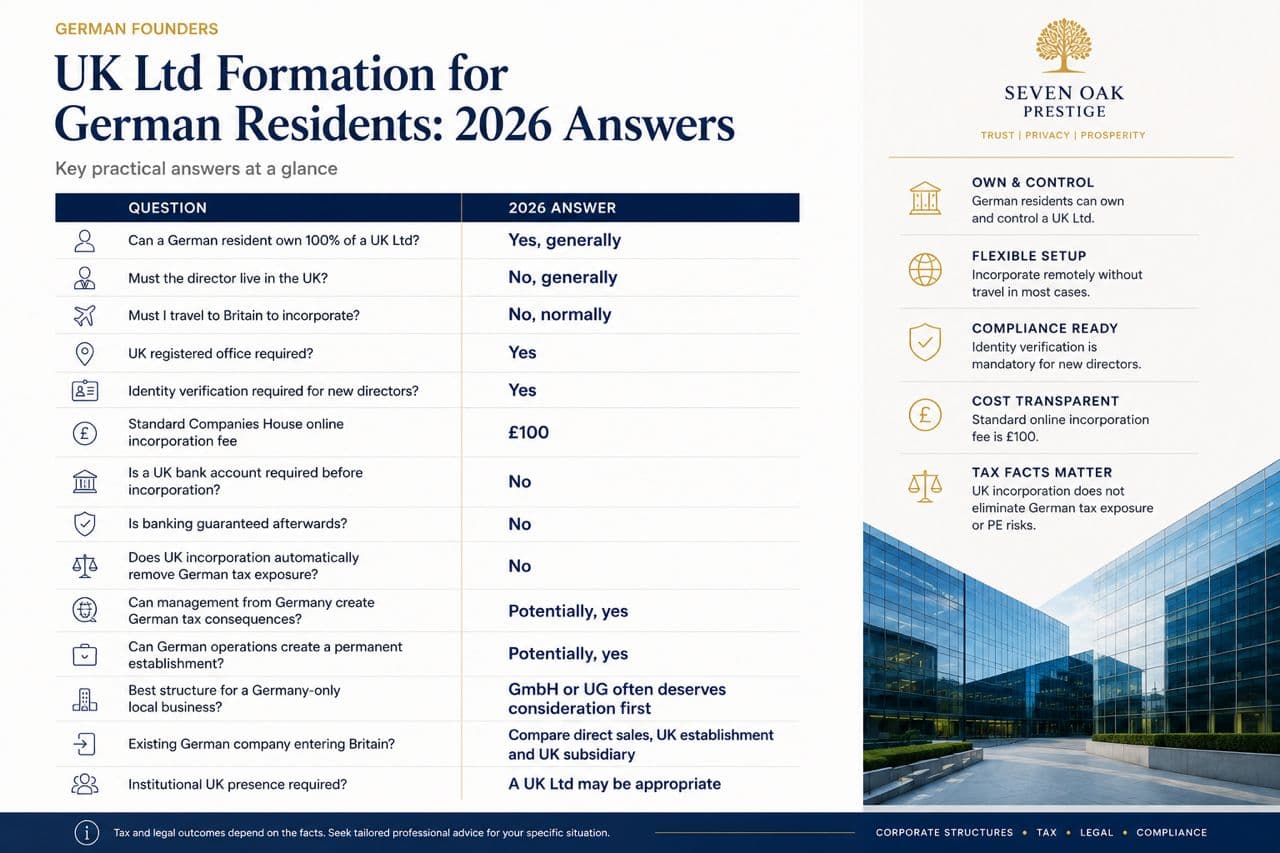
Companies House currently charges £100 for standard digital incorporation. The digital Confirmation Statement fee is currently £50 in the relevant annual payment period.
1. Who Is This Guide For?
There are really two different Germany-to-UK audiences.
Understanding which one you are in changes the entire structure.
German individual founder
For example:
- SaaS founder in Berlin;
- consultant in Munich;
- agency owner in Hamburg;
- e-commerce founder in Frankfurt.
This person may be comparing:
UK Ltd
vs
GmbH
vs
UG
and asking:
- which is easier to establish?
- where will the company be taxed?
- can I operate from Germany?
- what about VAT?
- can I obtain UK banking?
- does the UK Ltd create any real advantage?
Existing German company entering the UK
This is a different question.
An established GmbH may be considering:
German GmbH → UK subsidiary
or:
German GmbH → UK establishment
or:
continue selling directly from Germany
without creating another company.
That analysis can involve:
- employees;
- contracts;
- UK customers;
- local sales operations;
- warehousing;
- VAT;
- customs;
- banking;
- transfer pricing;
- group governance.
For an established German business, the incorporation form is only one part of market entry.
2. What Is the UK Equivalent of a German GmbH?
This is one of the questions already appearing in Seven Oak Prestige’s Google Search Console data.
The closest commonly used commercial comparison is usually the:
UK private company limited by shares — Ltd
Both GmbH and UK Ltd are limited-liability corporate vehicles.
But they are not legally or fiscally identical.
A GmbH is governed by German corporate law.
A UK Ltd is governed by UK company law.
They differ in areas such as:
- formation procedure;
- minimum capital;
- notarial requirements;
- public filing;
- governance;
- company taxation;
- local compliance.
Germany Trade & Invest confirms that a GmbH requires minimum share capital of €25,000, with at least €12,500 generally contributed for registration of a standard cash-formed GmbH. Registration is made through the German commercial register via a notary.
A UK Ltd does not have an equivalent statutory €25,000 minimum-capital requirement.
That makes the UK company easier to establish financially.
But:
lower formation capital does not automatically mean a better long-term structure.
3. UK Ltd vs GmbH vs UG
A German founder should understand all three before deciding.
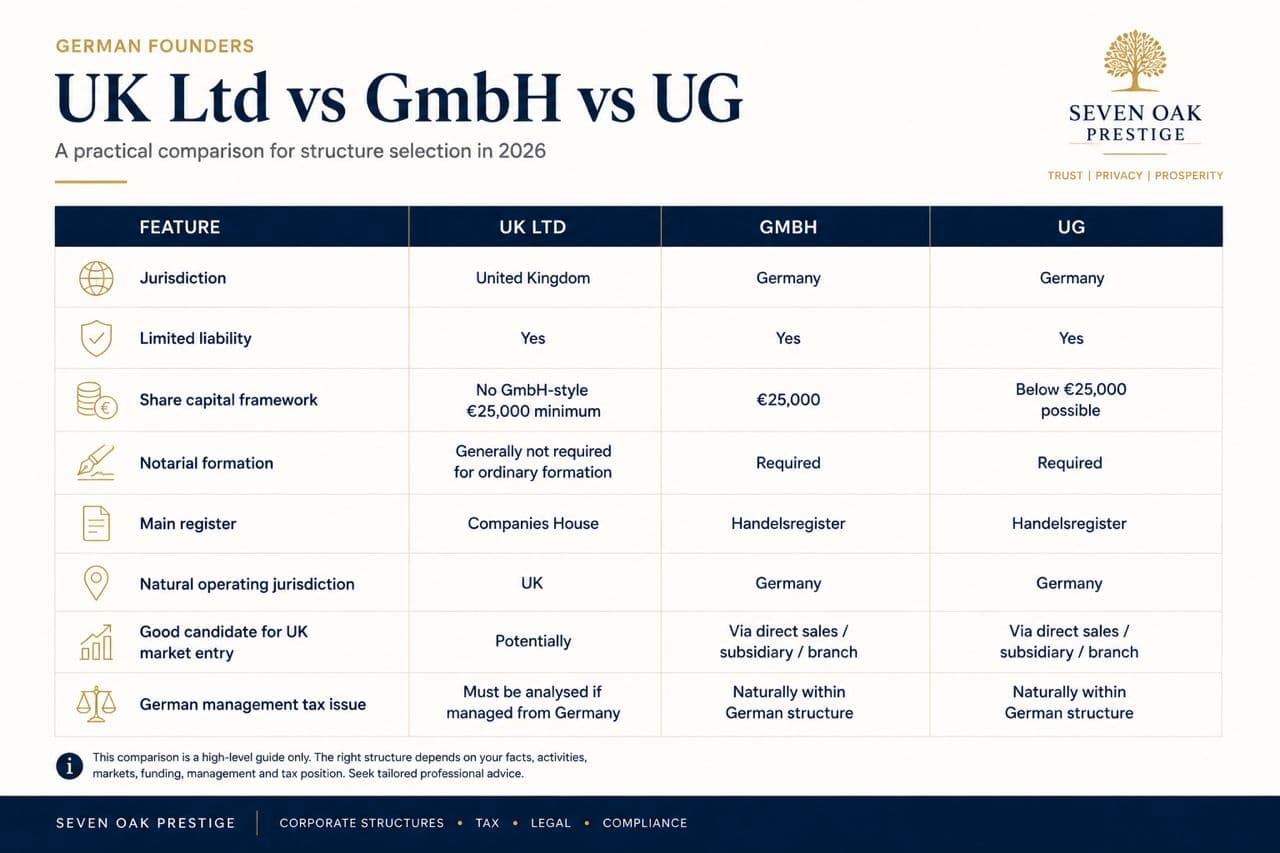
The German UG — Unternehmergesellschaft (haftungsbeschränkt) — is effectively a lower-capital version of the GmbH. Germany Trade & Invest notes that a UG can begin below the GmbH’s €25,000 capital level but generally must retain part of its profits until sufficient capital has accumulated.
Which is better?
There is no universal answer.
If a business is:
- managed in Germany;
- staffed in Germany;
- selling overwhelmingly to Germany;
- storing its assets in Germany;
- serving mostly German customers;
then a German GmbH or UG may be the more natural structure.
A UK Ltd becomes more convincing when there is a genuine British commercial function.
4. When Does a UK Ltd Make Commercial Sense for a German Founder?
A UK company may deserve serious consideration where the business has real reasons to operate through Britain.
Examples include:
UK customers
A British contracting and invoicing entity can be commercially useful for substantial UK business.
UK employees
A growing company may want to employ people directly through a UK entity.
UK operations
The company may establish:
- sales;
- operations;
- partnerships;
- local suppliers;
- fulfilment;
- offices.
UK investment
A UK corporate structure can be relevant where British investors, shareholders or group arrangements are expected.
UK e-commerce operations
A business holding goods in Britain or operating substantial UK fulfilment may have stronger reasons for a UK entity.
UK subsidiary of a German group
An existing GmbH may prefer to place UK activity in a legally separate subsidiary.
These are real commercial rationales.
Less persuasive reasons include:
- “UK companies are cheap”;
- “I heard UK tax is lower”;
- “I want Stripe”;
- “I want a British company for credibility”;
- “someone promised me a bank account”.
A legal entity should solve a business problem.
5. German Company Entering the UK: Do You Need a UK Subsidiary?
Not necessarily.
This is where many formation articles start from the wrong assumption.
A German company wanting British customers can have several possible routes.
Option 1 — Continue selling from Germany
A German company may be able to serve UK customers directly.
This can be appropriate where it has:
- no meaningful UK base;
- no UK employees;
- no separate British operation;
- limited local infrastructure.
A UK company should not be created simply because the company has British customers.
Tax, VAT, customs and contractual questions can still arise, but customer location alone does not always require a subsidiary.
Option 2 — Register a UK establishment
Companies House requires an overseas company to register where it establishes a place of business in the UK or usually carries on business from somewhere in Britain.
The current registration fee for a UK establishment of an overseas company is £124.
This does not create a completely separate parent/subsidiary legal structure in the way a new Ltd does.
Instead, the German company operates through its UK establishment.
That can be relevant where the parent wants the UK operation to remain legally part of the German company.
Option 3 — Create a UK subsidiary
A German GmbH may instead own a separate UK private limited company.
Structure:
German GmbH
↓
UK Ltd subsidiary
This can make sense where the company wants:
- separate UK contracts;
- separate UK liability;
- local employees;
- UK banking;
- a British operating company;
- clearer local management;
- acquisitions;
- investment;
- a distinct UK P&L.
The decision between subsidiary and establishment should be driven by commercial and tax structure, not registration fee alone.
6. UK Subsidiary vs UK Establishment for a German Company
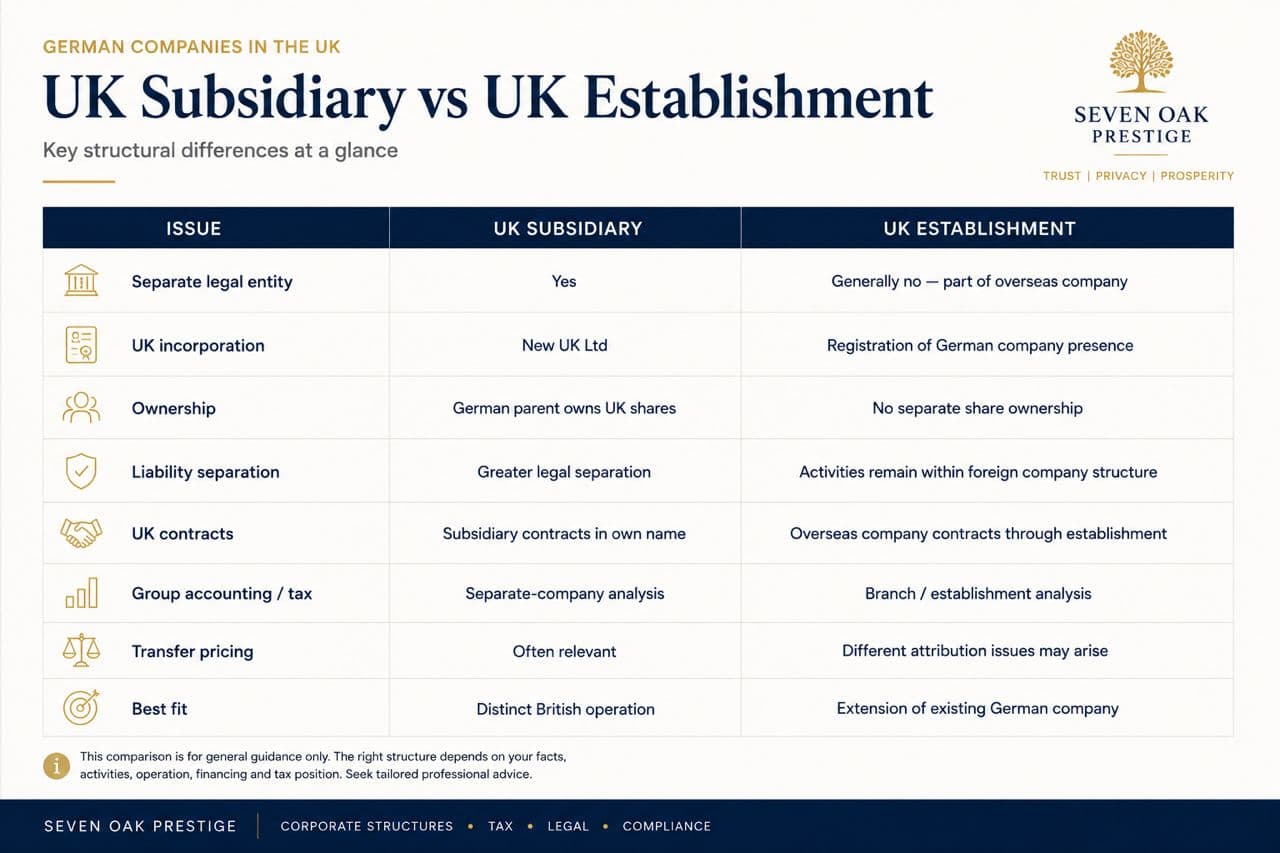
Companies House also imposes specific filing and disclosure requirements on overseas companies with registered UK establishments.
This is why an established German company should not automatically choose a new UK Ltd before comparing the two routes.
7. How to Form a UK Ltd From Germany
For a founder who has decided that the UK company is commercially appropriate, the formation process is relatively straightforward.
Step 1 — Define why the UK entity exists
Write one clear sentence.
For example:
The UK company will contract with British customers and operate our UK sales activity.
or:
The UK company will be the British subsidiary of our German software group.
If that sentence cannot be written clearly, reconsider the structure.
Step 2 — Decide who owns the company
Possible structures include:
German individual → UK Ltd
or:
German GmbH → UK Ltd
These are not economically identical.
Choose ownership before incorporation rather than restructuring immediately afterwards.
Step 3 — Determine directors and PSCs
Identify the real people who manage and control the company.
Do not add unnecessary UK directors simply to create an artificial appearance of British management.
Company records should reflect reality.
Step 4 — Set the share structure
For a straightforward one-founder business, ordinary shares may be sufficient.
For:
- German parent companies;
- multiple founders;
- investors;
- preference rights;
more planning may be appropriate.
Step 5 — Arrange the UK registered office
Every UK company requires an appropriate registered office in its UK jurisdiction.
The registered office is not automatically:
- a trading address;
- the director’s residence;
- proof of local business activity.
For the detailed distinction, see UK Registered Office vs Director Service Address for Non-Residents.
Step 6 — Complete Companies House identity verification
Since 18 November 2025, identity verification has become mandatory for new directors and is also part of the PSC compliance framework.
Individuals can verify directly using an available Companies House route or through an authorized ACSP.
A biometric passport from any country is among the documents supported by GOV.UK One Login.
Once verified, an individual receives a Companies House personal code.
The same personal code can be used across multiple relevant company roles.
For the detailed process, see Companies House Identity Verification for Non-Residents — Complete 2026 Guide.
Step 7 — Choose the correct SIC code
Your SIC code should describe the actual business activity.
Do not choose an unrelated activity because somebody claims it is:
- easier for banking;
- safer for compliance;
- less likely to be reviewed.
Providers assess the real business.
Step 8 — Submit the incorporation
Companies House currently charges £100 for standard digital company incorporation.
The company legally exists once Companies House completes incorporation.
Step 9 — Review the registered information
Check:
- company name;
- number;
- directors;
- shareholders;
- PSCs;
- shares;
- registered office;
- SIC codes.
Incorrect data can create unnecessary problems later during:
- banking;
- accounting;
- tax registration;
- commercial due diligence.
Step 10 — Move into post-incorporation readiness
After formation, the company may need to address:
- accounting;
- banking;
- Corporation Tax;
- VAT;
- EORI;
- payroll;
- contracts;
- annual accounts;
- Confirmation Statement.
Read What Happens After You Register a UK Company as a Non-Resident?
8. Will Germany Tax a UK Ltd Managed From Germany?
Potentially.
This is one of the most important sections in this article.
German corporation-tax rules can apply to relevant entities whose seat or place of management is in Germany.
German law defines Geschäftsleitung as:
the centre of commercial management.
Imagine a UK Ltd whose sole founder lives in Munich.
Every day, the founder:
- makes strategic decisions from Munich;
- negotiates contracts there;
- directs employees from there;
- controls the bank account there;
- performs the company’s work there.
It would be unsafe to assume:
“The company is UK-only for tax because Companies House says London.”
The tax analysis considers more than the registration certificate.
HMRC’s own company-residence guidance specifically recognises Germany as a jurisdiction that can treat a company as resident based on where its management or “real seat” is located.
A German founder should therefore obtain appropriate German tax advice where the British company will be materially managed from Germany.
9. UK–Germany Double Tax Treaty and Dual Residence
The United Kingdom and Germany have a Double Taxation Convention.
Where a company or other non-individual person would otherwise qualify as resident in both countries under domestic rules, the treaty provides that it is treated as resident in the state where its place of effective management is located.
This matters because:
double tax treaty ≠ no tax
and:
double tax treaty ≠ automatic UK residence.
The treaty determines how taxing rights are allocated and can provide mechanisms to relieve qualifying double taxation.
It also covers:
- permanent establishments;
- business profits;
- dividends;
- interest;
- royalties;
- associated enterprises;
- relief from double taxation.
The actual outcome depends on the structure and facts.
10. Can a UK Ltd Have a German Permanent Establishment?
Potentially.
German tax law defines a Betriebsstätte as a fixed business facility or installation serving the activity of an enterprise.
Examples include:
- place of management;
- branch;
- office;
- factory/workshop;
- warehouse;
- sales or purchasing location.
The UK–Germany treaty also contains a permanent-establishment definition covering fixed places of business including places of management, branches and offices.
That means a UK company can remain legally incorporated in Britain but still create meaningful German tax presence through its operations.
Examples can include:
UK Ltd + permanent office in Germany
UK Ltd + German warehouse
UK Ltd + German management location
UK Ltd + substantive German sales operation
Whether a permanent establishment actually exists depends on the facts.
11. What About Employees Working From Germany?
Employees create another layer.
A UK company employing someone who works from Germany can potentially face questions around:
- German payroll;
- social security;
- wage tax;
- employer registration;
- labour law;
- permanent establishment.
Likewise, simply calling someone a “contractor” does not automatically determine their legal status.
If the UK company will build a genuine German workforce, local professional advice should be obtained before hiring.
12. German GmbH and UK Subsidiary: Transfer Pricing
Once a German parent and UK subsidiary trade with each other, the relationship becomes a cross-border related-party relationship.
Transactions may include:
- management services;
- software development;
- staff support;
- marketing;
- licensing;
- intellectual property;
- financing;
- shared costs;
- commissions.
The UK–Germany treaty contains an associated-enterprises provision based on the principle that related-company arrangements should reflect commercial conditions comparable to those between independent businesses.
This can make:
- intercompany agreements;
- invoices;
- pricing methodology;
- documentation;
important.
A German parent should not simply transfer money back and forth with its UK subsidiary without a commercial basis.
13. UK Corporation Tax
A UK company normally has a UK Corporation Tax position, subject to the relevant residence and treaty rules.
Current ordinary rates include:
- 19% small profits rate for qualifying profits of £50,000 or less;
- 25% main rate above £250,000;
- Marginal Relief can apply between the thresholds.
Those limits can be affected by associated companies and certain accounting-period rules.
The important point for a German founder is:
UK Corporation Tax does not automatically replace every German tax consequence.
Company-level UK taxation and German residence or owner-level taxation should be analysed together.
For the broader framework, read our UK Company Tax for Non-Residents.
14. UK VAT and German VAT After Brexit
Post-Brexit trade makes this section particularly important.
The United Kingdom and Germany no longer sit inside a single EU VAT/customs environment in the same way they did before Brexit.
A German business therefore needs to distinguish:
German/EU VAT
from:
UK VAT.
Whether UK VAT registration is required can depend on:
- establishment;
- taxable turnover;
- goods or services;
- customer location;
- inventory;
- marketplace arrangements;
- place-of-supply rules.
A company that is not established in the UK can also face VAT rules that differ from the ordinary UK-established threshold framework.
So:
“We are below £90,000 turnover” is not enough to answer every German-to-UK VAT question.
The business model needs to be analysed.
15. Customs, Imports and EORI
A Germany–UK goods business should plan the physical supply chain before incorporating.
Relevant questions include:
- Where will goods be stored?
- Who exports from the EU?
- Who imports into Britain?
- Who acts as importer of record?
- Is a UK EORI needed?
- Is an EU/German EORI needed?
- Where is import VAT paid?
- Which customs declarations are required?
- What Incoterms are being used?
For e-commerce, these questions can matter more than the nominal incorporation fee.
Read UK E-Commerce Company for Non-Residents for the wider operating framework.
16. Can a German Founder Get UK Business Banking?
Potentially.
But incorporation does not guarantee banking.
A UK bank, EMI or fintech can assess:
- director residence;
- shareholder residence;
- UBO structure;
- business activity;
- operating address;
- website;
- customers;
- suppliers;
- expected turnover;
- transaction countries;
- source of funds;
- source of wealth;
- regulatory exposure.
The key principle is:
The banking application should tell the same story as the company structure.
For example:
Companies House says:
software consultancy
Website says:
software consultancy
Contracts show:
software services
Expected payments come from:
actual software customers
That coherence matters.
A British company should not be used to create the appearance of UK operations that do not exist.
17. UK Ltd for German SaaS and Technology Founders
A UK company may fit a German SaaS founder where there is a real British commercial rationale.
Relevant questions include:
- Which company owns the IP?
- Where do developers work?
- Where are customers?
- Where is management?
- Which company enters customer contracts?
- Will investors own shares?
- Is the UK part of the future funding strategy?
If the founder lives, works and manages everything in Germany while using the UK company merely to invoice globally, the tax analysis deserves special attention.
If the business is building real UK operations, the case for a UK company is stronger.
18. UK Ltd for German E-Commerce Businesses
For e-commerce, entity choice should follow logistics.
UK Ltd may make sense where:
- inventory is held in Britain;
- Amazon UK is important;
- UK fulfilment is used;
- British customers are a major market;
- UK imports are material.
German company may remain sufficient where:
- the business operates primarily from Germany;
- goods remain in EU fulfilment;
- UK sales are limited;
- no distinct British operation is required.
Again:
the supply chain should drive the entity decision.
19. UK Ltd for Consultants and Agencies in Germany
A German consultant or agency founder should ask:
- Where are services physically performed?
- Where are clients?
- Where is management?
- Which company enters the contracts?
- Will profits be retained?
- Which jurisdiction taxes the founder?
- Is there genuine UK commercial activity?
A London incorporation address alone does not turn work performed in Germany into British economic activity.
20. When a UK Ltd May Be the Wrong Choice
A UK company deserves reconsideration where:
Your business is entirely German
German clients.
German management.
German staff.
German office.
German operations.
No material British market.
A GmbH or UG may be simpler.
Your only objective is Stripe or banking
Formation does not guarantee provider acceptance.
Your only objective is “lower tax”
Tax treatment cannot be determined from the incorporation jurisdiction alone.
You actually need a German company
If the operating substance sits entirely in Germany, adding a British entity can create additional rather than reduced compliance.
You cannot explain the UK commercial rationale
This is a useful test.
If someone asks:
“Why does this business need a UK company?”
you should be able to provide a concrete operational answer.
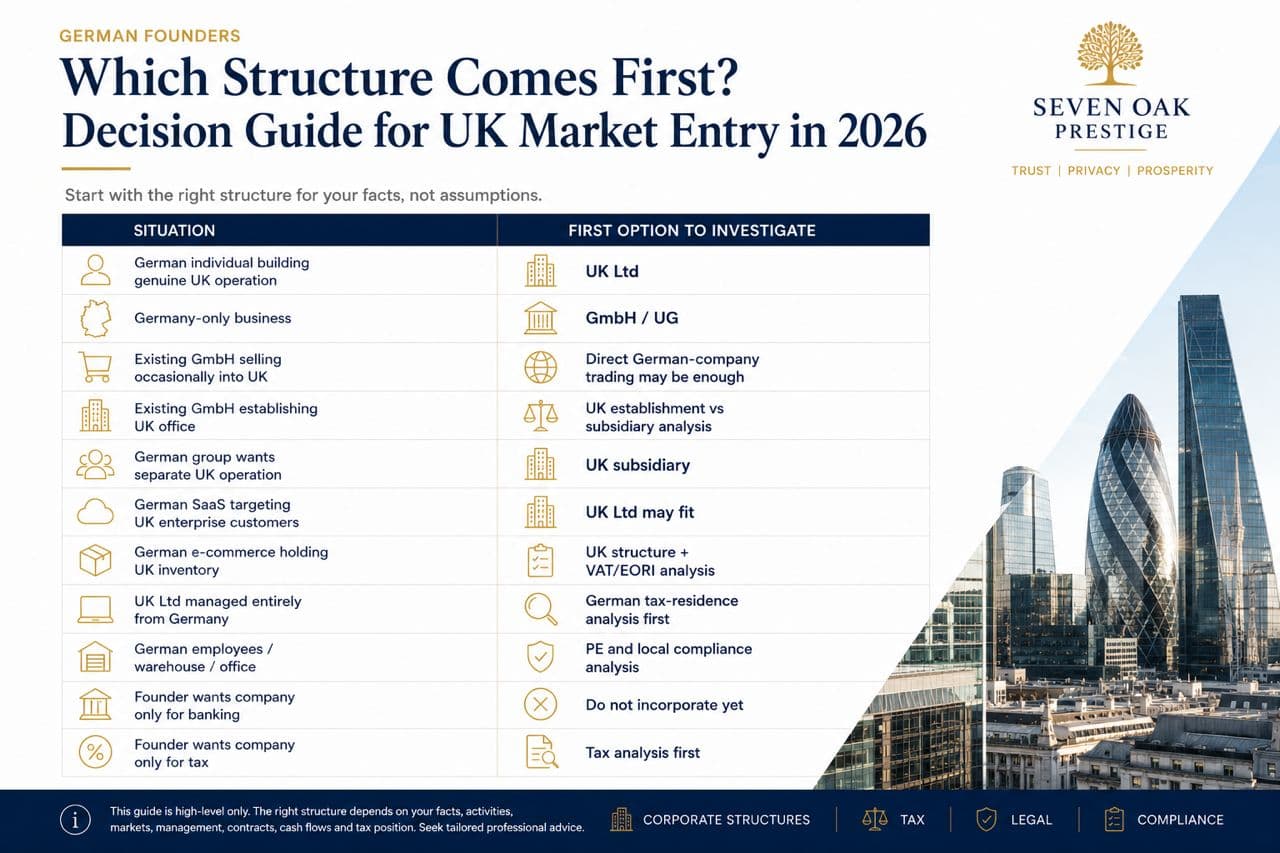
21. Germany → UK Market Entry Decision Matrix
22. Germany-to-UK Pre-Incorporation Checklist
Before registering the company, answer these questions.
Commercial purpose
Why does the UK entity exist?
Ownership
Will it be owned by:
- German individual?
- German GmbH?
- several founders?
- another group company?
Management
Where will major business decisions actually be made?
Employees
Will anyone work:
- in Germany?
- in Britain?
- remotely elsewhere?
Customers
Are revenues primarily:
- German;
- British;
- EU;
- global?
Tax
Have you considered:
- German company residence;
- UK company residence;
- permanent establishment;
- treaty;
- shareholder taxation;
- transfer pricing?
VAT and customs
Will you move goods between:
Germany/EU ↔ UK?
Banking
Which providers support:
- German resident director;
- German parent company;
- actual business model?
Compliance
Who will handle:
- accounting;
- Companies House;
- HMRC;
- German obligations?
If several of those answers are still unclear, formation may be premature.
Frequently Asked Questions
Can a German resident form a UK company?
Generally, yes.
A German resident can normally own shares in and act as director of a UK private limited company without relocating to Britain.
Can a German resident own 100%?
Generally, yes.
The same person can commonly be sole shareholder and sole individual director.
Do I need a UK-resident director?
Generally, no.
Do I need to travel to Britain?
Normally, no.
How much does Companies House incorporation cost in 2026?
Standard digital incorporation currently costs £100.
Is UK Ltd the same as GmbH?
No.
Both are limited-liability corporate forms, but they operate under different legal, capital, governance, filing and tax systems.
What is the UK equivalent of GmbH?
The closest common commercial comparison is usually the UK private company limited by shares — Ltd.
They are not legally identical.
Is UK Ltd cheaper than GmbH?
It can be substantially cheaper to incorporate initially because there is no equivalent €25,000 GmbH statutory share-capital framework.
But total long-term tax, accounting and compliance cost can tell a different story.
Can my UK company be taxed in Germany?
Potentially.
German rules can consider the company’s place of management, while German activities can also create additional taxation or permanent-establishment issues.
What does “place of management” mean in Germany?
German tax law defines Geschäftsleitung as the centre of commercial direction.
Can a UK Ltd have a Betriebsstätte in Germany?
Potentially.
German law recognises fixed business facilities including places of management, branches, offices and warehouses as possible permanent establishments.
Does the UK–Germany tax treaty prevent double taxation?
The treaty provides rules for allocating taxing rights and mechanisms for relief from qualifying double taxation.
It does not simply mean “pay tax only once anywhere you choose.”
Should my GmbH open a UK subsidiary?
Potentially where a distinct UK business operation is required.
But compare it with:
- direct selling from Germany;
- UK establishment;
- UK subsidiary.
What does a UK establishment cost?
Companies House currently charges £124 to register a UK establishment of an overseas company.
Is UK banking guaranteed?
No.
Banks and fintech providers make independent onboarding decisions.
Do I automatically need UK VAT?
No.
VAT depends on the actual supplies, establishment, inventory and customer structure.
The Seven Oak Prestige Germany–UK Structure Test
Before establishing a British entity for a German founder or company, we believe seven areas should align.
1. Commercial rationale
Why does Britain need its own entity?
2. Ownership
Should the owner be the founder personally or an existing German company?
3. Management
Where is the business actually directed?
4. Tax position
Could Germany tax the UK company or create permanent-establishment issues?
5. Operating model
Where are customers, staff, inventory and contracts?
6. Banking readiness
Can the company explain its activity and transaction model consistently?
7. Ongoing compliance
Is there a clear process for both UK and German obligations?
That is the difference between:
registering a British company
and:
building a workable Germany–UK business structure.
How Seven Oak Prestige Helps German Founders and Companies
Seven Oak Prestige supports international founders and overseas companies with the UK side of business establishment and operational readiness.
Support can include:
- UK Limited Company formation;
- subsidiary setup;
- ownership and director structuring;
- PSC preparation;
- Companies House identity-verification support;
- Registered Office;
- Director Service Address;
- Virtual Business Address;
- VAT registration;
- EORI registration;
- banking-readiness preparation;
- post-incorporation compliance planning.
Our role is not to say:
“Every German entrepreneur needs a UK Ltd.”
That would be poor advice.
The objective is to determine whether a UK entity has a real commercial role and, where it does, make sure the UK side is established coherently.
Start My UK Company
For German founders who have already determined that a UK Ltd fits their business model and want help completing the UK setup.
Start My UK Company
Review My Germany–UK Setup
For founders or German businesses deciding between:
- personal UK Ltd ownership;
- German GmbH → UK subsidiary;
- UK establishment;
- continuing to trade from Germany.
Review My Germany–UK Setup
Final Takeaway
A German resident can generally form and own a UK Limited Company.
An existing German business can also potentially establish a British subsidiary or UK establishment.
But the company-registration question should come last.
The better sequence is:
German founder or company
↓
UK commercial objective
↓
Direct German trading vs UK entity
↓
UK Ltd vs GmbH/UG vs subsidiary vs establishment
↓
Ownership
↓
Management location
↓
Companies House identity verification
↓
German tax residence and Betriebsstätte analysis
↓
UK Corporation Tax
↓
VAT and customs
↓
Banking
↓
Ongoing UK + German compliance
Only then:
register the UK structure.
The easiest entity to incorporate is not always the easiest entity to operate.
For a German founder, the strongest UK company is one that has a real British commercial purpose and remains coherent on both sides of the border.
Related Guides
Continue reading our Knowledge hubs:
UK Company Formation for Non-Residents — Complete 2026 Guide
Companies House Identity Verification for Non-Residents — Complete 2026 Guide
UK Registered Office vs Director Service Address
What Happens After You Register a UK Company as a Non-Resident?
UK E-Commerce Company for Non-Residents
UK Company Formation Cost for Non-Residents
UK Company Tax for Non-Residents
UK Business Banking for Non-Residents
Primary Sources Reviewed
Companies House — company incorporation and fees
Standard digital incorporation currently costs £100.
Companies House — UK establishments of overseas companies
An overseas business generally registers where it establishes a UK place of business or ordinarily carries on business from somewhere in the UK. Current registration fee: £124.
Companies House — identity verification
Mandatory verification began on 18 November 2025 for new directors, with PSC obligations incorporated into the phased regime.
German Fiscal Code — §10 AO
Defines Geschäftsleitung as the centre of commercial direction.
German Fiscal Code — §12 AO
Defines Betriebsstätte and identifies fixed places such as management locations, branches, offices and warehouses.
UK–Germany Double Tax Convention
Covers company residence, place of effective management, permanent establishments, associated enterprises and relief from qualifying double taxation.
Germany Trade & Invest
Official German investment guidance confirms the GmbH’s €25,000 minimum share-capital framework and the role of a German notary and commercial register.
About the Author
Isaac Jackson
Founder & Managing Director — Seven Oak Prestige Ltd
Isaac Jackson has 3+ years of hands-on experience supporting international entrepreneurs with UK company formation, Companies House compliance and cross-border business-establishment matters.
Seven Oak Prestige has supported close to 100 UK company formation and establishment cases, including international founders requiring assistance with ownership structure, Companies House identity verification, UK address infrastructure, banking readiness and post-incorporation planning.
For Germany-related content, the editorial focus is particularly on the distinction between incorporating a UK company and establishing a Germany–UK structure that remains commercially and operationally coherent.
Last reviewed: August 2026
Editorial Methodology
This guide is maintained using four layers of review.
Primary regulatory evidence
Companies House, GOV.UK/HMRC, German federal legislation, Germany Trade & Invest and the UK–Germany Double Tax Convention.
Practical international-founder experience
Recurring issues around:
- ownership;
- identity verification;
- UK address infrastructure;
- banking;
- cross-border operations;
- post-incorporation compliance;
are incorporated into the decision framework.
Editorial Disclaimer
This guide provides general UK company-formation and Germany–UK business-establishment information.
It is not personalised:
- UK legal advice;
- German legal advice;
- UK or German tax advice;
- accounting advice;
- immigration advice;
- banking approval advice.
German tax residence, permanent establishment, trade tax, payroll, VAT, transfer pricing and treaty outcomes depend on the actual circumstances.
Seven Oak Prestige supports the UK establishment and operational-readiness side of cross-border company structures.
Where German tax or legal consequences are material, advice from appropriately qualified German professionals should be obtained before implementation.
Shares & Directors for Non-Resident Founders