
UK Company Tax for Non-Residents: Corporation Tax, Dividends & Tax Residence (2026)
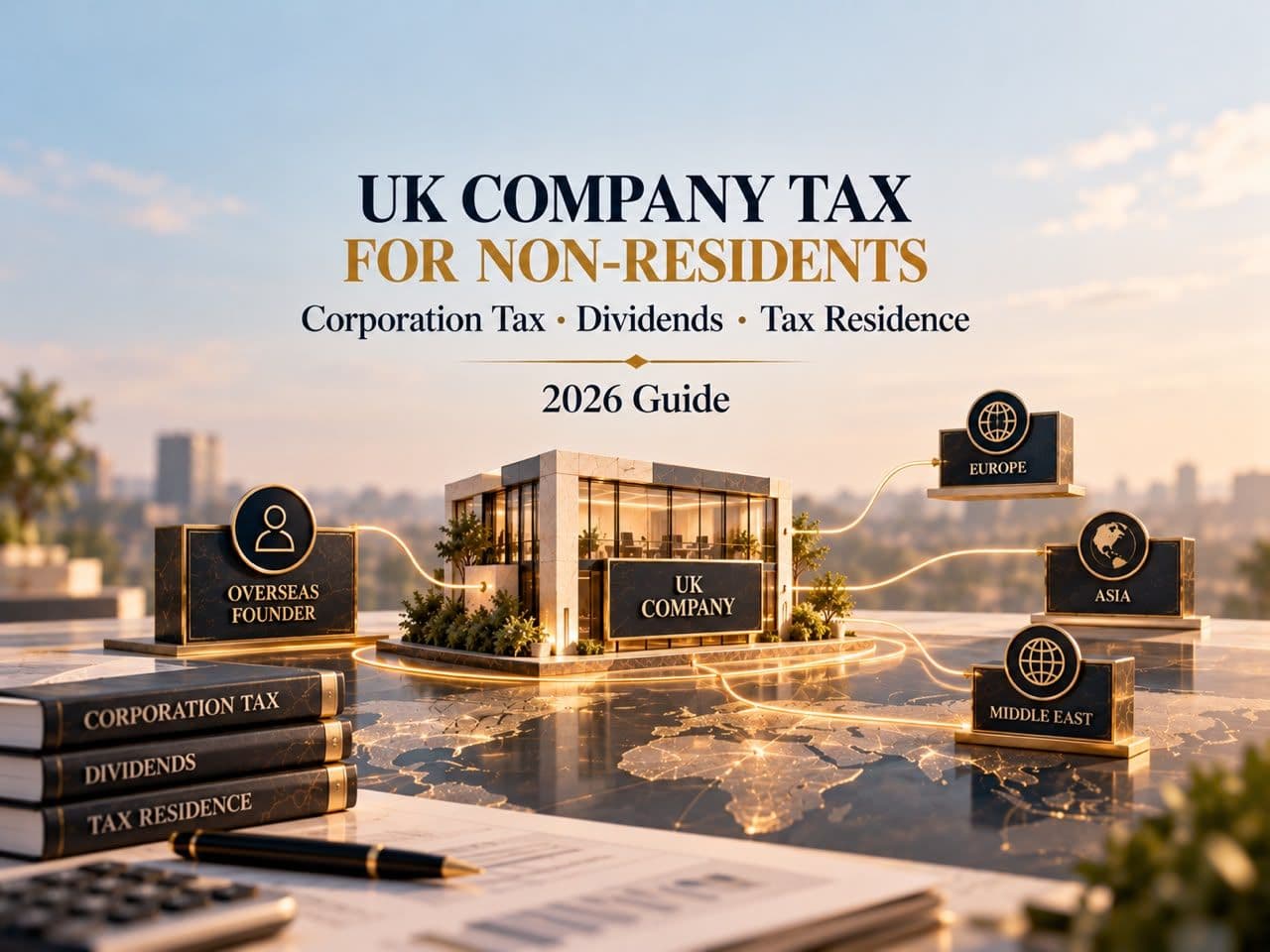
Corporation Tax, company residence, dividends, director remuneration, permanent establishment, VAT and double taxation for overseas founders
If you own or plan to own a UK Limited Company while living outside the United Kingdom, there are two tax questions you must keep separate:
How is the UK company taxed?
How are you, the overseas shareholder or director, taxed personally?
They are not the same question.
A founder living in India, the UAE, France, Pakistan, the United States or another country may own 100% of a UK Limited Company without becoming personally UK tax resident simply because they own the company.
The company has its own tax position.
A company incorporated in the United Kingdom is generally UK tax resident, subject to specific exceptions. A UK-resident company is generally within UK Corporation Tax on its profits from the UK and abroad, subject to applicable exemptions, reliefs and other rules.
But that is only the first layer.
The founder’s country of residence may separately:
- tax dividends received from the UK company;
- tax salary or director remuneration;
- treat the company as resident there under its own rules;
- recognise a permanent establishment;
- impose payroll or social-security obligations;
- apply controlled-foreign-company or similar anti-deferral rules.
That is why two common statements can both be misleading:
“The company is British, so I only need to think about UK tax.”
and:
“I live overseas, so my UK company does not pay UK tax.”
Cross-border taxation depends on the company, the founder, where management and business activities take place, the type of income involved and any applicable Double Taxation Agreement.
If you are still deciding whether a UK company is appropriate, start with Best UK Company Formation Services for Non-Residents: How to Choose in 2026.
Quick Answer: How Is a UK Company Owned by a Non-Resident Taxed?
A UK company owned by a non-resident is generally taxed separately from its overseas owner.
A UK-incorporated company is generally UK tax resident and, if UK resident, is normally within UK Corporation Tax on its UK and overseas profits. The overseas shareholder or director then has a separate personal tax position for salary, director fees, dividends and other payments. Their country of residence may also impose tax obligations on the founder or, depending on the facts, the company.
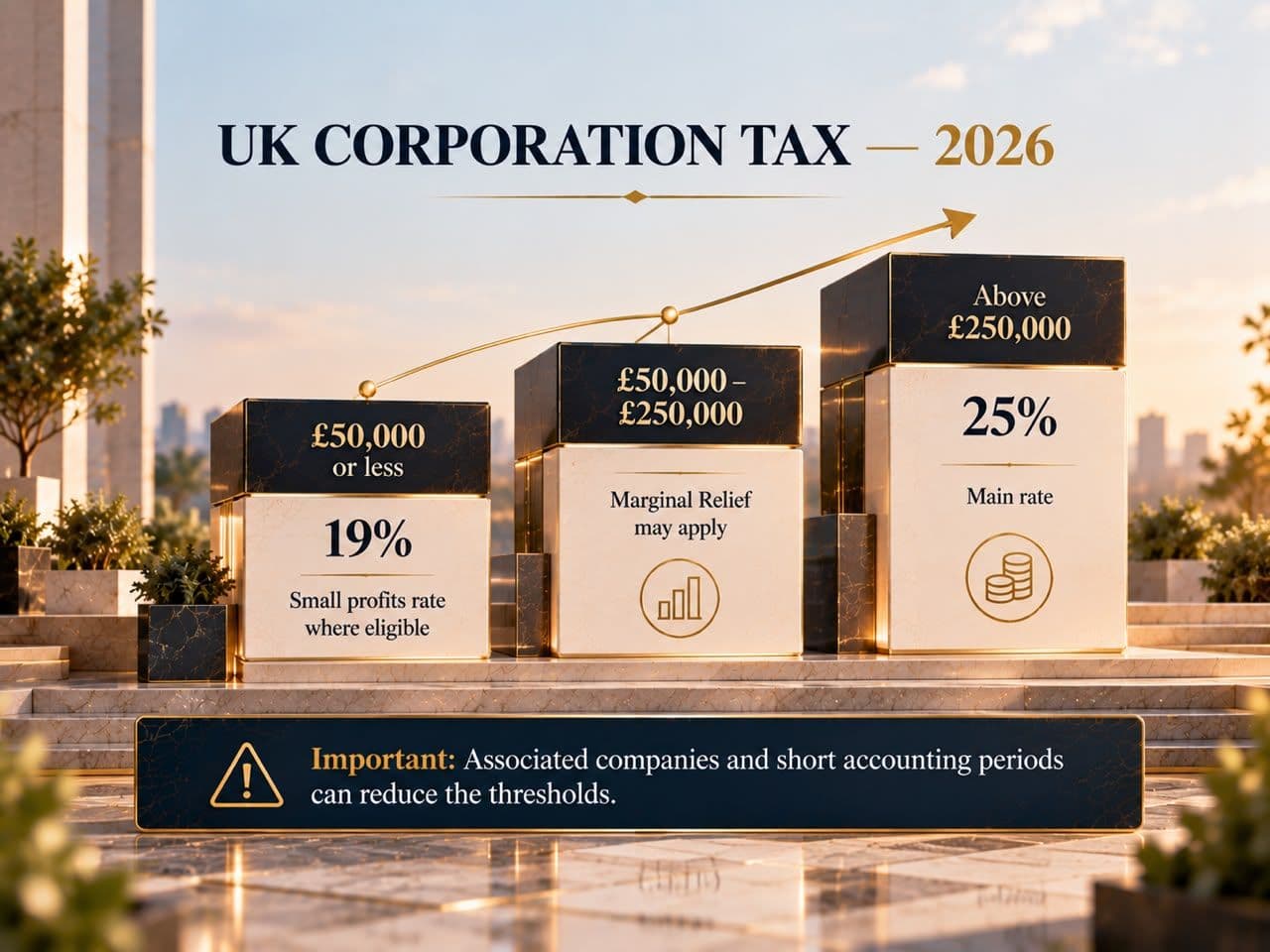
For companies eligible for the small profits rate, the Corporation Tax rate is 19% on profits of £50,000 or less.
The 25% main rate applies where profits exceed £250,000.
Between those limits, Corporation Tax is calculated at the main rate with Marginal Relief potentially reducing the liability.
The £50,000 and £250,000 limits can also be reduced where the company has associated companies or a short accounting period.
The most useful way to understand the overall position is therefore through three separate layers.
1. The Three-Layer Tax Model for Non-Resident Founders
Layer 1 — The UK Company
Ask:
- Is the company UK tax resident?
- What profits are taxable?
- What Corporation Tax rate applies?
- Are associated companies involved?
- Does the company have taxable activities or a permanent establishment elsewhere?
Layer 2 — The Founder
Ask:
- Where is the founder personally tax resident?
- Does the founder receive salary or director fees?
- Are dividends being paid?
- Where are the founder’s duties physically performed?
- How does the founder’s country of residence tax those amounts?
Layer 3 — The Cross-Border Structure
Ask:
- Could the company also be resident in another country?
- Does a Double Taxation Agreement apply?
- Is there a foreign permanent establishment?
- Are related companies involved?
- Could transfer-pricing or CFC-type rules apply?
- Is double-tax relief available?
This framework prevents a common mistake: treating “UK company tax” as one percentage that answers every tax question.
It does not.

2. Are the UK Company and Its Overseas Owner Taxed Separately?
Yes.
A UK Limited Company is a separate legal entity from its shareholder.
The company can:
- earn revenue;
- incur business expenses;
- make profits;
- own assets;
- employ people;
- pay Corporation Tax;
- retain profits;
- distribute dividends.
The founder or shareholder can separately receive:
- salary;
- director fees;
- dividends;
- genuine expense reimbursements;
- repayment of money previously lent to the company;
- proceeds from selling shares.
Those payments do not all have the same tax treatment.
In simple terms:
Company profit ≠ shareholder personal income
and:
Corporation Tax ≠ personal Income Tax
A UK company can therefore pay Corporation Tax while its overseas shareholder has separate personal tax obligations in their country of residence.
Likewise, leaving money inside the company is not necessarily the same as personally receiving that money.
This company/shareholder distinction should be understood before deciding how profits will be extracted.
If you are still deciding how ownership and management should be arranged, read How to Structure Shares and Directors in a UK Ltd as a Non-Resident Founder.
3. Is a UK Company Owned by a Non-Resident Still UK Tax Resident?
Usually, yes.
Under the UK incorporation rule, a company incorporated in the United Kingdom is generally UK resident for tax purposes, subject to specific exceptions.
Therefore, none of the following automatically makes a UK company non-resident:
- its shareholder lives in Dubai;
- its director lives in Mumbai;
- its customers are in the United States;
- its developers work in Pakistan;
- the company sells services entirely online;
- its founder manages part of the business from overseas.
The residence of the company and the personal residence of its owner are different tax questions.
A founder should therefore not assume:
“I never visit Britain, so my UK Ltd is outside UK Corporation Tax.”
That is not the normal starting position.
4. Can a UK Company Also Be Tax Resident Abroad?
Potentially.
A company can be UK resident under UK domestic law while another country also treats it as resident under that country’s domestic rules.
That can create a dual-residence situation.
Relevant questions may include:
- Where are strategic decisions genuinely made?
- Who actually exercises control?
- Where does senior management operate?
- Where are important contracts approved?
- Does the board genuinely exercise its authority?
- Does the founder’s country operate a place-of-effective-management or similar corporate-residence test?
Where both countries consider the company resident, the relevant Double Taxation Agreement may become important.
The actual treaty must be examined. Different treaties can use different mechanisms for resolving corporate dual residence.
Can a UK Company Become Treaty Non-Resident?
Potentially, yes.
Where the company is dual resident and the applicable treaty’s residence provisions award residence to the other jurisdiction, the company can be treated as treaty non-resident for UK tax purposes.
This should not be reduced to:
“I manage my company abroad, therefore it is no longer UK resident.”
Managing a company from overseas does not, by itself, automatically make a UK-incorporated company non-resident.
5. What Does Central Management and Control Mean?
Central management and control concerns where the highest level of management and control of the business is genuinely exercised.
For companies incorporated outside the UK, central management and control can itself be relevant to UK corporate residence.
For an international structure, it also matters because another country may operate its own corporate-residence or management test.
Relevant facts can include:
- where strategic decisions are genuinely made;
- who makes those decisions;
- where the board actually exercises control;
- whether board meetings are substantive rather than merely formal;
- where major commercial decisions are approved;
- whether another person or company effectively controls the board.
A statutory UK address does not by itself prove that substantive management takes place in Britain.
Likewise, using a UK accountant, formation agent or address provider does not relocate the company’s genuine management.
For non-resident founders, this distinction is important because a company’s statutory address and the location of its actual management serve different purposes.
For the company-law address distinction, see Registered Office vs Director Service Address for Non-Residents.
6. How Much Corporation Tax Does a UK Company Pay in 2026?
For ordinary non-ring-fence companies, the principal rates are:
Profits of £50,000 or less: 19% small profits rate, where the company is eligible.
Profits above £250,000: 25% main rate.
Profits between £50,000 and £250,000: Corporation Tax is calculated at the main rate with Marginal Relief potentially reducing the liability.
The middle band is therefore not simply another fixed tax rate.
Associated Companies Can Change the Thresholds
The £50,000 and £250,000 limits should not always be applied at face value.
They can be proportionately reduced for short accounting periods and according to the number of associated companies.
For example, if the company has three associated companies — four companies in total for this calculation — the normal thresholds are divided by four:
Lower limit: £12,500
Upper limit: £62,500
before considering any short-accounting-period adjustment.
This can matter significantly for international groups.
For example:
Overseas parent company
↓
UK subsidiary
or:
Founder
↓
controls several companies
↓
one is a UK Ltd
A group structure should therefore not automatically apply the same Corporation Tax thresholds as a standalone company.
7. Is Corporation Tax Charged on Turnover or Profit?
Generally, taxable profit — not gross turnover.
A simplified starting point is:
Business income
minus
allowable expenses and deductions
equals
taxable profit
Corporation Tax is then calculated under the applicable tax rules.
For example:
Revenue: £100,000
Allowable business costs: £65,000
Simplified accounting profit before further tax adjustments: £35,000
The Corporation Tax analysis therefore starts around the profit position rather than applying 19% or 25% directly to £100,000 of sales.
In practice, taxable profit can differ from accounting profit because tax rules may affect matters such as:
- deductible expenses;
- capital allowances;
- losses;
- financing costs;
- connected-party transactions;
- chargeable gains;
- specific reliefs.
So:
£100,000 turnover does not mean £100,000 taxable profit.
8. Are UK-Resident Companies Taxed on Overseas Profits?
Generally, a UK-resident company is within UK Corporation Tax on its profits from the UK and abroad, subject to applicable exemptions, reliefs and other rules.
This is particularly important for digital and international businesses.
Suppose a UK Ltd sells software or consulting services to customers in:
- the United States;
- Germany;
- Singapore;
- the UAE;
- India.
Those profits do not automatically fall outside UK Corporation Tax simply because the customers are overseas.
Customer location and company tax residence are different questions.
The company may nevertheless have additional tax obligations elsewhere depending on where it operates.
9. What Is a Permanent Establishment?
A permanent establishment, or PE, is broadly a concept used to determine whether a company has sufficient business presence in another jurisdiction for that jurisdiction to tax relevant business profits.
The detailed definition depends on domestic law and, where applicable, the relevant tax treaty.
Potential situations can involve:
- a branch;
- an office or other fixed place of business;
- certain activities carried out through employees;
- certain dependent-agent arrangements.
The precise PE test can vary by jurisdiction and treaty, and relevant UK domestic rules concerning dependent-agent permanent establishments changed for chargeable periods beginning on or after 1 January 2026.
A company can therefore be:
UK tax resident
while also having:
a taxable permanent establishment abroad.
Corporate residence and permanent establishment answer different questions.
Corporate residence: Where is the company resident for tax purposes?
Permanent establishment: Has the company created sufficient taxable business presence in another jurisdiction?
Confusing the two can lead to incorrect cross-border tax conclusions.
10. Example: A Founder Runs the UK Ltd Entirely from Abroad
Consider:
Founder resident in Country A
↓
100% shareholder and director of UK Ltd
↓
UK Ltd sells services internationally
↓
Founder performs the work from Country A
The wrong shortcut is:
“There are no UK customers, so there is no UK Corporation Tax.”
A better analysis starts with the company.
The UK Ltd is incorporated in the UK and is generally UK tax resident.
Its taxable profits therefore normally enter the UK Corporation Tax framework.
Country A must then be considered separately.
Depending on its laws and the facts, Country A may examine the company’s management, local activities, permanent establishment, payroll or other tax obligations.
Finally, the founder’s personal salary and dividend position must be considered.
This is why a non-resident company-owner tax analysis should consider both jurisdictions.
11. How Are Dividends Taxed for a Non-Resident Shareholder?
Dividends require separate analysis from Corporation Tax.
A company first needs sufficient distributable profits from which a lawful dividend can be paid.
The shareholder then considers their own tax position.
Ordinary dividends from a UK company are generally paid without UK withholding tax.
For a genuinely non-UK-resident shareholder, special UK rules for non-resident investment income can also limit the UK Income Tax exposure.
However, the shareholder’s country of residence may tax the dividend, so:
“No UK withholding tax” should never be read as “tax-free everywhere.”
The final position can depend on:
- the shareholder’s tax residence;
- whether they were non-UK resident for the whole tax year;
- split-year treatment where relevant;
- other UK-source income;
- the domestic rules of the residence country;
- the applicable tax treaty;
- available reliefs;
- local reporting requirements.
For Indian residents, the additional corporate-residence and treaty issues deserve separate treatment. See UK Company Tax for Indian Residents: Corporation Tax, POEM & Double Taxation.
12. Is Salary Treated the Same as Dividends?
No.
Salary is remuneration for work. A dividend is a distribution to shareholders from distributable profits.
For a non-resident director, the UK tax treatment of remuneration requires more than simply asking where the director lives.
Relevant factors can include:
- whether the payment relates to duties as a company director or to separate employment duties;
- where those duties are physically performed;
- whether any director duties are performed in the UK;
- the director’s tax residence;
- PAYE requirements;
- National Insurance or applicable social-security arrangements;
- the provisions of the relevant Double Taxation Agreement.
A non-resident director who performs duties in the UK can have UK Income Tax and PAYE consequences in relation to those UK duties.
Tax treaties may also contain specific provisions dealing with directors’ fees, so director remuneration should not automatically be treated in the same way as ordinary overseas employment income.
The director’s country of residence may separately tax the remuneration under its own rules, with treaty or domestic double-tax relief potentially relevant.
That is why:
“Should I take salary or dividends?”
cannot safely be answered merely by comparing UK Corporation Tax and dividend rates.
For an international founder, the nature of the payment, where the duties are performed, the applicable treaty and the tax rules in the country of residence can all materially change the analysis.
13. What If the Founder Takes No Salary or Dividend?
The company can retain its post-tax profits.
Those retained profits remain company money.
They do not automatically become the shareholder’s personal funds merely because that shareholder owns 100% of the company.
Payments between the company and its owner should therefore be correctly classified.
Depending on the circumstances, a payment may be:
- salary;
- dividend;
- director’s loan;
- reimbursement of genuine company expenses;
- repayment of money previously lent to the company;
- another type of distribution.
Using the company’s bank account as a personal wallet can create accounting and tax problems.
For international founders, keeping company and personal finances properly separated is particularly important because the underlying records may later support both UK accounting and foreign reporting.
14. When Must a UK Company Deal With Corporation Tax?
An active limited company within the charge to Corporation Tax generally needs to tell HMRC within three months of starting its first Corporation Tax accounting period.
For a typical private company within the normal payment regime:
Corporation Tax payment: normally 9 months and 1 day after the end of the Corporation Tax accounting period.
Company Tax Return: normally 12 months after the end of the Corporation Tax accounting period.
Companies House annual accounts operate on a separate timetable.
Do not treat:
annual accounts
and:
Corporation Tax / Company Tax Return
as the same filing.
For the wider post-incorporation sequence, see What Happens After You Register a UK Company as a Non-Resident?.
If you already own a UK company and are deciding how to manage the accounting obligations from overseas, read Do I Need an Accountant for a UK Company If I Live Abroad?.
15. Does Every Non-Resident-Owned UK Company Need VAT Registration?
No.
VAT and Corporation Tax are separate systems.
For businesses within the ordinary UK VAT threshold framework, compulsory registration can arise once taxable turnover exceeds the applicable registration threshold, currently £90,000.
But international founders need to understand an additional distinction:
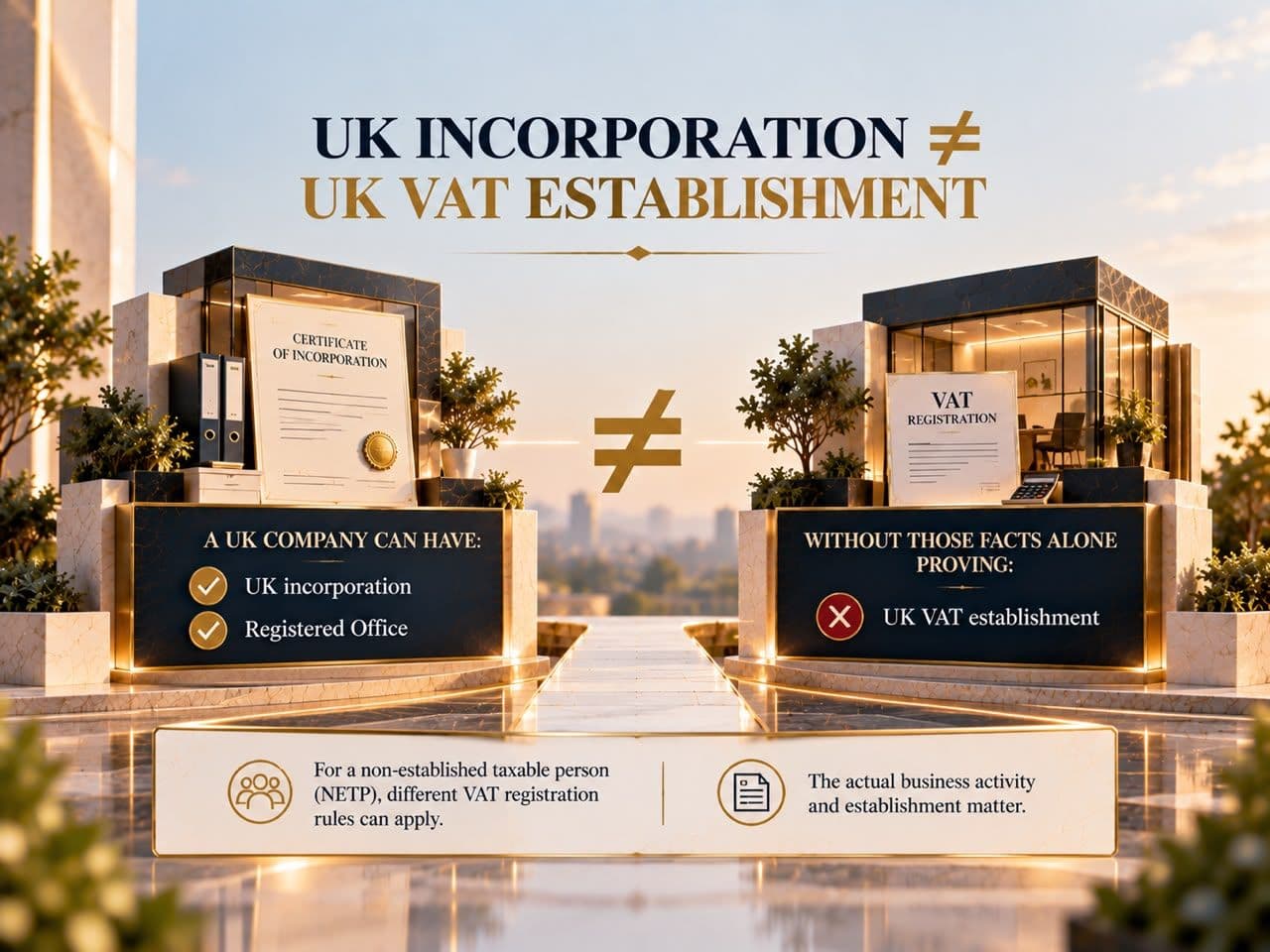
UK incorporation does not by itself determine UK VAT establishment.
A UK Registered Office, serviced office or virtual address does not by itself prove that the business has the substantive UK establishment required for VAT purposes.
Where a business is a non-established taxable person (NETP), it may have to register for UK VAT as soon as it makes, or expects to make, taxable supplies in the UK to which the NETP registration rules apply; the ordinary £90,000 threshold may therefore not protect it.
The VAT position depends on the actual operating model, including what is supplied, where it is supplied, where the business is genuinely established and whether special VAT rules apply.
For businesses selling online, stock location, marketplaces, imports and fulfilment can add further issues. See UK E-Commerce Company for Non-Residents: Setup, VAT & Payments.
16. How Do Double Taxation Agreements Affect a UK Company?
The United Kingdom has Double Taxation Agreements with many jurisdictions.
Depending on the treaty, these can address:
- corporate residence;
- permanent establishments;
- business profits;
- dividends;
- interest;
- royalties;
- employment income;
- directors’ fees;
- capital gains;
- methods for relieving double taxation.
A treaty is not a mechanism for simply choosing whichever country has the lowest tax rate.
Instead, it can allocate or limit taxing rights according to the wording of that particular agreement.
For corporate residence, the precise treaty wording matters.
Where a company is treated as resident by both jurisdictions, the relevant treaty’s residence provisions need to be examined rather than assuming that one universal test resolves the issue.
17. What Is Double-Tax Relief?
Where the same income or profit is legitimately taxed in two jurisdictions, domestic rules and/or the applicable treaty may provide relief.
Depending on the circumstances, relief may operate through:
- a tax credit;
- an exemption;
- a restriction on one country’s taxing rights;
- a treaty claim;
- another domestic relief mechanism.
That does not necessarily mean one country simply refunds every pound of tax paid in another.
The result depends on the type of income, the jurisdictions involved and the rules of the relevant treaty.
18. Does Nationality Determine the Tax Position?
Nationality alone does not determine the tax position of a non-resident UK company owner.
For example:
Indian citizen resident in India
can have a materially different tax position from:
Indian citizen genuinely resident in the UAE.
Likewise:
French citizen resident in France
may have a different position from:
French citizen resident elsewhere.
For a non-resident UK company owner, the more useful questions are:
Where are you personally tax resident?
Where do you physically perform your work?
Where is the company actually managed?
Where does the company have people, premises and substantial operations?
The answers need to be considered under the rules of the jurisdictions involved rather than inferred from nationality alone.
19. What Changes If Another Company Is Involved?
Structures involving an overseas parent or another related company deserve additional review.
For example:
Overseas company
↓
UK subsidiary
The companies may transact through:
- product sales;
- management services;
- software licences;
- royalties;
- intercompany loans;
- consulting;
- manufacturing;
- distribution.
Those arrangements should reflect genuine commercial activity and appropriate documentation.
Depending on the structure and jurisdictions involved, relevant issues can include:
- transfer pricing;
- associated-company Corporation Tax thresholds;
- withholding taxes;
- treaty provisions;
- permanent establishments;
- foreign corporate-residence rules;
- local overseas-investment requirements.
Artificial charges should not be created merely to move profit between countries.
The commercial and accounting records should reflect what the companies genuinely do.
20. Common Tax Mistakes Made by Non-Resident UK Company Owners
Assuming there is no UK Corporation Tax because the owner lives abroad
A UK-incorporated company is generally UK tax resident, subject to specific exceptions.
Applying 19% Corporation Tax to every company
The 25% main rate, Marginal Relief, associated-company rules and other factors may change the calculation.
Applying Corporation Tax directly to turnover
Corporation Tax is generally concerned with taxable profit, not gross sales.
Ignoring foreign company-residence rules
Another country may also treat the company as resident there.
Confusing permanent establishment with company residence
They answer different tax questions.
Assuming no UK dividend withholding means no tax anywhere
The shareholder’s country of residence may tax the dividend.
Choosing salary versus dividends using UK rates alone
The founder’s residence-country rules, the nature and location of the duties and the applicable treaty can materially change the analysis.
Assuming a UK Registered Office proves UK tax or VAT establishment
A statutory company address and substantive business establishment are different concepts.
Assuming every UK Ltd automatically benefits from the ordinary VAT threshold
The NETP rules can produce a different result.
Ignoring accounting until a filing deadline approaches
Good tax compliance starts with accurate accounting records throughout the year.
21. Non-Resident UK Company Tax Checklist
Before extracting profits or changing the company structure, establish four things.
The Company
- Where is the company incorporated?
- Is it active?
- What are its taxable profits?
- Are associated companies involved?
- Could another country also treat it as resident?
- Does it have a foreign permanent establishment?
The Founder
- Where are you personally tax resident?
- Where do you physically perform your work?
- Are you receiving salary or director fees?
- Are you receiving dividends?
- How does your residence country tax those amounts?
The Cross-Border Position
- Is a Double Taxation Agreement relevant?
- Are related companies involved?
- Could transfer-pricing or CFC-type rules apply?
- Is foreign tax already being paid on the same income?
- Is specialist advice required in the founder’s country?
UK Accounting and Compliance
- Has HMRC been notified where required?
- Is the Corporation Tax accounting period understood?
- Are the payment and filing deadlines recorded?
- Are accurate accounting records being maintained?
- Has the VAT position been reviewed separately?
Frequently Asked Questions
Does a UK company pay Corporation Tax if its owner lives abroad?
Usually, yes. A UK-incorporated company is generally UK tax resident under the incorporation rule, subject to specific exceptions including treaty non-residence.
What is the UK Corporation Tax rate in 2026?
For companies eligible for the small profits rate, the Corporation Tax rate is 19% on profits of £50,000 or less. The main rate is 25% where profits exceed £250,000. Marginal Relief can reduce the liability between those limits, and the thresholds can be reduced for associated companies and short accounting periods.
Is Corporation Tax charged on revenue?
Generally no. Corporation Tax is based on taxable profits rather than gross turnover.
Can my UK company also be tax resident in my country?
Potentially. Another jurisdiction may apply its own corporate-residence rules. Where both countries treat the company as resident, the residence provisions of the relevant Double Taxation Agreement may need to be examined.
Does a non-resident shareholder pay UK tax on dividends?
The answer depends on the shareholder’s circumstances and the rules applying to non-residents. Ordinary UK company dividends are generally paid without UK withholding tax, and special UK rules for non-resident investment income may also be relevant. The shareholder’s country of residence may separately tax the dividend.
Is salary treated the same as a dividend?
No. Salary is remuneration for work; a dividend is a shareholder distribution from distributable profits. The UK and foreign tax treatment can be different.
Can a non-resident director have UK PAYE obligations?
Potentially. A non-resident director who performs duties in the UK can have UK Income Tax and PAYE consequences in relation to those duties. Treaty provisions, the nature of the remuneration and social-security arrangements may also need to be considered.
Does every UK company need VAT registration?
No. VAT depends on the business’s supplies and establishment position. A business treated as an NETP can be subject to different registration rules from a UK-established business.
Do I Need an Accountant Because I Live Outside the UK?
Not simply because you are non-resident.
But living overseas does not remove the company’s UK accounting and filing responsibilities.
Professional accounting support can become particularly useful where the company is actively trading, VAT registered, paying salaries or dividends, operating across several currencies or jurisdictions, or forming part of an international group.
How Seven Oak Prestige Supports International Founders
Seven Oak Prestige supports international and non-resident founders through UK company formation, business establishment and the ongoing accounting and compliance requirements that can follow incorporation.
For an existing UK company, accounting support can include annual accounts and applicable Corporation Tax compliance, with bookkeeping, VAT, payroll and other requirements scoped where relevant.
For a founder who has not yet incorporated, Seven Oak Prestige can support the UK company formation process, ownership setup, statutory address requirements and the practical compliance steps that follow incorporation.
Cross-border questions involving personal tax residence, treaty residence, permanent establishments, complex international groups or another country’s tax rules may require separate specialist tax advice.
The objective is not to make a tax assumption from a Companies House incorporation certificate alone.
It is to understand what belongs to the company, what belongs to the founder and where additional cross-border analysis is required.
Final Takeaway
For a non-resident founder, UK company taxation becomes much easier to understand when it is divided into three layers.
The company:
UK corporate residence, taxable profits and Corporation Tax.
The founder:
Personal tax residence, salary, director fees and dividends.
The international structure:
Foreign corporate residence, permanent establishments, tax treaties, related companies and double-tax relief.
The first dangerous shortcut is:
“I live abroad, so my UK company pays no UK tax.”
The second is:
“My UK company pays Corporation Tax, so my home country has nothing to tax.”
Either can be wrong.
The correct analysis starts with the UK company, then considers the founder, and finally examines how the jurisdictions interact.
Own or Planning a UK Company While Living Overseas?
Seven Oak Prestige can support your UK company formation and scope the ongoing UK accounting and compliance requirements for an existing company.
Review My UK Company Setup
About the Author
Isaac Jackson
Founder & Managing Director — Seven Oak Prestige Ltd
Isaac Jackson works with international and non-resident founders establishing and operating UK companies. His work covers UK company formation, ownership and statutory-address requirements, Companies House compliance, KYC preparation, banking readiness and the practical coordination of ongoing accounting and compliance requirements.
Through Seven Oak Prestige, he works particularly with founders managing UK companies while living overseas, where company obligations often need to be considered alongside the founder’s wider international circumstances.
Editorial Methodology
Last reviewed: 7 October 2026
This guide has been prepared for non-resident founders who own, or are considering owning, a UK Limited Company.
Material UK tax and compliance points are reviewed against current primary guidance from HMRC, GOV.UK and Companies House. Where cross-border taxation is discussed, the article distinguishes between UK domestic rules and matters that depend on another jurisdiction, an applicable Double Taxation Agreement or the individual facts of the company and its owner.
Particular attention has been given to:
- UK corporate tax residence;
- Corporation Tax rates and Marginal Relief;
- associated-company thresholds;
- overseas profits of UK-resident companies;
- permanent establishments;
- dividends paid to non-resident shareholders;
- director remuneration and PAYE considerations;
- Corporation Tax payment and filing deadlines;
- UK VAT establishment and NETP rules;
- Double Taxation Agreements and double-tax relief.
The article deliberately separates three issues that are frequently confused: the UK company’s tax position, the founder’s personal tax position and the wider cross-border structure.
Tax rules can change, and cross-border outcomes are highly fact-dependent. The article is reviewed periodically and material regulatory changes are incorporated where necessary.
Disclaimer
This article provides general information only and should not be treated as personalised tax, legal or accounting advice.
A UK company’s tax position and the personal tax position of its directors and shareholders can depend on facts including residence, management and control, business activities, permanent establishments, remuneration, ownership structure and the provisions of any applicable Double Taxation Agreement.
Seven Oak Prestige can support UK company formation and scope ongoing UK accounting and compliance requirements. Where a matter requires specialist cross-border tax advice, treaty analysis, advice on another country’s tax law or other regulated professional advice outside the agreed service scope, appropriate specialist advice should be obtained.