
How to Choose the Right Payment Provider for Your UK Company (2026): A Strategic Guide for International Entrepreneurs
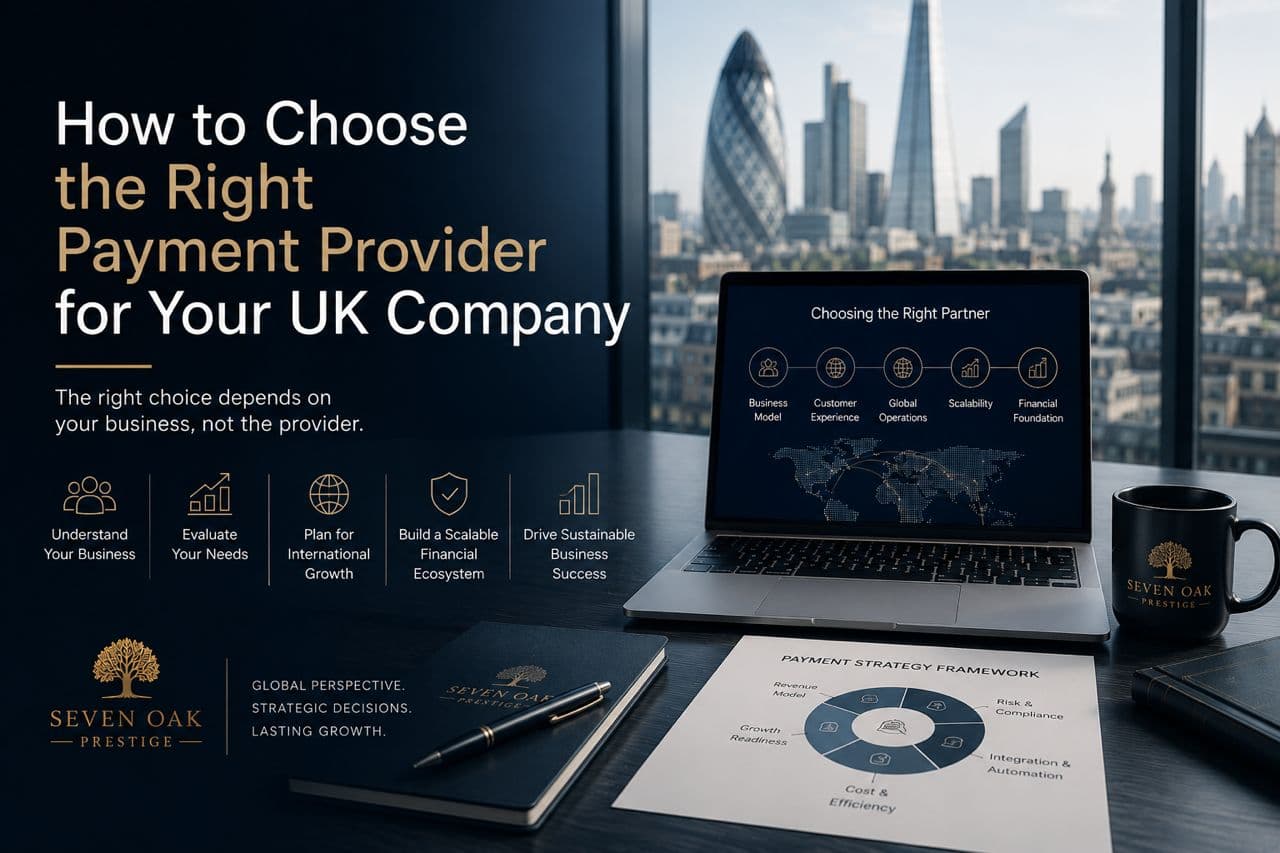
The Biggest Mistake Isn’t Choosing the Wrong Payment Provider
It is tempting to believe that somewhere there is a “best” payment provider.
A platform that works perfectly for every business.
A single solution that will handle every customer, every market and every stage of growth.
If that were true, entrepreneurs would all be using the same provider.
They are not.
Because the question itself is flawed.
After years of speaking with international founders, we have noticed something interesting.
When entrepreneurs ask,
“Which payment provider should I choose?”
they are often asking the wrong question.
Not because payment providers are unimportant.
But because the answer has very little to do with the provider itself.
It has everything to do with the business standing behind it.
A Consultant, a Software Company and an Online Store Walk Into the Same Conversation
Imagine three founders sitting around the same table.
The first runs an international management consultancy.
The second has built an AI software platform.
The third sells premium consumer products online.
Each asks exactly the same question.
“Which payment provider is best?”
At first glance, it sounds like they should receive the same answer.
In reality, giving all three entrepreneurs the same recommendation would probably be poor advice.
The consultant may only invoice a handful of international clients each month.
The software company could process thousands of subscription payments every day.
The e-commerce brand may need to manage refunds, multiple currencies and seasonal sales volumes.
They all receive payments.
Yet they operate completely different businesses.
This is why experienced advisers rarely begin with the provider.
They begin with the business model.
The Internet Loves Rankings. Business Doesn’t.
Search online and you’ll quickly find articles claiming:
- The best payment gateway.
- The number one fintech.
- The top business banking platform.
- The ultimate payment solution.
Those headlines attract clicks.
But business decisions are rarely made through rankings.
Choosing financial infrastructure is much closer to choosing the right office than choosing the most famous building.
The most prestigious address means very little if it doesn’t suit the way your business operates.
Financial platforms work in exactly the same way.
The objective isn’t to choose the most popular name.
It is to choose the right combination of tools for your business.
The Question Every Founder Should Ask Instead
Rather than asking:
“Which payment provider is the best?”
Ask yourself something far more valuable.
“How will my customers pay me one year from now?”
That single question changes the conversation.
Because it forces you to think beyond today’s needs.
Will you be invoicing international clients?
Selling digital products?
Managing subscriptions?
Operating an online marketplace?
Expanding into new countries?
Hiring staff?
Offering recurring billing?
A payment provider should support where your business is going.
Not simply where it is today.
Great Companies Don’t Collect Tools. They Build Systems.
One of the biggest differences between early-stage founders and experienced business leaders is the way they think about infrastructure.
New entrepreneurs often search for individual tools.
Experienced founders build systems.
They don’t ask,
“Should I use Stripe?”
They ask,
“What payment system will support the customer experience we want to deliver?”
They don’t ask,
“Should I open Wise?”
They ask,
“How will we manage international cash flow as we expand?”
The software becomes part of the answer.
It is never the entire strategy.
Your Financial Infrastructure Is Like Building a City
Imagine building a modern city.
You wouldn’t start by choosing traffic lights.
You would first decide where the roads should go.
Where businesses will operate.
Where people will live.
How everything connects.
Only then do individual components begin to make sense.
International businesses are built the same way.
Business banking.
Payment providers.
Accounting software.
Expense management.
Multi-currency solutions.
Each has an important role.
But none of them should be chosen in isolation.
When they work together, they create something much more valuable than individual financial products.
They create infrastructure.
And infrastructure is what allows businesses to grow with confidence.
This Guide Is Different
This article will not tell you that one payment provider is better than another.
That would be misleading.
Instead, we’ll help you understand:
- Which types of businesses typically benefit from different payment solutions.
- How to evaluate providers based on your own business model.
- Why scalability matters more than popularity.
- The common mistakes entrepreneurs make when choosing payment infrastructure.
- How to build a financial ecosystem that grows alongside your business.
Because choosing a payment provider is not about finding the most famous name.
It is about making one of the most important operational decisions your business will make.
And that decision deserves more than a comparison table.
Stop Comparing Providers. Start Comparing Your Business Requirements.
There is a reason why so many online comparisons create confusion.
Most begin by comparing companies.
Few begin by understanding the business.
That is like recommending a vehicle before asking whether someone needs to drive through a city, cross a desert or transport heavy equipment.
The answer depends entirely on the journey.
Choosing payment infrastructure works exactly the same way.
Before looking at providers, take a step back and examine how your business actually operates.
The clearer that picture becomes, the easier every financial decision becomes afterwards.
Every Business Collects Money Differently
Receiving a payment may seem like a simple transaction.
Behind the scenes, however, every business follows its own commercial rhythm.
A software company may charge customers automatically every month.
An international consultant might send only a handful of invoices each month, each with a different value.
An e-commerce retailer could receive hundreds of small payments every day from customers across multiple countries.
A recruitment agency may invoice businesses after successfully placing candidates.
Each model creates different operational needs.
This is why the “best” payment provider for one entrepreneur may create unnecessary complexity for another.
Understanding your own business model is always the first step.
Before Looking at Features, Understand Your Revenue Model
One of the questions we encourage founders to answer is surprisingly simple.
“How does money actually move through your business?”
Think about the journey.
Where does your customer discover you?
How do they decide to buy?
When do they pay?
How often do they pay?
Do they pay once?
Every month?
Every year?
In different currencies?
Do they buy online or after speaking with your sales team?
These answers are often far more valuable than comparing feature lists.
Because they help identify the type of financial infrastructure your business genuinely requires.
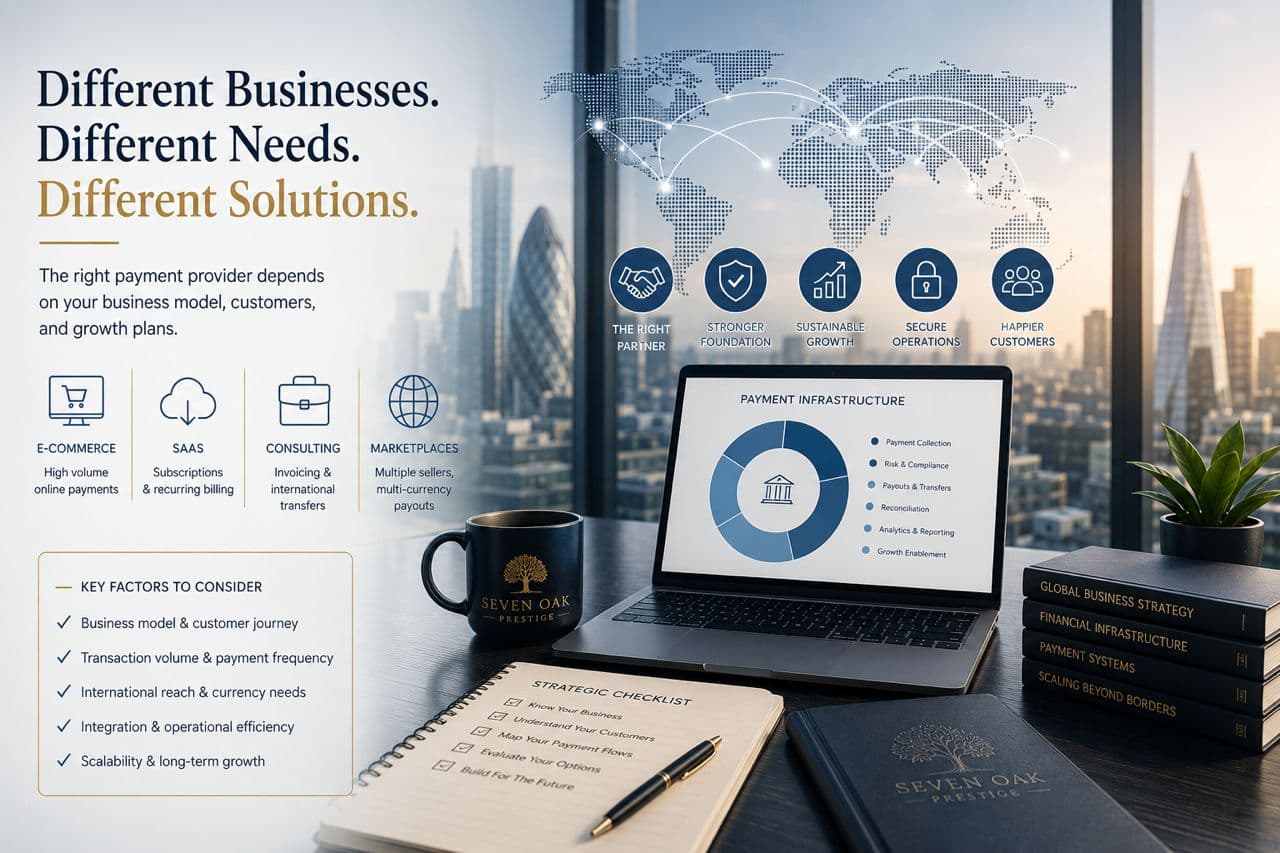
Different Businesses Priorities Different Things
Rather than asking which provider is “best”, ask which capabilities matter most to your business.
A SaaS company may value subscription management and recurring billing.
An international consultant may place greater importance on professional invoicing and international transfers.
An online retailer often focuses on a smooth checkout experience and customer convenience.
A digital publisher may need recurring memberships and subscription management.
A recruitment agency might prioritise efficient international payments and financial organisation.
The provider hasn’t changed.
The priorities have.
The Cheapest Option Is Not Always the Most Valuable
It is natural to compare transaction fees.
Every entrepreneur wants to manage costs wisely.
However, experienced founders rarely make financial decisions based on price alone.
Imagine choosing office space.
One building is less expensive.
The other is in a location that helps attract larger clients.
The monthly rent may differ.
The long-term value could be completely different.
Financial infrastructure works in a similar way.
The question should not simply be:
“What does it cost?”
It should also be:
“What value does it create for my business over the next three to five years?”
Build for the Business You Intend to Become
One mistake we often see is businesses selecting financial tools that perfectly suit today’s needs, but quickly become limiting as the company grows.
Growth changes everything.
More customers.
More countries.
More currencies.
More employees.
More transactions.
The infrastructure supporting your business should be capable of evolving alongside those changes.
That does not necessarily mean choosing the most sophisticated solution from the beginning.
It means choosing solutions that leave room for growth.
A Practical Framework for Making Better Decisions
Before choosing any payment provider, ask yourself these questions:
Business Model
What exactly does my company sell?
Customer Journey
How do customers normally pay?
Growth Plans
Where do I expect my business to be in three years?
International Activity
Which countries will I trade with?
Operational Requirements
Will I need subscriptions, invoicing, international transfers or multiple currencies?
Scalability
Will this solution still support my business as it grows?
These questions often produce better decisions than comparing feature tables alone.
Good Decisions Begin With Clarity
Entrepreneurs often assume successful companies have access to better tools.
In reality, they often begin with better questions.
Technology changes constantly.
Business principles do not.
The founders who understand their customers, their operations and their long-term objectives are usually the ones who make the strongest financial decisions.
Choosing a payment provider then becomes much simpler.
Because the business leads the decision.
Not the other way around.

The Most Successful International Businesses Rarely Depend on a Single Financial Provider
One assumption quietly influences thousands of business decisions every year.
It sounds reasonable.
It feels efficient.
And yet, it often limits growth before a business has even reached its full potential.
The assumption is this:
“I only need one financial provider.”
In reality, most mature international businesses operate very differently.
They build financial ecosystems.
Not because one provider is inadequate.
But because different tools solve different business challenges.
Understanding this distinction is one of the biggest shifts an entrepreneur can make.
Your Financial Infrastructure Should Evolve as Your Business Evolves
The financial needs of a business are rarely static.
A company processing ten invoices a month will naturally operate differently from one processing ten thousand online transactions.
Likewise, a consultancy expanding into Europe faces different operational requirements from an e-commerce brand selling worldwide.
Growth changes expectations.
Customers expect faster payments.
Suppliers expect reliable settlements.
Teams require better financial controls.
Management needs accurate reporting.
International expansion introduces additional currencies and payment flows.
As these needs evolve, financial infrastructure must evolve with them.
Businesses that recognize this early often scale with greater confidence.
Every Financial Tool Has a Different Role
One of the reasons entrepreneurs become overwhelmed is because they expect every provider to solve every problem.
That is rarely how successful businesses operate.
Instead, they assign clear responsibilities to different parts of their financial ecosystem.
For example:
A business bank account often becomes the foundation for managing day-to-day business finances.
A payment platform focuses on delivering a smooth checkout experience for customers.
An Electronic Money Institution (EMI) may support international transfers and multi-currency operations.
Accounting software provides financial visibility and reporting.
Each serves a different purpose.
When these tools complement one another, businesses become more resilient, more organised and better prepared for growth.
Why Businesses Sometimes Outgrow Their First Choice
There is nothing unusual about a business changing the tools it uses over time.
In fact, it often reflects progress.
A freelancer who once served five clients may later manage an international agency.
A software startup may evolve from a small product launch into a global subscription platform.
An online retailer may begin selling in markets it never originally anticipated.
Growth creates new operational realities.
The financial infrastructure that worked well during the first year may no longer be the best fit in the third or fifth year.
That is why flexibility matters.
Choosing a provider should never feel like making a permanent commitment.
It should feel like selecting the right solution for the current stage of your business journey.
Popularity Is Not a Business Strategy
Many entrepreneurs are influenced by what everyone else appears to be using.
Popularity creates confidence.
However, popularity does not necessarily create suitability.
A platform that performs exceptionally well for a fast-growing SaaS company may add unnecessary complexity to a traditional consultancy.
Likewise, a solution designed for invoice-based businesses may not support the operational needs of a high-volume online retailer.
Experienced founders understand this.
Rather than following trends, they evaluate technology through the lens of their own business model.
That approach usually leads to stronger long-term decisions.
The Question That Changes Every Financial Decision
Before comparing providers, pause and ask yourself one question.
“What problem am I actually trying to solve?”
Is it accepting online payments?
Managing multiple currencies?
Reducing administrative work?
Improving the customer checkout experience?
Supporting recurring subscriptions?
Expanding internationally?
The clearer the problem becomes, the easier the solution becomes.
Technology should always answer a business need.
It should never become the starting point.
Build for Tomorrow, Not Only for Today
One of the habits we admire most in successful founders is their ability to think several years ahead.
They understand that today’s business will not remain today’s business forever.
Customers change.
Markets evolve.
Technology improves.
Regulations develop.
Growth introduces opportunities that cannot always be predicted.
For that reason, they build systems capable of adapting rather than systems designed only for immediate convenience.
That mindset creates resilience.
And resilience is often one of the greatest competitive advantages an international business can possess.
A Framework We Encourage Every Founder to Use
Whenever evaluating a financial provider, we encourage entrepreneurs to step back from features and ask five strategic questions.
Will this solution support the way my customers prefer to pay?
Will it continue meeting my needs if my business doubles in size?
Does it integrate naturally into the rest of my financial operations?
Can it support international growth as my markets expand?
Does it strengthen the experience I want customers to have when they interact with my business?
These questions often produce better decisions than any feature comparison.
Because they focus on business strategy rather than product marketing.
The Best Payment Provider Is the One That Helps Your Business Grow
By now, you have probably noticed that we have deliberately avoided answering one question.
“Which payment provider is the best?”
Not because there is no answer.
But because there is no universal answer.
The right decision for an AI software company may be completely different from the right decision for an international consultancy.
An online retailer serving thousands of customers every month will naturally have different priorities from a publishing business selling digital subscriptions.
Business decisions should never be made in isolation.
They should always be made in context.
That is what separates strategic planning from simple product comparison.
Build Around Your Business, Not Around a Brand
One of the easiest mistakes to make as an entrepreneur is allowing well-known brands to influence your thinking.
A provider may be widely recognised.
It may be recommended by other founders.
It may even dominate online comparisons.
None of those factors automatically make it the right choice for your business.
Experienced entrepreneurs approach decisions differently.
They begin by understanding the business they are building.
Only then do they evaluate the tools that will support it.
The business comes first.
The technology follows.
That order rarely changes.
Growth Rewards Businesses That Stay Adaptable
Every successful company reaches moments where important decisions need to be revisited.
A payment solution that worked perfectly during the first year may no longer support the business five years later.
Customer expectations evolve.
Technology improves.
International expansion creates new opportunities.
Regulatory environments develop.
The strongest businesses remain adaptable.
They review their systems.
They improve their processes.
They invest in better infrastructure when growth demands it.
Adaptability is not a sign that previous decisions were wrong.
It is a sign that the business is evolving.
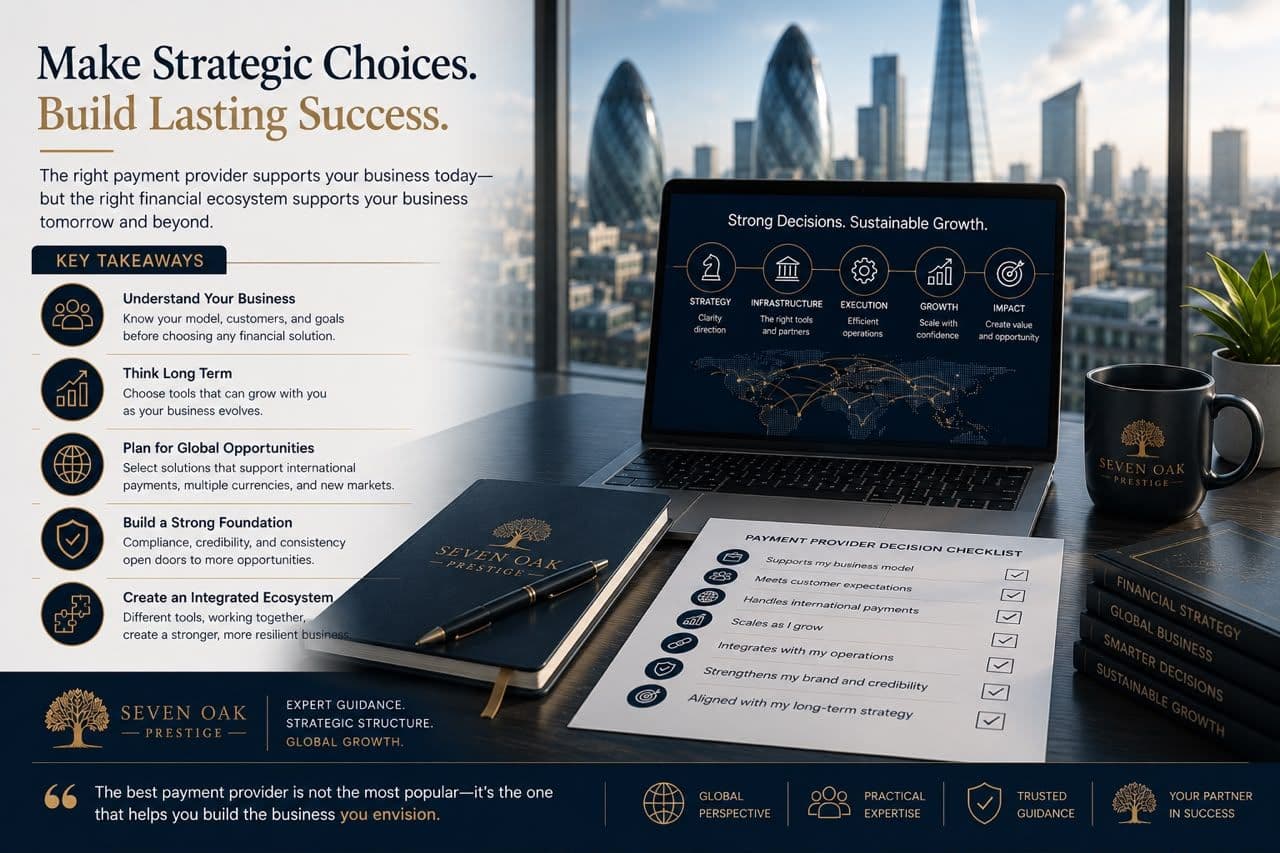
A Practical Decision Matrix
Before choosing any payment provider, pause for a moment and ask yourself these questions.
Customer Experience
Will this make it easier for customers to pay me?
Business Model
Does it support the way my company generates revenue?
International Operations
Can it accommodate the countries where I intend to trade?
Scalability
Will it continue supporting my business if transaction volumes increase significantly?
Operational Efficiency
Will it integrate naturally with the rest of my financial processes?
Long-Term Vision
Does this decision still make sense if my business doubles over the next three years?
The more confidently you can answer these questions, the easier your decision becomes.
Frequently Asked Questions
Which payment provider is best for a UK Limited Company?
There is no single answer.
The most appropriate solution depends on factors such as your business model, customer journey, operational requirements and growth objectives.
Should I choose Stripe, PayPal or Wise?
These platforms serve different purposes and are often used alongside other financial solutions.
Rather than asking which one is universally “better”, consider which one best supports the way your business operates.
Is it normal for businesses to use more than one financial provider?
Yes.
Many growing businesses build a financial ecosystem that includes business banking, payment processing, international transfers and accounting software.
Different tools often perform different roles.
Should I focus on transaction fees first?
Fees are important.
However, they should be considered alongside customer experience, operational efficiency, scalability and long-term business strategy.
The lowest cost does not always create the greatest value.
How do I know whether my business is ready?
A business is generally in a stronger position when it has:
- A professional website.
- A clearly explained business model.
- Consistent company information.
- Transparent customer communication.
- A realistic understanding of its financial requirements.
Preparation rarely eliminates every challenge, but it almost always improves decision-making.
Related Articles
Continue exploring the Seven Oak Prestige Knowledge Hub:
- The Ultimate Guide to Business Banking & Fintech Solutions
- PayPal Business for UK Companies
- Wise Business for UK Companies
- Stripe for UK Companies
- 7 Reasons UK Business Bank Account Applications Are Unsuccessful
- Companies House Identity Verification for International Entrepreneurs
- How to Start a UK Company from Abroad
- How to Start a UK Company from Egypt
- How to Start a UK Company from India
Final Thoughts
When entrepreneurs first begin researching payment providers, it is easy to believe the decision is about software.
After all, the websites compare features.
The videos compare fees.
The reviews compare ratings.
Those comparisons have their place.
But they rarely answer the question that matters most.
What kind of business are you trying to build?
That question should guide every important decision.
Not only the payment provider you choose, but the systems you implement, the customer experience you create and the way your business grows over time.
Technology will continue to change.
New financial platforms will emerge.
Existing providers will introduce new features.
Markets will evolve.
What will remain constant is the value of thoughtful preparation, clear strategy and professional execution.
Businesses that invest in those foundations are rarely dependent on one provider.
They are prepared to adapt, to grow and to seize opportunities wherever they arise.
That is the real objective.
Not choosing the most popular payment provider.
Building a business capable of succeeding with whichever professional tools best support its journey.
About the Author
Isaac Jackson
Founder & Editorial Director, Seven Oak Prestige
Isaac Jackson specializes in helping international entrepreneurs establish UK Limited Companies and build strong foundations for global business. Through Seven Oak Prestige, he supports founders with company formation, compliance guidance, registered business address services and business banking preparation. His editorial work focuses on turning complex business topics into practical, strategic guidance that helps entrepreneurs make informed decisions with confidence.
Speak Directly with an Expansion Advisor
Skip the uncertainty and speak directly with an experienced adviser.
Whether you are planning your first UK company or strengthening an existing international structure, our team is here to help.
UK Office: +44 (0)20 4578 0726
WhatsApp (24/7): +44 7447488755
Office Hours: Monday to Friday, 09:00–18:00 (UK Time)
Website: www.sevenoakprestige.com
Email: contact@sevenoakprestige.com