
Wise Business for UK Companies: What Every International Entrepreneur Should Know Before Applying (2026)

Key Takeaways
- Wise Business can be an effective financial tool for many international businesses, but it is not the right solution for every company.
- Opening a Wise Business account involves an independent onboarding and verification process.
- A professionally prepared business is often easier for financial providers to understand.
- Business preparation should begin before submitting an application.
- Wise should be viewed as one component of a broader international financial strategy rather than a complete banking solution.
Introduction
There is a conversation we have with international entrepreneurs almost every week.
It usually begins with a simple question.
“Can you help me open a Wise Business account?”
At first, it sounds like a straightforward request.
But after a few minutes, another conversation almost always follows.
Someone knows a business owner whose account was restricted.
Another founder says their application took longer than expected.
Someone else believes opening a UK company automatically guarantees access to every financial platform.
These conversations have one thing in common.
They are usually driven by uncertainty rather than understanding.
That is exactly why we decided to write this guide.
Not to convince you to use Wise.
Not to compare transaction fees.
And certainly not to suggest that one financial provider is perfect for every business.
Instead, our objective is much simpler.
To help international entrepreneurs understand how Wise Business fits into the wider financial ecosystem of a UK company, what preparation really looks like and why many frustrations can be avoided long before an application is submitted.
Because after working with founders from around the world, one lesson appears repeatedly.
Businesses rarely encounter challenges because they chose the wrong financial platform.
More often, challenges begin because they were never shown how to prepare for the journey that comes after company formation.
Why This Guide Is Different
Search online for information about Wise Business and you’ll find hundreds of reviews.
Most compare fees.
Some list features.
Others rank Wise against competitors.
Very few explain what international entrepreneurs actually need to know before they apply.
Questions like:
- Why do some applications take longer than others?
- Why are additional documents sometimes requested?
- Why do some businesses experience account restrictions?
- What can founders do before applying to present a stronger business profile?
- Is Wise enough on its own, or should it be part of a broader financial strategy?
These are the questions we hear every day.
And they’re the questions this guide has been written to answer.
Who This Guide Is For
Whether you’re building your first international business or expanding an existing one, this guide is designed for entrepreneurs operating through—or planning to establish—a UK Limited Company.
It is particularly relevant for:
- Software and SaaS founders.
- E-commerce businesses.
- Shopify, Amazon and eBay sellers.
- Consultants and digital agencies.
- Import and export businesses.
- Recruitment companies.
- AI startups.
- Publishing businesses.
- Media companies.
- Online education providers.
- International service businesses.
Although these businesses operate in different industries, they all face one common challenge.
Moving money across borders efficiently while building a business that is prepared for long-term international growth.
One Question That Changes Everything
Most entrepreneurs ask:
“Can I open a Wise Business account?”
Experienced founders ask a different question.
“Is my business prepared for the responsibilities that come with operating internationally?”
That single shift in perspective changes everything.
Because financial platforms are not simply tools.
They become part of the way your business operates, grows and builds trust over time.
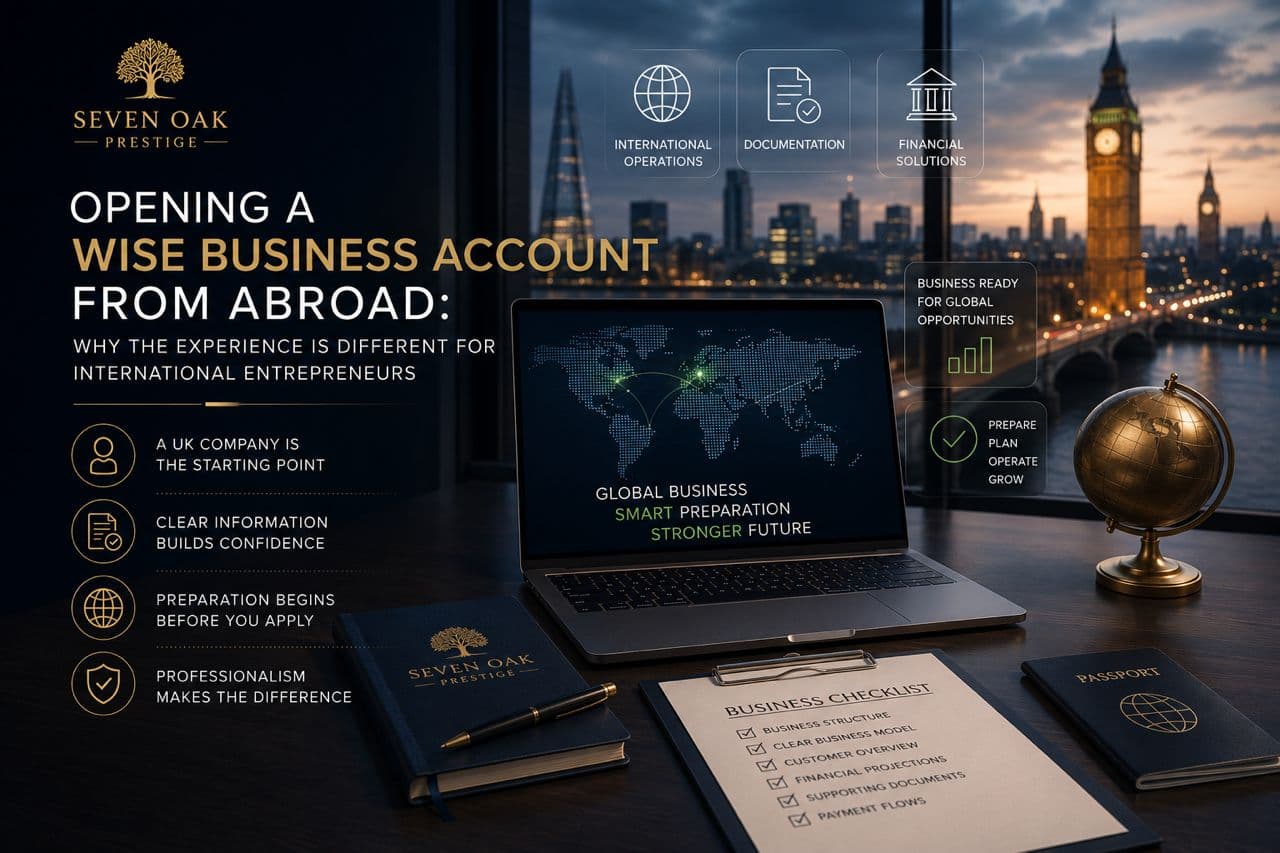
Opening a Wise Business Account from Abroad: Why the Experience Is Different for International Entrepreneurs
If you’ve spent time in entrepreneur communities, you’ve probably seen the same conversations appear again and again.
“My application is still being reviewed.”
“Wise requested more information.”
“A friend told me their account was restricted.”
“I thought registering a UK company would make everything straightforward.”
After reading enough of these discussions, it’s easy to reach the wrong conclusion.
Some people assume opening a Wise Business account from abroad is simply difficult.
Others believe approval depends on luck.
From our experience, neither explanation tells the full story.
The reality is more nuanced.
Wise is not simply opening an account.
Like many regulated financial institutions, it is onboarding a business that it may support for years to come.
That perspective changes the conversation completely.
A UK Company Is the Starting Point, Not the Finish Line
One misunderstanding appears surprisingly often.
Some founders believe that once they receive their Certificate of Incorporation, the hardest part is over.
In practice, incorporation is only the beginning.
A UK Limited Company gives your business a recognized legal structure.
It does not automatically explain:
- what your business actually does,
- who your customers are,
- how you expect to receive payments,
- or why your company is ready to operate internationally.
Those questions still need clear answers.
The businesses that prepare them early usually approach onboarding with greater confidence.
Think Like Someone Seeing Your Business for the First Time
Imagine someone who has never met you.
They know nothing about your company.
No previous conversations.
No referrals.
Only the information your business provides.
Would they immediately understand:
- what you sell,
- who your customers are,
- how your business makes money,
- why customers choose you,
- and how they can contact you?
If the answer is yes, your business is already communicating professionalism.
If the answer is no, the priority should not necessarily be opening another financial account.
It should be improving the way your business presents itself.
That investment continues to deliver value long after onboarding has been completed.
Why Some Applications Require Additional Information
One of the biggest frustrations entrepreneurs experience is receiving a request for additional documentation.
The first reaction is often:
“Have I done something wrong?”
In many situations, the answer is simply no.
Additional questions are a normal part of onboarding for many financial providers.
They help build a clearer understanding of the business.
For example, a provider may seek clarification regarding:
- business activities,
- expected payment flows,
- customer locations,
- supporting documentation,
- ownership structure,
- or other information relevant to its onboarding process.
A request for more information should not automatically be interpreted as a negative outcome.
Very often, it is simply part of understanding the business more completely.
The Businesses That Experience Fewer Challenges Often Share One Habit
Preparation.
Not perfect paperwork.
Not expensive branding.
Preparation.
Before they apply, they already have:
- a professional website,
- a business email linked to their own domain,
- a clear explanation of their products or services,
- consistent company information,
- realistic expectations regarding international operations.
Notice that none of these elements are particularly complicated.
Yet together they create something valuable.
Clarity.
And clarity makes every business easier to understand.
One Conversation We Have Regularly
A founder contacts us after incorporating a UK company.
Their next question is almost always about banking or payment platforms.
Our first question is usually different.
“Can I see your website?”
That question often surprises people.
They expected us to ask about financial products.
Instead, we start by looking at how the business presents itself.
Because before any financial platform understands your company…
Your website introduces it.
Before anyone reviews documentation…
They usually try to understand the business behind it.
That is why we spend so much time encouraging entrepreneurs to build the business before they build the payment infrastructure.
Preparation Is Not About Approval
There is another important point that deserves attention.
Preparing your business professionally should never be viewed as a way to guarantee approval.
No legitimate adviser can promise that.
Every financial institution makes its own independent decisions according to its internal onboarding, compliance and risk policies.
Preparation serves a different purpose.
It allows your business to present itself accurately, consistently and professionally.
Those are valuable qualities regardless of which financial provider you choose.
A Better Way to Think About Wise
Instead of asking:
“How quickly can I open a Wise Business account?”
Consider asking:
“If someone reviewed my business today, would they immediately understand what we do and why customers trust us?”
That single question often leads entrepreneurs to improve areas of their business that continue adding value for years.
Not only during onboarding.
But throughout the entire life of the company.
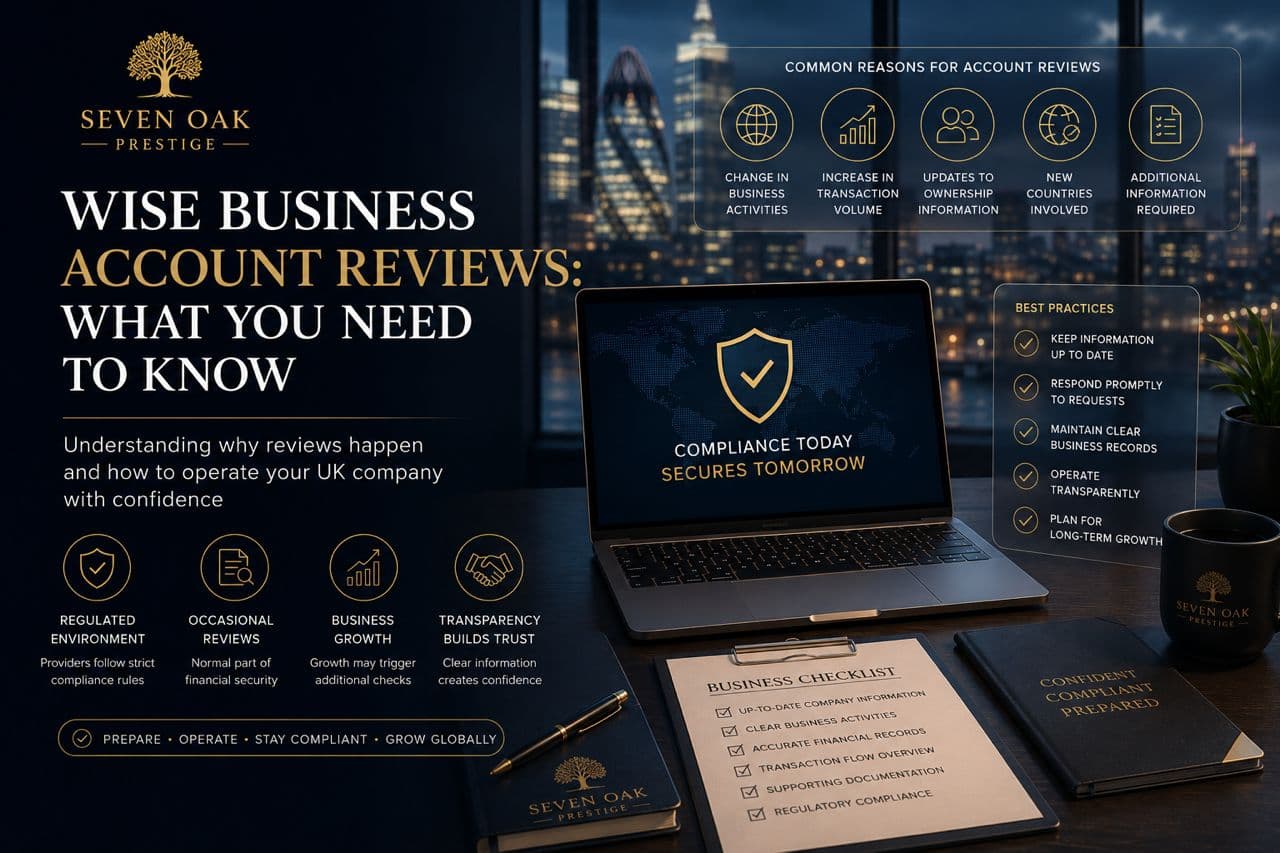
Understanding Account Reviews: What Every International Entrepreneur Should Know
There is one topic that almost every entrepreneur searches for sooner or later.
Not because they expect something to go wrong.
Because they’ve read stories online.
“My Wise account was temporarily restricted.”
“My friend was asked to provide additional documents.”
“Someone said their account was closed without warning.”
When founders see enough of these discussions, concern naturally follows.
The first instinct is often to ask:
“Could the same thing happen to my business?”
It’s a fair question.
The answer, however, deserves more than a simple yes or no.
Looking Beyond Individual Stories
One of the challenges with reading experiences shared on social media or discussion forums is that you usually see only one side of the story.
You rarely know:
- what information was originally provided,
- whether additional documents were requested,
- how the business operated,
- what activity took place on the account,
- or what internal compliance obligations the provider was required to follow.
For that reason, individual experiences should never be treated as universal rules.
A single account does not represent every business.
Just as one positive experience does not guarantee another business will have exactly the same outcome.
Every application and every account is assessed on its own circumstances.
Why Financial Providers Sometimes Review Accounts
One of the biggest misconceptions is that account reviews only happen when something has gone wrong.
In reality, ongoing reviews are a normal part of the financial industry.
Banks, Electronic Money Institutions and payment providers all operate within legal and regulatory frameworks.
As businesses evolve, providers may occasionally need to better understand:
- changes in business activities,
- significant increases in transaction volumes,
- new countries involved in trading,
- updated ownership information,
- or other matters relevant to their compliance responsibilities.
For legitimate businesses, these reviews are often part of operating within a regulated financial system.
Growth Can Change the Conversation
Imagine a small consultancy that processes a handful of international payments each month.
Now imagine that same company two years later.
It has expanded internationally.
It employs staff.
It serves customers in multiple countries.
Its payment volumes have increased significantly.
The business has changed.
As businesses grow, financial providers may seek to better understand that growth.
This should not automatically be viewed as unusual.
Growth often brings new operational realities.
The Businesses That Operate Smoothly Often Have One Thing in Common
Preparation does not end after onboarding.
Professional businesses continue maintaining good habits throughout the life of the company.
That includes:
- Keeping company information current.
- Updating business details when they change.
- Maintaining an active and informative website.
- Keeping accurate financial records.
- Responding promptly to legitimate requests for information.
- Ensuring that business activities remain clearly explained.
These habits are not only useful for one provider.
They contribute to the long-term professionalism of the business itself.
A Lesson We Have Learned
After working with entrepreneurs from many different countries, one lesson appears repeatedly.
Businesses often spend enormous effort preparing to incorporate.
Far fewer invest the same energy preparing to operate.
Incorporation is an event.
Operating internationally is an ongoing responsibility.
The businesses that recognize this difference early usually make stronger long-term decisions.
Don’t Build Your Business Around One Platform
This may be one of the most important lessons in this guide.
No matter how good a financial platform may be, your business should never depend entirely on a single provider.
Experienced entrepreneurs think differently.
They build resilience.
They develop professional accounting systems.
They organize documentation carefully.
They maintain strong customer relationships.
They create financial processes capable of adapting as the business grows.
Technology supports those systems.
It should not become the business itself.
Think Like the CEO, Not Just the Applicant
When entrepreneurs first apply for a financial platform, they often think like applicants.
Experienced founders think like CEOs.
Applicants ask:
“How quickly can I get approved?”
CEOs ask:
“How do I build a business that can operate confidently for the next ten years?”
That difference in mindset influences every decision that follows.
What We Encourage Our Clients to Do
At Seven Oak Prestige, we encourage clients to view company formation and financial onboarding as part of a much larger journey.
Before approaching any financial provider, we recommend focusing on the fundamentals:
- Build a professional website.
- Clearly explain your business activities.
- Use a professional business email.
- Keep company information accurate and consistent.
- Organize supporting documentation.
- Understand your expected payment flows.
- Plan for future growth rather than only immediate needs.
These steps cannot guarantee any particular outcome with a financial provider.
What they do is help ensure your business is presented professionally, transparently and consistently.
Those qualities remain valuable regardless of which provider you choose.
A Final Thought Before We Continue
Perhaps the most useful way to think about Wise is this:
Wise is not simply evaluating whether a company exists.
It is trying to understand the business behind that company.
The clearer your business story becomes, the easier it is for others to understand who you are, what you do and how you operate.
That principle extends far beyond one platform.
It is one of the foundations of building an international business that lasts.
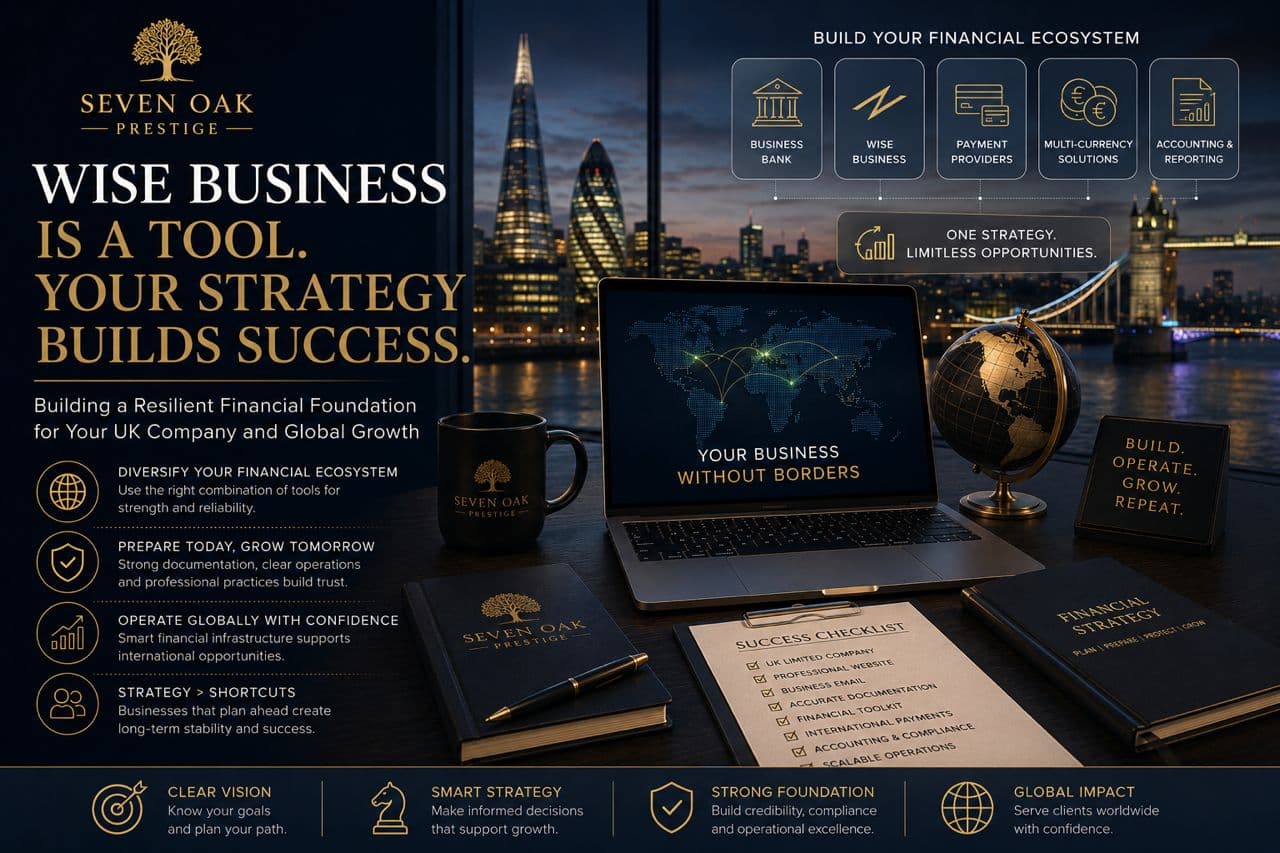
Wise Business Is a Tool. Your Business Strategy Is What Determines Long-Term Success.
If you’ve read this guide from beginning to end, you’ve probably realized something.
This article was never really about Wise.
It was about building an international business that is prepared to operate professionally.
Wise simply became the lens through which we explored that journey.
That distinction matters.
Because successful entrepreneurs rarely build businesses around financial platforms.
They build businesses around customers, processes, credibility and long-term vision.
Financial platforms simply support that vision.
There Is No “Perfect” Financial Provider
One of the biggest mistakes founders make is searching for the perfect platform.
The perfect bank.
The perfect payment provider.
The perfect EMI.
After years of working with international entrepreneurs, we’ve reached a different conclusion.
There isn’t one.
Every financial institution has its own strengths.
Every platform has its own onboarding process.
Every provider serves different types of businesses and customers.
The better question is:
“Which combination of financial tools best supports the way my business operates today, while leaving room for tomorrow?”
That is how experienced founders think.
Build a Financial Ecosystem, Not a Single Dependency
Imagine your business five years from now.
You are serving clients across several countries.
Your team has grown.
Your revenue has increased.
You invoice in multiple currencies.
You work with suppliers in different parts of the world.
Would you really want every financial process to depend on one platform?
Probably not.
The businesses that scale successfully often build an ecosystem.
Depending on their needs, that ecosystem may include:
- A business bank account.
- One or more Electronic Money Institutions (EMIs).
- A payment provider such as PayPal or Stripe.
- Multi-currency capabilities.
- Accounting software.
- Expense management tools.
- Financial reporting systems.
Each serves a different purpose.
Together, they create resilience.
The Businesses That Inspire Confidence Usually Share the Same Habits
Think about companies you naturally trust.
They communicate clearly.
Their websites are professional.
Their documentation is organized.
Their customer experience is consistent.
Nothing feels improvised.
That level of professionalism rarely happens by accident.
It is built through habits.
Small decisions repeated consistently over time.
Those habits create confidence.
Confidence strengthens relationships.
And strong relationships are often the foundation of sustainable growth.
Don’t Build Around Shortcuts
International entrepreneurs are often under pressure.
They want to launch quickly.
Start invoicing immediately.
Receive payments without delay.
There is nothing wrong with moving efficiently.
But there is a difference between moving quickly and taking shortcuts.
The businesses that perform well over time usually invest in the fundamentals.
They explain their services clearly.
They maintain accurate company information.
They keep their website current.
They understand their financial responsibilities.
Those investments may not generate immediate excitement.
But they create long-term stability.
The Advice We Give Every New Client
When someone asks us:
“What’s the best financial solution for my UK company?”
Our answer is rarely the name of a provider.
Instead, we ask a series of questions.
What does your business do?
Who are your customers?
Which countries do you trade with?
How do you expect to receive payments?
What are your growth plans over the next three years?
Only after understanding the business do we begin discussing financial solutions.
Because no platform can be evaluated in isolation.
It should always be evaluated within the context of the business it is expected to support.
That philosophy guides every recommendation we make.
Frequently Asked Questions
Can international entrepreneurs apply for Wise Business?
Many international entrepreneurs operating through a UK Limited Company apply for Wise Business.
Eligibility, supported countries and onboarding decisions are determined independently by Wise according to its own policies and regulatory obligations.
Does registering a UK company guarantee access to Wise Business?
No.
A UK Limited Company provides a recognized legal structure, but every financial provider independently assesses applications based on its own onboarding, verification and risk management processes.
Why might additional information be requested?
Financial providers may request further information to better understand a business, its activities or expected transaction patterns.
Providing clear and organized documentation can help support these reviews.
Should my business rely only on Wise?
Many international businesses choose to use a combination of financial solutions rather than depending on a single provider.
The right approach depends on your business model, operational needs and long-term objectives.
Can Wise Business replace a traditional business bank account?
Wise Business offers valuable financial services for many businesses, but whether it can replace a traditional business bank account depends on your specific operational requirements, the services you need and the jurisdictions in which you operate.
Related Guides
Continue exploring our Knowledge Hub:
- The Ultimate Guide to Business Banking & Fintech Solutions
- PayPal Business for UK Companies
- UK Company Formation for Non-Residents
- Companies House Identity Verification for Non-Residents
- 7 Common Reasons UK Business Bank Account Applications Are Rejected
- How to Start a UK Company from Pakistan
- How to Start a UK Company from Egypt
- How to Start a UK Company from Algeria
- How to Start a UK Company from India
Final Thoughts
Building an international business has never been more accessible.
But accessibility should never be confused with simplicity.
Registering a company is only the beginning.
Opening a financial account is only another step.
The real challenge—and the real opportunity—is building a business that customers trust, financial institutions understand and partners are confident working with.
Wise Business can be an excellent part of that journey for many entrepreneurs.
But like every professional tool, its value depends on the strength of the business behind it.
The companies that succeed internationally are rarely those searching for shortcuts.
They are the ones that invest in preparation, communicate with clarity and make thoughtful decisions long before the first payment arrives.
That is the foundation of sustainable international growth.
About the Author
Isaac Jackson
Founder & Editor, Seven Oak Prestige
Isaac Jackson specialises in helping international entrepreneurs establish UK Limited Companies and build business foundations that support international growth. His work focuses on company formation, Companies House compliance, business banking preparation and helping founders understand the practical realities of operating across borders.
WhatsApp Business: +44 7447 488755
Available 24 hours a day, 7 days a week for enquiries, document sharing and initial guidance. If a detailed consultation is required, we’ll be happy to arrange a scheduled call through our UK office.
Speak Directly with an Expansion Advisor
Skip the uncertainty and speak directly with an experienced adviser.
Whether you are planning your first UK company or strengthening an existing international structure, our team is here to help.
UK Office: +44 (0)20 4578 0726
WhatsApp (24/7): +44 7447488755
Office Hours: Monday to Friday, 09:00–18:00 (UK Time)
Website: www.sevenoakprestige.com
Email: contact@sevenoakprestige.com