
PayPal Business for UK Companies: The Complete Guide for International Entrepreneurs (2026)
PayPal Business for UK Companies: The Complete Guide for International Entrepreneurs (2026)
Introduction
Almost every international entrepreneur reaches the same moment.
The company has been registered.
The website is almost finished.
The first overseas client is ready to pay.
Then one simple question suddenly becomes surprisingly important.
“Can I use PayPal for my UK company?”
On the surface, it sounds like a straightforward question.
In reality, it opens the door to a much bigger conversation.
Because choosing a payment solution is not simply about collecting money.
It is about building a business that customers trust, payment providers understand and financial institutions are comfortable supporting over the long term.
This is where many articles stop.
They explain how to create a PayPal account.
They list a few features.
Perhaps they compare some transaction fees.
Then they move on.
That approach misses the bigger picture.
After working with international entrepreneurs, one pattern appears repeatedly.
The businesses that experience the smoothest growth are rarely the ones that rush to open payment accounts.
They are the businesses that prepare properly before they apply.
A payment platform should never be viewed in isolation.
It forms part of a wider business ecosystem that includes your company structure, your website, your documentation, your banking strategy and the way your business presents itself to the outside world.
Understanding that relationship is far more valuable than learning where to click during the registration process.
That is exactly what this guide has been written to explain.
Why This Guide Is Different
Search online for PayPal Business UK and you’ll find hundreds of articles.
Many of them answer the same questions.
How to sign up.
How to verify your email.
How to receive payments.
Some compare transaction fees.
Others simply repeat information already available in PayPal’s own documentation.
Very few explain what international entrepreneurs actually need to understand before making PayPal part of their business.
That is the gap this guide aims to fill.
Rather than looking at PayPal as a standalone product, we will look at it from the perspective of someone building an international company.
A founder who wants to create something credible.
Something scalable.
Something capable of serving customers across different countries.
Because when viewed from that perspective, PayPal is no longer just another payment platform.
It becomes one component of a much broader business strategy.
Who This Guide Is Written For
This guide has been written for entrepreneurs who either already operate through a UK Limited Company or are planning to establish one.
That includes founders building:
- SaaS companies
- Software businesses
- Artificial Intelligence startups
- Digital agencies
- Consulting firms
- E-commerce brands
- Shopify stores
- Amazon businesses
- eBay stores
- Recruitment companies
- Publishing businesses
- Digital magazines
- Media companies
- Online education platforms
- Professional service businesses
Although these industries are very different, they all have one thing in common.
At some point, every one of them needs a reliable way to receive payments from customers.
The Question Most Entrepreneurs Should Really Be Asking
Interestingly, one of the most common questions we hear is also the wrong one.
Instead of asking:
“Can I use PayPal?”
A better question would be:
“Is PayPal the right payment solution for the way my business operates?”
Those are two completely different conversations.
The first focuses on technology.
The second focuses on business strategy.
Successful companies almost always begin with the second question.
PayPal Is Not Your Business Strategy
One misconception appears again and again.
Entrepreneurs often spend weeks deciding which payment platform they want to use.
Far fewer spend the same amount of time thinking about the business that platform is expected to support.
Incorporating a company.
Building a professional website.
Explaining your services clearly.
Creating transparent policies.
Preparing your documentation.
Developing a credible online presence.
Those foundations often have a much greater influence on long-term success than the choice between one payment provider and another.
Technology supports a business.
It does not replace one.
A Different Way to Think About PayPal
Imagine your business as a modern office building.
Your UK Limited Company is the legal structure.
Your website is the front entrance.
Your products or services are the rooms inside.
Your business banking is the financial infrastructure.
Your accounting system manages the internal operations.
PayPal?
PayPal is one of the doors through which customers enter.
An important door.
But still only one part of the entire building.
Businesses become stronger when every part of that structure works together.
That is why this guide focuses not only on PayPal itself, but also on how it fits within the wider financial ecosystem of an international business.
What We’ll Cover
Over the next sections, we’ll explore:
- How PayPal Business works with a UK Limited Company.
- How payment providers generally assess businesses.
- What professional preparation looks like before applying.
- Common misunderstandings that delay entrepreneurs.
- How PayPal fits alongside business banking and other financial solutions.
- Best practices for building a payment strategy that supports long-term international growth.
By the end of this guide, you’ll have a clearer understanding not only of PayPal Business, but also of the broader decisions involved in building a professional business that is ready to operate internationally.
Before You Open a PayPal Business Account, Understand What You’re Really Building
There is a moment that almost every entrepreneur experiences.
The company has been incorporated.
The incorporation certificate has arrived.
The excitement is real.
Naturally, the next thought is:
“Now I need somewhere for my customers to pay me.”
For many businesses, PayPal quickly appears on the shortlist.
It is recognised around the world.
Millions of customers already know how it works.
Many online stores display the PayPal logo alongside their checkout.
At first glance, choosing PayPal seems obvious.
But this is where experienced entrepreneurs pause.
Not because PayPal is necessarily the wrong choice.
Because they understand something that many first-time founders overlook.
Opening a payment account is not the objective.
Building a payment strategy is.
Those two ideas may sound similar.
They are not.
Think Beyond Your First Customer
Imagine your business two years from now.
Perhaps today you are a freelancer.
In twelve months you may have five employees.
Two years later you could be serving customers in fifteen countries.
The payment solution that works for a small consultancy might not be the one that best supports a rapidly growing software company.
The same applies to an online magazine, a digital agency or an international e-commerce business.
That is why successful founders rarely choose financial tools based only on what they need today.
They choose solutions that can support the business they expect to become.
PayPal Is One Piece of a Larger Financial Ecosystem
One mistake we frequently see is entrepreneurs trying to find a single platform that does everything.
Receive payments.
Hold money.
Exchange currencies.
Pay suppliers.
Manage expenses.
Generate reports.
Support international growth.
No single platform is designed to be everything for every business.
Instead, think of your business as an ecosystem.
Each component has its own purpose.
Your UK Limited Company provides the legal structure.
Your accountant helps maintain financial records.
Your website generates customer confidence.
Your business banking solution manages daily financial operations.
Your payment providers help customers pay you.
Each performs a different role.
The businesses that scale successfully usually understand this distinction early.
The Question PayPal Is Really Asking
Many entrepreneurs assume that PayPal simply wants to verify a company’s registration documents.
That is only one part of the picture.
A more useful way to think about onboarding is this:
“If someone who has never heard of my business visited my website today, would they immediately understand who we are, what we do and why customers trust us?”
That question sits at the heart of professional preparation.
Because when your business is transparent, organized and easy to understand, every conversation becomes easier.
Not only with payment providers.
Also with customers.
Suppliers.
Business partners.
And eventually, investors.
Your Website Speaks Before You Do
Many founders spend weeks perfecting their company registration.
Then launch a website containing little more than a logo and a contact form.
Imagine walking into a beautifully designed office building only to discover every room is empty.
That is how an unfinished website often feels.
A professional website should answer questions before anyone needs to ask them.
What does the company do?
Who does it help?
How can customers get in touch?
What products or services are offered?
What happens after a purchase?
Where can visitors find your business policies?
A website that communicates clearly creates confidence.
Not only for customers.
For anyone trying to understand your business.
Different Businesses Tell Different Stories
A software company tells one story.
An online retailer tells another.
A management consultancy communicates differently from a digital publisher.
Trying to present every business in exactly the same way rarely works.
For example:
A SaaS company should clearly explain its software, pricing model and customer support.
An e-commerce business should make shipping, returns and product information easy to understand.
A publishing platform should explain its editorial focus, revenue model and advertising approach.
A consulting firm should demonstrate expertise, industries served and the value it delivers to clients.
The clearer your story, the easier it becomes for others to understand your business.
Preparation Creates Confidence
There is an interesting pattern we have observed over time.
Entrepreneurs often spend considerable effort choosing the right payment platform.
Far fewer spend the same amount of effort preparing the business that platform will support.
Preparation is rarely exciting.
It does not produce an incorporation certificate.
It does not create a new logo.
But it quietly influences almost every stage of building an international business.
A well-prepared business is easier to understand.
Easier to trust.
And easier to support.
Those advantages continue long after the company has been incorporated.
A Better Way to Approach PayPal
Rather than asking:
“How quickly can I open a PayPal Business account?”
Consider asking:
“If someone reviewed my business today, would they immediately recognize it as professional, transparent and ready for international customers?”
That small shift in thinking changes everything.
Because successful international businesses are rarely built by chasing the fastest solution.
They are built by establishing the strongest foundation.
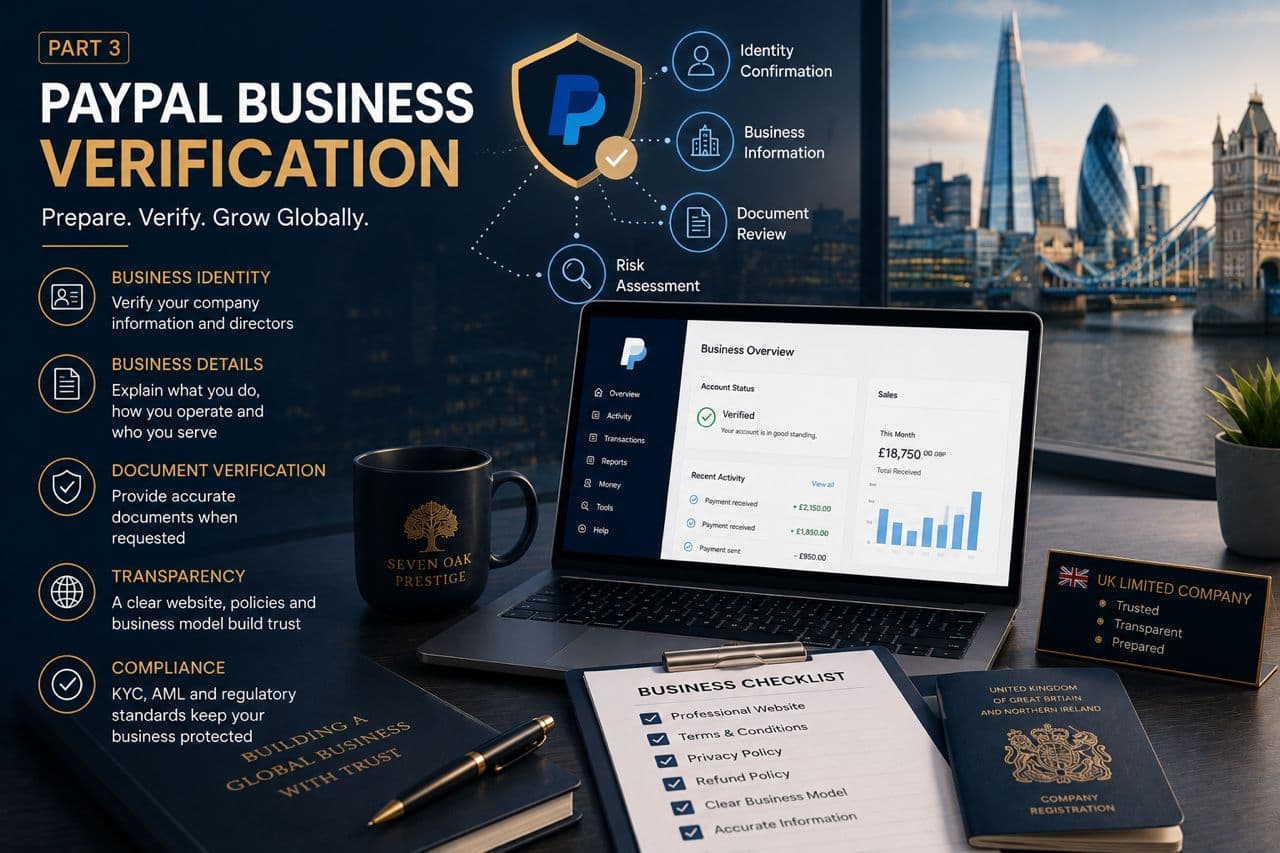
The Businesses That Succeed with PayPal Usually Prepare Long Before They Apply
One of the biggest misconceptions surrounding PayPal Business is that success begins when you click “Create Account.”
It doesn’t.
In many cases, it begins weeks—or even months—earlier.
Long before the first application is submitted.
Long before the first customer makes a payment.
Long before the first invoice is sent.
Because the strongest businesses are not built around applications.
They are built around preparation.
That distinction is easy to overlook, but it often separates businesses that are ready to grow internationally from those that spend valuable time solving avoidable problems.
Think Like a Payment Provider
Imagine, for a moment, that you are reviewing businesses all day.
One company has a professional website.
Its services are clearly explained.
Its contact information is complete.
Its policies are easy to find.
Its branding is consistent.
Its business model makes sense.
Another company has a logo.
A homepage.
Very little information.
No explanation of what it actually sells.
Which business would you understand more quickly?
That is why preparation matters.
Payment providers are not only reviewing company information.
They are trying to understand the business behind the company.
Trust Is Built Before the First Transaction
Many entrepreneurs believe trust begins after customers start buying.
In reality, trust begins much earlier.
It begins the moment someone discovers your business.
Whether that person is:
- A potential customer.
- A payment provider.
- A banking compliance team.
- A commercial partner.
They all ask similar questions.
Who are you?
What do you actually do?
Why should someone trust your business?
Your website, documentation and communication answer those questions long before you ever speak to them.
The Small Details That Make a Big Difference
Professional businesses rarely stand out because of one dramatic feature.
Instead, they create confidence through dozens of small details working together.
For example:
A business email that matches your domain.
A website free from broken pages.
Clear service descriptions.
Transparent pricing where appropriate.
Easy-to-find contact information.
Professional branding.
Consistent company information across every platform.
Individually, these may seem minor.
Collectively, they create credibility.
That credibility influences how your business is perceived.
Every Industry Tells a Different Story
One of the mistakes generic articles make is assuming every business looks the same.
It doesn’t.
A software company communicates differently from an online retailer.
A recruitment agency operates differently from a publishing platform.
An international consultant presents different information from an e-commerce brand.
For example:
Software & SaaS
Visitors should immediately understand:
- What the software does.
- Who it is designed for.
- How subscriptions work.
- Where customers can receive support.
E-commerce
Customers expect to see:
- Product information.
- Delivery details.
- Return policies.
- Customer support.
- Secure purchasing experience.
Consultants & Agencies
Professional service businesses benefit from demonstrating:
- Their areas of expertise.
- Industries served.
- Typical client challenges.
- The outcomes they help clients achieve.
Publishing & Digital Media
Media businesses should clearly explain:
- Editorial focus.
- Audience.
- Revenue model.
- Advertising approach.
- Memberships or subscriptions where applicable.
Every industry has its own story.
The clearer that story becomes, the easier it is for people to understand your business.
Transparency Is One of Your Greatest Business Assets
Entrepreneurs often ask us:
“What documents should I prepare?”
It is an understandable question.
But there is another question that is even more valuable.
“If someone spent five minutes reviewing my business, would everything they see tell the same story?”
Your website.
Your company information.
Your invoices.
Your email domain.
Your social media.
Your business description.
Everything should support the same message.
Consistency creates confidence.
Confidence creates trust.
Growth Requires More Than a Payment Account
Receiving payments is important.
But international businesses eventually need much more.
As they grow, many introduce:
- Business banking.
- Multi-currency capabilities.
- Accounting software.
- Expense management.
- Team permissions.
- Financial reporting.
- International payment solutions.
PayPal can play an important role within that ecosystem.
But like every professional tool, it delivers the greatest value when it supports a business that has already been built on strong foundations.
A Lesson We See Repeatedly
After helping entrepreneurs from many different countries establish UK companies, one observation continues to stand out.
The businesses that progress most smoothly are not necessarily the biggest.
They are usually the ones that arrive prepared.
They understand their business model.
They explain it clearly.
They invest in a professional online presence.
They think beyond incorporation.
And they approach international growth with patience rather than urgency.
That mindset often proves more valuable than any individual financial product.
Beyond PayPal: Building a Payment Strategy That Grows with Your Business
If there is one lesson that experienced entrepreneurs learn early, it is this:
The payment solution you choose today should still support your business tomorrow.
That may sound obvious.
In practice, many businesses only think about payments when they are about to receive their first customer.
The reality is very different.
Payment infrastructure is part of your business strategy.
It influences how customers experience your brand.
How quickly you receive funds.
How efficiently you operate internationally.
And, ultimately, how confidently your business can grow.
For that reason, choosing PayPal should never be viewed as the final decision.
It should be viewed as one decision within a much broader financial strategy.
Every Business Evolves
Very few businesses remain exactly as they were on the day they incorporated.
A consultant may later build an agency.
A freelancer may launch a software company.
An online store may begin selling internationally.
A publisher may introduce subscriptions.
A SaaS business may expand into new markets.
As your business evolves, your financial requirements evolve with it.
That is why flexibility matters.
The strongest businesses periodically review their financial ecosystem to ensure it still supports their objectives.
Customer Trust Begins at Checkout
Imagine two businesses selling similar services.
Both have professional websites.
Both offer competitive pricing.
Both appear credible.
When customers reach the payment stage, they expect the same level of professionalism they experienced throughout the rest of the journey.
The payment experience is often the final step before a purchasing decision.
A smooth, familiar and transparent checkout process reinforces the confidence that has already been built.
In many cases, that experience contributes just as much to customer satisfaction as the product itself.
Technology Should Support Strategy, Not Replace It
Modern entrepreneurs have access to more financial technology than ever before.
Business banking.
Electronic Money Institutions.
Payment providers.
Accounting software.
Expense management tools.
Multi-currency solutions.
Automation platforms.
The challenge is no longer finding technology.
The challenge is choosing technology that supports your business rather than complicating it.
Every decision should begin with one question:
“Does this help my business serve customers more effectively?”
If the answer is yes, the technology is supporting your strategy.
If not, it may simply be adding complexity.
The Most Valuable Investment Is Preparation
There is no payment platform that can replace preparation.
A professional website.
Clear documentation.
Consistent company information.
Transparent business activities.
Well-defined customer journeys.
These are not administrative tasks.
They are investments in credibility.
And credibility has long-term value.
It influences how customers, suppliers, commercial partners and financial institutions perceive your business.
A Strong Business Is Built on Consistency
One characteristic appears again and again among businesses that grow successfully.
Consistency.
The same business description appears across the website, invoices and company documents.
The same level of professionalism is reflected in customer communication.
The same attention to detail is visible throughout the organization.
Consistency creates confidence.
Confidence builds relationships.
Relationships support growth.
Our Perspective at Seven Oak Prestige
At Seven Oak Prestige, we have always believed that company formation is only the beginning of the journey.
Our role is not simply to help entrepreneurs establish a UK company.
It is to help them establish a business that is prepared for international opportunities.
That means thinking beyond incorporation.
Beyond payment providers.
Beyond banking.
Towards building a business that inspires confidence wherever it operates.
Where appropriate, we can introduce eligible clients to selected banking and fintech partners within our professional network.
Every institution independently evaluates applications according to its own onboarding, compliance and risk assessment procedures.
Our focus is on helping entrepreneurs prepare professionally before those conversations begin.
Frequently Asked Questions
Can a UK Limited Company use PayPal Business?
Many UK Limited Companies use PayPal Business, subject to PayPal’s eligibility criteria, supported countries and independent onboarding procedures.
Is PayPal a replacement for business banking?
No.
PayPal is a payment platform.
Many businesses also use business banking solutions and other financial services depending on their operational requirements.
Does having a UK company guarantee a PayPal Business account?
No.
Every application is assessed independently by PayPal according to its own verification, compliance and risk management processes.
Is PayPal suitable for software companies and digital agencies?
For many businesses in these sectors, PayPal can form part of their payment strategy.
The suitability of any payment solution depends on the company’s business model, customer base and operational requirements.
Should my business rely on one payment provider?
Many growing businesses choose to build a broader financial ecosystem by combining payment providers, business banking solutions and other financial tools that support their long-term objectives.
Related Guides
Continue exploring our Knowledge Hub:
- The Ultimate Guide to Business Banking & Fintech Solutions
- UK Company Formation for Non-Residents
- Companies House Identity Verification for Non-Residents
- 7 Reasons UK Business Bank Account Applications Are Rejected
- How to Start a UK Company from Egypt
- How to Start a UK Company from Pakistan
- How to Start a UK Company from the UAE
Final Thoughts
International business has never been more accessible.
A founder in Cairo can work with clients in London.
A software developer in Lahore can serve companies in New York.
A consultant in Dubai can advise businesses across Europe.
Technology has made global commerce possible.
Professional preparation is what makes it sustainable.
PayPal Business is one of many tools available to modern entrepreneurs.
Its value is greatest when it supports a business that has already invested in credibility, transparency and long-term planning.
Businesses that grow internationally are rarely built around a single platform.
They are built around thoughtful decisions, consistent execution and a clear understanding of where they want to go.
That is the mindset that creates businesses capable of lasting well beyond their first international payment.
About the Author
Isaac Jackson
Founder & Editor, Seven Oak Prestige
Isaac Jackson specializes in UK company formation for international entrepreneurs, helping founders establish compliant UK business structures and prepare for Companies House requirements, international payment solutions, business banking and sustainable global growth.
Speak Directly with an Expansion Advisor
Skip the uncertainty and speak directly with an experienced adviser.
Whether you are planning your first UK company or strengthening an existing international structure, our team is here to help.
UK Office: +44 (0)20 4578 0726
WhatsApp (24/7): +44 7447488755
Office Hours: Monday to Friday, 09:00–18:00 (UK Time)
Website: www.sevenoakprestige.com
Email: contact@sevenoakprestige.com