
How to Start & Register a UK Company from Pakistan: Complete 2026 Guide for Pakistani Residents

UK Limited Company Formation, Companies House Identity Verification, UK Address, Ownership, Costs, Banking, Tax & Ongoing Compliance
Updated: August 2026
A Pakistani citizen or resident can generally establish and own a UK Private Limited Company without moving to Britain.
UK company law does not generally require the director of a private limited company to live in the United Kingdom. A private company must have at least one director who is at least 16 years old. Pakistani founders can therefore potentially establish and manage a UK Ltd remotely from Karachi, Lahore, Islamabad, Rawalpindi, Faisalabad or elsewhere in Pakistan.
But the most important question is not simply:
“Can I register a UK company from Pakistan?”
The better question is:
“Does a UK Limited Company make commercial sense for the business I am actually building?”
That distinction matters.
A Pakistani founder may use a UK company for:
- consulting;
- SaaS;
- software;
- professional services;
- international contracting;
- e-commerce;
- Amazon;
- digital agencies;
- wholesale;
- import/export;
- an international startup.
But registering a UK Ltd does not automatically guarantee:
- a UK bank account;
- Stripe;
- Wise;
- Payoneer;
- Revolut;
- Amazon approval;
- another payment provider;
- favourable tax treatment.
Companies House incorporation, identity verification, banking and payment-provider onboarding are separate processes.
This complete 2026 guide explains how those pieces fit together while remaining focused on one central question:
how a Pakistani resident correctly establishes a UK Limited Company.
For the broader international-founder framework, see Seven Oak Prestige’s UK Company Formation for Non-Residents guide.
Quick Answer: Can a Pakistani Resident Register a UK Company?
Generally, yes.
A Pakistani resident can potentially be:
- the sole shareholder;
- the sole director;
- the beneficial owner;
- the Person with Significant Control;
- and the person managing the UK company remotely.
A UK-resident director is not generally required.
A British shareholder is not generally required.
The company does, however, require an appropriate UK registered office address, and the relevant directors and PSCs must comply with the Companies House identity-verification regime introduced from 18 November 2025.
Pakistan → UK Company Formation 2026: Decision Matrix
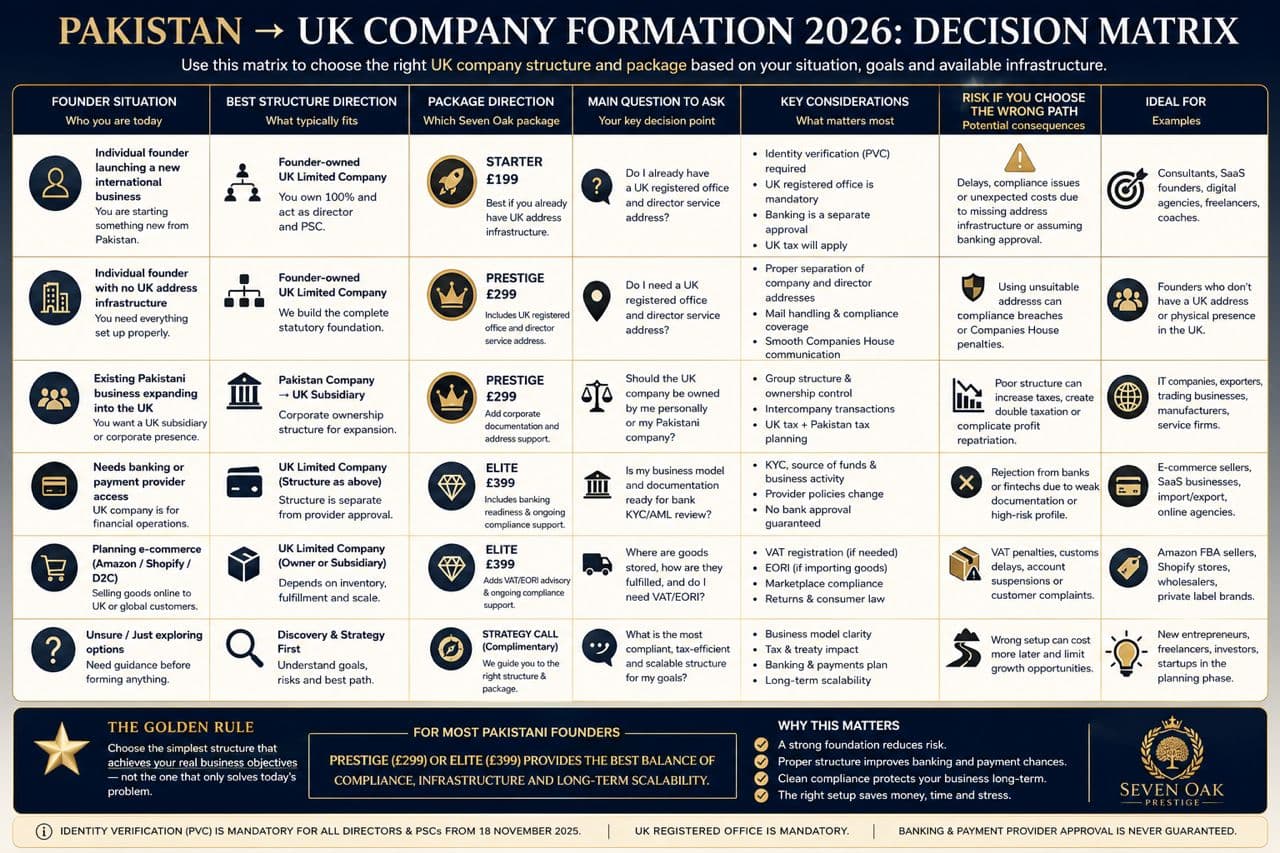
A UK Ltd is useful when it performs a genuine commercial function. It should not be created merely because UK incorporation is accessible or because a founder assumes it will automatically unlock banking or payment providers.
1. Why Pakistani Entrepreneurs Establish UK Companies
Pakistan has a large community of:
- software developers;
- IT consultants;
- digital agencies;
- freelancers;
- e-commerce sellers;
- exporters;
- startup founders;
- professional-service businesses.
A UK Ltd can offer a recognised international corporate structure for businesses serving customers beyond Pakistan.
Potential advantages include:
- a Companies House registration;
- limited liability;
- English-language corporate documentation;
- documented ownership;
- professional contracting;
- a recognised business jurisdiction.
But these advantages should not be confused with guaranteed provider access.
Some competing formation sites market a UK Ltd as an almost automatic pathway to international banking or payment gateways. Current competitor content still makes claims around access to Stripe, Wise, Tide and other providers that are much stronger than the underlying reality justifies.
Seven Oak’s approach should be different:
Form the right company first. Then assess each financial provider separately.
2. Do Pakistani Residents Need to Move to the UK?
No.
A director of a UK private company does not generally need to reside in Britain.
That means a Pakistani founder can potentially own and direct the company while continuing to live in Pakistan.
However, company ownership does not give the founder:
- UK residence;
- a work visa;
- settlement;
- British citizenship;
- permission to work physically in Britain.
Company law and immigration law are separate.
For the detailed distinction, see Do You Need a UK Visa to Own or Run a UK Company?
3. Can a Pakistani Founder Own 100% of the UK Company?
Generally, yes.
A private company limited by shares can have one shareholder.
A straightforward founder structure may therefore look like:
Pakistani Founder
↓
100% Shareholder
↓
Director
↓
PSC
↓
UK Limited Company
That does not mean every founder should automatically choose this structure.
If there are:
- co-founders;
- investors;
- family shareholders;
- an existing Pakistani company;
- future equity plans,
ownership should be designed before incorporation.
For deeper guidance, use Seven Oak Prestige’s UK Shares and Directors for Non-Resident Founders guide
4. Pakistani Individual vs Pakistani Company as Shareholder
An important question for established entrepreneurs is:
Should I personally own the UK Ltd, or should my Pakistani company own it?
These are different structures.
Founder-owned
Pakistani individual
↓
UK Ltd
This may suit a new standalone international venture.
Corporate-owned
Pakistani company
↓
UK subsidiary
This can be more coherent where an established Pakistani business is genuinely expanding into Britain.
The second structure can introduce additional issues around:
- intercompany transactions;
- transfer pricing;
- accounting;
- funding;
- tax.
Do not create the UK company first and only later decide who should really have owned it.
5. Director, Shareholder and PSC Are Different Roles
These terms are often confused.
Director
Responsible for managing the company and complying with directors’ duties.
Shareholder
Owns shares.
PSC
A Person with Significant Control is an individual or qualifying legal entity meeting one or more statutory control conditions.
For a simple single-founder UK Ltd, one Pakistani founder can potentially be:
director + shareholder + PSC
But Companies House treats these roles separately.
That matters particularly for identity verification.
6. Companies House Identity Verification Changed Formation in 2025–26
This is one of the biggest areas where older Pakistan formation guides are now outdated.
From 18 November 2025, identity verification became legally required under the new Companies House regime.
For new directors:
- identity must be verified;
- the director’s personal code is required when incorporating or being appointed.
Existing directors provide their personal code in connection with their next confirmation statement during the transition period.
PSCs also have a separate requirement to connect their verified identity to their PSC role.
This is no longer an optional “extra check.”
It is part of the modern Companies House framework.
7. What Is the Companies House Personal Code?
After identity verification, Companies House provides the individual with a personal code.
The same personal code is reused when the person needs to demonstrate that they have been verified.
For example, someone who is director of several companies does not normally obtain a separate code for every company.
Companies House confirms that the code belongs to the individual and is reused for relevant appointments.
This is especially important for Pakistani founders who intend to establish more than one UK company or already hold UK directorships.
8. Directors and PSCs Have Different Verification Steps
A founder who is both:
director
and:
PSC
should not assume that supplying the code once automatically completes every Companies House role requirement.
Directors and PSCs have separate processes for connecting their verified identities to Companies House records.
For PSCs, Companies House provides a specific service and a defined 14-day period for providing verification details depending on the relevant circumstances.
For the full identity-verification process, use Seven Oak Prestige’s dedicated Companies House Identity Verification for Non-Residents guide
9. Can Pakistani Founders Complete Identity Verification Remotely?
Potentially, yes.
Companies House supports direct identity verification through GOV.UK One Login for qualifying users, as well as verification through an Authorized Corporate Service Provider.
An overseas founder is not automatically excluded simply because they live outside Britain.
The success of a particular verification route depends on matters such as:
- identity document;
- consistency of personal details;
- verification technology;
- whether an ACSP is used.
The key message is:
Identity verification has made UK company formation more controlled, not unavailable to Pakistani residents.
10. Documents Pakistani Founders Should Prepare
There is an important distinction between:
Companies House filing requirements
and:
the KYC requirements of a formation agent, bank or payment provider.
Depending on the engagement, a Pakistani founder may need to prepare:
- valid passport or accepted ID;
- proof of current residential address;
- date of birth;
- full legal name;
- director information;
- shareholder information;
- PSC information;
- business description;
- expected activities;
- source-of-funds information where relevant.
A provider may request more information than Companies House itself.
That is normal in AML/KYC environments.
11. Consistency of Name and Address Matters
Pakistani documents sometimes present names or addresses differently across:
- passport;
- CNIC;
- bank statement;
- utility documentation;
- English translations.
Before incorporation, check that the information used across:
- Companies House;
- KYC;
- banking;
- payment providers;
is consistent.
Minor inconsistencies can cause avoidable delays later.
Do not invent a simplified address purely to make forms easier.
Use accurate information and explain formatting differences where needed.
12. Do You Need a UK Registered Office?
Yes.
Every UK company must have an appropriate registered office in the relevant UK jurisdiction.
For most Seven Oak clients this will be England and Wales.
An overseas founder cannot simply use their Pakistani residential address as the UK registered office.
The registered office is the statutory address of the company.
For founders without their own UK premises, a professional registered-office service can provide this infrastructure.
13. Registered Office vs Director Service Address
These are not the same thing.
Registered office
Official address of the company.
Director service address
Public correspondence address for the director.
Residential address
The director’s actual home address, which is generally kept off the public register in the normal course.
For a Pakistani founder, this distinction is particularly useful because it allows the founder to maintain an accurate Pakistani residential address while using appropriate UK statutory/address infrastructure.
For the complete explanation, see UK Registered Office vs Director Service Address for Non-Residents.
14. Can a Pakistani Founder Use the Starter Package?
Potentially, yes.
This is important because package suitability should not be based simply on nationality.
Seven Oak’s Starter package is currently aimed at founders who primarily need the incorporation handled and who already have the required address infrastructure.
The current Seven Oak pricing structure is:
Starter — £199
Core formation.
Prestige — £299
Adds registered office and director service-address infrastructure.
Elite — £399
Adds broader operational and banking-readiness support.
Seven Oak’s own current guidance already recognises that a Pakistani founder may choose Starter if they already have an appropriate UK address arrangement.
The right question is not:
“Are you Pakistani?”
It is:
“What infrastructure do you already have?”
15. Choose the Company Name
The company name must comply with Companies House rules.
Before incorporating:
- check availability;
- avoid misleading names;
- identify sensitive words;
- consider trade-mark risk;
- think about long-term branding.
Changing a name later can create administrative work across:
- contracts;
- website;
- banking;
- invoices;
- payment providers.
Choose carefully before filing.
16. Select the Correct SIC Code
A SIC code describes the business activity.
Examples can differ for:
- software development;
- management consultancy;
- e-commerce;
- marketing;
- education;
- wholesale;
- IT consulting.
Do not select a SIC code merely because someone says it is “bank-friendly.”
Your:
- SIC code;
- website;
- business description;
- invoices;
- contracts;
- banking application
should describe substantially the same real business.
Consistency is more valuable than artificial risk reduction.
17. Decide the Share Structure
Many simple founder-owned businesses do not need complicated shares.
A basic structure might use:
1 ordinary share at £1
owned by the founder.
But founders expecting:
- partners;
- investors;
- different voting rights;
- future share transfers;
should consider ownership properly before incorporation.
Simple is good when the business is genuinely simple.
It is not good when it ignores a known future ownership arrangement.
18. Registered Email Address
UK companies also provide a registered email address to Companies House.
The registered email is not displayed publicly like the registered office.
Use an email account that:
- remains accessible;
- is monitored;
- will not disappear if an employee or consultant leaves.
Important statutory communication should not depend on a temporary inbox.
19. Full Step-by-Step: How to Register a UK Company From Pakistan
The cleanest incorporation sequence is:
Step 1 — Confirm that a UK Ltd suits the business
Understand why you need it.
Step 2 — Decide who will own it
Individual founder or existing Pakistani company?
Step 3 — Identify directors and PSCs
Step 4 — Complete Companies House identity verification
Step 5 — Obtain the personal code
Step 6 — Choose the company name
Step 7 — Select accurate SIC code(s)
Step 8 — Decide share capital and ownership
Step 9 — Arrange the UK registered office
Step 10 — Determine director service address
Step 11 — Provide registered email
Step 12 — Complete provider KYC where applicable
Step 13 — Submit incorporation
Step 14 — Receive Certificate of Incorporation
Step 15 — Organise post-incorporation compliance
This keeps the journey straightforward.
20. How Much Does Companies House Charge in 2026?
The current Companies House digital incorporation fee is:
£100
Paper incorporation currently costs:
£124
Eligible same-day software incorporation currently costs:
£156
Companies House also currently charges £50 for the digital confirmation-statement fee in the applicable 12-month payment period.
These are government fees.
They should not be confused with the total cost of:
- registered office;
- service address;
- formation-agent support;
- identity verification;
- accounting;
- banking readiness;
- VAT;
- EORI.
For the broader cost framework, use Seven Oak’s UK Company Formation Cost for Non-Residents guide.
21. How Long Does UK Incorporation Take?
Straightforward online incorporations are often processed quickly.
But no responsible formation provider should guarantee that every application will be approved at a specific hour.
Applications can be delayed because of:
- inconsistent information;
- identity issues;
- company-name review;
- filing errors;
- additional scrutiny.
Treat incorporation time as an estimate, not a guaranteed commercial deadline.
22. What Happens After Incorporation?
Once the company is incorporated, you receive a Certificate of Incorporation and company number.
But that is the beginning of the company’s operating life.
Post-incorporation matters can include:
- accounting;
- HMRC;
- banking;
- contracts;
- invoices;
- VAT where relevant;
- EORI where relevant;
- annual accounts;
- confirmation statements.
Instead of turning this Pakistan formation page into another huge post-formation manual, continue with Seven Oak’s What Happens After UK Company Formation? Complete 2026 Checklist.
23. Company Formation Does Not Guarantee a UK Bank Account
This distinction should be explicit.
Companies House decides whether the company is incorporated.
A bank or EMI separately decides whether it wants to onboard the customer.
The bank may assess:
- Pakistani residence;
- company activity;
- customers;
- suppliers;
- expected turnover;
- transaction countries;
- source of funds;
- source of wealth;
- website;
- contracts;
- ownership.
A UK company can therefore be perfectly valid at Companies House while still being declined by a financial institution.
That is not a contradiction.
For preparation, use Seven Oak’s UK Business Banking Readiness Assessment.
24. What About Stripe, Wise, Payoneer and Revolut?
Do not assume that UK incorporation automatically unlocks them.
Provider policies:
- differ;
- change;
- depend on residence;
- depend on business model;
- depend on KYC;
- may change after incorporation.
Some current Pakistan-focused competitors still present provider access as a relatively straightforward consequence of UK incorporation.
Seven Oak should take the more accurate position:
Company registration does not create provider eligibility.
Where assistance is needed, see Seven Oak’s Fintech & Banking Guidance service.
25. Do Not Register a UK Company Solely for Stripe
This deserves its own warning because it is a common motivation among international digital founders.
A weak sequence is:
Want Stripe
↓
register UK company
↓
assume acceptance
A stronger sequence is:
business model
↓
company jurisdiction
↓
real commercial purpose
↓
provider eligibility
↓
application
If Stripe or another specific provider is the only reason the company exists, check the provider’s current requirements before committing to the structure.
26. UK Corporation Tax: Basic Position
A UK-incorporated company is generally within the UK Corporation Tax framework.
The fact that its shareholder lives in Pakistan does not turn the company into a tax-free entity.
The company may need to account for:
- income;
- expenses;
- taxable profits;
- Corporation Tax;
- filings.
This article should not repeat the entire tax pillar.
For the detailed UK framework, use Seven Oak’s UK Company Tax for Non-Residents guide.
27. Pakistan Tax Can Still Matter
The founder and the UK company are separate legal/tax subjects.
A Pakistani resident may separately need to consider Pakistan rules relating to matters such as:
- foreign income;
- dividends;
- salary;
- overseas assets;
- management;
- business activity.
The answer depends on the individual’s circumstances and Pakistan law.
This is therefore an area for cross-border tax advice rather than assumptions based solely on Companies House registration.
28. The UK–Pakistan Double Taxation Convention Is in Force
Unlike some jurisdictions, Pakistan has a tax treaty with the United Kingdom.
The 1986 UK–Pakistan Double Taxation Convention remains in force and has been modified by the Multilateral Instrument.
The UK government’s updated May 2026 materials confirm that the MLI modifications are effective for the treaty.
The treaty includes provisions covering matters such as:
- residence;
- permanent establishment;
- business profits;
- dividends;
- interest;
- royalties;
- technical fees;
- elimination of double taxation.
The treaty should not be reduced to:
“You cannot be taxed twice.”
Its application depends on:
- the specific income;
- residence;
- domestic tax rules;
- treaty article;
- factual structure.
29. Does Every Pakistani-Owned UK Company Need VAT?
No.
UK company formation does not automatically create a VAT-registration requirement.
VAT depends on factors such as:
- taxable turnover;
- business establishment;
- location of customers;
- goods vs services;
- where goods are stored;
- importation.
A Pakistani consultant selling services internationally can have a very different VAT position from a Pakistan-based Amazon seller holding inventory in Britain.
Seven Oak provides UK VAT Registration support where relevant.
30. Does Every UK Company Need EORI?
No.
An EORI is principally relevant to customs activity.
A software or consultancy business will generally have a different profile from a company importing physical products.
Where the UK company will participate in customs movements, consider UK EORI Registration support.
31. Pakistan E-commerce Founders
A UK Ltd can potentially be used for:
- Shopify;
- Amazon;
- direct-to-consumer sales;
- wholesale;
- international e-commerce.
But e-commerce introduces additional issues such as:
- VAT;
- customs;
- payment processors;
- product compliance;
- consumer law;
- fulfilment.
Do not force all of that detail into this formation master.
Continue with Seven Oak’s UK E-commerce Company for Non-Residents guide.
For Amazon specifically, see the Amazon FBA UK for Non-Residents 2026 guide.
32. Common Business Models for Pakistani Founders
A UK company can potentially support genuine businesses including:
Technology
- SaaS;
- software development;
- AI;
- cloud services.
Professional services
- consulting;
- marketing;
- engineering;
- design;
- recruitment where lawful.
E-commerce
- Shopify;
- Amazon;
- direct retail;
- wholesale.
Education
- online training;
- professional education.
International trade
- import/export;
- distribution;
- B2B wholesale.
The declared activity should match what the company actually does.
33. Confirmation Statement
A UK company has ongoing Companies House responsibilities after incorporation.
The confirmation statement is used to confirm that key company information remains accurate.
Companies House currently charges £50 for the digital confirmation-statement fee in the relevant 12-month payment period.
Under the identity-verification regime, directors’ personal codes are now also relevant to confirmation-statement processes.
A confirmation statement is not the same thing as annual accounts.
34. Annual Accounts and Record Keeping
The company should maintain proper records from the beginning.
Keep evidence of:
- revenue;
- expenses;
- invoices;
- customer payments;
- supplier payments;
- banking transactions;
- contracts.
Do not wait until the annual filing deadline to reconstruct a year’s worth of business activity.
A UK company managed from Pakistan remains a UK company with UK filing responsibilities.
35. Common Mistakes Pakistani Founders Should Avoid
Mistake 1 — Forming the company only because somebody promised Stripe
Provider eligibility is separate.
Mistake 2 — Assuming a UK Ltd guarantees banking
It does not.
Mistake 3 — Ignoring identity verification
New directors must satisfy the post-18 November 2025 regime.
Mistake 4 — Assuming the personal code belongs to one company
It belongs to the verified individual.
Mistake 5 — Choosing the wrong ownership structure
Decide individual vs Pakistani corporate ownership before filing.
Mistake 6 — Using an unsuitable UK address
The registered office has statutory requirements.
Mistake 7 — Choosing a fake “low-risk” SIC code
Use the real activity.
Mistake 8 — Confusing £100 with the complete first-year cost
That is only the Companies House digital incorporation fee.
Mistake 9 — Ignoring UK tax
A UK company is not automatically tax-free because the owner lives in Pakistan.
Mistake 10 — Treating the UK–Pakistan treaty as a blanket exemption
Treaties allocate and relieve taxation under specific rules.
Mistake 11 — Mixing personal and business transactions
Maintain clean company records.
Mistake 12 — Ignoring annual compliance after incorporation
Formation is only the beginning of the company’s filing lifecycle.
Pakistan → UK Company Formation Checklist
Before incorporation
- Confirm the commercial purpose of the UK company
- Decide individual vs corporate ownership
- Confirm directors
- Confirm shareholders
- Identify PSCs
- Complete identity verification
- Obtain Companies House personal code
- Choose company name
- Select accurate SIC code
- Decide share structure
- Arrange UK registered office
- Determine director service address
- Provide registered email
- Prepare provider KYC information
- Submit incorporation
After incorporation
- Store Certificate of Incorporation
- Organise company records
- Set up accounting
- Review Corporation Tax requirements
- Assess banking readiness
- Check payment-provider eligibility
- Review VAT where relevant
- Review EORI where relevant
- Prepare invoices/contracts
- Monitor registered-office correspondence
- Prepare annual accounts
- File confirmation statement
Frequently Asked Questions
Can a Pakistani citizen register a UK company?
Generally, yes. Pakistani nationality or residence does not in itself prevent a person from establishing a UK private limited company.
Do I need to live in Britain?
No. UK company directors do not generally need to reside in Britain.
Do I need to visit the UK?
Not ordinarily for incorporation itself.
Can I own 100% of the company?
Generally, yes, in a standard single-shareholder private company.
Can I be director and shareholder?
Yes.
Can I also be the PSC?
Potentially, yes, where the control conditions are met.
Do I need a British partner?
No general requirement exists to appoint a British shareholder or business partner.
Do I need a UK-resident director?
No.
Do I need a UK registered office?
Yes.
Can my Pakistani home address be the registered office?
No. The registered office must satisfy UK Companies House requirements in the company’s jurisdiction.
Can my Pakistani residential address remain private?
The director’s usual residential address is generally kept off the public register, while the service address is public.
Do Pakistani directors need Companies House identity verification?
New directors are subject to the mandatory identity-verification regime that began on 18 November 2025.
What is the personal code?
It is the code Companies House provides after successful identity verification and which the person uses to connect their verified identity to relevant roles.
How much is Companies House incorporation?
Digital incorporation currently costs £100.
Is £100 the total company cost?
No. It is the Companies House incorporation fee, not the total cost of address, compliance, accounting or other business infrastructure.
Can I choose Seven Oak’s Starter package from Pakistan?
Potentially, yes, particularly where the founder already has the required UK address infrastructure.
Which package is better if I do not have a UK address?
A package containing appropriate registered-office and director-service-address infrastructure is generally more practical.
Does my UK company guarantee Wise?
No.
Does it guarantee Stripe?
No.
Does it guarantee Payoneer?
No.
Does it guarantee Revolut?
No.
Each provider conducts a separate assessment.
Is there a UK–Pakistan tax treaty?
Yes. The UK–Pakistan Double Taxation Convention remains in force and is modified by the Multilateral Instrument.
Does the treaty mean I pay no tax?
No.
Does every UK company need VAT?
No.
Does every UK company need EORI?
No.
Can I run an e-commerce company from Pakistan?
Potentially, yes, subject to the wider VAT, customs, payments and platform requirements relevant to the business model.
Can my Pakistani company own the UK Ltd?
Potentially, yes. Corporate ownership should be planned carefully before incorporation.
Can Seven Oak Prestige assist?
Seven Oak Prestige can support suitable Pakistani founders with UK company formation and related corporate services, subject to the engagement and applicable compliance requirements.
How Seven Oak Prestige Supports Pakistani Founders
Seven Oak Prestige supports international founders who need more than a low-cost incorporation certificate.
Depending on the engagement, support can include:
- UK Limited Company formation;
- founder/shareholder structuring;
- UK subsidiary setup;
- Companies House identity-verification support;
- UK registered office;
- director service address;
- mail handling;
- banking readiness;
- VAT registration;
- EORI registration;
- ongoing company-compliance support.
The objective is to create a company whose:
ownership
↓
identity records
↓
business activity
↓
address structure
↓
banking profile
↓
tax/accounting records
tell one coherent story.
Related UK Company Guides for Pakistani Founders
If you need deeper guidance, continue with:
UK Company Formation for Non-Residents — Complete 2026 Guide
Companies House Identity Verification for Non-Residents
UK Registered Office vs Director Service Address
How to Structure Shares and Directors as a Non-Resident
UK Business Banking Readiness Assessment
UK Company Tax for Non-Residents
UK Company Formation Cost for Non-Residents
What to Do After UK Company Formation
UK E-commerce Company for Non-Residents
Amazon FBA UK for Non-Residents
Final Takeaway
For a Pakistani founder, the strongest UK company setup is not:
Pakistan
↓
UK Ltd
↓
Stripe
↓
done
It is:
Pakistani founder or business
↓
clear commercial reason
↓
correct ownership
↓
director / shareholder / PSC structure
↓
Companies House identity verification
↓
appropriate UK addresses
↓
incorporation
↓
accounting and tax readiness
↓
banking/payment-provider assessment
↓
ongoing compliance
A UK Ltd can be a valuable international structure for Pakistani entrepreneurs.
But the company becomes useful because its commercial purpose, ownership, compliance and financial infrastructure make sense together — not simply because registration is possible.
Ready to Start Your UK Company From Pakistan?
Start My UK Company From Pakistan
For founders who already operate a Pakistani company or want advice before choosing ownership:
Review My Pakistan → UK Company Structure
About the Author
Isaac Jackson is Founder & Managing Director of Seven Oak Prestige Ltd, supporting international entrepreneurs with UK company formation, Companies House compliance and business banking readiness.
Contact Seven Oak Prestige Ltd
Email: contact@sevenoakprestige.com
WhatsApp: +44 7447 488755
UK Office: +44 2045 780726