
What Happens After You Register a UK Company as a Non-Resident? Complete 2026 Checklist

Banking, Corporation Tax, Companies House, Identity Verification, Accounting, VAT, EORI and Ongoing Compliance Explained
Updated: August 2026
Registering your UK Limited Company is an important milestone.
But incorporation is not the end of the process.
For an international founder, it is often the point at which the more important work begins.
Once Companies House issues the Certificate of Incorporation, your company becomes a separate legal entity. From that point forward, you need to think about:
- company documents;
- Companies House records;
- director and PSC identity verification;
- registered office and service addresses;
- business banking;
- accounting records;
- Corporation Tax;
- VAT;
- EORI and customs where relevant;
- PAYE and payroll if employing people;
- annual accounts;
- confirmation statements;
- website and invoice disclosures;
- payment processors;
- contracts;
- international tax considerations;
- maintaining consistency across your company profile.
Companies House confirms that incorporation does not have legal effect until the Certificate of Incorporation has been issued. The certificate is conclusive evidence that the company has been registered under the Companies Act.
For a non-resident founder, there is another important principle:
A UK company can be registered in Britain while its founder lives and manages the business from another country.
That is perfectly possible.
However, incorporation in the UK does not make your overseas residence, operating location, banking profile or international tax obligations disappear.
This guide explains what you should do after UK company formation, in the order that matters.
Quick Answer: What Should You Do After Registering a UK Company?
After incorporation, most international founders should work through the following sequence:
Stage
What to do
1
Review your incorporation documents
2
Confirm directors, shareholders and PSC information
3
Complete/associate Companies House identity verification
4
Secure and monitor your registered office
5
Confirm director service and residential addresses
6
Establish proper company recordkeeping
7
Open a dedicated business account
8
Prepare your banking/KYC evidence
9
Determine when the company becomes active
10
Set up Corporation Tax correctly
11
Assess VAT obligations
12
Obtain an EORI number if relevant
13
Set up bookkeeping and accounting
14
Prepare invoices, contracts and website disclosures
15
Set up payment processing if required
16
Register PAYE if employing or paying salary where required
17
Understand your first accounts deadline
18
Understand your Company Tax Return deadline
19
File your annual confirmation statement
20
Maintain the company throughout the year
But several of these steps depend on how your company will actually operate.
That is where international founders need more than a generic checklist.
Review My UK Company Setup
1. First, Confirm That the Company Has Actually Been Incorporated
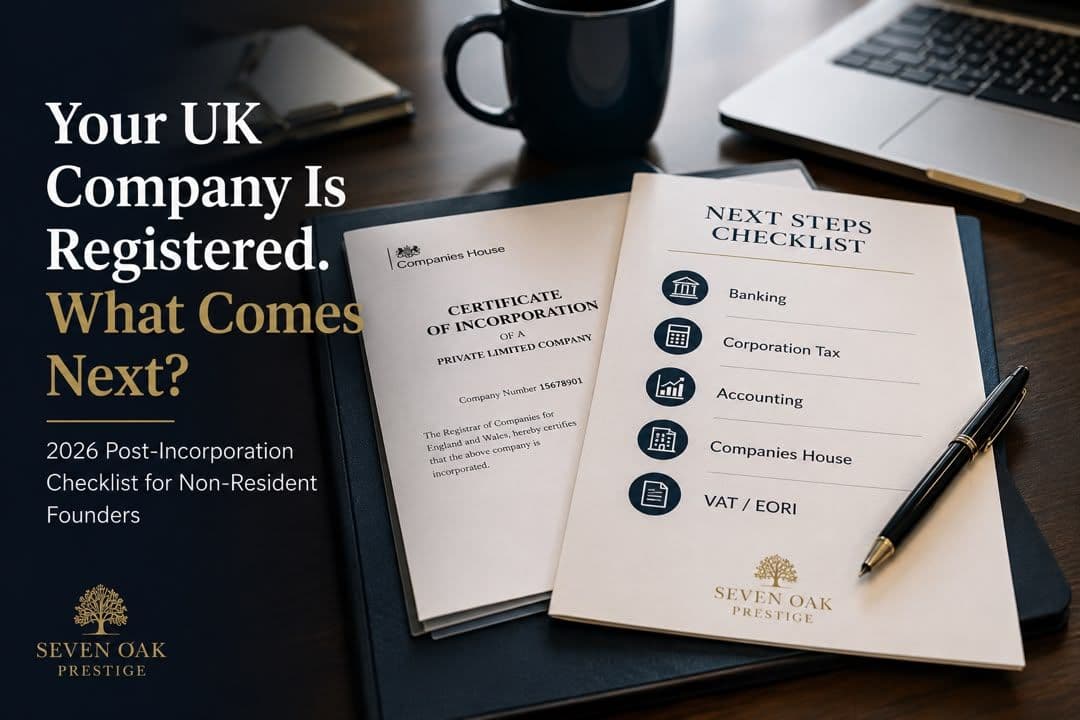
Do not treat the company as legally incorporated merely because you submitted the application.
The key document is the:
Certificate of Incorporation
It confirms:
- legal company name;
- company registration number;
- incorporation date;
- whether the company is limited by shares or guarantee;
- whether it is private or public;
- its UK jurisdiction.
Companies House states that the company does not legally exist as an incorporated entity until the certificate is issued.
Once you have it, keep the original digital certificate permanently.
Banks, payment processors, counterparties, accountants and compliance teams may request it later.
2. Build a Permanent Company Document File
One weakness we see with international founders is that incorporation documents are downloaded once and then scattered across WhatsApp, email and several devices.
Do not operate that way.
Create one permanent company file containing, where applicable:
- Certificate of Incorporation;
- Memorandum of Association;
- Articles of Association;
- share certificates;
- statement of capital;
- initial shareholder information;
- director information;
- PSC information;
- first board resolutions or minutes;
- registered office agreement;
- director service address agreement;
- Companies House authentication information;
- Companies House personal codes — stored particularly securely;
- beneficial ownership records;
- banking documentation;
- tax correspondence;
- contracts;
- accounting records.
Quality Company Formations, for example, highlights the Certificate of Incorporation, memorandum/articles and share certificates among the core formation documents issued to clients.
But the real objective is not merely possession of documents.
It is to create an audit trail.
If a bank asks six months later why John owns 70% while Maria owns 30%, you should be able to establish that ownership from the corporate records immediately.
3. Check the Companies House Register Yourself
After incorporation, search your company on Companies House.
Do not simply assume every submitted detail is correct.
Check:
- legal company name;
- company number;
- incorporation date;
- registered office;
- directors;
- director service addresses;
- PSCs;
- statement of capital;
- SIC codes.
An incorrect detail should be corrected through the appropriate Companies House process rather than ignored.
This matters particularly because banks, fintech providers, payment processors, suppliers and customers may independently check the public register.
A discrepancy between your application and Companies House can create unnecessary questions.
4. Understand the Difference Between Your Four Main Addresses
A non-resident founder might legitimately have:
Registered office: London
Director service address: London
Residential address: Dubai
Operating address: Dubai
Those are not contradictions.
They describe different functions.
Your registered office is the statutory address of the company, while your director service address is the director’s public correspondence address. Your genuine residential and operating addresses can be different. If you are unsure how these addresses interact, read our UK Registered Office vs Director Service Address for Non-Residents: Complete 2026 Guide.
This distinction becomes extremely important during banking onboarding.
Do not call a mail-handling address your “operating headquarters” if no operations actually take place there.
5. Make Sure Your Registered Office Continues to Work
A registered office is not something to think about only on incorporation day.
It must continue to function.
Companies House now requires an appropriate address where documents delivered to the company would ordinarily come to the attention of someone acting for the company and where delivery can be acknowledged.
That means your post-incorporation checklist should include:
- confirming your address service is active;
- confirming when it expires;
- understanding which mail is included;
- ensuring Companies House mail reaches you;
- ensuring HMRC mail reaches you;
- updating the provider when your contact email changes.
For overseas founders, statutory mail handling is a compliance function, not merely a cosmetic London address.
6. Protect the Director’s Residential Address Correctly
Your director service address and residential address are not the same legal concept.
The service address is normally public.
The usual residential address is generally kept private by Companies House.
That is why many overseas directors use the company’s professional registered-office location as their service address while providing their genuine overseas home address privately.
Never provide a UK correspondence address as your residential address simply because you prefer UK details.
Accuracy is more important than appearance.
7. Complete the 2026 Companies House Identity-Verification Requirements
This is now one of the most important post-incorporation compliance issues.
Mandatory Companies House identity verification started on 18 November 2025.
Existing directors must provide their Companies House personal code as part of the company’s relevant confirmation statement process. New directors must provide verification information when they are incorporated or appointed.
After successful verification, the individual receives a:
Companies House personal code
The code links the verified identity to the person’s Companies House roles.
For an existing director, Companies House currently requires the personal code in the company’s next confirmation statement.
Directors who are also PSCs
This is a particularly important 2026 detail.
Being verified once does not mean you simply forget about each role.
If the same person is both:
- director; and
- PSC,
their verified identity must be connected appropriately to each role.
Companies House explains that the director code is provided through the confirmation statement, while PSC verification details are provided separately under the PSC process during the applicable 14-day window.
For international founders who need the complete process, see our Companies House Identity Verification for Non-Residents — Complete 2026 Guide.
8. Do Not Share Your Companies House Personal Code Casually
Treat the personal code as sensitive corporate information.
Do not publish it on:
- your website;
- social media;
- public documents;
- client invoices.
Keep it in your secure company records and provide it only where legitimately required.
The company may need the codes of its directors when completing the relevant confirmation statement.
9. Confirm the Ownership Structure Before Starting Banking
One of the worst times to discover that the share structure is wrong is during a bank compliance review.
Before applying anywhere, confirm:
- shareholders;
- shares issued;
- ownership percentages;
- voting rights;
- directors;
- PSCs;
- any corporate shareholders;
- beneficial owners.
Example:
Founder A owns 75 ordinary shares.
Founder B owns 25 ordinary shares.
Companies House, your share certificates, internal registers and bank application should not show four different interpretations of that arrangement.
If the ownership structure is complex, review our guide on UK Company Shares and Directors for Non-Resident Founders.
10. Hold an Initial Board Decision Process
A private limited company does not necessarily have to hold a physical board meeting merely because it has just been incorporated.
But directors should formally establish the company’s initial decisions.
Depending on the structure, this may include:
- confirming banking arrangements;
- approving contracts;
- confirming initial subscriptions for shares;
- approving accounting arrangements;
- confirming authorised signatories;
- approving business operations;
- approving director remuneration where relevant.
For multi-director companies, formal board minutes can become particularly valuable.
Rapid Formations notes that while there is no general statutory requirement for a UK private company to hold board meetings, board meetings and proper minutes are important governance tools, particularly where multiple directors are involved.
A one-director company can often document decisions through written director resolutions instead.
11. Separate the Company’s Money From Your Personal Money

A UK Ltd is a separate legal entity.
Its money should therefore be treated separately from the founder’s money.
GOV.UK states that there must be a clear division between company finances and those of its owners/directors and identifies a dedicated business account as the simplest mechanism.
This becomes especially important for:
- accounting;
- tax;
- expenses;
- director loans;
- dividends;
- source-of-funds reviews;
- banking;
- due diligence.
Avoid routinely receiving customer payments into a personal account and then attempting to reconstruct the company’s books months later.
12. Do Not Apply Randomly to Every Bank
For a non-resident director, “company incorporated” does not mean “banking approved”.
Banking is a separate underwriting process.
A provider may consider:
- director nationality;
- director residence;
- PSC residence;
- business activity;
- website;
- expected turnover;
- source of funds;
- customers;
- suppliers;
- transaction countries;
- payment sizes;
- trading history;
- operating address;
- supporting contracts;
- regulated activity;
- sanctions exposure.
This is where a lot of otherwise legitimate companies fail unnecessarily.
Weak approach
Incorporate Monday → apply to five providers Tuesday → provide inconsistent information → receive multiple declines.
Strong approach
Incorporate → prepare company profile → prepare KYC documentation → map expected flows → determine suitable providers → apply selectively.
Our UK Business Banking Readiness Assessment explains this process in more depth.
13. Build a Banking-Readiness File
Before opening a bank or fintech application, prepare:
Founder KYC
- passport;
- residential proof of address;
- identity verification;
- source-of-funds information where relevant.
Company documents
- Certificate of Incorporation;
- articles;
- ownership structure;
- shareholder information;
- registered office.
Commercial evidence
Depending on the business:
- website;
- business plan;
- contracts;
- invoices;
- customer agreements;
- supplier agreements;
- marketplace accounts;
- product information;
- professional profiles.
Transaction profile
Be able to explain:
- expected monthly turnover;
- average transaction value;
- incoming currencies;
- outgoing currencies;
- customer countries;
- supplier countries;
- source of initial capital.
Banks may independently request company registration documentation, director information, addresses and financial/business information during onboarding.
The application should describe the real business you intend to operate, not the business you think the bank wants to hear.
14. Your Registered Office Is Not Your Banking Substance
This distinction deserves its own section.
A professional London registered office may provide:
- statutory compliance;
- privacy;
- mail handling;
- consistent corporate records;
- professional presentation.
It does not automatically establish:
- UK employees;
- UK management;
- UK trading premises;
- UK warehouse operations;
- UK economic substance.
If a bank asks:
“Where is the company operated?”
and you operate it from Mumbai, say Mumbai.
There is nothing inherently inconsistent about:
UK incorporation + London registered office + Indian director + Indian operating location.
What creates problems is pretending those facts are different.
15. Understand When Your Company Becomes Active
Incorporation and trading are separate events.
A company can be:
- incorporated and immediately active;
- incorporated but not yet trading;
- dormant for a period and then begin trading.
HMRC considers a company potentially active for Corporation Tax when it begins business activity, trading or receiving income.
That distinction affects your Corporation Tax obligations and potentially your first tax accounting period.
16. Register or Activate Corporation Tax Correctly
A common misconception is:
“Companies House incorporated the company, so there is nothing else to do with HMRC.”
Not necessarily.
Companies registered through the GOV.UK incorporation service are usually set up for Corporation Tax at the same time unless dormant.
You do not automatically need to appoint an accountant simply because you live outside the UK. However, trading activity, VAT, payroll, dividends, multiple currencies and international transactions can make professional support much more useful. Read our guide: Does a Non-Resident-Owned UK Company Need an Accountant?
But you still need to ensure HMRC knows when the company becomes active.
HMRC states that a company within the charge to Corporation Tax must notify HMRC within 3 months of starting its tax accounting period / becoming active.
Do not ignore HMRC simply because you are outside Britain.
17. Do Not Confuse “Non-Resident Founder” With “Non-UK Company”
This is an expert distinction that many articles fail to explain.
Suppose:
Company: incorporated in England
Director/shareholder: lives in India
That does not make the company an Indian company or automatically a “non-UK company” for UK Corporation Tax.
HMRC’s incorporation rule generally treats a UK-incorporated company as UK resident for Corporation Tax, subject to specific treaty-residence exceptions.
This is why:
founder residence ≠ company incorporation ≠ company tax residence
They are related but legally distinct concepts.
For the wider implications, read our UK Company Tax for Non-Residents Guide.
18. Check Whether Your Home Country Also Taxes You or the Company
A UK company does not disconnect its owner from their country of residence.
A founder living in another jurisdiction may face local rules involving:
- personal taxation;
- dividend taxation;
- salary taxation;
- foreign company reporting;
- controlled foreign company rules;
- management and control;
- permanent establishment;
- foreign asset reporting;
- remittance rules;
- exchange-control rules.
For example, these considerations differ materially between:
- India;
- United States;
- UAE;
- France;
- Germany;
- Ghana.
The correct analysis depends on the jurisdiction.
That is one reason we created dedicated country-level resources rather than pretending one generic non-resident tax answer works globally.
Indian founders can use our complete guide to starting a UK company from India.
US founders and existing American businesses should instead use our US–UK expansion guide, because the US tax and reporting framework is materially different.
19. Set Up Accounting From Day One — Not at Year End
Do not wait until the first accounts deadline to start bookkeeping.
GOV.UK requires companies to maintain financial/accounting records including money received and spent, assets, debts and — where relevant — stock and purchases/sales.
Maintain records such as:
- sales invoices;
- supplier bills;
- receipts;
- bank statements;
- payment-processor statements;
- expenses;
- subscriptions;
- contracts;
- director payments;
- shareholder funding;
- loans;
- stock records;
- VAT records where applicable.
Companies generally need to retain accounting records for at least six years from the end of the relevant financial year, subject to circumstances requiring longer retention.
20. Record Founder Funding Properly
Suppose the founder sends £5,000 from their personal account to the new company.
What is it?
It might be:
- share capital;
- a director’s loan;
- reimbursement;
- another form of funding.
Do not simply label everything “transfer”.
Accounting treatment matters.
The banking narrative should also match the accounting reality.
If the founder tells the bank:
“This £5,000 is initial working capital provided by the shareholder”
your records should be capable of supporting that explanation.
21. Set Up Professional Invoicing
Once the company trades, invoices should identify the actual legal entity.
Do not invoice customers under an unrelated personal name if the contracting entity is the UK Ltd.
Your invoice should appropriately identify:
- legal company name;
- invoice number;
- invoice date;
- customer;
- goods/services;
- amount;
- payment terms;
- required tax/VAT information where applicable.
Business letters, order forms and websites must also display prescribed company information, including company number, registered office and place of registration.
This matters for both compliance and credibility.
22. Update Your Website After Incorporation
If you formed:
EXAMPLE TECHNOLOGIES LTD
but your website still says only:
Example Technologies
with no legal company details, fix it.
For UK limited companies, business websites must show information including:
- registered company name;
- registered number;
- registered office;
- jurisdiction of registration;
- limited-company status.
Your website should also accurately explain what you sell.
This matters beyond Companies House.
Banks and payment processors often review websites during onboarding.
23. Make Your Business Description Consistent Everywhere
One surprisingly important post-incorporation task is semantic consistency.
Suppose Companies House says:
Software development
Your website says:
AI healthcare infrastructure
The bank application says:
Marketing consultancy
Stripe says:
Online education
Those might all be legitimate parts of a complex business — but unexplained inconsistency can create compliance friction.
A strong company profile should have a coherent answer to:
What does the company actually do, who pays it, and why?
Your SIC code does not have to describe every commercial detail.
But everything should make sense together.
24. Review Your SIC Codes
A SIC code describes the nature of the company’s business activity on Companies House.
If the code selected at formation does not accurately represent the actual activity, consider correcting it through the appropriate filing process.
Avoid selecting codes simply because:
- they sound sophisticated;
- another company uses them;
- they appear lower risk.
The SIC code should reflect the genuine activity.
If the company’s activity has changed since incorporation, or the original code no longer describes what the business actually does, review the classification rather than leaving an outdated code on the register. See our UK SIC Codes for Non-Resident Companies guide for how to choose, check and update the correct code.
25. Determine Whether You Need VAT Registration
Do not assume:
“I have a UK Ltd, therefore I automatically need VAT.”
And do not assume:
“I am under £90,000, therefore VAT can never apply.”
Both are oversimplifications.
The normal UK VAT compulsory-registration threshold is currently £90,000 of taxable turnover, subject to the relevant tests.
But international structures require more care.
Whether the company is UK-established for VAT purposes and where its supplies take place can materially affect the analysis.
HMRC specifically operates separate rules for non-established taxable persons (NETPs), including circumstances in which there is no normal registration threshold for UK taxable supplies.
Crucially:
A foreign-resident director does not automatically make a UK-incorporated Ltd an NETP.
VAT establishment depends on the actual business facts.
If registration is needed, Seven Oak provides UK VAT Registration support.
26. E-commerce Founders Need Additional VAT Analysis
For e-commerce, you may also need to consider:
- location of inventory;
- Amazon FBA stock;
- UK fulfilment;
- marketplaces;
- overseas inventory;
- £135 consignment rules;
- B2B versus B2C sales;
- import VAT;
- distance-selling rules where applicable;
- marketplace deemed-supplier rules.
This is why “my turnover is below £90,000” is not sufficient analysis for every international seller.
For the complete operational framework, see our UK e-commerce guide for non-resident founders.
27. Determine Whether You Need an EORI Number
An EORI number becomes relevant where the business moves goods across customs borders.
A consulting company selling professional services does not normally require an EORI merely because it has a UK company.
An importer, exporter or e-commerce business moving physical goods may.
If your activity involves international movement of goods, consider this at the beginning rather than discovering it when stock reaches customs.
Seven Oak’s UK EORI Registration service can assist where appropriate.
28. Set Up Payment Processing Only After the Business Profile Is Ready
Stripe, PayPal, Shopify Payments and other payment processors conduct their own underwriting.
A Companies House certificate does not guarantee approval.
They may consider:
- owner residence;
- industry;
- website;
- products/services;
- refund policy;
- delivery model;
- fulfilment;
- transaction countries;
- expected volume;
- chargeback exposure.
Before applying, make sure:
- website is live enough to explain the business;
- legal business name is displayed;
- products/services are understandable;
- refund/terms/privacy information is appropriate;
- company information is consistent;
- bank details belong to the correct business where required.
International founders often create unnecessary problems by applying before the commercial infrastructure is ready.
29. Do Not Artificially Inflate Expected Turnover
If you expect £5,000 per month, say approximately £5,000.
Do not declare £100,000 because you believe a larger number looks more credible.
Equally, do not deliberately understate genuine expected activity to appear “lower risk”.
Banks and payment processors may compare declared turnover with actual account activity later.
Credibility comes from reasonable, supportable estimates.
30. Decide Whether You Need PAYE
If the company employs people or pays salary in circumstances requiring payroll, PAYE may need to be established.
HMRC states that businesses normally need to register as an employer when employing staff and must register before the first payday to obtain the PAYE reference. Registration can also apply where the company is employing its own director.
Payroll involves:
- employer registration;
- payroll software;
- employee details;
- deductions;
- reporting to HMRC;
- tax and National Insurance;
- potentially workplace pension obligations.
Do not automatically create payroll merely because you are a director.
Whether and how an overseas director should receive salary requires proper tax analysis.
31. Hiring UK Employees Creates More Than Payroll Obligations
If the UK company hires employees in Britain, the company may need to address:
- right-to-work checks;
- employment contracts;
- PAYE;
- National Insurance;
- workplace pension duties;
- employer’s liability insurance;
- employment law;
- payroll reporting.
Business.gov.uk identifies employer registration, payroll, pension, insurance and employment checks among the core first-employer responsibilities.
This is very different from simply owning a UK Ltd from overseas with no UK staff.
32. Understand Your First Accounts Deadline
This is one of the dates every director should record immediately.
For a private limited company, the normal first Companies House accounts deadline is:
21 months after incorporation
After that, annual accounts are normally due nine months after the company’s financial year ends.
Do not confuse:
- annual accounts;
- Corporation Tax payment;
- Company Tax Return;
- confirmation statement.
Your company will have separate deadlines for its Confirmation Statement, annual accounts, Corporation Tax and Company Tax Return. These dates do not necessarily fall together. See our UK Company Compliance Calendar for the full 2026 timetable
33. Your First Accounts Period Can Be Longer Than 12 Months
This catches many first-time directors.
Companies House accounting periods and Corporation Tax accounting periods do not always align perfectly in the company’s first year.
A Corporation Tax accounting period cannot exceed 12 months.
Therefore, in certain first-year situations, the company may need two Company Tax Returns covering the first Companies House accounts period.
This is exactly why an accountant should review the first period rather than assuming “one year = one tax return”.
34. Know the Four Major Annual Tax/Accounts Deadlines
For a typical private company:
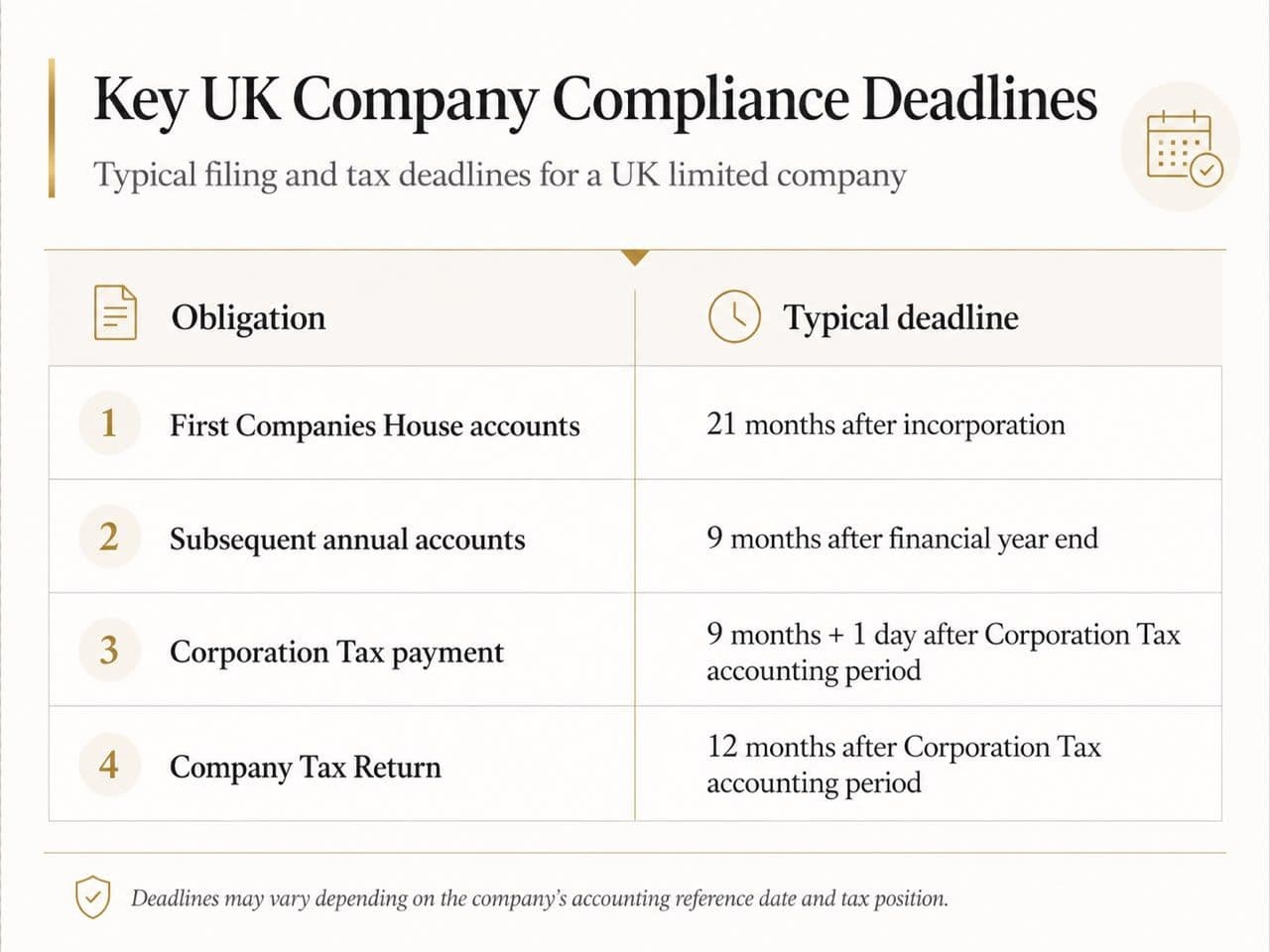
These are the standard deadlines currently summarised by GOV.UK.
Your exact situation may differ, particularly for shortened/extended periods or special circumstances.
35. Understand the Confirmation Statement
The confirmation statement is not your annual accounts.
It is Companies House’s annual check of core company information.
You review matters such as:
- registered office;
- directors;
- company records location;
- statement of capital;
- shareholders;
- SIC code;
- PSC information.
A company must file at least one confirmation statement every 12 months, with a filing window of up to 14 days after the review period ends.
The current online filing fee is £50.
36. The Confirmation Statement Is Even More Important in 2026
Because of identity verification, it now has an additional operational importance.
Current directors must provide their personal codes as required through the company’s confirmation statement process.
Companies House warns that the company cannot file its confirmation statement unless all directors subject to the requirement have completed the relevant verification.
That means:
Do not wait until the filing deadline to discover that one director has not verified.
For a company with several international directors, prepare well in advance.
37. The Confirmation Statement Does Not Fix Every Company Change
Another common misconception is:
“I’ll change everything when I submit the confirmation statement.”
No.
Companies House explains that only certain changes can be updated through the confirmation statement itself, including matters such as SIC code, capital and shareholder information.
Other changes require separate filings.
For example, director changes and registered-office changes should be handled through the correct processes when they occur.
38. Keep Companies House Updated During the Year
Do not treat Companies House as an annual-only obligation.
Changes may arise during the year involving:
- directors;
- registered office;
- PSCs;
- shares;
- company name;
- registered email;
- business activity.
Your public record should remain accurate.
Companies House guidance emphasises that directors must report specified information and annual filings and remain responsible even where an accountant or adviser assists.
39. Your Accountant Does Not Replace the Director
You can appoint professionals to handle:
- bookkeeping;
- accounts;
- tax filings;
- payroll;
- VAT.
But legal responsibility does not simply disappear.
GOV.UK specifically states that even where a director hires others to manage day-to-day compliance, the director remains legally responsible for the company’s records, accounts and performance.
Therefore, every international director should at least know:
- what must be filed;
- by when;
- who is responsible;
- whether it was completed.
40. What If the Company Has Not Started Trading?
Do not confuse “new” with “active”.
A newly incorporated company can remain dormant before it starts trading.
HMRC recognises that a company may be dormant for Corporation Tax between incorporation and first trading.
If the company is dormant, different filing/tax treatment may apply.
You may need to tell HMRC that the company is dormant. After HMRC accepts the dormant status, further Company Tax Returns are generally not required unless HMRC asks for one or the company starts trading again.
Companies House obligations can still remain.
41. Dormant Does Not Mean “Forget the Company Exists”
Even dormant companies generally still have Companies House responsibilities.
Do not abandon:
- registered office;
- Companies House mail;
- confirmation statement;
- required accounts;
- identity verification;
- company records.
Dormancy is a tax/accounting status, not permission to ignore the legal entity.
42. Avoid Mixing Personal and Company Expenses
If you pay something personally for the company, record it correctly.
If the company pays something for you personally, record it correctly.
These may have implications involving:
- reimbursed expenses;
- director’s loan account;
- remuneration;
- benefits;
- dividends.
The wrong approach is:
“It’s my company, so all the money is mine.”
Legally, the company is separate.
The company’s funds are not simply the shareholder’s personal wallet.
43. Understand How You Can Take Money Out of the Company
A director/shareholder may potentially receive money through mechanisms such as:
- salary;
- dividends;
- expense reimbursement;
- repayment of a director’s loan;
- other legitimate arrangements.
Each has different legal/accounting/tax treatment.
Do not label every withdrawal “dividend”.
A dividend generally requires sufficient distributable profits and proper corporate documentation.
International founders should also consider how their country of residence taxes what they receive.
44. Prepare for International Tax From the Beginning
If you live outside Britain, ask these questions early:
- Where is the company incorporated?
- Where is the director resident?
- Where is management actually exercised?
- Where are employees?
- Where are customers?
- Where are contracts negotiated?
- Where is inventory?
- Does another jurisdiction claim taxing rights?
- Does a tax treaty apply?
- How will salary/dividends be taxed personally?
A London registered office alone does not answer those questions.
45. Existing Overseas Businesses Need an Intercompany Strategy
Suppose you already own:
US Corporation
and now create:
UK Ltd
The two companies may transact.
Examples:
- management services;
- software licensing;
- cost sharing;
- intercompany lending;
- marketing;
- intellectual property;
- product supply.
Those arrangements should not be improvised through unexplained transfers.
They may require:
- agreements;
- transfer-pricing consideration;
- proper invoicing;
- accounting treatment;
- tax analysis.
For US businesses, this is covered more deeply in our dedicated US–UK expansion framework.
46. E-commerce Companies Should Set Up Their Supply Chain Before Scaling
For a new e-commerce UK Ltd, incorporation should quickly be followed by mapping:
Supplier
→ Inventory
→ Importer
→ Warehouse
→ Marketplace/store
→ Customer
→ Payment processor
→ Business account
→ VAT/customs records
Without that map, founders often discover VAT, EORI or banking problems only after inventory has already moved.
Our e-commerce pillar explains the broader structure for non-resident operators.
47. Make Sure Contracts Use the Correct Legal Entity
If the company is:
ABC GLOBAL LTD
customer agreements should not casually identify:
John Smith Trading
unless that is an intentionally used trading name with appropriate legal disclosure.
Similarly, supplier and payment-processing contracts should identify the entity that actually:
- buys;
- sells;
- receives money;
- incurs liability.
Corporate identity matters.
48. Protect Your Brand and Intellectual Property
Companies House registration gives you a company name.
It does not automatically give you comprehensive trademark protection.
If brand value matters, consider:
- trademark searches;
- UK trademark registration;
- domain ownership;
- intellectual-property assignments;
- employee/contractor IP clauses.
This becomes especially relevant for:
- SaaS;
- AI;
- consumer brands;
- e-commerce;
- agencies;
- digital products.
49. Review Insurance Requirements
Insurance depends on the business.
Possible areas include:
- employer’s liability;
- professional indemnity;
- public liability;
- cyber insurance;
- product liability;
- directors’ and officers’ cover.
Not every business needs every policy.
But company formation alone does not protect the business from every commercial risk.
50. Create a Compliance Calendar
This is perhaps the simplest operational improvement a founder can make.
Record:
Companies House
- confirmation statement date;
- annual accounts deadline;
- address renewal;
- identity-verification deadlines.
HMRC
- Corporation Tax period;
- Corporation Tax payment date;
- Company Tax Return deadline;
- VAT returns if registered;
- PAYE deadlines if applicable.
Commercial
- insurance renewal;
- registered-office renewal;
- banking KYC renewal;
- domain renewal;
- contracts;
- licences.
Do not rely on memory.
51. First 30 Days After Incorporation — Practical Checklist
Corporate
- Save Certificate of Incorporation
- Save memorandum/articles
- Check share certificates
- Check Companies House register
- Confirm shareholders
- Confirm PSCs
- Confirm directors
- Confirm SIC code
- Complete relevant identity-verification steps
Addresses
- Registered office active
- Director service address correct
- Residential address genuine
- Operating address documented
- Mail forwarding tested
Banking
- Prepare KYC documents
- Prepare proof of address
- Prepare business description
- Prepare expected turnover
- Identify customer/supplier countries
- Select suitable banking provider
- Apply only when ready
Finance
- Set up bookkeeping
- Separate company/personal finances
- Record founder funding properly
- Prepare invoice template
Tax
- Determine trading start date
- Confirm Corporation Tax status
- Assess VAT
- Assess EORI/customs
- Consider home-country tax obligations
Commercial
- Update website legal details
- Prepare contracts
- Review payment processors
- Review privacy/terms/refund policies where relevant
52. First-Year Compliance Timeline
Immediately after incorporation
Verify documents, addresses, ownership and Companies House records.
Before accepting meaningful transactions
Set up banking, bookkeeping, contracts and invoicing.
When the company becomes active
Ensure Corporation Tax registration/status is correct.
Before taxable activity requiring VAT registration
Complete the VAT analysis.
Before importing/exporting where an EORI is required
Obtain the appropriate EORI.
Before first payday
Complete relevant employer/PAYE registration.
Throughout the year
Maintain records and update Companies House changes.
Confirmation statement cycle
Review and file at least once every 12 months.
First accounts
Normally file within 21 months of incorporation.
53. The Biggest Post-Incorporation Mistakes We See
Mistake 1
Assuming incorporation includes banking approval.
Mistake 2
Using the registered office as a fake residential address.
Mistake 3
Calling a mail address the operating headquarters.
Mistake 4
Applying to multiple banks with inconsistent information.
Mistake 5
Failing to keep accounting records from day one.
Mistake 6
Ignoring Corporation Tax because the founder lives abroad.
Mistake 7
Assuming the £90,000 VAT threshold answers every international VAT scenario.
Mistake 8
Ignoring Companies House identity verification.
Mistake 9
Forgetting that director and PSC verification roles may require separate action.
Mistake 10
Mixing personal and company money.
Mistake 11
Forgetting the confirmation statement.
Mistake 12
Waiting until the first accounts deadline to find an accountant.
Mistake 13
Putting inconsistent business descriptions across Companies House, banking and payment processors.
Mistake 14
Assuming a UK Ltd eliminates the founder’s home-country tax obligations.
Mistake 15
Treating company formation as the entire international-business strategy.
54. What “Banking Ready” Actually Means
A banking-ready UK company is not simply one that possesses a Certificate of Incorporation.
It is a company where the following story makes sense:
Who owns it?
Clear.
Who controls it?
Clear.
Where do they live?
Clear.
What does the company sell?
Clear.
Who buys it?
Clear.
Where does money come from?
Clear.
Where does money go?
Clear.
Why is a UK company commercially appropriate?
Clear.
Can supporting documents substantiate those answers?
Yes.
That is what creates readiness.
Not a London postcode alone.
55. What Post-Incorporation Readiness Looks Like
A properly prepared non-resident UK company should eventually have five layers aligned:
1. Corporate layer
Companies House records, directors, shareholders, PSCs and addresses.
2. Compliance layer
Identity verification, annual filings and statutory records.
3. Financial layer
Business banking, accounting, invoices and source-of-funds trail.
4. Tax layer
Corporation Tax, VAT, EORI/PAYE where relevant and international tax analysis.
5. Commercial layer
Website, customers, suppliers, contracts and actual economic activity.
If one layer says something materially different from another, investigate why.
Frequently Asked Questions
Can I start trading immediately after my UK company is incorporated?
The company legally exists once Companies House issues the Certificate of Incorporation. You may then begin appropriate business activity, but you should still ensure banking, tax, licences, VAT, contracts or industry-specific requirements are addressed where relevant.
Do I need to live in the UK after creating the company?
No general Companies House requirement forces an ordinary UK company director to become UK resident merely because the company was incorporated in the UK.
Do I need a UK bank account?
A UK limited company’s finances should be kept separate from the personal finances of its owners/directors. The practical banking solution depends on provider eligibility and the company’s circumstances.
Is banking guaranteed after company formation?
No.
Company incorporation and bank approval are completely separate decisions.
When do I register for Corporation Tax?
Ensure HMRC is notified when the company becomes active; HMRC states that companies within the charge should notify it within three months of starting the relevant tax accounting period.
Is a UK Ltd owned by a non-resident automatically tax-free?
No.
Is a UK-incorporated company automatically a “non-resident company” because its director lives abroad?
No. Founder residence and company residence are separate concepts. UK incorporation generally creates UK Corporation Tax residence subject to specific treaty exceptions.
When are my first accounts due?
For a private limited company, usually 21 months after incorporation.
When is Corporation Tax normally due?
For many companies, nine months and one day after the end of the Corporation Tax accounting period.
When is the Company Tax Return due?
Normally 12 months after the end of the relevant Corporation Tax accounting period.
When is the confirmation statement due?
The company must file at least one confirmation statement every 12 months, with up to 14 days after the review period ends to file.
Do directors need identity verification in 2026?
Yes. Mandatory requirements began on 18 November 2025, subject to the applicable transition and role-specific deadlines.
Does a director who is also PSC use the personal code only once?
The same verified identity is used, but Companies House requires the code to be connected to each relevant role using the applicable process.
Do I automatically need VAT because I formed a UK Ltd?
No. VAT registration depends on the company’s activities and circumstances.
Is £90,000 always the VAT threshold for a non-resident business?
No. £90,000 is the normal threshold, but separate rules apply to non-established taxable persons and international supplies.
Do I need EORI for consulting?
Normally not simply because you provide consulting. EORI primarily becomes relevant to customs activities involving movement of goods.
Can I use the registered office as my business address?
Sometimes, depending on the service agreement. But a statutory registered office and genuine trading/operating address remain different concepts.
Does having a London registered office help banking?
It can provide administrative consistency and privacy, but it does not guarantee banking approval or create genuine UK operations.
What if I do not start trading immediately?
The company may remain dormant for Corporation Tax until it becomes active, but Companies House responsibilities still need attention.
Should I appoint an accountant immediately?
Not every company needs the same level of accounting support from day one, but accounting records should be established from the start and professional support is particularly valuable for international or tax-complex structures.
From Company Formation to a Proper UK Business Infrastructure
The most important lesson is simple:
Your Certificate of Incorporation creates the company. It does not create the entire business infrastructure around it.
For an international founder, the work after incorporation involves aligning:
Companies House
with
HMRC
with
banking
with
accounting
with
your actual business activity
with
your country of residence.
A well-structured UK company should be explainable.
Its ownership should be clear.
Its addresses should be truthful.
Its accounting should be traceable.
Its banking profile should match its commercial activity.
Its tax obligations should be understood.
Its Companies House information should stay current.
That is what turns a newly incorporated UK Ltd into a credible international operating company.
How Seven Oak Prestige Supports Non-Resident Founders After Incorporation
Seven Oak Prestige supports international founders beyond the Companies House registration stage, including areas such as:
- UK company formation;
- registered office;
- director service address;
- Companies House identity-verification support;
- banking and fintech readiness;
- VAT registration;
- EORI registration;
- ongoing corporate compliance guidance.
If you are still at the formation stage, begin with our complete UK Company Formation for Non-Residents guide.
If the company already exists and banking is your next priority, review our Banking & Fintech Guidance service.
For founders trying to understand the full first-year budget, our UK Company Formation Cost for Non-Residents 2026 guide explains why the Companies House fee is only one component of the real cost of establishing and maintaining an international UK company.
Final Post-Incorporation Checklist
Before considering your UK company fully operationally prepared, ask:
Corporate
- Is the Companies House record correct?
- Are shareholders and PSCs correct?
- Are directors correct?
- Are all addresses used honestly?
- Are identity-verification requirements complete?
Banking
- Is company banking separated from personal money?
- Is the business description accurate?
- Can expected transactions be explained?
- Can source of funds be supported?
Accounting
- Is bookkeeping operational?
- Are expenses being recorded?
- Is founder funding classified correctly?
- Have first-year deadlines been recorded?
Tax
- Is HMRC aware of the trading status?
- Has VAT been assessed?
- Is EORI relevant?
- Have overseas tax implications been considered?
Commercial
- Does the website identify the UK Ltd correctly?
- Do contracts identify the correct company?
- Do invoices identify the correct company?
- Does your activity match what you tell banks and payment providers?
Annual compliance
- First accounts deadline recorded?
- Corporation Tax payment deadline recorded?
- Company Tax Return deadline recorded?
- Confirmation statement deadline recorded?
- Address-service renewal recorded?
If you can answer yes across those areas, you are much closer to having a UK company that is not merely incorporated — but genuinely prepared to operate.
Important Notice
This guide provides general information for international founders and does not constitute personalized legal, tax, accounting, immigration or financial advice.
The correct treatment depends on the company’s activities, ownership, country of management, founder residence, customers, suppliers and tax circumstances.
For cross-border tax matters, obtain advice from an appropriately qualified adviser in the relevant jurisdictions.
If you have not incorporated yet, start with our Complete UK Company Formation for Non-Residents Guide, which covers eligibility, incorporation, addresses, ownership, banking and the wider setup process before reaching the post-incorporation stage discussed here.
Then:
If your company is already incorporated and your next challenge is banking, review our UK Business Banking Readiness Assessment or explore our Fintech & Banking Guidance.
And:
If you are budgeting for the complete first year rather than simply the Companies House fee, see How Much Does It Cost to Register a UK Company as a Non-Resident in 2026?.
Review My UK Company Setup
About the Author
Isaac Jackson — Founder & Managing Director, Seven Oak Prestige Ltd
Isaac Jackson has more than three years of hands-on experience supporting international founders with UK company formation, Companies House processes, address solutions, compliance preparation and banking readiness.
His work focuses on the practical requirements faced by founders who establish and operate UK Limited Companies while living outside the United Kingdom.