
UK Company Filing Deadlines for Non-Residents | 2026 Compliance Calendar

UK Company Compliance Calendar 2026 for Non-Resident Directors
Managing a UK Limited Company from overseas means tracking several different compliance dates.
One of the most common mistakes is assuming that:
annual accounts
Confirmation Statement
Corporation Tax payment
and
Company Tax Return
are all due on the same date.
They are not.
Companies House and HMRC operate separate systems, and your company’s accounting reference date, Confirmation Statement review period and Corporation Tax accounting period can all create different deadlines.
For overseas directors, there is another layer: Companies House identity verification, PSC requirements, Registered Office correspondence and coordination with accountants or agents.
This guide brings those obligations together into one practical reference calendar.
If your company has only recently been incorporated, start with our post-incorporation checklist for non-resident founders.
Seven Oak Prestige — UK Ltd Compliance Calendar 2026
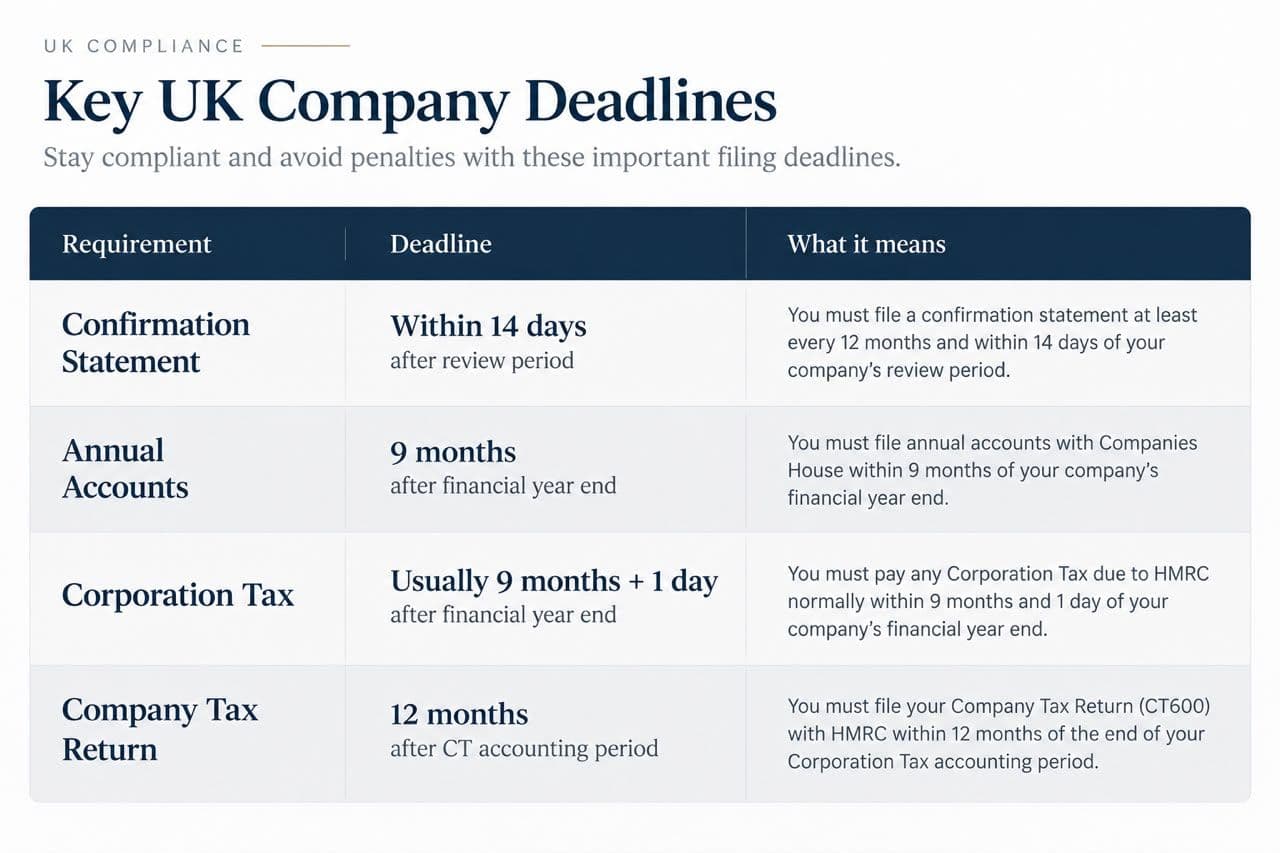
Core Filing Deadlines at a Glance
Confirmation Statement
Deadline: Within 14 days after the end of the company’s review period.
Frequency: At least once every 12 months.
Applies to: All UK companies, including dormant companies.
First Company Accounts
Deadline: If the first accounts cover more than 12 months, the deadline is generally the later of 21 months after incorporation or 3 months after the accounting reference date.
Frequency: First filing only.
Applies to: Private limited companies.
Later Annual Accounts
Deadline: Normally 9 months after the company’s financial year ends.
Frequency: Annual.
Applies to: Private limited companies.
Corporation Tax Payment
Deadline: Normally 9 months and 1 day after the Corporation Tax accounting period ends.
Frequency: Usually annual.
Applies to: Companies owing Corporation Tax under the standard payment regime.
Company Tax Return
Deadline: Normally 12 months after the Corporation Tax accounting period ends.
Frequency: Annual.
Applies to: Companies required by HMRC to file a return.
Director Identity Verification
Deadline: Existing directors generally provide their Companies House personal code with the relevant Confirmation Statement. New directors provide it through the applicable appointment or incorporation process.
Applies to: Directors within the identity-verification regime.
PSC Identity Verification — Director and PSC
Deadline: The PSC code is provided separately during the applicable 14-day period starting the day after the company’s confirmation statement date.
Applies to: Existing PSCs who are also directors.
PSC Identity Verification — PSC Only
Deadline: Existing PSCs who are not directors generally have a 14-day period beginning on the first day of their birth month.
Applies to: Relevant existing PSCs.
VAT Return and Payment — Only If Applicable
Deadline: Usually 1 month and 7 days after the VAT accounting period ends.
Frequency: Usually quarterly.
Applies to: VAT-registered companies only.
PAYE Payment — Only If Applicable
Deadline: Normally by the 22nd of the following tax month when paying electronically.
Frequency: Monthly or eligible quarterly basis.
Applies to: Companies operating PAYE only.
Important: VAT and PAYE rows apply only where those registrations or obligations actually exist. Do not add them to your calendar simply because you own a UK company.
The first-accounts deadline also deserves particular care. Where first accounts cover more than 12 months, Companies House uses the later of 21 months after incorporation or 3 months after the accounting reference date for a private company. If the first accounts cover 12 months or less, the normal filing period applies instead.
Corporation Tax note: the standard 9-months-plus-one-day rule does not apply in the same way to companies within HMRC’s large-company quarterly instalment regime. HMRC says companies with annual taxable profits above £1.5 million will normally enter that regime, subject to rules including adjustments for associated companies.
Not Sure Which Rows Apply to Your Company?
The calendar should be built around your company’s actual incorporation date, accounting reference date, tax registrations and director/PSC position.
Seven Oak Prestige can help overseas founders organise the corporate information and Companies House requirements relevant to their UK company.
1. When Is Your Confirmation Statement Due?
Every UK company must file a Confirmation Statement at least once during each applicable review period, including dormant and non-trading companies.
For a newly incorporated company, the first review period normally runs for 12 months.
The company then has 14 days after the end of the review period to deliver the Confirmation Statement.
The purpose is to confirm that important information held by Companies House is correct or has been appropriately updated.
This can include information relating to:
- Registered Office;
- directors;
- PSCs;
- SIC codes;
- share capital;
- shareholders.
A company may file a Confirmation Statement earlier than the normal deadline.
The Confirmation Statement is also the filing used to update a company’s SIC information. If the company’s business activity has changed or its existing classification is no longer accurate, read our guide to changing and choosing UK SIC codes for non-resident companies.
However, directors should be careful because early filing can affect future review periods, while certain PSC identity-verification windows follow their own specific rules.
For the complete filing process, see our Companies House Identity Verification for Non-Residents guide.
2. When Are a Private Company’s First Accounts Due?
This is one of the most misunderstood UK company deadlines.
For a private company whose first accounts cover more than 12 months, Companies House requires them by the later of:
21 months after incorporation
or
3 months after the accounting reference date.
If the first accounts cover 12 months or less, the normal private-company filing period applies instead.
That means you should not simply assume:
“My first accounts are always due 21 months after incorporation.”
For many normally incorporated private companies, 21 months will indeed be the practical deadline.
But changes to the accounting reference date or a shortened first accounting period can affect the calculation.
Always check the filing date shown on the company’s Companies House record.
3. When Are Later Annual Accounts Due?
After the first accounting cycle, a private company’s accounts are normally due 9 months after the end of its financial year.
That is a Companies House filing deadline.
It is not the same as:
- the Corporation Tax payment deadline;
- the Company Tax Return deadline.
A non-resident director should therefore know at minimum:
- the company’s accounting reference date;
- the Companies House accounts deadline;
- who is preparing the accounts;
- whether bookkeeping is current;
- whether the accountant has the necessary information.
For the wider legal responsibilities of an overseas director, read UK Company Director Duties for Non-Residents.
4. When Is Corporation Tax Due?
For most ordinary companies outside the quarterly-instalment regime, Corporation Tax is normally payable 9 months and 1 day after the end of the Corporation Tax accounting period.
The important point is that the tax payment deadline generally arrives before the deadline for filing the Company Tax Return.
Example Only
Corporation Tax accounting period ends:
31 March 2027
Corporation Tax normally payable:
1 January 2028
Company Tax Return normally due:
31 March 2028
So:
Corporation Tax can be payable before the Company Tax Return itself is due.
That distinction is particularly important for founders who expect their accountant to prepare the tax return close to the filing deadline.
The payment may already have been due months earlier.
Large Companies
Companies within HMRC’s large-company regime follow different payment rules and generally pay Corporation Tax by instalments.
HMRC currently says this normally applies where annual taxable profits exceed £1.5 million, although the threshold can be reduced where the company has associated companies.
This guide focuses on the standard regime that applies to most small and early-stage UK companies.
5. When Is the Company Tax Return Due?
Where HMRC requires a Company Tax Return, the normal filing deadline is 12 months after the end of the Corporation Tax accounting period.
This should not be confused with the Corporation Tax payment deadline.
A company may still need to file a return even where:
- it made a loss;
- little or no Corporation Tax is due;
- HMRC has specifically issued a notice requiring the return.
If HMRC has issued a notice to deliver a Company Tax Return, do not simply ignore it because the company believes it owes no tax.
If you are still organising HMRC access from overseas, see our HMRC Business Tax Account for Non-Resident UK Companies.
If you manage the company from overseas and are unsure whether you need professional accounting support or can handle the filings yourself, read our guide to whether a non-resident-owned UK company needs an accountant
6. What Are the Companies House Identity Verification Deadlines?
Identity verification now forms part of the UK company compliance timetable.
The exact timing depends on the individual’s role and when that role began.
That is why it should not be treated as one universal company deadline.
Existing Directors
Companies House currently requires an existing director to provide their personal code as part of the company’s next Confirmation Statement filing from 18 November 2025.
If the same person is a director of several companies, the identity itself normally only needs to be verified once.
However, the same personal code must then be used for each relevant appointment.
New Directors
Where a person becomes a director from 18 November 2025 onwards, the personal code is required as part of the appointment filing or incorporation process.
If You Are Both a Director and PSC of the Same Company
This is where many founders become confused.
The same personal code can be used, but it must be provided separately for each role.
For the director role:
provide it through the relevant Confirmation Statement.
For the PSC role:
provide it separately during the PSC’s 14-day window.
Companies House’s current guidance says that for a person who is both director and PSC, the PSC window starts the day after the company’s confirmation statement date.
Filing the Confirmation Statement early does not change that PSC window.
Existing PSC Who Is Not a Director
For an existing PSC who is not also a director, Companies House says the relevant 14-day period begins on the first day of the person’s birth month.
New PSC
Where a person becomes a PSC after 18 November 2025, the personal code can generally be provided when the person is first added to the register or within 14 days of being added.
Because these rules are role-specific, always check the actual Companies House position rather than using somebody else’s deadline.
For a deadline-focused explanation, use our Companies House Identity Verification Deadline Guide.
7. What If the Company Is VAT Registered?
VAT creates a separate recurring compliance cycle.
Most VAT-registered businesses submit VAT Returns quarterly.
The normal online filing deadline is generally:
one calendar month + seven days after the end of the VAT accounting period.
The payment deadline is usually the same.
A VAT Return normally still needs to be submitted even where there is no VAT to pay or reclaim for that period.
But this section matters only if the company is VAT registered.
Creating a UK Limited Company does not automatically mean VAT registration is required.
If VAT is relevant to your cross-border activity, it should be analysed separately from company incorporation.
8. What If the Company Operates PAYE?
A company employing staff or operating payroll may have much more frequent obligations.
Where PAYE is paid electronically, HMRC normally requires payment by the 22nd of the following tax month.
Eligible employers paying quarterly generally work to the corresponding quarterly deadline.
That means one company can simultaneously have:
monthly payroll obligations
- ●
quarterly VAT obligations
- ●
annual Companies House filings
- ●
Corporation Tax deadlines.
This is why an effective compliance calendar should reflect the company’s actual operating model.
9. First-Year UK Company Timeline
A newly incorporated company should not be managed from a single anniversary reminder.
A more realistic first-year sequence looks like this:
Immediately After Incorporation
Check:
- company name and number;
- Registered Office;
- director information;
- PSC information;
- Companies House identity requirements;
- access to official correspondence.
If you are still at this stage, use our UK Company Formation for Non-Residents — Complete 2026 Guide.
When Business Activity Starts
Consider:
- Corporation Tax position;
- bookkeeping;
- HMRC access;
- VAT where relevant;
- PAYE where relevant;
- banking and payment records.
The first Companies House accounting period and the first Corporation Tax accounting period can also produce different reporting dates. GOV.UK expressly notes that newly incorporated companies can have different dates for their first Companies House accounts and first Company Tax Return.
Around the First Confirmation Statement
Check:
- company information;
- director details;
- PSC details;
- SIC codes;
- applicable director personal-code requirement;
- applicable PSC verification window.
Before the First Accounts Deadline
Make sure:
- bookkeeping is complete;
- records have reached the accountant;
- the correct first-account deadline has been checked;
- any Corporation Tax payment date is also understood.
After the Corporation Tax Accounting Period Ends
Track separately:
Corporation Tax payment
and
Company Tax Return filing.
They are not the same deadline.
For the full operational sequence, see What Happens After You Register a UK Company as a Non-Resident?.
10. Seven Oak Prestige Non-Resident Director Compliance Overlay
The statutory deadlines apply regardless of whether the director lives in Britain or overseas.
But distance creates practical risks that generic UK company calendars often overlook.
Registered Office
Ask:
- Is the Registered Office service still active?
- Is official correspondence being monitored?
- Are Companies House and HMRC letters being forwarded or scanned?
- Does the provider have your current contact information?
Missing official correspondence can contribute to missed deadlines, penalties or enforcement problems.
For an overseas director, reliable mail handling is therefore part of practical compliance management.
Read Registered Office vs Director Service Address for Non-Residents.
If you do not personally maintain UK premises, see UK Company Formation Without Your Own UK Address.
Accountant Coordination
Check:
- Does the accountant know the actual accounts deadline?
- Have bank statements and invoices been provided?
- Is bookkeeping complete enough to prepare the accounts?
- Is the Corporation Tax payment known before the payment deadline?
- Has the relevant HMRC agent authorisation been completed?
An accountant can perform technical work.
The director should still maintain appropriate oversight.
Companies House
Check:
- Confirmation Statement date;
- accounts deadline;
- director changes;
- PSC changes;
- registered address;
- identity-verification position.
HMRC
Check:
- whether the company has started trading;
- Corporation Tax accounting period;
- Corporation Tax payment date;
- Company Tax Return date;
- VAT status;
- PAYE status;
- whether the company is dormant.
Banking and Operational Records
Make sure the company’s actual activity remains consistent across:
- Companies House;
- HMRC;
- banking providers;
- payment providers;
- invoices;
- accounting records.
This consistency becomes particularly important for internationally managed companies.
11. Common UK Company Deadline Mistakes
Mistake 1: Treating Every Deadline as the Incorporation Anniversary
They are not.
Accounts, Confirmation Statements, tax payments and tax returns follow different rules.
Mistake 2: Confusing Companies House Accounts With a Company Tax Return
Companies House and HMRC are separate authorities.
The filings are different.
Mistake 3: Assuming the Tax Return Comes Before the Tax Payment
For most ordinary companies, Corporation Tax is payable before the Company Tax Return filing deadline.
Mistake 4: Assuming “21 Months” Always Applies to First Accounts
It depends on the first accounting period and accounting reference date.
Check the actual Companies House deadline.
Mistake 5: Completing Director Verification but Forgetting the PSC Role
If the same founder is both director and PSC, the personal code may need to be provided separately for both roles.
Mistake 6: Assuming an Accountant Automatically Monitors Everything
Do not rely on assumptions.
Know who is responsible for preparing each filing and when information must reach them.
Mistake 7: Ignoring Registered Office Mail
Official correspondence should reach the director or authorised adviser promptly.
Mistake 8: Tracking VAT or PAYE When They Do Not Apply
Your calendar should reflect your actual registrations.
Mistake 9: Assuming a Dormant Company Has No Compliance
Dormant companies still have Companies House obligations, including annual accounts and Confirmation Statements.
12. Seven Oak Prestige Annual Compliance Checklist
Use this as a practical management framework.
Companies House
- Confirm the annual accounts deadline.
- Confirm the Confirmation Statement date.
- Review director information.
- Review PSC information.
- Review the Registered Office.
- Check Companies House identity-verification obligations.
HMRC
- Confirm the Corporation Tax accounting period.
- Confirm the Corporation Tax payment date.
- Confirm the Company Tax Return deadline.
- Check whether VAT applies.
- Check whether PAYE applies.
- Confirm whether HMRC considers the company active or dormant.
Accounting
- Keep bookkeeping current.
- Reconcile bank transactions.
- Preserve invoices and receipts.
- Send records to the accountant before deadlines become urgent.
- Understand major taxes and liabilities becoming due.
Addresses and Correspondence
- Keep the Registered Office service active.
- Monitor Companies House mail.
- Monitor HMRC mail.
- Update the company when relevant statutory details change.
Director and PSC Compliance
- Complete identity verification where required.
- Protect the Companies House personal code.
- Provide the code for each required role.
- Do not assume director and PSC deadlines are identical.
Company Changes
Check whether the year included:
- new shares;
- share transfers;
- new directors;
- resignations;
- PSC changes;
- changes in business activity;
- address changes.
Some changes may require filings before the normal annual cycle.
13. What Happens If You Miss a UK Company Deadline?
The consequence depends on the obligation.
For example, Companies House imposes automatic financial penalties when annual accounts are filed late.
Late tax returns, late tax payments or other failures can lead to separate HMRC penalties, interest or compliance action.
Persistent company-law non-compliance can also lead to further Companies House enforcement.
The practical rule is simple:
Do not rely solely on a generic calendar. Always verify your company’s actual Companies House and HMRC dates.
If a filing is already overdue, deal with it promptly rather than waiting for the next annual cycle.
14. How Seven Oak Prestige Supports Non-Resident Directors
Seven Oak Prestige supports international founders with the corporate infrastructure needed to establish and manage UK companies from overseas.
Depending on the service required, support can include:
- UK company formation;
- Registered Office;
- Director Service Address;
- Companies House processes;
- identity-verification support;
- company-information updates;
- post-incorporation compliance preparation;
- VAT and EORI assistance;
- coordination with relevant accountants and professional advisers;
- banking and payment-readiness support.
At Seven Oak Prestige, our focus is on helping international founders understand the distinction between:
company formation
Companies House compliance
HMRC administration
banking readiness
and
ongoing professional accounting or tax work.
Seven Oak Prestige does not assume the statutory responsibilities of a company’s directors and does not replace specialist tax, legal or accounting advice.
Need Help Organising Your UK Company Compliance From Overseas?
Discuss Your UK Company Compliance With Seven Oak Prestige →
Frequently Asked Questions
When is a UK company’s first Confirmation Statement due?
For a newly incorporated company, the first review period normally runs for 12 months, followed by the applicable filing period.
The exact date should always be checked on the company’s Companies House record.
When are the first accounts of a private company due?
If the first accounts cover more than 12 months, the deadline is the later of:
- 21 months after incorporation; or
- 3 months after the accounting reference date.
If they cover 12 months or less, the normal filing period applies.
When are later private-company accounts due?
Normally 9 months after the end of the company’s financial year.
When must Corporation Tax be paid?
For most companies outside HMRC’s instalment-payment regime, Corporation Tax is normally due 9 months and 1 day after the relevant accounting period ends.
When is a Company Tax Return due?
Normally 12 months after the end of the Corporation Tax accounting period where a return is required.
Are Companies House accounts and Corporation Tax deadlines the same?
No.
They are separate obligations administered through different systems.
Does a dormant company still need to file?
Yes.
A dormant company normally still has Companies House filing responsibilities, including accounts and Confirmation Statements.
Its Corporation Tax position should be considered separately with HMRC.
Does a non-resident director receive extra filing time?
No general extra filing period exists simply because the director lives overseas.
The company’s statutory deadlines continue to apply.
Does every director have the same identity-verification deadline?
No.
The process depends on when the director was appointed and the applicable Companies House transition rules.
PSC timing can also differ from director timing.
If I am both director and PSC, do I provide my personal code only once?
No.
You generally verify your identity once and use the same personal code, but Companies House can require you to provide it separately for the director role and PSC role.
What happens if I file annual accounts late?
Companies House imposes automatic late-filing penalties on companies that submit accounts after the deadline.
How do I find my company’s exact deadlines?
Use the company’s live Companies House record and relevant HMRC account or correspondence.
A compliance calendar should be built from those actual dates rather than estimates.
About the Author
Isaac Jackson — Founder & Managing Director, Seven Oak Prestige Ltd
Isaac Jackson has more than three years of hands-on experience supporting international founders with UK company formation, Companies House processes, address solutions, compliance preparation and banking readiness.
His work focuses on the practical requirements faced by founders who establish and operate UK Limited Companies while living outside the United Kingdom.
Editorial Methodology
Last reviewed: 12 September 2026
This guide was prepared following review of current primary guidance from Companies House and HMRC concerning:
- private-company annual accounts;
- first-account filing periods;
- Confirmation Statements;
- Corporation Tax payment deadlines;
- quarterly Corporation Tax instalments;
- Company Tax Returns;
- director identity verification;
- PSC identity verification;
- VAT;
- PAYE;
- late-filing penalties.
The article was also reviewed against Seven Oak Prestige’s existing content on:
- UK company formation for non-residents;
- post-incorporation compliance;
- director duties;
- HMRC Business Tax Accounts;
- Companies House identity verification;
- Registered Office requirements.
Its role is intentionally narrow:
to serve as a practical UK company deadline reference for directors managing a company from overseas.
It is not intended to replace the broader formation or post-incorporation guides.
Important Disclaimer
This guide provides general educational information and does not constitute legal, tax or accounting advice.
Actual filing deadlines can depend on:
- incorporation date;
- accounting reference date;
- accounting period;
- Corporation Tax accounting period;
- company size;
- associated companies;
- VAT or PAYE registrations;
- director and PSC circumstances;
- changes made during the company’s life.
Always verify the company’s actual Companies House and HMRC records.
Seven Oak Prestige Ltd provides UK company formation, address services, Companies House assistance, compliance preparation, VAT/EORI assistance and banking-readiness support.
Where specialist tax, accounting or legal advice is required, an appropriately qualified professional should be consulted.
Related Guides
UK Company Formation for Non-Residents — Complete 2026 Guide
The main Seven Oak Prestige guide to establishing a UK Limited Company while living overseas.
What Happens After You Register a UK Company as a Non-Resident?
Use the broader post-incorporation checklist for Companies House, HMRC, accounting, banking and operational setup.
UK Company Director Duties for Non-Residents
Understand the responsibilities that remain with a director even when accountants and agents assist the company.
HMRC Business Tax Account for Non-Resident UK Companies
Understand Government Gateway, your company UTR, Corporation Tax access and accountant authorisation.
Companies House Identity Verification for Non-Residents — Complete 2026 Guide
Understand the identity-verification routes, personal code and requirements affecting overseas directors and PSCs.
Companies House Identity Verification Deadline — Check Your Real Date
Determine when the relevant director or PSC verification requirement applies.
Registered Office vs Director Service Address for Non-Residents
Understand the difference between the company’s statutory address, a director’s service address and the private residential address.
UK Company Formation Without Your Own UK Address
Understand how international founders can meet UK statutory-address requirements without personally owning or renting premises in Britain.