
UK Company Director Duties for Non-Residents | 2026 Guide

What Are Your Legal Duties as a Non-Resident Director of a UK Company?
You can generally act as a director of a UK Limited Company while living outside the United Kingdom.
But living overseas does not remove your responsibilities as a director.
A director is responsible for helping ensure that the company is properly managed, required information is delivered to Companies House, appropriate records are maintained and the legal duties applying to directors are respected.
You can appoint:
- an accountant;
- bookkeeper;
- company secretary;
- formation agent;
- solicitor;
- compliance adviser.
They can prepare and submit work on the company’s behalf.
But they do not automatically replace your own responsibilities as a director.
If you are still deciding whether to establish a UK company, start with our UK Company Formation for Non-Residents — Complete 2026 Guide.
Quick Answer: What Is a Non-Resident UK Director Responsible For?
Area
Director responsibility
Companies House
Ensure required company information is accurate and filed when due
Area
Director responsibility
Annual accounts
Ensure accounts and appropriate accounting records are maintained
Area
Director responsibility
Confirmation Statement
Ensure the company’s statement is submitted when required
Area
Director responsibility
Companies Act duties
Follow the statutory duties applying to directors
Area
Director responsibility
Identity verification
Satisfy current Companies House requirements when they apply
Area
Director responsibility
Corporation Tax
Ensure relevant company tax obligations are dealt with
Area
Director responsibility
Financial oversight
Understand the company’s financial position sufficiently to make responsible decisions
Area
Director responsibility
Conflicts
Identify and deal appropriately with conflicts of interest
Area
Director responsibility
Insolvency
Give proper consideration to creditors if the company becomes financially distressed
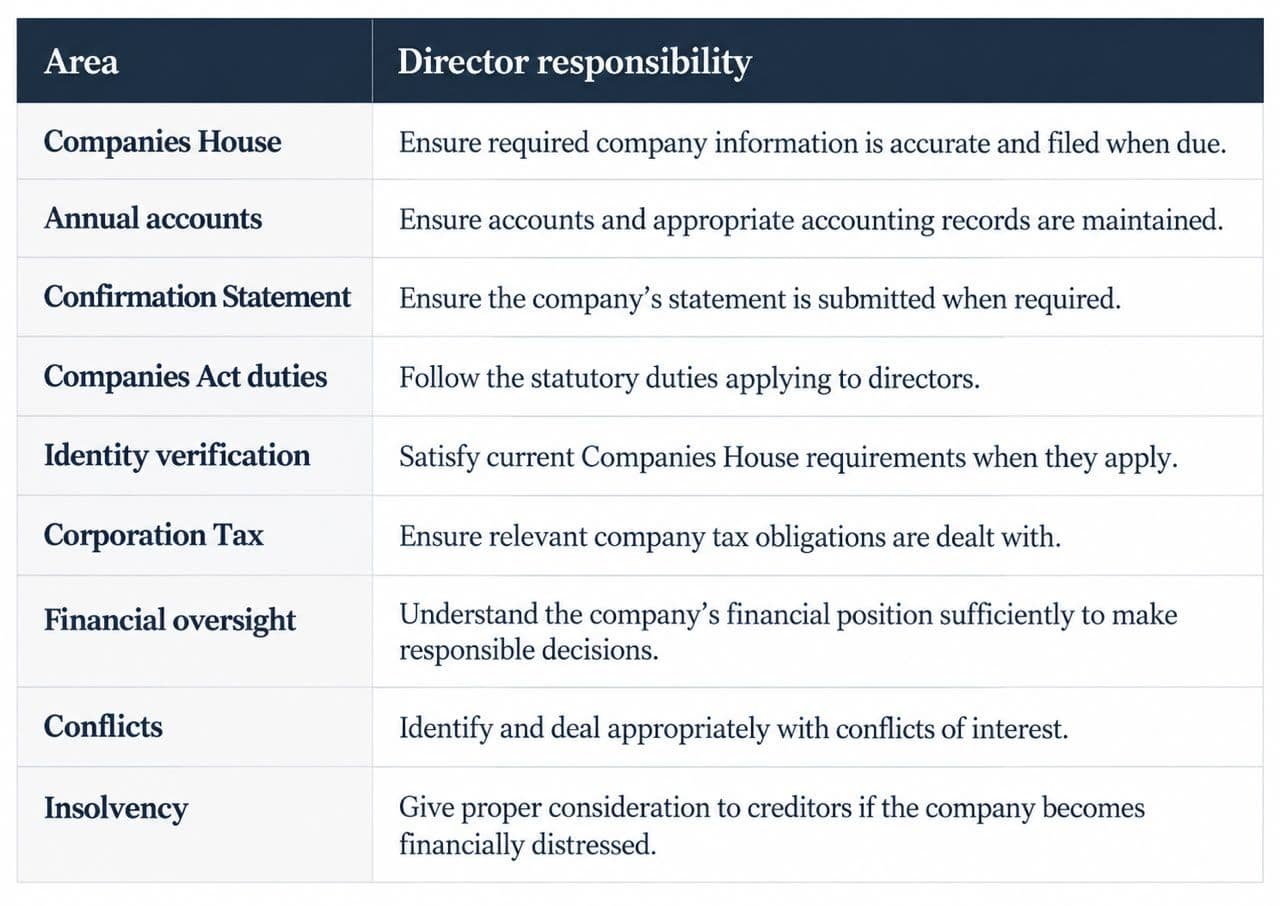
The key principle: you may delegate administration, but you cannot simply abandon director oversight.
Keeping company information accurate also means reviewing the company’s stated business activity when it changes. If the SIC code no longer reflects what the company actually does, see our guide to choosing and updating UK SIC codes.
If your company has already been incorporated and you need the wider company-level checklist, see What Happens After You Register a UK Company as a Non-Resident?.
If you Need Help Managing Your UK Company From Overseas?
Discuss My UK Company Compliance →
1. Does a UK Company Director Have to Live in the UK?
No.
A director of an ordinary UK private limited company does not generally need to live in the United Kingdom.
An overseas founder can potentially be:
shareholder
- ●
director
- ●
Person with Significant Control — PSC
while remaining resident abroad.
These are nevertheless different roles.
A shareholder owns an interest in the company.
A director manages the company and carries legal responsibilities.
A PSC identifies significant ownership or control for Companies House transparency purposes.
If you need a clearer explanation of these roles, read How to Structure Shares and Directors in a UK Ltd as a Non-Resident Founder.
2. What Are the Seven Legal Duties of a UK Company Director?
The Companies Act 2006 sets out seven general duties for directors.
They apply to directors whether they live in the UK or overseas.
1. Act within your powers
You must act in accordance with the company’s constitution and use your powers for the purposes for which they were given.
2. Promote the success of the company
You must act in good faith in the way you consider most likely to promote the success of the company for the benefit of its members as a whole.
Relevant considerations include matters such as:
- long-term consequences;
- employees;
- business relationships;
- reputation;
- community and environmental impact;
- fairness between members.
3. Exercise independent judgment
A director should exercise their own judgment rather than simply allowing another person to control every company decision.
4. Exercise reasonable care, skill and diligence
The law expects a director to exercise an appropriate standard of care, taking account of both the role and the director’s own knowledge, skill and experience.
5. Avoid conflicts of interest
A director should avoid situations where they have, or may have, interests that conflict with the interests of the company.
6. Not accept benefits from third parties
A director must not accept a benefit from a third party because they are a director, or because of something they do or do not do as a director, subject to the statutory rules.
7. Declare interests in proposed transactions or arrangements
Where a director has a relevant direct or indirect interest in a proposed company transaction or arrangement, that interest may need to be declared appropriately.
These duties still matter if you are the sole shareholder and sole director.
Owning the entire company does not make you and the company the same legal person.
3. What Companies House Responsibilities Does a Director Have?
Directors are legally responsible for ensuring that the company complies with its filing obligations.
That does not mean you personally need to submit every filing.
An accountant or authorized agent may prepare and submit documents on your behalf.
But you should still understand what is being filed and when.
Common Companies House matters include:
- annual accounts;
- Confirmation Statements;
- changes to directors;
- changes to officer details;
- Registered Office changes;
- share allotments;
- certain charges;
- PSC changes.
A useful rule is:
Agent submits. Director oversees.
You should not discover after a deadline that a filing was missed simply because you assumed another person was dealing with it.
4. Confirmation Statements and Identity Verification
The Confirmation Statement is one of the core recurring Companies House requirements.
It confirms that key information about the company is accurate or has been updated appropriately.
That can include information relating to:
- Registered Office;
- directors;
- PSCs;
- SIC codes;
- share capital;
- shareholders.
Companies House identity verification has also become part of this compliance framework.
Directors and PSCs must comply with the identity-verification requirements when the relevant part of the regime applies to them.
For many existing directors, the personal code is linked to the company’s relevant Confirmation Statement process.
PSC requirements can follow a separate timeline.
If you want the full verification process, documents and ACSP route, read Companies House Identity Verification for Non-Residents — Complete 2026 Guide.
If your question is specifically “When is my deadline?”, use our Companies House Identity Verification Deadline Guide.
5. Accounts, Corporation Tax and Financial Oversight
A director should understand enough about the company’s financial position to exercise proper oversight.
You do not need to become an accountant.
But you should know:
- when the company’s annual accounts are due;
- whether bookkeeping is up to date;
- who prepares the accounts;
- whether the company is trading or dormant;
- whether HMRC obligations are being handled;
- whether taxes or creditors are becoming overdue.
An accountant can prepare:
- annual accounts;
- tax computations;
- Corporation Tax returns;
- VAT returns where applicable;
- bookkeeping.
But the existence of an accountant does not mean the director can completely ignore the company’s financial affairs.
If you are deciding whether your company is simple enough to manage without professional accounting support, see our guide: Does a Non-Resident-Owned UK Company Need an Accountant?
6. What Can You Delegate to an Accountant or Agent?
A lot.
You can use professionals to help with:
- Companies House filings;
- bookkeeping;
- annual accounts;
- Corporation Tax;
- VAT;
- payroll;
- company secretarial work;
- address services;
- compliance administration.
What you should not do is assume:
“My accountant is responsible for the company now.”
They are not the director.
Your role includes providing accurate information, reviewing important matters and making the decisions that properly belong to the board.
A good professional adviser should make compliance easier to manage.
They should not make the director invisible from the decision-making process.
7. Does Your Registered Office Change Your Director Responsibilities?
No.
A UK company must have an appropriate Registered Office.
But this is the company’s statutory address.
It is not automatically:
- your residential address;
- your place of work;
- your trading office;
- evidence that you live in Britain.
A non-resident director may therefore legitimately have:
Residential address: France, India, UAE or another country
Director Service Address: UK professional address
Registered Office: UK company address
These are different concepts.
For a detailed explanation, see Registered Office vs Director Service Address for Non-Residents.
If you do not personally own or rent UK premises, read UK Company Formation Without Your Own UK Address.
8. What About Personal Tax, UK Visits and Immigration?
Three different questions should be kept separate:
Company tax
Director personal tax
Immigration
A UK Limited Company can have Corporation Tax obligations.
That does not automatically mean every overseas director personally owes UK Income Tax simply because their name appears on Companies House.
The director’s personal position can depend on factors including:
- remuneration;
- tax residence;
- where duties are performed;
- UK visits;
- PAYE treatment;
- applicable tax treaties;
- National Insurance or social-security rules.
Physically performing director duties in the UK can be relevant.
But a visit to Britain should not automatically be treated as creating the same tax outcome in every case.
The facts matter.
Likewise, being appointed as director does not itself give you immigration permission to live or work physically in the United Kingdom.
Company law and immigration law answer different questions.
For that distinction, read Do You Need a UK Visa to Own or Run a UK Limited Company as a Non-Resident?.
Where cross-border director remuneration, UK duties or residence issues are material, specialist tax advice may be appropriate.
9. What Changes If the Company Is in Financial Difficulty?
Directors need to pay particular attention when a company can no longer comfortably meet its obligations.
Warning signs can include:
- unpaid taxes;
- overdue suppliers;
- persistent cash-flow problems;
- inability to pay debts when due;
- rapidly increasing liabilities.
When insolvency becomes relevant, directors need to give proper consideration to creditors and should not simply continue operating as though nothing has changed.
Potential issues can include:
- wrongful trading;
- fraudulent trading;
- misfeasance;
- transactions that prejudice creditors;
- director disqualification;
- personal liability in appropriate circumstances.
These are specialist areas.
If the company appears unable to pay its debts, obtain appropriate insolvency advice early.
10. Practical Checklist for a Non-Resident Director
This is not a universal statutory monthly checklist.
It is a practical routine that can help an overseas director maintain oversight.
Companies House
- Know the next Confirmation Statement date.
- Know the annual accounts deadline.
- Keep director and PSC information accurate.
- Deal with required company changes promptly.
Identity Verification
- Complete Companies House identity verification when required.
- Keep your personal code secure.
- Check that the relevant director and PSC requirements have actually been satisfied.
Accounts and Tax
- Keep bookkeeping reasonably current.
- Provide documents to your accountant on time.
- Know whether Corporation Tax, VAT or payroll obligations apply.
- Keep company and personal money properly distinguished.
Governance
- Understand significant company decisions.
- Consider conflicts of interest.
- Follow the Articles of Association.
- Maintain appropriate records of important decisions.
Financial Position
- Know whether the company can meet its obligations.
- Monitor major liabilities.
- Act early if the company becomes financially distressed.
Correspondence
- Monitor Companies House and HMRC communications.
- Ensure mail sent to the Registered Office reaches the appropriate person.
A remote company should not mean a remote director in the governance sense.
11. How Seven Oak Prestige Supports Non-Resident Directors
Seven Oak Prestige supports international founders with the corporate and compliance infrastructure required to establish and maintain a UK Limited Company from overseas.
Depending on the service required, our support can include:
- UK company formation;
- Registered Office;
- Director Service Address;
- Companies House processes;
- identity-verification support;
- post-incorporation compliance preparation;
- company-information updates;
- banking and payment readiness;
- coordination with accountants and specialist advisers where appropriate.
Seven Oak Prestige does not assume the director’s statutory responsibilities.
The director remains responsible for making appropriate decisions and obtaining specialist legal, tax, insolvency or immigration advice where necessary.
Our role is to make the UK company setup and compliance process clearer, organized and easier to manage internationally.
Need Help Managing Your UK Company From Overseas?
Discuss My UK Company Compliance →
12. Frequently Asked Questions
Do UK company directors have to live in the UK?
No.
Directors of ordinary UK private limited companies do not generally need to reside in the United Kingdom.
Living overseas does not remove the responsibilities that apply to the director.
Are non-resident directors subject to the same Companies Act duties?
Yes.
The seven general duties under the Companies Act 2006 apply regardless of whether the director lives in the UK or overseas.
Can my accountant file Companies House documents for me?
Yes.
An accountant or authorized agent can prepare and submit many filings on behalf of the company.
The directors remain responsible for ensuring that the company complies with its filing obligations.
Do overseas directors need Companies House identity verification?
Directors must comply with Companies House identity-verification requirements when the relevant rules apply to them.
Living overseas does not itself create an exemption.
Read our Companies House Identity Verification for Non-Residents Guide for the detailed process.
Do I need to visit the UK to act as a director?
There is no general Companies House requirement for an overseas director to visit Britain simply to hold the position.
Separate immigration and tax questions can arise if you physically work or perform director duties in the UK.
Does a non-resident director automatically pay UK Income Tax?
No.
The answer depends on matters such as remuneration, residence, where duties are performed, PAYE treatment and any relevant tax treaty.
Can I be personally liable even though the company is Limited?
Potentially, in particular circumstances.
Limited liability protects shareholders from ordinary company liabilities in important ways, but it does not give a director immunity from breaches of their own duties, fraud, personal guarantees or other forms of personal liability.
What happens if I miss my Confirmation Statement?
A Confirmation Statement is a statutory company filing.
Failing to comply can create Companies House compliance and enforcement issues.
Directors should therefore know the relevant deadline and ensure the required information and identity-verification steps have been dealt with.
What should I do if my company is becoming insolvent?
Act early.
When insolvency becomes relevant, directors’ responsibilities toward creditors become particularly important.
Specialist insolvency advice should be obtained where the company cannot meet its obligations or serious financial distress exists.
13. A Director Is More Than a Name on Companies House
For a non-resident founder, incorporating a UK company can be relatively straightforward.
The ongoing responsibility is different.
A properly managed company requires:
accurate records
- ●
timely filings
- ●
financial oversight
- ●
informed director decisions
- ●
appropriate professional support
The accountant can help.
The formation agent can help.
The Registered Office provider can help.
But the director remains the director.
If your company has only recently been incorporated and you want the broader operational checklist, continue with What Happens After You Register a UK Company as a Non-Resident?.
14. About the Author
Isaac Jackson — Founder & Managing Director, Seven Oak Prestige Ltd
Isaac Jackson has more than three years of hands-on experience supporting international founders with UK company formation, Companies House processes, address solutions, compliance preparation and banking readiness.
His work includes helping overseas founders understand the responsibilities that continue after incorporation, including Companies House filings, identity verification, corporate records and operational compliance.
15. Editorial Methodology
Last reviewed: 10 September 2026
This guide was prepared following review of the current UK framework governing company directors, including:
- sections 171–177 of the Companies Act 2006;
- Companies House guidance on the responsibilities of company directors;
- current Companies House identity-verification requirements;
- Insolvency Service guidance concerning director duties where insolvency arises;
- HMRC guidance relevant to non-resident directors and duties performed in the UK.
Seven Oak Prestige’s existing non-resident company-formation, post-incorporation, identity-verification, address and immigration content was also reviewed to keep the search intent of this page distinct.
This article is specifically designed to clarify the difference between:
the director’s legal responsibilities
and
the company’s filing obligations
and
work delegated to an accountant or agent
and
cross-border tax or immigration questions.
16. Important Disclaimer
This guide provides general educational information and does not constitute legal, tax, accounting, insolvency or immigration advice.
Director responsibilities and potential liabilities depend on the company’s circumstances, activities, financial position and the conduct of the individual director.
Tax treatment for a non-resident director can depend on residence, remuneration, where duties are performed, applicable double-taxation agreements and social-security rules.
Seven Oak Prestige Ltd provides UK company formation, Companies House assistance, address services, corporate-support, compliance-preparation and banking-readiness services.
Where specialist legal, tax, insolvency or immigration advice is required, an appropriately qualified professional should be consulted.
17. Related Guides
UK Company Formation for Non-Residents — Complete 2026 Guide
The main Seven Oak guide to establishing a UK Limited Company while living overseas.
What Happens After You Register a UK Company as a Non-Resident?
The broader post-incorporation checklist covering Companies House, accounting, banking and operational preparation.
Companies House Identity Verification for Non-Residents — Complete 2026 Guide
Understand identity-verification routes, personal codes and the current director and PSC requirements.
Companies House Identity Verification Deadline — Check Your Real Date
Understand when the relevant director or PSC verification requirement applies.
How to Structure Shares and Directors in a UK Ltd as a Non-Resident Founder
Understand the difference between shareholders, directors, PSCs, ownership and control.
Registered Office vs Director Service Address for Non-Residents
Understand the company’s statutory address, the director’s public service address and the private residential address.
UK Company Formation Without Your Own UK Address
Understand how an overseas director can satisfy the UK address requirements without personally owning or renting UK property.
Do You Need a UK Visa to Own or Run a UK Limited Company as a Non-Resident?
Understand the important distinction between company ownership, directorship and permission to work physically in the United Kingdom.