
Companies House ID Verification Deadline | Check Your Real Date 2026

Companies House Identity Verification Deadline: What Is Your Real Date in 2026?
If you are already a director or Person with Significant Control — PSC — of a UK company, do not assume that 18 November 2026 is simply the date by which everyone must verify.
Companies House is more specific.
18 November 2025 was the start of mandatory identity verification and a 12-month transition period. It was not a universal deadline.
Your actual compliance date depends on:
- your role;
- whether you are already a director;
- whether you are also a PSC;
- when you became a PSC;
- and, for many existing directors, your company’s Confirmation Statement cycle.
For many existing directors, the most important date is therefore connected to the company’s next relevant Confirmation Statement, not a generic November 2026 date.
If you need the complete explanation of how Companies House identity verification works, including documents, ACSP verification and personal codes, start with our Companies House Identity Verification for Non-Residents: Complete 2026 Guide.
Quick Answer: When Is Your Companies House Identity Verification Deadline?
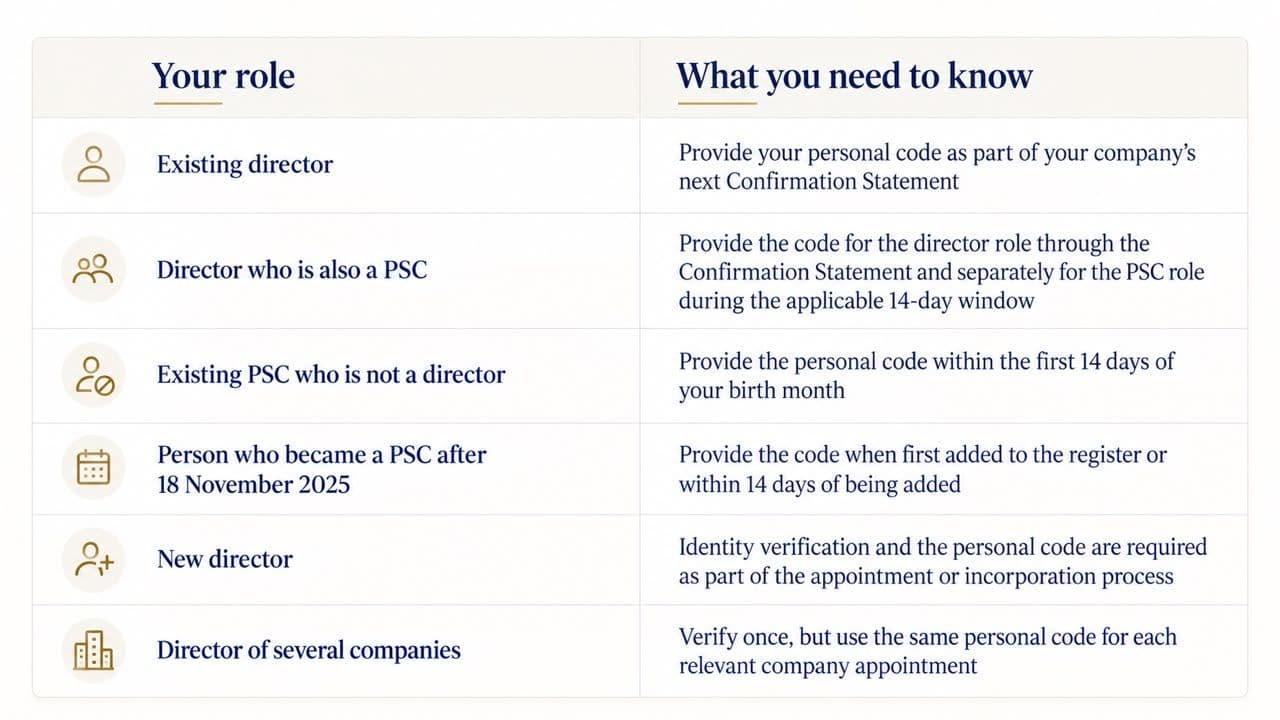
The key distinction: you normally verify your identity once, but you may need to use the same personal code separately for different Companies House roles.
Not Sure Which Deadline Applies to You?
Seven Oak Prestige can help non-resident founders review their Companies House identity-verification position and determine which step applies to their director and PSC roles.
Check My Identity Verification Position →
1. Is 18 November 2026 Your Companies House Deadline?
Not necessarily.
Companies House introduced mandatory identity verification on 18 November 2025.
That date marked the start of a 12-month transition period.
It did not create one identical deadline for every director and PSC.
Companies House instead assigns compliance requirements according to the person’s role and circumstances.
For an existing director, the practical trigger is generally the company’s next Confirmation Statement.
For an existing PSC, a separate 14-day period applies.
That distinction is why relying solely on a statement such as:
“I have until November 2026”
can be dangerous.
You may have an earlier obligation.
2. Existing Director: Your Confirmation Statement Matters
If you were already a director when mandatory identity verification began, Companies House requires your personal code as part of your company’s next Confirmation Statement.
That means you should check:
- your company on the Companies House register;
- its Confirmation Statement cycle;
- whether your identity has already been verified;
- whether your personal code is available.
If you are a director of several UK companies, the same principle applies to each relevant appointment.
You do not verify your identity separately for every company.
You verify once and receive one Companies House personal code, then use that same personal code when required for the different company appointments.
If you are still learning how Confirmation Statements fit into wider post-incorporation compliance, see our What Happens After You Register a UK Company as a Non-Resident? 2026 Checklist.
3. What If You Are Both a Director and a PSC?
This is where many founders become confused.
A founder can simultaneously be:
Shareholder
- ●
Director
- ●
Person with Significant Control
That is completely normal.
For example, a sole founder owning 100% of a UK Limited Company will commonly be both a director and PSC.
You do not normally complete identity verification twice.
Instead:
Director role
Your personal code is provided as part of the company’s Confirmation Statement.
PSC role
The same personal code must also be provided separately using the Companies House PSC identity-verification process.
For an existing PSC who is also a director of the same company, the PSC’s 14-day period starts the day after the company’s Confirmation Statement date.
Importantly, filing the Confirmation Statement early does not move that PSC window forward.
This means:
one person
→ one identity verification
→ one personal code
→ separate use of that code for the director and PSC roles
For a deeper explanation of how directors, shareholders and PSCs differ, read How to Structure Shares and Directors in a UK Ltd as a Non-Resident Founder.
4. What If You Are a PSC but Not a Director?
The deadline works differently.
If you were already registered as a PSC before mandatory identity verification began and you are not a director of that company, Companies House generally requires you to provide your personal code during the:
first 14 days of your birth month.
For example:
Birthday: 24 September
PSC compliance window:
1 September to 14 September
The relevant dates can also be checked through the Companies House register and PSC verification service.
Because we are now in 2026, founders should not assume that a birth-month deadline later in the transition period is still available if their relevant window has already passed.
Check your own record.
5. What If You Became a PSC After 18 November 2025?
Different rules apply to new PSC appointments.
If you became a PSC after 18 November 2025, you can generally provide your Companies House personal code:
- when you are first added to the Companies House register; or
- within 14 days of being added.
This is another reason a universal “November 2026 deadline” is misleading.
A person becoming a PSC today does not simply receive permission to wait until the end of the transition period.
Their own compliance period applies.
6. What About Newly Appointed Directors?
For new directors, identity verification has moved much earlier in the process.
If you are:
- incorporating a new UK company; or
- being appointed as a new director;
the Companies House personal code is required as part of the relevant registration or appointment filing.
In other words, new directors should not expect the same transition mechanism that applies to existing appointments.
If you are planning a new UK company rather than dealing with an existing one, read our UK Company Formation for Non-Residents: Complete 2026 Guide.
7. How Do You Verify Your Identity?
There are two principal routes.
Option 1 — GOV.UK One Login
This is the direct Companies House route and is free.
Depending on the verification process available to you, GOV.UK One Login can accept certain identity documents including:
- a biometric passport from any country;
- a UK photo driving licence;
- and certain UK biometric immigration documents.
A foreign driving licence should not simply be assumed to qualify for the direct GOV.UK photo-ID route.
For many overseas founders, a valid biometric passport is therefore particularly important.
Option 2 — Authorised Corporate Service Provider — ACSP
You can also have your identity verified by an Authorised Corporate Service Provider, commonly referred to as a Companies House authorised agent.
An ACSP must meet the applicable Companies House and UK AML-supervision requirements.
An authorised agent may charge for the verification service.
This route can be useful for an overseas founder who:
- prefers guided assistance;
- cannot easily complete the direct route;
- has a document situation requiring a different verification approach;
- wants identity verification coordinated with wider company compliance.
The legal outcome is the same:
successful verification results in a Companies House personal code.
For the full comparison of the available routes and documentation requirements, continue to our Companies House Identity Verification for Non-Residents Guide.
8. Is the Companies House Personal Code a Company Code?
No.
This distinction is important.
Your Companies House personal code belongs to you as an individual.
It does not belong to:
- Seven Oak Prestige;
- your accountant;
- your UK Limited Company;
- your Registered Office provider.
If you have directorships in several companies, you normally use the same personal code to connect your verified identity to the relevant appointments.
Companies House currently issues an 11-character personal code after successful verification.
Keep it secure.
You may need to provide it to an authorised person who is making a relevant Companies House filing on your behalf.
9. Does Your UK Registered Office Affect Identity Verification?
Your company’s UK address and your personal identity are separate matters.
A non-resident director can have:
- a UK Registered Office for the company;
- a UK Director Service Address;
- and a genuine residential address outside the United Kingdom.
Do not provide the company’s Registered Office as your personal residential address unless it is genuinely your home.
Identity verification does not turn a commercial UK address into a residential address.
For the full distinction, read UK Registered Office vs Director Service Address for Non-Residents.
10. What Happens If You Miss Your Identity Verification Requirement?
Identity verification is now a legal requirement, not an optional Companies House service.
The consequences depend on the nature and duration of the non-compliance.
Companies House states that non-compliance can lead to measures including:
- restrictions on company filings;
- annotations on the public register;
- financial penalties;
- criminal enforcement;
- director disqualification in appropriate cases;
- and other enforcement action.
It is also unlawful for a director to continue acting as a director when the applicable identity-verification requirement has not been satisfied.
For a company with an unverified director where verification is required, the Confirmation Statement process can also be affected.
We deliberately do not state one universal fine amount here.
Different Companies House enforcement mechanisms and offences can lead to different consequences, so quoting a single headline figure would oversimplify the regulatory position.
The practical conclusion is much simpler:
do not allow the deadline to pass unnecessarily.
11. What If You Cannot Complete Your PSC Requirement on Time?
Companies House currently provides a mechanism for a PSC to request a 14-day extension in certain circumstances.
The important point is timing:
the extension request must be made before the PSC verification deadline has already passed.
It should therefore be treated as a contingency mechanism, not as a reason to delay verification.
If you know there is a problem with:
- documentation;
- access to the verification service;
- your Companies House record;
- or your ability to provide the code;
address it before the end of your applicable window.
12. Why Should Non-Resident Directors Act Early?
The legal requirement is the same whether you live in:
- the UK;
- France;
- India;
- UAE;
- USA;
- Africa;
- Asia;
- or elsewhere.
But overseas founders can face additional practical friction.
For example:
- an identity document may not work through the route expected;
- details may differ between the passport and Companies House register;
- a director may misunderstand the difference between verification and providing the personal code;
- a PSC may complete the director step but forget the separate PSC step;
- an ACSP may need additional time to review documents.
The safest approach is therefore not:
“What is the last possible day?”
It is:
“What is my actual requirement, and can I complete it now?”
13. What Should You Do Now?
Use this four-step check.
Step 1 — Find your company
Locate the company on the Companies House register.
Step 2 — Identify your role
Are you:
- director only;
- PSC only;
- director and PSC;
- director of multiple companies?
Step 3 — Check the relevant date
For an existing director, review the Confirmation Statement position.
For a PSC, identify the applicable 14-day window.
Step 4 — Verify and connect the personal code
Choose:
GOV.UK One Login
or
an Authorised Corporate Service Provider.
Then make sure the personal code is actually provided for each role where Companies House requires it.
Verification alone and satisfying every role-specific filing requirement are not always the same step.
14. How Seven Oak Prestige Can Help
Seven Oak Prestige supports international and non-resident founders with Companies House identity-verification preparation and wider UK company compliance.
Depending on the service required, our support can include:
- identifying the relevant director and PSC roles;
- reviewing the Companies House position;
- explaining the applicable verification route;
- Companies House identity-verification support;
- ACSP-assisted verification where applicable;
- personal-code guidance;
- director and PSC compliance preparation;
- Registered Office and Director Service Address support;
- wider post-incorporation compliance preparation.
We do not change or manipulate identity information to make an applicant appear easier to verify.
All identity, residence, director, ownership and PSC information should be genuine and consistent with the relevant evidence.
Need Help With Companies House Identity Verification?
Check My Verification Position →
15. Frequently Asked Questions
Is 18 November 2026 my Companies House identity verification deadline?
Not necessarily.
Mandatory identity verification started on 18 November 2025 with a 12-month transition period, but Companies House applies specific due dates according to the person’s role and circumstances.
For an existing director, the personal code is generally provided through the company’s next Confirmation Statement.
PSC deadlines operate separately.
I’m a director and PSC. Do I have to verify my identity twice?
No.
You normally verify your identity once and receive one Companies House personal code.
However, if you are both director and PSC, you need to provide that same code separately for each role through the applicable Companies House processes.
When is the PSC deadline if I am also a director?
For an existing PSC who is also a director of the same company, the 14-day PSC period begins the day after the company’s Confirmation Statement date.
The PSC step is separate from providing the code as a director through the Confirmation Statement.
When is my deadline if I am a PSC but not a director?
For an existing PSC who is not a director of the same company, the applicable period is generally the first 14 days of the PSC’s birth month.
Check the Companies House record for your specific period.
What if I became a PSC after 18 November 2025?
You can generally provide your personal code when you are first added to the Companies House register or within 14 days of being added.
Can I verify my identity from outside the UK?
Yes.
Companies House states that identity verification can be completed through the available GOV.UK route where you meet its requirements, or through an authorised ACSP.
An ACSP can verify a client from another country, subject to the applicable verification requirements.
Can I use a foreign passport?
A biometric passport from any country can be used through the relevant GOV.UK One Login photo-ID route, subject to the service’s requirements.
Can I use my foreign driving licence?
Do not assume so.
The GOV.UK direct photo-ID guidance specifically lists a UK photo driving licence.
Non-resident founders with an accepted biometric passport may find that the more relevant direct route.
Is Companies House identity verification free?
The direct GOV.UK One Login service is free.
An Authorised Corporate Service Provider may charge for an assisted verification service.
Is there one fixed fine if I miss the deadline?
There is no single penalty figure that accurately describes every form of Companies House identity-verification non-compliance.
Companies House has a range of enforcement powers, including financial penalties and other measures depending on the offence and circumstances.
Can I request more time?
For PSC verification details, Companies House currently allows an application for a 14-day extension in certain circumstances.
The request must be made before the existing deadline expires.
16. Check the Date Before It Becomes a Problem
Companies House identity verification is no longer a future reform.
It is already part of the UK company compliance framework.
The important question in 2026 is not:
“Does identity verification apply?”
For directors and PSCs within the mandatory regime, the more useful questions are:
When does it apply to me?
Have I actually verified?
Have I provided my personal code for every role that requires it?
For an international founder, dealing with those questions early is considerably easier than discovering the issue when a Companies House filing is already due.
Check Your Companies House Verification Position
If you are a non-resident director or PSC and are unsure which requirement applies, Seven Oak Prestige can help you review the position and prepare the appropriate next step.
17. About the Author
Isaac Jackson — Founder & Managing Director, Seven Oak Prestige Ltd
Isaac Jackson has more than three years of hands-on experience supporting international founders with UK company formation, Companies House processes, address solutions, compliance preparation and banking readiness.
His work includes helping non-resident directors understand Companies House identity-verification requirements, director and PSC roles, personal codes and the wider compliance steps involved in maintaining a UK Limited Company from overseas.
18. Editorial Methodology
Last reviewed: 8 September 2026
This guide was reviewed against current Companies House and GOV.UK guidance covering:
- mandatory Companies House identity verification;
- director verification dates;
- PSC 14-day compliance periods;
- new director requirements;
- new PSC requirements;
- Companies House personal codes;
- GOV.UK One Login;
- Authorized Corporate Service Providers;
- PSC extensions;
- Companies House enforcement for non-compliance.
It was also reviewed against Seven Oak Prestige’s existing Companies House and non-resident company-formation content to preserve clear search-intent ownership.
This article is specifically designed to answer:
“When is my identity-verification requirement due?”
For the broader process — including how verification works and which documents can be used — refer to our complete identity-verification guide.
Companies House requirements can change, so the individual company and officer record should always be checked before acting.
19. Important Disclaimer
This article provides general information about Companies House identity verification and does not constitute legal advice.
Identity-verification dates depend on the individual’s role, appointment history, PSC status and company circumstances.
Seven Oak Prestige Ltd can assist with UK company formation, Companies House processes, identity-verification preparation, ACSP-assisted services where applicable, address solutions and corporate compliance support.
Companies House remains responsible for the statutory register and applicable filing requirements.
Where there is uncertainty regarding an offence, enforcement action, director disqualification or another legal consequence, specialist legal advice may be appropriate.
20. Related Guides
Companies House Identity Verification for Non-Residents — Complete 2026 Guide
The main Seven Oak guide covering verification routes, personal codes, documents, directors, PSCs and the complete identity-verification process.
UK Company Formation for Non-Residents — Complete 2026 Guide
Understand the full process for establishing a UK Limited Company while living overseas.
What Happens After You Register a UK Company as a Non-Resident?
A practical post-incorporation checklist covering Companies House, identity verification, addresses, tax and operational preparation.
How to Structure Shares and Directors in a UK Ltd as a Non-Resident Founder
Understand the distinction between directors, shareholders and PSCs — especially when the same founder holds several roles.
Registered Office vs Director Service Address for Non-Residents
Understand which UK company addresses are public, which belong to the company and why a Registered Office is not a director’s residential address.
How Much Does It Cost to Register a UK Company as a Non-Resident in 2026?
Compare the official incorporation fee with the wider cost of addresses, identity verification, compliance and operational setup.