
How to Structure Shares and Directors in a UK Ltd as a Non-Resident Founder (2026 Guide)

How to Structure Shares and Directors in a UK Ltd as a Non-Resident Founder
A non-UK resident can own 100% of a UK private limited company and can generally act as its sole individual director.
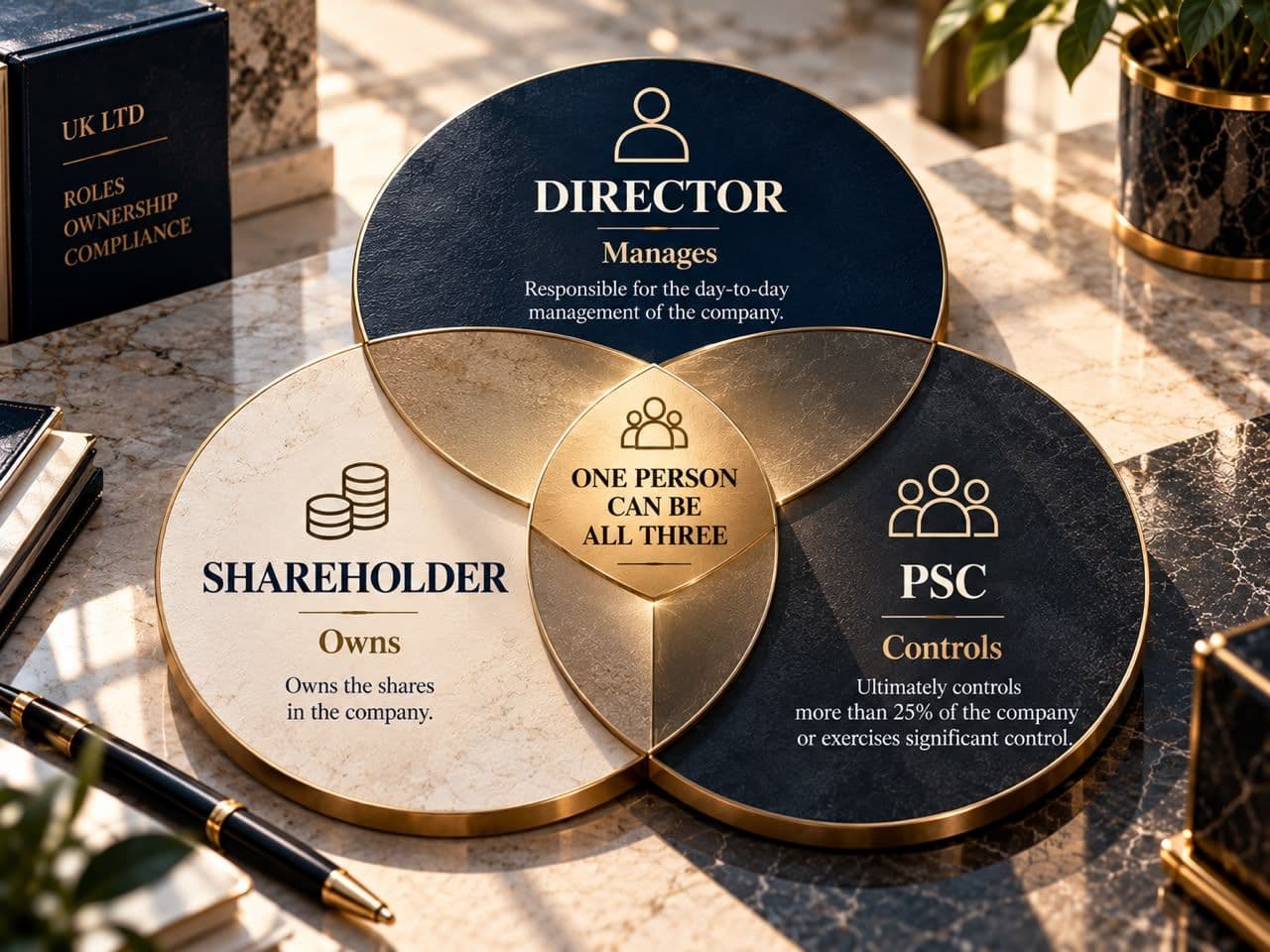
The shareholder and director can be the same person. They do not, however, mean the same thing.
A shareholder owns shares in the company.
A director manages the company and carries legal responsibilities for doing so.
A Person with Significant Control (PSC) is someone who meets one or more statutory control conditions, which commonly include holding more than 25% of the shares or voting rights.
For a solo international founder, that can produce a very simple structure:
One founder
100% shareholder
Sole individual director
PSC
That structure can work perfectly well.
But once there are co-founders, investors, family shareholders, different voting rights or plans to raise capital, the decisions made before incorporation deserve more thought.
The objective is not to create the most sophisticated share structure possible.
It is to create the simplest structure that accurately reflects who owns the business, who manages it and who controls it — while leaving sensible room for what the company is genuinely likely to do next.
If you are still deciding whether a UK company is the right vehicle in the first place, start with Seven Oak Prestige’s complete UK company formation guidance for non-resident founders.
Quick Answer: What Structure Works for a Solo Non-Resident Founder?
For many one-person businesses, a straightforward starting structure is:
Shareholder: Founder
Ownership: 100%
Director: Founder
PSC: Founder
Share class: Ordinary shares
UK rules allow a private company limited by shares to have one shareholder, and that shareholder can also be the company’s only director.
There is no general Companies House requirement to add a UK-resident director simply because the founder lives abroad.
That does not mean every founder should automatically use this structure.
Before incorporating, ask five questions:
Who genuinely owns the business?
Who will actually manage it?
Will another founder or investor enter soon?
Does anyone need rights that are different from their economic ownership?
Will the structure still make sense when explained to Companies House, an accountant, a bank, an investor or another due-diligence reviewer?
Those questions matter more than choosing a share number because it appeared in somebody else’s incorporation template.
1. Can a Non-Resident Own 100% of a UK Limited Company?
Yes.
A private company limited by shares must have at least one shareholder. If there is only one shareholder, that person can own 100% of the company.
The shareholder can live outside the United Kingdom.
That means an overseas founder can potentially have:
100% ownership
100% voting control through ordinary shares
sole directorship
PSC status
while continuing to live abroad.
Residence still matters for other reasons.
A founder’s country of residence can affect personal taxation, overseas-investment rules, local reporting, banking, KYC and other cross-border obligations.
The important distinction is this:
Being non-resident does not by itself prevent you from owning the UK company. It also does not make your residence-country obligations disappear.
2. Does a UK Company Need a UK-Resident Director?
No, not merely because it is a UK private limited company.
A private company must have at least one director, and at least one director must be an individual. A director must generally be at least 16.
The director does not have to live in the UK.
So an overseas founder should not appoint another person simply because they have been told:
“A UK company needs a UK director.”
For an ordinary private limited company, that is not a general Companies House requirement.
A better question is:
What genuine role will the second director perform?
If there is no sensible answer, adding that person can create responsibility and complexity without solving a real problem.
Directorship is not decorative. Directors carry statutory responsibilities even where someone else handles the company’s routine administration.
Founders who want to understand those responsibilities in detail should read our UK Company Director Duties for Non-Residents guide.
3. Director, Shareholder and PSC: Three Different Roles
This is the distinction every founder should understand before incorporation.
Director
The director manages the company and is legally responsible for carrying out the role properly.
A director does not need to own shares.
Shareholder
The shareholder owns shares in the company.
The rights attached to those shares can include voting, dividends and rights to capital, depending on the share class and the company’s constitutional arrangements.
A shareholder does not automatically have to become a director.
Person with Significant Control
PSC status concerns significant ownership or control.
A person will commonly qualify where they:
own more than 25% of the shares;
hold more than 25% of the voting rights;
have the right to appoint or remove a majority of the board;
or satisfy another statutory significant-influence-or-control condition.
One individual can therefore be:
Director + Shareholder + PSC
But another company might legitimately have:
Director — 0% shareholder
or:
Investor — Shareholder but not Director
or:
Founder — Shareholder + PSC + Director
The labels should never be treated as interchangeable.
4. Can a Director Own 0% of the Company?
Yes.
Suppose a founder owns the entire company but appoints an experienced executive to help manage it.
The structure could be:
Founder A
100% shareholder
PSC
Director
Director B
Director
0% shareholder
Director B has management responsibilities but no ownership simply because they hold office as a director.
This can make sense where the second person genuinely contributes to management.
What should be avoided is appointing a director merely to make the company appear more British, more established or supposedly more attractive to a bank.
The appointment creates a real legal role.
5. Can a Shareholder Own Shares Without Being a Director?
Yes.
Consider a founder raising capital from an investor:
Founder: 80% shareholder + director
Investor: 20% shareholder, not a director
The investor owns part of the business but does not automatically acquire responsibility for managing the company.
Their precise rights will depend on the shares and any relevant articles, shareholders’ agreement or investment documentation.
This distinction becomes particularly important once outside investors enter the business.
6. Can a Non-Executive Director Also Be a Shareholder?
Yes. There is no general rule that being a non-executive director prevents someone from owning shares in the company.
The two questions remain separate:
What management or oversight role does the person have?
and:
What economic ownership and voting rights do they have?
In businesses where formal director independence is important, however, a shareholding may need to be considered as part of the wider governance and independence analysis.
For a typical founder-managed private company, the starting principle remains straightforward: directorship and share ownership are separate roles.
7. Should a New Company Issue 1 Share or 100 Shares?
Both structures can represent 100% ownership.
For example:
One-share structure
1 ordinary share × £1
Founder owns 1 of 1 shares.
Ownership: 100%
100-share structure
100 ordinary shares × £0.01
Founder owns 100 of 100 shares.
Ownership: 100%
In both examples, total nominal share capital is £1.
The company is not worth more simply because it has 100 shares rather than one.
The practical difference is divisibility.
With 100 shares, percentages are immediately intuitive:
70 shares = 70%
30 shares = 30%
60 shares = 60%
40 shares = 40%
That can be convenient where multiple founders are involved.
But 100 shares is not a universal “best” structure. A solo founder who has no realistic need to divide ownership immediately may be perfectly well served by a simpler structure.
Choose the number deliberately rather than because somebody told you that every company should have 100 shares.
8. Nominal Value Is Not the Value of the Company
This is another frequent misunderstanding.
If a company issues:
100 ordinary shares × £0.01
its total nominal share capital is:
£1
That does not mean the business is worth £1.
The company might later be commercially valued at £50,000, £1 million or considerably more while its original nominal share capital remains small.
Nominal value is part of the legal share-capital structure. It should not be confused with the commercial valuation of the business or the price an investor may later pay for an interest in it.
A high nominal share value does not make a new company more credible.
9. How Should Two Founders Divide the Shares?
This is where incorporation templates stop being useful and commercial judgment becomes important.
A 50/50 split may be appropriate where two founders genuinely intend equal ownership.
But equal ownership also means neither founder necessarily has a simple majority if they disagree.
Before choosing 50/50, discuss:
who makes operational decisions;
what requires both founders’ approval;
what happens if one founder stops working;
how shares can be transferred;
what happens if one wants to sell;
how a serious disagreement is resolved;
what happens on death or incapacity;
how future investment will affect both holdings.
An unequal split can also be perfectly legitimate.
For example:
60/40
Founder A — 60%
Founder B — 40%
Both ordinarily satisfy the PSC shareholding condition because each owns more than 25%.
70/30
Founder A — 70%
Founder B — 30%
Again, both ordinarily cross the shareholding PSC threshold.
80/20
Founder A — 80%
Investor B — 20%
Founder A ordinarily satisfies the PSC shareholding condition.
Investor B does not qualify through the 20% shareholding alone, although other voting, appointment or control rights could change the PSC analysis.
The percentage should reflect the actual commercial agreement.
Do not begin with “What percentage looks best?”
Begin with:
Who is contributing what, who should own what, and what rights are they actually agreeing to?
10. Does 51% Give a Founder Complete Control?
Not necessarily.
Holding 51% can give a shareholder a simple majority in circumstances where an ordinary resolution is sufficient and the shares carry the relevant voting rights.
It does not mean that shareholder can unilaterally determine every matter affecting the company.
Different decisions can involve different statutory thresholds, class rights, articles and contractual protections.
An investor with less than 50% may also have specifically negotiated rights over important decisions.
So:
51/49 is not simply “controller versus powerless minority.”
Good structuring looks at the rights behind the percentages.
11. Exactly 25% Is Not the Same as More Than 25%
This small distinction matters for PSC analysis.
The shareholding and voting-right conditions refer to more than 25%, not simply 25% or more.
A person holding exactly 25% therefore does not meet the shareholding PSC condition merely because of that holding.
But that is not the end of the analysis.
They could still qualify through another condition, including voting arrangements, rights over the board or significant influence or control.
That is why PSC analysis should never consist solely of looking at the largest shareholder.
12. Should You Add a Spouse or Family Member as a Shareholder?
Only where you genuinely intend them to own part of the company.
Do not give somebody shares because you believe an additional shareholder will make the business appear:
more credible;
more established;
more British;
or easier to bank.
Shares create real ownership.
Depending on the rights and percentage involved, the family member may have voting and economic rights, may become a PSC, and may have tax or reporting consequences in the relevant jurisdictions.
If the real intention is that you own 100% of the business, the corporate records should not tell a different story merely for appearance.
13. Should You Add a Second Director for Banking?
Not simply because you hope it will improve approval.
Banks, EMIs and payment providers conduct their own KYC, AML and eligibility assessments.
They may look at:
directors;
shareholders;
PSCs and ultimate beneficial owners;
countries of residence;
business activity;
customers and suppliers;
expected transactions;
source of funds;
website and commercial evidence.
A second director can be entirely appropriate where that person genuinely manages the company.
But adding somebody with no real management function can create another person to explain and verify without necessarily improving the company’s banking profile.
The better principle is:
make the structure commercially genuine and easy to evidence.
If banking is an important part of your proposed setup, use our UK Business Banking Readiness Assessment before approaching providers.
14. When Should You Use More Than One Share Class?
For many small founder-managed companies, one class of ordinary shares is sufficient.
Different share classes become relevant when there is a genuine need for different rights.
Those differences can concern matters such as:
voting;
dividends;
capital;
redemption;
investor preference;
founder control.
For example, a growing company may eventually need to distinguish founder rights from investor rights.
But complexity should solve a real problem.
Creating A, B and C shares at incorporation because they appear sophisticated can introduce legal, tax and administrative questions the company did not need.
Where bespoke voting, dividend, investment or exit rights are required, the articles and associated legal documentation should be properly designed and specialist advice obtained where appropriate.
15. What Happens When an Investor Joins Later?
An investor can acquire an interest later, but first determine how they are entering.
One possibility is for the company to issue new shares.
Suppose the founder initially owns:
100 of 100 shares = 100%
The company later issues 25 new shares to an investor.
The result becomes:
Founder: 100 of 125 = 80%
Investor: 25 of 125 = 20%
The founder still owns 100 shares.
What changed is the total number of shares in issue.
That is dilution.
Another possibility is that the investor buys some of the founder’s existing shares. That is a share transfer, not a new allotment, and the mechanics are different.
If your company already exists and ownership needs to change, use our guide to transferring shares in a UK company as a non-resident rather than treating the transaction as a new-company structuring exercise.
16. How Does Companies House Identity Verification Affect the Structure?
This is now part of incorporation planning, not something to think about months later.
Mandatory Companies House identity verification applies to directors and PSCs.
A person who becomes a director must provide their Companies House personal code as part of the relevant appointment or incorporation process. PSCs also need to connect their verified identity to their PSC role within the applicable period.
The personal code belongs to the individual, not to one company.
So if one founder is:
Director + Shareholder + PSC
the person does not obtain a different identity simply because they occupy several roles. The same personal code can be used when the verified identity needs to be connected to relevant Companies House roles.
But the roles remain legally distinct. Being verified as a director does not mean the PSC obligation should simply be ignored.
A three-founder company where all three individuals are directors and PSCs therefore has a different verification workload from a one-person company.
That is not a reason to avoid genuine co-founders.
It is a reason to establish the real structure from the beginning.
For the detailed process, including the 11-character personal code and director/PSC requirements, read our Companies House Identity Verification for Non-Residents guide.
17. Registered Office, Director Service Address and Home Address Are Not the Same
A non-resident founder may encounter several addresses during incorporation.
They serve different purposes.
Registered Office
This is the company’s official UK address.
Director Service Address
This is the director’s public correspondence address.
Usual Residential Address
This is the director’s genuine home address.
It should not be replaced with a London address merely because the founder wants the company to appear more British.
For example, a legitimate structure could be:
Registered Office: London
Director Service Address: London
Usual Residential Address: Dubai
The same principle applies to a founder genuinely resident in India, France, Egypt, Switzerland, Saudi Arabia or another jurisdiction.
If you do not have premises of your own in Britain, our guide to forming a UK company without your own UK address explains the options. For the precise distinction between the different addresses, see Registered Office vs Director Service Address for Non-Residents.
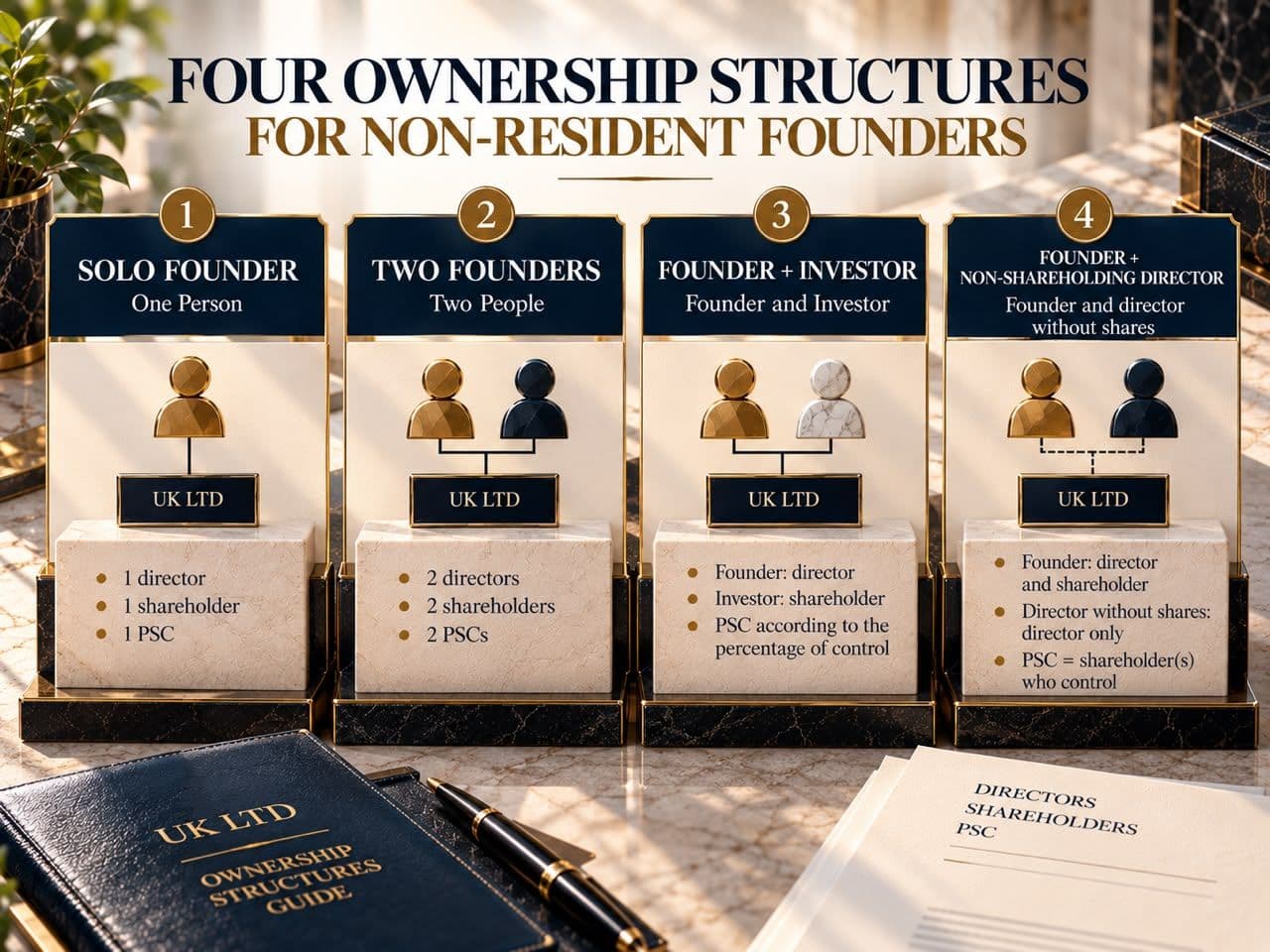
18. Five Practical Structures for Non-Resident Founders
There is no universal structure, but these examples show how the principles work.
Solo founder
Founder: 100%
Director: Founder
PSC: Founder
Suitable where one person genuinely owns and manages the business and no immediate outside ownership is planned.
Two genuine co-founders
Founder A: 60%
Founder B: 40%
Directors: Both founders
PSCs: Both founders through their shareholdings
The ownership is simple, but the founders should still decide how important decisions, exits and disputes will work.
Founder with a minority investor
Founder: 80%
Investor: 20%
Director: Founder
PSC through shareholding: Founder
The investor does not meet the shareholding PSC threshold solely through a 20% holding, but any additional control rights still need to be considered.
Founder with a non-shareholding director
Founder: 100% shareholder + PSC + director
Director B: Director, 0% shares
This can work where Director B genuinely contributes to management but is not intended to own the business.
Three founders
Founder A: 50%
Founder B: 30%
Founder C: 20%
Founders A and B ordinarily meet the PSC shareholding condition.
Founder C does not meet that condition solely through the 20% holding, although other rights could change the position.
The lesson is not that one of these structures is “best”.
It is that shareholding, directorship and control should be analysed separately and then made coherent.
19. Does the Structure Affect Business Banking?
It can affect the information a provider needs to understand, but there is no magic share structure that guarantees approval.
A bank or payment provider may need to identify who owns and controls the company and understand why the structure makes commercial sense.
A genuine:
70/30 founder structure
can be straightforward.
So can:
100% founder ownership.
So can:
founder + minority investor.
Problems are more likely when the information does not reconcile.
For example:
the website describes one owner while Companies House shows another;
the person presented as the decision-maker is not reflected in the corporate structure;
shareholder information conflicts with KYC documents;
a supposed nominee or passive participant cannot be adequately explained;
or ownership changes have not been properly documented.
Companies House registration and banking approval are separate decisions.
A legally valid company does not automatically qualify for every financial provider.
For a broader explanation of provider eligibility and preparation, read our UK Business Banking for Non-Residents guide.
20. Do Not Confuse Company Law with Tax Residence
A director can live outside the UK.
A shareholder can live outside the UK.
Those company-law facts do not determine the entire tax position.
A UK-incorporated company will ordinarily be UK tax resident, subject to relevant rules including circumstances where treaty provisions affect dual residence. The founder’s own country may also impose tax, reporting or foreign-company rules.
The practical point is simple:
“Companies House allows this structure” does not mean “this structure has no tax consequences where I live.”
Cross-border tax should therefore be reviewed separately where material rather than distorted into a Companies House structuring decision.
21. Pre-Incorporation Structure Checklist
Before submitting the incorporation, you should be able to answer these questions clearly.
Ownership
Who genuinely owns the business?
What percentage should each person own?
Is anyone expected to invest soon?
Management
Who will actually manage the company?
Does each proposed director have a real reason to hold the role?
Shares
How many shares will be issued?
What is their nominal value?
Is one ordinary class sufficient?
Control
Who qualifies as a PSC?
Does anyone have special voting, appointment or control rights that need separate consideration?
Identity verification
Have the proposed directors completed the necessary Companies House identity-verification steps?
Have the PSC requirements been identified?
Addresses
What will be used for the company’s Registered Office?
What will each director use as their public service address?
What is each director’s genuine residential address?
Future plans
Is outside investment realistically expected?
Will another founder join?
Could employee equity be needed?
Is a holding-company or subsidiary structure planned?
Financial readiness
Can the ownership and management structure be explained consistently to a bank, payment provider, accountant or commercial counterparty?
If any of those answers are unclear, resolve them before incorporation where possible.
22. Common Structuring Mistakes
Giving someone shares “for banking”
Shares create genuine ownership. They should not be allocated merely to improve appearances.
Adding a UK-resident director unnecessarily
There is no general requirement for the director of an ordinary UK private company to live in the UK.
Treating 50/50 as automatically fair
Equal ownership can work well, but the founders still need a mechanism for decisions and disagreements.
Confusing shareholders with directors
One owns shares. The other manages the company. One person can be both, but the roles remain different.
Forgetting PSC analysis
Do not assume that only the largest shareholder matters.
Treating exactly 25% as automatically satisfying the shareholding PSC condition
The relevant condition is generally more than 25%.
Creating complicated share classes too early
Complexity should solve a genuine commercial requirement.
Using a UK correspondence address as a false residential address
A professional UK service address does not change where the director genuinely lives.
Leaving identity verification until the last minute
Director and PSC identity requirements are now part of the Companies House framework.
Structuring only for today
You do not need to predict the company’s next decade. But if an investor or co-founder is expected shortly, ignoring that foreseeable event can create unnecessary restructuring.
Frequently Asked Questions
Can a non-resident own 100% of a UK Limited Company?
Yes. A private company limited by shares can have one shareholder, and that shareholder can own the whole company.
Can a non-resident be the sole director?
Generally, yes. Directors do not have to live in the UK. A private company must have at least one director, and at least one must be an individual.
Can the shareholder and director be the same person?
Yes.
Can a director own no shares?
Yes. Directorship and share ownership are separate.
Can a shareholder own shares without being a director?
Yes.
Can a non-executive director own shares?
Yes. The roles are not mutually exclusive, although governance or independence considerations can matter in some companies.
Does exactly 25% make someone a PSC?
Not through the shareholding condition alone. That condition generally requires more than 25%. Other forms of control can still result in PSC status.
Is 100 shares better than one share?
Not inherently. One share can be sufficient for a sole founder. A larger number such as 100 can make percentage divisions easier where multiple owners are involved.
Are 100 shares worth more than one share?
No. The number of shares by itself does not determine the company’s commercial value.
Can I add an investor later?
Yes. Depending on the transaction, the company might issue new shares or an existing shareholder might transfer shares. Those are different processes.
Do directors and PSCs need Companies House identity verification?
Yes, under the current Companies House identity-verification regime. The timing and way the personal code is provided depends on the person’s role and circumstances.
Does a shareholder need identity verification merely because they own shares?
Ordinary share ownership by itself is not the relevant trigger. The current mandatory framework applies to roles including directors and PSCs.
Does a UK company need a UK-resident shareholder?
Not merely because it is incorporated in the UK.
Will adding a UK director improve my banking chances?
There is no universal rule that it will. Financial providers make their own eligibility, KYC and risk decisions.
Structure the Company Before You Register It
Most share structures can be changed later.
That does not mean changing them later is always the best plan.
New shares can require additional corporate decisions and filings.
Transferring existing shares has its own documentation, corporate-record, PSC and potentially tax or Stamp Duty considerations.
Adding or removing directors changes the company’s management record.
Bringing in investors can affect ownership, control and existing shareholders.
The objective is therefore not to design a company today for every event that might happen ten years from now.
It is to avoid creating a structure today that already contradicts what you know you are building.
For many international founders, the right answer remains refreshingly simple:
one genuine owner, one genuine director, ordinary shares and a transparent PSC position.
For others, two founders, outside investment or different rights justify more planning.
Keep the structure as simple as the business allows — but not simpler than the ownership, control and future plans require.
Planning Your UK Company from Overseas?
Seven Oak Prestige Ltd supports non-resident founders with the practical infrastructure surrounding UK company formation, including director and shareholder structure preparation, share allocation, PSC preparation, Companies House identity-verification support, Registered Office and Director Service Address services, compliance preparation and business-banking readiness.
Before incorporation, we can help you organise the proposed structure so that the ownership, management, Companies House information, address arrangements and supporting documentation tell one coherent story.
For founders who want to understand the complete first-year budget before proceeding, our UK Company Formation Cost for Non-Residents guide explains the government fee alongside the wider infrastructure a non-resident company may require.
Discuss Your UK Company Structure
About the Author
Isaac Jackson
Founder & Managing Director — Seven Oak Prestige Ltd
Isaac Jackson supports international founders and overseas businesses establishing and operating UK companies, including founders requiring support with company formation, statutory addresses, Companies House administration, KYC preparation, compliance coordination and banking readiness.
Seven Oak Prestige Ltd
Company Registration No. 16903092
Registered Office: 124 City Road, London EC1V 2NX, United Kingdom
Last reviewed: 5 October 2026
Important Disclaimer
This guide provides general corporate information and does not constitute personalised legal, tax, investment or financial advice.
The appropriate ownership and governance structure depends on the company’s articles, shareholder arrangements, investment plans, tax circumstances and the laws applying to the owners in their countries of residence.
Bespoke share classes, shareholders’ agreements, investment transactions and material cross-border tax arrangements should be reviewed by appropriately qualified professionals where necessary.