
Do You Need a UK Visa to Own or Run a UK Limited Company as a Non-Resident? Complete 2026 Guide

Company Ownership, Directorship, Remote Management, Business Visits, KYC, Banking and UK Work Visa Rules Explained
Updated: August 2026
A non-resident does not generally need a UK visa simply to form, own or act as a director of a UK Limited Company while remaining outside the United Kingdom.
This is one of the most misunderstood aspects of UK company formation.
Company law and immigration law answer two different questions:
Can you own or direct the company?
and:
What are you allowed to do physically while you are in the UK?
Those are not the same thing.
An entrepreneur can potentially live in:
- India;
- United States;
- UAE;
- France;
- Ghana;
- Singapore;
- Canada;
- another overseas jurisdiction;
while owning and managing a UK Limited Company remotely.
But owning that UK company does not automatically give the person permission to move to Britain, work there, or use repeated business visits as a way of living in the UK.
That distinction is the foundation of this guide.
Quick Answer
Do I need a UK visa to register a UK company from overseas?
Usually no.
You can generally form a UK Limited Company remotely without travelling to Britain.
Do I need a visa to own shares in a UK company?
Not simply because you own the shares.
Company ownership does not itself require UK residence.
Do I need a visa to be a director while living overseas?
Not merely because you are a director.
Directors of UK private companies do not generally have to live in Britain.
Do I need a visa if I want to physically work for the company from inside the UK?
Potentially yes.
The immigration analysis changes once you intend to perform work physically in Britain.
Does having a UK Limited Company give me a visa?
No.
Company incorporation does not grant immigration permission.
Want to Establish Your UK Company Without Relocating?
Seven Oak Prestige assists international founders with UK company formation, registered-office and director-service-address arrangements, Companies House identity verification and banking-readiness support.
Discuss My UK Company Setup
1. Company Law and Immigration Law Are Separate
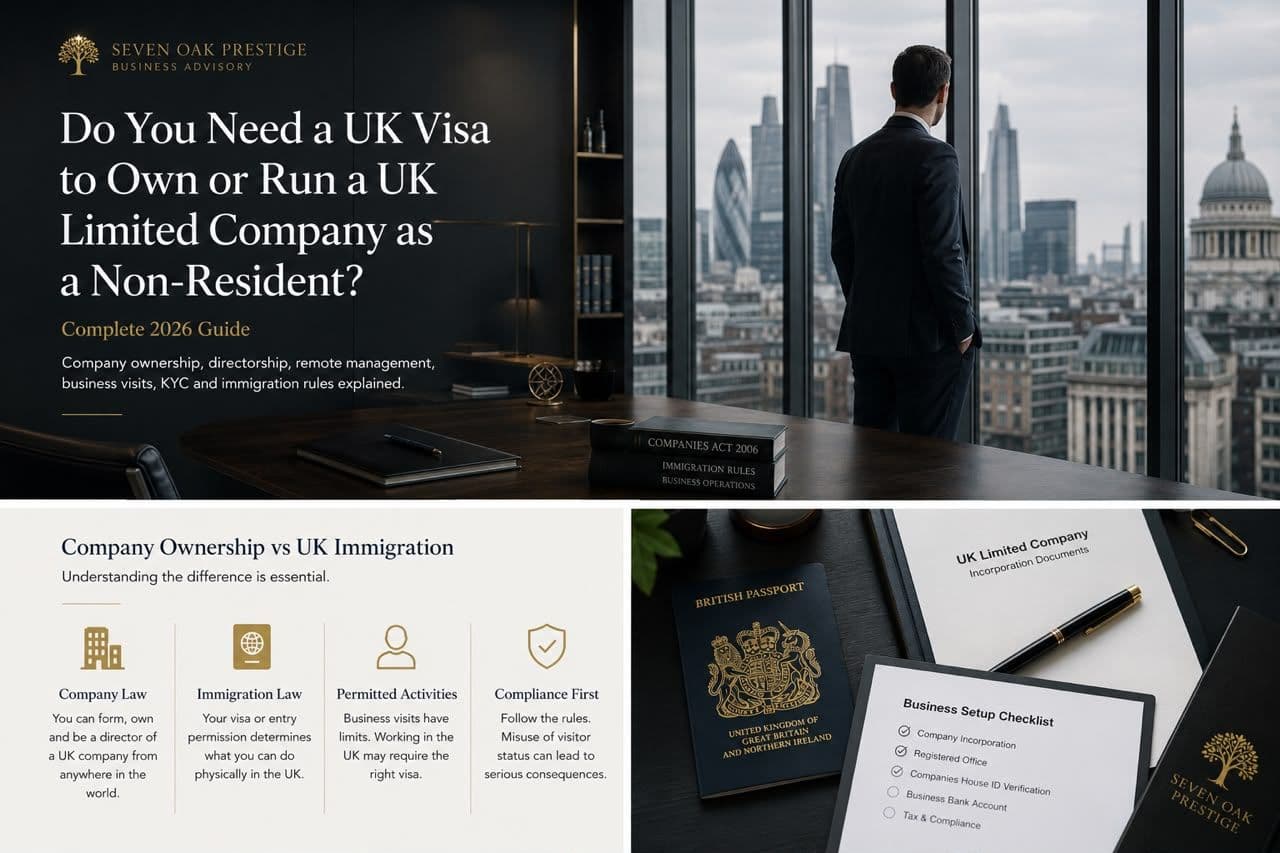
This is the most important concept in the article.
A UK company is a legal entity registered under UK company law.
A visa or immigration status determines what an individual is permitted to do physically in the UK.
Therefore:
UK company ownership
does not equal
UK immigration permission
and:
being a company director
does not automatically equal
permission to work physically in Britain.
This is why a founder can legally own a UK company from Dubai, Mumbai or New York while having no UK work visa at all.
The immigration question becomes much more important when that founder intends to:
- move to Britain;
- spend substantial periods there;
- work from the UK;
- run daily operations physically from the UK;
- take employment with the company;
- establish the UK as their main home.
2. Can a Non-Resident Own a UK Limited Company Without a Visa?
Generally, yes.
There is no general requirement that a shareholder of a UK private limited company must be UK-resident simply because they own shares.
A founder may potentially be:
100% shareholder
while living entirely overseas.
For example:
Founder residence: India
Shareholding: 100% of UK Ltd
Registered office: London
Management location: India
The fact that the company is incorporated in Britain does not force the shareholder to immigrate to Britain.
If you are still deciding whether a UK company is appropriate, start with our UK Company Formation for Non-Residents: Complete 2026 Guide.
3. Can a Non-Resident Be the Director of a UK Limited Company?
Yes, in an ordinary private-company structure, a director does not generally have to live in the UK.
A non-resident can therefore potentially be:
- sole director;
- sole shareholder;
- PSC;
while living abroad.
However, being recorded as a director does not create a right to physically work in Britain.
That is where company law stops and immigration law begins.
For the ownership distinction, see our UK Company Shares and Directors for Non-Resident Founders.
4. Does Owning a UK Company Give You the Right to Live in Britain?
No.
A Certificate of Incorporation does not provide:
- permanent residence;
- a work visa;
- settlement rights;
- British citizenship;
- automatic right to enter Britain;
- automatic right to work for the company in Britain.
Companies House and UK Visas and Immigration are different systems.
The fact that your name appears as:
Director
or:
Person with Significant Control
on Companies House should never be treated as immigration permission.
Rapid Formations makes the same distinction in its current guidance for overseas directors: directorship does not automatically create the right to live or work in the UK.
5. Do You Need to Travel to the UK to Form the Company?
Usually, no.
For a straightforward UK company formation, much of the process can be completed remotely.
This can include:
- preparing the company structure;
- arranging the registered office;
- supplying director/shareholder information;
- completing Companies House identity verification;
- filing incorporation documents;
- receiving digital incorporation documents.
The major formation competitors currently describe non-resident incorporation as a remote process without a requirement to travel merely to form the company.
So:
You should not buy a flight to London simply because you believe Companies House requires you to be physically present to incorporate.
6. Do You Need to Travel to the UK for Companies House Identity Verification?
This is a particularly important 2026 question.
Usually, no.
Companies House identity verification became a legal requirement from 18 November 2025, but the official verification framework includes remote methods.
A person can verify through GOV.UK One Login using supported identification, including a biometric passport from any country, or may use an Authorised Corporate Service Provider where appropriate.
That means an overseas director should not assume:
“I need to fly to Britain for KYC.”
Companies House verification and immigration are completely separate.
If you have an eligible biometric passport and can complete the official digital process, there may be no need to travel to Britain at all for Companies House verification.
For the complete identity-verification process, see our Companies House Identity Verification for Non-Residents — Complete 2026 Guide.
7. What If Online Companies House Verification Does Not Work?
Do not immediately assume that travel to Britain is the solution.
Companies House provides more than one verification route.
Official guidance currently identifies:
- GOV.UK One Login;
- certain Post Office processes;
- verification through a Companies House Authorised Corporate Service Provider.
For an overseas founder, the most suitable option depends on:
- available identification;
- country;
- document type;
- whether digital verification succeeds;
- access to an authorised provider.
The key principle is:
Companies House KYC is not the same thing as immigration or UK physical presence.
8. Do You Need to Travel to the UK to Open a Business Bank Account?
There is no universal UK company-law requirement saying that every non-resident director must travel to Britain to obtain a business bank account.
But banking is different from incorporation.
Each:
- bank;
- EMI;
- fintech provider;
has its own onboarding and eligibility rules.
Some providers may support remote onboarding.
Others may require additional verification.
Some may not accept the founder’s country of residence or business model at all.
A provider could also request:
- video verification;
- additional proof of address;
- source-of-funds evidence;
- contracts;
- website;
- trading evidence;
- operating-address evidence;
- further due diligence.
Therefore:
Do not book a flight to London simply because your UK company needs banking. First establish whether the provider accepts your residence, activity and ownership profile.
Our UK Business Banking Readiness Assessment explains what international founders should prepare before applying.
For practical provider guidance, see our Fintech & Banking Guidance.
9. Can Travelling to the UK Improve Your Bank Application?
Do not assume so.
A physical visit does not correct an underlying eligibility problem.
For example, if a provider does not onboard residents of a particular jurisdiction, simply entering Britain temporarily does not normally change the person’s genuine country of residence.
Likewise, a founder should never represent a temporary UK visit as:
UK residence
or use:
- hotel address;
- friend’s address;
- virtual office;
as evidence of genuine residential status where it is not.
Banking applications should reflect the real facts.
10. Can You Visit the UK for a Business Meeting?
Potentially, yes.
The UK Standard Visitor framework permits certain business activities.
Official GOV.UK guidance includes activities such as:
- attending meetings;
- attending conferences or seminars;
- negotiating and signing contracts;
- attending trade fairs for promotional purposes, but not directly selling;
- carrying out site visits and inspections.
So a foreign founder may potentially come to London to:
- meet accountants;
- meet advisers;
- inspect premises;
- negotiate with suppliers;
- meet potential partners;
- attend conferences;
- sign certain deals.
But that does not mean the visitor can simply work full-time for their UK company while in Britain.
11. Can You Work for Your Own UK Company While Visiting?
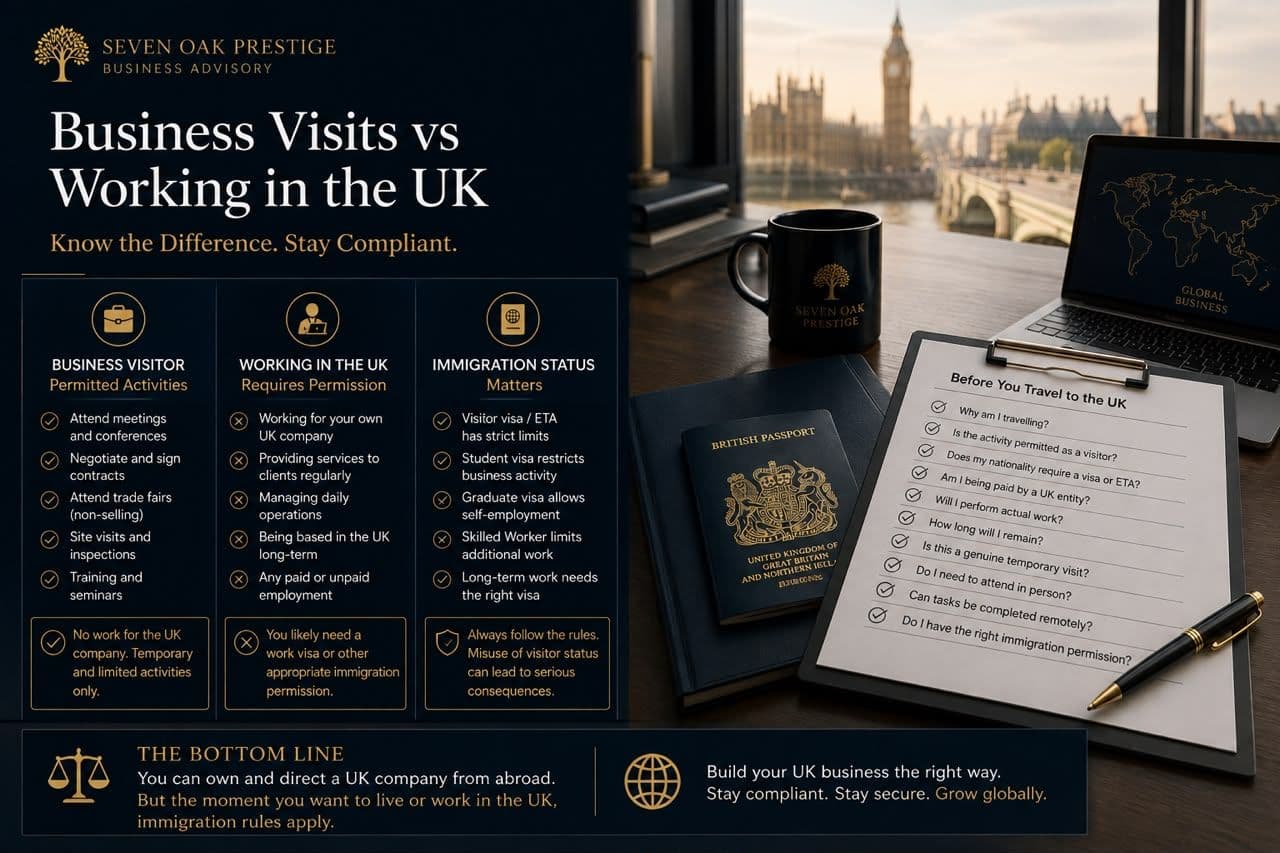
This is where founders need to be careful.
A Standard Visitor cannot generally perform paid or unpaid work for a UK company or work as a self-employed person except where a specific permitted activity applies.
So:
Potentially permitted
Founder flies in for three days to:
- meet an accountant;
- negotiate a contract;
- attend a trade conference;
- inspect office premises.
Much more problematic
Founder comes as a visitor and then:
- works every day from the UK office;
- performs normal operational duties;
- delivers services to customers;
- effectively manages the UK business from Britain for extended periods.
The second scenario is not simply “business visiting”.
12. Can You Sign Contracts in the UK as a Visitor?
The current permitted-business-activity rules expressly include negotiating and signing deals and contracts.
That makes an important distinction possible:
visiting Britain to negotiate/sign a contract
is not necessarily the same as:
relocating to Britain and performing ongoing work for your UK company.
The substance of what you actually do matters.
13. Do All Foreigners Need a Standard Visitor Visa?
No.
Whether you need:
- a Standard Visitor visa;
- an Electronic Travel Authorisation;
- neither in advance;
depends on nationality and circumstances.
GOV.UK currently states that depending on nationality, a traveller may need a visitor visa, an ETA, or may fall into another entry category.
Therefore, do not simply search:
“Do company directors need UK visa?”
The correct question is:
What is my nationality, why am I travelling, and what activities do I plan to perform while in Britain?
14. An ETA Is Not a UK Work Visa
Another common misunderstanding.
An Electronic Travel Authorisation can permit eligible travellers to visit the UK for certain purposes, including qualifying business trips.
It does not generally permit the holder to work for a UK company or as a self-employed person.
So:
ETA
does not mean:
permission to relocate and run your UK company from Britain.
15. Can You Manage the UK Company Entirely From Overseas?
Operationally, many businesses can be managed remotely.
Examples include:
- consulting;
- software development;
- SaaS;
- marketing agency;
- online education;
- certain e-commerce structures;
- digital services.
A founder could potentially:
- sign electronic contracts;
- supervise staff remotely;
- manage accounts;
- communicate with customers;
- make company decisions;
from another country.
However, remote management can create tax consequences in the founder’s home country, even if there is no UK immigration issue.
For the broader distinction between company incorporation and international taxation, see our UK Company Tax for Non-Residents guide.
16. Immigration Residence and Tax Residence Are Not the Same
This distinction deserves explicit treatment.
Someone may:
- have no UK work visa;
- live in India;
- own a UK Ltd;
- remain personally tax resident in India.
Another founder may:
- hold a UK work visa;
- physically relocate;
- eventually become UK tax resident.
Immigration status and tax residence interact but they are not synonymous.
Do not use visa status alone to determine:
- company tax residence;
- personal tax residence;
- permanent establishment;
- foreign-company reporting.
17. When Do You Actually Need a UK Work Visa?
The visa question becomes materially more important when you want to physically live and work in Britain.
That might include:
- relocating to manage the UK company;
- taking an active UK-based role;
- being employed physically in Britain;
- setting up operations on the ground;
- transferring from an overseas parent company.
There is no single visa called:
“UK Limited Company Owner Visa.”
The appropriate immigration route depends on the facts.
18. Innovator Founder Visa
One potential route is the:
Innovator Founder visa
This is not simply available because you registered a normal UK Ltd.
Current GOV.UK rules require an applicant seeking to establish a business under this route to obtain endorsement and demonstrate that the business idea is:
- new;
- innovative;
- viable;
- scalable.
Therefore:
“I own a normal consulting UK Ltd”
does not automatically mean:
“I qualify for Innovator Founder.”
Those are completely different tests.
19. UK Expansion Worker Visa
This route is particularly relevant to existing overseas businesses expanding into Britain.
The UK Expansion Worker route allows qualifying senior managers or specialist employees of an overseas business to come to Britain to help establish a UK branch where the overseas company has not yet started trading in the UK.
Current requirements include matters such as:
- sponsorship;
- prior overseas employment;
- eligible occupation;
- minimum salary conditions.
This makes the route fundamentally different from a solo entrepreneur simply incorporating a new UK Ltd.
20. UK Expansion Worker vs UK Subsidiary Formation
These are related, but they are not the same process.
Company formation question
What legal UK entity or establishment should the overseas business create?
Immigration question
Which overseas employee is permitted to physically move to Britain to establish or work in that operation?
A company can potentially establish its corporate structure before the relevant employee completes the immigration process.
That is another example of why:
Companies House
and
UKVI
should not be treated as one system.
21. Global Talent Visa
Global Talent may be relevant to certain individuals in qualifying fields.
But it should not be described as a generic “entrepreneur visa”.
1st Formations includes it among possible routes for people relocating to Britain to pursue business activity, but eligibility depends on the specific Global Talent framework rather than merely owning a company.
For personalised immigration eligibility, founders should use an appropriately authorised immigration adviser.
22. High Potential Individual Visa
The High Potential Individual route may also be relevant to certain qualifying graduates.
Again, company ownership does not itself generate eligibility.
This is why we should avoid the misleading idea:
“Form UK company first → visa automatically follows.”
That is not how the immigration system works.
23. Can a Student Visa Holder Own or Run a UK Company?
This is particularly sensitive.
UK immigration rules restrict Students from being self-employed or engaging in business activity except in limited circumstances.
Government sponsor guidance specifically gives examples of prohibited business activity that can include:
- setting up and trading as a business;
- working for a company where the Student has a significant beneficial interest;
- working for a company while also holding a statutory role such as director.
Therefore:
A person should not assume that because Companies House technically permits a directorship, their Student immigration conditions permit them to actively operate the business in Britain.
This is exactly why company law and immigration law must be considered separately.
24. Can a Graduate Visa Holder Run a Business?
The Graduate route is materially different.
Current Immigration Rules state that work, including self-employment, is permitted under the Graduate route, subject to the applicable conditions.
Government caseworker guidance also confirms that Graduates can undertake work including self-employment and business activity.
That can make the Graduate route more relevant to some international founders who have completed qualifying UK study.
But individual immigration circumstances should still be checked carefully.
25. What About Skilled Worker Visa Holders?
A Skilled Worker should not simply assume they can run an unlimited separate business.
Current GOV.UK rules allow certain additional work, including work for one’s own business, up to 20 hours per week, provided the person remains in the sponsored role and the additional work satisfies the relevant occupation conditions.
This is therefore a much more constrained situation than:
non-resident founder running the company entirely from overseas.
26. Can You Hire UK Employees Without Moving to Britain?
Potentially, yes.
The owner does not necessarily have to relocate just because the company hires employees in Britain.
A UK company can potentially have:
Founder/director: overseas
Employees: UK
But hiring creates separate obligations involving:
- PAYE;
- right-to-work checks;
- employment contracts;
- workplace pensions;
- employer’s liability insurance;
- payroll;
- employment law.
Again:
company owner immigration
and
employee compliance
are separate issues.
27. Do You Need a Visa to Open a UK Office?
The company can potentially lease premises regardless of whether every shareholder personally has a UK work visa.
But if the founder wants to physically work from that office on an ongoing basis, their immigration permission becomes relevant.
For example:
Structure A
UAE founder owns UK Ltd.
UK staff work from London office.
Founder manages remotely from Dubai.
Structure B
UAE founder moves to London and personally performs daily executive duties from the office.
The company can exist in both structures.
The founder’s immigration analysis is different.
28. Do You Need a Visa to Attend a Bank Meeting in London?
Potentially, a genuine business meeting may fall within permitted visitor activities, subject to the traveller’s nationality and entry requirements.
But again, attending a meeting and working for the bank/account/company from Britain are different activities.
If a financial provider asks to meet you, first confirm:
- whether physical presence is actually required;
- which entry permission applies;
- what the meeting involves.
Do not assume a company-formation adviser can provide immigration clearance.
29. Do You Need to Travel to the UK for Banking KYC?
There is no single universal answer because banks set their own onboarding rules.
But the correct starting assumption should be:
Check provider-specific requirements before travelling.
Remote onboarding may involve:
- passport;
- selfie/video verification;
- residential proof;
- company documents;
- source-of-funds documentation;
- website;
- contracts.
If the provider requires something different, it should tell you during onboarding.
Travel should not be used to disguise your true residence.
30. Can You Use a UK Registered Office to Prove You Live in Britain?
No.
This is an extremely important compliance point.
A registered office is the company’s statutory address.
A director service address is the director’s public correspondence address.
Neither becomes your genuine residential address merely because you pay for the service.
For the complete distinction, see our UK Registered Office vs Director Service Address for Non-Residents.
A bank, UKVI or another compliance body may request your genuine residential address separately.
31. Can You Use Your UK Company Address on a Visa Application?
Only where the form genuinely asks for the company/business address.
Do not substitute:
registered office
for:
personal residential address
when those are different facts.
Consistency is important across:
- Companies House;
- immigration applications;
- banking;
- tax;
- KYC.
32. Does a UK Company Help With a Visa Application?
Possibly as part of the factual background of a genuine business, but the company itself does not create visa eligibility.
For example, an Innovator Founder application requires much more than a Companies House certificate.
A UK Expansion Worker application likewise requires sponsorship and qualifying employment circumstances.
The correct approach is:
Immigration route requirements first
then determine what corporate evidence is relevant.
Not:
incorporate company and assume visa follows.
33. Do You Need to Be in Britain to Sign Company Documents?
Modern corporate administration can often be completed electronically, depending on the document and circumstances.
Routine Companies House filings do not generally require a non-resident director to fly to Britain solely to sign them physically.
The more important question is whether:
- the filing is valid;
- identity verification has been completed;
- authorised signatures/approvals exist;
- records are properly maintained.
34. Do You Need to Travel to Receive the Certificate of Incorporation?
No.
The Certificate of Incorporation can be issued electronically.
A non-resident founder does not need to stand inside Companies House to collect it.
This is one reason UK incorporation is attractive for internationally managed businesses.
35. Can an Overseas Founder Open the Company and Never Visit the UK?
Potentially, yes.
A business can be genuinely UK-incorporated while its founder never physically visits Britain.
But the company must still maintain its legal and tax obligations.
That can include:
- registered office;
- Companies House filings;
- identity verification;
- accounting;
- Corporation Tax;
- VAT where applicable;
- confirmation statements;
- annual accounts.
If the company has just been incorporated, use our Complete Post-Incorporation Checklist for Non-Resident Founders.
36. Will Never Visiting the UK Affect Banking?
It can influence some providers’ assessments, but there is no universal rule.
Financial institutions may look at:
- founder residence;
- company activity;
- UK nexus;
- customer base;
- contracts;
- transaction countries;
- business substance.
Some internationally oriented companies can operate legitimately without the founder ever relocating.
Others may have a stronger reason for genuine UK operations.
Banking strategy should reflect the actual business model.
37. Will Never Visiting the UK Affect Tax?
Not necessarily in the way founders expect.
A UK-incorporated company is generally within the UK corporate-tax framework, subject to detailed rules and treaty situations.
Separately, the country from which the founder actually manages the company may have its own rules.
So:
“I never travelled to Britain”
does not automatically mean:
“the UK company has no UK tax obligations.”
And:
“the company is British”
does not automatically mean:
“my home country has no tax interest.”
38. Scenario: Indian Founder Running UK Ltd From India
Possible factual structure:
Residence: India
UK company: Ltd
Director: Indian resident
Registered office: London
Management: India
Customers: international
There is no inherent requirement to relocate to Britain simply because the founder owns the company.
However, the founder should separately consider:
- Indian tax;
- FEMA/RBI;
- overseas investment;
- remittances;
- POEM;
- banking.
For those issues, use our UK Company Formation From India — Complete 2026 Guide.
39. Scenario: US Founder With UK Subsidiary
Suppose:
US corporation
↓
100% owns UK Ltd
A US executive may not need to permanently relocate simply because the subsidiary exists.
But if the US parent wants to send a senior employee to Britain to establish or operate the UK business, immigration options such as Global Business Mobility may become relevant depending on the circumstances.
This is fundamentally different from simply being a shareholder.
[US → UK Expansion Guide — INSERT LIVE INTERNAL LINK]
40. Scenario: UAE Founder Visiting London for Meetings
Suppose a UAE resident owns a UK consulting company but primarily manages it from Dubai.
They travel to London for:
- accountant meeting;
- client negotiations;
- industry event;
- contract signing.
Those activities may potentially fall within permitted business-visitor activities, subject to their nationality, entry requirements and the precise facts.
But the founder should not treat visitor status as permission to permanently base themselves in London and work normally from there.
41. Scenario: International Student Already in Britain
This is almost the opposite situation.
The person is physically present in the UK but their visa may restrict business activity.
Therefore, a Student should not reason:
“Companies House allows me to be a director, so my Student visa must allow it.”
UK immigration guidance specifically restricts business activity under the Student route.
This is a high-risk area for assumptions.
42. Scenario: Graduate Visa Founder
A qualifying Graduate route holder has significantly broader work permission, including self-employment under current rules.
That means the analysis may differ considerably from a Student visa holder.
Immigration status matters more than the fact that both individuals own a UK company.
43. Visa vs Company Formation vs Banking — The Three-Layer Test
Before taking action, separate the problem into three layers.
Layer 1 — Company Law
Can the company be formed?
Usually yes for many non-residents.
Layer 2 — Immigration
What can the founder physically do in Britain?
Depends on immigration status and planned activities.
Layer 3 — Banking / KYC
Will the financial provider onboard the company and founder?
Depends on its own risk and eligibility framework.
These three questions should never be collapsed into:
“I have a UK Ltd, therefore everything is approved.”
44. Common Mistakes International Founders Make
Mistake 1 — Thinking UK company ownership gives UK residency
It does not.
Mistake 2 — Flying to Britain unnecessarily to form the company
Most ordinary incorporation can be handled remotely.
Mistake 3 — Thinking Companies House KYC requires travel to London
Remote verification options exist.
Mistake 4 — Using visitor status to work normally in the UK
Visitor business activities are limited.
Mistake 5 — Using a registered office as a fake residential address
Incorrect.
Mistake 6 — Assuming visiting the UK solves banking eligibility
Not necessarily.
Mistake 7 — Assuming directorship equals Right to Work
It does not.
Mistake 8 — International student running a company without checking visa conditions
Potential immigration breach.
Mistake 9 — Assuming “business visa” is one universal visa
There are multiple routes with different conditions.
Mistake 10 — Incorporating purely to obtain immigration status
A company certificate itself does not create that status.
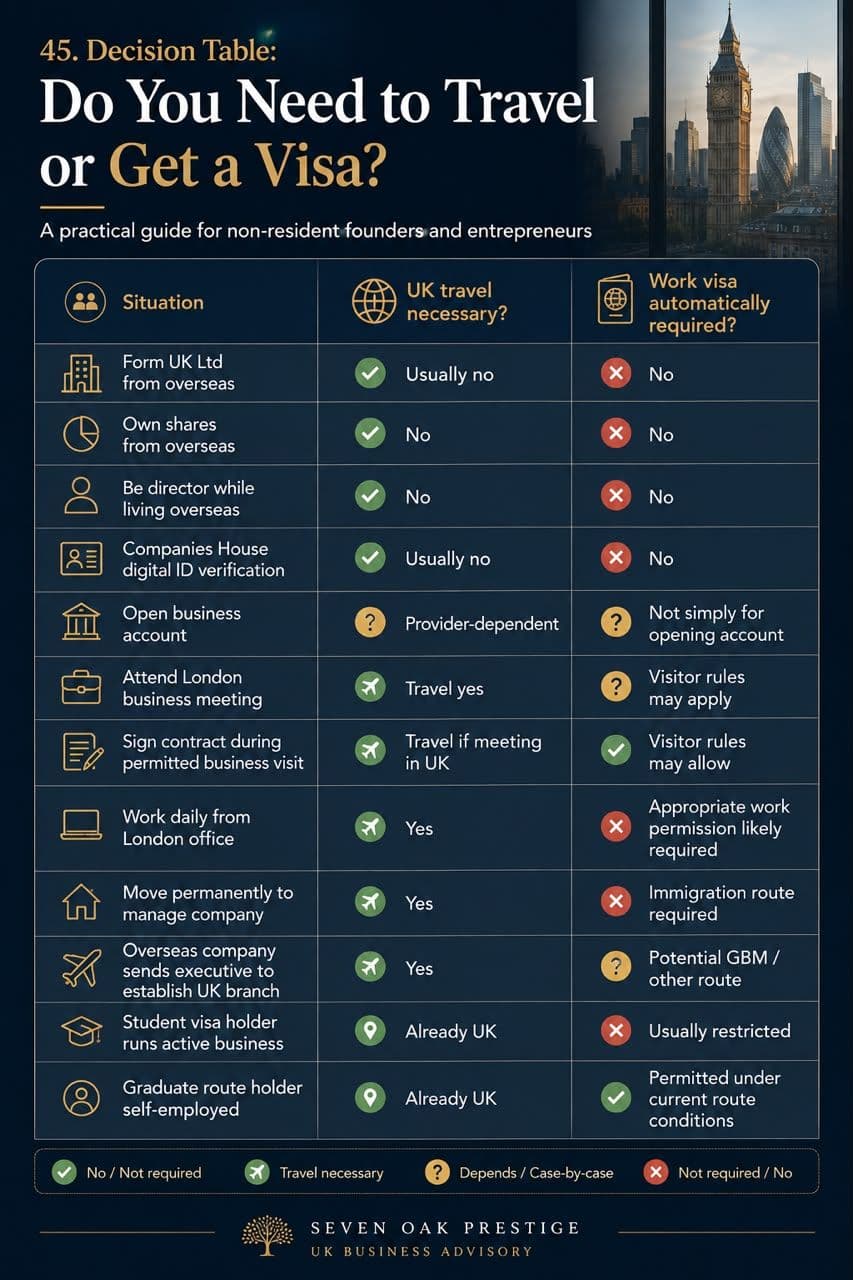
45. Decision Table: Do You Need to Travel or Get a Visa?
46. Before You Travel to the UK: Founder Checklist
Before booking your flight, ask:
- Why am I travelling?
- Is the activity permitted as a visitor?
- Does my nationality require a visa or ETA?
- Am I being paid by a UK entity?
- Will I perform actual work?
- How long will I remain?
- Is this genuinely a temporary business visit?
- Does the bank actually require me in person?
- Can Companies House verification be completed remotely?
- Am I confusing my registered office with residence?
- Do I intend to relocate rather than visit?
If the answer begins to look like:
“I am moving there to run the company every day”
you are no longer dealing with simple remote ownership.
Frequently Asked Questions
Do I need a visa to open a UK Limited Company?
Not simply to incorporate and own the company while remaining overseas.
Can I be a UK company director without a UK visa?
If you remain abroad, directorship itself does not generally require a UK work visa. The immigration question changes when you physically undertake work in Britain.
Do I have to visit the UK to register the company?
Usually no.
Do I have to travel to the UK for Companies House verification?
Usually no. Remote verification routes are available, including supported biometric-passport verification through GOV.UK One Login.
Can I open a UK business account without visiting?
Potentially, depending on the financial provider and your circumstances.
Should I travel to Britain to improve my bank approval?
Not simply for appearance. Provider eligibility and your genuine residence/business profile matter more.
Can I visit London to meet my accountant?
Potentially, subject to visitor eligibility and immigration rules.
Can I attend business meetings in Britain?
Permitted visitor activities include qualifying meetings, conferences and contract negotiations.
Can I sign a business contract while visiting?
Negotiating and signing contracts is included among general permitted visitor business activities.
Can I work from my UK company’s office as a visitor?
A Standard Visitor generally cannot work for a UK company except where a specific permitted activity applies.
Does an ETA allow me to work?
No. An ETA can support eligible visits but does not generally permit work for a UK company or self-employment.
Does having a UK company give me residency?
No.
Does having a UK company guarantee a visa?
No.
What visa is available for entrepreneurs?
There is no universal company-owner visa. Innovator Founder may apply to qualifying innovative, viable and scalable businesses with endorsement.
Is UK Expansion Worker suitable for a solo founder?
It is primarily designed for qualifying senior managers or specialist employees of existing overseas businesses expanding into Britain, subject to sponsorship and eligibility requirements.
Can an international student become a company director?
This requires particular care because Student immigration conditions restrict business activity and can treat working for a company while holding a statutory role as business activity.
Can a Graduate visa holder be self-employed?
Current Graduate-route rules permit self-employment, subject to the route’s conditions.
Can a Skilled Worker run a side business?
Current rules permit certain work for one’s own business up to 20 hours weekly where the relevant conditions are satisfied.
Can I operate my UK company permanently from India?
Potentially from a company-law perspective, but Indian tax, FEMA/RBI and other local obligations must also be considered.
Does travelling to the UK change my actual residential address?
No.
Can I use my London registered office as proof that I live in London?
No, unless you genuinely reside there and the evidence supports that. A registered office is a company address, not proof of personal residence.
The Core Rule to Remember
The easiest way to avoid confusion is to separate these three statements:
I own a UK company.
That is a corporate-law fact.
I am allowed to enter Britain for a particular purpose.
That is an immigration question.
I am allowed to physically work in Britain.
That is another immigration/work-permission question.
The first statement does not automatically prove either of the other two.
For most non-resident founders who genuinely remain overseas, the UK company can often be established and managed remotely without relocating merely for incorporation.
But once the founder wants to live, work or establish themselves physically in Britain, appropriate immigration analysis becomes essential.
How Seven Oak Prestige Can Help
Seven Oak Prestige supports international founders with the corporate and operational side of establishing a UK company, including:
- UK company formation;
- registered office;
- director service address;
- Companies House identity-verification support;
- share/director structure;
- banking readiness;
- fintech guidance;
- VAT;
- EORI;
- post-incorporation compliance guidance.
For the complete formation framework, see our UK Company Formation for Non-Residents Guide.
If your UK company already exists, continue with our Post-Incorporation Checklist.
If banking is the immediate issue, start with our UK Business Banking Readiness Assessment.
Discuss My UK Company Setup
Important Immigration Disclaimer
Seven Oak Prestige provides corporate formation and business-advisory information.
This article is general information and does not constitute regulated UK immigration advice.
Immigration eligibility depends on:
- nationality;
- current immigration status;
- intended activities;
- duration of stay;
- employment arrangements;
- sponsorship;
- individual circumstances.
For personalized UK visa advice or immigration representation, use an appropriately authorized UK immigration adviser or solicitor.
About the Author
Isaac Jackson is Founder & Managing Director of Seven Oak Prestige Ltd, supporting international entrepreneurs with UK company formation, Companies House compliance and business banking readiness.
Contact Seven Oak Prestige Ltd
Email: contact@sevenoakprestige.com
WhatsApp: +44 7447 488755
UK Office: +44 2045 780726