
UK Company Formation Without Your Own UK Address | 2026

Can You Form a UK Company Without Your Own UK Address?
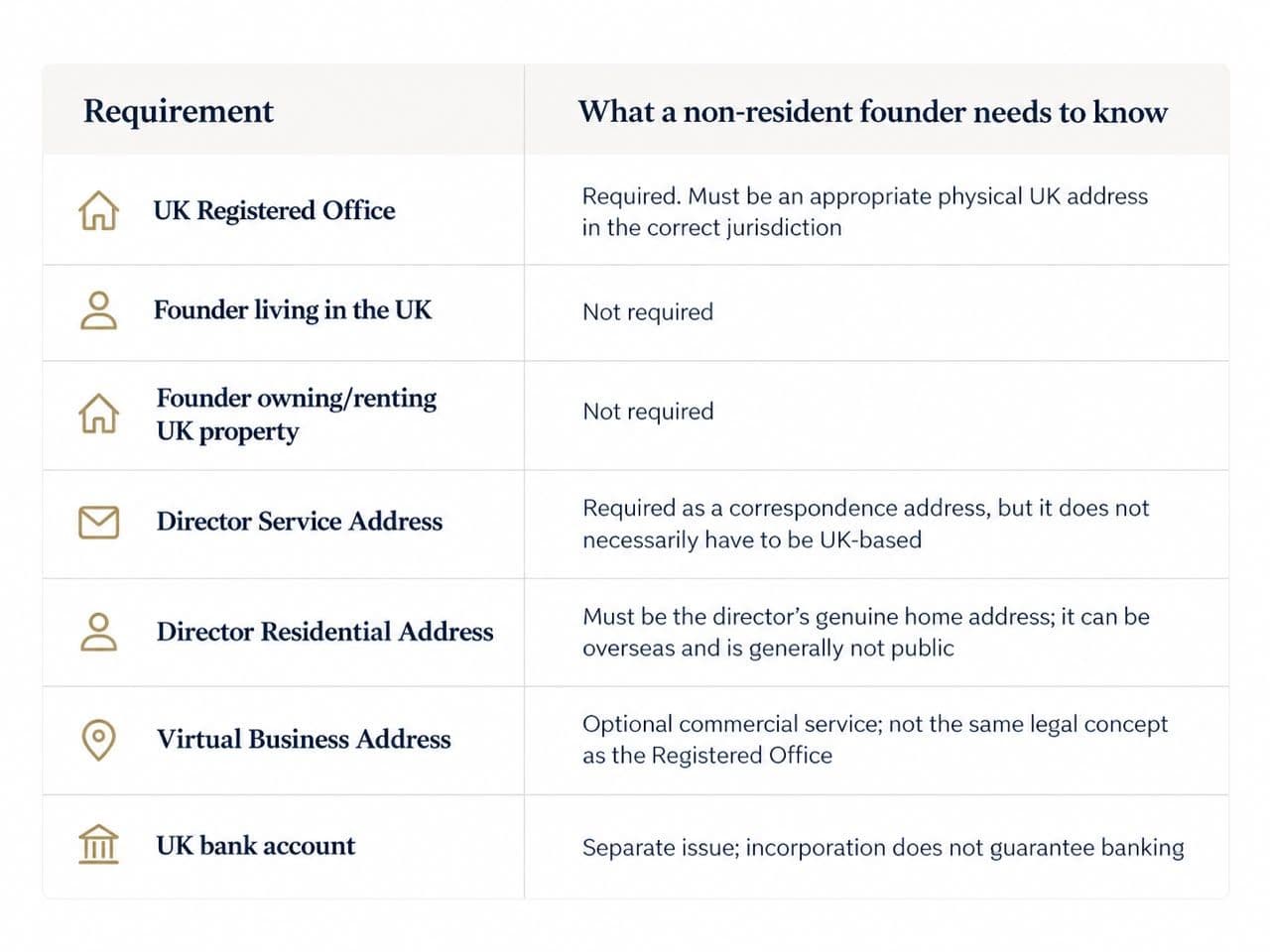
Yes. You can form and own a UK Limited Company without living in the UK, renting a UK office or owning UK property.
But the company itself must have an appropriate UK Registered Office address before Companies House will incorporate it.
That is the distinction many non-resident founders miss:
You do not need your own UK address. Your company does need a compliant UK Registered Office.
A professional Registered Office service can satisfy this requirement where the provider has authorised the company to use the address and the address meets Companies House requirements.
For the complete incorporation process, read our UK Company Formation for Non-Residents — Complete 2026 Guide.
Quick Answer: What Do You Actually Need?
Don’t Have a UK Address of Your Own?
You can still establish a UK company with the correct address structure.
Talk to an Expert
1. What Does “Registered Office” Actually Mean?
The Registered Office is the company’s official public address.
Every UK company must have one.
The address must:
- be a physical address in the UK;
- be in the same UK jurisdiction where the company is incorporated;
- qualify as an appropriate address;
- allow documents sent to the company to be expected to come to the attention of someone acting on its behalf;
- allow delivery to be acknowledged.
A Royal Mail PO Box alone is not sufficient.
The law does not require the director or shareholder to personally own, rent or live at the Registered Office.
Many businesses use:
- an accountant’s address;
- a solicitor’s address;
- a formation agent’s address;
- a professional Registered Office service.
For a detailed comparison, read our UK Registered Office vs Director Service Address for Non-Residents.
2. Does the Director Service Address Have to Be in the UK?
Not necessarily.
A director provides both:
- a service address; and
- a usual residential address.
The Director Service Address is the public correspondence address.
It can potentially be:
- the company’s Registered Office;
- the director’s residential address;
- another suitable correspondence address.
Unlike the company’s Registered Office, the director’s service address does not have the same requirement to be physically located in the UK.
For many international founders, however, using a professional UK Director Service Address is a practical choice because it:
- keeps the founder’s home address private;
- provides consistent UK correspondence handling;
- avoids relying on an overseas address for public correspondence;
- creates a clearer separation between private and business information.
For the full explanation, see our Registered Office vs Director Service Address Guide.
3. Can I Use My Overseas Home Address?
Yes — as your genuine residential address.
If you live in India, France, the UAE, Ghana or another country, your usual residential address should remain your actual home address.
You do not need to pretend that you live in the UK.
Your overseas home address can generally be used as your director’s residential address.
That information is normally kept on the private Companies House register rather than displayed publicly.
Your public Service Address can be different.
A UK Registered Office or Virtual Business Address should not be presented as your personal residential address if you do not genuinely live there.
This distinction is also important when completing banking, fintech and KYC applications.
4. Why Do Non-Resident Founders Use Professional UK Address Services?
Because the company needs a compliant UK Registered Office even when the founder lives abroad.
A professional service solves that practical problem without requiring the founder to:
- rent a UK office;
- buy UK property;
- ask a friend to receive statutory mail;
- move to Britain.
For many international founders, a professional address arrangement can provide:
- Registered Office;
- Director Service Address;
- statutory mail handling;
- scanning or forwarding;
- better privacy;
- continuity if the founder changes residence.
A non-resident founder can therefore establish a UK company while continuing to live and operate internationally.
5. Is a Virtual Business Address the Same as a Registered Office?
No. They can be connected, but they are not the same legal concept.
A Registered Office is a statutory Companies House requirement.
A Virtual Business Address is generally a commercial service used for wider business correspondence.
A Virtual Business Address may be useful for:
- customer correspondence;
- supplier correspondence;
- business mail;
- website contact details;
- creating separation between statutory and commercial correspondence.
But you should never assume that every virtual address can automatically be used as a Registered Office.
Check exactly what the provider authorizes.
For a more detailed explanation of address types, read our UK Registered Office vs Director Service Address for Non-Residents
6. Can I Use a Friend’s or Relative’s UK Address?
Potentially, but there are practical consequences.
If the address satisfies the Companies House requirements and you have permission to use it, it may potentially be used.
However:
- it becomes publicly visible;
- statutory correspondence will be sent there;
- the occupier needs to handle the mail reliably;
- the company remains dependent on that private arrangement;
- changing circumstances may require another Registered Office update later.
For founders who want privacy and continuity, a professional Registered Office service is often more practical.
7. Can I Use a PO Box as My Registered Office?
A Royal Mail PO Box alone is not sufficient.
The Registered Office must be an appropriate physical address where documents can be delivered and brought to the attention of someone acting for the company.
This is one reason non-resident founders should use a service specifically designed to meet Companies House Registered Office requirements rather than simply purchasing a generic mailbox.
8. Will My Overseas Home Address Appear Publicly?
Generally, no.
The director’s usual residential address is normally kept on a private Companies House register.
What normally appears publicly includes:
- the company’s Registered Office;
- the director’s Service Address;
- director name and other public appointment information.
Using a professional Director Service Address can therefore help keep your actual residential address separate from the public-facing company record.
For directors and PSCs, separate identity-verification requirements also apply.
Read our Companies House Identity Verification for Non-Residents — Complete 2026 Guide
9. Does Having No Personal UK Address Prevent Banking?
Not automatically.
Banking and Companies House address requirements are different.
A bank or fintech may separately ask for:
- your genuine residential address;
- proof of residential address;
- the company’s Registered Office;
- trading or operating address;
- business activity;
- customer countries;
- supplier countries;
- expected transactions;
- source of funds.
A UK Registered Office should therefore not be presented as your personal UK residence unless you genuinely live there.
Some providers may also distinguish between:
Registered Office
and
real operating or trading location
depending on the business model.
For the dedicated banking analysis, read our UK Business Banking for Non-Residents — Banks, Fintechs & Eligibility.
Company incorporation does not guarantee banking or payment-provider approval.
10. How Much Do UK Address Services Cost?
The cost depends on which addresses and services you actually require.
A non-resident founder may need to budget for:
- Companies House incorporation;
- Registered Office;
- Director Service Address;
- Virtual Business Address;
- mail handling;
- identity verification;
- accounting;
- banking-readiness support.
The official incorporation fee is only one part of the first-year cost.
For the complete breakdown, read our UK Company Formation Cost for Non-Residents — 2026 Fees
11. Which Seven Oak Prestige Package Fits a Founder Without a UK Address?
The right package depends on which address services you already have.
Starter — £199
May suit founders who already have suitable UK address arrangements and primarily need the incorporation process completed.
Prestige — £299
Designed for many non-resident founders who need:
- UK company incorporation;
- Registered Office;
- Director Service Address;
- statutory mail handling;
- broader formation support.
Recommended for many non-resident founders without their own UK address.
Elite — £399
Designed for founders who require a more complete setup, including:
- everything included in Prestige;
- Virtual Business Address;
- Companies House Identity Verification support for one director;
- priority support;
- banking and payment-provider readiness assistance.
Third-party banking or payment-provider approval is never guaranteed.
View UK Company Formation Packages
Need Help Choosing? Talk to an Expert
12. What Should You Have Ready Before Incorporation?
If you are forming from overseas, prepare:
- proposed company name;
- real business activity;
- SIC code;
- director details;
- shareholder details;
- PSC information;
- genuine overseas residential address;
- suitable Registered Office arrangement;
- suitable Director Service Address;
- identity-verification information;
- expected business activity.
If you are still unfamiliar with the full process, read our UK Company Formation for Non-Residents — Complete 2026 Guide before proceeding.
13. The Key Address Mistakes to Avoid
Most address problems arise from treating different address types as interchangeable.
Avoid:
- using a non-UK address as the company’s Registered Office;
- using a PO Box alone as the Registered Office;
- presenting a virtual address as your personal residence;
- assuming Virtual Business Address and Registered Office mean the same thing;
- using someone’s address without permission;
- allowing statutory mail to go unread;
- letting an address service expire without replacing the Registered Office;
- giving banks an address description that does not match reality.
The correct structure should remain consistent across:
Companies House → KYC → banking → customer-facing information.
Frequently Asked Questions
Can I form a UK company while living permanently abroad?
Yes.
Directors generally do not need to live in the UK, but the company must have an appropriate UK Registered Office.
Do I need to own property in the UK?
No.
You do not need to buy or personally rent UK property simply to establish a UK Limited Company.
Do I need to rent a physical UK office?
No.
A compliant Registered Office service can satisfy the company’s statutory address requirement.
Can I use an accountant’s or formation agent’s address?
Yes, potentially.
You need permission to use the address, and it must satisfy the requirements for an appropriate Registered Office.
Can I use a PO Box?
Not by itself.
A Royal Mail PO Box alone cannot serve as the company’s Registered Office.
Does my Director Service Address have to be in the UK?
Not necessarily.
The director’s service address is a public correspondence address and can potentially be outside the UK.
Many non-resident founders nevertheless choose a professional UK service address for privacy and practical correspondence handling.
Can my residential address remain outside the UK?
Yes.
Your residential address should reflect where you genuinely live.
Will my residential address appear publicly?
Generally, no.
The director’s usual residential address is normally held privately by Companies House.
Is a Virtual Business Address mandatory?
No.
It is an optional commercial service rather than a statutory Companies House requirement.
Can I change my Registered Office later?
Yes.
The company can change its Registered Office, provided the replacement address satisfies the relevant requirements and remains within the company’s jurisdiction of incorporation.
Does having a Registered Office guarantee a bank account?
No.
Banks and fintech providers conduct separate KYC, eligibility and risk assessments.
Can Seven Oak Prestige provide the address if I live overseas?
Yes, depending on the package selected.
Our packages are designed to support international founders who may not have their own UK premises.
Related Guides
UK Company Formation for Non-Residents — Complete 2026 Guide
The complete incorporation process for international founders.
UK Registered Office vs Director Service Address for Non-Residents
A detailed explanation of the different address types and privacy considerations.
UK Company Formation Cost for Non-Residents — 2026 Fees
For Companies House fees, address services and realistic first-year costs.
UK Business Banking for Non-Residents — Banks, Fintechs & Eligibility
For business banking, fintech eligibility, KYC and banking readiness.
Companies House Identity Verification for Non-Residents — Complete 2026 Guide
For director and PSC identity-verification requirements.
Ready to Form a UK Company Without Your Own UK Address?
You do not need to move to Britain, rent an office or own UK property simply to establish a UK Limited Company.
What you need is the correct UK address structure.
Seven Oak Prestige supports non-resident founders with:
- UK company formation;
- Registered Office;
- Director Service Address;
- Virtual Business Address where required;
- Companies House processes;
- identity-verification support;
- banking-readiness preparation.
View UK Company Formation Packages
Talk to an Expert
About the Author
Isaac Jackson — Founder & Managing Director, Seven Oak Prestige Ltd
Isaac Jackson has more than three years of hands-on experience supporting international founders with UK company formation, Companies House processes, UK address solutions, compliance preparation and banking readiness.
His work focuses particularly on helping non-resident founders understand the practical difference between legal company requirements and the additional services needed to operate a credible UK business from overseas.
Editorial Methodology
This guide was reviewed using:
- current Companies House Registered Office requirements;
- current Companies House director-address requirements;
- current Companies House identity-verification requirements;
- Seven Oak Prestige’s practical experience supporting non-resident founders;
- Seven Oak Prestige’s non-resident formation, address and banking-readiness content architecture.
The article deliberately distinguishes between:
Registered Office
Director Service Address
Residential Address
Virtual Business Address
and
Banking / operating address requirements
because these address concepts are frequently confused by international founders.
Last reviewed: 8 September 2026
Editorial Disclaimer
This guide provides general educational information only.
It does not constitute legal, tax, accounting or financial advice.
Companies House address requirements and individual banking-provider policies can change.
A Registered Office service does not establish personal UK residence and does not guarantee banking, payment-provider or other third-party approval.