
HMRC Business Tax Account for Non-Resident UK Companies | 2026

How Can a Non-Resident Director Access HMRC for a UK Limited Company?
If you own or manage a UK Limited Company while living overseas, you may need online access to HM Revenue & Customs — HMRC — to manage the company’s UK tax affairs.
The first distinction to understand is simple:
Companies House and HMRC are not the same system.
Companies House maintains the corporate register.
HMRC administers UK taxes.
After incorporation, you may therefore encounter several different references and accounts, including:
- your Companies House company number;
- your company’s Unique Taxpayer Reference — UTR;
- Government Gateway credentials;
- an HMRC Business Tax Account;
- Corporation Tax;
- VAT or PAYE where applicable.
You do not need to live in the UK simply to manage a UK company’s HMRC affairs online.
If your company has only recently been incorporated, start with our post-incorporation checklist for non-resident founders.
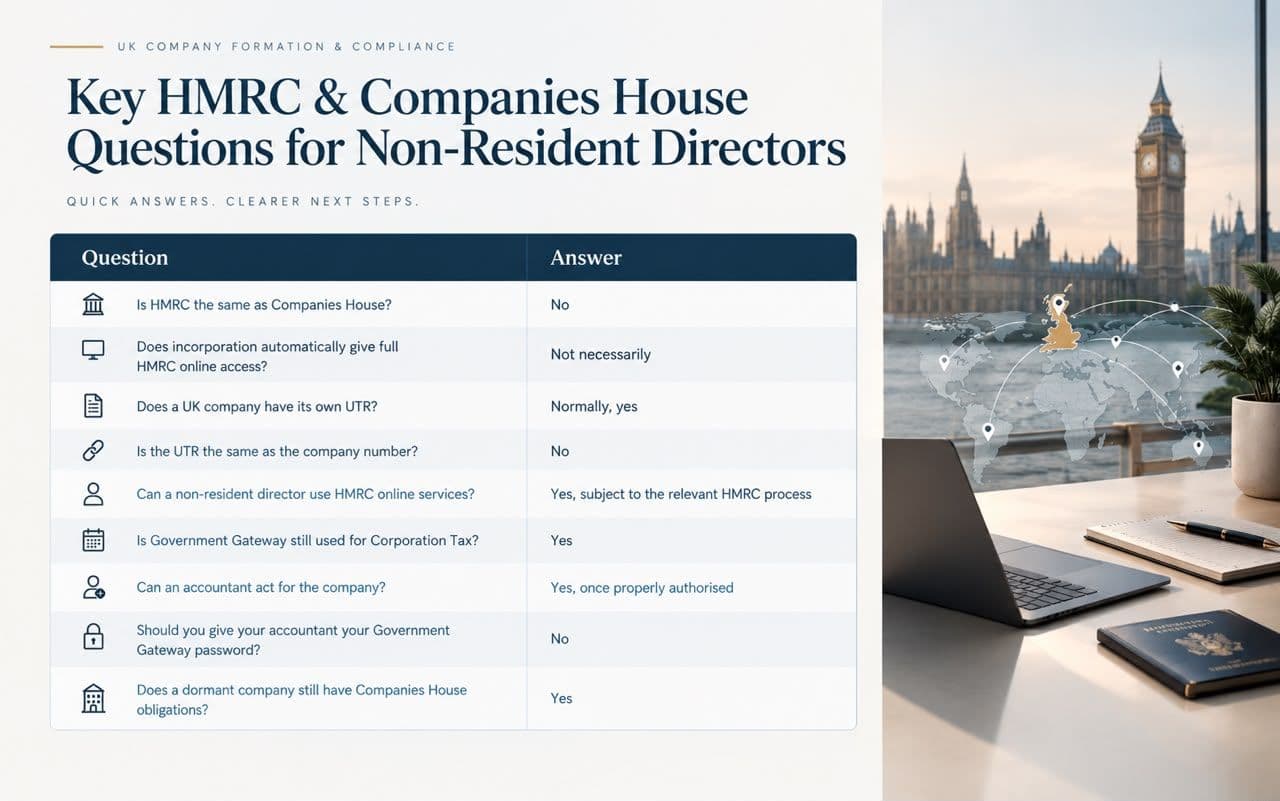
Quick Answer
Is HMRC the same as Companies House? → No
Does incorporation automatically give full HMRC online access?→ Not necessarily
Does a UK company have its own UTR?→ Normally, yes
Is the UTR the same as the company number?→ No
Can a non-resident director use HMRC online services?→ Yes, subject to the relevant HMRC process
Is Government Gateway still used for Corporation Tax?→ Yes
Can an accountant act for the company?→ Yes, once properly authorized
Should you give your accountant your Government Gateway password?→ No
Does a dormant company still have Companies House obligations?→Yes
For a broader explanation of establishing the company itself, see our UK Company Formation for Non-Residents — Complete 2026 Guide
1. What Is an HMRC Business Tax Account?
An HMRC Business Tax Account is the online area through which a business can access supported tax services.
For a UK Limited Company, this can include services relating to:
- Corporation Tax;
- VAT;
- PAYE for employers;
- other business taxes where relevant.
For a non-resident director, the practical distinction is:
Companies House confirms and maintains the company.
HMRC manages the company’s UK tax administration.
One does not replace the other.
2. Is Government Gateway Still Used for UK Companies in 2026?
Yes.
For Corporation Tax, HMRC’s current guidance still instructs companies to sign in to their Business Tax Account using a Government Gateway user ID and password.
If you do not yet have a Government Gateway user ID, HMRC allows you to create one during the sign-in process.
GOV.UK One Login is expanding across government services, but you should not assume that a personal GOV.UK One Login automatically gives access to your company’s Corporation Tax account.
For a UK Limited Company, the safer operational approach is:
first identify which HMRC account and credentials are already linked to the company before creating anything new.
This avoids unnecessary duplicate accounts and access problems.
3. What Is Your Company UTR?
Your company UTR — Unique Taxpayer Reference — is a 10-digit HMRC tax reference.
It is different from:
- your Companies House company number;
- your VAT number;
- your EORI number;
- your Companies House personal identity-verification code.
These identifiers serve different purposes.
The company UTR is used in the Corporation Tax relationship between the company and HMRC.
HMRC says you can find it on correspondence sent to the company.
4. Where Does HMRC Send the Company UTR and Other Corporation Tax Letters?
HMRC uses the company’s Registered Office address for Corporation Tax correspondence.
Before adding Corporation Tax services, HMRC specifically tells companies to check that their Registered Office address is correct because this is where its letters will be sent.
This is especially important for non-resident founders.
A Registered Office should not be treated simply as an address used on incorporation day.
It is an ongoing statutory correspondence point.
If you use a professional address service, make sure:
- the service remains active;
- HMRC mail is accepted;
- correspondence is scanned or forwarded promptly;
- your contact information is current.
For the full distinction between your company’s address and the director’s address, read Registered Office vs Director Service Address for Non-Residents.
If you do not personally own or rent UK premises, see UK Company Formation Without Your Own UK Address.
5. What If You Have Not Received Your Company UTR?
Do not immediately assume that HMRC has failed to issue one.
First check:
- the Registered Office address shown at Companies House;
- whether HMRC correspondence has already arrived there;
- whether your mail provider has received or scanned any HMRC letters.
HMRC currently states that if you have not received the company’s UTR 15 working days after registering the company, you can request it online.
This is particularly important for overseas founders because a missing UTR may simply be sitting in unmonitored UK post.
6. Is the UTR the Same as the Corporation Tax Activation Code?
No.
This is one of the most common sources of confusion.
Your UTR identifies the company for Corporation Tax.
The Corporation Tax activation code is a separate code HMRC sends after Corporation Tax services are added to the Business Tax Account.
HMRC currently says the activation code should arrive:
- within 10 days; or
- within 21 days if you live abroad.
The code and activation instructions are sent by post to the company’s Registered Office.
So the sequence is:
company incorporated
→
UTR available
→
sign in to Business Tax Account
→
add Corporation Tax service
→
HMRC sends activation code
Do not confuse the UTR with the activation code.
7. When Should You Add Corporation Tax to the Business Tax Account?
HMRC says Corporation Tax services should be added when the company starts to do business.
HMRC gives examples such as:
- buying;
- selling;
- advertising;
- renting property;
- employing someone.
You will normally need:
- company registration number;
- date the company started doing business;
- date the first accounts are made up to;
- 10-digit company UTR.
Once Corporation Tax services are active, you can use HMRC online services to manage Corporation Tax obligations.
The important point is:
incorporation date and trading start date are not always the same date.
8. What If the Company Is Dormant?
A new company that has not started trading is usually dormant for Corporation Tax.
HMRC also considers a company usually dormant where it has stopped trading and has no other income.
But do not assume that simply filing dormant accounts at Companies House automatically deals with every HMRC requirement.
If HMRC has issued a notice to deliver a Company Tax Return, that notice must still be dealt with.
HMRC states that where a company has filed a Company Tax Return or received a notice to deliver one, it may still need to submit a return for that period even if it is dormant.
If the company has stopped trading, you can tell HMRC that it is dormant for Corporation Tax.
Once HMRC has been informed, you will generally not need to file another Company Tax Return unless:
- HMRC asks you to; or
- the company begins trading again.
You must still deal separately with Companies House obligations such as annual accounts and the Confirmation Statement.
9. Can a Non-Resident Director Access HMRC From Abroad?
Living outside the UK does not itself prevent you from using HMRC’s online services for your UK company.
You may need:
- the company’s UTR;
- Government Gateway credentials;
- company details;
- access to Registered Office correspondence;
- relevant activation information.
You should continue to provide your actual residence correctly whenever it is requested.
Your UK Registered Office does not mean that you personally reside in Britain.
This same distinction is important for Companies House, banking, KYC and tax administration.
For the broader corporate setup, read our UK company formation guide for overseas founders.
10. Can Your Accountant Manage HMRC for You?
Yes.
A company can authorize a professional accountant or tax adviser to deal with HMRC on its behalf.
The exact authorization method depends on the tax service involved.
Giving an accountant access as an authorized agent is different from sharing your own Government Gateway credentials. If you are still deciding whether your company actually needs professional accounting support, read Does a Non-Resident-Owned UK Company Need an Accountant?
HMRC currently uses several routes, which can include:
- online authorization;
- Business Tax Account authorization;
- digital-handshake processes for supported taxes;
- form 64-8 in relevant circumstances.
For Corporation Tax, an authorized agent can gain access to relevant company and financial information and deal with HMRC on the company’s behalf.
But one rule is particularly important:
Do not give your Government Gateway credentials to your accountant.
HMRC explicitly says that clients must not give sign-in credentials to agents, and agents must not use a client’s credentials to access the account.
Your accountant should use the proper HMRC agent-authorization process and their own agent access.
For the broader distinction between delegated work and the director’s own responsibilities, read UK Company Director Duties for Non-Residents.
11. Does an Accountant Remove the Need for Director Oversight?
No.
An accountant may handle:
- Corporation Tax returns;
- bookkeeping;
- VAT;
- PAYE;
- accounts;
- correspondence with HMRC.
But the company and its directors still need to provide accurate information and maintain appropriate oversight.
HMRC states that even where an agent submits a tax return, the taxpayer remains legally responsible and should check the information before submission.
For a non-resident director, a sensible division is:
Accountant
handles technical tax work.
Director
keeps oversight and provides accurate business information.
12. Do You Need HMRC Access Before Opening a UK Business Bank Account?
Not as a universal legal requirement.
These are separate processes:
Companies House
→ company registration
HMRC
→ tax administration
Bank or fintech
→ financial-services onboarding
A bank or payment provider may request tax-related information depending on its own onboarding process.
But having:
- a UTR;
- an HMRC Business Tax Account;
- Corporation Tax registration;
does not guarantee banking approval.
Likewise, a banking rejection does not automatically mean the company’s Companies House or HMRC position is invalid.
Non-resident founders should keep these processes separate.
13. Is Companies House Identity Verification the Same as HMRC Access?
No.
Companies House identity verification and HMRC tax access are separate systems.
Your:
Companies House personal code
is not the same as your:
Government Gateway user ID
which is not the same as your:
company UTR
which is also separate from your:
Corporation Tax activation code.
A non-resident founder may encounter all of these.
For Companies House specifically, read Companies House Identity Verification for Non-Residents — Complete 2026 Guide.
If you need to know when the verification requirement applies to you, see our Companies House Identity Verification Deadline Guide.
14. Why Your Registered Office Matters After Incorporation
Your Registered Office remains important after the company has been formed.
It can receive correspondence from:
- Companies House;
- HMRC;
- courts;
- other official bodies.
For HMRC specifically, Corporation Tax letters, activation information and other correspondence may be sent there.
For an international founder, poor mail handling can therefore create real administrative problems.
A professional Registered Office should provide a reliable process for receiving and communicating official correspondence.
For more detail, see our Registered Office vs Director Service Address guide.
15. Common HMRC Mistakes Non-Resident Founders Should Avoid
Mistake 1: Treating Companies House and HMRC as one system
They are separate.
Company incorporation does not mean every HMRC tax service is automatically configured.
Mistake 2: Confusing the company number with the UTR
They are different identifiers issued by different authorities.
Mistake 3: Confusing the UTR with the activation code
The UTR identifies the company.
The Corporation Tax activation code is sent separately after enrolment.
Mistake 4: Ignoring Registered Office mail
Important HMRC correspondence may be sent there.
Mistake 5: Giving Government Gateway login details to an accountant
Use HMRC’s proper agent-authorization process instead.
Mistake 6: Assuming every new company is immediately trading
A newly incorporated company may still be dormant for Corporation Tax.
Mistake 7: Assuming dormant means “ignore HMRC”
If HMRC has issued a notice to file, or if the company’s trading status changes, action may still be required.
Mistake 8: Creating multiple HMRC accounts without checking existing access
Identify what already exists before creating new credentials.
16. Simple HMRC Setup Checklist for a Non-Resident UK Company
Step 1 — Confirm the Companies House record
Check:
- company name;
- company number;
- Registered Office;
- directors;
- PSC information.
Step 2 — Monitor Registered Office mail
Look for correspondence from HMRC, particularly the company UTR.
Step 3 — Obtain the company UTR
If it has not arrived within HMRC’s current timeframe, use the official process to request it.
Step 4 — Determine whether the company has started doing business
This matters for Corporation Tax.
Step 5 — Access the HMRC Business Tax Account
Use the appropriate Government Gateway credentials for the company.
Step 6 — Add Corporation Tax when appropriate
Provide the company details requested by HMRC.
Step 7 — Watch for the activation code
HMRC sends it to the Registered Office after Corporation Tax enrolment.
Step 8 — Decide whether to appoint an accountant
Use the correct HMRC authorization route rather than sharing your login.
Step 9 — Keep company records and HMRC access organized
Store references and credentials securely.
Step 10 — Continue with the wider post-incorporation setup
Corporation Tax is only one part of operating the company.
For the full checklist, read What Happens After You Register a UK Company as a Non-Resident?.
17. How Seven Oak Prestige Supports Non-Resident Founders
Seven Oak Prestige helps international founders establish and organise the corporate infrastructure required to operate a UK Limited Company from overseas.
Depending on the service required, support can include:
- UK company formation;
- Registered Office;
- Director Service Address;
- official correspondence handling under applicable address services;
- Companies House processes;
- identity-verification support;
- post-incorporation compliance preparation;
- VAT and EORI assistance;
- coordination with accountants and professional advisers;
- banking and payment-readiness support.
Seven Oak Prestige does not replace specialist tax or accounting advice.
Our role is to help international founders understand the corporate process, organise the required information and coordinate appropriate next steps where support is required.
Recently Formed a UK Company and Unsure What Comes Next?
Discuss Your UK Company Setup With Seven Oak Prestige →
Frequently Asked Questions
Is Government Gateway the same as an HMRC Business Tax Account?
No.
Government Gateway provides sign-in credentials.
The Business Tax Account is the online area through which supported business tax services are accessed.
Is Government Gateway still used for Corporation Tax in 2026?
Yes.
HMRC’s current Corporation Tax setup guidance instructs companies to use a Government Gateway user ID and password to sign in to the Business Tax Account.
Is GOV.UK One Login replacing Government Gateway?
GOV.UK One Login is being introduced across government services, but businesses should not assume that it automatically replaces the Government Gateway credentials currently used for their Corporation Tax Business Tax Account.
Is my UTR the same as my Companies House number?
No.
Your company number comes from Companies House.
Your UTR is an HMRC tax reference.
How long should I wait for a company UTR?
HMRC currently says that if the UTR has not arrived 15 working days after registering the company, you can request it online.
How long does the Corporation Tax activation code take?
HMRC currently states that the code should arrive within 10 days, or 21 days if you live abroad.
Can I access HMRC while living outside the UK?
Yes.
Living overseas does not itself prevent a director from managing the company’s HMRC affairs online, subject to the relevant account and security requirements.
Can my accountant access HMRC for me?
Yes, once properly authorized.
You should not give the accountant your own Government Gateway login credentials. HMRC provides separate agent-authorization processes.
Does a dormant company need Corporation Tax registration?
A company that has not started doing business is usually dormant for Corporation Tax.
Its exact HMRC obligations depend on whether HMRC has issued a notice to file and whether the company later begins trading.
Does a dormant UK company still file at Companies House?
Yes.
Dormancy for Corporation Tax does not remove Companies House obligations such as annual accounts and the Confirmation Statement.
Does having an HMRC Business Tax Account mean the company is fully tax compliant?
No.
The account is an administrative tool.
Compliance depends on the company’s actual activities, registrations, records, filings and payments.
About the Author
Isaac Jackson — Founder & Managing Director, Seven Oak Prestige Ltd
Isaac Jackson has more than three years of hands-on experience supporting international founders with UK company formation, Companies House processes, address solutions, compliance preparation and banking readiness.
His work focuses particularly on the practical challenges faced by founders who establish and operate UK companies while living overseas.
Editorial Methodology
Last reviewed: 10 September 2026
This guide was prepared using current HMRC and GOV.UK guidance covering:
- Corporation Tax Business Tax Accounts;
- Government Gateway;
- company Unique Taxpayer References;
- Corporation Tax activation;
- dormant companies;
- HMRC agent authorization;
- Registered Office correspondence.
The article was also reviewed against Seven Oak Prestige’s existing non-resident company formation and post-incorporation content to preserve a distinct search intent.
The purpose of this page is specifically to explain:
how an overseas founder accesses and organizes HMRC tax administration for a UK Limited Company.
It does not attempt to provide technical tax calculations or personalized tax advice.
Important Disclaimer
This guide provides general educational information only and does not constitute tax, accounting or legal advice.
HMRC online systems, activation procedures and account-access processes can change.
A company’s Corporation Tax, VAT, PAYE and other tax obligations depend on its actual activities and circumstances.
Seven Oak Prestige Ltd provides UK company formation, address services, Companies House assistance, compliance preparation, VAT/EORI assistance and banking-readiness support.
Where specialist tax or accounting advice is required, an appropriately qualified professional should be consulted.
Related Guides
UK Company Formation for Non-Residents — Complete 2026 Guide
Understand the full process of establishing a UK Limited Company while living overseas.
What Happens After You Register a UK Company as a Non-Resident?
Use the wider post-incorporation checklist covering Companies House, HMRC, accounting, banking and operational preparation.
UK Company Director Duties for Non-Residents
Understand what remains the director’s responsibility even when accountants and agents assist the company.
Registered Office vs Director Service Address for Non-Residents
Understand why the Registered Office matters for HMRC correspondence and how it differs from the director’s residential and service addresses.
UK Company Formation Without Your Own UK Address
Understand how overseas founders can satisfy UK statutory address requirements without personally owning or renting premises in Britain.
Companies House Identity Verification for Non-Residents — Complete 2026 Guide
Understand why Companies House identity verification is separate from HMRC access and Corporation Tax.
Companies House Identity Verification Deadline — Check Your Real Date
Check when current director and PSC verification requirements apply.
How to Structure Shares and Directors in a UK Ltd as a Non-Resident Founder
Understand the separate roles of directors, shareholders and PSCs before managing the company’s ongoing compliance.