
How to Set Up a UK Company from the United States: Complete 2026 Guide for US Founders & Businesses

For an American entrepreneur or US company planning to establish a presence in the United Kingdom, registering a company can be surprisingly straightforward.
Choosing the right structure is not.
A US founder may be asking:
Can an American own 100% of a UK Limited Company?
An established US corporation may be asking:
Should we create a UK subsidiary or operate through a UK branch?
A SaaS startup may be asking:
Do we need a UK entity before hiring employees or signing British enterprise customers?
An e-commerce company may be asking:
Do we need UK VAT registration if we hold stock in Britain?
And an American founder personally owning a UK company should be asking another question before incorporation:
What US tax and reporting obligations can arise from owning a foreign corporation?
These are different scenarios.
They should not be answered with the same one-line advice.
This guide explains the complete 2026 US-to-UK company establishment journey, including:
- UK Limited Company formation
- 100% US ownership
- UK subsidiary structures
- UK branch / establishment structures
- UK Ltd vs US LLC
- UK Ltd vs Delaware C-Corp
- Companies House identity verification
- directors and shareholders
- banking and payments
- Corporation Tax
- US foreign-corporation reporting
- CFC considerations
- UK–US tax treaty concepts
- transfer pricing
- intercompany transactions
- VAT
- payroll and UK employees
- SaaS and technology expansion
- e-commerce
- accounting and ongoing compliance
The objective is not simply to answer:
“How do I register a UK company from America?”
It is to answer:
“What is the right UK structure for what I am actually trying to build?”
Quick Answer: Can a US Citizen or Resident Start a UK Company?
Yes.
A US citizen or resident can generally establish and own a UK private company limited by shares without becoming UK-resident.
A private UK company can also be wholly owned by a US company.
For example:
US individual founder
↓
100% shareholder
↓
UK Limited Company
Or:
US C-Corporation
↓
100% corporate shareholder
↓
UK Limited Company subsidiary
A UK company director does not generally need to reside in Britain.
However, incorporation is only one layer of the structure.
US founders must separately consider:
- US taxation and reporting;
- UK taxation;
- where the business operates;
- employees;
- VAT;
- intercompany transactions;
- banking;
- ownership;
- management.
If you want the general non-resident incorporation process first, read:
Discuss My US–UK Expansion
1. Which Situation Describes You?
Before reading 8,000 words about structures you may not need, identify your position.
Scenario A — Individual US Founder
You live in the United States and want to personally establish a UK Limited Company.
Common reasons:
- UK clients;
- international consulting;
- SaaS;
- e-commerce;
- investment;
- UK market entry.
Your main questions concern:
- personal ownership;
- UK incorporation;
- US foreign-corporation reporting;
- UK tax;
- banking;
- operating the business remotely.
Scenario B — Existing US LLC or Corporation
You already have a business in the United States and want to enter Britain.
Your main decision is often:
UK subsidiary
vs
UK branch / establishment
vs, occasionally,
no separate UK entity yet.
This guide goes deeply into that distinction.
Scenario C — US SaaS, AI or Technology Startup
You may need a UK entity because:
- an enterprise customer wants a UK contracting entity;
- you are hiring UK staff;
- investors want clearer international operations;
- you are establishing a European commercial team;
- you need UK payroll;
- you want local invoicing.
Your questions usually extend beyond incorporation into:
IP, intercompany services, transfer pricing, employees and tax.
Scenario D — US E-commerce Company
You may want to:
- sell into Britain;
- store products in the UK;
- use Amazon FBA;
- import stock;
- operate a UK Shopify business;
- work with a UK fulfilment center.
VAT, EORI and customs can therefore become as important as company formation.
For the broader e-commerce framework, read:
How to Start an E-commerce Business with a UK Limited Company as a Non-Resident: Complete 2026 Guide
2. Why Would an American Founder Establish a UK Company?
There is no universal reason.
A UK company should solve a genuine commercial problem.
Common reasons include:
Serving UK customers
Some businesses want a local contracting and invoicing entity.
Hiring UK employees
A UK entity can provide a clearer structure for payroll and employment.
Building UK operations
A growing business may need local:
- staff;
- offices;
- suppliers;
- partnerships.
Creating a UK subsidiary
A US parent company may want to ring-fence British operations inside a separate legal entity.
Acquiring a UK business
A UK subsidiary may be used as an acquisition vehicle in certain transactions.
International expansion
A UK operation can form part of a broader global expansion strategy.
But none of these reasons means:
Every American entrepreneur should have a UK company.
If the business has no meaningful UK activity, the additional company can simply create another layer of tax, accounting and compliance.
3. UK Ltd vs US LLC: They Are Not Direct Equivalents
One of the most common search queries is:
UK Ltd vs US LLC
Seven Oak Prestige already has a dedicated comparison:
UK Company vs US LLC: Which Is Better for International Entrepreneurs? (2026 Guide)
The important distinction is structural.
A UK private company limited by shares is a corporation with separate legal personality.
A US LLC can be taxed in different ways under US rules depending on elections and ownership.
Therefore, do not assume:
UK Ltd = British LLC.
That simplification can create tax misunderstandings.
4. UK Ltd vs Delaware C-Corporation
For startup founders, the more meaningful comparison may actually be:
UK Ltd vs Delaware C-Corp
A Delaware C-Corp can be attractive where:
- US venture capital is central;
- US investors expect Delaware governance;
- the company primarily operates in the US;
- a US startup ecosystem structure is important.
A UK Ltd can make more sense where:
- the real operating business is in Britain;
- UK employees and customers are central;
- it will function as the UK subsidiary of a US parent;
- the company needs a genuine UK legal vehicle.
The correct answer depends on the commercial structure.
Not the filing fee.
5. Should a US Founder Create a Standalone UK Ltd?
For an individual founder who does not already have a US operating company, a standalone UK Ltd may be reasonable where the UK entity itself is intended to be the actual operating business.
Example:
US-resident consultant
↓
personally owns
↓
UK Ltd
↓
contracts with UK/international clients.
But this creates an important US question:
How will the United States treat my ownership of this foreign corporation?
That needs to be considered before, not after, incorporation.
6. Should an Existing US Business Create a UK Subsidiary?
For an established American company, this is often the more natural structure.
Example:
Delaware C-Corp
↓
100% ownership
↓
UK Ltd
↓
UK employees / UK sales / UK contracts.
Business.gov.uk states that a UK subsidiary is generally a separate legal entity and can be wholly controlled by the overseas parent.
That separation can be commercially useful because the UK company has its own:
- corporate identity;
- contracts;
- accounts;
- liabilities;
- payroll;
- tax responsibilities.
7. UK Subsidiary vs UK Branch: The Essential Decision
This is one of the most important choices for a US company entering Britain.
UK Subsidiary
A separate UK legal entity.
Typically:
US Parent
↓
UK Limited Company
UK Branch
The US company itself establishes a UK place of business.
The branch is not a separate legal entity from its US parent. Business.gov.uk expressly distinguishes the two structures on this basis.
8. UK Subsidiary vs Branch — Decision Table
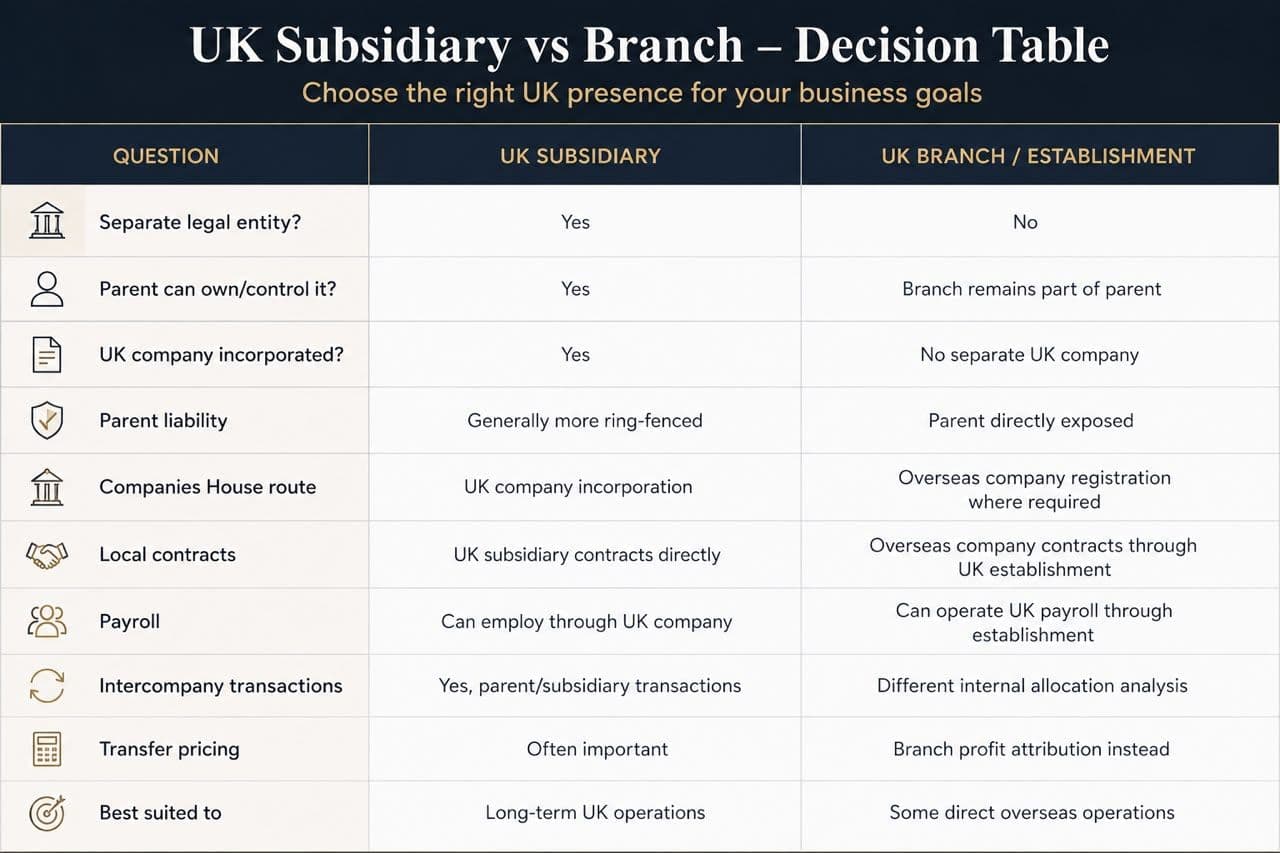
A branch is not inherently inferior.
A subsidiary is not inherently superior.
The question is what fits:
- liability;
- tax;
- operational plans;
- customer requirements;
- employment;
- long-term expansion.
9. When Must a US Company Register a UK Establishment?
GOV.UK states that an overseas company must register with Companies House if it establishes a place of business in the UK or usually carries on business from somewhere in the UK.
If there is no UK base, Companies House registration as an overseas company may not be required, although tax obligations can still arise.
Registration of an overseas company currently uses form OS IN01, and the current registration fee is £124.
That is different from incorporating a new UK subsidiary.
10. Can a US Company Own 100% of a UK Ltd?
Yes.
A UK subsidiary can be fully owned by its American parent.
Example:
ABC Technologies Inc. — Delaware
owns
100 ordinary shares
in
ABC Technologies UK Ltd
The American company becomes the corporate shareholder.
The UK subsidiary still requires appropriate:
- directors;
- PSC/ownership information;
- registered office;
- Companies House filings.
11. Can the US Founder Personally Own the UK Company Instead?
Potentially.
But do not choose between:
US parent owns UK Ltd
and
founder personally owns UK Ltd
based merely on convenience.
The decision can affect:
- group structure;
- investors;
- accounting;
- tax;
- control;
- future sale;
- intercompany transactions.
If the UK operation is genuinely part of an existing US company, direct parent ownership is often conceptually cleaner than having the founder personally own two unrelated companies.
Professional US and UK tax advice becomes particularly valuable here.
12. Directors of a US-Owned UK Company
A private UK company must have at least one individual director.
The director does not generally need to be UK-resident.
Therefore, a US founder can potentially serve as director of their UK company while remaining in America.
Do not appoint a UK nominee director merely because someone tells you:
“Every UK company needs a British director.”
That is not a general Companies House requirement.
For deeper governance guidance:
How to Structure Shares and Directors in a UK Ltd as a Non-Resident Founder
13. Person with Significant Control
A Person with Significant Control — PSC — is not simply “the director.”
Control can arise through:
- share ownership;
- voting rights;
- appointment rights;
- other significant influence or control.
For a wholly owned subsidiary, ownership through the US parent needs to be reflected through the applicable PSC/registrable legal entity framework.
Do not treat beneficial-ownership disclosure as a box-ticking exercise.
Financial institutions also review who ultimately owns and controls the company.
14. Companies House Identity Verification in 2026
This is one of the biggest changes affecting US founders registering UK companies.
Since 18 November 2025, identity verification has become a legal requirement within the Companies House framework.
For a new company, the personal code for each director is required as part of the registration filing.
A Companies House personal code is an 11-character personal code, not a code belonging to the company.
Directors and PSCs are within the verification regime.
For Americans, a biometric passport can be one route through GOV.UK One Login, subject to the applicable identity-verification process.
Read:
Companies House Identity Verification for Non-Residents (2026 Complete Guide)
15. Registered Office
Every UK company requires an appropriate UK registered office.
This is the company’s statutory address.
It is not automatically:
- the founder’s home;
- the physical trading office;
- the warehouse;
- the operating headquarters.
These distinctions become important during banking, tax and commercial due diligence.
16. Director Service Address
The director service address is used for official correspondence relating to the director’s appointment.
An American founder can use an appropriate service address while still truthfully reporting their actual residential address where required.
Do not falsely present the registered office as the founder’s personal residence.
17. Registered Office vs Operating Address
This distinction matters enormously for US founders.
Imagine:
Registered Office: London
Founder: New York
Software team: California
UK sales employee: Manchester
Customers: UK + US
The London statutory address does not automatically mean the whole business is physically managed from London.
Banks, HMRC and other institutions can look beyond a mailing address to understand actual operations.
18. How to Register a UK Ltd from the United States

For a straightforward subsidiary or founder-owned Ltd, the process typically looks like this:
Step 1 — Decide the structure
Individual founder or US corporate shareholder?
Step 2 — Choose directors
At least one individual director.
Step 3 — Decide share ownership
Founder ownership or US parent ownership.
Step 4 — Identify PSCs / control
Understand who ultimately controls the company.
Step 5 — Arrange registered office
Use an appropriate UK address.
Step 6 — Complete identity verification
Obtain required Companies House personal codes.
Step 7 — Choose company name
Check availability and restrictions.
Step 8 — Select SIC codes
Describe the actual UK business activity.
Step 9 — Submit incorporation
Companies House reviews the filing.
Step 10 — Establish operational infrastructure
Banking, accounting, tax, website, payroll, VAT etc.
19. How Much Does UK Company Formation Cost in 2026?
The current standard digital Companies House incorporation fee is £100.
Paper incorporation is currently £124.
The digital confirmation-statement fee is currently £50.
But the government fee is not the full cost of creating an operational US-owned UK company.
Additional costs can include:
- registered office;
- director service address;
- identity-verification support;
- accountant;
- payroll;
- VAT registration;
- banking readiness;
- legal advice;
- transfer-pricing support;
- UK employment documentation.
For the wider cost framework:
How Much Does It Cost to Register a UK Company as a Non-Resident in 2026?
20. UK Corporation Tax
A UK subsidiary is a UK company and can have UK Corporation Tax obligations.
For 2026, the UK framework includes:
- 19% small profits rate for qualifying profits under £50,000;
- 25% main rate for profits above £250,000;
- Marginal Relief between those levels.
Those thresholds can be affected by associated companies and other circumstances.
Do not assume every UK subsidiary simply pays 19%.
Read:
How UK Company Tax Works for Non-Residents (2026)
21. US Tax Does Not Disappear Because the Company Is British
This is one of the most important sections of this guide.
A US person who owns or controls a UK company can have US reporting and tax considerations because the UK company is a foreign corporation from the US perspective.
The IRS requires certain US citizens, residents, officers, directors and shareholders of foreign corporations to file Form 5471, depending on the applicable filing category and ownership circumstances.
That means:
“I pay UK Corporation Tax, therefore the United States has nothing else to consider.”
can be a dangerous assumption.
22. Form 5471
Form 5471 is an information return used for certain US persons connected with foreign corporations.
The filing categories are complex.
Examples can include circumstances where a US person:
- acquires a significant ownership interest;
- controls a foreign corporation;
- is a US shareholder of a Controlled Foreign Corporation.
The IRS instructions use ownership thresholds such as 10% for several filer categories and more than 50% for control in Category 4.
This is exactly why US founders should involve a US international-tax professional where appropriate.
23. What Is a Controlled Foreign Corporation?
Under US tax rules, a foreign corporation can become a Controlled Foreign Corporation — CFC where US shareholders own more than 50% of its voting power or value, subject to the detailed statutory ownership rules.
A simple example:
US individual founder
↓
owns 100%
↓
UK Ltd
may therefore create a US CFC analysis.
That does not tell you the final tax result.
It tells you that the US international-tax rules need to be examined.
24. GILTI and Subpart F

US CFC rules can bring certain foreign-company income into the US shareholder’s tax analysis even before cash is distributed.
Two concepts commonly encountered are:
- Subpart F income;
- GILTI / related current international-tax inclusion rules.
This area changed substantially over time and can differ depending on whether the US owner is:
- an individual;
- a C-Corporation;
- another entity.
For this reason, Seven Oak Prestige should not tell a US founder:
“Your UK company only pays UK tax.”
The correct recommendation is to obtain US international-tax advice alongside UK company advice.
25. Foreign Tax Credits
UK tax paid by the company and US tax attributable to a US shareholder do not automatically produce “double tax with no relief.”
Foreign-tax-credit mechanisms and treaty rules can sometimes reduce qualifying double taxation.
But eligibility and calculation depend on the taxpayer and income.
Again:
UK tax calculation
and
US tax calculation
must be analysed separately before relief is considered.
26. UK–US Double Taxation Convention
The UK and United States have a tax treaty.
It deals with issues including:
- residence;
- business profits;
- permanent establishment;
- dividends;
- interest;
- royalties;
- relief from double taxation.
The treaty is not a licence to choose whichever country’s tax rate is lower.
It is a framework for allocating taxing rights and resolving certain cross-border issues.
27. Permanent Establishment
A US company does not necessarily need a UK subsidiary to create UK tax exposure.
Where the American company itself conducts sufficient activity in Britain, a permanent establishment analysis can arise.
Relevant facts can include:
- fixed place of business;
- employees;
- authority to conclude contracts;
- nature of activities.
This is one reason an American business should think about structure before hiring UK staff or establishing permanent operations.
28. Transfer Pricing Between US Parent and UK Subsidiary
Once you create:
US Parent
↕
UK Subsidiary
you can create transactions between related entities.
Examples:
- management services;
- software development;
- licence fees;
- IP royalties;
- intercompany loans;
- shared staff costs;
- marketing services.
HMRC’s transfer-pricing framework is built around the arm’s-length principle — broadly, connected-party transactions should be evaluated as though appropriate terms had been agreed between independent parties.
This becomes particularly important as the UK subsidiary grows.
29. Example: SaaS Parent and UK Subsidiary
Imagine:
Delaware SaaS Inc.
owns
SaaS UK Ltd
The UK company:
- employs London sales staff;
- provides customer support;
- signs certain UK customers.
The US parent:
- owns core IP;
- develops software;
- maintains engineering.
The group must determine how economic activity and charges between the entities are documented.
Simply transferring arbitrary amounts between the companies is poor practice.
30. Management Fees
A US parent may charge its UK subsidiary for genuine management or shared services.
Potential examples:
- finance;
- HR;
- technology;
- executive support.
But the charge should be:
- commercially explainable;
- documented;
- appropriately priced;
- related to real services.
The existence of two companies does not justify moving profit between them without substance.
31. Intercompany Loans

US parents sometimes finance UK subsidiaries through loans rather than solely through share capital.
This can raise:
- interest;
- arm’s-length pricing;
- documentation;
- deductibility;
- withholding-tax/treaty questions;
- thin-capitalisation considerations.
HMRC applies arm’s-length principles to related-party lending as well as ordinary services and goods.
32. IP and Royalty Arrangements
Technology companies should be particularly careful.
A US parent might own:
- software;
- trademarks;
- patents;
- brand assets.
The UK subsidiary may use those assets.
That can create:
- licence agreements;
- royalty payments;
- transfer-pricing questions;
- withholding-tax considerations.
Do not invent an IP fee after year-end simply because the UK subsidiary made too much profit.
Structure and documentation should follow economic reality.
33. UK VAT
Corporation Tax and VAT are completely different.
The UK’s standard VAT registration threshold for ordinary taxable supplies is currently £90,000.
But US businesses should not automatically stop the analysis there.
Cross-border transactions, overseas sellers, stock location and the nature of supplies can create additional VAT rules.
34. US SaaS Company Selling to UK Customers
For a US SaaS company, the VAT treatment depends on matters such as:
- B2B vs B2C customers;
- supply type;
- customer location;
- whether the UK entity is making the supply.
Do not assume:
“No physical goods = no VAT issue.”
Digital services can have their own place-of-supply rules.
35. US E-commerce Company Holding Stock in Britain
This is a different situation.
If a US e-commerce business holds inventory in Britain or uses a UK subsidiary to import and sell goods, VAT, customs and EORI can become central.
Read:
How to Start an E-commerce Business with a UK Limited Company as a Non-Resident: Complete 2026 Guide
and:
UK EORI Registration
36. Can an American Founder Open a UK Business Bank Account?
Potentially.
But UK company formation and banking are separate processes.
A financial institution may review:
- US founder identity;
- company ownership;
- business model;
- customers;
- suppliers;
- expected turnover;
- transaction countries;
- source of funds;
- website;
- operating address.
A valid Companies House certificate does not guarantee banking approval.
Seven Oak Prestige’s banking-readiness framework explains this in depth:
UK Business Banking for Non-UK Residents: Banking Readiness Guide
37. Banking for a US-Owned UK Subsidiary
For an established US group, financial institutions may want to understand:
- parent company;
- ownership chain;
- group accounts;
- reason for UK expansion;
- expected UK activity;
- intercompany flows.
Example:
US parent funds UK subsidiary
↓
UK subsidiary pays UK staff
↓
UK subsidiary invoices UK customers
↓
profits may eventually be distributed or reinvested.
That is much more understandable than an application saying:
“International business receiving worldwide transfers.”
38. Banking Readiness Checklist

Before applying:
- Certificate of Incorporation
- Articles
- director information
- shareholder/parent details
- UBO details
- website
- business description
- customer profile
- supplier profile
- source of initial funding
- projected turnover
- expected currencies
- operating-address explanation
- parent-company documents where applicable
Banking applications should tell one coherent story.
39. Stripe and Payment Processing
A US founder may already have Stripe US.
That does not automatically mean the UK subsidiary should process all UK transactions through the same account.
The correct setup depends on:
- contracting entity;
- merchant of record;
- settlement accounts;
- currencies;
- tax;
- customer geography.
Do not create a UK Ltd merely to gain another Stripe account.
The entity should serve a real commercial function.
40. Revolut, Wise, Airwallex and Other Providers
Multi-currency financial platforms can support international businesses.
But provider eligibility, supported structures and onboarding policies can change.
US founders should evaluate:
- account functionality;
- currencies;
- FX;
- payment methods;
- cards;
- supplier payments;
- local account details;
- integration requirements.
Avoid building the whole UK expansion around one fintech provider.
41. Hiring Employees in the UK
Hiring your first UK employee can be the moment when a purely remote international operation becomes materially more complex.
Areas to consider include:
- employment contracts;
- PAYE;
- National Insurance;
- pension auto-enrolment;
- holiday entitlement;
- statutory employment rights;
- payroll administration.
For many established US businesses, a UK subsidiary becomes particularly useful once the company develops a real UK team.
42. UK Subsidiary vs Employer of Record
A US startup testing Britain may consider using an Employer of Record before establishing a subsidiary.
Potential advantages:
- faster first hire;
- less immediate infrastructure.
Potential disadvantages:
- ongoing EOR fees;
- less direct control;
- eventual migration may still be required.
A common expansion path can therefore be:
test market / first hire
↓
EOR
↓
UK subsidiary once UK operations become substantial
But this is a commercial decision, not a universal rule.
43. PAYE
A UK employer generally needs payroll infrastructure for employees.
PAYE is the system through which employers account for:
- Income Tax;
- employee National Insurance;
- employer obligations.
The exact payroll cost should be calculated based on current rates and employee circumstances rather than generic percentages from blogs.
44. Auto-Enrolment Pension
Eligible UK workers can fall within workplace-pension auto-enrolment.
This means American businesses budgeting for UK hires should look beyond salary alone.
Total employment cost can include:
salary
- ●
employer taxes
- ●
pension
- ●
benefits
- ●
payroll/compliance
45. UK Employment Law Is Not US At-Will Employment
This is a major cultural and legal difference.
US companies should not simply reuse American employment documents in Britain.
UK employees have statutory rights that can differ materially from US employment norms.
Employment contracts, dismissal processes, leave and other employment matters should be reviewed under UK law.
46. US SaaS and AI Companies Entering Britain
This is an especially attractive use case for a UK subsidiary.
A US SaaS/AI company may establish a UK entity to:
- sign enterprise customers;
- hire sales staff;
- hire developers;
- participate in UK tenders;
- build local partnerships;
- establish EMEA operations.
But the structure needs to define:
Who owns the IP?
Which company signs customers?
Which company employs staff?
How is the UK subsidiary compensated?
Where does revenue belong?
Those questions matter more than the incorporation certificate.
47. Contracting with UK Customers
A UK subsidiary may make procurement easier for some British customers.
Some enterprise clients prefer:
- UK legal entity;
- GBP invoices;
- UK governing law;
- UK bank details;
- local account management.
But customer preference alone should not override tax and structural planning.
48. Data Protection and UK GDPR
A US company operating in Britain may need to consider UK data-protection rules.
The correct obligations depend on:
- personal data processed;
- UK customers;
- UK employees;
- role as controller/processor;
- international transfers.
A privacy policy alone is not a complete data-protection program.
49. Intellectual Property
Before expanding, determine which entity owns:
- software;
- trademarks;
- patents;
- brand;
- customer data rights;
- domain assets.
Do not casually move IP between US and UK companies without legal and tax analysis.
For many startups, IP is the most valuable asset in the group.
50. Insurance
Depending on the business, UK operations may require or benefit from:
- employers’ liability insurance;
- professional indemnity;
- cyber cover;
- product liability;
- public liability.
Do not assume a US policy automatically covers UK operations.
51. Accounting for a UK Subsidiary
A UK Ltd has its own accounting obligations.
It may need to maintain:
- accounting records;
- annual accounts;
- Corporation Tax records;
- payroll records;
- VAT records where applicable.
A subsidiary should not simply disappear inside the US parent company’s QuickBooks file.
52. US GAAP vs UK Statutory Accounts
A US parent may prepare group reporting under US GAAP.
The UK subsidiary still has UK statutory reporting obligations.
The two reporting systems can coexist.
For a growing group, monthly management reporting should ideally reconcile the UK subsidiary into the parent company’s consolidated financial reporting.
53. Confirmation Statement
Every UK company must file a confirmation statement at least annually, including dormant/non-trading companies.
The current online fee is £50.
It confirms that Companies House information is current.
It is not the same as annual accounts.
54. Annual Accounts
UK companies generally have annual Companies House accounting obligations.
The exact reporting framework and filing deadlines depend on:
- company size;
- accounting reference period;
- filing status.
A US parent should establish a UK accounting process from day one rather than wait until the first statutory deadline.
55. UK Subsidiary Governance
Even where the US parent owns 100%, the UK subsidiary is still a company with its own directors and duties.
Board governance should therefore reflect reality.
Good practice can include:
- documented decisions;
- board minutes where appropriate;
- intercompany agreements;
- clear delegations;
- proper accounting records.
56. Dividends from UK Subsidiary to US Parent
Once the UK company becomes profitable, the group may eventually consider distributing profits to the US parent.
This raises questions around:
- distributable reserves;
- corporate approvals;
- UK tax treatment;
- US tax treatment;
- treaty interaction.
This should be planned as part of the wider group tax strategy.
57. Selling the UK Subsidiary
Creating a separate UK subsidiary can also provide structural flexibility if the UK operation is later:
- sold;
- brought into a joint venture;
- separated;
- reorganised.
This is one reason corporate groups often prefer a subsidiary over simply conducting all UK operations directly through the US parent.
58. Fundraising and Investors
For a US venture-backed startup, investors will often care about:
- where the parent sits;
- IP ownership;
- subsidiary structure;
- intercompany arrangements.
A UK subsidiary does not normally need to become the group’s parent merely because the company is expanding into Britain.
Do not reorganise the entire cap table without considering investor expectations and tax consequences.
59. When a UK Ltd May Be Unnecessary
You may not need a UK company merely because:
- you have one UK customer;
- someone wants to pay you in GBP;
- you want a London address;
- you want a different Stripe account;
- you want to appear international.
A structure should earn its compliance burden.
If the US company can legally and efficiently serve the market without creating a separate entity, incorporation may be premature.
60. When a UK Subsidiary Starts Making More Sense
A UK subsidiary becomes increasingly logical when the business develops:
- recurring UK revenue;
- UK staff;
- UK premises;
- significant local contracts;
- local inventory;
- regulated obligations;
- operational management.
At that point, local infrastructure can solve real operational problems.
61. Common Mistakes US Founders Make
Mistake 1 — Starting with incorporation instead of structure
Choose the entity after understanding the business objective.
Mistake 2 — Assuming UK Ltd is equivalent to an LLC
It is not.
Mistake 3 — Ignoring Form 5471
Foreign-company ownership can create US reporting.
Mistake 4 — Ignoring CFC analysis
100% US ownership is precisely the kind of situation that can require international-tax attention.
Mistake 5 — Choosing branch vs subsidiary only on formation cost
Liability, tax and operations matter more.
Mistake 6 — Moving money between US and UK entities informally
Intercompany flows should be documented.
Mistake 7 — Ignoring transfer pricing
Related-party transactions are not automatically ordinary expenses.
Mistake 8 — Hiring UK employees using US employment assumptions
UK employment law differs.
Mistake 9 — Assuming VAT begins only at £90,000 in every scenario
Cross-border facts can change the analysis.
Mistake 10 — Treating the London registered office as physical substance
Addresses have different functions.
Mistake 11 — Applying for banking before the group structure is understandable
Preparation matters.
Mistake 12 — Creating UK company solely for payment-provider access
Providers make independent decisions.
62. US Founder Pre-Incorporation Checklist
Before forming the UK entity:
Commercial
- Why does the UK entity exist?
- Who will its customers be?
- Will it hire staff?
- Will it hold inventory?
Structure
- individual ownership or US parent?
- subsidiary or branch?
- directors?
- PSC/control?
US Tax
- Form 5471?
- CFC?
- current inclusion issues?
- foreign tax credits?
UK Tax
- Corporation Tax?
- VAT?
- payroll?
Intercompany
- management fees?
- loans?
- IP?
- services?
- transfer pricing?
Operational
- banking?
- payment providers?
- website?
- accounting?
If those questions do not have reasonable answers yet, wait before incorporating.
63. UK Subsidiary Readiness Checklist
For an established US company:
- UK expansion has a genuine commercial purpose
- parent/subsidiary ownership documented
- directors selected
- Companies House identity verification completed
- UK registered office arranged
- business activities/SIC codes selected
- UK accounting provider identified
- US international-tax adviser consulted where appropriate
- banking strategy prepared
- source of subsidiary funding documented
- transfer-pricing model considered
- intercompany agreements prepared where appropriate
- VAT reviewed
- payroll reviewed
- employment contracts reviewed
- IP ownership clarified
- data-protection implications considered
- insurance reviewed
- ongoing UK filing calendar created
64. Individual US Founder vs Existing US Company
Individual Founder
Possible route:
You → UK Ltd
Best where the UK company itself is intended to be your primary operating business.
Key concern:
US foreign-corporation tax/reporting.
Existing US Business
Possible route:
US Parent → UK Subsidiary
Best where Britain is part of an existing group’s expansion.
Key concerns:
branch vs subsidiary, payroll, PE, intercompany transactions, transfer pricing.
This distinction should drive the entire setup.
65. What Seven Oak Prestige Can Support
Seven Oak Prestige supports international founders and businesses with the UK establishment side of expansion.
This can include:
- UK company incorporation;
- corporate structure preparation;
- Companies House identity verification guidance;
- registered office;
- director service address;
- Companies House compliance;
- VAT registration support;
- EORI registration;
- banking readiness;
- international business establishment guidance.
Seven Oak Prestige does not replace a US CPA, US attorney or specialist international-tax adviser for US tax matters.
The strongest US→UK expansion normally involves the appropriate professionals on both sides of the Atlantic.
Frequently Asked Questions
Can a US citizen own a UK company?
Yes. A US citizen can generally own shares in a UK private limited company.
Can an American own 100%?
Yes, potentially.
Does the founder need to live in Britain?
No, not simply to own or direct a UK company.
Does a UK Ltd require a UK director?
Not as a general Companies House rule.
Can my US LLC own a UK Ltd?
Potentially, yes. The ownership, tax and legal implications should be reviewed.
Can my Delaware C-Corp own 100% of a UK subsidiary?
Yes, a foreign parent can own a UK subsidiary.
Is a UK subsidiary a separate company?
Yes. Business.gov.uk describes a subsidiary as a separate legal entity.
Is a UK branch separate from the US parent?
No. A branch is part of the overseas company.
Which is better, UK subsidiary or branch?
Neither is universally better. Liability, tax, staffing and operational objectives determine the appropriate structure.
How much does a UK company cost to register?
The standard digital Companies House incorporation fee is currently £100.
How much is the confirmation statement?
The current digital fee is £50.
How quickly can a UK subsidiary be incorporated?
Straightforward digital subsidiary incorporation can be fast, although Companies House review, identity verification and professional preparation can affect timing. Business.gov.uk notes that a new subsidiary can typically be set up very quickly compared with a branch.
Do directors need identity verification?
Yes. New directors need to satisfy the Companies House identity-verification requirements and provide their personal code in the applicable filing.
Does my US passport work for Companies House verification?
A biometric passport from any country is one of the documents that can be used through the relevant GOV.UK One Login route, subject to the process.
Will my UK company pay Corporation Tax?
A UK company can have UK Corporation Tax obligations.
What is the UK Corporation Tax rate?
The current framework includes 19% for qualifying small profits, 25% main rate and Marginal Relief between the relevant thresholds.
Do I still have US tax responsibilities?
Potentially, yes. US persons owning foreign corporations can have additional US reporting and tax obligations.
What is Form 5471?
It is an IRS information return used by certain US persons connected with foreign corporations.
Does every US shareholder file Form 5471?
Not automatically. Filing depends on the applicable category, ownership and control facts.
Is a UK company a CFC?
It can be a CFC for US tax purposes where the statutory US ownership tests are satisfied.
Does the UK–US tax treaty eliminate tax?
No. It coordinates taxing rights and can provide mechanisms relating to double taxation; it does not simply eliminate tax.
Can the US parent charge the UK company management fees?
Potentially, if genuine services are provided and the arrangement is appropriately documented and priced.
Do transfer-pricing rules apply?
They can. HMRC’s framework is based on arm’s-length treatment of applicable connected-party transactions.
Can the US parent lend money to the UK subsidiary?
Potentially, but documentation, interest, tax and transfer-pricing issues should be considered.
Can my UK company hire British employees?
Yes, subject to UK employment, payroll and related requirements.
Should I use an Employer of Record instead?
It can be useful for early market testing, but a subsidiary may become more appropriate as UK operations grow.
Does a UK subsidiary need VAT?
It depends on the company’s activities and VAT position.
What is the normal UK VAT registration threshold?
Currently £90,000 for taxable supplies under the standard registration framework.
Does a UK company automatically receive banking?
No.
Can Seven Oak Prestige guarantee a bank account?
No. Banks and fintech providers make their own onboarding and risk decisions.
Can I use Stripe with a UK subsidiary?
Potentially, subject to Stripe’s current eligibility and verification requirements.
Can a US SaaS company establish a UK subsidiary?
Yes, and this is a common structural option for businesses developing genuine UK operations.
Do I need a UK subsidiary just to sell one contract?
Not necessarily.
Can I operate a UK company from America?
Operationally, many businesses can be managed remotely, but UK and US tax and regulatory implications still require analysis.
Is UK Ltd better than US LLC?
Neither is universally better.
For the full comparison, read:
UK Company vs US LLC: Which Is Better for International Entrepreneurs?
Continue the US–UK Expansion Journey
UK Company vs US LLC
Shares & Directors
Companies House Identity Verification
UK Company Formation Cost
UK Company Tax for Non-Residents
UK Business Banking Readiness
UK E-commerce for Non-Residents
UK Dropshipping for Non-Residents
VAT Registration
EORI Registration
This creates the semantic chain:
USA / US founder
→ UK company
→ subsidiary / branch
→ LLC comparison
→ tax
→ shares/directors
→ identity verification
→ banking
→ VAT
→ SaaS / e-commerce
→ Seven Oak advisory
Planning a UK Expansion from the United States?
Establishing a UK company is straightforward compared with deciding how that company should fit into your US business.
For an individual American founder, the key questions may be:
ownership + US foreign-corporation tax + banking.
For an existing US company, the questions become:
subsidiary vs branch + employees + tax + intercompany pricing + UK operations.
The strongest structure is not the cheapest entity to register.
It is the structure that remains understandable when reviewed by:
Companies House
HMRC
the IRS
your bank
your investors
your accountants
and
your customers.
Seven Oak Prestige supports international entrepreneurs and businesses with the UK establishment side of that process.
Discuss My US–UK Expansion
Important Notice
This guide is general business information.
It is not US or UK legal, tax, investment or accounting advice.
US ownership of foreign corporations can create complex reporting and tax obligations, including Form 5471 and CFC-related considerations. UK subsidiaries and branches can also create Corporation Tax, VAT, payroll, permanent-establishment and transfer-pricing issues.
Businesses undertaking material US–UK expansion should obtain appropriate professional advice in both jurisdictions before implementing a structure.
About the Author
Isaac Jackson is Founder & Managing Director of Seven Oak Prestige Ltd, supporting international entrepreneurs with UK company formation, Companies House compliance and business banking readiness.
Email: contact@sevenoakprestige.com
UK Office: +44 20 4578 0726
WhatsApp: +44 7447 488755