Back to Blog
UK dropshipping companyUK Ltd for dropshippingdropshipping company formation UK company for Shopifynon-resident dropshippingdropshipping VAT UKdropshipping payment gatewaystart dropshipping UK

How to Start a Dropshipping Business with a UK Limited Company as a Non-Resident: Complete 2026 Guide

Written by Isaac Jackson Director of Strategy & Content Seven Oak Prestige Ltd| Reading time : 15 minutes
How to Start a Dropshipping Business with a UK Limited Company as a Non-Resident: Complete 2026 Guide

Dropshipping remains one of the most accessible ways to build an international e-commerce business - but the model has changed considerably.

In 2026, successful dropshipping is no longer simply about finding a low-cost product, creating a Shopify store and buying advertising.

Customers expect faster delivery. Payment providers scrutinise new businesses more closely. Online marketplaces require stronger seller verification. Product safety and consumer-protection requirements are becoming increasingly important. International sellers must also understand where their goods are located, who is importing them and where VAT may become payable.

For international entrepreneurs, another question arises:

Should you operate your dropshipping business through a UK limited company?

For many founders, a UK company can provide a recognized corporate structure through which they contract with suppliers, operate an online store, receive business revenue and build an international e-commerce operation.

However, incorporation alone does not solve banking, VAT, payment-processing, marketplace or compliance requirements.

This guide explains the complete picture.

Key Takeaways

A non-UK resident can generally own and direct a UK private limited company, subject to the applicable Companies House requirements.

A UK company can operate a dropshipping business through its own website or platforms such as Shopify and potentially sell through online marketplaces, subject to each provider’s eligibility and verification requirements.

Creating a UK company (create a UK company as non-resident ) does not automatically guarantee acceptance by Shopify Payments, Stripe, PayPal, Amazon, TikTok Shop, eBay, a bank or any other third-party provider.

The current Companies House online incorporation fee is £100. (GOV.UK)

Identity verification has become a legal requirement for directors and people with significant control under the Companies House implementation that began on 18 November 2025. (GOV.UK)

VAT cannot be determined purely by where the company is incorporated. Where goods are located, where customers are based, whether an online marketplace is involved, the value of consignments and where the business is established can all affect the VAT treatment.

UK consumer and product-safety obligations can still apply even though a third-party supplier physically dispatches the product.

And ultimately:

Dropshipping removes the need to hold inventory. It does not remove the responsibilities of operating a real business.

Discuss My UK Dropshipping Company now

1. What Is Dropshipping?

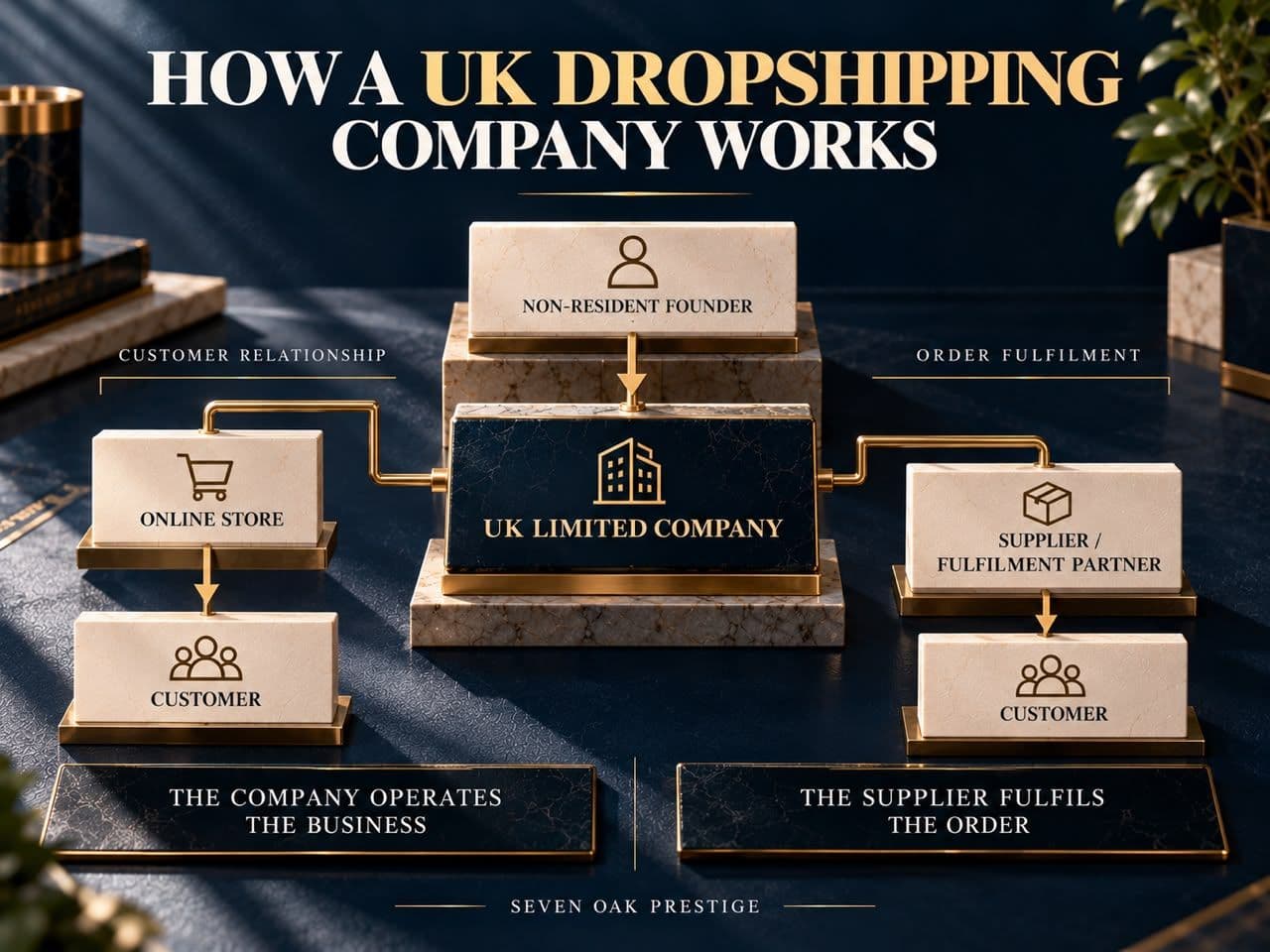
Dropshipping is an e-commerce fulfilment model in which the retailer sells products without normally keeping those products in its own inventory.

A typical transaction works like this:

  1. A customer places an order through your website or marketplace.
  2. Your business receives the customer’s payment.
  3. You send the relevant order information to your supplier.
  4. You purchase the product from the supplier.
  5. The supplier ships the product directly to your customer.
  6. Your business retains the difference between its selling price and its costs.

You therefore control the customer relationship and sale, while another business performs much of the fulfilment.

That distinction matters.

Your supplier sending the parcel does not necessarily mean your supplier has taken over your responsibilities to the consumer.

2. Is Dropshipping Still Worth It in 2026?

Dropshipping is not dead.

But the easy version of dropshipping is becoming increasingly difficult.

Shopify’s own 2026 assessment is that dropshipping can still be viable where the model fits the merchant’s margins, marketing capabilities and supplier arrangements. (Shopify)

The better question is therefore not:

“Does dropshipping still work?”

It is:

“Can you build a dropshipping operation with enough margin, differentiation, reliability and compliance to operate sustainably?”

The strongest businesses in 2026 increasingly behave more like genuine e-commerce brands than temporary product-testing websites.

That means focusing on:

  • carefully selected products;
  • reliable suppliers;
  • realistic delivery times;
  • good customer support;
  • transparent refund policies;
  • product quality;
  • sustainable customer-acquisition costs;
  • appropriate margins;
  • repeat customers;
  • strong business documentation;
  • robust payment infrastructure;
  • tax and compliance planning.

Simply copying a popular product from another store and launching advertisements is unlikely to create a durable competitive advantage.

3. Can a Non-UK Resident Start a UK Dropshipping Company?

In principle, yes.

UK private limited companies can have international shareholders and directors.

The founder does not simply become a UK resident because they own a UK company, however, and incorporating a UK company should not be confused with acquiring UK immigration or tax residence.

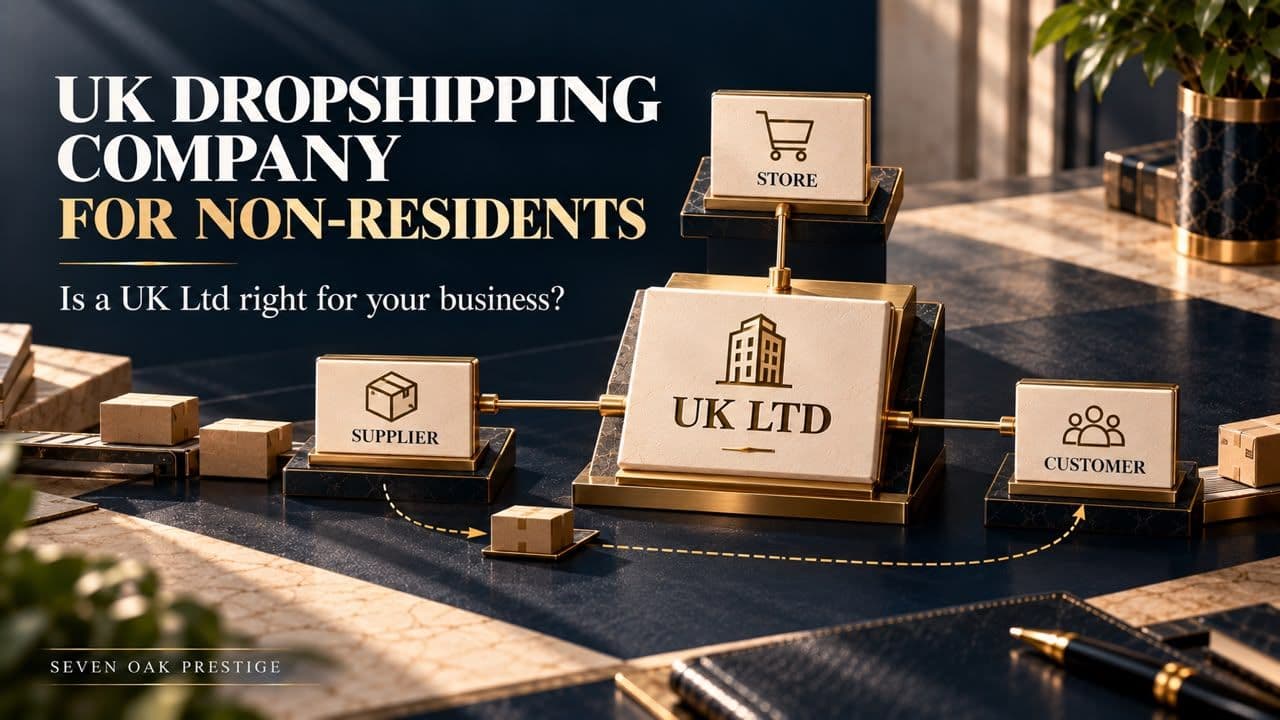
A typical structure might therefore look like:

Founder: resident in another country

UK Limited Company: registered with Companies House

Online Store: Shopify or another e-commerce platform

Payment Provider / Business Account

Supplier

Customers in the UK, EU, USA or other markets

Each layer has separate requirements.

That is one of the most important concepts international founders should understand.

4. Why Use a UK Limited Company for Dropshipping?

There is no universal structure that is best for every entrepreneur.

However, international e-commerce founders may consider a UK limited company for several reasons.

Separate legal identity

A limited company is legally separate from its shareholder or shareholders.

This provides a formal corporate structure for contracts, commercial relationships and financial records.

International commercial presence

A UK entity can give an international entrepreneur a recognisable corporate structure when dealing with customers, suppliers and professional counterparties.

Multiple shareholders

A company can accommodate more than one shareholder and different ownership percentages.

Business continuity

Unlike conducting business informally as an individual, a company creates an entity that can maintain contracts, accounts, records and ownership structures as the operation grows.

Professional credibility

A properly operated company can create a clearer distinction between the founder personally and the e-commerce business.

But the critical words are properly operated.

A Companies House certificate on its own does not create commercial credibility.

5. UK Limited Company vs Operating Dropshipping Personally

A founder should think beyond the cost of registration.

Operating personally may appear simpler at the beginning.

A limited company introduces additional obligations, including:

  • annual accounts;
  • confirmation statements;
  • company records;
  • Corporation Tax responsibilities;
  • director duties;
  • bookkeeping;
  • ownership records;
  • identity-verification requirements.

Every UK company must provide information to Companies House, including annual accounts and confirmation statements where applicable. (GOV.UK)

The correct question is therefore:

Does the commercial benefit of establishing a company justify the additional administration and compliance?

For a founder who intends to build a genuine international e-commerce operation, the answer may be very different from someone testing a few products as a temporary side project.

6. How to Structure the Shares and Directors

Blog Image

A one-person dropshipping business does not need to create an unnecessarily complicated ownership structure.

If you are still deciding how ownership and control should be structured, read our detailed guide on how to structure shares and directors in a UK Ltd as a non-resident founder.

A common simple structure could involve:

1 director

1 shareholder

100% ownership by the founder

But other structures are possible.

For example, two business partners could own:

Founder A — 60%

Founder B — 40%

The company’s share structure should reflect the real commercial arrangement.

Do not add shareholders, directors or nominees merely to make the company appear more “UK-based”.

Banks, payment institutions and regulated providers routinely identify beneficial owners and controllers as part of KYC and AML procedures.

The legal structure should therefore be accurate, explainable and consistent.

7. Companies House Identity Verification in 2026

This has become particularly important.

From 18 November 2025, Companies House identity verification became a legal requirement under the new regime, with transitional requirements applying to existing directors and people with significant control.

Companies House Identity Verification for Non-Residents

New directors are now within the compulsory verification framework, while PSCs also have specific requirements for providing their personal codes. (GOV.UK)

International founders should therefore prepare appropriate identity documentation before establishing their structure.

This is another reason why company formation should no longer be viewed as nothing more than completing a Companies House form.

8. What SIC Code Should a Dropshipping Company Use?

Dropshipping does not have its own dedicated SIC code.

The appropriate SIC code should reflect what the company actually does.

For many online retail businesses, an e-commerce or retail-related SIC classification may be appropriate depending on the products and business model.

Do not choose a SIC code simply because another dropshipping website uses it.

The activity disclosed to Companies House should remain consistent with:

  • the company’s website;
  • invoices;
  • banking application;
  • payment-provider application;
  • business description;
  • expected transactions.

That consistency becomes particularly important when the company undergoes compliance reviews.

9. Registered Office, Business Address and Trading Address

International entrepreneurs frequently confuse these.

They serve different purposes.

Registered office

Every UK company must maintain an appropriate registered office address in the jurisdiction where it is registered.

Read our guide UK Registered Office

Official Companies House and government correspondence can be sent there.

Director service address

Directors provide a service address for public correspondence.

Director Service Address

Trading or operating address

The location from which the business is actually operated may be different.

If you live in Dubai, Paris, Accra, Lagos or Mumbai and genuinely operate the business from there, you should not automatically describe a London registered office as your physical operating location.

This distinction can matter significantly when dealing with banks and payment institutions.

A virtual or registered-office service provides an address service.

It should not be misrepresented as a physical business operation where that is not true.

10. Choosing Your Dropshipping Market

Before selecting suppliers, decide where the company intends to sell.

For example:

  • United Kingdom
  • European Union
  • United States
  • Canada
  • Australia
  • multiple international markets

This decision affects considerably more than marketing.

It may influence:

VAT

customs

product regulation

delivery expectations

returns

payment processing

supplier selection

consumer law

pricing

A founder who has not established where the business will sell cannot properly design the rest of the operation.

11. Choosing a Dropshipping Niche

Do not select products purely because a social-media video says they are “winning products”.

Analyse the underlying economics.

Consider:

Demand

Do customers genuinely search for or purchase the product?

Competition

How many sellers offer essentially the same product?

Gross margin

Can the selling price absorb:

  • supplier cost;
  • shipping;
  • payment fees;
  • advertising;
  • refunds;
  • chargebacks;
  • apps;
  • tax;
  • customer service;
  • currency conversion?

Repeat purchasing

Can one customer generate more than one transaction?

Returns

Some categories create considerably more returns than others.

Product regulation

Cosmetics, children’s products, electronics, supplements and other regulated categories can create far more complex compliance requirements than ordinary low-risk consumer products.

Shipping

A product with poor shipping economics can destroy an otherwise attractive margin.

12. The Dropshipping Unit-Economics Test

Blog Image

Many new founders calculate profit incorrectly.

Suppose you sell a product for:

£50

and purchase it from the supplier for:

£18

That does not automatically mean you made £32 profit.

You may still have:

Supplier cost: £18
Shipping: £4
Payment processing: £1.50
Advertising/customer acquisition: £12
Apps/software allocation: £2
Refund/chargeback allowance: £2

Your contribution could already be approximately:

£10.50

before considering wider overhead, taxes and other costs.

This is why focusing exclusively on revenue screenshots is dangerous.

A £100,000-revenue store can be weaker than a £30,000-revenue store with superior margins and repeat customers.

13. How to Choose a Dropshipping Supplier

Your supplier is effectively part of your customer experience.

Evaluate:

  • product quality;
  • dispatch times;
  • delivery times;
  • tracking;
  • stock reliability;
  • packaging;
  • return arrangements;
  • customer-data handling;
  • product-safety evidence;
  • invoices;
  • communication;
  • refund procedure.

Request documentation where appropriate.

If you cannot identify who actually supplies the product, where it originates or whether relevant safety requirements have been met, you may be creating a serious operational risk.

UK product-safety guidance states that businesses selling consumer products in the UK must not sell products they know — or should have known — are unsafe, and businesses need supplier records allowing product origins to be traced. (GOV.UK)

The UK is also moving toward stronger online product-safety oversight. In 2026, the government proposed reforms intended to strengthen responsibilities across online marketplaces and sellers. (GOV.UK).

This deserves considerably more attention than most traditional dropshipping tutorials give it.

14. China-Based vs UK/EU/Local Suppliers

Blog Image

Cheap procurement is not automatically the best procurement strategy.

An overseas supplier may provide:

  • lower unit costs;
  • enormous product catalogues;
  • rapid product testing.

A local or regional supplier may provide:

  • faster delivery;
  • easier returns;
  • more predictable inventory;
  • simpler customer service;
  • stronger product documentation.

The correct decision depends on your customer promise and economics.

If reducing the product cost by £3 creates an additional ten days of shipping time, the saving may not be commercially worthwhile.

15. Building the Online Store

Shopify remains a major platform for dropshipping and continues to publish dedicated 2026 guidance and dropshipping integrations. (Shopify)

However, your store must become more than a product catalogue.

A professional e-commerce website should clearly communicate:

  • legal business name;
  • relevant contact information;
  • product descriptions;
  • pricing;
  • delivery expectations;
  • refund and returns information;
  • privacy information;
  • terms of sale;
  • customer-support process.

The company information appearing across the store, Companies House, payment-provider application and invoices should be consistent.

16. UK Consumer Rights and Dropshipping

Using a dropshipping supplier does not automatically remove your responsibility to your customer.

For many online purchases, UK customers have cancellation rights.

Government guidance states that businesses must generally inform customers that they can cancel qualifying online orders up to 14 days after delivery, subject to exceptions. Failure to provide the required information can significantly extend the cancellation period. (GOV.UK)

Refund obligations also apply in qualifying circumstances. (GOV.UK)

Your supplier saying:

“We don’t accept returns”

does not automatically override your legal obligations as the retailer.

This is why the return agreement with the supplier should be considered before products are placed on sale.

17. Product Safety: An Increasingly Important Dropshipping Risk

Dropshippers sometimes assume:

“I never touched the product, so product compliance belongs to the supplier.”

That assumption can be dangerous.

Products placed on the UK market can be subject to safety requirements regardless of whether the retailer physically stored them.

Particular care should be taken with categories such as:

  • electronics;
  • toys;
  • children’s products;
  • cosmetics;
  • batteries;
  • food;
  • supplements;
  • medical-related products;
  • protective equipment;
  • products containing chemicals.

Different categories can carry separate regulatory obligations.

Before listing products, determine what requirements apply.

18. Do You Need VAT for a UK Dropshipping Company?

This is one of the most misunderstood areas of dropshipping.

There is no reliable answer based only on the sentence:

“I own a UK company.”

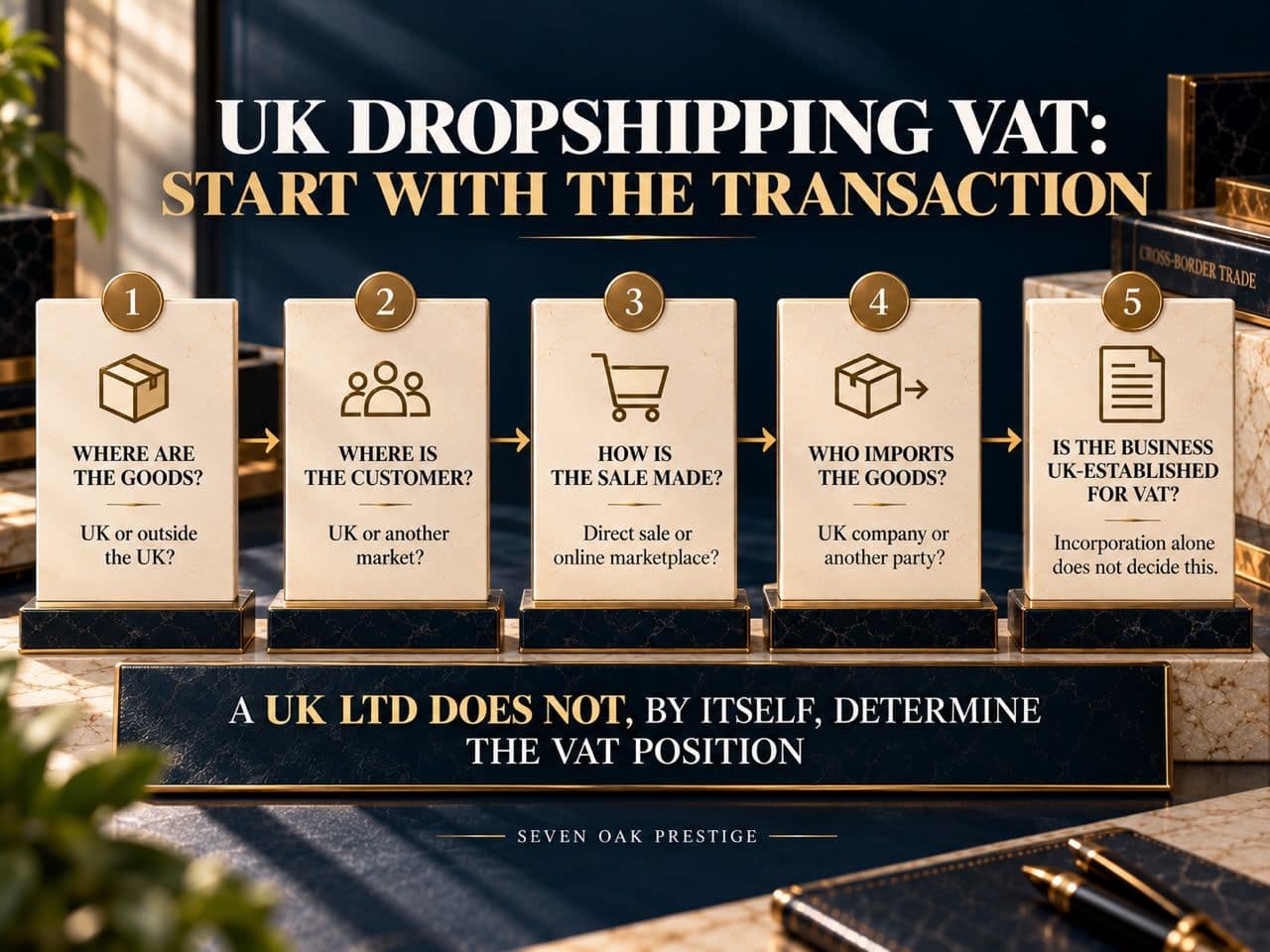
The VAT analysis can depend on:

  • where the goods are when sold;
  • where the supplier is;
  • where the customer is;
  • who imports the goods;
  • whether an online marketplace facilitates the transaction;
  • the consignment value;
  • where the business is established for VAT purposes.

For ordinarily established UK businesses, the general compulsory VAT-registration threshold is currently £90,000 of VAT-taxable turnover. (GOV.UK).

Read our VAT guide here

But international founders must be particularly careful.

HMRC confirms that the standard registration threshold does not apply in the same way to a non-established taxable person making taxable supplies in the UK; such persons may need to register when making taxable UK supplies without benefiting from the usual threshold. (GOV.UK)

This is precisely why international dropshipping VAT should be assessed against the actual transaction chain rather than guessed from turnover alone.

19. The £135 UK Import VAT Rule

Blog Image

When goods are outside the UK at the point of sale and are sent directly to UK consumers, special VAT rules can apply.

The treatment of consignments with an intrinsic value not exceeding £135 can differ from higher-value consignments.

Where an online marketplace facilitates the transaction, the marketplace may also become responsible for accounting for VAT in circumstances covered by the rules. (GOV.UK)

This distinction is important for dropshippers because:

Shopify store + direct sale

may not produce the same VAT outcome as:

marketplace + marketplace-facilitated sale.

Never assume that because Amazon, eBay or another marketplace handles VAT in one transaction, your independent Shopify sales receive the same treatment.

20. What if You Sell to EU Customers?

Selling to EU customers introduces another tax and regulatory layer.

Depending on your structure and fulfilment model, areas such as:

  • EU VAT;
  • Import One Stop Shop (IOSS);
  • customs;
  • product compliance;
  • responsible-person requirements;
  • consumer law;

may become relevant.

The UK’s IOSS guidance provides a mechanism for reporting qualifying VAT on certain low-value goods imported for EU consumers. (GOV.UK)

EU product-safety requirements must also be considered where relevant.

The General Product Safety Regulation has increased the information and traceability expectations attached to many consumer products sold online into the EU. UK government export guidance specifically highlights online-listing requirements under the GPSR. (Business Growth Service)

21. EORI and Customs

If your business becomes involved in importing or exporting goods, an EORI number may be required depending on the movement and customs arrangements.

Where the UK company needs an EORI number, Seven Oak Prestige can also support the UK EORI registration process

The important distinction for a dropshipper is identifying:

Who is actually acting as the importer?

Do not assume the supplier always carries this responsibility.

The answer should be established contractually and operationally.

Unexpected import VAT or customs charges reaching your customer can produce:

  • refused deliveries;
  • refunds;
  • complaints;
  • chargebacks;
  • negative reviews.

22. Business Banking for Dropshipping Companies

Blog Image

A UK company does not automatically receive a UK bank account.

Banking providers conduct their own onboarding and risk assessments.

They may ask about:

  • director residence;
  • shareholder residence;
  • expected turnover;
  • source of funds;
  • supplier countries;
  • customer countries;
  • website;
  • products;
  • expected transaction sizes;
  • payment processors;
  • business model.

Dropshipping can receive additional scrutiny because the business often combines international suppliers, card payments, high transaction volumes, refund exposure and cross-border movement of funds.

Preparation matters.

That is our dedicated banking &fintechs service

23. Banking Readiness Before You Apply

Before applying for a business account, aim to have a coherent file containing:

Certificate of Incorporation

company ownership structure

director identity documents

proof of residential address

professional website

business email

supplier information

business model

expected turnover

target markets

source-of-funds explanation where requested

contracts or invoices where available

Your answers should match what the provider can observe publicly.

For example, saying:

“We sell UK home accessories”

while your website advertises cryptocurrency services creates an obvious inconsistency.

Banking readiness is largely about credibility, consistency and evidence.

24. Can a UK Dropshipping Company Get Stripe, PayPal or Shopify Payments?

Potentially.

But incorporation does not guarantee acceptance.

Payment providers apply their own rules regarding:

  • supported countries;
  • beneficial owners;
  • business activities;
  • prohibited products;
  • fulfilment;
  • refund risk;
  • chargebacks;
  • operating history;
  • verification.

A professional formation adviser should therefore never promise:

“Register a UK company and you will automatically get Stripe.”

The correct objective is:

Build a company and operating profile that is transparent, credible and properly prepared for provider onboarding.

Acceptance remains the provider’s decision.

25. Avoid Creating a False UK Presence

International entrepreneurs sometimes receive poor advice telling them to:

  • claim they live in Britain when they do not;
  • submit an address that is not their residence;
  • hide their actual country;
  • use another person’s payment account;
  • misstate the company’s business activity.

Do not do this.

It may produce inconsistencies during KYC or ongoing account reviews and can lead to restrictions or closure.

A legitimate non-resident structure should be built as a non-resident structure.

Transparency is considerably more sustainable than trying to make an international founder appear artificially resident in the UK.

26. Shopify Dropshipping with a UK Company

Blog Image

Shopify can provide the commerce infrastructure for:

  • storefront;
  • checkout;
  • products;
  • order management;
  • integrations;
  • analytics.

But distinguish between:

using Shopify to operate your website

and

being approved for a particular payment service.

These are separate questions.

The business should therefore be designed so that its entire operation does not depend on an assumption that one particular payment institution will approve it.

27. Can You Dropship on TikTok Shop?

Dropshipping models can also be used alongside social-commerce channels, and Shopify continues to publish 2026 material specifically addressing TikTok dropshipping. (Shopify)

But seller eligibility, location, verification, product restrictions and fulfilment requirements should be checked directly against TikTok’s current rules before designing your structure.

A UK company certificate should never be treated as guaranteed TikTok Shop approval.

28. Can You Dropship on eBay?

Potentially, subject to eBay’s current seller and dropshipping policies.

Again, distinguish between:

having a legal company

and

being permitted to operate a particular marketplace business model.

Marketplaces can change their seller policies independently of Companies House.

The supplier relationship and fulfilment method should therefore be checked against the platform rules before listing products.

29. Amazon and Dropshipping

Amazon can represent another distribution channel, but its rules regarding fulfilment and seller responsibility should be reviewed carefully.

Do not design an entire company first and investigate marketplace eligibility afterwards.

The correct order is:

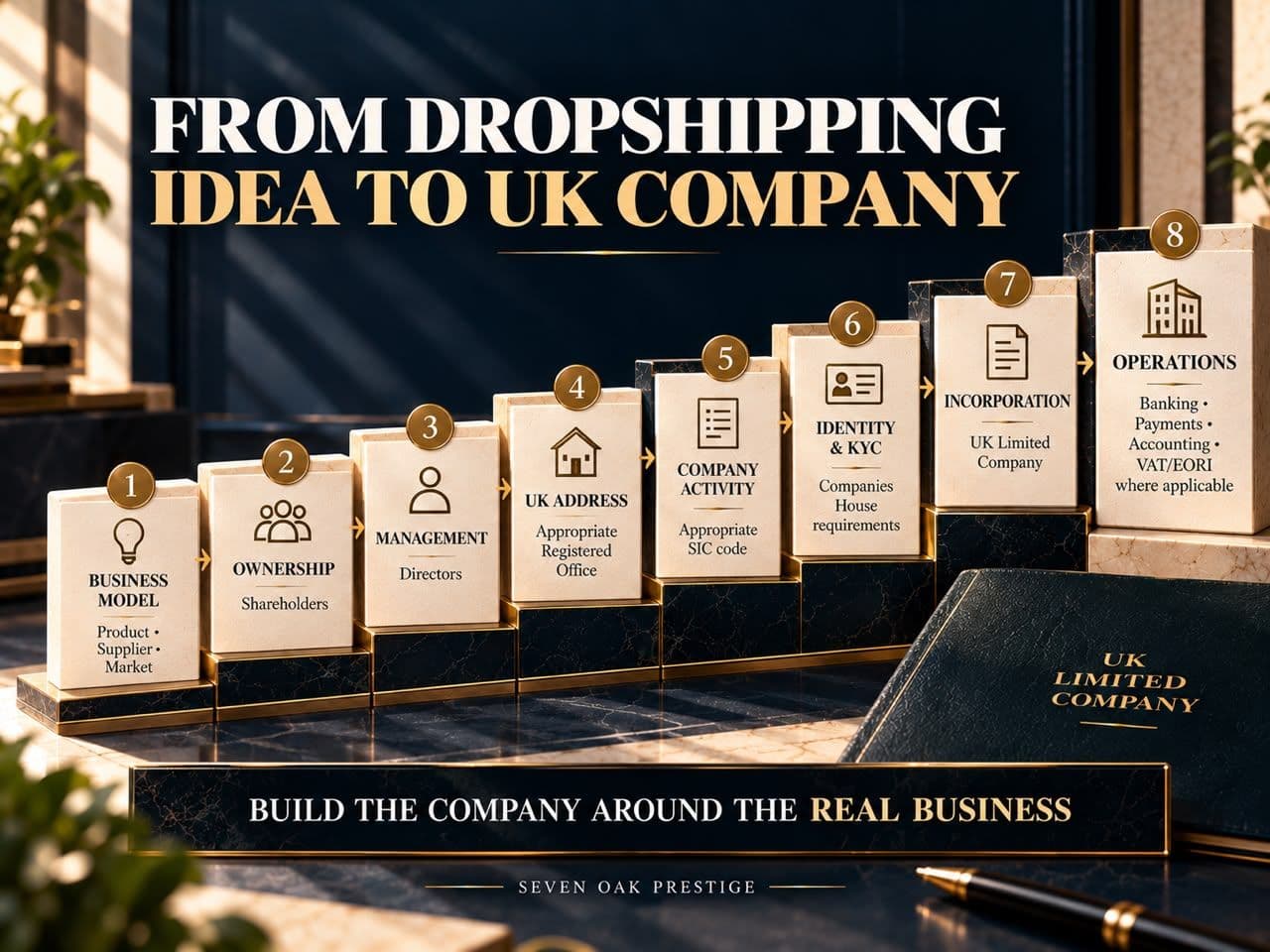
Business model → market → platform → fulfilment → compliance → company structure.

Not:

Company first → hope everything else works later.

30. Bookkeeping for a Dropshipping Company

Dropshipping can generate large numbers of transactions.

Your records may need to reconcile:

  • customer revenue;
  • payment-provider fees;
  • supplier invoices;
  • advertising expenditure;
  • refunds;
  • chargebacks;
  • foreign-exchange costs;
  • software subscriptions;
  • VAT where applicable;
  • customs/import costs.

Do not wait until the first accounts deadline to create this system.

Accounting infrastructure should ideally be designed before significant transaction volume begins.

31. Corporation Tax

A UK limited company has UK corporate-tax responsibilities.

However, international structures can become more complex than simply asking where the company was incorporated.

For example, where the business is actually managed, where the founder resides and whether another country considers the business taxable there may require professional tax analysis.

International founders should therefore avoid assuming:

“I pay UK Corporation Tax, so no other country can tax anything.”

Your personal residence and the company’s cross-border activities can create additional considerations.

we explained here : How UK company tax works for non-residents

32. Paying Yourself

Company revenue belongs to the company.

The shareholder’s personal money and the company’s money should not simply be mixed together.

Depending on the circumstances, directors/shareholders may receive value through mechanisms such as:

  • salary;
  • dividends;
  • legitimate expense reimbursement;
  • director’s loan arrangements.

The appropriate method depends on both UK rules and potentially the founder’s country of residence.

International tax advice may therefore be necessary.

33. Chargebacks and Reserves

Blog Image

This is an underestimated dropshipping risk.

If customers:

  • receive products late;
  • receive incorrect products;
  • cannot reach support;
  • dislike quality;
  • believe advertising was misleading;

refund and chargeback rates can increase.

That affects more than profit.

Payment providers evaluate transaction risk.

A store with rapidly increasing sales and unusually high disputes can attract account scrutiny.

Good fulfilment is therefore also part of payment-provider risk management.

34. Customer Service Is a Competitive Advantage

Dropshippers often outsource fulfilment but forget that the customer bought from their store, not from the factory.

Build:

  • clear support channels;
  • order tracking;
  • realistic shipping information;
  • automated order updates;
  • escalation procedures;
  • refund workflows;
  • supplier communication.

The objective is to make the customer experience resemble a professional retailer rather than a middleman forwarding orders to an unknown supplier.

35. Advertising and Marketing Compliance

Your advertising must accurately represent your products, pricing and offers.

UK marketing law requires advertising to be accurate and honest and to comply with applicable advertising rules. (GOV.UK)

Avoid:

  • fake countdown timers;
  • invented scarcity;
  • fabricated reviews;
  • misleading before-and-after claims;
  • false discounts;
  • unrealistic delivery claims.

The UK’s unfair-commercial-practices framework has also been updated under the Digital Markets, Competition and Consumers Act regime. (GOV.UK)

Short-term conversion tactics are not worth long-term regulatory or reputational risk.

36. A Better Dropshipping Strategy for 2026

The strongest approach is increasingly:

Step 1 — Validate

Test genuine customer demand.

Step 2 — Calculate

Determine unit economics before scaling advertising.

Step 3 — Verify suppliers

Assess quality, delivery, documentation and returns.

Step 4 — Structure properly

Set up the appropriate company, ownership and operational framework.

Step 5 — Build compliance

Address tax, product, consumer and website requirements.

Step 6 — Establish payment infrastructure

Prepare for banking and payment-provider onboarding.

Step 7 — Launch professionally

Provide clear information, support and delivery expectations.

Step 8 — Measure

Track:

  • conversion;
  • customer-acquisition cost;
  • gross margin;
  • contribution margin;
  • refund rate;
  • chargeback rate;
  • repeat purchase rate;
  • delivery times.

Step 9 — Build a brand

Move beyond identical products and identical supplier photography where commercially possible.

Step 10 — Diversify

Avoid becoming completely dependent on one:

  • supplier;
  • product;
  • advertising account;
  • payment processor;
  • marketplace.

That is how dropshipping develops from a product-testing method into an actual e-commerce business.

37. Common Dropshipping Mistakes International Founders Make

Registering the company before understanding the transaction flow

Know where your supplier, goods and customers will be.

Assuming a UK company guarantees banking

It does not.

Assuming a UK company guarantees Stripe

It does not.

Ignoring VAT until turnover becomes large

Cross-border VAT can sometimes arise before the ordinary UK threshold becomes relevant.

Choosing products without checking safety requirements

Cheap procurement does not remove regulatory obligations.

Using unrealistic delivery promises

Long shipping combined with “3-day delivery” advertising creates disputes.

Mixing personal and company funds

Maintain proper financial separation.

Misrepresenting residence

Provide accurate information to financial institutions.

Scaling advertising before calculating margins

Revenue without contribution margin is not a sustainable business.

Depending entirely on one supplier

Create operational resilience.

38. How Much Does It Cost to Start a UK Dropshipping Company?

The official Companies House digital incorporation fee is currently £100. (GOV.UK)

However, this should not be confused with the actual cost of establishing an operational dropshipping business.

A realistic startup budget may also include:

  • company formation assistance;
  • registered office/address services;
  • identity-verification support;
  • domain name;
  • professional email;
  • Shopify/e-commerce platform;
  • apps;
  • branding;
  • product samples;
  • accounting;
  • VAT support where applicable;
  • advertising;
  • supplier payments;
  • payment-processing fees;
  • returns;
  • working capital.

This distinction matters.

Companies House registers the company. It does not build the business around it.

Find here the True cost of setting up a UK company as a non-resident

39. Which Seven Oak Prestige Package Is Right for a Dropshipping Founder?

International e-commerce founders need different levels of support depending on how far their business has progressed.

Startup Package

Designed for entrepreneurs who need the essential UK company foundation and are at the beginning of their international business journey.

Best suited to: founders preparing their first UK dropshipping or e-commerce structure.

Explore the Startup Package →

Prestige Package

For founders who require a more comprehensive business setup and additional support around establishing a professional UK presence.

Best suited to: entrepreneurs who have validated their business model and want a stronger operational foundation.

Explore the Prestige Package →

Elite Package

For entrepreneurs seeking the highest level of support across the broader establishment and advisory process.

Best suited to: international founders building a more substantial UK or cross-border operation and requiring greater strategic assistance.

Explore the Elite Package →

The exact services included in each package should always be checked against the current package description before purchase.

40. Dropshipping Business Launch Checklist

Before accepting your first order, ask:

  • Have I identified my target country?
  • Have I validated product demand?
  • Do I understand my true unit economics?
  • Have I checked my supplier?
  • Have I ordered product samples where appropriate?
  • Do I understand delivery times?
  • Have I considered product-safety requirements?
  • Is my company ownership structure accurate?
  • Have the relevant directors/PSCs completed required identity verification?
  • Is my registered office appropriate?
  • Is my actual trading location accurately represented?
  • Have I assessed VAT based on the real transaction flow?
  • Have I considered customs/EORI requirements?
  • Do I have a suitable business account?
  • Is my payment-provider application consistent with my website?
  • Do I have terms and conditions?
  • Do I have a privacy notice?
  • Do I have a compliant refund/returns policy?
  • Can customers contact me easily?
  • Can I reconcile supplier orders with customer payments?
  • Do I have enough working capital for refunds and chargebacks?
  • Do I have a backup supplier/payment plan?

Frequently Asked Questions

Can I start a UK dropshipping company if I live outside the UK?

Yes. A non-UK resident can generally own shares in and act as a director of a UK private limited company, provided the applicable Companies House requirements are met.

However, owning a UK company does not make you a UK resident and does not automatically give you access to UK banking, payment processing or marketplace accounts.

Your actual country of residence should always be disclosed accurately where a bank, payment provider or platform asks for it.

What is the best UK company structure for a dropshipping business?

For a solo founder, a simple structure with one director and one shareholder is often sufficient.

Where there are multiple founders, the share structure should reflect the genuine ownership arrangement.

The best structure depends on factors such as:

  • number of founders;
  • ownership percentages;
  • voting rights;
  • future investment plans;
  • profit distribution;
  • management responsibilities.

Complex structures should not be created without a genuine commercial reason.

Should I register a UK company before testing my dropshipping business?

Not necessarily.

Some founders prefer to validate demand before creating a full company structure, while others need a company before they can contract with suppliers, open business accounts or establish payment infrastructure.

The important point is to avoid forming a company without first understanding:

  • what you intend to sell;
  • where your customers will be;
  • which supplier you will use;
  • expected transaction volumes;
  • banking requirements;
  • VAT implications;
  • marketplace eligibility.

The company should support the business model rather than being created in isolation.

Do I need a business plan for a UK dropshipping company?

Companies House does not normally require a formal business plan simply to incorporate a private limited company.

However, banks, payment providers and other institutions may ask you to explain:

  • your products;
  • target customers;
  • supplier locations;
  • expected turnover;
  • expected transaction sizes;
  • source of funds;
  • marketing strategy;
  • fulfilment arrangements.

A concise and credible business plan can therefore be very useful during onboarding and banking-readiness reviews.

Can I run a UK dropshipping company from my home country?

Potentially, yes.

The UK company can be incorporated in the UK while the director manages the business from another country.

However, this can create cross-border tax, management and regulatory considerations.

You should also accurately identify your real operating location when banks, payment institutions or tax authorities request it.

Can I use a UK virtual office for my dropshipping business?

A suitable virtual office or registered-office service can be used for legitimate company-address purposes.

However, you should not describe the virtual office as your physical residence or operating premises if you do not actually work from there.

Banks and payment providers may separately ask for:

  • director residential address;
  • actual trading address;
  • proof of residence;
  • operational location.

These addresses serve different purposes.

Does a UK company make my dropshipping business look more credible?

A properly maintained UK limited company can provide a formal corporate structure and may improve how the business presents itself to suppliers, customers and counterparties.

However, credibility depends on much more than incorporation.

A professional business profile should also include:

  • a clear website;
  • company email;
  • transparent contact details;
  • consistent company information;
  • professional policies;
  • reliable fulfilment;
  • appropriate banking;
  • proper bookkeeping;
  • timely compliance filings.

Can I use a UK company to sell through Shopify from abroad?

Potentially, yes.

A UK limited company can operate a Shopify store while its director lives abroad.

However, the eligibility requirements for payment services used with Shopify may differ from the requirements for simply using Shopify as an e-commerce platform.

Shopify access and payment-provider approval should therefore be treated as separate matters.

Can I use Shopify Payments with a UK company if I am not a UK resident?

Possibly, but having a UK company alone does not guarantee eligibility.

Payment providers may assess:

  • director residence;
  • business location;
  • ownership;
  • product category;
  • fulfilment;
  • website;
  • customer markets;
  • account history;
  • fraud and chargeback risk.

Always check the provider’s current eligibility requirements and provide accurate information.

Can I use Stripe for a UK dropshipping company?

A UK company can potentially apply for Stripe where the business and founders meet the applicable eligibility requirements.

However, Stripe approval is independent from Companies House registration.

The payment provider may review the company’s:

  • website;
  • products;
  • refund policy;
  • delivery terms;
  • beneficial owners;
  • operating countries;
  • expected volume;
  • fulfilment arrangements.

No formation provider should promise guaranteed Stripe approval.

Can I use PayPal for a UK dropshipping company?

Potentially, subject to PayPal’s current eligibility, verification and acceptable-use requirements.

As with other payment providers, the company may need to provide business and identity documentation.

The business should also maintain realistic delivery times and refund procedures, as disputes and chargebacks can affect payment-account stability.

Do I need a UK business bank account for dropshipping?

Not necessarily a traditional UK high-street bank account, but a properly separated business account or payment infrastructure is highly advisable.

Company revenue and business expenses should not simply be mixed with the director’s personal finances.

The most suitable account depends on the company’s:

  • ownership;
  • director residence;
  • business activity;
  • customer markets;
  • transaction volume;
  • currencies;
  • supplier countries.

Why are some dropshipping companies rejected by banks or payment providers?

Dropshipping can receive additional scrutiny because the model can involve:

  • international suppliers;
  • card payments;
  • cross-border transactions;
  • long shipping times;
  • refunds;
  • chargebacks;
  • limited operating history;
  • rapidly increasing transaction volume.

Applications can also fail where information is inconsistent.

For example:

  • the website shows one activity but the application describes another;
  • the business address is misrepresented;
  • expected turnover is unrealistic;
  • suppliers cannot be clearly identified.

Preparation and consistency are therefore important.

Do I need VAT if I am dropshipping to UK customers?

Possibly.

VAT treatment depends on the actual transaction chain.

Relevant factors can include:

  • where the goods are located at the time of sale;
  • where the customer is located;
  • whether the seller is established in the UK;
  • whether an online marketplace facilitates the sale;
  • the value of the consignment;
  • who imports the goods.

International dropshippers should not assume that the ordinary UK VAT threshold is the only rule that matters.

Does the £90,000 VAT threshold apply to every dropshipping business?

No.

The £90,000 threshold is the general UK VAT registration threshold for certain UK-established businesses.

Different rules can apply to businesses that are not established in the UK but make taxable supplies in the UK.

This is particularly important for international founders operating a UK company from overseas.

The VAT position should therefore be reviewed based on the actual business circumstances.

What is the £135 rule for UK dropshipping?

Special VAT rules can apply where goods are outside the UK at the point of sale and are sent to UK customers in consignments valued at £135 or less.

The treatment can also differ depending on whether the sale is made directly through your own website or facilitated by an online marketplace.

Because of this, dropshippers should map the entire transaction flow before deciding how VAT should be handled.

Do I need VAT if I only sell through Shopify?

Using Shopify does not itself determine whether VAT registration is required.

Shopify is the e-commerce platform.

VAT obligations depend on the underlying transaction, including:

  • supplier location;
  • goods location;
  • customer location;
  • business establishment;
  • import arrangements.

The same principle applies to other website platforms.

Do I need VAT if I sell through Amazon, eBay or TikTok Shop?

Possibly.

Online marketplaces may have specific VAT responsibilities in certain circumstances, particularly where overseas goods are sold to UK consumers.

However, marketplace VAT treatment does not necessarily remove every VAT obligation from the seller.

The correct treatment depends on the transaction structure.

Can I sell to customers in the EU through my UK dropshipping company?

Potentially, yes.

However, EU sales can create additional requirements involving:

  • EU VAT;
  • customs;
  • IOSS;
  • product safety;
  • consumer law;
  • labelling;
  • responsible-person requirements for certain products.

The business should identify these requirements before actively targeting EU customers.

What is IOSS and does a dropshipping business need it?

The Import One Stop Shop, or IOSS, is an EU VAT mechanism designed for certain low-value goods imported and sold to EU consumers.

Whether it is relevant depends on how your products are supplied, the value of the goods and the markets being served.

It should not be assumed that every UK dropshipping company needs IOSS.

Do I need an EORI number for dropshipping?

Possibly.

An EORI number may be required where the business is involved in customs activities as an importer or exporter.

The key question is:

Who is legally acting as the importer or exporter in the transaction?

If your supplier handles all import procedures, the position may differ from a structure where your UK company imports the goods itself.

Can my supplier handle all customs and VAT for me?

Sometimes a supplier may offer fulfilment arrangements that include customs handling or duties.

However, you should never assume this automatically removes your legal or tax responsibilities.

The commercial agreement should clearly identify:

  • who imports the goods;
  • who pays customs duties;
  • who pays import VAT;
  • who handles returns;
  • who bears the risk of rejected or delayed shipments.

Can I dropship from China to UK customers using a UK company?

Potentially, yes.

However, you should consider:

  • shipping times;
  • import VAT;
  • customs;
  • product safety;
  • returns;
  • customer expectations;
  • product documentation;
  • supplier reliability.

The cheapest supplier is not always the most commercially sustainable supplier.

Do I need product safety documents from my dropshipping supplier?

For regulated products, appropriate product-safety and compliance documentation can be essential.

Depending on the product, this may include:

  • test reports;
  • conformity documentation;
  • technical information;
  • manufacturer details;
  • labelling information;
  • traceability records.

You should understand what documentation applies before placing the product on sale.

What products should I avoid when starting dropshipping?

New founders should be particularly cautious with products that can create complex regulatory, safety or payment-provider risks.

Examples may include:

  • supplements;
  • medical-related products;
  • cosmetics;
  • children’s products;
  • electrical equipment;
  • batteries;
  • high-value branded goods;
  • restricted products;
  • products making health claims.

This does not mean every such product is prohibited, but they usually require greater compliance expertise.

Can I dropship branded products?

You should only sell branded products where you have the legal right to do so and where the supply chain is genuine.

Selling counterfeit goods or using another company’s intellectual property without permission can create serious legal, marketplace and payment-provider issues.

Always verify the legitimacy of the supplier.

Can I use AliExpress for UK dropshipping?

Some dropshipping businesses use marketplaces or supplier platforms such as AliExpress.

However, supplier-platform availability does not remove your responsibilities as the retailer.

You should still assess:

  • supplier credibility;
  • product quality;
  • shipping time;
  • safety documentation;
  • returns;
  • tracking;
  • customer service;
  • import treatment.

How much money should I have before starting dropshipping?

There is no single amount that works for every founder.

Your budget should cover more than company registration.

You may need capital for:

  • product samples;
  • store setup;
  • domain;
  • software;
  • advertising;
  • supplier payments;
  • refunds;
  • chargebacks;
  • professional services;
  • taxes;
  • working capital.

A business with insufficient working capital can fail even if it generates sales.

How much profit margin should a dropshipping business target?

There is no universal percentage.

The correct margin depends on:

  • product type;
  • advertising cost;
  • shipping;
  • payment fees;
  • return rate;
  • customer acquisition cost;
  • competition;
  • repeat purchases.

Founders should focus on contribution margin rather than simply the difference between selling price and supplier price.

What is a good chargeback rate for dropshipping?

There is no single safe rate that applies across every payment provider.

However, consistently high disputes or chargebacks can create serious payment-processing problems.

The best approach is to reduce disputes through:

  • realistic shipping promises;
  • accurate product descriptions;
  • good tracking;
  • responsive customer service;
  • clear refund policies.

Can my payment provider hold or reserve my dropshipping funds?

Potentially, yes.

Payment providers can apply reserves, payout delays or additional reviews depending on their risk policies and the account’s activity.

Factors such as rapid growth, disputes, refunds or unusual transaction patterns may trigger additional scrutiny.

Dropshipping businesses should therefore maintain sufficient working capital rather than relying on immediate access to every customer payment.

Can I operate several dropshipping stores under one UK company?

Potentially.

A single UK company may operate more than one trading brand or website, provided the structure is properly documented and the business activity remains transparent.

However, banks and payment providers may need to understand all websites and trading names associated with the company.

You should avoid creating multiple stores that conceal the true nature of the business.

Can I use a trading name different from my UK company name?

Yes, a company can generally trade under a different business or brand name, subject to applicable naming and intellectual-property rules.

However, the legal company details should still appear where required.

Payment providers should also be able to understand the relationship between the trading name and the registered company.

Can I change my dropshipping niche after incorporating the company?

Yes, potentially.

A UK company can change or expand its activities.

However, if the activity changes significantly, you may need to review:

  • SIC codes;
  • website;
  • banking profile;
  • payment-provider information;
  • insurance;
  • VAT;
  • product regulation.

A major business-model change should not be hidden from providers that require accurate business information.

Do I need business insurance for dropshipping?

Depending on the products and markets involved, appropriate insurance may be advisable and sometimes commercially important.

Potential areas can include:

  • product liability;
  • public liability;
  • professional or cyber cover;
  • stock or goods-related risks where applicable.

The appropriate coverage depends on the actual business.

Who is responsible if a dropshipped product injures a customer?

Liability can depend on the specific product, supply chain, contractual relationships and applicable law.

You should not assume that the overseas supplier automatically carries all responsibility.

This is why supplier due diligence, product-safety compliance and appropriate insurance can be important.

Do I need terms and conditions for a dropshipping website?

A professional e-commerce website should have terms appropriate to the business.

These commonly address areas such as:

  • ordering;
  • payment;
  • delivery;
  • cancellation;
  • returns;
  • refunds;
  • liability;
  • intellectual property;
  • governing law.

Generic templates copied from another website may not accurately reflect your actual fulfilment model.

Do I need a privacy policy for my dropshipping store?

If your business collects personal information from customers, privacy and data-protection obligations may apply.

Your privacy notice should explain how information is collected, used, stored and shared.

This becomes particularly relevant where customer information is passed to third-party suppliers for fulfilment.

Can I share customer addresses with my dropshipping supplier?

Customer information may need to be shared with a supplier so the supplier can fulfil the order.

However, the business should ensure that personal information is processed appropriately and in accordance with applicable data-protection requirements.

The privacy notice should accurately explain relevant data sharing.

Do I need to register with the ICO for a dropshipping company?

Some UK companies processing personal information may need to pay the data-protection fee or otherwise consider their obligations with the Information Commissioner’s Office.

Whether registration or payment is required depends on the business’s circumstances and applicable exemptions.

This should be reviewed as part of the company’s compliance setup.

Can I hire freelancers or virtual assistants for my dropshipping business?

Yes.

Dropshipping companies frequently use external support for:

  • customer service;
  • product research;
  • marketing;
  • design;
  • bookkeeping;
  • administration.

Appropriate agreements should be used, particularly where freelancers have access to customer data, payment systems or commercially sensitive information.

Can I open a UK dropshipping company with another person?

Yes.

Two or more founders can own shares in a UK limited company.

Before incorporating, they should agree on:

  • ownership percentages;
  • decision-making;
  • director responsibilities;
  • future investment;
  • dividends;
  • what happens if one founder leaves.

A shareholders’ agreement may be appropriate where there are multiple founders.

Can I add another shareholder later?

Potentially, yes.

The company can issue or transfer shares subject to its articles, existing rights and relevant legal requirements.

However, ownership changes should be properly documented and reported where required.

Banks, payment providers and other regulated institutions may also need to be notified of changes in beneficial ownership.

Can I add another director later?

Yes, subject to the company’s constitutional and Companies House requirements.

The new director will also need to satisfy the applicable identity-verification regime and their appointment must be properly filed.

Can I sell my dropshipping company later?

Potentially.

A limited company can create a more transferable business structure than operating informally as an individual.

A buyer may assess:

  • accounts;
  • customer history;
  • supplier relationships;
  • intellectual property;
  • domains;
  • payment accounts;
  • liabilities;
  • compliance records.

Building clean records from the beginning can therefore increase long-term business value.

Is dropshipping suitable for building a long-term brand?

It can be.

Dropshipping can be used as an initial fulfilment model for validating products and markets.

As a business grows, founders may move toward:

  • private labelling;
  • custom packaging;
  • local inventory;
  • fulfilment centers;
  • exclusive supplier relationships;
  • proprietary products.

The strongest long-term strategy is usually to create a recognisable customer proposition rather than relying indefinitely on generic products available from hundreds of other sellers.

Is a UK company the best option for every international dropshipper?

No.

A UK company can be attractive for many international entrepreneurs, but it is not automatically the best jurisdiction for every founder.

The correct structure depends on:

  • founder residence;
  • customer markets;
  • tax circumstances;
  • banking access;
  • supplier countries;
  • platform requirements;
  • business scale;
  • long-term plans.

The decision should be based on the entire operating model rather than simply the speed of UK incorporation.

What should I prepare before forming a UK dropshipping company?

Ideally, prepare:

  • passport or acceptable identification;
  • proof of residential address;
  • proposed company name;
  • ownership structure;
  • director details;
  • business activity;
  • target markets;
  • supplier information;
  • expected turnover;
  • proposed website or domain;
  • initial source of funds;
  • intended banking and payment arrangements.

Preparing these elements in advance makes the establishment process more coherent.

How long does it take to set up a UK dropshipping company?

Companies House processing times can vary.

The company-formation process itself is usually only one part of becoming operational.

Additional time may be required for:

  • identity verification;
  • registered-office setup;
  • banking;
  • payment-provider onboarding;
  • VAT registration;
  • EORI registration;
  • website development;
  • supplier onboarding.

Founders should therefore distinguish between:

“company incorporated”

and

“business ready to trade.”

Can Seven Oak Prestige set up the entire dropshipping business for me?

Seven Oak Prestige can support eligible international founders with the UK company-establishment and related advisory services included in the selected package.

The scope may include areas such as company formation, address services, compliance support, VAT or EORI assistance and banking-readiness guidance depending on the package and services purchased.

However, third-party approvals, supplier performance, platform acceptance, payment-provider acceptance and commercial profitability remain outside the control of the formation adviser.

Which Seven Oak Prestige package is best for a new dropshipping founder?

The appropriate package depends on how much support the founder requires.

A founder who needs the essential company structure may find the Startup Package appropriate.

A founder who requires a broader professional setup and additional establishment support may consider the Prestige Package.

A founder establishing a more substantial international operation and requiring the highest level of advisory assistance may consider the Elite Package.

The package should be selected based on the actual business requirements rather than simply choosing the highest tier.

Can I use a virtual address?

A suitable address service may be used for appropriate corporate-address purposes, but it should not be misrepresented as your personal residence or physical trading premises where this is not true.

Can I get Stripe with a UK company?

A UK company can apply to relevant payment providers where eligible, but incorporation does not guarantee approval. Payment providers conduct independent verification and risk assessment.

Can I use Shopify with a UK company?

A UK limited company can operate an e-commerce website using platforms such as Shopify, subject to the platform’s terms and any separate requirements relating to payment services.

Do I need VAT for dropshipping?

Possibly. The answer depends on factors including where the goods and customers are located, where the business is established and whether sales are made directly or through a marketplace. The ordinary UK VAT threshold should not be used as the sole test for every international structure.

Can I sell to EU customers?

Yes, potentially, but EU VAT, import and product-regulatory requirements may apply depending on the transaction structure.

Does the supplier handle customer refunds?

Not necessarily. Your agreement with the supplier does not remove consumer obligations that apply to your business as the retailer.

Is dropshipping legal in the UK?

Dropshipping itself is a business and fulfilment model rather than a prohibited activity. The business must still comply with the laws and regulations relevant to the products, customers and markets involved.

Is dropshipping profitable in 2026?

It can be, but profitability depends on product margin, advertising costs, fulfilment, refunds, chargebacks, competition and repeat purchasing rather than the fulfilment model alone.

Do I need a UK bank account?

A UK limited company is not automatically required to have a traditional UK high-street bank account simply because it is incorporated in the UK, but an appropriate business payment/account infrastructure is generally important for separating company finances and operating professionally.

Can Seven Oak Prestige guarantee that my banking or payment account will be approved?

No responsible adviser should guarantee approval by a third-party bank, EMI, payment processor or marketplace. Seven Oak Prestige can support company establishment and, where included in the relevant service, help prepare the business for the applicable onboarding process. Final acceptance remains with the provider.

Build the Company Around the Business — Not the Other Way Around

A UK company can be a powerful foundation for an international dropshipping business.

But a Certificate of Incorporation is only one part of the structure.

A sustainable operation needs alignment between:

company structure

ownership

supplier

products

target markets

website

consumer obligations

VAT

banking

payments

fulfilment

accounting

ongoing compliance

That is the difference between simply registering a company and establishing a business.

Related Guides:


Continue Your UK Business Setup

UK Company Formation for Non-Residents: Complete 2026 Guide

How to Start an E-commerce Business with a UK Limited Company as a Non-Resident: Complete 2026 Guide


How to Structure Shares and Directors in a UK Ltd as a Non-Resident Founder


Companies House Identity Verification for Non-Residents


How Much Does It Cost to Register a UK Company as a Non-Resident?


How UK Company Tax Works for Non-Residents


UK Business Banking Readiness for Non-UK Residents

Establish Your UK E-commerce Business with Seven Oak Prestige

Seven Oak Prestige supports international entrepreneurs establishing and operating UK companies through an advisory-led approach.

Whether you are testing your first e-commerce concept or developing an established international operation, choose the level of assistance appropriate to your business.

Seven Oak Prestige Ltd
UK Corporate Advisory for International Entrepreneurs

Email: contact@sevenoakprestige.com
UK Office: +44 20 4578 0726
WhatsApp: +44 7447 488755

Explore Startup | Prestige | Elite

Company formation does not guarantee approval by any bank, payment institution, marketplace or third-party service provider. Tax, VAT and regulatory treatment depends on individual circumstances and professional advice should be obtained where appropriate.


Discuss My UK Dropshipping Company now .

About the Author

Isaac Jackson is Founder & Managing Director of Seven Oak Prestige Ltd, supporting international entrepreneurs with UK company formation, Companies House compliance and business banking readiness.