
UK Company Formation from UAE | 2026 Guide for Dubai & UAE Residents

How to Start & Register a UK Company from the UAE in 2026
Written by Isaac Jackson, Founder & Managing Director — Seven Oak Prestige Ltd
Last reviewed: 27 September 2026
Yes. A person living in Dubai, Abu Dhabi or elsewhere in the United Arab Emirates can generally form, own and direct a UK private company limited by shares without moving to Britain.
A UK private company must have at least one director. The director must be at least 16, but does not have to live in the UK. A company limited by shares can also have one shareholder who owns 100% of the company and acts as its only director.
For a UAE-based founder, incorporation is only one part of the decision.
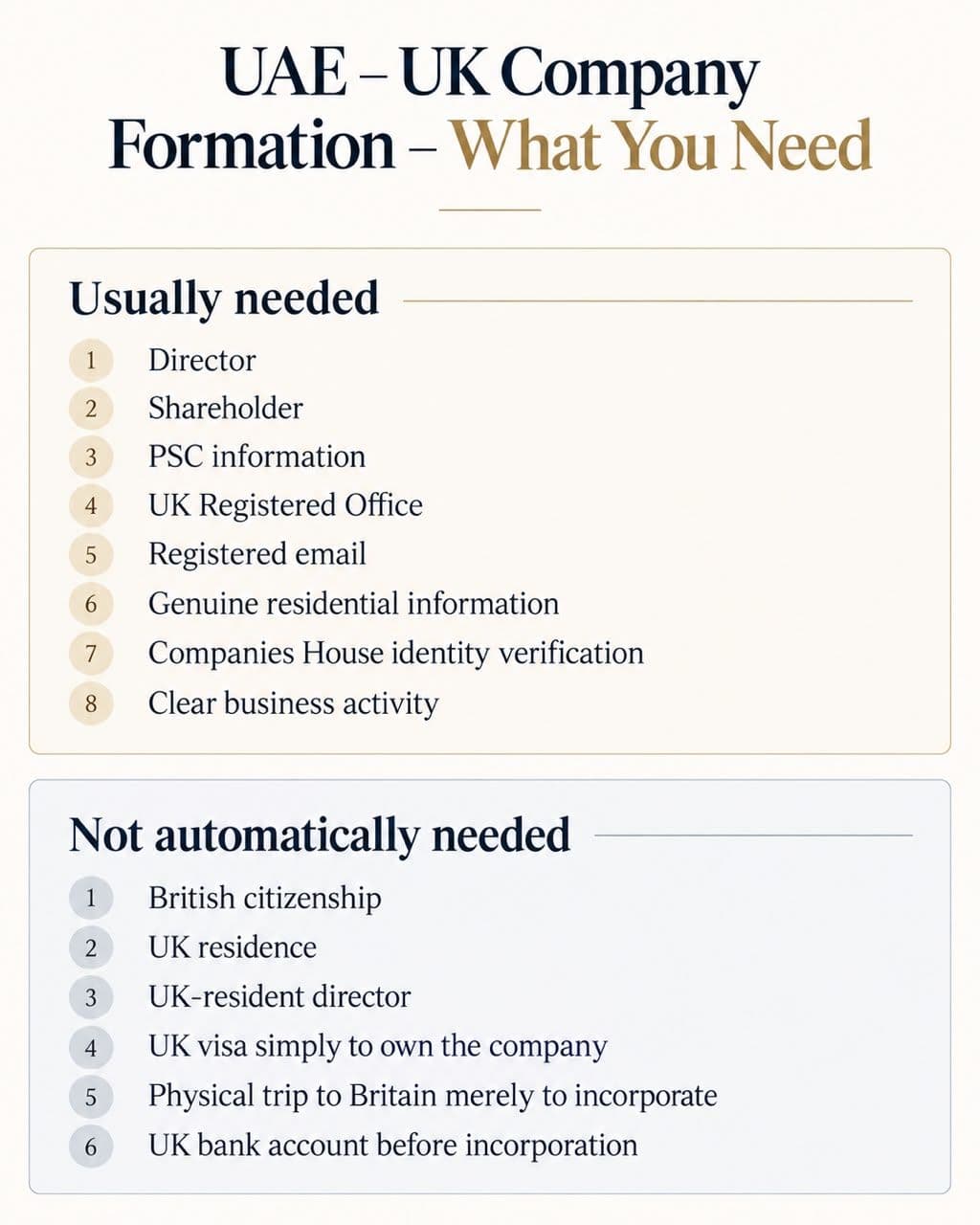
Before filing, you should know:
- what the UK company will actually do;
- whether you or an existing UAE company should own it;
- who the directors, shareholders and PSCs will be;
- which UK addresses are required;
- how Companies House identity verification applies;
- what documents to prepare;
- what the first-year setup and renewal costs are;
- and what happens after Companies House accepts the company.
Company formation, banking, tax and immigration are separate questions. A good UAE-to-UK structure does not assume that success in one automatically solves the others.
Important scope
This guide is for people already resident in the UAE, or UAE businesses, that want to establish a UK company.
If you are based in Britain and want to establish a Dubai or UAE company, this is not the correct guide.
That distinction is deliberate.
Can a UAE Resident Form a UK Company? Quick Answer
Can a UAE resident register a UK company?
Answer: Yes, generally.
Can a Dubai resident own 100% of a UK Ltd?
Answer: Yes. A single shareholder can own the entire company.
Can the shareholder also be the only director?
Answer: Yes.
Does the director need to live in the UK?
Answer: No. UK private-company directors do not generally need to live in Britain.
Do you need a UK Registered Office?
Answer: Yes. It must meet Companies House requirements for an appropriate physical UK address.
Do you need to travel to Britain simply to incorporate?
Answer: Not generally.
Do you need a UK bank account before incorporation?
Answer: No.
Does incorporation guarantee banking or payment-provider approval?
Answer: No.
Does Companies House identity verification matter in 2026?
Answer: Yes. For a new company, Companies House currently asks for the personal code of each director as part of the registration filing. PSCs are also subject to identity-verification requirements, but their code-submission timing follows separate rules.
What is the current online Companies House incorporation fee?
Answer: £100.
Companies House currently says online companies are usually registered within 24 hours. That is Companies House processing time, not the full KYC and onboarding process.
1. How to Register a UK Company from the UAE: Step by Step
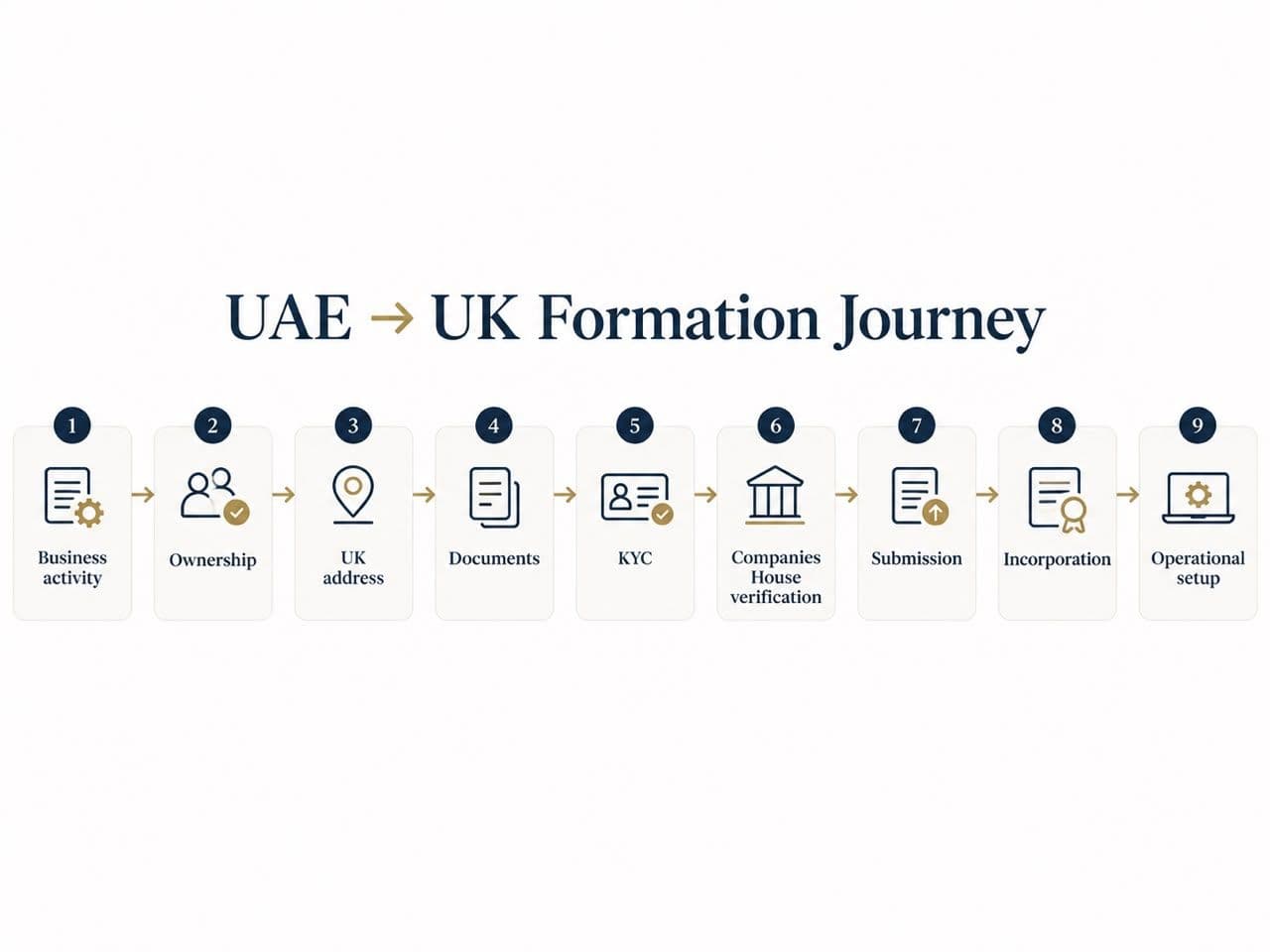
This is the core process.
Step 1 — Define what the UK company will do
Be able to explain:
- the product or service;
- how the company earns revenue;
- where customers are located;
- where suppliers are located;
- which markets the company will serve.
Avoid vague descriptions such as:
“general trading”
or:
“online services”
when the real activity can be described more precisely.
Step 2 — Decide who should own the company
The company might be owned by:
- one UAE-resident founder;
- several founders;
- an existing UAE company.
Make this decision before incorporation.
Changing ownership afterwards can create additional legal, tax, banking and administrative work.
Step 3 — Appoint the director or directors
A private UK company needs at least one director.
The director does not need to live in the UK.
Step 4 — Decide the share structure
Confirm:
- shareholder names;
- number of shares;
- ownership percentages;
- share class where relevant.
For a straightforward founder company, a simple ordinary-share structure is often sufficient unless there is a genuine commercial reason for something more complex.
Step 5 — Identify the PSCs
Companies House requires the company to identify relevant People with Significant Control.
For example, a person holding more than 25% of the shares or voting rights may fall within the PSC rules, although other control tests also exist.
Step 6 — Choose the company name
Check:
- availability;
- Companies House naming restrictions;
- similarity to existing registered names;
- restricted words where applicable.
Step 7 — Choose the correct SIC code
The SIC code should reflect the company’s genuine activity.
Do not choose an inaccurate code because somebody claims a particular activity is “better for banking”.
Step 8 — Arrange the UK Registered Office
The company must have an appropriate UK Registered Office before registration.
It must be in the same UK jurisdiction in which the company is registered and satisfy Companies House’s appropriate-address requirements.
Step 9 — Prepare identity and residential information
Relevant directors and shareholders should prepare the required identity and residential-address information before onboarding begins.
Step 10 — Complete provider KYC
Where you use a formation provider, the provider conducts its own customer due diligence.
This is separate from Companies House identity verification.
Step 11 — Complete Companies House identity verification
For new company registrations, Companies House currently requires the personal code for each director as part of the registration filing.
PSCs must also verify their identity and provide their personal code according to the timing rules that apply to them.
Step 12 — Review the application
Before submission, check:
- company name;
- Registered Office;
- registered email;
- director details;
- shareholders;
- PSCs;
- share structure;
- SIC codes.
Step 13 — Submit to Companies House
The current standard online Companies House fee is £100.
Companies House currently says a straightforward online registration is usually completed within 24 hours.
That does not mean the entire formation process takes 24 hours.
KYC, document collection, ownership review and identity verification happen before submission.
Step 14 — Check the company after incorporation
Once Companies House accepts the filing:
- review the public record;
- check the director and shareholder information;
- verify the Registered Office;
- confirm the SIC code;
- retain the Certificate of Incorporation and formation documents.
Then move into operational setup.
read our post-incorporation guide : What to Do After UK Company Formation as a Non-Resident .
2. Should You Own the UK Company Personally or Through a UAE Company?
This decision should be made before incorporation.
Option A — Founder-owned UK Ltd
Structure
UAE-resident founder
↓
100% shareholder
↓
UK Limited Company
This can suit a new standalone venture that is separate from any existing UAE company.
For example, a Dubai-based consultant or technology founder may establish a personally owned UK company for a new international business.
Option B — UAE company owns the UK company
Structure
Existing UAE company
↓
100% corporate shareholder
↓
UK Limited Company
This may be more appropriate where an established UAE business is genuinely expanding into the UK.
Corporate ownership can affect:
- group accounting;
- beneficial-ownership disclosures;
- banking;
- intercompany transactions;
- tax;
- transfer pricing;
- contracts.
Do not choose personal ownership merely because it looks easier during incorporation if the commercial reality is that the UK operation belongs to an existing UAE group.
Explore our guide to UK Subsidiary vs Branch for Overseas Companies .
compare UK Company vs UAE Company
Not sure whether the UK company should be owned personally or by your UAE company?
If you already operate a UAE company, it is worth reviewing the ownership structure before incorporation. Choosing between personal ownership and UAE-company ownership at the start can avoid unnecessary restructuring later.
Check My UAE-to-UK Company Setup
3. What You Need Before Applying
A clean UAE-to-UK formation file usually starts with the following information.
Valid identity document
A current passport will commonly be relevant to onboarding and identity verification.
Genuine UAE residential information
Use the address where you actually live.
Do not use the UK company’s Registered Office as though it were your UAE residential address.
Emirates ID where relevant
An Emirates ID can be useful evidence in some onboarding processes.
It should not, however, be treated as universally sufficient for every:
- KYC process;
- Companies House verification route;
- bank;
- fintech;
- payment provider.
Requirements vary.
Clear business activity
Be ready to explain:
- what the company sells;
- who buys it;
- where customers are;
- where suppliers are;
- expected turnover;
- how the company earns revenue;
- expected transaction flows.
Ownership information
Confirm:
- directors;
- shareholders;
- ownership percentages;
- PSCs.
Source of funds where relevant
A bank, fintech or compliance provider may later ask how the company will initially be funded.
The explanation should match the genuine facts and supporting evidence.
The strongest application is not the one with the most documents. It is the one where identity, residence, ownership, activity and expected transactions tell one consistent story.
4. KYC and Companies House Identity Verification Are Different
This distinction is especially important under the current Companies House regime.
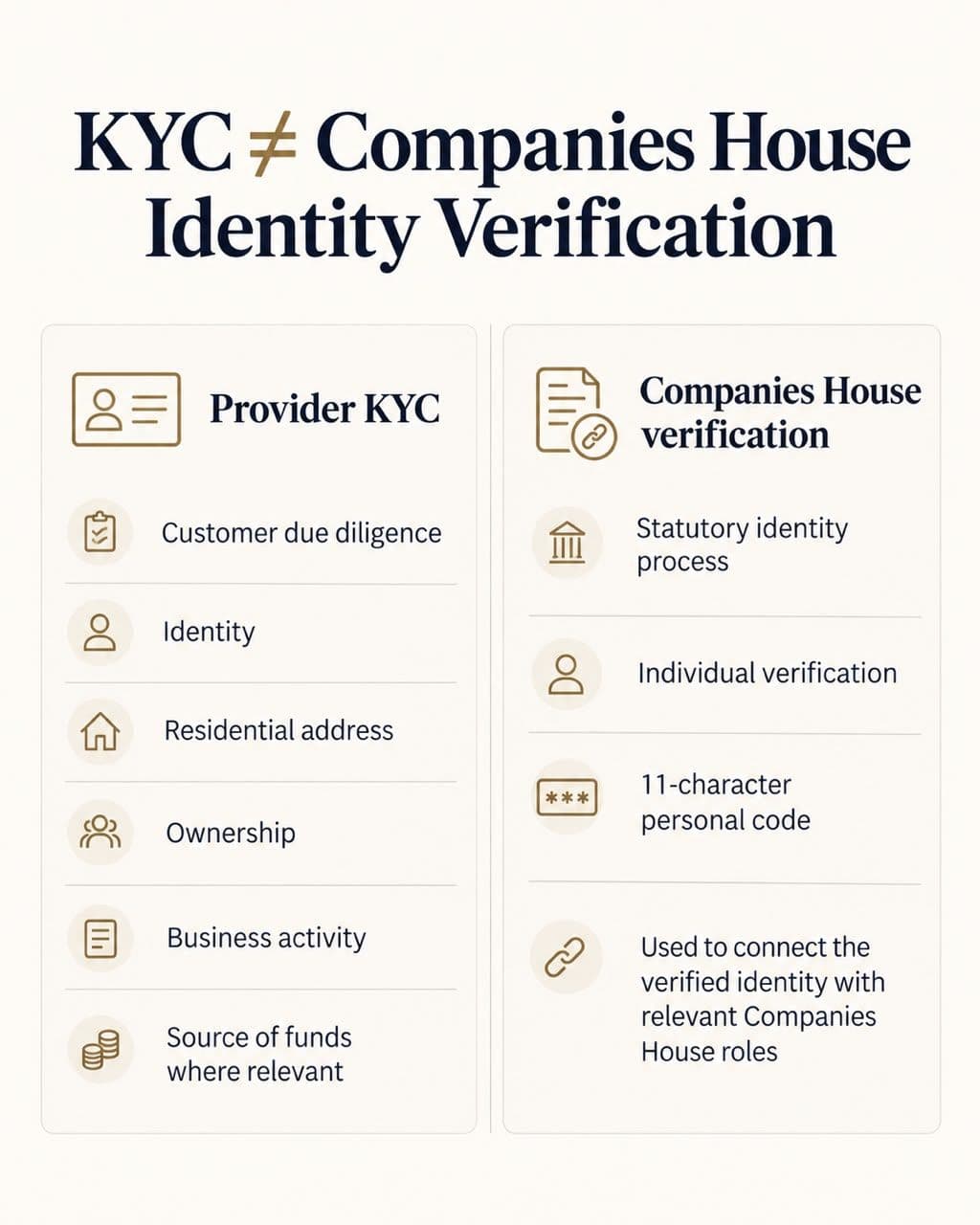
Provider KYC
A professional formation provider may carry out checks covering:
- identity;
- residential address;
- directors;
- shareholders;
- beneficial owners;
- business activity;
- source of funds where relevant.
This is part of the provider’s own AML and customer-due-diligence responsibilities.
Companies House identity verification
Companies House operates a separate statutory identity-verification system.
The personal code issued after successful verification contains 11 characters and belongs to the individual rather than to any particular company.
For a new company, Companies House currently requires each director’s personal code as part of the registration filing.
PSCs must also verify and provide their personal codes according to the separate timing rules applicable to PSCs.
Passing your formation provider’s KYC does not, by itself, mean your Companies House identity-verification requirement has been completed.
Seven Oak provides assistance for international directors who need help with the Companies House verification process.
Standalone assistance: £74 for one director.
Need help completing Companies House identity verification?
Get support with Companies House identity verification
5. UK Address Requirements for UAE Residents
A UAE resident does not need to personally live in Britain.
The UK company does need an appropriate Registered Office.
Companies House requires the Registered Office to be an appropriate physical UK address in the relevant jurisdiction.
Several different addresses may be relevant.
Registered Office
Purpose: Statutory company address
Public: Yes
This is the company’s official Companies House address.
Director Service Address
Purpose: Director’s public correspondence address
Public: Yes
This does not have to be the director’s home address.
Residential Address
Purpose: Director’s genuine home address
Public: Not displayed in the same way as the service address
A UAE-resident director should provide their genuine residential details when required.
Virtual Business Address
Purpose: Commercial correspondence where appropriate
Public: Depends on use
A Virtual Business Address should not be described as staffed operating premises if the business does not genuinely operate from that location.
Understand the Difference Between a Registered Office and Director Service Address
These addresses serve different legal purposes and should not be treated as interchangeable.
Compare Registered Office vs Director Service Address
Don’t Have Your Own UK Address?
You can still form a UK company as a non-resident if you use a suitable UK address service that meets Companies House requirements.
See How to Form a UK Company Without Your Own UK Address
6. UK Company Formation Cost from the UAE
The current standard Companies House online incorporation fee is:
Companies House digital incorporation
Current fee: £100
Paid to: Companies House
Included in Seven Oak formation packages: Yes
Companies House fees can change, so the official fee should always be checked before filing.
The statutory filing fee is not the same as the complete cost of setting up and maintaining the company.
A UAE founder may also require:
- Registered Office;
- Director Service Address;
- Virtual Business Address;
- Companies House identity-verification assistance;
- accounting;
- banking preparation;
- VAT;
- EORI.
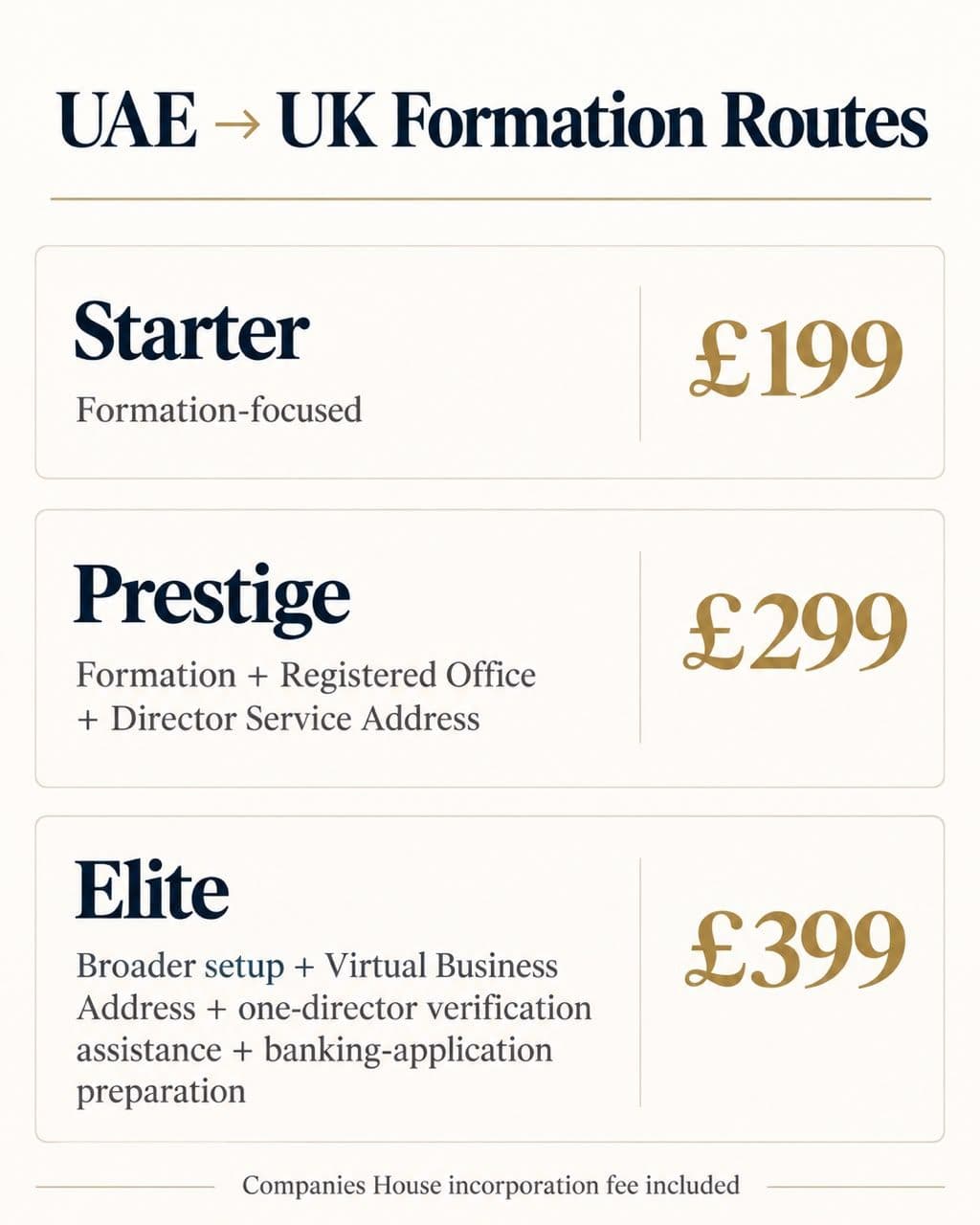
Starter — £199
Companies House incorporation fee: Included
Designed for:
Founders who already have suitable UK address arrangements.
Primary role:
Formation-focused support.
Prestige — £299
Companies House incorporation fee: Included
Includes:
- company formation;
- Registered Office;
- one Director Service Address;
- banking guidance.
Relevant year-two address renewal
Registered Office: £59/year
Director Service Address: £35/year
Combined relevant address renewal: £94/year
Elite — £399
Companies House incorporation fee: Included
Includes Prestige plus:
- Virtual Business Address for 12 months;
- Companies House identity-verification assistance for one director;
- business-profile review;
- practical support preparing the business-banking application and required information.
Financial-provider approval remains entirely with the provider.
Relevant year-two address renewal
Registered Office: £59/year
Director Service Address: £35/year
Virtual Business Address: £150/year
Combined relevant address renewal: £244/year
Other services where relevant
VAT registration support: £144
EORI registration support: £60
Do not choose a package based only on the first-year headline price.
For a non-resident founder, compare:
first-year cost + what is included + what renews + what still needs to be arranged separately.
Want to See the Full First-Year and Renewal Cost Breakdown?
Compare the statutory filing fee, formation packages, address renewals and common add-on costs before choosing a setup.
See the Full UK Company Formation Cost Guide for Non-Residents.
7. How Long Does UK Company Formation Take from the UAE?
There are two different timelines.
Companies House processing
Companies House currently says an online company is usually registered within 24 hours.
This is the government processing stage.
Full provider process
Before submission, a professional provider may need to complete:
- onboarding;
- identity-document collection;
- residential-address review;
- KYC;
- ownership checks;
- Companies House identity verification;
- SIC-code review;
- address preparation.
For a straightforward Seven Oak formation, a practical end-to-end timeframe is commonly around 3–5 working days once the required information and compliance documents are available.
This is not guaranteed.
The process can take longer where there are:
- missing documents;
- multiple shareholders;
- corporate shareholders;
- complex ownership;
- additional compliance questions.
24-hour Companies House processing is not the same as a 24-hour complete international company setup.
8. Banking and Payment Providers Are Separate from Incorporation
A Certificate of Incorporation confirms that the UK company legally exists.
It does not require a bank, EMI, fintech or payment processor to accept the business.
A provider may separately assess:
- founder residence;
- nationality;
- ownership;
- beneficial owners;
- business activity;
- source of funds;
- customer countries;
- supplier countries;
- expected turnover;
- expected currencies;
- transaction routes;
- website and commercial evidence.
This means a UAE resident can be completely eligible to form a UK company while still being subject to separate financial-provider eligibility checks.
The same principle applies to providers such as:
- Wise;
- Revolut;
- Airwallex;
- Stripe;
- Payoneer;
- Shopify Payments.
Do not form a UK company solely because somebody promises approval from one particular provider.
Planning Your UK Business Banking from the UAE?
Forming the company and opening a business account are separate stages. Before applying, check whether your ownership, business activity, customer countries and expected transactions fit the provider’s eligibility requirements.
Explore our guide to UK Business Bank Accounts for UAE Residents .
9. UK–UAE Tax, VAT and EORI
Company formation should not be confused with tax analysis.
A UK-incorporated company may have UK Corporation Tax, reporting, payroll, VAT or other obligations depending on its activities, profits, management and transactions.
UAE residence can create separate cross-border questions.
The UK and UAE have a comprehensive Double Taxation Convention in force. The Convention was subsequently modified by the Multilateral Instrument. The relevant MLI modifications became effective from 1 January 2020 for withholding taxes and from 1 April 2020 for UK Corporation Tax.
The existence of the treaty does not mean:
- UK tax automatically disappears;
- every UAE-resident owner receives the same outcome;
- UAE tax becomes irrelevant;
- treaty relief applies automatically.
HMRC also makes clear that treaty relief can depend on the relevant income type and the applicable conditions being satisfied.
VAT
A UAE resident does not automatically need UK VAT registration merely because they own a UK company.
VAT depends on the actual business.
EORI
An EORI number becomes relevant to certain customs activity.
It is not a universal company-formation requirement.
Need to Understand the UK–UAE Tax Position?
Forming a UK company from the UAE does not automatically settle the company’s UK tax position or the founder’s UAE tax position. Cross-border treatment can depend on where the company is managed, what it earns, how profits are distributed and whether treaty provisions apply.
Explore our guide to UK Company Tax for UAE Residents .
10. Which Structure Fits Your Situation?
Different UAE founders can use the same UK company form for very different businesses.
Consultant or agency founder
Main formation issues:
Ownership
Contracting entity
UK address
Banking readiness
Accounting
A straightforward personally owned company may be appropriate where this is a genuinely separate founder business.
SaaS or technology founder
Additional issues:
Intellectual property
Subscriptions
Payment processing
Investors
Cross-border management
E-commerce founder
Additional issues:
Stock
Fulfilment
Imports
VAT
EORI
Marketplaces
Payment infrastructure
Internal link: UK E-Commerce Company for Non-Residents
https://www.sevenoakprestige.com/blog/uk-ecommerce-company-non-residents-2026
Existing UAE company entering Britain
Main structural question:
Should the UK operation be:
- a subsidiary;
- a UK establishment/branch;
- or another structure?
Compare UK Subsidiary vs Branch for Overseas Companies .
11. Common Mistakes UAE Founders Should Avoid
Mistake 1 — Forming the company only for banking or Stripe
A UK company should have a genuine commercial purpose.
Mistake 2 — Confusing UAE residence with nationality
A founder can live in the UAE while holding another nationality.
Providers can assess those facts separately.
Mistake 3 — Assuming Emirates ID solves every verification requirement
Different organisations have different document requirements.
Mistake 4 — Using the UK Registered Office as though it were your personal residence
Your company address and your genuine home address serve different purposes.
Mistake 5 — Choosing an inaccurate SIC code to appear lower risk
The SIC code should reflect the genuine activity.
Mistake 6 — Choosing personal ownership when the UAE company should own the UK entity
Review ownership before incorporation.
Mistake 7 — Treating incorporation as the finish line
The Certificate of Incorporation does not automatically create:
- banking;
- accounting;
- tax compliance;
- VAT registration;
- EORI;
- payment-provider approval.
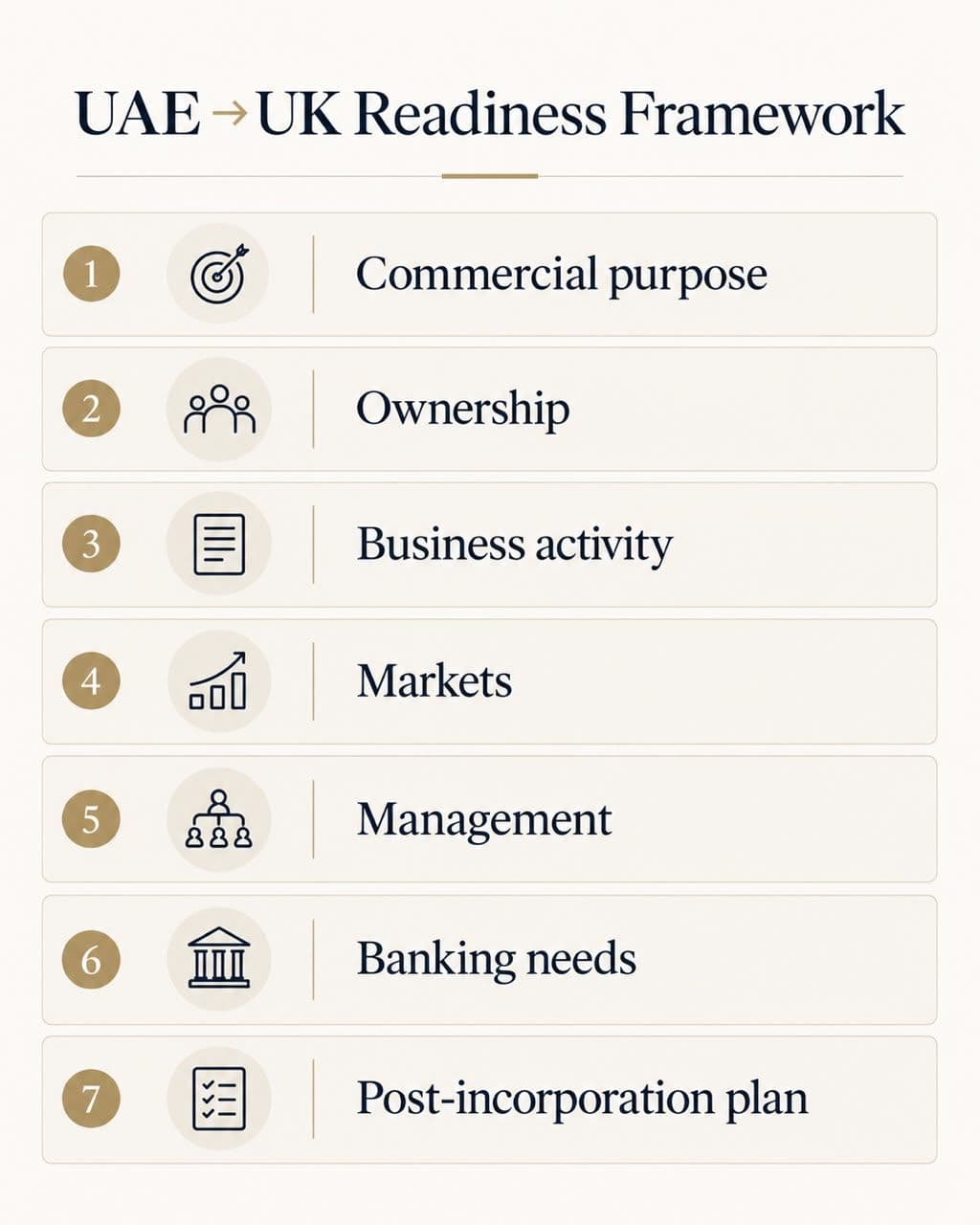
12. UAE → UK Company Readiness Check
Before filing, answer these seven questions.
1. Why does the business need a UK company?
The answer should be commercial.
Examples might include:
- UK customers;
- international contracts;
- UK market entry;
- a formal UK subsidiary;
- international SaaS activity.
2. Who should own it?
You personally?
Co-founders?
An existing UAE company?
3. What exactly will it sell?
You should be able to explain the activity clearly in one or two sentences.
4. Where will the customers be?
UK?
UAE?
Europe?
United States?
International?
5. Where will the business be managed?
This can become relevant to tax, accounting and substance analysis.
6. What financial functions does the business actually need?
Examples:
- GBP collection;
- EUR collection;
- supplier transfers;
- subscription payments;
- card processing;
- marketplace payouts.
7. What happens after incorporation?
Plan for:
- banking;
- accounting;
- tax;
- VAT/EORI where relevant;
- contracts;
- website;
- payment providers;
- annual compliance.
If these answers are unclear before incorporation, it is usually better to clarify the structure first rather than create a company and solve the contradictions afterwards.
13. What Seven Oak Will Not Promise
Seven Oak will not guarantee:
- a UK bank account;
- Wise;
- Revolut;
- Airwallex;
- Stripe;
- Shopify Payments;
- VAT registration;
- immigration rights.
We will not recommend hiding your actual country of residence.
We will not describe a statutory UK address as genuine staffed operating premises where no business operations take place.
We will not create artificial shareholders or directors simply to make an application appear easier.
And we will not tell a UAE resident that forming a UK Ltd automatically removes UK or UAE tax considerations.
A credible international company should be accurate, consistent and commercially explainable.
14. How Seven Oak Supports UAE Founders
The standard process is:
Step 1 — Select the appropriate package
Choose Starter, Prestige or Elite according to the support and UK address infrastructure required.
Step 2 — Complete payment
Payment is made before substantive onboarding begins.
Step 3 — Provide the company information
Including:
- proposed name;
- activity;
- directors;
- shareholders;
- ownership;
- UK address requirements.
Step 4 — Complete KYC
Relevant directors and shareholders provide the required identity and residential-address information.
Step 5 — Complete Companies House identity verification
Relevant directors complete the current Companies House verification process and provide their personal code for incorporation.
Step 6 — Review the company structure
Seven Oak reviews:
- ownership;
- directors;
- shareholders;
- PSCs;
- share structure;
- SIC code;
- UK address setup;
- filing information.
Step 7 — Submit to Companies House
Submission takes place once the onboarding file is ready.
Step 8 — Move into post-incorporation support
Depending on the package and business, this may include:
- statutory-address administration;
- banking-application preparation;
- accounting coordination;
- VAT;
- EORI;
- compliance planning.
Companies House, HMRC, banks, fintechs, payment processors and other third parties retain their own final decision-making authority.
Check Your UAE-to-UK Company Setup
You do not need to send a long questionnaire first.
Start with three points:
1. Where in the UAE do you live?
Dubai, Abu Dhabi or another Emirate.
2. What does the business actually do?
One clear description is enough to start.
3. Who should own the UK company?
- you personally;
- your existing UAE company;
- multiple shareholders.
Check My UAE-to-UK Company Setup
Frequently Asked Questions
Can a UAE resident form a UK company?
Yes, generally.
A private-company director does not have to live in Britain.
Can a Dubai resident own 100% of the UK company?
Yes.
A single shareholder can own the whole company and can also act as its sole director.
Do I need a UK-resident director?
No general Companies House rule requires an ordinary private-company director to live in the UK.
Do I need to travel to the UK?
Not generally simply to incorporate a standard company.
Do I need a UK Registered Office?
Yes.
It must satisfy Companies House’s physical-address, jurisdiction and appropriate-address requirements.
Can I use a professional Registered Office?
Yes, provided you have permission to use it and it satisfies the Companies House requirements.
What does Companies House charge?
The current standard online incorporation fee is £100. Fees can change, so check the official rate before filing.
How long does Companies House registration take?
Companies House currently says online companies are usually registered within 24 hours.
That does not include formation-provider KYC, document collection, ownership review or identity verification.
Do UAE-based directors need Companies House identity verification?
For a new company registration, each director must provide their Companies House personal code as part of the registration filing. PSCs are also subject to identity-verification requirements but have separate code-submission timing rules.
Can my UAE company own the UK Ltd?
Potentially, yes.
An existing UAE company can be a corporate shareholder where that structure reflects the genuine commercial relationship.
Do I need a UK bank account before incorporation?
No.
Banking is separate from company formation.
Does forming the UK company guarantee Wise, Revolut or Stripe?
No.
Each provider applies its own eligibility, KYC/KYB and risk criteria.
Does living in Dubai mean the UK company pays no UK tax?
No.
The founder’s UAE residence and the UK company’s tax obligations are separate questions. Forming or managing a UK company while living in Dubai does not, by itself, remove UK Corporation Tax, filing or other potential UK tax obligations.
The actual position depends on factors such as the company’s activities, profits, management, transactions and wider cross-border structure.
For the UAE-specific tax considerations, read our UK Company Tax for UAE Residents guide.
Related UAE and Non-Resident Guides
UK Company vs UAE Company
Use this if the founder has not yet decided which jurisdiction or overall structure fits the business.
UK Business Bank Account for UAE Residents
Use this for provider eligibility, banking readiness and financial-provider onboarding.
UK Company Tax for UAE Residents
Use this for Corporation Tax, UAE tax, treaty and management/residence issues.
Companies House Identity Verification Assistance
Use this for practical support with Companies House verification.
Registered Office vs Director Service Address
Use this for the difference between statutory company, director and residential addresses.
UK Company Formation Without Your Own UK Address
Use this for non-residents without their own premises in Britain.
UK Company Formation Cost for Non-Residents
Use this for first-year costs, renewal costs and package comparisons.
UK Subsidiary vs Branch for Overseas Companies
Use this for established UAE companies entering the UK.
UK E-Commerce Company for Non-Residents
Use this for stock, VAT, EORI, fulfilment and e-commerce infrastructure.
Post-Incorporation Checklist
Use this after the company has been incorporated.
About the Author
Isaac Jackson
Founder & Managing Director — Seven Oak Prestige Ltd
Isaac Jackson supports international founders and overseas businesses establishing and operating UK companies, including founders requiring support with company formation, statutory addresses, Companies House administration, KYC preparation, compliance coordination and banking readiness.
Seven Oak Prestige Ltd
Company Registration No. 16903092
Registered Office: 124 City Road, London EC1V 2NX, United Kingdom
Editorial Methodology
This guide was prepared specifically for the search intent:
How can a UAE resident or UAE business form a UK company in 2026?
It deliberately covers the:
UAE → UK
direction only.
It does not attempt to answer the different question of how someone in Britain should establish a Dubai or UAE company.
The article was reviewed against:
- current Companies House incorporation guidance;
- current director and shareholder requirements;
- current Registered Office requirements;
- current Companies House identity-verification and personal-code guidance;
- the current online incorporation fee;
- the UK–UAE Double Taxation Convention and MLI position;
- Seven Oak’s dedicated UAE banking, tax and structural resources;
- recurring practical issues arising in international-founder onboarding.
Last reviewed: 27 September 2026
Editorial Disclaimer
This guide provides general information about UK company formation.
It does not constitute personalised:
- legal advice;
- tax advice;
- accounting advice;
- immigration advice;
- banking advice;
- financial-services advice.
Cross-border consequences can depend on:
- nationality;
- residence;
- ownership;
- management location;
- business activity;
- source of funds;
- customers and suppliers;
- tax residence;
- transaction flows.
Where a proposed UAE–UK structure involves material tax, legal, group-company or regulated-business issues, appropriately qualified professional advice may be required.
Companies House, HMRC, UAE authorities, banks and payment providers make their own decisions.
Primary Official Sources Reviewed
Companies House / GOV.UK — Register Your Company
Used to verify the current £100 online incorporation fee, current processing statement and registration-stage personal-code requirement.
Companies House — When You Need to Verify Your Identity
Used to verify the current director and PSC timing rules, including the requirement for director personal codes on new registrations.
Companies House — Personal Codes for Identity Verification
Used to verify that the code contains 11 characters, belongs to the individual and is reused across relevant Companies House roles.
Companies House — Incorporation and Names
Used to verify the current digital incorporation fee and processing position.
GOV.UK — Register a Private or Public Company
Used to verify the current £100 online fee and £124 paper fee.
HMRC — United Arab Emirates Tax Treaties
Used to verify the UK–UAE Double Taxation Convention and the MLI effective dates.
HMRC — UAE Treaty Summary
Used to confirm that treaty outcomes depend on the relevant income and applicable conditions rather than automatic relief.