
UK Business Bank Account for UAE Residents: Complete 2026 Guide for Dubai Founders & UK Companies
UK Banking, Fintech Eligibility, KYC, Proof of Address, Revolut, Wise, Airwallex, Multi-Currency Payments & Banking Readiness Explained
Updated: August 2026
Establishing a UK Limited Company while living in Dubai, Abu Dhabi or elsewhere in the United Arab Emirates is one question.
Getting the company properly banked is another.
A UAE resident may be legally entitled to own and direct a UK Limited Company, yet still discover that the bank or fintech provider they expected to use does not support their residence, business activity, ownership structure or transaction profile.
That distinction is fundamental:
UK company formation does not automatically create UK business banking eligibility.
Companies House decides whether a company can be incorporated.
A bank, electronic money institution or payment provider makes a separate commercial and compliance decision about whether it wants to provide financial services to that business.
For UAE-based founders, that second decision can depend on considerably more than having a Certificate of Incorporation.
A provider may assess:
- where the directors actually live;
- directors’ nationalities;
- shareholders and ultimate beneficial owners;
- where the company actually operates;
- why a UK company is required;
- why UK banking is required;
- the company’s customers;
- supplier countries;
- expected turnover;
- currencies used;
- transaction values;
- transaction frequency;
- source of business funds;
- source of the founder’s wealth;
- website and digital presence;
- contracts and invoices;
- the company’s industry;
- regulated or higher-risk activities;
- countries from which money will be received;
- countries to which money will be sent.
That is why the question should not simply be:
“Which bank accepts UAE residents?”
A better question is:
“Which banking structure is suitable for this particular UK company, with this UAE-based owner, this business activity and these expected transactions?”
This complete guide explains that decision from beginning to end.
Quick Answer: Can a UAE Resident Open a UK Business Bank Account?
Potentially, yes — but not with every provider and not automatically.
A UAE resident who owns a UK Limited Company may have banking or fintech options, but the appropriate route depends on the exact business and current provider eligibility.
Traditional UK banks often have stricter requirements for overseas directors and international ownership.
Digital banking and fintech providers may offer more remote onboarding, but they still impose their own:
- residency requirements;
- business-location requirements;
- industry restrictions;
- KYC requirements;
- ownership requirements;
- trading-address requirements.
Official UK government guidance recognises that opening a UK business bank account for an overseas-owned or overseas-managed business can take substantially longer and can involve additional checks on directors, owners and foreign investors. A bank may also want a UK business plan explaining why the company genuinely requires UK banking.
So the answer is not:
“Yes, every UAE resident can obtain a UK bank account.”
Nor is it:
“No, you must live in Britain.”
The accurate answer is:
UAE-based directors can have viable banking routes, but eligibility must be assessed provider by provider and business by business.
Assess My UK Banking Readiness
1. UAE Residence and UK Company Ownership Are Separate Questions
A founder can genuinely live in Dubai while owning a British company.
For example:
Nationality: French
Residence: Dubai, UAE
Company: UK Limited Company
Registered Office: London
There is nothing inherently contradictory about that structure.
Likewise:
Nationality: Indian
Residence: Abu Dhabi
Company: UK Limited Company
can also be perfectly coherent.
The important point is that:
nationality
is not the same as:
residence
and neither is the same as:
company jurisdiction.
This distinction becomes particularly important during financial onboarding.
A bank might support:
- a UK company;
- a French owner;
- but not a UAE-resident applicant under a particular product.
Another provider may accept the same profile.
Therefore, founders should never assume that because Companies House accepted the incorporation, a particular bank must accept the banking application.
If you have not yet established the company, begin with our complete guide to starting a UK company from the UAE.
If you are still deciding whether a British or UAE entity is more appropriate, read our UK Company vs UAE Company comparison guide before making the banking decision.
2. Company Formation and Banking Are Two Separate Compliance Processes
This is one of the most important principles for non-resident founders.
Companies House asks:
- Who are the directors?
- Who are the shareholders?
- Who controls the company?
- What is the registered office?
- What is the company name?
- What activities are represented by the SIC codes?
- Have relevant identity-verification obligations been met?
A financial institution asks additional questions:
- What does the business actually do?
- Who are its customers?
- Where are they?
- Who are the suppliers?
- Where does the money originate?
- Where will it go?
- Why does the business need this account?
- What volume is expected?
- Is the activity inside the provider’s risk appetite?
This is why receiving a Certificate of Incorporation is not a banking approval.
It is only the beginning of the operating setup.
For the wider post-incorporation sequence, see our complete post-formation checklist for non-resident UK company owners.
3. Why UAE Residents Can Face Additional Banking Questions
The UAE is one of the world’s most international business centres.
That creates significant legitimate cross-border business activity, but it also means a UAE-based applicant can have a more international profile than a straightforward UK domestic company.
Consider the following example:
Director: Indian national resident in Dubai
Company: UK Ltd
Customers: UK, Germany and Saudi Arabia
Suppliers: UAE and India
Currencies: GBP, EUR, USD and AED
For a financial institution, that means understanding several different relationships.
The provider may want to know:
- why the company is British;
- why the director is in UAE;
- why suppliers are in India;
- why payments come from Germany;
- why money is sent to UAE;
- what each transaction represents.
None of these features necessarily makes the company unsuitable.
But they make clarity more important.
A coherent business is generally easier to explain than an unexplained collection of jurisdictions.
4. What Does “UK Business Bank Account” Actually Mean?
Online articles frequently use several different products interchangeably.
They should not.
There are at least three distinct categories.
Traditional business bank account
A regulated bank may provide:
- current account;
- deposits;
- cards;
- lending;
- overdrafts;
- trade finance;
- relationship management;
- other banking products.
Traditional banks can be particularly useful for established or complex businesses.
Business.gov.uk notes that traditional banks may be more suitable for complicated structures and specialist services such as cash handling, borrowing and letters of credit.
Fintech or digital business account
A fintech or EMI can potentially provide:
- GBP account details;
- EUR accounts;
- USD accounts;
- transfers;
- FX;
- cards;
- payment integrations;
- expense management.
But the regulatory structure and available products may differ from those of a traditional deposit-taking bank.
Payment processor / merchant account
Stripe, PayPal and similar services primarily solve another problem:
accepting customer payments.
They are not substitutes for understanding the business’s primary financial account structure.
A founder may therefore need:
business account + payment processor
rather than choosing between the two.
5. Traditional UK Bank or Fintech — Which Is Better for a UAE Resident?
There is no universal winner.
Traditional UK banking may make more sense for:
- established companies;
- larger businesses;
- UK subsidiaries of international groups;
- businesses requiring credit;
- complex ownership;
- trade finance;
- letters of credit;
- substantial UK operations;
- businesses seeking long-term UK banking relationships.
Fintech providers can be attractive for:
- remote founders;
- digital businesses;
- SaaS;
- consulting;
- e-commerce;
- international transfers;
- multi-currency requirements;
- companies requiring API integrations.
Official UK guidance notes that digital providers are often quicker to establish, while traditional banks can offer a broader range of banking and financing services.
The correct solution should be selected around the business requirement, not simply whichever application appears fastest.
6. What Documents Can a UAE Resident Be Asked to Provide?
Requirements vary, but a well-prepared UAE-based founder should expect to provide several layers of documentation.
UK company documents
Potentially:
- Certificate of Incorporation;
- Memorandum and Articles of Association;
- Companies House information;
- ownership structure;
- shareholder details;
- director details;
- registered office;
- company registration number.
Personal identity
Typically:
- passport;
- national identity document where accepted;
- liveness/selfie verification.
UAE residence evidence
Potentially:
- Emirates ID;
- UAE residence visa;
- other residence documentation.
Residential proof
Potentially:
- UAE bank statement;
- utility bill;
- tenancy documentation;
- other provider-approved evidence.
Business evidence
Depending on stage:
- website;
- business plan;
- contracts;
- signed agreements;
- invoices;
- supplier documentation;
- customer documentation;
- financial projections;
- existing business statements.
Financial evidence
Potentially:
- personal bank statements;
- business bank statements;
- audited accounts;
- management accounts;
- source-of-funds evidence;
- investment/funding agreements.
Airwallex, for example, states that its UK company verification can involve the Certificate of Incorporation, constitutional documents, photo ID and residential-address information for directors and UBOs, and additional supporting documents depending on the business.
Wise similarly states that UK/EEA business verification can include the company’s registered and trading addresses, business activities, intended use, expected volumes, source of business funds, UBO information and directors’ countries of residence.
7. Emirates ID Is Not Always the Same as Proof of Residential Address
This distinction can cause unnecessary delays.
An Emirates ID demonstrates identity and UAE status in relevant circumstances.
But if a provider asks:
“Provide a document showing your current residential address.”
the provider may still require another document showing the actual address.
For example:
- bank statement;
- utility document;
- tenancy-related document;
- another approved document.
Do not assume that one document automatically answers every KYC requirement.
And never alter your residential information merely because a particular document is easier to provide.
The address declared should reflect where you genuinely reside.
8. UAE Residential Address vs UK Registered Office
A UK company’s registered office is not the director’s home address.
Example:
UK company registered office:
124 City Road, London
Director’s genuine residence:
Dubai, UAE
When a bank asks for:
company registered address
the London address may be relevant.
When it asks:
where does the director live?
the correct answer is the genuine UAE residential address.
When it asks:
where does the business actually operate?
the answer may be another location entirely.
This distinction is important because providers increasingly distinguish between:
- registered office;
- business/trading address;
- residential address.
Wise, for example, specifically states that a trading address must represent a genuine physical place where the business operates and cannot simply be a mail-forwarding service, virtual office or registration agency. Wise also allows registered and trading addresses to be in different countries, subject to its support rules and verification.
For the complete distinction, read our UK Registered Office vs Director Service Address guide.
9. Why Your UK Business Rationale Matters
One of the most important banking questions may never appear exactly as:
“Why did you incorporate in Britain?”
But the provider will often need to understand the answer.
Compare these two cases.
Case A — coherent UK purpose
A Dubai-resident software consultant:
- serves UK businesses;
- invoices in GBP;
- signs UK contracts;
- plans to hire a British account manager;
- operates through a UK Ltd.
The UK structure has an understandable commercial rationale.
Case B — unclear UK purpose
A founder:
- has no UK customers;
- no UK suppliers;
- no UK operations;
- no UK website;
- no UK contractual relationships;
- and says the sole reason for incorporating was “to get a bank account.”
That can naturally attract more questions.
Business.gov.uk explicitly advises overseas companies seeking UK banking to prepare a UK business plan explaining why the account is required.
The UK company should therefore have a real commercial purpose, not merely a banking purpose.
10. What Counts as a Genuine UK Business Connection?
A founder does not necessarily need every item below.
But relevant UK connections may include:
- UK customers;
- UK contracts;
- British suppliers;
- UK employees;
- UK contractors;
- UK inventory;
- UK Amazon operations;
- UK marketplace sales;
- UK subsidiary status;
- UK office or genuine operating address;
- British investment;
- UK professional services;
- British commercial partnerships.
The stronger the commercial rationale, the easier it generally becomes to explain why the British entity exists.
11. Banking for a Brand-New UK Company
A newly incorporated company does not have the same history as an established business.
That does not make banking impossible.
It means the provider may rely more heavily on:
- founder experience;
- business plan;
- website;
- contracts;
- prospective customers;
- supplier relationships;
- source of startup capital;
- expected turnover;
- existing related businesses.
A pre-revenue company should not invent transactions to appear established.
Instead, explain the genuine stage of development.
For example:
“The company was incorporated this month. The founder has operated in this industry for seven years. Two prospective UK clients are currently in contract discussions. Initial capital will be funded from the founder’s documented personal savings.”
That is significantly more credible than manufacturing artificial invoices.
12. Banking for an Established UAE Business Creating a UK Subsidiary
The analysis is different when the applicant is not a startup.
Example:
UAE Parent Company
↓
UK Subsidiary
The bank may want to understand:
- UAE parent-company documents;
- ownership chain;
- ultimate beneficial owners;
- existing bank statements;
- reason for UK expansion;
- expected UK turnover;
- intercompany funding;
- anticipated transactions between parent and subsidiary;
- UK customers;
- business plan.
This can actually create a strong commercial case where the UK subsidiary is a genuine expansion vehicle.
For founders deciding whether personal or corporate ownership is preferable, our UK Company vs UAE Company guide explores the broader structure.
13. Source of Funds: What Does the Bank Want to Know?
Source of funds means where the specific money entering the account comes from.
Examples can include:
- founder’s savings;
- business revenue;
- shareholder capital;
- investor funding;
- company loan;
- sale proceeds;
- consulting income.
Documentation could include:
- bank statements;
- contracts;
- invoices;
- loan agreements;
- investment agreements;
- company financial records.
Wise expressly says it may ask businesses to explain how the account will be funded and may seek documents such as bank statements, loan agreements or contracts.
The purpose is not simply to ask:
“Do you have money?”
It is to understand:
“Where did this particular money legitimately come from?”
14. Source of Wealth Is Different
Source of wealth asks how an individual accumulated their overall financial position.
Possible examples:
- employment income;
- long-term business ownership;
- property sale;
- investments;
- inheritance;
- accumulated professional earnings.
The bank might ask both:
Source of wealth:
How did you become financially able to invest?
and:
Source of funds:
Where is this £30,000 company investment specifically coming from?
Keeping these concepts separate can make KYC responses much clearer.
15. Expected Turnover: Be Realistic
Founders sometimes believe that a very high projected turnover makes the company look more credible.
It can have the opposite effect.
If a brand-new consulting company with no customers says:
Expected first-year turnover: £5 million
a reviewer may naturally ask:
- Which clients?
- Which contracts?
- What capacity?
- How will the business achieve that volume?
- Why is there no evidence?
Likewise, dramatically understating expected turnover can create problems later if account activity quickly exceeds the declared profile.
Use:
- realistic projections;
- reasonable assumptions;
- existing pipeline;
- historical performance where relevant.
Consistency matters more than impressiveness.
16. Customer Countries Matter
A provider needs to know where incoming funds will originate.
For example:
80% United Kingdom
10% Germany
10% UAE
is a fundamentally different transaction profile from:
payments from 40 unrelated countries with no clear commercial explanation.
The company should know:
- primary customer markets;
- typical transaction size;
- expected frequency;
- currencies received;
- customer types.
17. Supplier Countries Matter Too
Banks also care about outbound flows.
A Dubai-based UK e-commerce company may receive money from British customers but pay manufacturers in China.
That is commercially understandable.
The business description should therefore connect the flows:
UK customer revenue
→ UK company
→ Chinese manufacturer
rather than leaving the reviewer to guess why payments are moving between unrelated jurisdictions.
18. Transaction Corridors Should Match the Business Model
Consider a SaaS company.
Expected flows:
UK/EU subscription revenue
→ UK Ltd
→ AWS / software suppliers / contractors
That makes sense.
Now consider a consulting company that declares UK clients but begins sending most money to commodity traders in unrelated markets.
That deviation may trigger review.
Banks monitor ongoing account use, not merely the initial application.
A successful onboarding therefore depends on the company continuing to operate broadly in line with its declared business model.
19. Website Readiness Is Part of Banking Readiness
A website is not merely an SEO tool.
It can become part of the provider’s verification picture.
A professional business website should accurately show:
- what the business does;
- who it serves;
- products/services;
- company identity;
- contact details;
- appropriate policies;
- genuine pricing or service descriptions where relevant.
Avoid:
- placeholder text;
- fake client logos;
- unsupported awards;
- untrue offices;
- contradictory company descriptions.
Wise specifically states that it may request the company’s website or online storefront as part of understanding its activities, and certain payment features require a customer-ready business website.
20. Contracts and Invoices Can Strengthen the Application
Where genuine contracts already exist, they can help explain:
- customer relationship;
- service;
- invoice amount;
- payment frequency;
- jurisdiction;
- commercial purpose.
For a startup, a signed contract can be more informative than a generic business plan.
For an existing company, historic invoices and bank statements may show that the business model is already operational.
Never manufacture a contract simply to satisfy onboarding.
21. Traditional UK High-Street Banking for UAE Directors
Many traditional UK business accounts are designed primarily around businesses with stronger UK operational connections.
Government guidance says overseas company onboarding may involve:
- additional director and owner checks;
- global database searches;
- UK business plan;
- contact with an inward-investment team;
- potentially an in-person UK representative for a full traditional bank mandate.
This means traditional banking can be realistic for some international companies, especially:
- established UAE groups expanding into Britain;
- companies with UK operations;
- companies employing UK staff;
- businesses needing trade finance;
- businesses needing lending;
- larger organisations.
But it should not be presented as the automatic first route for every one-person Dubai startup.
22. Revolut Business for UAE Residents: Important 2026 Eligibility Point
This is an area where many online articles are currently inaccurate.
As of the current Revolut UK Business eligibility guidance, a company registered in the UK or EEA can apply where the person submitting the application resides in specified supported jurisdictions including:
- UK;
- EEA;
- United States;
- Australia;
- Singapore;
- India;
- certain supported territories.
UAE is not currently listed in that UK/EEA-company applicant-residence list.
Interestingly, UAE is listed among eligible applicant residences for certain US-registered company applications.
That distinction matters.
Therefore:
A UAE resident should not form a UK Ltd on the assumption that Revolut Business UK will automatically be available.
Provider rules can change, so eligibility should always be verified again at the point of application.
This is precisely why banking strategy should be checked before selecting a company structure solely around one provider.
23. Wise Business for a UAE-Based Director
Wise can be relevant to many international businesses, but eligibility should not be reduced to:
“UK company = Wise account.”
Wise’s own documentation shows that business verification can consider:
- registered address;
- trading address;
- company activities;
- intended account usage;
- expected volumes;
- source of funds;
- beneficial owners;
- directors’ residence.
Wise also distinguishes the business’s registered address from its genuine trading address and states that the trading location cannot simply be a virtual office, mail-forwarding address or registration agent.
Furthermore, features vary by location. For example, Wise’s current business-card availability list does not list UAE among supported card locations.
The practical lesson is:
Do not assume that because one Wise feature is available to a UK company, every Wise feature will be available to a UAE-based operator.
Check:
- business eligibility;
- trading-location support;
- account details;
- card availability;
- payment features;
individually.
24. Airwallex for UK Companies With UAE-Based Owners
Airwallex can be particularly relevant to international businesses needing:
- multi-currency collections;
- international transfers;
- local receiving details;
- expense management;
- corporate cards;
- online payments.
Airwallex states that UK limited companies are an eligible business type subject to KYC and its risk policies. For UK-company onboarding, it can request company documents, director and UBO information, and supporting business documentation.
Airwallex also provides UK-registered businesses with a broad range of global-account and payment functions.
However, eligibility remains subject to:
- company registration country;
- industry;
- risk appetite;
- KYC;
- applicant profile.
And feature availability can differ by registered business location.
Therefore the correct statement is not:
“Airwallex will approve every UAE resident with a UK Ltd.”
It is:
Airwallex can be a relevant option for suitable UK companies with international operations, but the individual company’s eligibility and profile must be assessed.
25. Can a UK Company Receive AED?
Potentially, depending on the financial provider and the receiving method.
For international companies trading with the UAE, this can be commercially important.
Airwallex lists AED among currencies for which certain global-account collection capabilities exist, although eligibility and restrictions depend on the customer’s location and product.
Wise also supports international receipt and conversion of multiple currencies in various circumstances, including some AED receipt routes through global account details.
But:
supporting AED
is not the same as:
being a UAE bank account.
Founders should distinguish:
- AED-capable international account;
- UAE local bank account;
- GBP UK account;
- multi-currency fintech account.
26. Do You Need a UAE Bank Account as Well?
Possibly.
A UAE resident may have:
UK Ltd
+
UK/international business account
while personally using UAE banking.
An established group may instead have:
UAE Company
→ UAE corporate bank account
and:
UK Subsidiary
→ UK business account.
If genuine operations exist in both countries, separate accounts can create cleaner:
- accounting;
- transaction flows;
- tax records;
- operational separation.
The right answer follows the corporate structure.
27. A UK Registered Office Is Not a Shortcut Around Banking Requirements
Some founders believe:
“If my UK company has a London address, the bank will treat me as UK resident.”
That is incorrect.
The registered office tells the bank where the company is officially registered.
It does not change where the director actually lives.
Nor does it necessarily prove where the company conducts day-to-day business.
Trying to blur these distinctions can create more compliance problems than it solves.
28. Do You Need a Physical UK Office?
Not necessarily for every provider or business.
But certain providers may require a genuine UK business presence or may ask for evidence that the business operates physically in the UK.
Others may support a UK company whose genuine trading activity is managed overseas.
The correct approach is:
provide the real operating structure.
Do not rent an artificial office purely to answer a question inaccurately.
If the business genuinely operates from Dubai, state Dubai.
If it genuinely has London staff and premises, document them.
29. Can a Home Address in Dubai Be the Trading Address?
For many remote businesses, the founder’s home can genuinely be where day-to-day work occurs.
Whether a provider accepts it depends on its policy.
Wise, for example, recognises that some directors or significant owners operate businesses from home and can accept certain personal-address evidence for the trading location, subject to its document requirements and supported-country rules.
Again:
truthful operating address first; provider compatibility second.
Never reverse those priorities.
30. Banking for UAE-Based Consulting Companies
Consulting is one of the clearest international-use cases.
Example:
Director: Dubai resident
Company: UK Ltd
Clients: UK and Europe
Income: monthly consulting retainers
Expenses: software, contractors, professional fees
The application should clearly explain:
- type of consulting;
- customer profile;
- how customers are acquired;
- expected invoice values;
- countries;
- why UK entity is used.
Avoid descriptions such as:
“General consulting and international business.”
That is too vague.
A stronger description might be:
“Management and market-entry consulting for European technology companies expanding into the GCC, delivered remotely from the UAE under annual and project-based B2B contracts.”
Specificity helps.
31. Banking for UAE-Based SaaS and Technology Founders
Technology companies can create different transaction profiles.
A SaaS bank application may need to explain:
- subscription model;
- monthly recurring revenue;
- payment processor;
- customer jurisdictions;
- developer locations;
- cloud-service payments;
- refunds;
- expected growth.
If the business uses Stripe or another payment processor, the bank should understand that incoming payments may arrive as aggregated processor settlements rather than individual customer bank transfers.
This should be stated where relevant.
32. Banking for Amazon FBA Businesses
Amazon businesses require another type of explanation.
The bank may need to understand:
Amazon settlements
→ UK Ltd
→ suppliers / freight / advertising / VAT / fulfilment
Where inventory is purchased internationally, the transaction flows may include:
- China;
- UK;
- Europe;
- UAE.
The structure must remain understandable.
For the complete operating model, see our Amazon FBA UK guide for non-residents.
33. Banking for TikTok Shop and Social Commerce
A UK bank account does not automatically mean that a business qualifies for TikTok Shop UK.
The banking layer is only one part of the model.
The business may separately need to satisfy:
- platform eligibility;
- business verification;
- local operating requirements;
- fulfilment;
- returns;
- VAT;
- seller compliance.
This is explained in our TikTok Shop UK guide for non-resident founders.
34. Banking for Shopify and International E-Commerce
Shopify merchants should prepare to explain:
- products;
- supplier countries;
- customer countries;
- average order value;
- payment processor;
- refunds;
- chargebacks;
- fulfilment;
- inventory location.
Higher refund or chargeback businesses can receive additional scrutiny.
For the complete company and operating structure, see our UK e-commerce company guide for non-residents.
35. Banking for Import and Export Businesses
International trading produces some of the most complex transaction flows.
The bank may need to understand:
- supplier;
- buyer;
- product;
- country of origin;
- shipping route;
- customs documents;
- invoice;
- freight;
- expected margins.
For example:
UK Ltd
purchases electrical equipment from Germany
and resells to a distributor in UAE.
That is a commercial story.
The bank may ask for:
- supplier invoices;
- purchase orders;
- sales contracts;
- shipping documents.
Businesses importing or exporting through Great Britain may also require an EORI number.
Seven Oak provides UK EORI registration support.
36. VAT and Banking Should Match
VAT registration can also become part of the business profile.
For example, a company says:
“We hold UK inventory and sell £500,000 annually to British customers.”
But the business has never considered VAT.
That inconsistency may eventually require explanation.
VAT obligations depend on the actual trading facts, including whether the business is UK-established, where goods are stored and where taxable supplies arise.
For specialist support, see Seven Oak’s UK VAT Registration service.
37. Business Account vs Stripe
A common misunderstanding is:
“If I get the bank account, Stripe is guaranteed.”
No.
Stripe conducts its own underwriting and KYC.
Similarly:
“If Stripe accepts me, the bank must accept me.”
Also incorrect.
These are separate providers with separate:
- terms;
- risk models;
- prohibited activities;
- residence requirements;
- verification processes.
The entire infrastructure should be planned as a system:
company
→ banking
→ payment processor
→ customers
→ accounting
→ tax
38. Multi-Currency Banking for UAE Founders
One of the strongest reasons UAE-based founders consider fintech platforms is international currency management.
A UAE/UK business may need:
- GBP for UK customers;
- EUR for European customers;
- USD for global contracts;
- AED for UAE relationships.
When comparing providers, consider:
- supported currencies;
- local receiving details;
- SWIFT;
- FX pricing;
- transfer fees;
- beneficiary-country coverage;
- limits;
- card availability.
Do not compare providers solely on the headline account-opening fee.
39. Should You Apply to Five Providers at the Same Time?
Usually, a more targeted strategy is preferable.
Before applying, identify:
- company profile;
- director residence;
- ownership;
- business activity;
- expected volume;
- required currencies;
- countries involved;
- required products.
Then identify providers whose current eligibility is broadly compatible.
Applying indiscriminately can waste time and create inconsistent applications.
The objective should not be:
“Apply everywhere until somebody says yes.”
It should be:
“Prepare one coherent banking profile and approach appropriate providers.”
40. What If a Bank or Fintech Rejects the Application?
A rejection does not mean the UK company is invalid.
Nor does it automatically mean every other provider will reject the business.
But it should not be ignored.
Review:
- Was residence unsupported?
- Was business activity restricted?
- Was the website incomplete?
- Was UK rationale weak?
- Were documents missing?
- Was turnover unsupported?
- Did supplier/customer countries create an issue?
- Was source of funds unclear?
Sometimes there is nothing to “fix”: the provider may simply not support the profile.
In that case, the correct solution is another suitable provider — not false information.
41. Should You Change Your Address After a Rejection?
Only if your genuine address has actually changed.
Never replace a Dubai residence with:
- registered office;
- friend’s UK address;
- virtual office;
- temporary hotel address
solely because a provider does not support UAE residents.
A banking application should be accurate even when the accurate answer means that particular provider is not available.
42. Can a Banking Rejection Affect Companies House?
Ordinarily, these are separate systems.
A private provider rejecting an account does not cancel the UK company.
The company still has its normal responsibilities, including:
- Companies House filings;
- accounts;
- confirmation statement;
- tax obligations.
This is why founders should not abandon compliance simply because banking took longer than expected.
43. Banking for Small Companies
A company does not need to be large to deserve a professional banking strategy.
Seven Oak supports:
- startup founders;
- single-director companies;
- consultants;
- freelancers operating through Ltd companies;
- small e-commerce businesses;
- early-stage SaaS ventures.
The important factor is not merely size.
It is whether the:
- business is genuine;
- activity is understood;
- documentation is coherent;
- provider is appropriate.
44. Banking for Established and Larger UAE Businesses
The same principles scale upward.
An established UAE company entering Britain may require:
- UK subsidiary banking;
- multi-user permissions;
- treasury;
- international FX;
- substantial payment volumes;
- trade finance;
- corporate cards;
- payroll;
- multiple currencies;
- relationship banking.
For a larger group, “Which app opens fastest?” is usually the wrong question.
The banking structure should match:
- group structure;
- financial controls;
- transaction values;
- audit requirements;
- operational scale.
Seven Oak can support both smaller founders and established UAE companies with the UK banking-readiness and onboarding-preparation process, while the final approval remains entirely with the financial institution.
45. Banking for UAE Parent Companies With UK Subsidiaries
This is one of the most valuable cross-border structures.
Example:
UAE Parent
↓
UK Ltd
↓
UK Business Account
The account application should be ready to explain:
- parent business;
- ownership;
- purpose of subsidiary;
- intercompany funding;
- customers;
- UK operations;
- expected flows.
If £100,000 arrives from the UAE parent shortly after account opening, the provider should be able to understand why.
Documentation may include:
- board resolutions;
- intercompany loan;
- capital subscription;
- management agreement;
- parent-company statements.
46. Intercompany Transactions Must Be Explainable
Suppose both entities exist:
UAE Co
↔
UK Ltd
Transactions could legitimately include:
- management fees;
- software-development costs;
- inventory;
- loans;
- capital;
- marketing;
- shared services.
But each transfer should have a commercial rationale.
For example:
£20,000 — “consulting”
between two related businesses with no agreement can create questions.
A documented intercompany agreement is much clearer.
47. High-Risk and Regulated Activities
Some businesses face materially more difficult banking.
Examples can include:
- financial services;
- payments;
- remittance;
- cryptocurrency;
- gambling;
- certain high-value goods;
- regulated investment activities;
- higher-risk international trade.
A company should identify licensing or regulatory requirements before applying.
Using a generic SIC code does not convert a regulated business into an ordinary consultancy.
48. Banking Readiness Before Company Formation
The best time to think about banking is often before incorporating.
Ask:
- Where will the director reside?
- Who owns the business?
- What is the activity?
- Who are customers?
- Which countries are involved?
- Which currencies are needed?
- Is UK nexus genuine?
- Which provider types could support the profile?
This can prevent a founder from building the whole company around an account that was never available to them.
Seven Oak’s UK Business Banking Readiness Assessment is designed for this wider analysis.
49. Banking Readiness After Incorporation
If the company already exists, review the corporate profile before applying.
Check:
Companies House
Does the registered activity make sense?
Website
Does it describe the same business?
Customer profile
Can you explain who pays you?
Supplier profile
Can you explain where money goes?
Turnover
Is it realistic?
Address
Is the UAE residence accurate?
Documents
Are they current?
Source of funds
Can initial capital be evidenced?
This is significantly more effective than filling out provider applications blindly.
50. UAE Founder Banking Readiness Checklist
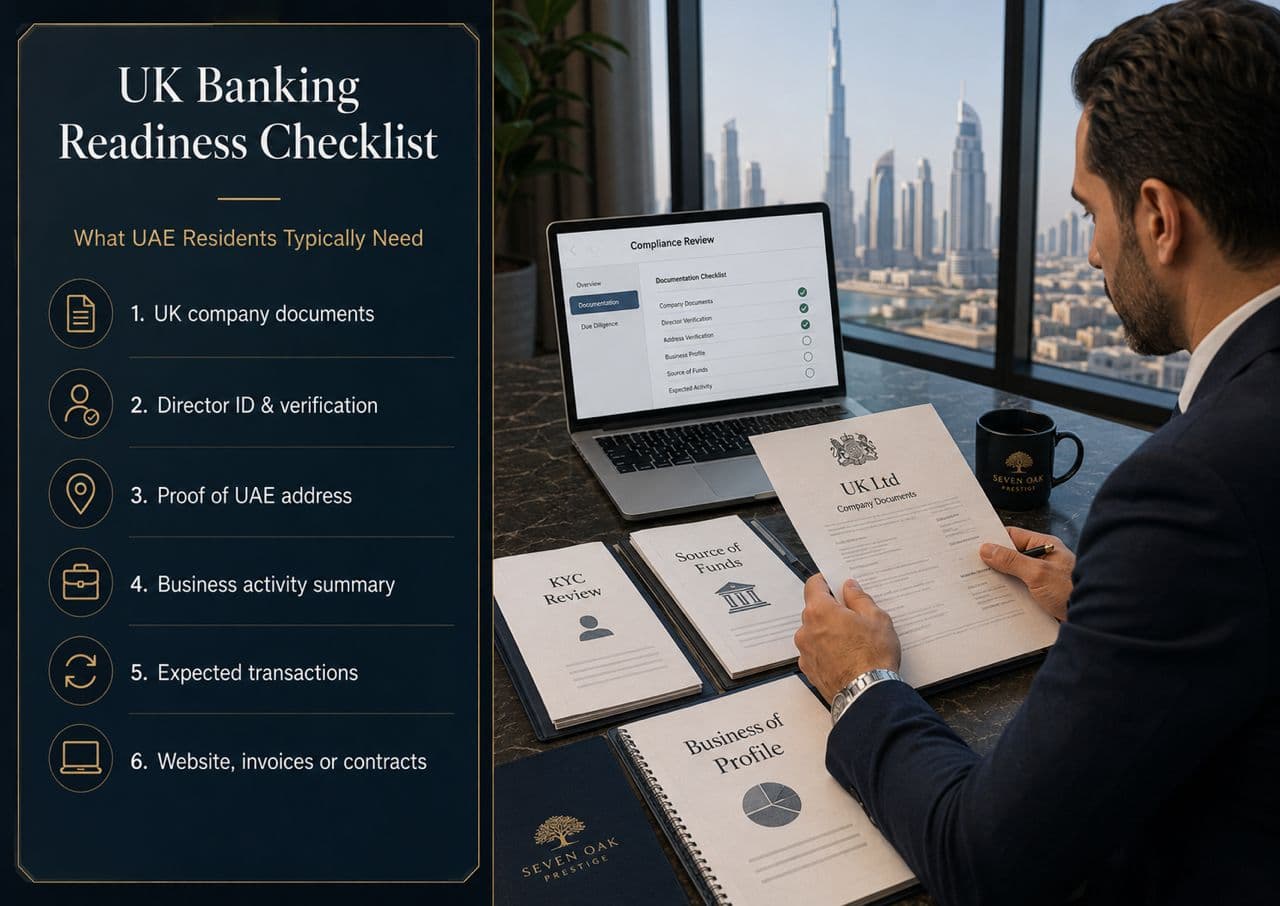
Before applying, prepare:
Founder
- passport;
- UAE residence evidence;
- UAE residential address proof;
- Emirates ID where relevant;
- source-of-funds documentation.
UK Company
- Certificate of Incorporation;
- Articles;
- company number;
- registered office;
- shareholder information;
- PSC information.
Business
- concise activity description;
- website;
- business plan if required;
- contracts;
- invoices;
- supplier information;
- customer information.
Financial Profile
- expected annual turnover;
- expected monthly account volume;
- largest expected transaction;
- incoming countries;
- outgoing countries;
- required currencies;
- source of startup capital.
UK Rationale
Be prepared to explain:
Why UK Ltd?
and:
Why does the company require UK/international business banking?
51. Common Banking Mistakes UAE-Based Founders Should Avoid
Mistake 1 — Assuming incorporation guarantees banking
It does not.
Mistake 2 — Choosing the company only for Revolut or Wise
Provider eligibility can change.
Mistake 3 — Using a virtual office as a personal residence
Registered office and residential address are different.
Mistake 4 — Vague business descriptions
“General trading” or “international consulting” may provide insufficient context.
Mistake 5 — Inflating turnover
Use credible projections.
Mistake 6 — Hiding transaction countries
Declare the real flows.
Mistake 7 — Applying everywhere simultaneously
Target appropriate providers.
Mistake 8 — Inconsistent website
The site should match the application.
Mistake 9 — Ignoring source of funds
Know how initial capital will be evidenced.
Mistake 10 — Assuming a provider is a bank when it is an EMI or payment institution
Understand what product you are actually opening.
52. The Seven Oak Banking Readiness Framework
A professionally prepared application should answer five questions.
1. Who are you?
Identity, residence, ownership.
2. What does the company do?
Specific activity and commercial model.
3. Why is it a UK company?
Commercial rationale.
4. Where does money come from and go?
Customers, suppliers, countries, currencies.
5. Why is this provider suitable?
Required banking features matched to the profile.
When all five answers fit together, the application tells a coherent story.
Frequently Asked Questions
Can a UAE resident open a UK business bank account?
Potentially, yes. However, eligibility varies by provider. UAE residence should be assessed together with the UK company, business activity, ownership, UK commercial rationale and transaction profile.
Can a Dubai resident open a bank account for a UK Ltd?
Potentially. The director’s Dubai residence does not invalidate the UK company, but some providers will not support UAE-resident applicants while others may have routes depending on the business.
Does Companies House give me a business bank account?
No. Companies House registers the company. Banking providers conduct a separate onboarding and risk assessment.
Do I need a UK-resident director to get banking?
Not as a universal legal rule. However, individual banks may impose UK-residency requirements under their own product criteria.
Can I own 100% of the UK company while living in UAE?
Generally, a UAE resident can own 100% of an ordinary UK private limited company. Banking eligibility remains a separate issue.
Can an Indian national living in Dubai apply for UK business banking?
Potentially. Nationality and residence are separate facts. The provider may assess both, together with the company and business profile.
Can a Pakistani national resident in UAE have a UK business account?
Potentially, subject to provider eligibility and normal compliance checks.
Can a British expatriate living in Dubai open an account for a UK Ltd?
Potentially. British nationality does not necessarily override a provider’s residence requirements, so the founder’s current UAE residence should still be declared accurately.
Can I use my London registered office as my residential address?
No, unless you genuinely live there. A company registered office should not be presented as the director’s personal residence.
Can I use my UAE home as my trading address?
Potentially, where that is where the business genuinely operates and the provider accepts and can verify it.
Is Emirates ID enough for banking?
Not necessarily. A provider may separately require proof of the actual residential address.
What proof of address can I use?
Requirements vary. Common examples can include bank statements, utility documents and other recognised evidence showing the genuine address.
Does my proof of address need to be recent?
Often yes. Providers commonly impose document-age requirements. Check the relevant provider’s current rules.
Can a new UK company get a bank account before earning revenue?
Potentially. A provider may rely more heavily on the business plan, founder background, source of startup funds, website, contracts and expected activity.
Do I need a website?
Not universally, but a genuine professional website can materially help a provider understand an online or international business. Some products specifically request one.
Do I need contracts?
Not always, but genuine contracts can strengthen the evidence of anticipated trading activity.
What is source of funds?
It explains where the particular money entering the business account originates.
What is source of wealth?
It explains how the founder accumulated their overall wealth or financial resources.
Can I transfer my personal savings into my new UK company?
Potentially, provided the transfer is properly characterised and the origin of the funds can be demonstrated where required.
Can my UAE company fund my UK subsidiary?
Yes, potentially. The transfer should be properly documented, for example as capital or an intercompany loan depending on the structure.
Is Revolut Business available to UAE residents with a UK Ltd?
Under Revolut’s current UK Business eligibility guidance, UAE residence is not listed among the supported applicant residences for UK/EEA-registered companies. UAE is listed for certain US-company applications. Always verify current rules before applying.
Can UAE residents use Wise Business for a UK company?
Wise eligibility and features depend on the business, trading location, applicant and current regional availability. Do not assume that UK incorporation alone guarantees access to every Wise Business feature.
Can I get a Wise Business card delivered to UAE?
Wise’s current Business card availability list does not include UAE. Product availability can change, so current rules should be checked directly.
Can UAE residents use Airwallex with a UK company?
Airwallex supports eligible UK-registered companies, subject to KYC, supported industries and its risk policies. The individual UAE-based founder/company profile still needs to satisfy its onboarding requirements.
Is Airwallex a traditional UK bank?
Airwallex provides business-account, payments, FX and other financial services, but founders should understand the exact regulated product they are using rather than treating every fintech account as identical to a traditional bank current account.
Is Wise a bank?
Wise’s products are structured differently from a traditional UK high-street bank. Users should distinguish payment/e-money services from deposit-taking bank products and review the protections applicable to the relevant provider.
Can I receive GBP from UK clients?
Potentially, depending on the provider and account product.
Can I receive USD and EUR as well?
Many international business-account providers offer multi-currency capabilities, but available currencies and receiving methods differ.
Can my UK company receive AED?
Potentially through certain international providers and payment routes. This does not necessarily mean the company has a UAE domestic bank account.
Do I need a UAE corporate bank account as well?
Not always. It depends on whether a UAE company also exists and where the operations take place.
Can I use my personal UAE bank account for UK company revenue?
A limited company’s finances should generally be kept separate from personal finances. Proper business banking and accounting separation are important.
Can Seven Oak guarantee a bank account?
No. The final decision belongs exclusively to the bank, fintech or financial institution.
Does a banking rejection mean my company is high risk?
Not necessarily. A provider may reject an application simply because the residence, industry, company profile or product need falls outside its current eligibility or risk appetite.
If Wise rejects me, should I apply to Revolut immediately?
Not automatically. First understand whether the reason would also affect another provider, and verify the other provider’s current eligibility.
Should I hide a previous rejection?
If another provider directly asks about relevant application history, answer accurately. Do not misrepresent information.
Can I change my residence from UAE to UK to get approved?
Only if you have genuinely changed residence. Never declare a false residence.
Can I appoint a nominee director only to obtain banking?
A corporate structure should not be engineered to conceal the true owner or misrepresent management purely to bypass provider eligibility. Banks will generally require disclosure of beneficial ownership and control.
Do all shareholders need KYC?
Provider requirements vary, but significant shareholders and ultimate beneficial owners are commonly subject to verification.
What is a UBO?
An Ultimate Beneficial Owner is an individual who ultimately owns or controls the company. Financial providers commonly use ownership thresholds and control tests when identifying UBOs.
Does my nationality matter?
It can form part of the overall compliance assessment, but nationality alone does not determine whether the business is bankable.
Does UAE residence make my company high risk?
No blanket conclusion should be drawn merely from lawful UAE residence. Providers assess the complete profile.
Does the size of my company matter?
Yes in terms of appropriate products and due diligence, but both small and large genuine businesses can require banking support.
Can Seven Oak assist a small one-person business?
Yes. Seven Oak can support suitable start-ups and smaller UK companies with banking-readiness preparation.
Can Seven Oak assist an established UAE company opening a UK subsidiary?
Yes. The banking-readiness process can also support established UAE businesses and larger cross-border structures establishing genuine UK operations.
Can a UAE parent company own the UK company?
Potentially, yes. Corporate ownership introduces additional ownership, KYC, tax and intercompany considerations.
Does my UK Ltd need VAT before getting banking?
Not universally. VAT requirements depend on the company’s business circumstances rather than banking alone.
Do import/export businesses face additional checks?
They may, particularly where transaction corridors, products, customs, suppliers or higher-value international payments require further explanation.
Can I use the UK account for transactions unrelated to the stated business?
Doing so can create serious compliance problems. Account usage should reflect the genuine declared business activity.
What happens if my turnover becomes much higher than originally expected?
Providers may ask for updated business information or supporting documents. Growth should be explainable through genuine commercial activity.
Do I need to tell the provider if the business activity changes?
Material changes may need to be disclosed depending on the provider’s terms and KYC requirements.
Is there one “best bank” for every UAE resident?
No. The best provider depends on the company’s size, sector, ownership, residency, currencies, countries, transaction volumes and required services.
How Seven Oak Prestige Supports UAE-Based Founders
Seven Oak Prestige supports UAE residents and UAE businesses establishing and operating UK companies.
Our support can include:
- UK company formation;
- UK subsidiary establishment;
- ownership and corporate-structure preparation;
- UK registered office;
- director service address;
- Companies House identity-verification support;
- banking-readiness assessment;
- banking and fintech application guidance;
- VAT registration;
- EORI registration;
- post-incorporation support.
We support different stages and sizes of business, including:
- first-time founders;
- consultants;
- SaaS companies;
- technology businesses;
- e-commerce companies;
- Amazon sellers;
- import/export businesses;
- SMEs;
- established UAE companies;
- international groups creating UK subsidiaries.
Banking support does not mean guaranteed approval.
The bank or financial provider retains complete discretion over onboarding.
Our role is to help the company approach banking with a more coherent, accurate and properly prepared profile.
For broader support, see our Fintech & Banking Guidance service.
Final Banking Readiness Test
Before applying for a UK business account from the UAE, ask:
Can I prove who I am?
Can I prove where I genuinely live?
Can I explain exactly what the company does?
Can I explain why it is incorporated in the UK?
Can I explain where customers are located?
Can I explain where suppliers are located?
Can I explain where the first funds will come from?
Can I justify my projected turnover?
Does my website match the application?
Do my SIC codes match the real activity?
Are my company, banking and payment-processing plans consistent?
Have I checked the provider’s current residence and business eligibility before applying?
If several answers are unclear, the company is probably not yet banking-ready.
Fixing those points before submitting the application is usually more valuable than completing another application quickly.
Ready to Prepare Your UK Company for Banking From the UAE?
If you live in Dubai, Abu Dhabi or elsewhere in the UAE and already own — or are preparing to establish — a UK Limited Company, Seven Oak Prestige can review the banking-readiness side of your structure.
Assess My UK Banking Readiness
For founders who have not yet established the company:
Start My UK Company From the UAE
For established UAE businesses entering Britain:
About the Author
Isaac Jackson is Founder & Managing Director of Seven Oak Prestige Ltd, supporting international entrepreneurs with UK company formation, Companies House compliance and business banking readiness.
Contact Seven Oak Prestige Ltd
Email: contact@sevenoakprestige.com
WhatsApp: +44 7447 488755
UK Office: +44 2045 780726