
UK Company vs UAE Company: Which Structure Is Better for UAE Residents, Dubai Entrepreneurs & UK–UAE Businesses in 2026?

UK Ltd vs UAE Free Zone, Mainland Company, UK Subsidiary, Banking, Tax, SaaS, E-commerce, Amazon FBA, TikTok Shop and Cross-Border Expansion Explained
Updated: August 2026
For an entrepreneur living in Dubai, Abu Dhabi or elsewhere in the United Arab Emirates, establishing a UK Limited Company can be surprisingly straightforward.
But the more important question is not:
“Can I open a UK company from the UAE?”
In many cases, you can.
The more important question is:
“Is a UK Limited Company actually the right structure for the business I am building?”
That question matters because a UAE resident may have several legitimate options.
You might:
- establish a UK Limited Company personally;
- continue operating through an existing UAE company;
- create a UK subsidiary owned by your UAE business;
- maintain separate UK and UAE operating companies;
- use a UAE free-zone company;
- use a UAE mainland company;
- establish a UK presence for an existing international group;
- or decide that only one jurisdiction is genuinely necessary.
The correct structure depends on much more than incorporation cost or headline tax rates.
It can depend on:
- where you genuinely live;
- your nationality and immigration status;
- where the company is actually managed;
- where your customers are located;
- whether you sell to UK, UAE, GCC, EU or global clients;
- whether you need a UAE business licence;
- whether you need a UK operating presence;
- where employees or contractors work;
- where inventory is stored;
- which company will sign customer contracts;
- which company will receive payments;
- your banking and fintech requirements;
- VAT and customs obligations;
- Amazon or TikTok Shop requirements;
- your existing UAE company structure;
- and the long-term direction of the business.
That is why a UK Ltd should not be chosen merely because somebody says it is “easy to register.”
And a Dubai free-zone company should not be chosen merely because somebody says it is “tax-free.”
Both statements leave out most of the decisions that actually determine whether an international company structure works.
This guide explains the complete UK–UAE decision framework for UAE residents, expatriate founders, Dubai entrepreneurs, British founders considering UAE expansion and existing UAE businesses entering the United Kingdom.
If you have already decided that a UK Ltd is the correct structure and simply want to understand how to incorporate it from Dubai or elsewhere in the UAE, start with our dedicated How to Start a UK Company from the UAE guide. It covers the formation process, director and shareholder information, Companies House requirements, documentation, banking preparation and post-incorporation steps.
If you are still deciding whether the UK, UAE or a combined structure is appropriate, continue here.
Executive Answer: UK Company or UAE Company?
There is no universal winner.
A UK Limited Company and a UAE company solve different commercial problems.
A UK Ltd may be more appropriate when:
- your target customers are primarily in the United Kingdom;
- you want a genuine UK operating company;
- UK commercial contracts are important;
- you are establishing a British subsidiary;
- your business has UK employees or planned UK operations;
- you operate an international SaaS, consulting or professional-services business where a UK contracting entity makes commercial sense;
- you hold inventory or conduct significant e-commerce activity in Britain;
- the UK is an actual market, not merely an address on your website.
A UAE company may be more appropriate when:
- you genuinely operate from the UAE;
- your main market is UAE or the wider GCC;
- your activity requires a UAE licence;
- UAE residence and local operations are central to your structure;
- you need UAE staff, premises or local contracts;
- the company is primarily managed and operated from Dubai, Abu Dhabi or another Emirate.
A UK + UAE structure may make sense when:
- an existing UAE company is expanding into Britain;
- a UAE parent needs a UK subsidiary;
- the business has genuine operations in both jurisdictions;
- different customer markets need separate operating entities;
- liability, staff, inventory or contracts need to be separated;
- a larger international group needs distinct UK and UAE companies.
The decision should therefore be:
commercial first, compliance second, tax third.
Not:
tax first and everything else later.
1. Why UAE Founders Are Different From Typical “Non-Resident” Founders
The UAE is not a single-nationality market.
A person searching from Dubai may be:
- Emirati;
- Indian;
- Pakistani;
- British;
- French;
- German;
- Italian;
- Lebanese;
- Egyptian;
- Jordanian;
- Ghanaian;
- Nigerian;
- South African;
- Russian;
- Kazakh;
- Filipino;
- Malaysian;
- or another nationality entirely.
This distinction matters.
A person’s:
nationality
and:
country of residence
are separate facts.
For example:
Nationality: Indian
Residence: UAE
Company: UK Limited Company
is completely different from:
Nationality: Indian
Residence: India
Company: UK Limited Company.
The underlying UK company may look similar on Companies House, but banking, proof-of-address, tax, KYC and cross-border considerations can differ materially.
That is why a UAE-focused UK company strategy should not simply say:
“Dubai founders can register remotely.”
It should examine the founder’s real UAE residence, ownership, business activity, transaction profile and operating model.
For the broader legal framework covering non-UK residents, see our UK Company Formation for Non-Residents guide.
2. Can a UAE Resident Own 100% of a UK Limited Company?
For a standard UK private company limited by shares, there is generally no requirement for the shareholder to live in Britain.
A UAE resident can potentially be:
sole shareholder
and:
sole director
of the company.
The same individual can also be the company’s Person with Significant Control where the applicable ownership/control conditions are met.
That makes a UK Ltd accessible to founders living throughout:
- Dubai;
- Abu Dhabi;
- Sharjah;
- Ras Al Khaimah;
- Ajman;
- Fujairah;
- Umm Al Quwain.
But simple ownership eligibility should not be confused with operational suitability.
Being allowed to own the company answers only one question:
Can I establish it?
It does not answer:
Should I establish it?
Nor does it automatically answer:
- Will a bank accept me?
- Is UK Ltd better than my UAE company?
- Where will tax arise?
- Can I use it for Amazon?
- Can I use it for TikTok Shop?
- Should my UAE company own the UK company instead?
- Do I need VAT?
- Do I need EORI?
- Does the company create UK immigration rights?
For a deeper explanation of ownership, shares, directors and PSC structures, see our UK Company Shares & Directors for Non-Resident Founders guide. Seven Oak’s existing guidance also correctly distinguishes overseas ownership from the separate banking, compliance and residence issues that follow.
3. Do You Need to Travel to Britain to Form the Company?
Generally, ordinary UK incorporation does not require a UAE resident to relocate to Britain.
That is one of the practical attractions of the UK structure.
A UAE-based founder may generally deal remotely with matters such as:
- incorporation preparation;
- director/shareholder information;
- registered office arrangements;
- identity-verification requirements;
- company documentation.
But this should not be exaggerated into:
“Everything connected with your UK business will always be remote.”
Third parties can impose their own requirements.
Banks, payment providers, marketplaces and regulated counterparties make independent decisions about:
- country of residence;
- identity;
- business model;
- transaction countries;
- source of funds;
- operating evidence.
The company-formation process and the banking process are therefore not the same process.
Your existing UAE formation guide already explains this distinction in detail.
4. UK Company Ownership Does Not Give You a UK Visa
This point should be understood from the beginning.
You can potentially own and manage a UK company while living in the UAE without needing UK immigration permission merely because you hold shares or act as director.
But:
company ownership
is not the same thing as:
permission to live and work physically in the United Kingdom.
If your plan changes from:
“I will operate from Dubai”
to:
“I want to relocate to London and work there,”
immigration becomes a separate matter.
For the full distinction, read our guide to owning or running a UK company as a non-resident without confusing company law with immigration law.
5. Before Choosing UK or UAE, Define What You Are Actually Building
This is where many founders make their first structural mistake.
They start by choosing a jurisdiction.
A better approach is to start with the business.
Consider five examples.
Example A — Dubai-based SaaS founder
Founder lives in Dubai.
Developers are distributed internationally.
Customers are mainly British and European companies.
The founder wants a credible contracting entity for enterprise customers.
A UK Ltd may deserve serious consideration.
But the founder should still analyse:
- IP ownership;
- subscription payments;
- VAT;
- banking;
- where strategic management occurs;
- whether a UAE company is also needed.
Example B — Dubai consultant serving UAE businesses
Founder lives in Dubai.
Most customers are in the UAE.
Services are delivered from the UAE.
The founder wants a UK company only because it “looks international.”
That does not automatically make UK incorporation the correct choice.
The UAE company may be the more natural operating entity.
Example C — Established UAE technology company entering Britain
The company already operates in Dubai.
It has staff, customers and banking.
It now wants UK sales operations.
Rather than the owner personally incorporating an unrelated UK company, the group might consider:
UAE Parent Company
↓
UK Subsidiary
That creates a much more coherent corporate story.
Example D — UAE resident Amazon seller targeting Britain
The seller stores inventory in Britain and sells primarily through Amazon UK.
Now the UK decision involves:
- Amazon seller verification;
- UK VAT;
- EORI;
- customs;
- importer-of-record planning;
- product compliance;
- banking.
A UK entity may fit the commercial model, but incorporation alone does not solve those other requirements.
For this business model, see our complete Amazon FBA UK guide for non-resident founders.
Example E — UK entrepreneur considering Dubai
The entrepreneur currently lives in Britain and operates a UK company.
They are considering “moving the business to Dubai.”
This phrase is often misleading.
They may actually be considering:
- creating a new UAE company;
- creating a UAE subsidiary;
- retaining the UK parent;
- closing or restructuring the UK entity;
- relocating personally;
- changing where management occurs.
Those are separate decisions.
Meydan Free Zone’s current UK-founder guide gets this distinction right: setting up in Dubai usually means establishing a new UAE legal entity rather than somehow converting the existing UK Ltd into a Dubai company.
6. UK Ltd, UAE Free Zone or Mainland Company — What Are You Comparing?
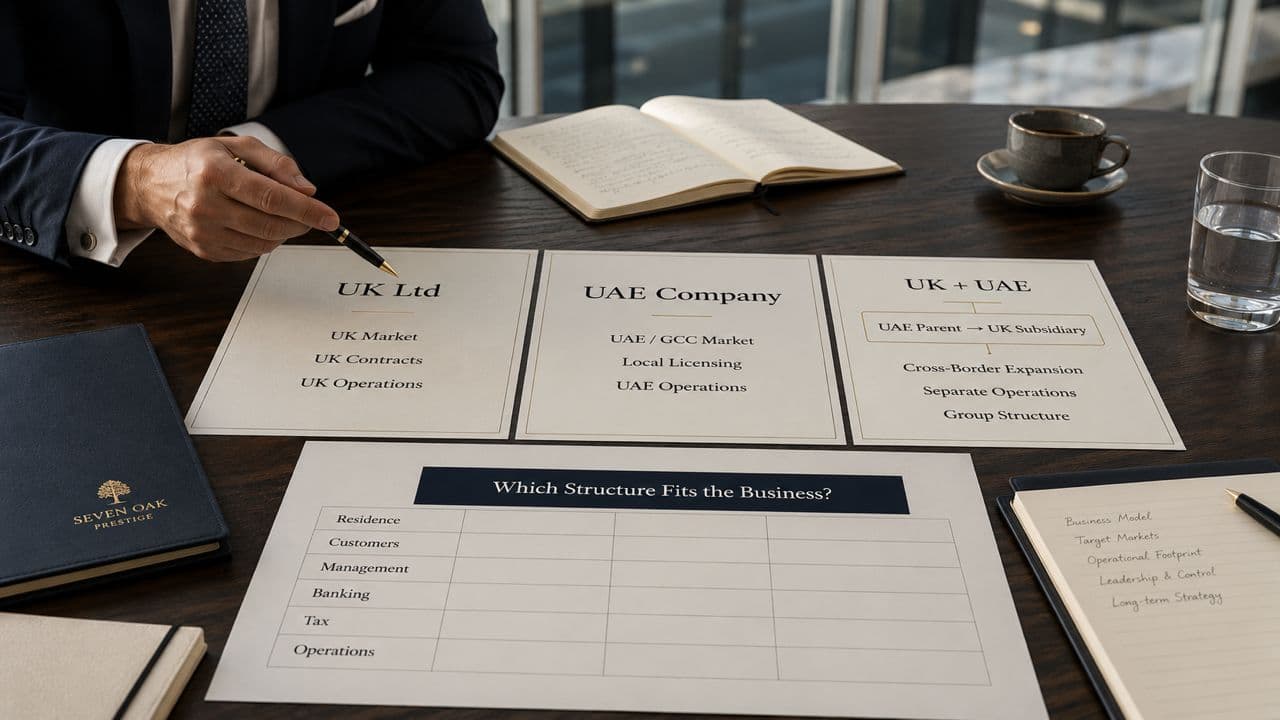
Before comparing jurisdictions, understand the entities.
UK Private Limited Company
A UK Ltd is incorporated under UK company law and registered with Companies House.
For an international founder, it can provide:
- separate legal personality;
- limited liability;
- ability to contract in the company’s name;
- transparent ownership/director records;
- UK corporate presence.
It also brings continuing obligations such as:
- annual accounts;
- confirmation statements;
- Corporation Tax compliance;
- Companies House obligations;
- identity-verification requirements.
If the UK is already your preferred jurisdiction, the practical setup process is covered in the existing UAE-to-UK formation guide.
UAE Free-Zone Company
A free-zone company is established within a specific UAE free zone and operates under that zone’s licensing framework.
Free zones can differ substantially in:
- permitted activities;
- visa allocation;
- office requirements;
- shareholder structure;
- renewal costs;
- banking profile;
- tax treatment;
- regulatory environment.
Therefore:
“UAE free-zone company” is not one single standard product.
The appropriate zone should follow the actual business activity.
UAE Mainland Company
A mainland company operates under the relevant UAE emirate’s mainland licensing framework.
It can be more appropriate where:
- local UAE activity is central;
- the company needs broader domestic-market operations;
- the activity requires mainland licensing;
- local staffing, premises or government-facing work matters.
Dubai’s official business guidance distinguishes mainland and free-zone structures rather than treating them as interchangeable.
7. UK Ltd vs UAE Free Zone: Quick Decision Table
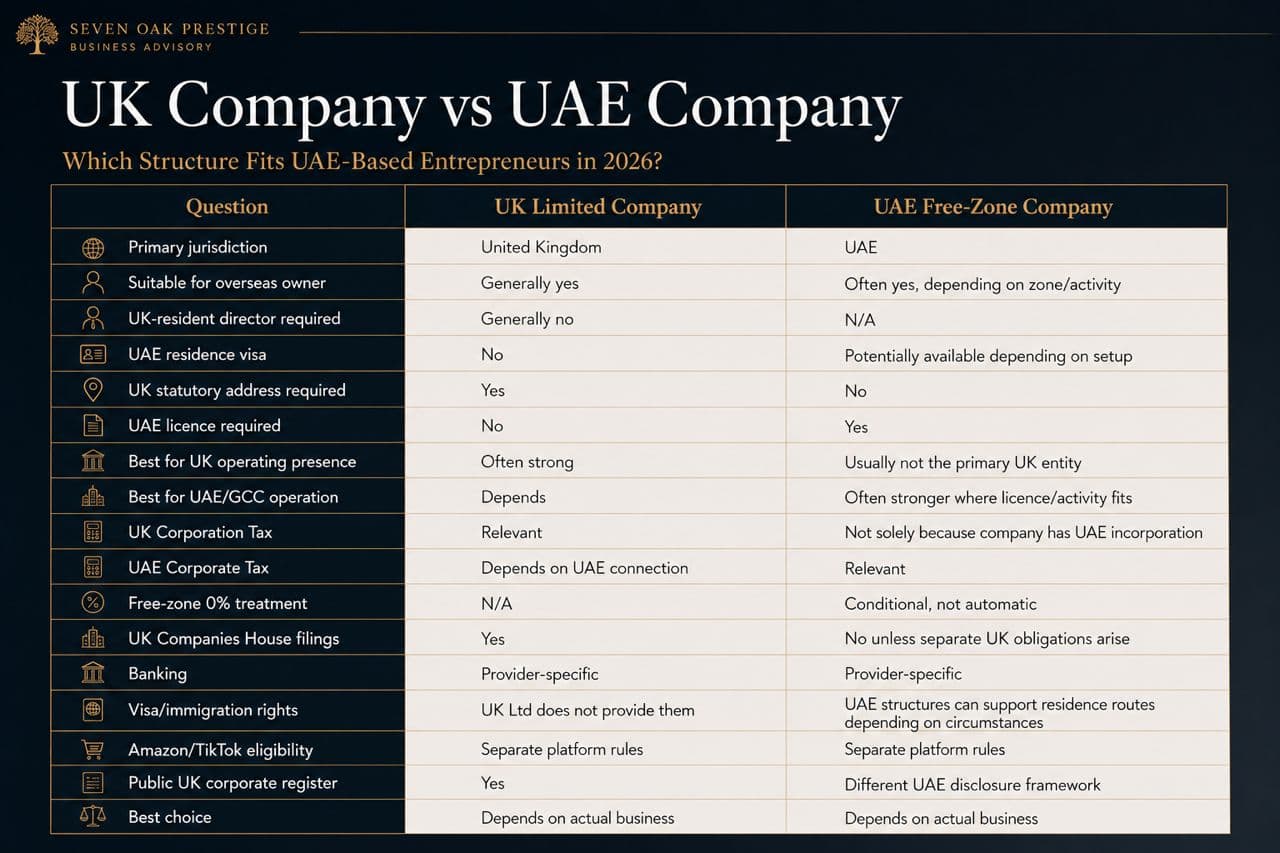
This table is deliberately a shortlisting tool, not a recommendation.
The founder’s residence, management, customers and operations can completely change the answer.
8. The Biggest Mistake: Choosing the Company Only for Tax
One of the most common online comparisons is:
UK = high tax
versus:
Dubai = zero tax
That is not a serious 2026 structuring analysis.
The UK’s current Corporation Tax system includes a 19% small-profits rate, a 25% main rate, and Marginal Relief between the relevant profit thresholds, subject to the detailed rules.
The UAE also now has a federal Corporate Tax regime.
And free-zone treatment is not synonymous with:
“all profits are always taxed at 0%.”
The tax analysis can depend on matters such as:
- taxable income;
- qualifying income;
- free-zone status;
- business activity;
- related parties;
- substance;
- management;
- permanent establishment;
- the founder’s personal residence.
This is one of the biggest weaknesses in some comparison pages currently ranking for UK-vs-Dubai terms. For example, one current comparison page reduces the decision to statements such as “UK 19%” and “Dubai 0%,” while simultaneously making broad banking and Stripe claims. That may make a page easy to read, but it is too simplified for a serious cross-border decision.
Seven Oak’s article should take the opposite approach:
Choose the structure based on commercial reality first, then determine the tax consequences of that real structure.
9. What if You Already Have a UAE Company?
This is where the quality of the lead changes significantly.
An entrepreneur with an existing UAE company does not necessarily need to create a completely unrelated UK company personally.
They may instead consider whether the UAE entity should become the shareholder of the UK company.
Example:
Dubai Technology Company
↓
UK Ltd
↓
UK Customers / Employees / Operations
This can create a recognisable group structure.
The UK company can potentially serve as:
- UK operating subsidiary;
- British sales entity;
- UK employer;
- local contracting company;
- UK market-entry vehicle.
But this also creates additional responsibilities.
The group may need to consider:
- beneficial ownership disclosure;
- PSC analysis;
- parent-company documents;
- intercompany agreements;
- transfer pricing;
- funding;
- management fees;
- loans;
- group accounting;
- banking;
- UK and UAE tax.
A financial institution looking at a UAE-parent/UK-subsidiary structure may also want a coherent explanation of why the UK entity exists and how money will move through the group.
That is a fundamentally different onboarding story from:
“I opened another company because I wanted a UK bank account.”
10. UAE Parent + UK Subsidiary vs Personal Ownership
Consider two structures.
Structure 1
UAE-resident founder
↓
UK Ltd
Structure 2
UAE Company
↓
UK Ltd
Neither is automatically superior.
Personal ownership can be simpler where:
- founder is starting a standalone new venture;
- there is no existing UAE operating company;
- the UK business is independent.
Corporate ownership may deserve consideration where:
- an established UAE company is genuinely entering Britain;
- brand, contracts and IP sit in the UAE parent;
- group ownership should remain consolidated;
- investors expect a corporate hierarchy.
The ownership structure should therefore follow the commercial relationship.
For general UK ownership mechanics, see the Seven Oak guide to shares, directors and PSC structures for non-resident founders
11. UK Subsidiary or UK Branch?
An established UAE business entering Britain should also distinguish:
UK subsidiary
from:
UK establishment / branch.
A subsidiary is its own UK legal entity.
A branch is generally part of the overseas company itself.
The correct choice can affect:
- liability;
- contracts;
- reporting;
- accounting;
- tax;
- corporate administration;
- customer perception.
This is a much more sophisticated question than ordinary UK company formation and is precisely the type of search intent the new article should capture.
12. UK Business Banking for UAE Residents
For many UAE founders, this is one of the most commercially important questions.
The wrong assumption is:
“Once Companies House approves the company, I can automatically open a UK bank account.”
That is false.
Company incorporation and financial-institution onboarding are independent processes.
Banks and fintechs can assess:
- director residence;
- nationality;
- shareholder structure;
- beneficial owners;
- business activity;
- website;
- customer countries;
- supplier countries;
- expected turnover;
- expected currencies;
- transaction flows;
- source of funds;
- source of wealth;
- reason for needing the account.
Seven Oak’s UK Business Banking Readiness Assessment is specifically built around this broader preparation model rather than treating banking as a checkbox after incorporation.
A UAE-based founder should therefore think about banking before submitting random applications.
13. Your UAE Address Matters
A UK company can have a London registered office while its director genuinely resides in Dubai.
Those are two different addresses serving two different purposes.
Example:
Company registered office: London
Director residence: Dubai
There is nothing inherently contradictory about that.
The problem arises when someone uses:
UK Registered Office
as though it were:
Director’s UAE residential address.
Banks and KYC providers generally want the real residential information when they ask where the director lives.
For the detailed distinction between registered office, director service address, residential address and business/trading addresses, see our UK Registered Office vs Director Service Address guide.
14. Companies House Identity Verification From the UAE
Identity verification should now be treated as part of the normal UK company-compliance landscape, not as an afterthought.
Relevant directors and PSCs can fall within Companies House identity-verification requirements.
For UAE founders, this makes consistency important.
If your genuine facts are:
Nationality: French
Residence: UAE
UK company address: London
those facts should remain coherent throughout your filings and KYC journey.
A dedicated explanation is available in our Companies House Identity Verification for Non-Residents guide.
15. Is a UK Ltd Better for SaaS Founders in Dubai?
Sometimes.
Not automatically.
A UAE-based SaaS founder should consider:
- where customers are;
- where contracts are signed;
- where intellectual property sits;
- where developers work;
- which entity receives subscriptions;
- VAT;
- banking;
- investor expectations;
- whether a UK company will have a real function.
A UK Ltd can make commercial sense where the company has a genuine UK or international operating rationale.
But creating a UK company solely because:
“I heard Stripe is easier there”
is not a robust company strategy.
Payment-provider acceptance is separate from company formation.
16. UK Ltd or UAE Company for Amazon FBA?
This is an excellent example of why jurisdiction cannot be chosen in isolation.
Suppose a Dubai resident wants to sell on Amazon UK.
The analysis may include:
- Amazon entity verification;
- stock location;
- UK VAT;
- GB EORI;
- importer of record;
- customs;
- product compliance;
- supplier contracts;
- banking;
- returns.
If the business will genuinely operate in the UK marketplace and hold inventory there, a UK structure may fit the operating model.
But the company alone does not make the seller ready.
Our Amazon FBA UK for Non-Residents guide covers the full operating system rather than treating Amazon as a company-registration exercise.
17. UK Ltd or UAE Company for E-commerce?
The same principle applies to Shopify and international e-commerce.
An e-commerce business is not simply:
company + website + payment gateway
It is:
company
→ products
→ suppliers
→ inventory
→ fulfilment
→ payments
→ banking
→ VAT
→ customs
→ consumer compliance
→ tax
That is why the correct company depends heavily on where the commercial chain actually operates.
For the wider framework, see the UK E-commerce Company for Non-Residents guide.
18. What About TikTok Shop UK From Dubai?
A UK Limited Company should never be presented as an automatic route to TikTok Shop UK.
Platform eligibility can involve separate operational and verification requirements.
Depending on current policies, relevant considerations can include:
- seller eligibility;
- business representative;
- inventory;
- domestic fulfilment;
- returns;
- identity verification;
- banking;
- VAT.
Therefore:
UK Ltd ≠ automatic TikTok Shop approval.
That distinction protects both the founder and Seven Oak from unrealistic expectations.
Read our TikTok Shop master guide .
19. UK Ltd or UAE Company for Consulting?
For consultants, the answer can be much more nuanced.
Dubai-based consultant serving UAE clients
A UAE company may be commercially natural.
Dubai-based consultant serving mostly UK companies
A UK Ltd may be relevant for:
- British contracting;
- UK procurement;
- international commercial positioning.
But the founder still needs to examine:
- where services are performed;
- UAE tax position;
- UK company tax;
- personal remuneration;
- banking.
A company should reflect the real consulting operation rather than simply where the client would prefer the invoice to come from.
20. UK Ltd or UAE Company for Import / Export?
For a trading business, ask:
- Where are goods purchased?
- Where do they enter customs territory?
- Who is the importer?
- Who owns inventory?
- Who invoices the buyer?
- Which entity pays suppliers?
- Where is the warehouse?
If goods enter Great Britain, the UK side may involve:
- EORI;
- customs declarations;
- import VAT;
- commodity codes;
- logistics arrangements.
A UAE trading company may still remain the parent or exporter while a UK subsidiary handles British distribution.
This can be much more coherent than forcing all international trade through a single entity.
21. Starting a Business in Dubai From the UK?
This section deliberately captures the reverse-direction queries already appearing in UAE Search Console data.
A UK entrepreneur searching:
“business setup in Dubai from UK”
may have a very different objective from a Dubai resident searching:
“start UK company from UAE.”
If you currently operate a UK business and are considering Dubai, first decide whether you are actually:
- relocating personally;
- creating a new UAE company;
- establishing a UAE subsidiary;
- keeping your UK company;
- restructuring ownership;
- changing where management occurs.
Meydan’s current guidance is strong here because it explicitly distinguishes an existing UK company from the new UAE entity being formed.
Seven Oak should go one step further by then asking:
What happens to the UK entity after the UAE company exists?
That is the gap many UAE formation pages leave unanswered.
22. A Dubai Company Does Not Automatically Remove UK Tax
This is another area where simplistic marketing can be dangerous.
Suppose:
Company: UAE
Director: UK resident
Strategic decisions: London
Clients: UK
Work: primarily UK
The founder cannot safely conclude:
“The company is registered in Dubai, therefore everything is outside UK tax.”
The location of incorporation is only one factor.
Company residence, management and permanent-establishment principles may also matter depending on the facts.
23. A UK Company Managed From Dubai Also Requires Analysis
Now reverse the situation:
Company: UK Ltd
Director: UAE resident
Management: Dubai
The company’s UK incorporation remains highly relevant to UK Corporation Tax and company compliance.
Separately, UAE corporate-tax considerations may arise depending on the company’s connection to the UAE and how the business is managed.
The correct conclusion is therefore not:
“UK company + Dubai director = no UAE issue.”
Nor:
“UK company + Dubai director = automatically taxed twice.”
The real facts need to be analysed.
24. When a UK Ltd Is Usually the Stronger Candidate
A UK Ltd deserves serious consideration where the business genuinely needs:
- UK customers;
- UK contracts;
- UK staff;
- UK operations;
- British market entry;
- UK stock/fulfilment;
- UK subsidiary status;
- British commercial identity.
It can also be attractive to globally focused:
- SaaS companies;
- technology businesses;
- agencies;
- consultancies;
- international service businesses;
- e-commerce operators.
But “international credibility” should support a real commercial strategy, not replace one.
25. When a UAE Company Is Usually the Stronger Candidate
A UAE structure may be more natural where:
- founder genuinely resides and operates in UAE;
- MENA/GCC customers dominate;
- UAE licence is necessary;
- UAE staff are employed;
- local premises matter;
- UAE residence visa is a key requirement;
- local UAE contracts are central.
26. When Both UK and UAE Companies Can Make Sense
A dual structure may be commercially justified where there are genuine operations in both regions.
For example:
UAE Holding / Operating Company
↓
UK Subsidiary
or:
Founder
↙︎ ↘︎
UAE Co UK Ltd
But having two companies introduces:
- two compliance systems;
- two accounting systems;
- two banking profiles;
- intercompany transactions;
- transfer-pricing considerations;
- group funding questions;
- more administrative cost.
So:
two companies should solve two real business problems.
They should not be created simply because the structure looks sophisticated.
27. Banking: UK vs UAE Is Not a Simple Winner
Neither jurisdiction guarantees easier banking.
A well-prepared UK company can still be declined.
A well-established UAE company can still face onboarding questions.
Financial institutions look at the whole business, not only the certificate of incorporation.
That includes:
- beneficial ownership;
- residence;
- business activity;
- customers;
- suppliers;
- transaction corridors;
- source of funds;
- website;
- operating evidence.
This is why banking readiness should be planned before formation when banking is commercially critical.
UK Business Banking Readiness Assessment
28. Your Company Should Tell One Coherent Story
This may be the most important principle in the entire guide.
Suppose your application says:
Founder residence: Dubai
Company: UK Ltd
Customers: UK businesses
Website: professional UK-facing consulting site
Banking purpose: receive GBP payments from UK clients
That is understandable.
Now compare:
Founder residence: Dubai
Company: UK Ltd
Website: says UAE local business
Customers: unknown
Suppliers: unknown
Address: virtual UK office presented as residence
Turnover: £2 million with no evidence
Purpose: “international payments”
That is much harder for a compliance team to understand.
A strong company structure should create consistency between:
incorporation
→ website
→ business activity
→ customers
→ payments
→ banking
→ tax
→ compliance
Our banking framework is already built around this principle of overall corporate readiness rather than a single application form.
29. What Happens After You Register the UK Company?
Once incorporated, the founder still needs to consider:
- statutory records;
- Companies House;
- identity verification;
- accounting;
- Corporation Tax;
- business banking;
- VAT where applicable;
- EORI where applicable;
- invoices;
- annual accounts;
- confirmation statements;
- changes to directors/shareholders;
- ongoing KYC with service providers.
For the full post-incorporation sequence, see our Complete 2026 Post-Incorporation Checklist for Non-Resident Founders.
30. The Seven Oak UAE–UK Decision Test
Before forming either company, answer these ten questions.
1. Where do you genuinely live?
UAE, UK or somewhere else?
2. Where will the company’s key decisions be made?
Dubai? London? Both?
3. Where are your main customers?
UK? UAE? GCC? EU? Global?
4. Where will employees or contractors work?
5. Where will inventory be stored?
6. Do you need a UAE trade licence?
7. Do you genuinely need a UK operating presence?
8. Which banks and payment providers matter to the business?
9. Is there already a UAE parent company?
10. What should the structure look like three years from now?
Those answers usually reveal much more than comparing incorporation prices.
31. Common UK–UAE Structuring Mistakes
Avoid these:
Choosing Dubai only because someone advertised “0% tax.”
Choosing UK only because somebody said Stripe or banking will be easy.
Creating two companies without a clear intercompany relationship.
Using a UK registered office as though it were your UAE residence.
Ignoring Companies House identity verification.
Confusing UAE free zone with UAE mainland.
Ignoring where management actually takes place.
Ignoring VAT and customs for e-commerce.
Assuming Amazon or TikTok approval follows incorporation.
Confusing company ownership with immigration status.
Applying to multiple financial institutions with inconsistent information.
Setting up the legal entity before understanding the operational model.
32. Already Decided You Need a UK Ltd?
If you have completed the comparison and concluded:
“Yes — a UK Limited Company fits my business.”
you do not need another comparison article.
Continue directly to our dedicated How to Start a UK Company from the UAE: Complete Guide for Dubai & UAE Entrepreneurs.
That guide covers the actual incorporation process, including:
- eligibility;
- company name;
- directors;
- shareholders;
- Companies House verification;
- UK registered office;
- documentation;
- banking preparation;
- VAT;
- EORI;
- post-incorporation obligations.
33. Need a Broader International Comparison?
Some UAE founders are not choosing only between Britain and Dubai.
They may also be considering:
- Singapore;
- Hong Kong;
- BVI;
- Cayman;
- Seychelles;
- other holding or international structures.
For that wider decision, use our UK Company vs Offshore Company Complete 2026 Guide. It compares international structures through tax, banking, substance, privacy, reporting and commercial-use considerations rather than treating “offshore” as synonymous with secrecy.
34. How Seven Oak Prestige Supports UAE-Based Founders
Seven Oak Prestige focuses on the UK corporate and business-readiness side of international establishment.
Depending on the engagement, support may include:
- UK Limited Company formation;
- UAE-parent / UK-subsidiary incorporation support;
- director/shareholder structuring;
- UK registered office;
- director service address;
- Companies House identity-verification support;
- VAT registration;
- EORI registration;
- banking and fintech readiness;
- KYC/document preparation;
- post-incorporation compliance guidance.
Our current packages range from Starter £199, Prestige £299 and Elite £399, with different levels of address, compliance and banking-readiness support. The site itself makes clear that banking providers make their own independent approval decisions.
For UAE-specific tax, licensing, immigration or regulated legal advice outside Seven Oak’s scope, the appropriate UAE professional should be involved.
35. Final Decision: UK Ltd, UAE Company or Both?
The strongest business structure is rarely the one with the most attractive advertisement.
It is the one that makes commercial sense when a bank, accountant, regulator, customer or investor asks:
Why does this company exist here?
A UAE resident establishing a UK company should be able to answer:
because the business genuinely needs a UK entity.
A British entrepreneur establishing a UAE company should be able to answer:
because the business genuinely needs a UAE entity.
And a group operating both should be able to explain:
what each company does, who owns it, where decisions are made and how money flows between them.
That is what separates a professionally structured international business from a collection of companies formed because somebody saw a social-media video about tax or banking.
Frequently Asked Questions About UK Companies, UAE Companies and UK–UAE Business Structures
Can a UAE resident open a UK Limited Company?
Yes, in many cases a UAE resident can own and direct a UK private limited company without living in the UK. The founder still needs to meet Companies House requirements and any applicable identity-verification and compliance obligations.
If you have already decided to form a UK company, see our full guide on How to Start a UK Company from the UAE.
Can a Dubai resident own 100% of a UK company?
Generally, yes. A Dubai resident can potentially be the sole shareholder and sole director of a standard UK private limited company.
There is generally no requirement to appoint a UK-resident shareholder simply because the owner lives in the UAE.
Do I need to be an Emirati citizen to open a UK company from the UAE?
No.
The UAE is home to founders of many nationalities. Your nationality and country of residence are separate facts.
For example, an Indian, French, British, Pakistani, Lebanese or African entrepreneur genuinely residing in the UAE may potentially establish a UK company subject to the normal incorporation and compliance requirements.
Do I need a UK-resident director?
For an ordinary UK private limited company, a UK-resident director is generally not required simply because the shareholders live overseas.
However, the company still needs a compliant UK registered office and must meet Companies House requirements.
Do I need to travel to the UK to register the company?
Usually not simply for incorporation.
A UAE-based founder can generally complete the ordinary UK incorporation process remotely.
Banks, payment providers and other third parties may have their own onboarding requirements.
Do I need a UK visa to own a UK company from Dubai?
Not merely to own shares or act as a director while remaining outside the UK.
Owning a UK company does not itself give you permission to live or work physically in Britain.
See our guide on whether a non-resident needs a UK visa to own or run a UK company.
Should I open a UK Ltd or UAE Free Zone company?
It depends on the actual business.
A UK Ltd may make more sense where:
- UK customers are important;
- you need a genuine UK operating company;
- UK contracts or employees are involved;
- the UK is a significant market.
A UAE free-zone company may make more sense where:
- you genuinely operate from the UAE;
- UAE or GCC customers are central;
- UAE licensing or residency is important;
- the business primarily operates from Dubai or another Emirate.
Sometimes both structures can be commercially justified.
Is a UK company better than a Dubai company?
Not universally.
A UK company may be better for one business and a UAE company may be better for another.
The decision should consider:
- founder residence;
- management location;
- customer geography;
- banking;
- licensing;
- tax;
- employees;
- inventory;
- platform requirements;
- future expansion.
The best jurisdiction is the one that fits the real operating model.
Is a UAE Free Zone company always tax-free?
No.
The UAE has a federal Corporate Tax regime, and preferential free-zone treatment is subject to conditions.
The phrase “Dubai free zone means 0% tax” is therefore too simplistic for a serious 2026 business-structure decision.
Is UK Corporation Tax always 25%?
No.
The UK currently operates different Corporation Tax rates depending on taxable profits and the applicable rules, including the small-profits rate, main rate and Marginal Relief.
A proper comparison should use the company’s actual expected profits rather than comparing one headline tax percentage with another.
Can my UAE company own a UK Limited Company?
Potentially, yes.
An existing UAE company can potentially own shares in a UK company.
For an established UAE business entering Britain, a structure such as:
UAE Parent Company → UK Subsidiary
may be commercially appropriate.
The group should then consider ownership disclosure, tax, transfer pricing, intercompany agreements and banking.
Should my UAE company open a UK subsidiary or should I own the UK company personally?
It depends on the commercial relationship.
Personal ownership may be simpler for a standalone new venture.
Corporate ownership may be more appropriate where an established UAE business is genuinely expanding into the UK and wants the British company to sit within the existing group.
What is the difference between a UK subsidiary and a UK branch?
A UK subsidiary is a separate UK legal company.
A branch or UK establishment is generally part of the overseas company itself.
The choice can affect:
- liability;
- accounting;
- reporting;
- tax;
- contracts;
- administration.
Established UAE companies should compare both structures before entering the UK.
Can I run a UK Ltd while living permanently in Dubai?
Potentially, yes.
However, the company still has UK corporate and tax obligations.
Separately, the founder should consider whether the way the company is managed from the UAE creates any UAE tax or operational consequences.
Can I manage my UK company entirely from the UAE?
Operationally, many founders manage UK companies from abroad.
However, management location can have tax and compliance implications.
That is why the structure should be reviewed based on where strategic decisions are actually made.
Can a UAE company become UK tax resident?
Potentially, depending on the facts.
A foreign-incorporated company may have UK tax-residence considerations if its central management and control is actually exercised in the UK, subject to applicable rules and treaty considerations.
This is particularly relevant to British founders who establish a UAE company but continue managing it from the UK.
If I move my business from the UK to Dubai, do I automatically stop paying UK tax?
No.
Creating a UAE company does not automatically determine:
- your personal UK tax residence;
- the tax residence of an existing UK company;
- whether UK permanent-establishment or management issues remain.
Personal relocation and company restructuring should be analysed separately.
Can I keep both a UK company and a UAE company?
Yes, where there is a genuine commercial reason.
For example:
- UAE headquarters + UK subsidiary;
- UAE operating company + UK sales company;
- distinct regional operations.
But two companies also mean:
- two compliance systems;
- two accounting systems;
- intercompany transactions;
- greater administration.
Both entities should have a clear commercial purpose.
Is it easier to get banking with a UK Ltd than a UAE company?
Not necessarily.
Banking eligibility depends on the whole profile, including:
- residence;
- nationality;
- ownership;
- business activity;
- countries involved;
- turnover;
- customers;
- suppliers;
- source of funds;
- operating evidence.
Neither UK nor UAE incorporation guarantees approval.
Can UAE residents open Revolut, Wise or Airwallex for a UK company?
Potentially, depending on the provider’s current eligibility rules and the applicant’s profile.
Provider requirements can change, so eligibility should be checked before relying on one particular provider as the reason for incorporating.
Does Seven Oak Prestige guarantee a UK bank account?
No.
Seven Oak can support banking readiness and application preparation, but the final onboarding decision belongs to the relevant bank, EMI or fintech provider.
Can I use my UK registered office as my UAE residential address?
No.
Your UK registered office is the company’s statutory address.
If a bank or compliance provider asks where you live, you should provide your genuine residential address in the UAE.
What proof of address can a UAE resident need?
Depending on the provider, acceptable evidence may include documents such as:
- UAE bank statement;
- utility bill;
- tenancy-related documentation;
- other accepted official proof.
Requirements vary between providers.
Do I need an Emirates ID to open a UK company?
Not necessarily for the basic Companies House incorporation itself.
However, UAE residence evidence such as Emirates ID or other documentation may be relevant to KYC, banking or service-provider verification depending on the circumstances.
Can an Indian resident of Dubai open a UK company?
Potentially, yes.
An Indian national genuinely resident in the UAE can be treated as a UAE resident for relevant KYC purposes where that residence can be properly documented.
Nationality and residence should not be confused.
Can a Pakistani resident of the UAE open a UK company?
Potentially, yes, subject to the normal UK incorporation and compliance requirements and any provider-specific eligibility rules.
Can a UAE resident use a UK company for consulting?
Potentially, yes.
This can make commercial sense where the UK company genuinely serves UK or international clients.
The founder should still consider banking, UK Corporation Tax, UAE tax implications and where services are actually performed.
Is a UK Ltd suitable for a SaaS founder based in Dubai?
Potentially.
A UK Ltd can be suitable for some SaaS and technology founders, particularly where UK customers, contracts, investors or operations are important.
But the founder should also consider:
- IP ownership;
- development team location;
- VAT;
- payment processing;
- banking;
- management location.
Can I run Amazon FBA UK from Dubai through a UK company?
Potentially, yes.
But a UK company is only one part of the structure.
You may also need to consider:
- Amazon seller verification;
- VAT;
- EORI;
- customs;
- importer of record;
- product compliance;
- banking.
See our complete Amazon FBA UK for Non-Residents guide.
Can I use a UK company for TikTok Shop UK while living in the UAE?
A UK company alone does not automatically guarantee TikTok Shop UK eligibility.
Platform-specific requirements may include operational, representative, fulfilment, returns and verification conditions.
See our dedicated TikTok Shop UK for Non-Residents guide.
Can a UAE resident use a UK Ltd for Shopify or e-commerce?
Potentially.
The correct structure depends on:
- customer countries;
- inventory location;
- fulfilment;
- VAT;
- payment processing;
- supplier relationships;
- returns.
A company should be chosen around the operating model, not only the website platform.
Do I need UK VAT if I live in Dubai?
Possibly.
VAT obligations depend on the company’s activity, taxable supplies, establishment, stock location and other facts—not simply the owner’s residence.
Non-resident businesses can also face different VAT rules from ordinary UK-established businesses.
Do I need an EORI number?
If the company imports or exports goods through the UK customs system, an EORI may be required.
This is particularly relevant to:
- Amazon FBA;
- import/export;
- international trading;
- physical-goods e-commerce.
Can I form a UK company just to access Stripe or another payment processor?
You can form a UK company for a genuine business purpose, but you should not assume incorporation guarantees access to a particular payment processor.
Stripe and other providers conduct their own KYC and business-risk assessments.
Is the UK or UAE better for international consulting?
It depends on where the business actually operates.
A Dubai consultant serving predominantly UAE clients may have a stronger commercial reason for a UAE company.
A UAE-based consultant serving UK clients may have a stronger reason to consider a UK contracting company.
The client base, management, banking and tax position should be considered together.
Is the UK or UAE better for international trading?
Again, it depends.
The relevant questions include:
- where goods originate;
- where goods are imported;
- where inventory sits;
- which entity buys and sells;
- where customers are;
- customs and VAT;
- banking.
For some businesses, a UAE parent and UK trading subsidiary can be appropriate.
Can I create a UK company if I already have a Dubai Free Zone company?
Yes, potentially.
The key question is whether the new UK company has a clear commercial role.
It could potentially be:
- a UK subsidiary;
- UK sales entity;
- UK operating company.
The ownership and intercompany relationship should be documented properly.
Do I need transfer pricing if I have both UK and UAE companies?
Potentially.
Where related UK and UAE companies transact with each other, matters such as:
- management fees;
- loans;
- services;
- goods;
- intellectual property
can create transfer-pricing considerations.
The exact rules depend on the companies and transactions involved.
Can a UK company employ staff in the UAE?
Potentially, but the structure needs to account for UAE employment, licensing, immigration, tax and local regulatory requirements.
A UK company should not simply employ or operate physically in the UAE without checking whether a UAE presence is required.
Can a UAE company employ people in the UK?
Potentially, but UK employment, payroll, tax, immigration and possible permanent-establishment issues should be considered.
For significant UK operations, a UK subsidiary may often deserve comparison with operating directly through the UAE company.
Is a UK company more credible internationally than a UAE company?
Both jurisdictions can support credible international businesses.
Credibility depends heavily on:
- real operations;
- banking;
- website;
- customers;
- contracts;
- compliance;
- financial history.
A jurisdiction alone does not create credibility.
What is the best structure for a UAE business entering the UK?
For an established UAE business, the main options may include:
- UK subsidiary;
- UK branch/establishment;
- separate UK company;
- other group structure.
The right approach depends on liability, ownership, operations, tax and long-term expansion plans.
What is the best structure for a UAE resident who simply wants a UK Ltd?
If you already know that you need a UK company, the next step is not another jurisdiction comparison.
Read our dedicated How to Start a UK Company from the UAE guide and then choose the appropriate formation and support package.
How much does UK company formation cost for a UAE resident?
The total cost depends on what you require beyond incorporation, such as:
- UK registered office;
- director service address;
- identity-verification support;
- banking readiness;
- VAT;
- EORI;
- ongoing compliance.
On the dedicated UAE landing page, I would show your service price in GBP as the official price with an approximate AED equivalent underneath for convenience.
Can Seven Oak Prestige help UAE residents establish a UK company?
Yes. Seven Oak Prestige supports international founders with the UK side of company establishment, including company formation, UK address services, Companies House verification support, banking readiness, VAT, EORI and post-incorporation guidance depending on the selected service.
For specialist UAE legal, tax, licensing or immigration matters outside that scope, an appropriate UAE professional should be involved.
Ready to Establish the Right UK Structure From the UAE?
If you are based in Dubai, Abu Dhabi or elsewhere in the UAE and are considering:
- a new UK Limited Company;
- a UK subsidiary for your UAE business;
- UK market entry;
- UK business banking readiness;
- VAT or EORI;
- an e-commerce, SaaS, Amazon FBA or international-services structure;
Seven Oak Prestige can help you assess and establish the UK side of the structure.
Start My UK Company From the UAE
For users still comparing:
Review My UK vs UAE Structure
About the Author
Isaac Jackson is Founder & Managing Director of Seven Oak Prestige Ltd, supporting international entrepreneurs with UK company formation, Companies House compliance and business banking readiness.
Contact Seven Oak Prestige Ltd
Email: contact@sevenoakprestige.com
WhatsApp: +44 7447 488755
UK Office: +44 2045 780726