
UK Ltd vs Offshore Company: How International Founders Should Choose in 2026

UK Ltd vs UAE, BVI, Cayman Islands, Seychelles, Hong Kong, Singapore & Other International Business Structures
Updated: 02 October 2026
For decades, international entrepreneurs have been sold a simple version of offshore company formation:
Choose a low-tax jurisdiction, register a company, open an international bank account and operate globally.
In 2026, that is an incomplete way to make the decision.
A British Virgin Islands company may make sense for a particular holding structure, special-purpose vehicle or joint venture.
Cayman may be familiar to institutional investors and fund structures.
A UAE company may make sense for an entrepreneur genuinely living, managing or operating from the Gulf.
Hong Kong can be relevant for China and Asia-facing trade.
Singapore can provide a credible regional operating or headquarters structure.
And for an international consultant, SaaS founder, agency, e-commerce business or trading company, a UK Limited Company may provide a more straightforward operating structure.
None of those conclusions can be reached from the headline corporate tax rate alone.
The more useful question is:
Which company structure fits where I live, what my business actually does, where it will be managed, who it trades with, how it will bank and receive payments, and what I need the company to achieve?
That is the question this guide is designed to answer.
1. Quick Answer: UK Ltd or Offshore Company?
A UK Limited Company is generally worth examining where an international founder needs a recognised operating company for consulting, SaaS, technology, agencies, e-commerce, international services, trading or contracting.
A BVI company may be more relevant for certain holding companies, SPVs and joint ventures.
Cayman Islands structures are particularly established in investment-fund, private-equity and institutional structures.
A UAE company can make more sense where the founder genuinely lives, operates or is building commercial substance in the Gulf.
Hong Kong can be relevant for China and Asia-facing trading and operations.
Singapore can be attractive for ASEAN-focused businesses, regional headquarters and sophisticated operating companies.
Seychelles and other international corporate jurisdictions require careful assessment of taxation, banking, substance, beneficial ownership, commercial purpose and the founder’s home-country obligations.
The central principle is simple:
Do not choose the jurisdiction first. Define the business first.
A company with a low headline tax rate can still be the wrong structure if it creates problems with banking, payments, customers, tax residence, CFC rules, economic substance or the founder’s home-country obligations.
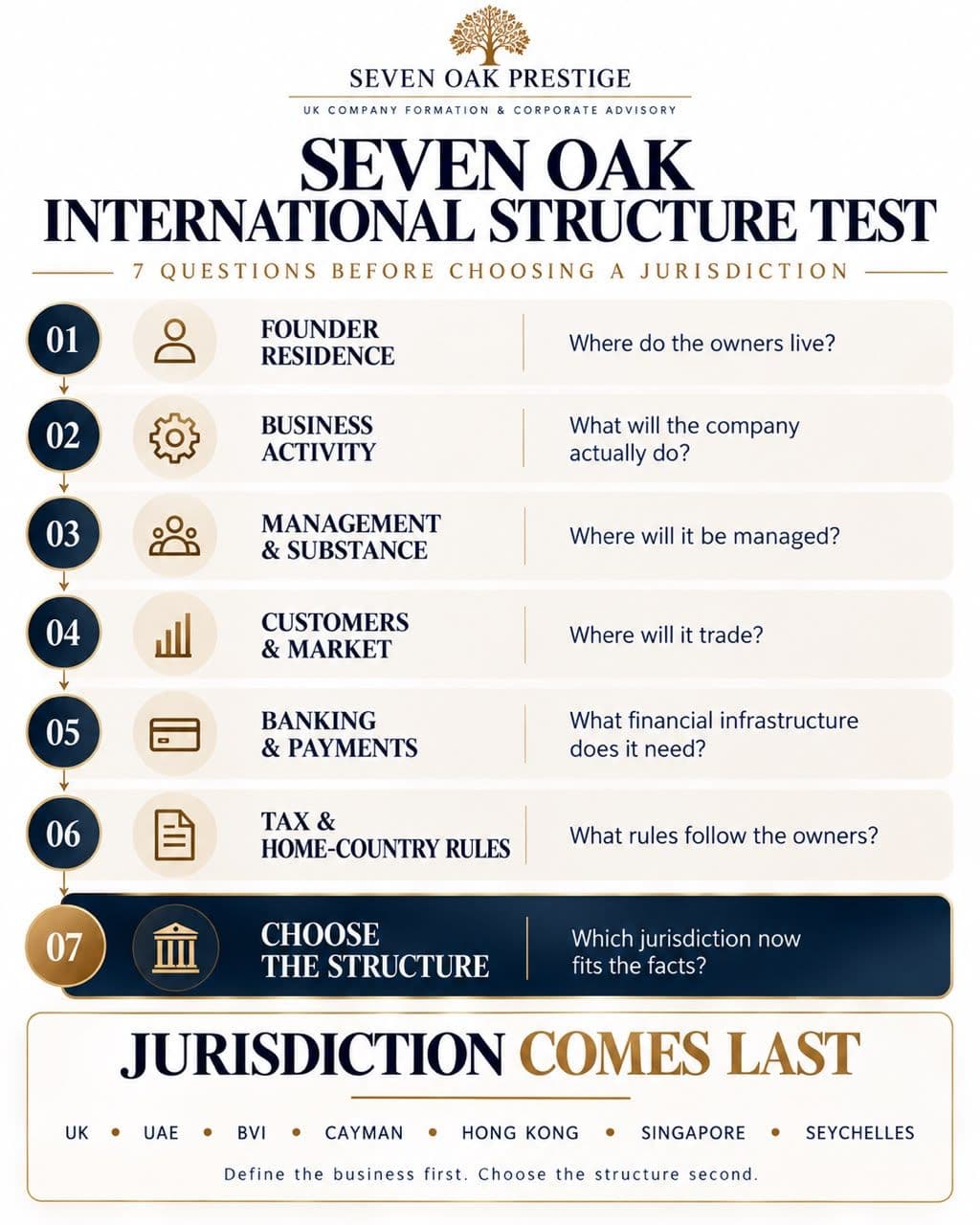
2. The Seven Oak International Structure Test
Before comparing the UK with BVI, Cayman, UAE or another jurisdiction, work through seven layers.
2.1 Founder Residence
Where do the ultimate owners actually live?
Incorporating abroad does not automatically remove a founder from the tax, reporting, foreign-investment or exchange-control rules of their country of residence.
An Indian resident, French resident and UAE resident could own the same type of foreign company and face materially different consequences.
Founder residence therefore belongs at the beginning of the structure decision, not at the end.
2.2 Business Activity
What will the company actually do?
An operating company sells products or services, contracts with customers and conducts the underlying business.
A holding company primarily owns shares, subsidiaries, investments, intellectual property or other assets where appropriate.
A special-purpose vehicle — SPV is normally created for a defined investment, transaction, financing, project or joint venture.
A fund or institutional investment structure is designed for a different purpose again.
A jurisdiction that makes sense for one of those functions may be unnecessarily complicated for another.
2.3 Management and Substance
Where will the important decisions actually be made?
Where are the directors?
Where are employees?
Where are contracts negotiated?
Where are the people and resources that actually operate the business?
The incorporation certificate tells you where a company was legally formed. It does not, by itself, answer every question concerning tax residence, permanent establishment or economic substance.
2.4 Customers and Operating Market
Where will the company actually make money?
A business selling mainly to UK customers can have different structural needs from a Gulf business, an Asia-facing trading company or an investment vehicle holding assets across several countries.
Customers matter, but so do suppliers, employees, inventory, warehouses, contracts and physical operations.
2.5 Banking and Payments
Before forming the company, ask what financial infrastructure it needs.
Which bank or regulated payment provider needs to support it?
Which currencies will it receive?
Where do the owners live?
Where are the customers and suppliers?
Does the business require card processing, marketplace payouts or other payment infrastructure?
This distinction is fundamental:
Company formation does not equal bank-account or payment-provider approval.
Financial providers make their own eligibility, KYC and risk decisions.
2.6 Tax and Home-Country Rules
Company jurisdiction is only one layer of the tax analysis.
Depending on the circumstances, relevant questions can include corporate tax, personal taxation, company tax residence, Controlled Foreign Company rules, permanent establishment, withholding taxes, foreign-company reporting, foreign-asset reporting, economic substance, treaty access and overseas-investment rules.
A company paying little or no corporate tax locally does not automatically produce a low-tax outcome for its owner.
2.7 Structure
Only after those questions should the founder ask:
UK Ltd?
UAE?
BVI?
Cayman?
Hong Kong?
Singapore?
Seychelles?
Another jurisdiction?
Residence → Activity → Management → Market → Banking → Tax/Home-Country Rules → Structure.
The jurisdiction should be the result of the analysis, not its starting point.
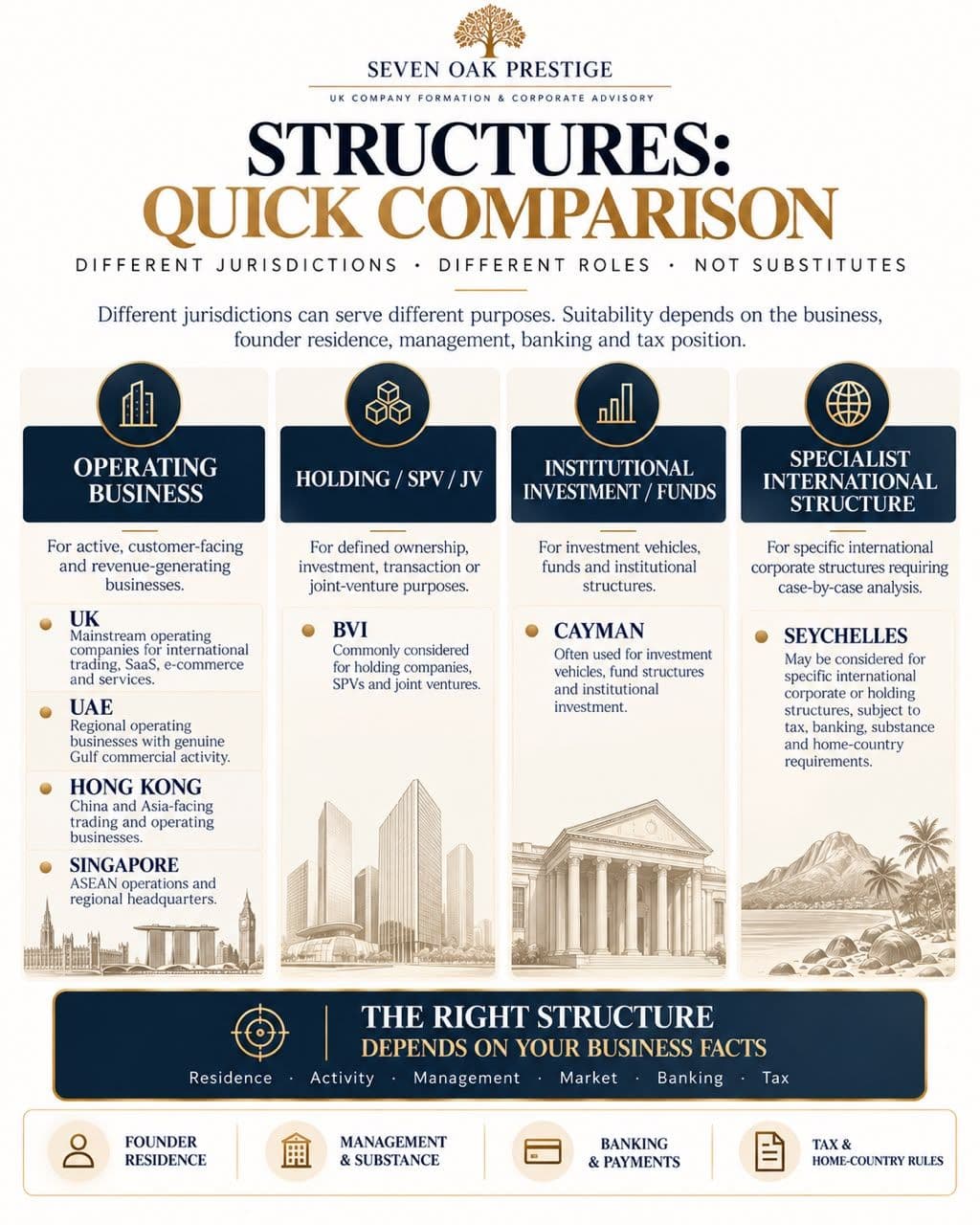
3. UK Ltd vs Offshore Structures: Quick Comparison
The following comparison is a shortlisting framework, not a universal ranking.
UK Limited Company
Typical role: Mainstream operating company.
Often examined for: SaaS, consulting, agencies, e-commerce, international services, trading and contracting.
Tax position: UK Corporation Tax applies. For the financial year beginning 1 April 2026, the small-profits rate remains 19% for qualifying profits up to £50,000 and the main rate 25% above £250,000, with Marginal Relief between the thresholds. Associated companies and other circumstances can affect those thresholds. (GOV.UK)
Transparency: Relatively high through Companies House.
Commercial consideration: A familiar operating-company structure does not guarantee banking or payment-provider approval.
Decision point: Does the business genuinely need a UK operating platform?
British Virgin Islands
Typical role: Holding company, SPV or joint-venture vehicle.
Often examined for: Group ownership, investments, asset holding and defined transactions.
Transparency: Different from the UK’s public-register model, but this should not be confused with anonymous beneficial ownership.
Commercial consideration: Banking, economic substance, beneficial ownership and the founder’s home-country rules need to be assessed.
Decision point: Is there a genuine holding, investment, SPV or joint-venture reason for using BVI?
Cayman Islands
Typical role: Investment, fund or institutional structure.
Often examined for: Investment funds, private equity, institutional capital and investment SPVs.
Commercial consideration: Specialist legal, regulatory, administration, beneficial-ownership and tax considerations can be significant.
Decision point: Is the entity genuinely serving an investment or institutional purpose?
UAE
Typical role: Operating or regional business structure.
Often examined for: Gulf operations, MENA expansion, residency-linked businesses and regional commercial activity.
Commercial consideration: Mainland and free-zone companies should not be treated as one generic “Dubai company”, and UAE Corporate Tax treatment depends on the entity and its circumstances.
Decision point: Will there be genuine UAE commercial activity, management, residence or substance?
Hong Kong
Typical role: Asia-facing operating and trading company.
Often examined for: China/Asia trade, regional operations and international services.
Tax consideration: Hong Kong’s territorial system and foreign-sourced income rules require analysis of the actual income and circumstances. The current foreign-sourced income exemption regime also contains specific rules for certain foreign-sourced income received in Hong Kong by multinational-enterprise entities. (Inland Revenue Department)
Decision point: Does Hong Kong genuinely correspond to the company’s Asian commercial activity?
Singapore
Typical role: Operating company or regional headquarters.
Often examined for: ASEAN expansion, technology, international trading and regional headquarters.
Tax position: Singapore’s corporate income tax rate is 17% of chargeable income, subject to applicable exemptions, rebates and other provisions. (Default)
Decision point: Is Southeast Asia a meaningful part of the company’s strategy?
Seychelles
Typical role: International corporate structure requiring fact-specific analysis.
Tax consideration: Seychelles should not be reduced to the old shorthand of a universally “tax-free offshore company”. The Seychelles Revenue Commission applies business-tax rules according to the relevant business structure, income and circumstances. (Seychelles Revenue Commission)
Commercial consideration: Banking, tax, substance, beneficial ownership, counterparty perception and home-country obligations need to be tested.
Decision point: Is there a commercial reason for Seychelles beyond formation cost or perceived privacy?
These jurisdictions solve different problems.
A Cayman fund should not be compared with a UK SaaS company as though they were interchangeable products.
4. What Does “Offshore Company” Actually Mean?
“Offshore” is widely used but often imprecisely.
For one founder, it simply means a company incorporated outside their country of residence.
For another, it means a company established in an international financial centre such as BVI or Cayman.
Those are not the same concept.
A French resident owning a UK Ltd technically owns a foreign company from a French perspective. That does not turn the United Kingdom into a traditional offshore jurisdiction.
Likewise, UAE, Hong Kong and Singapore should not automatically be grouped with classic offshore international business companies. They are substantial operating jurisdictions with their own corporate, tax and regulatory systems.
The more useful distinction is usually:
What function is this company supposed to perform?
5. Operating Company, Holding Company, SPV or Fund?
This distinction can resolve much of the jurisdiction question.
Operating Company
An operating company deals directly with customers, suppliers, staff, contracts, sales and invoices.
For many international founders, this is where jurisdictions such as the UK, UAE, Hong Kong or Singapore can become more naturally relevant.
Holding Company
A holding company primarily owns shares, subsidiaries, investments, intellectual property or other assets where appropriate.
The appropriate jurisdiction can depend on ownership, treaties, distributions, withholding tax, substance and the tax position of the ultimate owners.
Special-Purpose Vehicle
An SPV exists for a defined transaction, investment, financing, joint venture or project.
BVI and other international financial centres can become relevant where the entity has a genuine structural purpose.
Fund or Institutional Investment Structure
This is another category entirely.
Cayman and other specialist financial centres can be familiar within institutional investment structures precisely because they are solving a different problem from an ordinary customer-facing business.
The company should follow the function. The function should not be invented to justify the jurisdiction.
6. UK Limited Company: When Does It Make Sense?
A UK Ltd is not a traditional offshore company.
It operates within UK company law, Companies House filing requirements and the UK tax system.
For an overseas founder, however, it remains a foreign company relative to the founder’s country of residence.
A UK company can be particularly relevant for consulting, SaaS, software, technology, digital agencies, professional services, e-commerce, international trading and other customer-facing operating businesses.
Its attraction is generally not secrecy or a zero-tax promise.
It is the combination of a recognised corporate form, established commercial infrastructure and a transparent company-registration framework.
A non-UK resident can generally own a UK private limited company, and an ordinary private company does not generally require its director to live in the United Kingdom.
Founders who need to go deeper into ownership and governance can read How to Structure Shares and Directors in a UK Ltd as a Non-Resident Founder.
For founders who decide that the UK fits their commercial and operational needs, our UK company formation for non-residents service explains the practical route to establishing a UK Ltd, including the formation process, address requirements and ongoing support.
UK Transparency Is a Feature and a Trade-Off
Companies House makes substantial corporate information publicly accessible.
That provides less public privacy than many traditional international financial centres.
For an operating business, however, transparency can also make the corporate structure easier for customers, suppliers, financial institutions and other counterparties to understand.
It is therefore better viewed as a characteristic of the UK system rather than automatically as an advantage or disadvantage.
UK Address Requirements
A UK company needs an appropriate registered office.
That does not mean its founder must live at the address or that the registered office automatically represents the company’s warehouse, employees or operating headquarters.
For founders who need to understand the distinction between statutory and operational addresses, UK Registered Office vs Director Service Address for Non-Residents explains the address framework in detail.
Companies House Identity Verification
Identity verification is now a legal requirement within the Companies House framework.
New directors must provide the required verification information as part of incorporation or appointment, while existing directors and PSCs are subject to the applicable transition and filing rules. (GOV.UK)
International founders who need the detailed process can continue with Companies House Identity Verification for Non-Residents.
UK Corporation Tax
The UK is not a zero-tax jurisdiction.
For the financial year beginning 1 April 2026, the main Corporation Tax rate is 25% and the small-profits rate is 19% for qualifying profits up to £50,000, with Marginal Relief between £50,000 and £250,000. Those thresholds can be affected by associated companies and other circumstances. (GOV.UK)
But comparing 25% in the UK with 0% somewhere else still does not answer which structure produces the better overall result.
The wider analysis can involve personal tax, withholding tax, treaties, CFC rules, permanent establishment, banking, substance and the founder’s home-country obligations.
7. BVI: When It May Fit
The British Virgin Islands should not simply be described as a cheap company-registration destination.
A BVI entity may be examined for a genuine holding structure, SPV, joint venture, investment arrangement or wider corporate group.
The important distinction is between public privacy and legal invisibility.
A company can operate under a different public-disclosure framework from Companies House while still being subject to beneficial-ownership, KYC, regulatory and other information requirements.
The practical question is therefore not:
How private is BVI?
It is:
What legitimate commercial function does BVI perform in this structure?
Before forming the company, the founders should also understand whether appropriate banking is realistically available, where the beneficial owners live, how the company will be funded, what it will own, and how their home-country tax rules interact with it.
A BVI company can be entirely logical for the right purpose.
Using one for an ordinary customer-facing business simply because somebody advertised “0% tax” is a different proposition.
8. Cayman Islands: When It May Fit
Cayman should not be reduced to the stereotype of a tax-haven company.
Its significance is particularly strong in sophisticated investment structures, including investment funds, private equity, institutional capital and certain SPVs.
For those uses, familiarity among investors, fund professionals, administrators and advisers can be commercially important.
That is fundamentally different from an international freelancer, consultant or small e-commerce founder looking for a customer-facing company.
The useful distinction is:
Institutional investment or fund structure: Cayman may deserve serious investigation.
Ordinary operating business: The commercial reason for adding Cayman needs to be established.
The fact that a jurisdiction is respected for one kind of international structure does not mean it is appropriate for every international business.
9. Seychelles: Low Formation Cost Is Not a Strategy
Seychelles remains visible in international-company searches, particularly where founders are attracted by perceived privacy or accessible incorporation.
But formation price is one of the weakest criteria on which to build a cross-border structure.
Seychelles’ current tax framework is more nuanced than the historical marketing language surrounding “tax-free IBCs”. The Seychelles Revenue Commission applies business-tax rules according to the relevant business, income and circumstances. (Seychelles Revenue Commission)
Before choosing Seychelles, examine the actual tax position, banking, substance, beneficial ownership, counterparty perception, payment infrastructure and the owner’s home-country rules.
The right question is not:
How cheaply can I register it?
It is:
Will this company still work when I need to bank, trade, receive payments, satisfy KYC and explain the structure to customers, advisers and authorities?
10. UAE: A Genuine Operating Jurisdiction, Not One Generic “Offshore Company”
“Dubai company” can describe materially different structures.
The UAE has mainland businesses, numerous free zones and different corporate arrangements. They should not be treated as interchangeable.
The UAE also has a federal Corporate Tax system, so the old blanket statement that a Dubai company automatically means zero corporate tax is no longer an adequate basis for structuring a business.
A UAE company can make strong commercial sense where a founder genuinely lives and manages the business there, has Gulf operations or customers, or is building a credible regional platform.
Compare that with a founder who lives in France, manages everything from France, serves primarily European customers and has no meaningful UAE operations.
The UAE incorporation certificate does not, by itself, resolve the French tax, management, permanent-establishment or owner-level questions.
Seven Oak has a separate comparison for founders whose specific decision is UK versus UAE. UK Company vs UAE Company for UAE Residents and Dubai Entrepreneurs
The broader principle remains:
Where the founder genuinely lives and operates can matter as much as where the company is incorporated.
11. Hong Kong: When Asia Is the Commercial Reason
Hong Kong is better understood as an international operating and financial centre than as a traditional anonymous offshore jurisdiction.
It can be relevant for China-linked trade, Asian operations, import/export and regional commercial activity.
But Hong Kong’s territorial tax system should not be reduced to:
Foreign revenue = automatically tax-free.
The source and circumstances of profits matter.
Hong Kong also operates a foreign-sourced income exemption regime covering specified foreign-sourced income received in Hong Kong by relevant multinational-enterprise entities, with conditions including economic-substance, nexus and participation requirements depending on the income concerned. (Inland Revenue Department)
For a business with genuine China or Asia-facing activity, Hong Kong may therefore deserve serious consideration.
For a company with no meaningful Asian connection, the commercial rationale should be examined more carefully.
12. Singapore: When a Regional Headquarters Makes Sense
Singapore is similarly better understood as a premium operating and regional-headquarters jurisdiction.
It can be relevant for ASEAN expansion, technology, international trading and sophisticated regional operations.
Singapore’s corporate income tax rate is 17% of chargeable income, although applicable exemptions, rebates and other provisions can affect the final liability. (Default)
Its attraction is not anonymous ownership or a tax-free shell.
Its strengths lie in its commercial ecosystem, regional position, governance framework and established business infrastructure.
The useful distinction is therefore not:
UK or Singapore: which has the lower tax rate?
It is:
Which jurisdiction corresponds to where this company will actually operate and grow?
13. Founder Residence Can Completely Change the Answer
This is one of the most important factors missing from simplistic offshore comparisons.
Consider three people owning the same type of foreign company:
Owner A lives in France.
Owner B lives in the UAE.
Owner C lives in India.
The foreign company’s incorporation documents could be identical.
The owners’ tax, reporting, overseas-investment and distribution consequences may not be.
India Example
Indian residents considering a UK, UAE, BVI or Cayman company can face an additional India-side layer involving FEMA, the Overseas Investment framework, funding routes and Indian tax/reporting considerations.
A foreign incorporation does not automatically remove those obligations.
Indian founders considering the issue in detail should use Seven Oak’s dedicated FEMA & RBI Rules for Indian Residents with a UK Company rather than treating this broader jurisdiction guide as an India-specific compliance manual.
The principle applies well beyond India:
Your home-country rules travel with you into the structure analysis.
14. Company Jurisdiction Is Only One Tax Layer
Three concepts deserve particular attention.
Company Tax Residence
The place where a company is incorporated and every question concerning its tax residence are not universally identical concepts.
The UK generally treats a UK-incorporated company as UK resident for Corporation Tax purposes, subject to relevant exceptions and treaty provisions. Other jurisdictions can apply their own residence and management tests.
Controlled Foreign Company Rules
Many countries operate CFC or related anti-deferral rules.
Depending on the country, ownership, income and circumstances, foreign-company profits can create consequences for owners or parent companies elsewhere.
The detailed rules are jurisdiction-specific.
The practical principle is not:
Foreign company = foreign tax only.
It is:
The company and its owners must be considered together.
Permanent Establishment
A company incorporated in one country can potentially create taxable presence in another through its activities there.
Offices, employees, agents and other business operations can matter depending on the relevant domestic law and treaty.
Foreign incorporation therefore does not automatically export the underlying business activity out of the country where that activity actually occurs.
15. Banking, Payments and Online Infrastructure Can Change the Decision
A company that looks excellent on a corporate-structure diagram but cannot obtain appropriate banking or payment infrastructure may be commercially useless.
Financial institutions can consider matters such as the jurisdiction of incorporation, director and beneficial-owner residence, ownership structure, business activity, customers, suppliers, transaction countries, expected turnover, source of funds, source of wealth, website, operating substance and purpose of the account.
Their criteria can also change.
Consider a French entrepreneur choosing between a UK operating company and a BVI company.
If the underlying business is a customer-facing SaaS company serving European clients and requiring mainstream payment processing, the theoretical corporate advantages of BVI may be outweighed by the financial infrastructure the business actually needs.
For a genuine investment SPV, the conclusion could be completely different.
That is why:
Company formation does not equal bank-account approval.
The same principle applies to a UK Ltd. A Companies House certificate does not create an entitlement to a bank, EMI or payment account.
Founders considering a UK structure can examine provider fit and KYC separately in UK Business Banking for Non-Residents: Banks, Fintechs & Eligibility Explained.

Online Businesses
The same reasoning applies to Stripe, Shopify, Amazon, TikTok Shop and other platforms.
A company should not be formed solely because somebody claims that a particular jurisdiction will “unlock” a payment processor or marketplace.
The real operating chain may involve:
Company → Banking → Payment Processing → Tax/VAT → Suppliers → Inventory/Fulfilment → Customers → Accounting and Compliance
For founders whose primary business model is online retail, Seven Oak’s UK E-Commerce Company for Non-Residents: VAT & Banking 2026 covers that specialist intent without turning this jurisdiction comparison into another e-commerce guide.
The decision rule here is narrower:
Choose the corporate structure together with the financial and operating infrastructure it requires, not before it.
16. Privacy Is Not Secrecy
Privacy is one reason some founders investigate offshore companies.
But three concepts should not be confused:
public visibility;
legal beneficial ownership;
confidentiality from the general public.
A jurisdiction may publish less shareholder information than Companies House while still requiring beneficial owners to be identified to regulated service providers, financial institutions or competent authorities.
International financial transparency has also changed substantially.
The OECD Common Reporting Standard provides for participating jurisdictions to obtain specified financial-account information from financial institutions and automatically exchange reportable information with other participating jurisdictions. (OECD)
That means:
Less publicly searchable does not mean legally invisible.
A lawful international structure should be capable of surviving disclosure to the people and authorities legally entitled to understand who owns and controls it.
17. Can a Foreign Company Trade in the UK?
Potentially, yes.
Selling to British customers does not automatically mean every foreign company must create a UK Ltd.
However, a foreign company that establishes a place of business in the UK or usually carries on business from somewhere in the UK can have Companies House registration obligations. GOV.UK states that an overseas company without a UK base does not need to register with Companies House merely on that basis, although Corporation Tax obligations can still arise. (GOV.UK)
Depending on the activities, UK tax, VAT, customs, employment and permanent-establishment questions may also arise.
This is why:
Having UK customers
and
operating through a UK establishment
should not automatically be treated as the same thing.
18. Tax Treaties and Withholding Tax Can Matter More Than 0%
Imagine a company receiving dividends, interest or royalties from another country.
The source jurisdiction may impose withholding tax.
Treaty access can potentially alter the treatment where the relevant conditions are satisfied.
Some classic low-tax jurisdictions have different treaty networks from major operating jurisdictions.
The correct comparison therefore cannot stop at:
Corporate tax rate: 0%.
It must ask what happens as money enters the company, remains in the company and ultimately reaches its owners.
That is why:
0% local corporate tax does not necessarily mean the lowest total cross-border tax burden.
19. Commercial Credibility and Real Cost Matter
Never compare jurisdictions using incorporation fees alone.
The first year can involve incorporation, registered agents, registered offices, company secretaries where required, licences, accounting, tax advice, bank onboarding, legal advice and substance requirements.
Ongoing costs can include renewals, accounts, tax returns, audits where applicable, regulatory filings, economic-substance obligations and local operational costs.
There is also a less visible cost: friction.
Customers, suppliers, investors, marketplaces and financial institutions can care about where a company is incorporated, what it actually does there, who owns it and whether the structure makes commercial sense.
A company that is cheap to register but difficult to bank, explain or operate is not necessarily a cheap structure.
For an ordinary operating business, corporate transparency and commercial familiarity can have economic value of their own.
20. Which Jurisdiction Should You Investigate?
The useful question is not:
Which jurisdiction is best?
It is:
Which jurisdiction deserves further investigation for this particular business?
UK Ltd
Investigate when: The business needs a mainstream operating company for international services, SaaS, consulting, e-commerce, trading or contracting and the UK framework fits the commercial model.
Test carefully: UK Corporation Tax, founder-country obligations, banking, actual management and operating geography.
Decision point: Does the business genuinely benefit from being a UK operating company?
UAE
Investigate when: The founder or business has genuine Gulf residence, management, operations, customers or substance.
Test carefully: Exact company type, licensing, Corporate Tax treatment, banking, substance and continuing obligations elsewhere.
Decision point: Is there a genuine UAE commercial connection?
BVI
Investigate when: There is a genuine holding, SPV, investment or joint-venture requirement.
Test carefully: Banking, beneficial ownership, economic substance and home-country tax.
Decision point: What function does BVI perform that the operating company does not?
Cayman Islands
Investigate when: The structure involves funds, private equity or institutional investment requirements for which Cayman is commercially established.
Test carefully: Specialist legal, regulatory, administration, beneficial-ownership and tax requirements.
Decision point: Is the structure genuinely institutional or investment-led?
Hong Kong
Investigate when: There is genuine China, Hong Kong or Asia-facing trade or regional activity.
Test carefully: Source of profits, FSIE rules where relevant, banking, substance and home-country obligations.
Decision point: Does Hong Kong correspond to the economic activity?
Singapore
Investigate when: The company will build genuine Singapore or ASEAN operations, management or regional-headquarters functions.
Test carefully: Tax, governance, operating costs, substance and founder-country implications.
Decision point: Is Singapore part of the real operating strategy?
Seychelles
Investigate when: There is a defined international corporate purpose that remains coherent after tax, banking, substance and reporting are tested.
Test carefully: Current Seychelles tax treatment, banking, beneficial ownership, substance and home-country obligations.
Decision point: Does Seychelles solve a commercial problem beyond formation cost or perceived privacy?
21. When an Offshore Structure Makes Sense — and When It Does Not
An offshore or international financial-centre structure can be entirely legitimate.
It may make sense where there is a genuine holding-company purpose, defined SPV, joint venture, investment arrangement, fund structure, asset-ownership requirement or other commercially coherent reason supported by appropriate legal and tax advice.
It becomes harder to justify when the reasoning is limited to:
“I want zero tax.”
“I do not want anyone to know who owns the company.”
“Someone told me the bank will accept it.”
“It is cheaper to register.”
“I saw it recommended on social media.”
Those statements do not establish that the company will work with the founder’s residence, business activity, banking, customers, tax position or long-term plans.
The more complex the structure becomes, the more important it is that every entity has a clear purpose.
22. Eight Common International Company Structuring Mistakes
1. Choosing solely because the headline corporate tax rate is low or zero.
Local company tax is only one layer of an international structure.
2. Ignoring where the founder lives.
Personal tax, CFC rules, reporting and overseas-investment requirements can survive foreign incorporation.
3. Confusing incorporation with every question of tax residence.
A certificate of incorporation does not resolve every cross-border tax question.
4. Assuming privacy means anonymous ownership.
Modern beneficial-ownership, AML and international reporting frameworks make that assumption unreliable.
5. Incorporating before checking banking and payment infrastructure.
A legally valid company can still be unsuitable for the financial providers the business requires.
6. Ignoring substance and commercial purpose.
The structure should reflect what the company genuinely does and why it exists in that jurisdiction.
7. Ignoring treaties, withholding tax and permanent establishment.
These can materially alter the real cross-border outcome.
8. Adding companies without a genuine reason.
More entities mean more administration, accounting, banking, compliance and potential tax interactions.
Complexity should solve a real problem.
23. Frequently Asked Questions
Is a UK Ltd an offshore company?
Not in the conventional sense.
A UK Ltd is incorporated within the UK’s mainstream company-law, Companies House and tax framework.
A founder living abroad may describe it casually as a foreign or “offshore” company because it is outside their country of residence, but that does not make the United Kingdom a classic offshore jurisdiction.
What is the best offshore jurisdiction in 2026?
There is no universal best jurisdiction.
The appropriate structure depends on the company’s purpose, founder residence, management, customers, assets, banking, payment infrastructure, tax position, substance and home-country obligations.
UK Ltd or BVI?
They commonly solve different problems.
A UK Ltd may deserve consideration for a customer-facing operating business.
BVI may deserve consideration for an appropriate holding company, SPV, investment or joint venture.
The business purpose should determine which structure is investigated.
UK Ltd or UAE company?
A UK company can make sense where the business needs a recognised UK operating platform.
A UAE company can be more coherent where the founder genuinely lives, manages or operates in the Gulf or requires a substantive UAE/MENA commercial structure.
Founder residence, management, customers, substance, tax and banking should all be considered.
BVI or Cayman?
BVI is commonly examined for holding companies, SPVs and joint ventures.
Cayman is particularly established in institutional investment and fund structures.
Neither should be selected merely because it is labelled “offshore”.
Is Dubai still tax-free?
Not as a blanket statement.
The UAE operates a federal Corporate Tax regime, and free-zone treatment depends on the entity, income and applicable conditions.
A UAE structure should therefore be assessed according to the actual company and activity rather than an assumption that every Dubai company pays 0% tax.
Can an offshore company get a bank account?
Potentially.
But incorporation does not guarantee banking.
Financial institutions can assess the company, jurisdiction, beneficial owners, owner residence, business activity, customers, suppliers, source of funds, source of wealth, expected turnover and purpose of the structure.
Can an offshore company use Wise, Revolut, Airwallex or Stripe?
Potentially, where the company and its owners meet the provider’s current eligibility and onboarding requirements.
Provider policies can change, and incorporation in a particular jurisdiction does not guarantee approval.
Does offshore incorporation change my personal tax residence?
Not by itself.
Company incorporation and personal tax residence are separate questions.
Does a 0% company tax rate mean I personally pay no tax?
No.
The company’s local corporate tax position and the owner’s personal tax position are separate matters. Distributions, salary, dividends, CFC rules and other home-country provisions may need to be considered.
Can my home-country tax authority know about a foreign bank account?
Potentially.
The OECD Common Reporting Standard provides a framework for automatic exchange of specified financial-account information between participating jurisdictions. The precise reporting position depends on the jurisdictions, institution, account holder and entity classification. (OECD)
Can an offshore company trade with UK customers?
Potentially.
Selling to UK customers does not automatically require every foreign company to incorporate a UK Ltd, although UK tax, VAT, customs, permanent-establishment or overseas-company registration questions can arise depending on the actual activities. (GOV.UK)
Can an offshore company own a UK company?
Potentially.
A foreign corporate shareholder can own shares in a UK company, subject to the relevant corporate, beneficial-ownership, tax, KYC and other requirements.
When can a UK Ltd make more sense than a classic offshore company?
A UK Ltd can deserve closer consideration where the business needs a mainstream customer-facing operating company for contracts, SaaS, consulting, e-commerce, international services or trading and the UK structure fits the founder’s wider circumstances.
That does not mean a UK Ltd is universally preferable.
It means the structure should match the job.
UK Ltd or Offshore Company: The Final Decision
There is a simple way to test an international company proposal.
Remove the jurisdiction’s name from the plan.
Then describe:
who owns the business;
where the owners live;
what the company sells;
where it is managed;
where customers are;
where staff and assets are;
which banking and payment infrastructure it needs;
how money enters and leaves the structure;
and what the company is supposed to achieve.
Only then put the jurisdictions back into the analysis.
That exercise often exposes whether a proposed company solves a genuine commercial problem or merely follows a headline tax rate.
For a customer-facing international consultancy, SaaS company, agency, e-commerce operation or trading business, a mainstream operating jurisdiction such as the UK may be more coherent than a classic offshore IBC.
For genuine Gulf operations, the UAE may fit better.
For an Asia-facing business, Hong Kong or Singapore may deserve consideration.
For an appropriate holding company, SPV or joint venture, BVI may have a legitimate role.
For an institutional investment or fund structure, Cayman may be more natural.
The point is not that one jurisdiction wins.
They are different tools for different jobs.
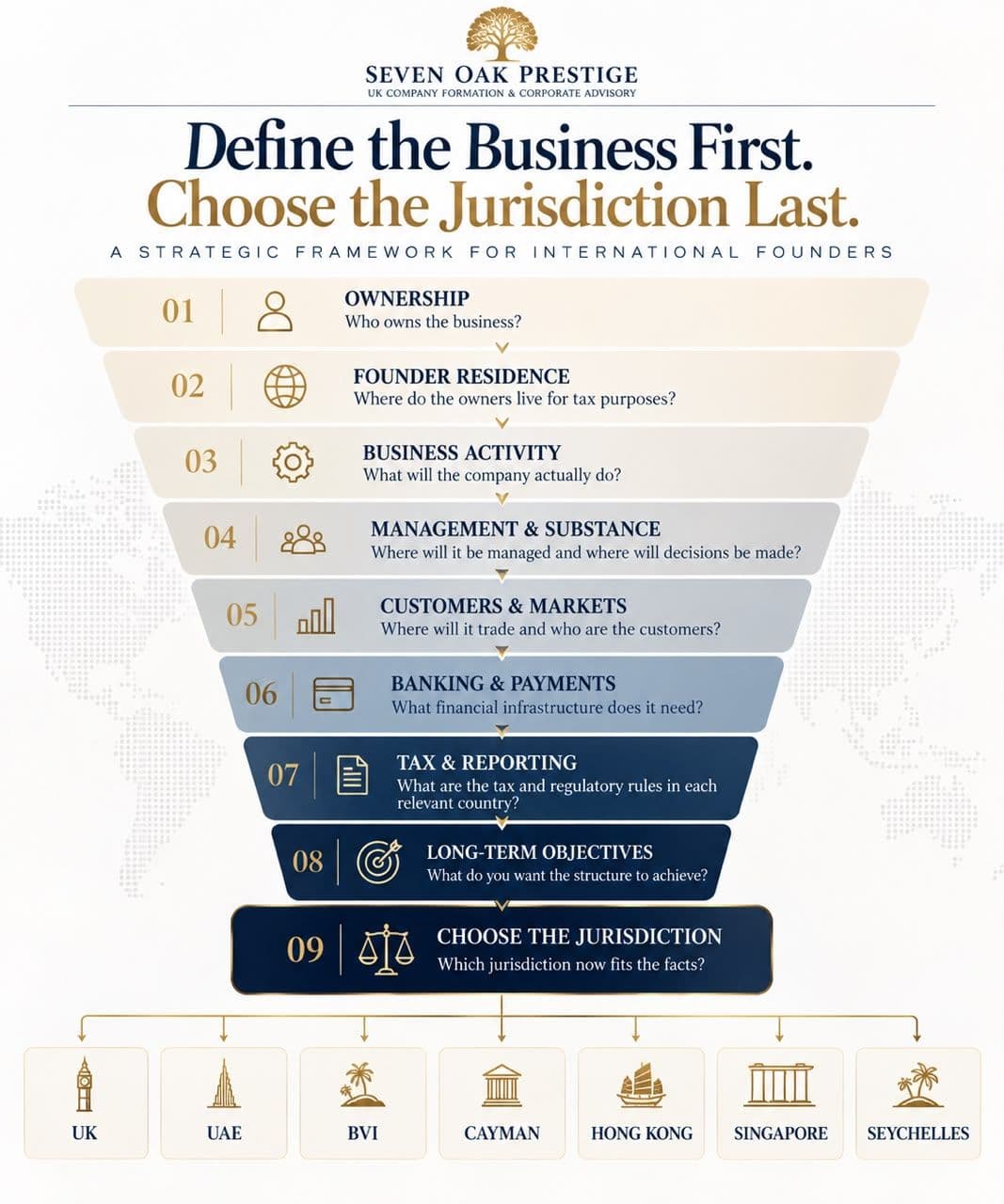
A durable international structure needs to work across:
Ownership → Founder Residence → Business Activity → Management and Substance → Customers and Markets → Banking and Payments → Tax and Reporting → Long-Term Commercial Objectives → Jurisdiction
That brings us back to the principle that should come before every international incorporation:
Do not choose the jurisdiction first. Define the business first.
If the UK Is the Appropriate Structure
Once the analysis points towards the UK as the appropriate operating jurisdiction, Seven Oak Prestige can support the UK corporate implementation.
Depending on the requirements, support can include UK company formation, Registered Office and Director Service Address services, Companies House identity-verification assistance, KYC preparation, banking readiness, VAT and EORI support, and post-incorporation coordination.
Seven Oak Prestige does not present itself as a BVI, Cayman, Seychelles or other offshore legal or tax adviser.
Where a proposed structure requires specialist home-country tax, offshore legal, fund, trust, investment, wealth-management or other regulated advice, an appropriately qualified professional should be involved.
For founders who have already determined that a UK company fits their business, Seven Oak’s existing non-resident formation resources explain the UK implementation process in more detail.
Need Help Establishing the UK Side of Your Business?
If you are comparing jurisdictions but believe a UK company may form part of your international business, Seven Oak Prestige can help you assess and implement the UK corporate requirements.
Before proceeding, be ready to explain:
your country of residence;
your business activity;
where your customers are located;
where the company will be managed;
and the banking or payment infrastructure the business requires.
DISCUSS MY UK COMPANY REQUIREMENTS
About the Author
Isaac Jackson
Founder & Managing Director — Seven Oak Prestige Ltd
Isaac Jackson supports international founders and overseas businesses establishing and operating UK companies, including founders requiring assistance with company formation, statutory-address services, Companies House administration, identity-verification coordination, KYC preparation, compliance coordination and banking readiness.
Seven Oak Prestige Ltd
Company Registration No. 16903092
Registered Office: 124 City Road, London EC1V 2NX, United Kingdom
Editorial Approach
Seven Oak Prestige publishes practical guidance for international founders and overseas businesses considering UK company formation and UK market entry.
For international-structure comparisons, our approach is to separate company incorporation from the wider tax, banking, regulatory and home-country consequences of owning and operating a foreign company.
We do not treat the jurisdiction with the lowest headline corporate tax rate as automatically preferable.
Instead, the analysis considers founder residence, business activity, management, operating market, banking and payment requirements, home-country obligations and genuine commercial purpose before the company jurisdiction is selected.
Where a UK company may not be the appropriate structure, this guide says so.
Editorial Methodology
This guide was developed around the practical decision facing an international founder comparing a UK Limited Company with another international jurisdiction.
The analysis considers seven questions:
- Founder residence
- Business activity
- Management and substance
- Customers and operating market
- Banking and payments
- Tax and home-country obligations
- Jurisdiction
The guide deliberately distinguishes operating companies from holding companies, SPVs, joint ventures and institutional investment structures because those vehicles solve materially different commercial problems.
Regulatory, tax and corporate statements were reviewed against relevant primary-source information from the authorities responsible for the jurisdictions and subjects discussed.
Last reviewed: 2 October 2026
Important Disclaimer
This guide provides general educational and corporate-structuring information.
It does not constitute personalised legal, tax, accounting, investment, financial, wealth-management, asset-protection or regulated advice.
International tax, CFC, permanent-establishment, economic-substance, beneficial-ownership, banking and reporting requirements can vary substantially according to the jurisdiction, company activity and circumstances of the owners.
Seven Oak Prestige provides UK company formation, corporate-administration and related business-support services.
Where a structure involves specialist UK or foreign tax, offshore law, trusts, investment funds, regulated activities or jurisdiction-specific requirements, advice should be obtained from an appropriately qualified professional.
Company incorporation does not guarantee bank-account, EMI, payment-processor, marketplace or other third-party approval.
Primary Official Sources Reviewed
UK Government / HM Revenue & Customs
Corporation Tax rates and allowances; international company-tax and permanent-establishment guidance. (GOV.UK)
Companies House / GOV.UK
UK company requirements, overseas-company registration and Companies House identity-verification requirements for directors and People with Significant Control. (GOV.UK)
OECD
Common Reporting Standard and automatic exchange of financial-account information. (OECD)
Hong Kong Inland Revenue Department
Foreign-Sourced Income Exemption regime and related economic-substance, nexus and participation requirements. (Inland Revenue Department)
Inland Revenue Authority of Singapore
Corporate Income Tax rates and current corporate-tax framework. (Default)
Seychelles Revenue Commission
Current Seychelles business-tax framework. (Seychelles Revenue Commission)