
How to Start & Register a UK Company from Iraq: Complete 2026 Guide for Iraqi Residents

UK Limited Company Formation, Companies House Identity Verification, UK Address, Costs, Banking, Sanctions, Tax & Ongoing Compliance
Updated: 29 August 2026
An Iraqi citizen or resident can generally establish and own a UK Private Limited Company without moving to Britain.
UK company law does not ordinarily require the director of a private limited company to live in the United Kingdom. A private company must have at least one director who is a natural person and aged 16 or over, while a company limited by shares can have a single shareholder who may also be that director.
For an entrepreneur living in Baghdad, Erbil, Sulaymaniyah, Basra or elsewhere in Iraq, this means that UK company formation can generally be completed remotely.
However, three separate questions must not be confused:
1. Can you legally register the UK company?
Usually, yes, subject to Companies House requirements.
2. Can you pass the required identity and compliance checks?
This depends on the individual, documents and verification route.
3. Will a bank or payment provider accept the company afterwards?
That is a completely separate decision made by the provider.
This distinction is especially important for Iraqi founders.
A UK Certificate of Incorporation proves that the company exists.
It does not guarantee:
- a UK bank account;
- Stripe;
- Wise;
- Payoneer;
- Airwallex;
- another payment provider;
- or exemption from UK or Iraqi tax obligations.
This guide focuses specifically on how an Iraqi resident establishes a UK Limited Company correctly in 2026, while linking to separate specialist guides where banking, payments, identity verification and costs require deeper analysis.
Quick Answer: Can an Iraqi Resident Register a UK Company?
Generally, yes.
An Iraqi resident can normally be:
- the sole shareholder;
- the sole director;
- a Person with Significant Control;
- and the beneficial owner of a UK Ltd.
There is no general UK company-law requirement for that director or shareholder to be British or UK-resident. Directors do not need to live in Britain.
The company will, however, need an appropriate UK registered office address in the jurisdiction in which it is registered.
Since the mandatory Companies House identity-verification regime began on 18 November 2025, new directors must also satisfy the applicable verification requirements and provide their Companies House personal code during incorporation.
Iraq → UK Company Formation: 2026 Decision Summary
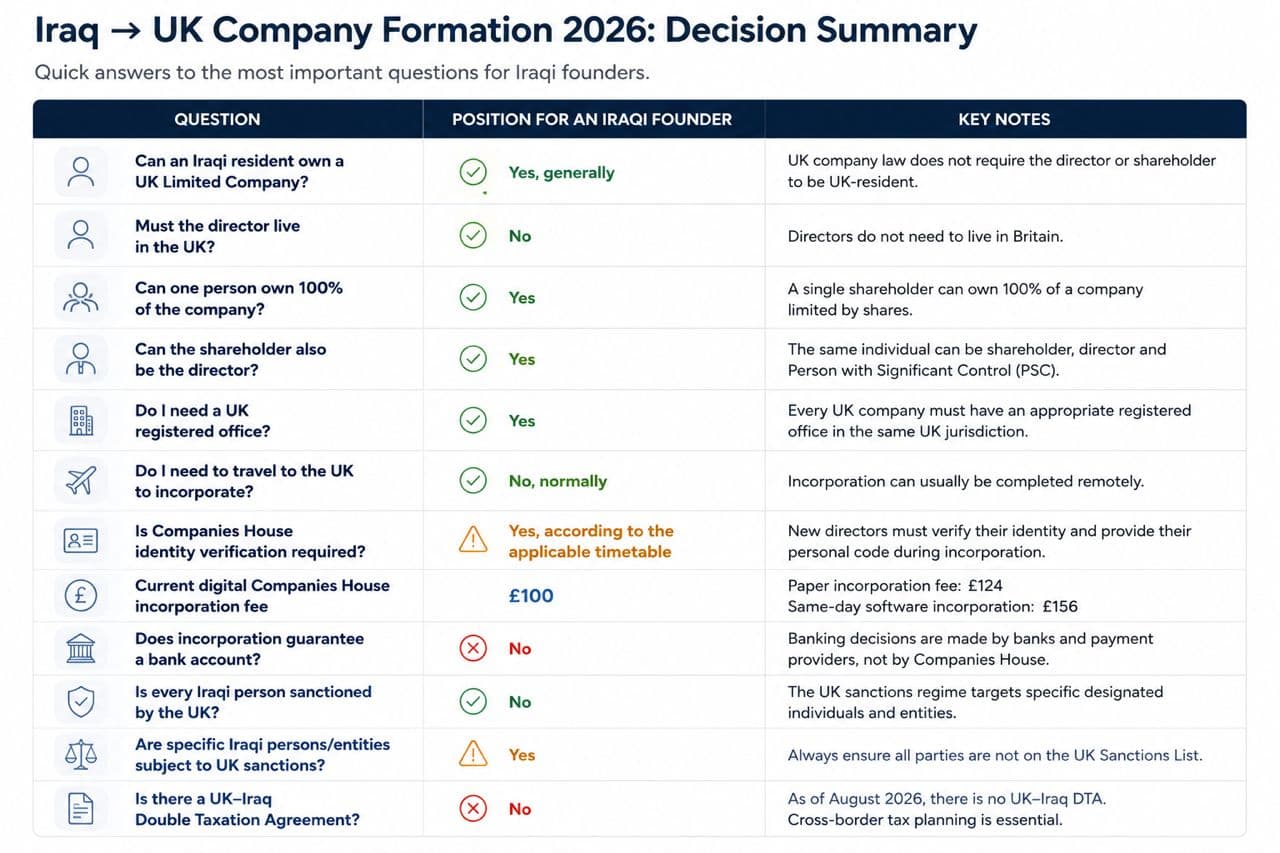
Key takeaway: Iraqi residence does not generally prevent you from forming and owning a UK Limited Company. The important distinction is between Companies House eligibility, identity verification and post-incorporation banking/compliance — each is assessed separately.
UK Company Formation from Iraq -Decision Matrix
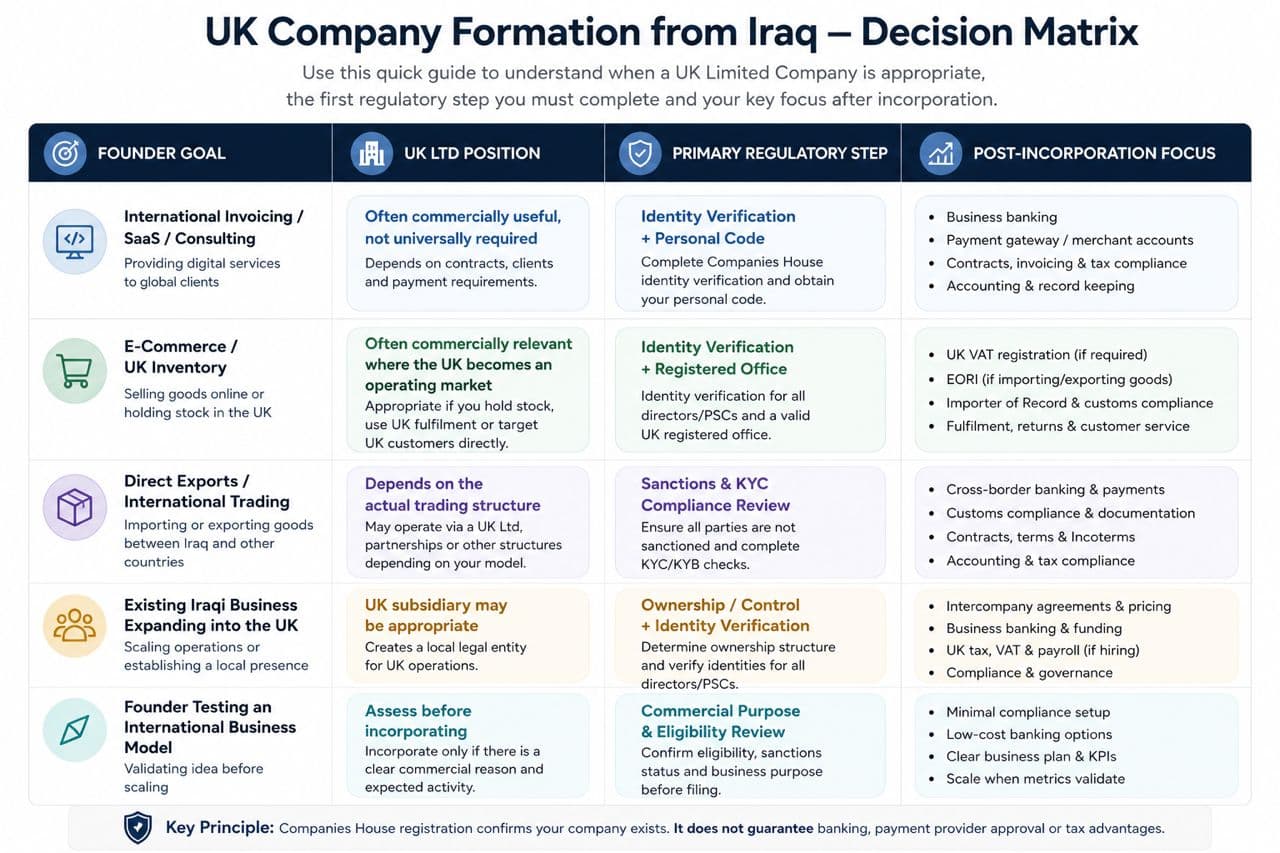
Key takeaway: Choosing the right structure: A UK Ltd should serve a genuine commercial purpose. The best structure depends on what the business actually does, how it trades and whether the UK is a real operating market.
1. Why Iraqi Entrepreneurs Establish UK Companies
A UK Ltd can make commercial sense where an Iraqi founder is building a genuine international business.
Typical examples include:
- software and SaaS;
- technology;
- consulting;
- engineering;
- digital agencies;
- professional services;
- e-commerce;
- education;
- import/export;
- international trading.
A British company can provide:
- a recognised corporate legal structure;
- a Companies House registration number;
- English-language corporate documents;
- limited liability;
- documented ownership;
- professional contracts and invoices.
But forming the company solely to obtain a UK certificate or to try to bypass another provider’s geographical restrictions is a weak foundation.
The UK company should have a clear commercial purpose.
2. Do You Need to Live in the UK?
No.
Companies House states that company directors do not have to live in the UK.
An Iraqi resident can therefore manage a UK company from Iraq.
This does not give the founder:
- UK immigration status;
- British residence;
- a UK work visa;
- or automatic permission to work physically in Britain.
Company ownership and immigration are separate issues.
For a founder operating entirely from Iraq, the incorporation process itself generally does not require relocation to the UK.
3. Can an Iraqi Resident Own 100% of the Company?
Yes.
A UK company limited by shares must have at least one shareholder. If there is only one shareholder, that person can own 100% of the company. The shareholder can also act as director.
A simple founder structure may therefore be:
Iraqi Founder
↓
100% shareholder
↓
Director
↓
UK Limited Company
That is legally different from saying it is automatically the best structure for every founder.
Where there are:
- business partners;
- investors;
- family shareholders;
- an existing Iraqi company;
- or future fundraising plans,
the share structure should be considered before incorporation rather than changed unnecessarily afterwards.
4. Director, Shareholder and PSC: They Are Different Roles
These terms are frequently confused.
Director
Responsible for managing the company and meeting directors’ legal duties.
Shareholder
Owns shares in the company.
Person with Significant Control
A PSC is a person or relevant legal entity that satisfies one or more statutory control conditions.
For a simple company owned and controlled entirely by one Iraqi founder, the same individual may therefore be:
Director + Shareholder + PSC
Companies House still treats those as distinct corporate roles.
That becomes especially important under the new identity-verification regime.
5. Companies House Identity Verification Is Now Central to Incorporation
This is one of the biggest differences between registering a UK company in 2026 and older company-formation guides.
From 18 November 2025, identity verification became legally required under the phased Companies House regime.
For a new company, Companies House asks for the personal code of each new director as part of incorporation.
After successful verification, the individual receives an 11-character Companies House personal code.
That code belongs to the individual, not to one particular company. The same individual uses the same code to connect their verified identity to relevant company roles.
6. Can Someone Living in Iraq Verify Their Identity?
Potentially, yes.
Companies House provides different verification routes.
The direct GOV.UK route currently supports qualifying identity documents including a biometric passport from any country.
Verification can also be performed through an Authorized Corporate Service Provider — ACSP.
An ACSP is a business authorized to carry out specified Companies House services, including identity verification.
For Iraqi founders, the appropriate route depends on:
- the available passport/document;
- whether the direct digital route works successfully;
- the provider’s acceptance criteria;
- consistency of personal information.
This specialist subject should not overwhelm the formation article.
For the complete process, use Seven Oak Prestige’s dedicated:
Companies House Identity Verification for Iraqi Residents (2026 Guide).
7. Directors and PSCs Do Not Use the Personal Code in Exactly the Same Way
This is an important 2026 detail.
A new director’s personal code is required as part of incorporation or appointment.
PSCs must also verify their identity and provide their personal code according to the applicable PSC timetable.
Where the same person is both director and PSC, Companies House requires the verification information to be connected to each relevant role.
This is another reason older “register a UK company from Iraq” articles can now be incomplete even if their basic company-law information remains correct.
8. What Information Is Needed to Form the Company?
Before incorporation, prepare the company’s basic corporate information.
This typically includes:
- proposed company name;
- registered office;
- registered email;
- director details;
- shareholder details;
- PSC information;
- share capital;
- SIC code;
- intended business activities;
- identity-verification information.
For an Iraqi founder using a professional formation provider, additional KYC information may also be required.
That can include evidence of:
- identity;
- residential address;
- beneficial ownership;
- business purpose;
- source of funds where relevant.
Those provider-level KYC requirements are separate from the basic Companies House incorporation form.
9. Choose the Company Name
The company name should comply with Companies House rules and accurately represent the intended business.
Before filing, check that the name is available and consider whether:
- it is too similar to another registered company;
- it contains restricted words;
- it conflicts with a trade mark;
- it still makes sense if the business expands internationally.
For most founders, changing the company name after launch creates unnecessary work across:
- banking;
- invoices;
- contracts;
- website;
- payment providers;
- accounting.
Choose carefully before incorporation.
10. Choose the Correct SIC Code
A SIC code describes the company’s business activity.
Examples vary by business model:
Software development
may use a software-related SIC.
Management consultancy
will require an appropriate consulting code.
E-commerce retail
may require a retail-related code.
Import/export or wholesale
may require different classifications depending on the products and activity.
Do not select a SIC code merely because you think it will make the company appear “low risk.”
The SIC code should reflect the real activity of the business.
Consistency is important because the same commercial activity may later appear in:
- Companies House filings;
- banking applications;
- website;
- invoices;
- contracts;
- payment-provider onboarding.
11. Choose the Share Structure
For a simple one-founder company, a straightforward structure might be:
1 ordinary share at £1
owned by the founder.
But that is only an example.
Before issuing shares, consider:
- number of founders;
- ownership percentages;
- voting rights;
- future investors;
- whether an Iraqi company rather than an individual should own the shares.
Overcomplicated share structures are rarely necessary for a basic founder-owned Ltd.
At the same time, using an arbitrary structure without thinking about future ownership can create avoidable restructuring later.
12. The UK Registered Office Is Mandatory
Every UK company must maintain an appropriate registered office address.
Companies House requires it to be:
- a physical address in the UK;
- in the same UK jurisdiction in which the company is registered;
- capable of ensuring that company post comes to the attention of someone acting for the company;
- capable of allowing confirmation of delivery.
A PO Box by itself does not satisfy the requirement.
An Iraqi founder who does not maintain physical premises in Britain will therefore often use an appropriate professional registered-office service.
13. Registered Office vs Director Service Address
These are not the same thing.
Registered office
The company’s official statutory address.
It is publicly visible.
Director service address
The correspondence address displayed publicly for the director.
The director must separately give Companies House their usual residential address, but that residential address is generally kept on the private register rather than displayed publicly.
Companies House confirms that directors provide both a public service address and their residential address.
For the complete distinction, use Seven Oak’s specialist guide on:
UK Registered Office vs Director Service Address for Non-Residents
14. Registered Email Address
A company also needs a registered email address.
Unlike the registered office, this email is not displayed publicly on the Companies House register.
It should nevertheless be actively monitored because Companies House can use it for official communications.
A professional company should not rely on an inaccessible or temporary email account.
15. How Much Does UK Company Formation From Iraq Cost?
The official Companies House digital incorporation fee is now:
£100
The current paper incorporation fee is:
£124
and eligible same-day software incorporation is currently £156.
Companies House also currently charges £50 for the digital confirmation statement fee within the relevant 12-month payment period.
But the £100 incorporation fee is not the complete cost of running a UK company.
An Iraqi founder may separately require:
- registered office;
- director service address;
- identity-verification assistance;
- accounting;
- VAT services;
- EORI;
- banking readiness;
- other operational services.
For the detailed breakdown, use the dedicated:
The True Cost of UK Company Formation from Iraq — 2026 Guide.
16. How Long Does Registration Take?
Companies House states that standard online applications are normally processed within 24 hours, although complex applications can take longer.
Therefore, it is better to say:
“Companies House normally processes straightforward digital applications within approximately 24 hours.”
rather than promising:
“Your Iraqi company will definitely be registered in 24 hours.”
Possible delays can arise from:
- identity issues;
- company-name review;
- inconsistent information;
- additional scrutiny;
- filing errors.
17. The Step-by-Step Formation Process
For most Iraqi founders, the sequence should look like this.
Step 1 — Confirm that a UK Ltd suits the business
Identify the genuine commercial reason for establishing it.
Step 2 — Decide ownership
Individual founder, partners or an existing company?
Step 3 — Complete identity verification
Obtain the relevant Companies House personal code where required.
Step 4 — Choose the company name
Step 5 — Select the business activity and SIC code
Step 6 — Determine directors, shareholders and PSCs
Step 7 — Establish the share structure
Step 8 — Arrange the registered office
Step 9 — Determine the director service address
Step 10 — Provide the registered email
Step 11 — Submit the incorporation filing
Step 12 — Receive the Certificate of Incorporation
Step 13 — Complete post-incorporation setup
Including tax, accounting and operational preparation where applicable.
This is the core formation journey.
Everything else should support it rather than replace it.
18. What Do You Receive After Incorporation?
Once Companies House accepts the incorporation, the new UK company receives a unique company number and Certificate of Incorporation.
The company’s details become available on the Companies House public register.
Depending on the incorporation method and company structure, other corporate records will also form part of the company’s statutory records.
Keep these documents secure.
Banks, payment providers, accountants and business partners may ask for them.
19. Is Iraq Banned From UK Company Formation?
No general rule prohibits every Iraqi citizen from owning a UK company.
However, the UK does maintain an Iraq sanctions regime.
The UK Sanctions List contains designated Iraqi individuals and entities subject to applicable restrictions.
This distinction matters enormously:
Iraqi nationality or residence is not the same thing as being a UK-sanctioned person.
At the same time, businesses dealing with Iraqi customers, founders or counterparties must still carry out appropriate sanctions screening and AML/KYC checks where required.
20. Sanctions Screening Is Different From a Country Ban
A weak formation article might simplify the issue in either direction:
“Iraq is banned.”
or:
“Iraq is not on a particular FATF list, therefore there are no compliance difficulties.”
Both are too simplistic.
The correct position is:
- Iraqi residents are not automatically prohibited from establishing UK companies;
- designated individuals and entities can be subject to UK sanctions;
- regulated firms and professional service providers may conduct sanctions and AML checks;
- individual banks and payment providers can also apply their own geographic risk appetite.
This is the commercially useful answer an Iraqi founder actually needs.
21. Does a UK Ltd Guarantee a Business Bank Account?
No.
This deserves emphasis—but it does not need 2,000 words inside the formation article.
Companies House registration and bank onboarding are separate processes.
A bank or payment institution may review:
- director residence;
- beneficial ownership;
- business activity;
- customers;
- suppliers;
- expected transactions;
- countries involved;
- source of funds;
- website;
- contracts;
- supporting commercial evidence.
An Iraqi founder should therefore establish the company with a realistic understanding that banking can require additional preparation.
For the detailed subject, use:
UK Business Bank Account for Iraqi Residents — 2026 Complete Guide.
22. What About Stripe, Wise, Airwallex and Payoneer?
The same principle applies.
A UK company number does not guarantee eligibility for any particular payment provider.
Provider policies change and onboarding is independently assessed.
Rather than making the formation guide into four separate fintech reviews, use the dedicated:
Stripe, Wise, Airwallex & Payoneer for Iraqi Founders — UK Company Payment Options in 2026.
23. The UK Company Is Generally UK Tax Resident
This point needs particular precision.
HMRC states that a company is UK-resident for Corporation Tax purposes if it is incorporated in the UK, subject to specific exceptions, or if its central management and control is in the UK.
Therefore, a standard UK Ltd incorporated by an Iraqi founder should not be presented as if living in Iraq automatically makes the company non-UK-resident.
UK incorporation generally brings the company into the UK Corporation Tax residence framework.
HMRC explains that UK-resident companies are normally subject to UK Corporation Tax on their chargeable profits on a worldwide basis, subject to applicable relief.
That is the starting point.
24. Can Iraqi Tax Still Matter?
Yes.
The founder living in Iraq and the UK company are not the same taxpayer.
Depending on the facts and Iraqi domestic law, issues may potentially arise around:
- founder income;
- salary;
- dividends;
- local management;
- Iraqi business activity;
- other tax obligations.
Cross-border tax should therefore be reviewed based on the specific circumstances.
And there is an additional important point.
25. There Is Currently No UK–Iraq Double Taxation Agreement
HMRC’s Double Taxation Relief Manual was updated on 4 August 2026 and continues to state:
there is no double taxation agreement between Iraq and the United Kingdom.
This means Iraqi founders should not assume that a UK–Iraq treaty will automatically resolve:
- company residence;
- dividend taxation;
- salary;
- permanent establishment;
- or double-tax questions.
That is materially different from countries where a comprehensive UK tax treaty exists.
The formation article should highlight that fact but not become a full tax textbook.
Professional UK/Iraq tax advice should be obtained for complex cross-border structures.
26. Corporation Tax Registration and HMRC
Incorporation creates the company through Companies House.
Tax administration sits with HMRC.
The company should therefore maintain accurate information concerning:
- accounting period;
- trading activity;
- income;
- expenses;
- taxable profits.
Tax and accounting should be treated as ongoing obligations rather than something considered only when Companies House accounts become due.
27. Does Every Iraqi UK Company Need VAT?
No.
UK company formation does not automatically mean VAT registration is required on day one.
VAT depends on factors including:
- business activity;
- taxable turnover;
- where supplies take place;
- customers;
- whether the company holds goods in Britain;
- whether special non-established-person rules apply.
An e-commerce/import company can have a very different VAT position from a consulting business selling digital services internationally.
Use the dedicated Seven Oak UK VAT Registration service/guide for the specialist analysis rather than turning the Iraq formation master into a VAT article.
28. When Is EORI Relevant?
An EORI becomes particularly relevant for businesses involved in importing or exporting goods through UK customs.
For example:
Iraq / overseas supplier
↓
UK customs
↓
UK company
↓
British customer
A software company ordinarily has a completely different operational profile.
So EORI should be treated as business-model dependent, not as a mandatory component of every formation.
29. Business Models That Can Use a UK Ltd
A UK company can potentially support many genuine businesses operated by Iraqi founders.
Examples include:
Technology
- SaaS;
- software development;
- AI;
- web services.
Professional services
- consulting;
- engineering;
- design;
- business services.
E-commerce
- online retail;
- marketplace selling;
- global brands.
International trade
- import;
- export;
- wholesale;
- distribution.
Education
- training;
- online education;
- professional courses.
But the company’s declared activity should reflect what it genuinely does.
Do not select a “safe-looking” activity merely to improve onboarding.
30. What Happens After Formation?
Once the company exists, the founder should move from incorporation to operation.
Typical next steps may include:
- organising statutory documents;
- activating accounting/bookkeeping;
- determining Corporation Tax obligations;
- establishing banking/payment infrastructure;
- preparing invoices and contracts;
- considering VAT/EORI where relevant;
- maintaining registered-office correspondence;
- keeping company information accurate.
For the complete post-formation journey, use Seven Oak’s:
What to Do After UK Company Formation as a Non-Resident — 2026 Checklist
31. Annual Accounts
UK companies are generally required to prepare and file annual accounts according to the applicable company-law deadlines and requirements.
Do not wait until the deadline before organising:
- invoices;
- expenses;
- bank records;
- customer payments;
- supplier documentation.
A UK Ltd should operate with proper records from its first transaction.
32. Confirmation Statement
Companies must also file confirmation statements.
The confirmation statement is not the same thing as annual accounts.
It is used to confirm or update key information held by Companies House.
The current digital confirmation statement fee is £50 for the first statement in the relevant 12-month payment period.
For existing directors subject to the identity-verification transition, the confirmation statement also interacts with the requirement to provide the director’s Companies House personal code.
33. Keep the Companies House Register Accurate
Changes may need to be reported when they occur.
Examples include changes to:
- registered office;
- directors;
- certain director details;
- PSC information;
- company name;
- share structure.
The fact that the founder is operating remotely from Iraq does not remove those obligations.
34. Common Mistakes Iraqi Founders Should Avoid
Mistake 1 — Assuming Iraqi residence prevents formation
It generally does not.
Mistake 2 — Assuming incorporation guarantees banking
It does not.
Mistake 3 — Confusing a registered office with a residential address
They serve different purposes.
Mistake 4 — Using a random SIC code to look lower risk
The SIC code should reflect genuine activity.
Mistake 5 — Ignoring identity verification until after incorporation
For new directors, verification is now part of the incorporation process.
Mistake 6 — Believing one personal code belongs to one company
The personal code belongs to the verified individual.
Mistake 7 — Assuming all Iraqi people are sanctioned
The UK sanctions regime targets designated persons/entities rather than operating as a blanket prohibition on all Iraqi nationals.
Mistake 8 — Assuming “not FATF grey-listed” means easy banking
Provider risk appetite is a separate issue.
Mistake 9 — Treating the UK company as tax-free because the owner lives in Iraq
A UK-incorporated company is generally UK tax resident.
Mistake 10 — Assuming a UK–Iraq tax treaty will solve double taxation
There is currently no UK–Iraq DTA.
Mistake 11 — Forming the company without a clear commercial purpose
The corporate structure should match the actual business.
Mistake 12 — Mixing personal and company transactions
Maintain clear business records.
35. Iraq → UK Company Formation Checklist
Before filing:
- Confirm a UK Ltd fits the business
- Decide shareholders
- Decide directors
- Determine PSCs
- Choose company name
- Select accurate SIC code
- Determine share structure
- Complete applicable identity verification
- Obtain Companies House personal code
- Arrange appropriate UK registered office
- Decide director service address
- Provide registered email
- Prepare incorporation details
- Complete provider KYC where applicable
- Submit Companies House application
- Store incorporation documents securely
After incorporation:
- Set up accounting
- Review Corporation Tax obligations
- Assess banking readiness
- Assess payment-provider requirements
- Review VAT where relevant
- Obtain EORI where relevant
- Prepare contracts/invoices
- Monitor registered-office correspondence
- Prepare for annual accounts
- Prepare for confirmation statement
Frequently Asked Questions
Can an Iraqi citizen register a UK company in 2026?
Generally, yes. UK company law does not ordinarily require the director of a private limited company to live in Britain.
Can I register the company while living in Iraq?
Normally, yes, subject to the applicable incorporation and identity-verification requirements.
Do I need to travel to London?
Not normally for company incorporation itself.
Can I own 100% of the UK company?
Yes. A single shareholder can own 100% of a company limited by shares.
Can I be both shareholder and director?
Yes.
How old must a UK company director be?
At least 16.
Do I need a British director?
No.
Do I need a UK resident director?
No.
Do I need a UK address?
The company needs an appropriate registered office in the relevant UK jurisdiction.
Can I use a PO Box?
A PO Box alone cannot be used as the registered office.
Is my Iraqi home address shown publicly?
The director’s usual residential address is generally held privately, while the director’s service address is public.
Do Iraqi directors now need identity verification?
New directors must comply with the Companies House identity-verification requirements and provide the relevant personal code during incorporation.
What is a Companies House personal code?
It is the 11-character code received after identity verification. It belongs to the person rather than the company.
How much does Companies House charge?
Digital incorporation currently costs £100.
How long does incorporation take?
Companies House says standard applications are normally processed within approximately 24 hours, although complex applications may take longer.
Is Iraq banned from UK company formation?
No blanket prohibition applies to every Iraqi national. Specific persons and entities can, however, be subject to the UK Iraq sanctions regime.
Will a UK company guarantee a UK bank account?
No.
Can an Iraqi founder use Stripe, Wise, Airwallex or Payoneer?
Eligibility depends on each provider’s current policies and assessment. The UK company alone does not guarantee acceptance.
Does the UK Ltd pay UK Corporation Tax?
A UK-incorporated company is generally UK resident for Corporation Tax purposes, subject to the applicable rules.
Is there a UK–Iraq Double Taxation Agreement?
No. HMRC’s guidance updated in August 2026 confirms that no double taxation agreement is currently in force between Iraq and the UK.
Does every company need VAT?
No. VAT depends on the business and transactions.
Does every company need EORI?
No. EORI is particularly relevant where the company participates in customs movements of goods.
Can Seven Oak Prestige help with the process?
Seven Oak Prestige can support suitable founders with the UK corporate-formation process and related services, subject to the engagement and applicable compliance requirements.
How Seven Oak Prestige Supports Iraqi Entrepreneurs
The aim should not be simply to obtain a Certificate of Incorporation.
A properly structured international company should begin with:
correct ownership
↓
verified identities
↓
accurate business activity
↓
appropriate UK addresses
↓
correct Companies House filing
↓
tax and accounting readiness
↓
banking/payment preparation
↓
ongoing compliance
Depending on the engagement, Seven Oak Prestige can support suitable Iraqi founders with:
- UK Limited Company formation;
- registered office;
- director service address;
- Companies House identity-verification support;
- corporate structuring;
- banking readiness;
- VAT registration;
- EORI registration;
- post-incorporation support.
For specialist issues, continue through the Iraq knowledge cluster:
Companies House Identity Verification for Iraqi Residents
→ identity verification and personal codes
The True Cost of UK Company Formation from Iraq
→ government, operational and annual costs
UK Business Bank Account for Iraqi Residents
→ banking readiness
Stripe, Wise, Airwallex & Payoneer for Iraqi Founders
→ payment-provider eligibility and preparation
UK Company Formation for Non-Residents
→ wider international-founder framework
What to Do After UK Company Formation
→ post-incorporation compliance
About the Author
Isaac Jackson is Founder & Managing Director of Seven Oak Prestige Ltd, supporting international entrepreneurs with UK company formation, Companies House compliance and business banking readiness.
Contact Seven Oak Prestige Ltd
Email: contact@sevenoakprestige.com
WhatsApp: +44 7447 488755
UK Office: +44 2045 780726