
Companies House Identity Verification for Iraqi Residents (2026 Guide)
For Iraqi entrepreneurs establishing or operating a UK Limited Company, company formation now involves an additional compliance step that cannot be treated as optional:
Companies House identity verification.
Since 18 November 2025, identity verification has become a legal requirement for directors and People with Significant Control (PSCs), with the requirements being introduced through a transitional timetable. New directors must now satisfy the verification requirements when incorporating a new company or being appointed to an existing one. Existing directors and PSCs have specific deadlines linked to their role and company records.
For an entrepreneur living in Baghdad, Erbil, Sulaymaniyah, Basra or elsewhere in Iraq, this naturally raises several questions:
Can I complete Companies House identity verification from Iraq?
Will an Iraqi passport be accepted?
Do I need to travel to the UK?
Do I need a UK residential address?
Should I use GOV.UK One Login or an Authorized Corporate Service Provider?
What happens if I am both director and shareholder?
What is the Companies House personal code?
The most important point is reassuring:
Living in Iraq does not, by itself, prevent an individual from completing Companies House identity verification.
Companies House provides routes that can be used by people outside the UK. GOV.UK One Login can support a biometric passport from any country, while an Authorized Corporate Service Provider can conduct Companies House identity verification for a client from any country, subject to the official identity-verification standard.
The challenge is therefore not simply nationality.
The challenge is choosing the correct verification route, ensuring that the identity information is consistent, and connecting the verified individual correctly to every relevant Companies House role.
This guide explains the process specifically for Iraqi founders.
1. What Is Companies House Identity Verification?
Companies House identity verification is designed to establish that a person appearing on the UK company register is genuinely the individual they claim to be.
It forms part of the UK’s wider reforms intended to improve the reliability of corporate information and reduce the misuse of companies for fraud and other unlawful activities.
Companies House states that identity verification is now a legal requirement for people setting up, running, owning or controlling UK companies, with the rules applying to directors, PSCs and certain other roles.
For most individuals, verification should only need to be completed once.
Once verification succeeds, Companies House issues the individual with a unique personal code.
That code is then used to connect the verified person to their Companies House roles.
2. Is Companies House Identity Verification Required for Iraqi Residents?
Yes, if the Iraqi resident holds a role that requires verification.
The rules are not based on whether the individual lives in Britain.
They are based primarily on the role the individual holds in relation to a UK company.
An Iraqi resident will need to verify if, for example, they are:
- a director of a UK Limited Company;
- a Person with Significant Control;
- a director of an overseas company registered in the UK;
- or another person who falls within one of the categories covered by the verification regime.
Therefore, an Iraqi founder cannot avoid the requirement simply because they operate the business remotely from Iraq.
Equally, they do not need to relocate to Britain simply to satisfy Companies House identity verification.
3. Can You Verify Your Identity From Iraq?
Yes.
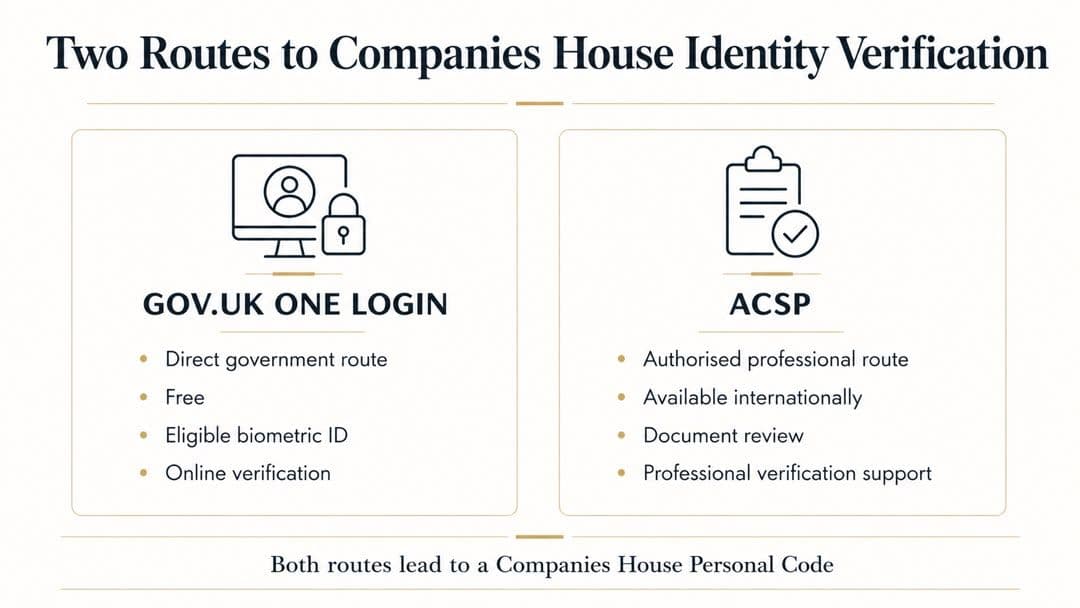
There are two principal routes.
Route 1 — GOV.UK One Login
Companies House provides a free verification service using GOV.UK One Login.
For online verification, GOV.UK currently lists the following qualifying photo-ID categories:
- a biometric passport from any country;
- UK photocard driving license;
- UK biometric residence permit;
- UK biometric residence card.
For an Iraqi resident who has a passport that is compatible with the relevant biometric-verification process, this may provide a direct route.
Route 2 — Authorized Corporate Service Provider
A person can instead ask an Authorized Corporate Service Provider, commonly abbreviated to ACSP, to conduct the Companies House identity verification.
Companies House explicitly states that this route can be used from any country. The agent must itself be authorized by Companies House and supervised under the UK’s Anti-Money Laundering framework.
For some international founders, this can be particularly useful where the direct online route is not convenient or the available documents require professional review.
4. Does an Iraqi Founder Need to Travel to the United Kingdom?
Normally, no.
Companies House does not require every overseas founder to travel to Britain simply to complete identity verification.
An appropriate ACSP can conduct the verification remotely if its own process permits remote checks and the official Companies House verification standard can be satisfied.
Companies House even advises individuals choosing an ACSP to check whether that agent requires in-person checks or provides the service remotely.
This is particularly relevant for Iraqi entrepreneurs.
A properly structured UK company formation process can therefore remain substantially remote.
5. Can an Iraqi Passport Be Used?
The answer depends partly on the verification route and the characteristics of the document.
For the direct GOV.UK One Login route, Companies House currently states that a biometric passport from any country is an accepted photo-ID category.
That means the relevant question is not simply:
“Is an Iraqi passport accepted?”
but:
“Does the passport and verification method satisfy the requirements of the selected Companies House route?”
For ACSP verification, authorized agents must obtain evidence from the Companies House-approved framework and verify the authenticity of the evidence and that it genuinely belongs to the individual. Companies House imposes a formal verification standard on ACSPs, including evidence checking and record-keeping.
An applicant should therefore avoid assuming that every identity document will work identically across every verification route.
6. What If GOV.UK One Login Does Not Work for the Iraqi Founder?
This is exactly why the ACSP route is important.
Failure to complete a particular GOV.UK One Login path does not automatically mean the person cannot satisfy Companies House identity verification.
Companies House provides the authorized-agent route as a separate method.
An authorized agent may assess the appropriate documentary evidence, conduct the required checks and, when satisfied that the Companies House identity-verification standard has been met, submit confirmation of the verification to Companies House.
This is an important distinction for international founders:
Difficulty with one verification route is not necessarily the same as being ineligible to verify.
7. What Is an ACSP?
An Authorized Corporate Service Provider is a business or individual registered with Companies House to carry out specified authorized-agent functions.
Examples may include:
- accountants;
- solicitors;
- company formation professionals;
- other AML-supervised corporate service providers.
To become an authorized agent, the provider must satisfy Companies House requirements and be supervised by an appropriate UK Anti-Money Laundering supervisory body.
Companies House maintains an official list of registered ACSPs and updated that public list as recently as July 2026.
This matters because not every website offering “UK identity verification” is necessarily authorized to verify an individual’s identity for Companies House.
8. How ACSP Verification Works for an Iraqi Founder
The process can be understood in six stages.
Step 1 — Establish the applicant’s identity information
The agent obtains the required personal information.
That normally needs to correspond accurately with the individual’s genuine identity.
Step 2 — Obtain acceptable identity evidence
The ACSP collects the appropriate documents under the Companies House verification standard.
Step 3 — Check that the evidence is genuine
The authorized agent must assess whether the document is authentic and valid according to the required process.
Step 4 — Establish that the identity belongs to the applicant
The agent must connect the identity evidence with the actual person being verified.
Step 5 — Maintain verification records
Companies House requires ACSPs to maintain records of the identity checks. Agents must generally retain the relevant records for seven years from completion of the identity checks.
Step 6 — Notify Companies House
When the ACSP is satisfied that the verification standard has been met, it can notify Companies House through the authorized-agent service.
Companies House then sends the individual their personal code.
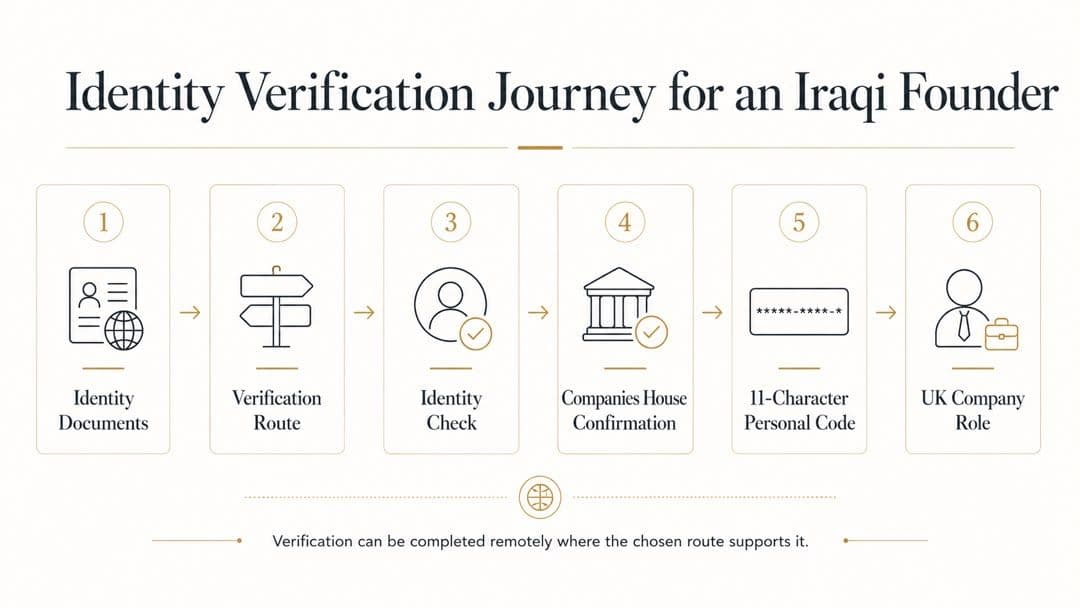
9. The Companies House Personal Code: What Iraqi Founders Must Understand
Successful identity verification does not end with a green check mark.
The key output is the Companies House personal code.
Companies House describes this as an 11-character code issued to an individual after their identity has been verified.
The code belongs to the person, not the company.
This is extremely important.
Suppose:
Ahmed Hassan
is director and PSC of:
ABC Technologies Ltd
and later becomes director of:
XYZ Consulting Ltd.
Ahmed does not receive one personal identity for each company.
His Companies House identity verification is personal to him.
The same verified identity can then be connected to his relevant company roles as required.
10. Keep the Personal Code Secure
The personal code should not be treated casually.
It may need to be provided to a trusted formation agent or professional who is filing on the individual’s behalf.
Companies House allows a person to share the code with people they trust to make relevant filings, but it remains sensitive information connected to the person’s verified identity.
If the code is believed to have been compromised, Companies House can cancel it and issue a new one.
11. Director Verification for a New UK Company
For new companies, identity verification should be incorporated into the formation process from the beginning.
Companies House states that when registering a new company, the filing will require the personal code for each director.
For an Iraqi founder planning to incorporate in 2026, the sensible sequence is therefore:
Prepare identity information
↓
Complete Companies House identity verification
↓
Receive the personal code
↓
Prepare incorporation
↓
Submit the director’s verified information with the company registration
This is far cleaner than attempting to treat identity verification as an afterthought.
12. Existing Directors Have Different Timing
For directors who were already on the register before mandatory verification began, Companies House introduced a transition period.
Existing directors generally need to provide their personal code as part of the company’s next confirmation statement during the transitional period.
If one person is director of several UK companies, their identity may only need to be verified once, but their personal code still needs to be connected appropriately to each relevant company role.
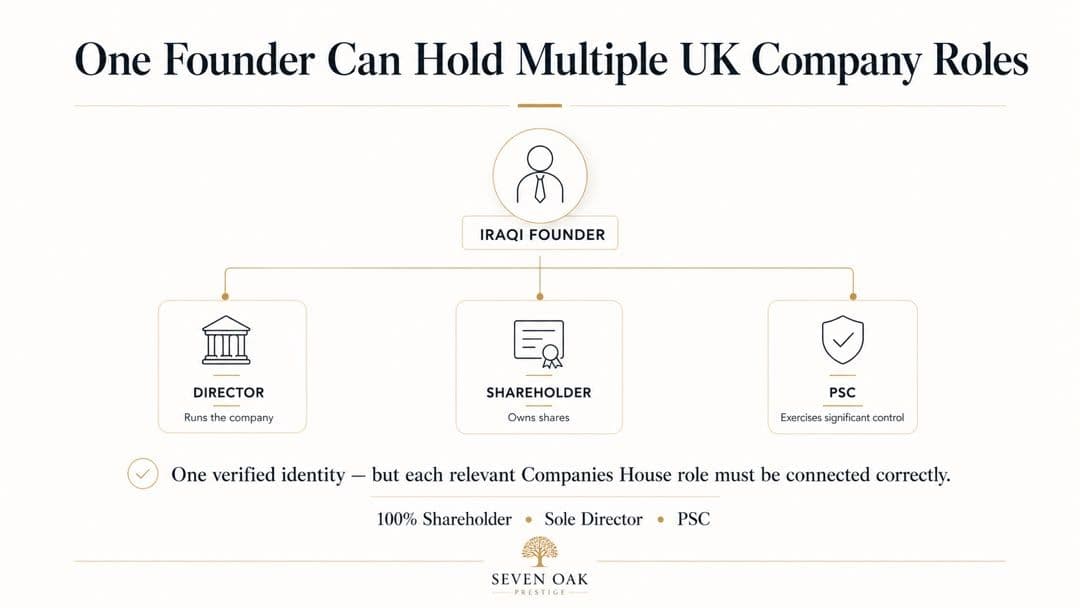
13. What If the Iraqi Founder Is Both Director and PSC?
This is particularly common.
A typical small UK company owned by one Iraqi founder might have:
Shareholder: Ahmed — 100%
Director: Ahmed
PSC: Ahmed
The same person therefore holds multiple legal roles.
Companies House specifically states that where an individual is both a director and PSC of the same company, the personal code must be provided separately for each role through the relevant process.
As director, the code is connected through the company’s confirmation-statement process where applicable.
As PSC, the verification information is provided through the separate PSC verification process within the applicable period.
This is one of the points founders frequently overlook.
One person. One verified identity. Multiple corporate roles that still need to be connected correctly.
14. What Is a Person With Significant Control?
A PSC is not simply another word for “director.”
It refers to a person who meets one or more statutory control conditions in relation to the company.
For many single-founder companies, the majority shareholder will also be a PSC.
Therefore, Iraqi entrepreneurs should determine their:
- director role;
- shareholder position;
- PSC status;
separately.
This becomes particularly important where the company has:
- several founders;
- family shareholders;
- investors;
- holding companies;
- unusual voting arrangements;
- or shareholders holding different percentages.
Identity verification should form part of the broader ownership-structure review rather than being treated as an isolated administrative task.
15. PSC Verification Has Its Own Deadline
Companies House gives PSCs specific time windows for submitting their personal code and verification statement.
For an existing PSC who is also a director of the same company, the 14-day period is linked to the company’s confirmation-statement date.
For an existing PSC who is not a director, the 14-day period is linked to the first day of their month of birth as shown on the register.
A new PSC appointed after 18 November 2025 can provide the code when first added or within the applicable 14-day period.
Therefore:
Iraqi founders should not assume that director verification automatically completes the PSC requirement.
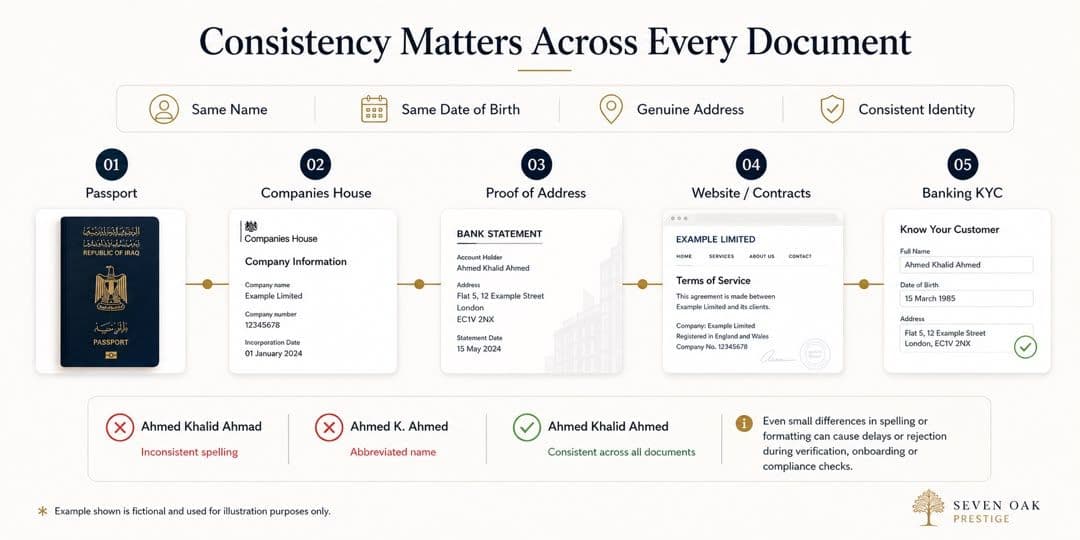
16. A Practical Iraq-Specific Risk: Name Consistency
For Iraqi founders, one of the most important practical points is ensuring that personal information is consistent across the entire UK company setup.
Names originating in Arabic or Kurdish can sometimes appear in different English transliterations.
For example, variations may arise in:
- passport spelling;
- proof-of-address spelling;
- Companies House incorporation;
- bank applications;
- contracts;
- invoices.
The correct approach is not to “improve” or casually shorten the name.
The company-formation and identity-verification process should be based on the founder’s official identity documentation.
This becomes especially important because Companies House can reject or fail to connect a personal code where the personal information linked to that code does not correspond correctly with its records. Companies House specifically identifies mismatched details, including date-of-birth discrepancies and incorrect information supplied through an ACSP, as potential causes of personal-code problems.
For an international founder, documentary consistency should therefore begin before incorporation.
17. Date of Birth Must Also Be Correct
A founder might assume that a small discrepancy in the date of birth does not matter.
It does.
Companies House explains that personal-code connection problems can occur where its recorded date of birth is incorrect compared with the information linked to the verified identity.
For an existing Iraqi-owned company, this is worth checking before the relevant verification deadline.
Do not wait until the confirmation statement is due to discover that the director’s historic Companies House record contains an inconsistency.
18. Does the Iraqi Director Need a UK Residential Address?
No general Companies House identity-verification rule says that an Iraqi director must become a UK resident.
Residence and company address are different concepts.
An Iraqi entrepreneur can operate a UK Limited Company while continuing to reside in Iraq, provided the company satisfies the relevant UK company-law requirements.
For identity verification, the founder should use their genuine personal information.
A UK registered office is not automatically the director’s home address.
Trying to turn a professional registered office into a fictitious residential address can create unnecessary inconsistency in later KYC processes.
19. Identity Verification Is Not the Same as a UK Registered Office
These are completely separate requirements.
Registered Office
The official UK address of the company.
Identity Verification
Verification of the human being who is acting as director, PSC or another relevant person.
A founder can have an excellent London registered office and still need to verify their identity.
Likewise, completing identity verification does not provide the company with its registered-office service.
Understanding this distinction helps founders compare formation packages correctly.
20. Identity Verification Is Also Different From AML/KYC
This is a crucial point.
Completing Companies House identity verification does not mean the founder has passed every future KYC or AML review.
Companies House itself states that where an ACSP verifies an individual, that verification is for Companies House purposes and not automatically for other government departments or services.
Similarly, a bank or payment provider may conduct its own independent checks.
For example, a future financial provider might ask for:
- passport;
- current residential address;
- source of funds;
- source of wealth;
- business activity;
- customer geography;
- supplier geography;
- expected turnover;
- website;
- contracts;
- invoices;
- sanctions exposure.
Therefore:
Companies House verification establishes corporate identity compliance. It does not guarantee financial-institution approval.
This distinction is especially important for Iraqi founders because banking and fintech providers may apply separate country-risk and enhanced-due-diligence policies.
21. Why Identity Verification Still Matters for Banking Readiness
Although Companies House identity verification does not replace financial KYC, it contributes to a more coherent corporate profile.
Consider two companies.
Company A
Director name verified correctly.
Companies House records match passport information.
PSC records are current.
Registered address is coherent.
Website identifies the legal company.
Company B
Director name differs between documents.
PSC verification is incomplete.
Website uses another company name.
Application addresses conflict.
A bank or fintech compliance team examining Company A encounters a much cleaner corporate picture.
That does not guarantee approval.
But corporate consistency reduces avoidable compliance friction.
This is why Seven Oak Prestige treats company formation, Companies House compliance and financial readiness as connected stages of the same business infrastructure.
22. Do You Need a UK Phone Number to Complete Companies House Verification?
A UK telephone number should not be confused with Companies House’s legal identity-verification requirements.
There is no general principle that an Iraqi founder must manufacture a British mobile number simply to become a verified director.
The individual should follow the requirements of the selected verification route.
A UK business telephone number may later have commercial value for customer service or business operations, but that is a different issue.
23. Do You Need a UK Bank Account First?
No.
Companies House identity verification is not dependent on first obtaining a UK business bank account.
In fact, from an operational perspective, identity and corporate records should normally be prepared before financial-institution applications.
A sensible sequence is:
Identity
→ Company formation
→ Operational documentation
→ Banking/fintech readiness
→ Provider application
This keeps the corporate record coherent from the beginning.
24. Does Companies House Verification Cost Money?
The direct GOV.UK One Login verification route is free of charge.
An ACSP, however, may charge a professional service fee for carrying out verification.
Companies House expressly recognises that authorised agents may charge for the service.
Therefore, founders should distinguish:
Government verification route
from
professional verification/support service
in the same way that the Companies House incorporation fee should be distinguished from a formation agent’s professional fees.
25. How Long Does Verification Take?
There is no single guaranteed timeframe that applies to every Iraqi applicant.
The direct GOV.UK route may be quick where the identity document and technology work smoothly.
An ACSP verification can depend on:
- document quality;
- document type;
- whether additional evidence is required;
- name consistency;
- verification technology;
- manual review;
- the agent’s own AML procedures.
Therefore, an Iraqi founder should avoid leaving verification until immediately before an incorporation or filing deadline.
Prepare early.
26. What Happens After an ACSP Successfully Verifies You?
Once an authorized agent notifies Companies House that verification has been successfully completed, Companies House sends the person their personal code by email.
The email address therefore matters.
If the applicant does not receive the code, Companies House advises checking with the ACSP that the correct email address was supplied. If necessary, Companies House can resend the personal-code email.
For founders using advisers, this is another reason to ensure the founder’s own contact information is recorded accurately.
27. Do Not Confuse the Personal Code With the Company Authentication Code
UK companies can have several codes.
They perform completely different functions.
Companies House Personal Code
- belongs to an individual;
- relates to verified identity;
- currently 11 characters;
- used to connect identity to corporate roles.
Company Authentication Code
- belongs to the company;
- used to authorise certain online filings;
- functions more like a corporate filing credential.
Companies House describes the company’s authentication code as sensitive information that should be protected similarly to a bank-card PIN.
Iraqi founders should keep both securely and understand that they are not interchangeable.
28. Is the Passport or Verification Evidence Published on Companies House?
No.
Companies House states that supporting information supplied for identity verification does not form part of the public register and is not made available publicly through its services.
However, certain verification-status information can appear on the register.
Where an ACSP has verified someone and the person connects that verified identity to the record, Companies House can display a verification statement including information such as the verification date and the name of the authorised agent.
Your identity documents themselves are not therefore published as part of the public company profile.
29. What If the Founder Has More Than One UK Company?
The verified identity belongs to the person.
So an Iraqi entrepreneur who controls several UK companies does not ordinarily repeat the entire identity-verification process independently for every company.
However, the personal code still needs to be connected to the relevant role in each company as required.
Companies House explicitly states that a director of more than one company will need to provide the code for each company.
This distinction matters:
Verify the human once; connect the verified identity to each relevant corporate role.
30. What If the Company Has Two Iraqi Directors?
Each person must satisfy the requirements individually.
Consider:
Ahmed — Director / 60% shareholder
Sara — Director / 40% shareholder
Ahmed’s personal code cannot be used for Sara.
Each verified identity is personal to that individual.
The company’s incorporation and later compliance must therefore account for the verification position of every director and PSC.
This is particularly important for family businesses and multi-founder Iraqi companies.
31. What If an Iraqi Investor Is a Shareholder but Not a Director?
Simply being described commercially as a “shareholder” does not tell us everything about the Companies House verification position.
The important question is whether that shareholder qualifies as a PSC or holds another role subject to verification.
For example, a founder holding more than 25% of shares or voting rights will commonly require PSC analysis.
Therefore, ownership should be structured deliberately before incorporation.
This connects directly to another important non-resident issue:
share structure should be designed before the company is registered, not repaired after investors arrive.
32. Why Iraqi Founders Should Complete Verification Before Purchasing Unnecessary Services
There is a simple operational principle:
Do not purchase every possible UK company add-on before you know that your identity documents, ownership structure and intended formation are coherent.
The founder should first understand:
- who will be director;
- who will be shareholder;
- who will be PSC;
- which identity-verification route will be used;
- how names appear on official documents;
- what UK address services are actually required.
Then incorporation can proceed on a controlled basis.
This avoids paying for infrastructure around a corporate structure that later needs to be changed.
33. Common Companies House Identity Verification Mistakes for Iraqi Founders
The most important avoidable mistakes are:
1. Using inconsistent English spellings of the same name
Use the official identity documentation as the primary reference.
2. Waiting until incorporation day to think about verification
For new directors, personal-code requirements are now part of the incorporation process.
3. Assuming shareholder and PSC mean exactly the same thing
They are related but legally distinct concepts.
4. Assuming director verification automatically completes PSC compliance
Where someone holds both roles, the personal code needs to be connected appropriately for each role.
5. Sharing the personal code carelessly
It should only be shared with trusted parties where needed for authorised filings.
6. Using a fictitious UK residential address
Use genuine personal information.
7. Assuming Companies House verification guarantees a bank account
It does not.
8. Choosing an “agent” without checking whether it is actually authorised
Companies House publishes an official ACSP list.
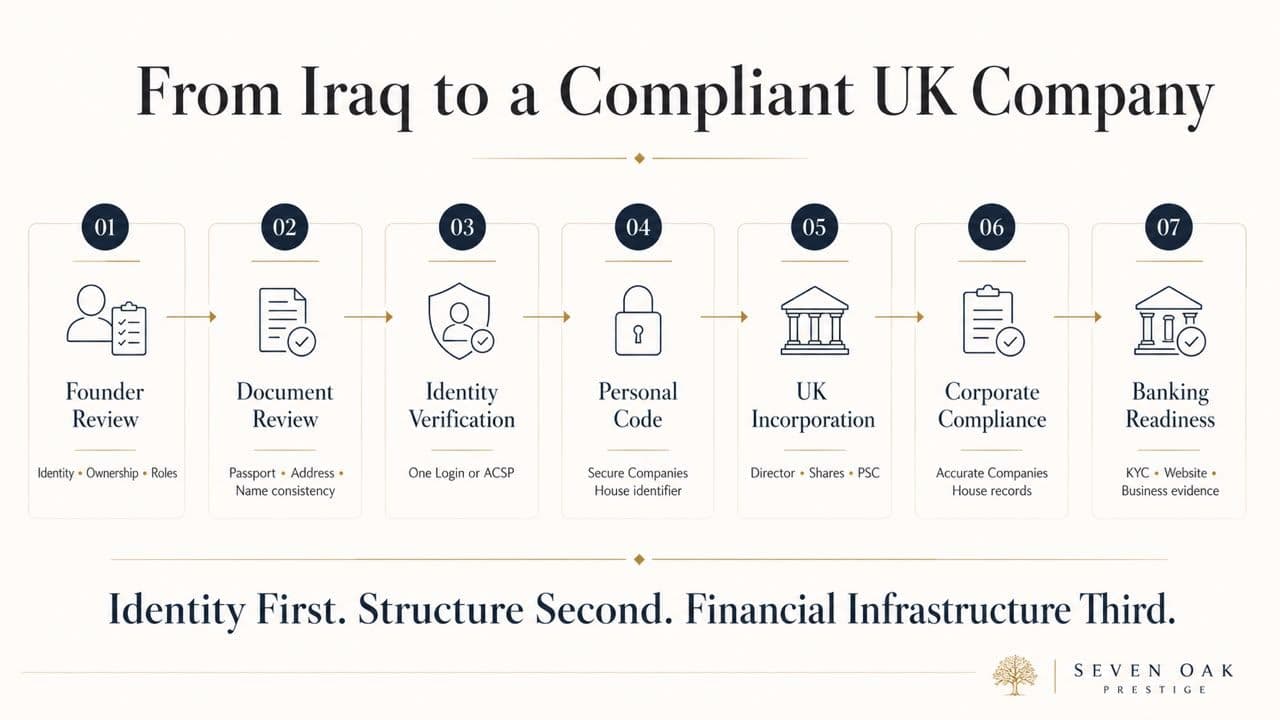
34. The Correct Verification Workflow for an Iraqi Founder
A strong process looks like this:
Stage 1 — Founder Review
Confirm:
- legal name;
- nationality;
- residence;
- date of birth;
- intended director role;
- intended ownership;
- PSC position.
Stage 2 — Document Review
Confirm the available identity document and determine the appropriate verification route.
Stage 3 — Identity Verification
Complete either:
GOV.UK One Login
or
ACSP verification.
Stage 4 — Personal Code
Receive and securely retain the Companies House personal code.
Stage 5 — Incorporation
Use the verified identity information consistently during registration.
Stage 6 — PSC Connection
Complete the separate PSC requirements where relevant.
Stage 7 — Ongoing Corporate Compliance
Maintain accurate Companies House records and use the personal code where required.
Stage 8 — Financial Readiness
Only then move into the appropriate banking/payment-provider preparation.
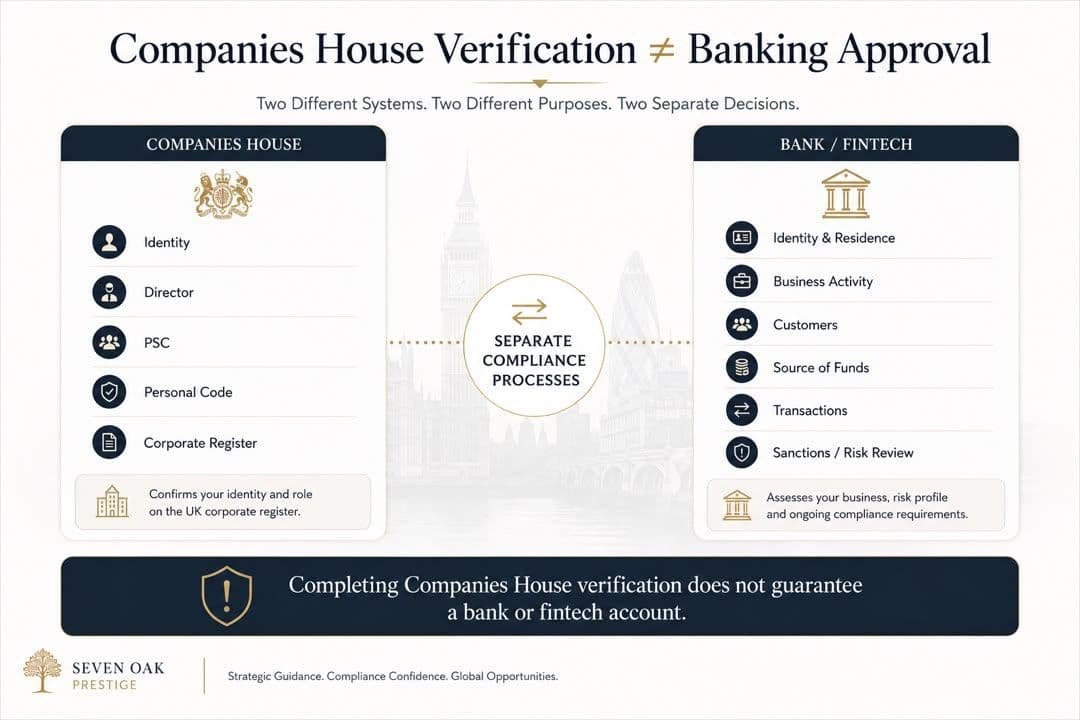
35. Companies House Verification vs Banking Verification
For an Iraqi founder, these should be thought of as two separate compliance layers.
Layer A — Companies House
Question:
“Are you genuinely the person recorded as controlling or directing this UK company?”
Relevant components:
- identity document;
- director;
- PSC;
- personal code;
- Companies House records.
Layer B — Bank / Fintech
Question:
“Do we want to provide financial services to this company and its owners?”
Potential factors:
- country of residence;
- nationality;
- business sector;
- counterparties;
- transaction geography;
- source of funds;
- sanctions screening;
- website;
- turnover;
- customer profile;
- provider risk appetite.
Completing Layer A is important.
It does not predetermine Layer B.
That distinction is particularly important for founders operating from Iraq.
36. Companies House Verification Is Not a Sanctions Clearance
Another important distinction.
Identity verification confirms identity.
It does not certify that a person, company, customer, supplier or transaction has passed every possible sanctions assessment.
Banks, fintech providers, professional advisers and other regulated businesses may still have independent legal and risk-screening obligations.
Therefore an Iraqi founder should not market themselves as:
“Government verified, therefore automatically approved for banking.”
That is not how the system works.
37. Why This Matters More in 2026 Than It Did Before
Historically, many overseas entrepreneurs considered Companies House registration primarily a document-filing exercise.
The UK’s company regime is changing.
By August 2026, Companies House has a mandatory identity-verification framework in operation, a formal authorised-agent regime and personal codes that connect verified individuals with corporate roles. Companies House estimates that 6–7 million individuals will need to verify by the end of the transitional period around mid-November 2026.
For international entrepreneurs, the practical implication is clear:
Identity preparation is now part of company formation itself.
Not something to consider several months later.
38. Should an Iraqi Founder Use GOV.UK One Login or an ACSP?
Neither route is universally “better.”
GOV.UK One Login may make sense when:
- the founder has compatible identity documentation;
- the technology works for them;
- the information is straightforward;
- they are comfortable completing the process directly.
The Companies House service itself is free.
ACSP verification may make sense when:
- the direct route is unsuitable;
- documentary review is needed;
- the founder wants professional coordination;
- multiple directors/PSCs are involved;
- incorporation is being handled as part of a wider professional setup.
The ACSP may charge for its professional service.
The correct decision should depend on the founder’s circumstances rather than nationality alone.
39. A Practical Example: Iraqi SaaS Founder
Consider an entrepreneur in Erbil establishing:
NOVA CLOUD SYSTEMS LTD
The founder will be:
- 100% shareholder;
- sole director;
- PSC.
A well-prepared process would be:
1. Review official passport details
↓
2. Ensure English name spelling is used consistently
↓
3. Determine verification route
↓
4. Complete Companies House identity verification
↓
5. Receive personal code
↓
6. Incorporate with verified director information
↓
7. Connect PSC verification correctly
↓
8. Establish website and operating documentation
↓
9. Prepare banking and fintech applications separately
That is a much more professional process than:
“Register company today, worry about everything else later.”
40. A Practical Example: Two-Founder Iraqi Consultancy
Suppose two professionals in Baghdad establish a UK consultancy:
Founder A — 50% shareholder + director
Founder B — 50% shareholder + director
Both individuals are likely to require identity verification in their relevant director and PSC capacities.
Each must have their own personal code.
The company cannot simply verify one founder and treat the second founder as covered.
Ownership and identity should therefore be mapped before incorporation.
41. What Happens If You Do Not Comply?
Identity verification is now a legal requirement.
Companies House states that continuing to act as a director after the applicable deadline without satisfying the verification requirements can constitute an offence. The company and its directors may also be committing an offence.
For PSCs, failure to comply can likewise result in enforcement consequences, including financial penalties or fines and a note on the public register.
Companies House also states that a company will be unable to file its confirmation statement unless all directors have satisfied the relevant verification requirements.
This is therefore not simply an optional “verification badge.”
It is part of continuing UK corporate compliance.
42. Frequently Asked Questions
Can an Iraqi resident complete Companies House identity verification?
Yes. Companies House provides verification routes that can be used by people outside the UK. ACSP verification can explicitly be carried out for a person in any country, while the direct GOV.UK route supports qualifying biometric passports from any country.
Can I register a UK company from Iraq in 2026?
An overseas resident can generally establish a UK private limited company subject to satisfying the applicable company-law and identity-verification requirements. New directors must now provide their Companies House personal codes as part of the incorporation filing.
Do I need to travel to London?
Not normally for Companies House verification itself. An ACSP can verify someone from any country, subject to its process and the Companies House verification standard.
Can I use an Iraqi passport?
The direct One Login route accepts a biometric passport from any country. The suitability of a particular document depends on the route and whether the document meets the relevant technical and verification requirements.
Is Companies House verification free?
Verification directly through the Companies House/GOV.UK One Login service is free. An ACSP may charge for professional verification services.
What is the Companies House personal code?
It is an 11-character personal identifier issued after successful verification. It belongs to the individual rather than to a particular company.
Can I use the same personal code for several UK companies?
The verified identity is personal to you, but the code must still be connected to each relevant company/role as required. A director of several companies needs to provide the code for each company.
I am both director and PSC. Do I only provide the code once?
No. Companies House specifically says that someone who is both director and PSC of the same company needs to provide the personal code separately for each role through the applicable process.
Do I need a UK residential address?
Companies House identity verification does not require an Iraqi founder to pretend to reside in the UK. Use genuine personal information and keep the director’s residence separate from the company’s UK registered-office arrangements.
Does Companies House verification guarantee Wise, Stripe, Airwallex, Payoneer or a UK bank account?
No. Financial providers conduct their own KYC, AML, sanctions, eligibility and risk assessments. Companies House verification does not replace those independent reviews.
Can an ACSP guarantee that verification will succeed?
No professional should guarantee a result before reviewing the identity evidence and satisfying the required verification standard.
43. Companies House Identity Verification Support for Iraqi Founders
For international founders, Companies House identity verification should not be treated as an isolated technical exercise.
It should fit correctly into the wider company structure:
Identity
→ Director
→ Shareholder
→ PSC
→ UK company incorporation
→ Corporate compliance
→ Banking and fintech readiness
Seven Oak Prestige Ltd supports Iraqi and other international entrepreneurs with UK corporate setup and compliance preparation, including:
- UK Limited Company Formation
- Companies House Identity Verification Support
- Director and Shareholder Structure Review
- PSC Preparation
- Registered Office Address
- Director Service Address
- Virtual Business Address
- Corporate Compliance Support
- Banking & Fintech Readiness
- KYC Documentation Preparation
- VAT Registration
- EORI Registration
- International Business Advisory
The objective is not simply to obtain a Companies House number.
It is to establish a UK company whose identity, ownership, records and operational documentation are coherent from the beginning.
Planning to Establish a UK Company From Iraq?
If you are an Iraqi entrepreneur preparing a UK Limited Company, complete the identity and corporate-structure review before submitting applications that depend on those records.
Seven Oak Prestige Ltd
UK Corporate Advisory for International Entrepreneurs
Email: contact@sevenoakprestige.com
UK Office: +44 2045 780726
WhatsApp: +44 7447 488755
Important: Companies House verification, banking approval and payment-provider onboarding are separate processes. Banks and fintech providers always make their own independent KYC, AML, sanctions, eligibility and risk decisions.
Related Guides
UK Company Formation from Iraq: Complete Guide for Iraqi Entrepreneurs
The True Cost of UK Company Formation from Iraq
UK Business Bank Account for Iraqi Residents
UK Business Banking Readiness Assessment
Companies House Identity Verification for Non-Residents
About the Author
Isaac Jackson is Founder & Managing Director of Seven Oak Prestige Ltd, supporting international entrepreneurs with UK company formation, Companies House compliance and business banking readiness.