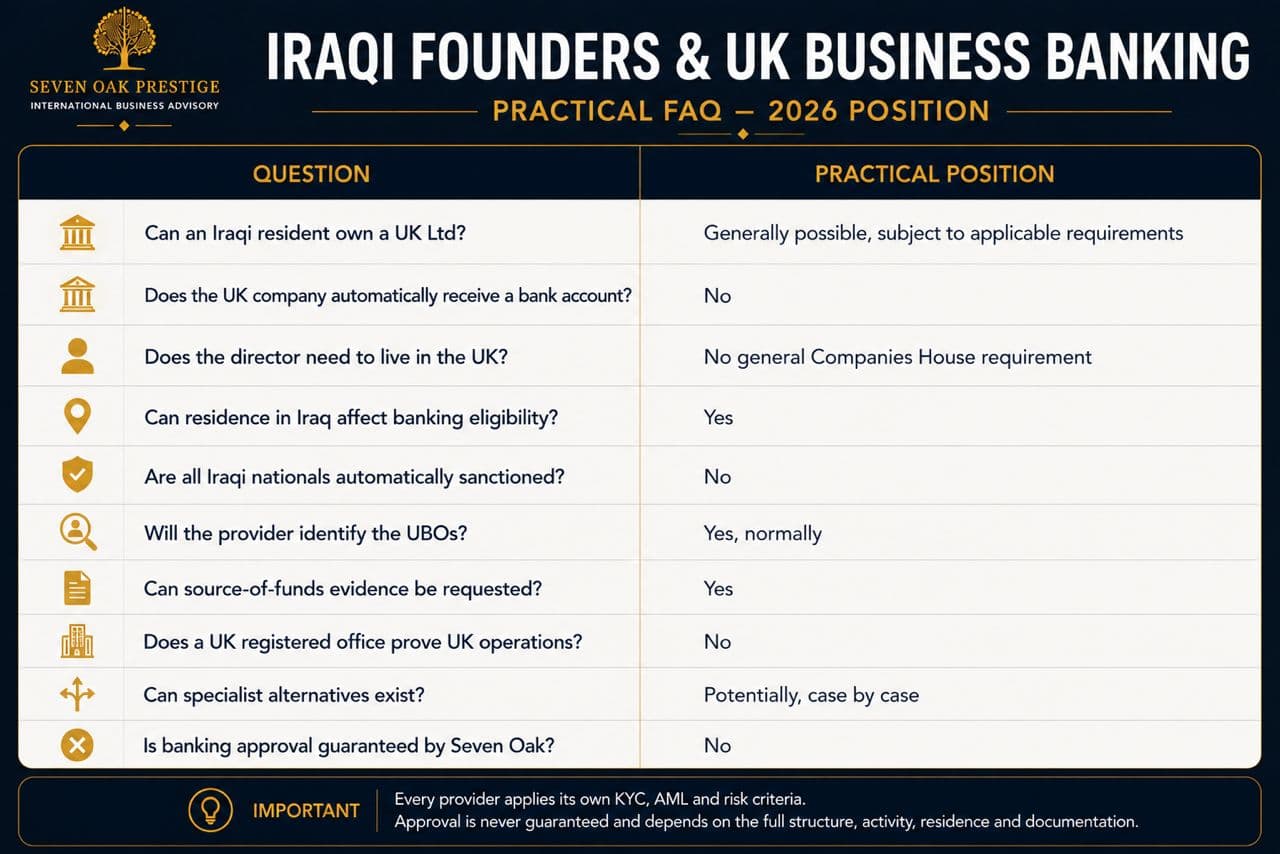
UK Business Bank Account for Iraqi Residents (2026 Complete Guide)

Executive Summary
For many Iraqi entrepreneurs, expanding beyond domestic markets has become an important part of long-term business growth.
Whether establishing an international trading company, an engineering consultancy, a logistics business, a technology startup or a professional services firm, many founders are looking for corporate structures and financial infrastructure capable of supporting international operations.
A UK Limited Company is often one part of that strategy.
However, incorporation alone is only the beginning.
One of the next practical challenges is establishing an appropriate business banking solution that enables the company to receive customer payments, pay suppliers and support day-to-day international operations.
Many entrepreneurs assume that opening a UK business bank account automatically follows company incorporation.
In reality, these are two entirely separate processes.
Banks and Electronic Money Institutions (EMIs) independently assess every business application through their own Know Your Customer (KYC), Anti-Money Laundering (AML) and internal compliance procedures.
Their objective is not simply to verify identity, but also to understand how the business intends to operate, the nature of its commercial activities and the expected flow of funds.
For this reason, successful business banking is often built on preparation rather than speed.
A professionally structured company with consistent documentation, a clearly defined business model and a credible online presence is generally easier for compliance teams to assess than one that has been incorporated without adequate planning.
This guide has been written specifically for entrepreneurs living in Iraq who wish to understand how UK business banking works after company formation.
Rather than focusing solely on banking providers, it explains how to prepare your business, organize your documentation and develop a stronger foundation for long-term international operations.
By the end of this guide, you will understand:
- Whether Iraqi residents can apply for UK business banking.
- How banks and EMIs typically assess business applications.
- The documents commonly requested during onboarding.
- Practical steps to improve your banking readiness.
- Common reasons applications require additional review.
- How to prepare your business before approaching financial institutions.
- The role of compliance in supporting sustainable international growth.
Whether you are launching your first international business or expanding an established company beyond Iraq, the objective remains the same: build a business that is professionally structured, commercially credible and prepared for long-term success.
Why This Guide Is Different
Search online for information about opening a UK business bank account from Iraq and you will often find very little practical guidance.
Many articles focus on company incorporation alone, while others simply publish lists of banks without explaining how business banking actually works.
Very few discuss what happens after incorporation.
They rarely answer questions such as:
- How do banks assess international business applications?
- Why do some applications require additional documentation?
- What information should be prepared before applying?
- How important is a professional website?
- What does business banking readiness actually mean?
- How can entrepreneurs prepare before approaching financial institutions?
These are often the questions that determine whether the onboarding process progresses smoothly.
That is why this guide takes a different approach.
Rather than concentrating on finding the “easiest” provider, it explains how to prepare your business professionally before submitting any application.
Understanding the wider banking journey helps entrepreneurs make informed decisions, improve operational readiness and establish stronger foundations for international business growth.
Why More Iraqi Entrepreneurs Are Expanding Internationally
Over the past decade, an increasing number of Iraqi entrepreneurs have begun looking beyond their domestic market to build businesses that serve customers across Europe, the Gulf region and other international markets.
While many businesses continue to operate successfully within Iraq, others are exploring international opportunities to diversify their customer base, establish stronger commercial relationships and build businesses capable of supporting long-term growth.
For these entrepreneurs, establishing a recognized UK Limited Company can form part of a broader international business strategy.
Rather than replacing their existing operations, many founders use a UK company to support cross-border commercial activities, develop relationships with overseas clients and suppliers, and operate within a corporate framework that is familiar to many international organizations.
As international trade continues to evolve, businesses increasingly require corporate structures capable of supporting global operations, professional credibility and cross-border transactions.
For many Iraqi entrepreneurs, this represents an opportunity to expand beyond geographical boundaries while maintaining a structured and compliant business model.
Industries Driving International Growth
Although every business is different, several sectors are increasingly exploring international expansion through UK corporate structures.
These include:
- International trading companies
- Import and export businesses
- Engineering and technical consulting firms
- Construction and infrastructure consultants
- Oil and energy support services
- Logistics and freight businesses
- Manufacturing companies
- Professional consulting firms
- Information technology businesses
- Software and digital service providers
- Educational and training organizations
Many of these businesses work with international suppliers, commercial partners or overseas clients, making a recognized corporate structure an important part of their long-term strategy.
Why Business Banking Matters
Once a UK company has been incorporated, one of the next practical priorities is establishing an appropriate business banking solution.
A business bank account is more than simply a place to receive payments.
For internationally operating businesses, it forms part of the financial infrastructure that supports daily commercial activities.
Depending on the nature of the business, this may include:
- Receiving payments from international customers.
- Paying overseas suppliers.
- Managing operational expenses.
- Supporting cross-border commercial relationships.
- Building financial credibility.
- Organizing company finances.
Understanding this wider role helps entrepreneurs appreciate why banks conduct detailed onboarding and compliance assessments before opening an account.

Why More Iraqi Entrepreneurs Are Expanding Internationally
Over the past decade, an increasing number of Iraqi entrepreneurs have begun looking beyond their domestic market to build businesses that serve customers across Europe, the Gulf region and other international markets.
While many businesses continue to operate successfully within Iraq, others are exploring international opportunities to diversify their customer base, establish stronger commercial relationships and build businesses capable of supporting long-term growth.
For these entrepreneurs, establishing a recognized UK Limited Company can form part of a broader international business strategy.
Rather than replacing their existing operations, many founders use a UK company to support cross-border commercial activities, develop relationships with overseas clients and suppliers, and operate within a corporate framework that is familiar to many international organizations.
As international trade continues to evolve, businesses increasingly require corporate structures capable of supporting global operations, professional credibility and cross-border transactions.
For many Iraqi entrepreneurs, this represents an opportunity to expand beyond geographical boundaries while maintaining a structured and compliant business model.
Industries Driving International Growth
Although every business is different, several sectors are increasingly exploring international expansion through UK corporate structures.
These include:
- International trading companies
- Import and export businesses
- Engineering and technical consulting firms
- Construction and infrastructure consultants
- Oil and energy support services
- Logistics and freight businesses
- Manufacturing companies
- Professional consulting firms
- Information technology businesses
- Software and digital service providers
- Educational and training organizations
Many of these businesses work with international suppliers, commercial partners or overseas clients, making a recognized corporate structure an important part of their long-term strategy.
Why Business Banking Matters
Once a UK company has been incorporated, one of the next practical priorities is establishing an appropriate business banking solution.
A business bank account is more than simply a place to receive payments.
For internationally operating businesses, it forms part of the financial infrastructure that supports daily commercial activities.
Depending on the nature of the business, this may include:
- Receiving payments from international customers.
- Paying overseas suppliers.
- Managing operational expenses.
- Supporting cross-border commercial relationships.
- Building financial credibility.
- Organizing company finances.
Understanding this wider role helps entrepreneurs appreciate why banks conduct detailed onboarding and compliance assessments before opening an account.
International Business Requires Professional Preparation
As businesses begin operating across multiple jurisdictions, financial institutions are expected to understand the commercial purpose of the accounts they provide.
For this reason, banks and Electronic Money Institutions (EMIs) typically review more than incorporation documents alone.
They may also seek to understand:
- What products or services the business provides.
- Where customers are located.
- How revenue will be generated.
- Expected payment activity.
- Company ownership.
- Business documentation.
- Professional online presence.
- Compliance readiness.
Preparing these areas before submitting an application often enables compliance teams to understand the business more efficiently.
Building International Credibility
One of the greatest advantages of careful preparation is credibility.
International customers, suppliers, financial institutions and commercial partners often evaluate a business based on the consistency and professionalism of the information it presents.
This may include:
- A professionally designed website.
- Clear descriptions of products or services.
- Consistent company information.
- Corporate documentation.
- Professional communication.
- Well-organized business records.
While no single factor determines the outcome of a banking application, presenting a transparent and professionally structured business can contribute to a stronger overall impression.
Executive Insight
Many successful Iraqi entrepreneurs do not view international expansion as a single event.
Instead, they approach it as a structured business journey.
They begin by establishing an appropriate corporate structure, develop a professional business identity, prepare comprehensive documentation and understand their ongoing compliance responsibilities before seeking banking and payment solutions.
This measured approach helps create stronger operational foundations that support sustainable international business growth over the long term.
Internal Links
- UK Company Formation for Iraq
- UK Company Formation for Non-Residents
- Business Banking Readiness Framework
Can Iraqi Residents Open a UK Business Bank Account?
One of the first questions many entrepreneurs ask after incorporating a UK Limited Company is whether living in Iraq prevents them from obtaining a UK business banking solution.
The answer is not a simple yes or no.
Business banking applications are assessed individually by each financial institution according to its own onboarding procedures, internal risk framework and compliance obligations.
Rather than making decisions based solely on an applicant’s country of residence, banks and Electronic Money Institutions (EMIs) seek to understand the overall profile of the business they are being asked to onboard.
This assessment generally considers a combination of factors, including the nature of the company’s activities, expected customer base, anticipated payment flows, supporting documentation and the overall readiness of the business.
For this reason, entrepreneurs should avoid thinking of business banking as a nationality-based decision.
Instead, it should be viewed as a professional business assessment.
A company that presents accurate information, maintains consistent documentation and clearly explains its commercial activities is often easier for compliance teams to understand than one with incomplete or inconsistent information.
Business Banking Is Built on Trust
Every financial institution has legal obligations to understand the businesses they provide services to.
As part of this responsibility, compliance teams aim to establish a clear understanding of:
- The products or services the company offers.
- Who its customers are expected to be.
- Where commercial activity will take place.
- How funds are expected to move through the account.
- The company’s ownership and management structure.
- The purpose of the business relationship.
These questions are designed to help financial institutions understand the commercial purpose of the account rather than simply verifying the identity of the applicant.
For internationally operating businesses, providing clear and consistent answers to these questions is an important part of the onboarding process.
Professional Preparation Supports Stronger Applications
Many entrepreneurs begin comparing banks before preparing the business itself.
In practice, experienced founders often reverse that process.
Rather than asking:
“Which bank is easiest?”
they first ask:
“Is my business ready to be assessed?”
This shift in mindset often leads to better preparation.
Before approaching any financial institution, entrepreneurs should ensure that their business demonstrates professionalism through:
- A clearly defined business model.
- Consistent corporate information.
- Professional branding.
- A comprehensive company website.
- Well-organised supporting documentation.
- Realistic commercial expectations.
These elements help provide context for compliance teams and make it easier to understand how the business intends to operate.
Looking Beyond the Application Form
A business banking application is only one part of the overall review process.
Compliance teams may also consider information that is publicly available about the business.
For example, they may review:
- The company website.
- Business descriptions.
- Public company information.
- Corporate branding.
- Supporting commercial documentation.
For this reason, entrepreneurs should ensure that the information presented across all platforms is accurate, consistent and aligned with the activities described in the application.
Professional consistency helps demonstrate that the business has been carefully established and is prepared for long-term operations.
Banking Readiness Begins Before You Apply
One of the most valuable lessons for internationally focused entrepreneurs is that successful banking preparation starts well before any application is submitted.
This preparation includes:
- Developing a professional corporate identity.
- Organising business documentation.
- Understanding expected payment flows.
- Preparing realistic financial projections.
- Establishing a credible online presence.
- Reviewing compliance responsibilities.
Approaching business banking in this structured way enables entrepreneurs to present a more complete picture of their company when engaging with financial institutions.
Executive Insight
Businesses that expand successfully into international markets often share one important characteristic.
They do not prepare only for incorporation.
They prepare for credibility.
From their website and company documentation to their corporate governance and operational planning, every aspect of the business is developed with long-term sustainability in mind.
Although every bank and Electronic Money Institution applies its own independent assessment criteria, entrepreneurs who invest in building a transparent, organized and professionally presented business are often better positioned when establishing new financial relationships.
For Iraqi entrepreneurs seeking to build internationally recognized businesses, banking readiness should therefore be viewed not as a final administrative step, but as an integral part of creating a resilient and globally focused enterprise.

Understanding How Financial Institutions Assess International Businesses
Many entrepreneurs assume that a business banking application is primarily about proving their identity.
Identity verification is certainly an important part of the onboarding process, but it is only one component of a much broader assessment.
Banks and Electronic Money Institutions (EMIs) are required to understand the businesses they establish relationships with. As part of their onboarding procedures, they typically seek to build a comprehensive understanding of how a company operates, how it generates revenue and how the account is expected to be used.
Although every institution applies its own independent policies, many assessments focus on similar areas of review.
Understanding these areas before applying allows entrepreneurs to prepare their businesses more effectively.
1. Understanding Your Business Activities
One of the first objectives of a compliance review is to understand exactly what the business does.
Descriptions that are too broad or generic can make it more difficult for reviewers to understand the commercial purpose of the company.
For example, describing a business simply as:
- Trading
- Technology
- Consulting
- Marketing
provides very little practical information.
Instead, businesses should aim to explain:
- the products or services provided;
- the industries they serve;
- how revenue is generated;
- and the commercial value they deliver to customers.
The clearer the explanation, the easier it becomes for financial institutions to understand the business model.
2. Understanding Your Customers
Financial institutions also seek to understand who the business intends to serve.
This may include:
- Businesses (B2B)
- Individual consumers (B2C)
- Government organizations
- International suppliers
- Professional firms
- Technology companies
- Manufacturers
- Commercial distributors
Providing a realistic description of your expected customer base helps explain the commercial purpose of the account and the type of transactions likely to occur.
3. Understanding Expected Payment Activity
Business banking is fundamentally about managing financial transactions.
For this reason, providers generally seek to understand how money is expected to move through the account.
Typical areas of review include:
- Expected incoming payments.
- Expected outgoing payments.
- Countries involved in trading.
- Primary currencies.
- Typical transaction values.
- Estimated monthly business activity.
- Nature of commercial relationships.
These questions are not intended to make business more difficult.
They help financial institutions understand whether the anticipated activity is consistent with the business being presented.
4. Understanding Corporate Governance
Professional businesses are generally supported by clear organizational structures.
Financial institutions may therefore review information relating to:
- Company ownership.
- Directors.
- Persons with Significant Control (PSCs).
- Business decision-making.
- Corporate records.
Maintaining accurate company information demonstrates that the business has been established responsibly and supports transparency throughout the onboarding process.
5. Understanding Operational Readiness
One area that is often overlooked by first-time entrepreneurs is operational readiness.
A company may already be legally incorporated while still requiring further preparation before beginning international operations.
Operational readiness often includes:
- A professional website.
- Business email addresses.
- Company documentation.
- Service descriptions.
- Customer communication processes.
- Internal record keeping.
- Professional branding.
These elements help present a complete picture of how the business intends to operate.
Banking Assessments Extend Beyond Documentation
Many entrepreneurs focus exclusively on gathering documents.
While documentation is important, successful applications are supported by a broader picture of the business.
Compliance teams seek to understand not only who the company is, but also how it intends to operate over the coming months and years.
Businesses that provide accurate information, maintain consistency across multiple sources and demonstrate thoughtful preparation often enable reviewers to complete this assessment more efficiently.
Executive Insight
One of the biggest differences between newly established businesses and professionally prepared international companies is the level of operational readiness.
Successful entrepreneurs rarely wait until they receive additional questions from a financial institution.
Instead, they prepare comprehensive documentation, establish a professional business identity and ensure that every aspect of their company presents a consistent and credible picture before approaching banks or payment providers.
This proactive approach not only supports compliance reviews but also strengthens relationships with clients, suppliers and commercial partners throughout the life of the business.
Internal Links
Preparing Your Business Before Applying for UK Business Banking
One of the most valuable steps an entrepreneur can take before approaching a bank or Electronic Money Institution (EMI) is preparing the business itself.
Many founders focus heavily on choosing a financial provider while giving far less attention to how their business will be presented during the onboarding process.
In reality, successful business banking often begins long before the application is submitted.
Preparation is not about predicting the outcome of an application. Rather, it is about ensuring that your business presents a clear, consistent and professional profile that enables compliance teams to understand how the company intends to operate.
For Iraqi entrepreneurs establishing an international business, this preparation can become an important part of building long-term commercial credibility.
Create a Clear Corporate Identity
Your business should communicate a consistent identity across every document and public platform.
This includes:
- Company name
- Registered Office Address
- Business email address
- Company website
- Company profile
- Contact information
- Service descriptions
- Corporate branding
Consistency across these elements helps create a professional image and reduces the likelihood of confusion during the onboarding process.
Financial institutions appreciate businesses that present accurate and coherent information from the outset.
Develop a Professional Online Presence
For many international businesses, the company website is one of the first publicly available sources of information.
Rather than acting solely as a marketing tool, it should clearly explain:
- What the business does.
- Which industries it serves.
- Who its customers are.
- The products or services offered.
- How potential clients can make contact.
Businesses operating internationally should also ensure that their website reflects the same information provided during incorporation and any future banking applications.
Consistency across all channels supports transparency and professionalism.
Organise Your Supporting Documentation
Well-prepared businesses are generally able to respond more efficiently if additional information is requested.
Depending on the provider and the nature of the business, useful documentation may include:
- Certificate of Incorporation.
- Shareholder information.
- Company profile.
- Business overview.
- Website screenshots.
- Product or service information.
- Commercial proposals.
- Corporate presentation.
- Expected transaction profile.
For newly incorporated companies, these documents help explain how the business intends to operate, even where trading has not yet commenced.
Understand Your Expected Business Activity
Before submitting an application, entrepreneurs should have a realistic understanding of how their company expects to operate.
Questions worth considering include:
- Which countries will you primarily trade with?
- Will your customers be businesses, individuals or both?
- What products or services will you provide?
- Which currencies do you expect to receive?
- What types of payments will you make?
- What level of monthly activity do you anticipate during your first year?
Preparing thoughtful and realistic answers to these questions helps demonstrate that the business has been planned carefully rather than established solely for incorporation purposes.
Think Beyond Opening an Account
For internationally focused businesses, business banking should not be viewed as the final objective.
Instead, it forms part of a wider financial infrastructure that supports long-term operations.
As your business develops, you may also need to consider:
- Payment solutions.
- International supplier payments.
- Multi-currency transactions.
- Accounting systems.
- VAT obligations where applicable.
- Corporate compliance.
- Future business expansion.
Viewing banking within this broader operational context helps entrepreneurs make decisions that support sustainable international growth rather than immediate convenience.
Professional Preparation Builds Commercial Confidence
Strong preparation benefits more than banking applications.
A business that maintains organised records, communicates professionally and presents consistent information is also more likely to inspire confidence among customers, suppliers, investors and commercial partners.
Professional preparation therefore supports multiple aspects of business development, from operational efficiency to commercial credibility.
Executive Insight
Successful international businesses are rarely built by reacting to compliance requests as they arise.
Instead, experienced entrepreneurs prepare their business in advance, ensuring that their documentation, corporate identity and operational structure accurately reflect how the company intends to operate.
While every financial institution applies its own independent assessment criteria, investing time in preparation helps create a business that is easier to understand, easier to assess and better positioned for long-term international growth.
Internal Links
Within this section, naturally include links to:
- Business Banking Readiness Framework (primary)
- UK Company Formation for Non-Residents
- Companies House Identity Verification Guide
- Registered Office Address Guide
- Director Service Address Guide
Building an Internationally Trusted Business
One of the most significant advantages of establishing a UK Limited Company is not simply the ability to trade through a recognized corporate structure.
It is the opportunity to build a business that inspires confidence among customers, suppliers, financial institutions and commercial partners across international markets.
For many Iraqi entrepreneurs, expanding internationally involves much more than entering a new market. It requires developing a business that communicates professionalism, transparency and long-term commitment from the very beginning.
This is why successful international companies invest in building credibility long before they approach a bank, negotiate with a supplier or sign their first overseas client.
Credibility is rarely created by a single document or certificate.
It is built through the consistency of the business as a whole.
Credibility Is Built Through Consistency
When different organizations review your business, they are often looking at the same underlying question:
“Does this company present itself as a genuine and professionally managed business?”
The answer is formed through many small details working together.
These may include:
- A professionally designed website.
- A domain-based business email.
- Consistent company information.
- Clearly defined services.
- Professional documentation.
- Transparent business communication.
- Organized corporate records.
- Accurate public information.
Individually, each element may appear relatively minor.
Collectively, they create the overall impression of the business.
For internationally operating companies, this consistency supports confidence across every stage of the commercial journey.
Professional Businesses Tell a Clear Story
One characteristic shared by many successful international businesses is clarity.
Whether speaking to a customer, a financial institution or a potential commercial partner, the business tells the same story.
That story should answer fundamental questions such as:
- Who are we?
- What do we do?
- Who do we serve?
- Why does our business exist?
- How do we create value?
- Where do we operate?
When these answers remain consistent across the website, company profile, marketing materials and supporting documentation, the business becomes significantly easier to understand.
This clarity benefits not only compliance reviews but also sales conversations, partnership discussions and future business development.
Reputation Extends Beyond Banking
Although this guide focuses on UK business banking, the preparation involved has wider commercial value.
The same professionalism that supports banking applications can also strengthen relationships with:
- International customers.
- Overseas suppliers.
- Professional advisers.
- Logistics providers.
- Technology partners.
- Investors.
- Government agencies.
- Commercial distributors.
Businesses that maintain organized records and present themselves consistently are often better positioned to establish long-term commercial relationships across international markets.
For entrepreneurs seeking sustainable growth, reputation becomes one of the company’s most valuable assets.
International Growth Requires Long-Term Thinking
Many entrepreneurs naturally focus on immediate priorities such as incorporating a company or opening a business account.
While these are important milestones, they should form part of a broader long-term strategy.
Businesses that grow successfully often invest in:
- Strong corporate governance.
- Professional communication.
- Accurate documentation.
- Compliance planning.
- Financial organisation.
- Operational systems.
- Continuous improvement.
Each of these areas contributes to building a business that can adapt, expand and establish credibility over time.
International growth is rarely achieved through one successful application.
It is built through hundreds of consistent decisions made throughout the life of the business.
A Strong Foundation Supports Every Future Opportunity
Whether your future plans include expanding into Europe, developing partnerships in the Gulf region or serving clients across multiple jurisdictions, the quality of your business foundations will continue to influence new opportunities.
Professional preparation today can support future banking relationships, commercial negotiations, supplier partnerships and customer confidence for years to come.
Viewed in this way, business banking becomes one important milestone within a much larger journey of building an internationally respected company.
Executive Insight
One observation becomes clear when working with internationally focused businesses.
The companies that create lasting success rarely concentrate on one objective at a time.
They build every part of the business together.
Their legal structure, corporate identity, documentation, compliance processes, communication and operational systems all reinforce one another.
This integrated approach creates a business that is easier to understand, easier to work with and better positioned for sustainable international growth.
For Iraqi entrepreneurs seeking to establish long-term commercial relationships beyond their domestic market, professionalism is not simply a competitive advantage.
It becomes part of the company’s identity.
Internal Links
- Business Banking Readiness Framework
- UK Company Formation for Iraq
- UK Company Formation for Non-Residents
A Practical Checklist Before Applying for UK Business Banking
Preparing for business banking is not simply about collecting documents.
It is about ensuring that every part of your business presents a consistent, professional and transparent picture before you approach a financial institution.
Although every bank and Electronic Money Institution (EMI) applies its own onboarding procedures, completing the following checklist can help you assess whether your business is operationally prepared.
Think of it as a final review before beginning your banking journey.
Corporate Structure
Before submitting any banking application, confirm that your company has been established correctly.
Review the following:
Your UK Limited Company has been incorporated.
Company information is accurate and consistent.
Directors and shareholders have been correctly recorded.
Your Registered Office Address is active.
Your Director Service Address has been arranged where appropriate.
A strong corporate structure provides the legal foundation upon which every other stage of your business will develop.
Business Identity
Ask yourself whether someone unfamiliar with your company could immediately understand what your business does.
Your business should have:
A professional company website.
A domain-based business email.
Clear descriptions of your products or services.
An informative About Us page.
Professional branding.
Accurate contact information.
These elements help establish credibility with customers, suppliers and financial institutions alike.
Business Documentation
Well-organized businesses are generally better prepared to respond when additional information is requested.
Before applying, ensure your documentation is organized and readily available.
This may include:
Certificate of Incorporation.
Company profile.
Business overview.
Service descriptions.
Website screenshots.
Supporting commercial documentation.
Expected transaction profile.
Corporate records.
Having this information prepared in advance allows you to respond confidently throughout the onboarding process.
Commercial Readiness
Financial institutions seek to understand how your business intends to operate.
Before applying, you should be able to explain:
Who your customers are.
Which countries you expect to trade with.
How revenue will be generated.
Typical incoming payments.
Typical outgoing payments.
Expected transaction volumes.
The commercial purpose of the account.
Preparing realistic answers to these questions demonstrates that the business has been carefully planned.
Compliance Readiness
Opening a business bank account is one milestone within the wider responsibilities of operating a UK company.
Before moving forward, ensure you understand your ongoing obligations, including:
Companies House filings.
Annual Confirmation Statements.
Annual Accounts.
HMRC responsibilities.
Maintaining accurate company records.
Responding promptly to official correspondence.
Good compliance practices support the long-term stability of your business.
Long-Term Growth Planning
International businesses rarely remain static.
As your company grows, your banking and operational requirements may also evolve.
Consider whether your current business structure is capable of supporting:
International customers.
Overseas suppliers.
Multi-currency transactions.
Additional team members.
Future expansion into new markets.
Increased operational activity.
Thinking beyond today’s requirements helps create a stronger foundation for tomorrow’s opportunities.
Preparation Creates Opportunity
No checklist can guarantee the outcome of a banking application.
Every financial institution makes its own independent decisions based on its internal policies and compliance framework.
However, entrepreneurs who invest time in preparation are often better equipped to present their businesses clearly, respond to additional questions efficiently and demonstrate the professionalism expected of internationally operating companies.
Preparation does not replace compliance.
It supports it.
Executive Insight
One of the defining characteristics of successful international businesses is that they prepare before opportunities arise.
Rather than waiting until a customer requests a contract or a financial institution asks for supporting information, they develop systems, documentation and professional standards in advance.
This proactive mindset creates operational resilience and allows the business to respond confidently as new opportunities emerge.
For Iraqi entrepreneurs seeking to establish an internationally recognized business, preparation should not be viewed as an administrative burden.
It is an investment in the future credibility, stability and growth of the company.
Internal Links
- Business Banking Readiness Framework (primary)
- Companies House Identity Verification Guide
- UK Company Formation for Iraq
- Registered Office Address Guide
- Director Service Address Guide
Download our International Business Banking checklist below
Free Download: International Business Banking Preparation Checklist (2026 Edition)

Frequently Asked Questions
1. Can an Iraqi resident open a UK business bank account?
Many Iraqi entrepreneurs successfully establish UK Limited Companies and apply for UK business banking solutions. However, company incorporation and business banking are separate processes.
Every bank and Electronic Money Institution (EMI) applies its own onboarding procedures, Know Your Customer (KYC), Anti-Money Laundering (AML) and compliance policies. Applications are assessed individually based on the overall profile of the business, the supporting documentation provided and the institution’s internal requirements.
2. Do I need to travel to the United Kingdom?
In many cases, no.
Many financial institutions offer digital onboarding and remote identity verification.
However, onboarding procedures differ between providers, and additional documentation or verification may be requested depending on the business model and the institution’s internal compliance framework.
3. Can I manage my UK company while living in Iraq?
Yes.
Many international entrepreneurs successfully manage their UK companies remotely.
Modern communication systems, cloud accounting software and digital compliance services allow directors to operate internationally while continuing to meet their ongoing UK company obligations.
4. Will I need to provide translated documents?
This depends on the financial institution and the documentation being submitted.
If official documents are not in English, some providers may request a certified or officially recognized English translation before continuing their review.
Preparing clear, accurate documentation in advance can help reduce unnecessary delays during onboarding.
5. What proof of address is commonly accepted?
Requirements vary between providers, but commonly accepted documents may include:
- Recent utility bills.
- Bank statements.
- Government-issued residence documents.
- Other official documents showing your current residential address.
Most institutions require documents that are recent and clearly display your name and residential address.
6. Can I receive payments from customers outside Iraq?
Many internationally focused businesses receive payments from customers located in different countries.
However, the availability of payment services, supported jurisdictions and account functionality depends on the individual financial institution and its own policies.
Entrepreneurs should ensure that their expected business activity is explained clearly during the onboarding process.
7. Do I need an established website before applying?
Although requirements differ between providers, a professional website is often beneficial.
A well-prepared website helps explain:
- what your business does;
- who your customers are;
- the services you provide;
- and how your company operates.
For many compliance teams, this information provides valuable context when reviewing an application.
8. What information should I prepare before applying?
Before approaching a bank or EMI, it is helpful to prepare:
- Company incorporation documents.
- Proof of identity.
- Proof of residential address.
- Company profile.
- Business overview.
- Website.
- Expected transaction profile.
- Clear description of your products or services.
Well-organised documentation allows businesses to respond more efficiently if additional information is requested.
9. Why are businesses asked questions about expected payment activity?
Understanding expected payment activity forms part of a financial institution’s responsibility to understand the commercial purpose of the account.
Questions about customers, suppliers, expected transaction volumes, countries involved and payment flows help compliance teams assess how the business intends to operate.
Providing accurate and realistic information supports a clearer onboarding process.
10. What is the biggest mistake international entrepreneurs make?
One of the most common mistakes is focusing entirely on incorporation while giving little attention to what happens afterwards.
Company formation is only the legal beginning of the business.
Long-term success also depends on professional documentation, corporate compliance, operational readiness, business banking preparation and maintaining a consistent corporate identity.
Entrepreneurs who prepare these areas from the outset are often better positioned for sustainable international growth.
11. How can I improve my business before applying?
Rather than concentrating solely on the application itself, focus on strengthening the business as a whole.
This includes:
- Maintaining consistent company information.
- Developing a professional website.
- Organizing corporate documentation.
- Preparing realistic commercial information.
- Understanding your compliance responsibilities.
- Reviewing your expected business activities before submitting an application.
Preparation cannot guarantee approval, but it allows your business to be presented in a clear, organized and professional manner.
12. Is opening a business bank account the final step?
No.
Business banking represents one milestone within a much broader international business journey.
Entrepreneurs should also plan for ongoing Companies House compliance, accounting obligations, professional business documentation, payment infrastructure and long-term operational development.
Businesses that continue investing in these areas are generally better prepared for future expansion and commercial growth.
Related Guides
Expanding a business internationally involves much more than incorporating a company or opening a business bank account. The following resources have been created to help Iraqi entrepreneurs understand each stage of the journey and make informed business decisions.
UK Company Formation for Iraqi Residents
Learn how to establish a UK Limited Company from Iraq, including the incorporation process, required information, Companies House obligations and practical considerations for international entrepreneurs.
UK Company Formation for Non-Residents
Explore our comprehensive guide explaining how non-UK residents can establish a UK Limited Company, understand their ongoing responsibilities and build a strong foundation for international business.
Business Banking Readiness Framework
Discover the practical steps international entrepreneurs can take before applying for business banking or payment providers. This guide explains how professional preparation, documentation and operational readiness support stronger banking applications.
Companies House Identity Verification Guide
Understand the purpose of Companies House Identity Verification, who may be required to verify their identity and how the process supports the integrity of the UK corporate register.
Registered Office Address Guide
Learn why every UK Limited Company must maintain a Registered Office Address and understand its role in receiving official correspondence from Companies House and HMRC.
Director Service Address Guide
Find out how a Director Service Address works, why many international entrepreneurs choose to use one and how it supports privacy while meeting Companies House requirements.
VAT Registration Guide
Understand when VAT registration may become necessary, when voluntary registration may be appropriate and the key considerations for internationally operating businesses.
7 Reasons UK Business Bank Account Applications Require Additional Review
Discover common factors that may lead to additional compliance questions during business banking applications and learn practical ways to prepare your business before applying.
Final Thoughts
For many Iraqi entrepreneurs, international expansion begins with a vision to build a business that reaches beyond national borders.
A UK Limited Company can provide an internationally recognized corporate structure that supports this ambition, but successful international business is built on much more than incorporation alone.
Professional preparation, corporate governance, organized documentation, business banking readiness and ongoing compliance all contribute to creating a business capable of supporting sustainable long-term growth.
Rather than viewing business banking as a single application or administrative requirement, it should be considered part of a wider strategy for building an internationally credible business.
Financial institutions seek to understand the companies they support, just as customers, suppliers and commercial partners seek confidence in the organizations they work with.
Businesses that communicate clearly, maintain consistent documentation and operate with professionalism are better positioned to establish those relationships over time.
Whether you are launching your first international venture or expanding an established Iraqi business into new global markets, investing in strong foundations today can create opportunities for many years to come.
International success is rarely built through one decision.
It is achieved through consistent preparation, informed planning and a long-term commitment to professionalism.
Need Assistance Establishing Your UK Company?
Whether you’re launching your first UK business or expanding an existing company into international markets, our experienced advisers are here to support you at every stage of your journey.
From UK company formation and corporate identity to business banking readiness and ongoing compliance, we help international entrepreneurs build businesses that are structured, credible and prepared for long-term success.
Contact Seven Oak Prestige Ltd
Email: contact@sevenoakprestige.com
WhatsApp: +44 7447 488755
UK Office: +44 2045 780726
We support entrepreneurs worldwide with:
- UK Limited Company Formation
- Registered Office Address
- Director Service Address
- Companies House Identity Verification
- Business Banking Readiness
- VAT & EORI Registration
- Corporate Compliance Guidance
- International Business Advisory
Book a consultation today and take the next step towards building a strong, compliant and internationally recognized UK business.