
Stripe, Wise, Payoneer & Banking for Iraqi Founders - 2026 Guide
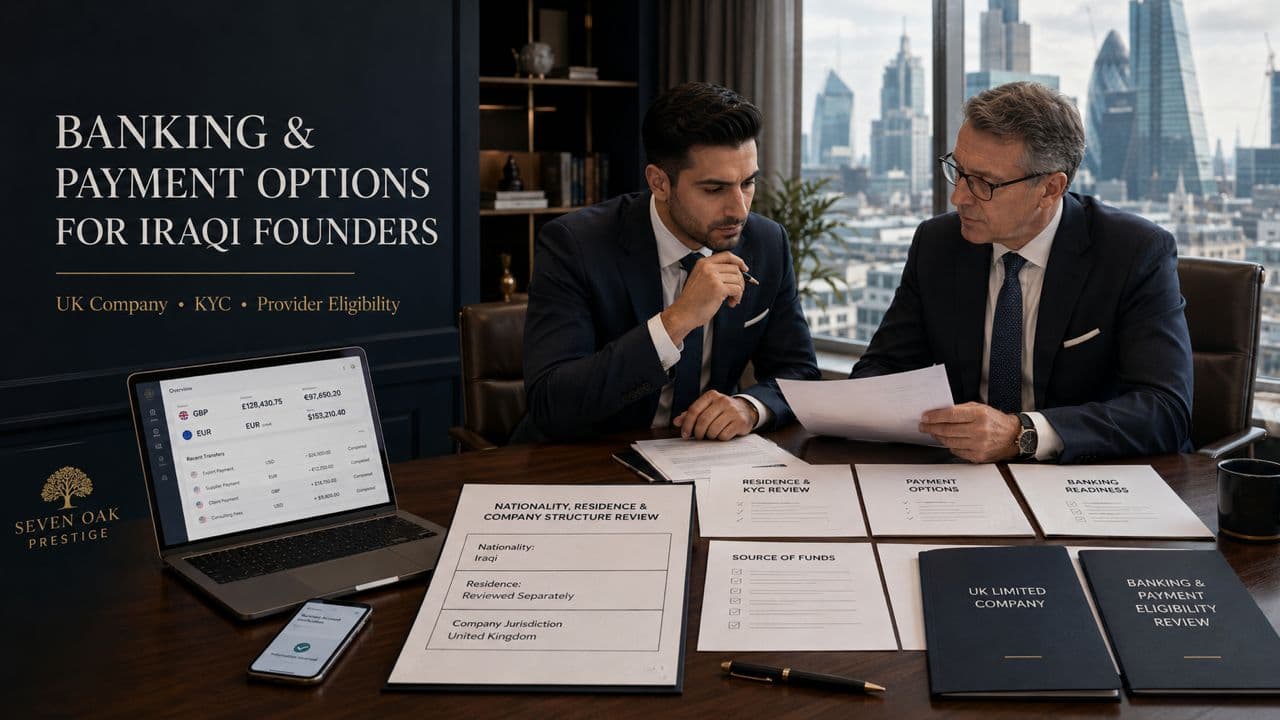
Stripe, Wise, Airwallex & Payoneer for Iraqi Founders: UK Company Payment Options in 2026
For an Iraqi entrepreneur, forming a UK Limited Company is often possible.
The more difficult question usually comes afterwards:
How will the company actually receive, hold and move money internationally?
An entrepreneur based in Baghdad, Erbil, Sulaymaniyah, Basra or elsewhere may want a UK company to work with customers in Britain, Europe, the United States, the Gulf or other international markets.
But a UK Certificate of Incorporation does not automatically provide access to:
- Stripe;
- Wise;
- Payoneer;
- Airwallex;
- a UK bank account;
- an electronic-money account;
- card-processing facilities.
For Iraqi founders, there is another distinction that matters enormously:
Iraqi nationality and current residence in Iraq are not the same eligibility question.
An Iraqi national who is legally resident in the UAE, UK, EU or another accepted jurisdiction may have access to providers that do not support somebody currently resident in Iraq.
Financial providers can consider several factors independently:
- nationality;
- current residence;
- company jurisdiction;
- directors;
- shareholders and UBOs;
- actual operating location;
- business activity;
- source of funds;
- customer countries;
- supplier countries;
- expected transactions;
- sanctions and financial-crime exposure.
The correct question is therefore not simply:
“Does this provider accept Iraq?”
It is:
“Does this provider accept my exact combination of nationality, residence, company, ownership and business activity?”
If you have not yet incorporated, begin with our UK Company Formation from Iraq — Complete 2026 Guide.
Quick Answer: What Is Actually Possible?
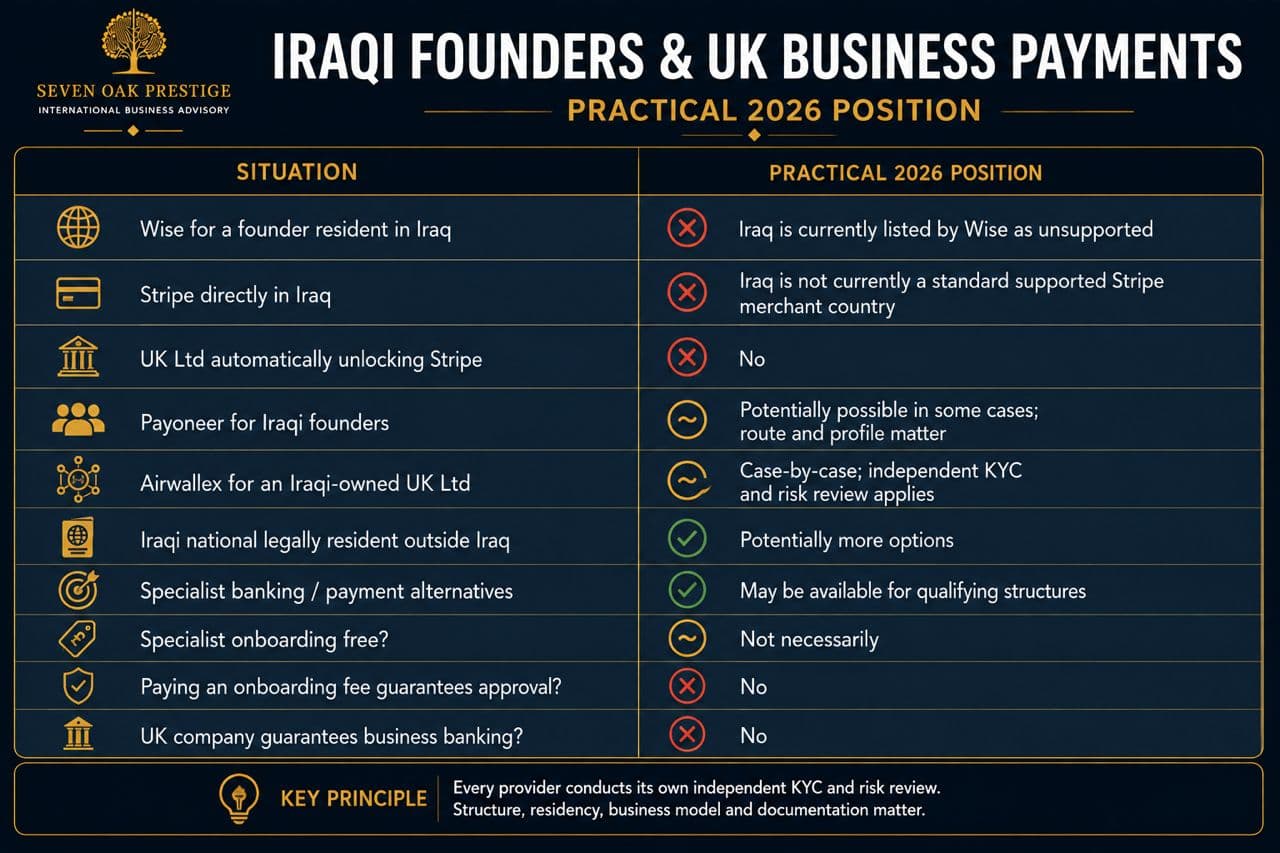
The central principle is:
A UK company changes the corporate structure. It does not erase the founder’s nationality, residence or compliance profile.
1. Iraqi Nationality vs Iraqi Residence: Why the Difference Matters
Consider two founders.
Founder A
- Iraqi citizen
- lives in Baghdad
- Iraqi residential address
- owns a UK Limited Company
Founder B
- Iraqi citizen
- legally resident in Dubai
- UAE residential address
- owns a UK Limited Company
Both founders have Iraqi nationality.
But a bank, EMI or payment provider may reach a different eligibility decision because the current country of residence, operating location and supporting documentation are different.
Some providers restrict residence in Iraq.
Others may assess both nationality and residence.
Others may accept an Iraqi-national UBO where the person resides in a supported jurisdiction, subject to enhanced due diligence.
Therefore:
“I am Iraqi” does not by itself determine whether financial services are available.
A proper eligibility review should identify:
- nationality;
- current legal residence;
- residential proof;
- company jurisdiction;
- ownership and control;
- actual business location;
- business activity;
- source of funds;
- expected transaction countries.
This nationality-vs-residence distinction is one of the most important things Iraqi founders should understand before incorporating.
Provider Availability for Iraqi Founders
Wise for Iraqi Residents: The Position Is Clear
Wise currently includes Iraq among the countries and regions where its services are not available.
Wise explains that customers in unsupported locations cannot register or use Wise in the normal way from those countries.
For an entrepreneur genuinely resident and operating in Iraq, this means:
Do not form a UK company on the assumption that the UK registered office will automatically unlock Wise Business.
A registered office and a real trading or operating location are different facts.
If your UK company uses a London registered office while the founder actually operates from Iraq, that information should be disclosed accurately whenever the provider requests it.
Do not use:
- a false UK residential address;
- a mail-handling address as a fictional residence;
- another person’s proof of address;
- invented UK employees;
- inconsistent KYC information.
For the broader provider framework, see our Wise Business for UK Companies — 2026 Guide.
Stripe and Iraq: Is Stripe Available?
Iraq is not currently included in Stripe’s standard supported-country list for direct merchant onboarding.
The United Kingdom is supported, but Iraq itself is not listed as a standard Stripe merchant jurisdiction.
That means there is an important distinction between:
Iraqi business seeking Stripe directly in Iraq
and:
UK Limited Company owned by an Iraqi founder seeking Stripe UK onboarding.
Those are not the same application.
However:
Creating the UK company does not guarantee Stripe approval.
Stripe can still evaluate:
- company details;
- UBOs;
- directors;
- representative;
- residential information;
- website;
- business model;
- products/services;
- transaction profile;
- countries involved.
Therefore Seven Oak Prestige does not recommend the logic:
I need Stripe
↓
therefore I need a UK company
The stronger sequence is:
I need an international company structure
↓
a UK Ltd genuinely fits the business
↓
then determine which payment providers fit that structure.
For the broader Stripe preparation framework, read Stripe for UK Companies — Complete 2026 Guide.
Payoneer for Iraqi Founders
Payoneer requires more nuanced treatment.
It would be misleading to say:
“Payoneer always works in Iraq.”
But it would also be too broad to say:
“Payoneer is impossible for every Iraqi founder.”
In practical cases, Payoneer may be possible depending on factors such as:
- residence;
- company structure;
- onboarding route;
- business activity;
- proof of address;
- source of funds;
- customer base;
- supporting documentation;
- provider compliance assessment.
This can make Payoneer relevant for some:
- consultants;
- agencies;
- technology businesses;
- marketplaces;
- international B2B service companies.
However:
Possible does not mean guaranteed.
Seven Oak Prestige can help review the proposed company structure, residence, business profile and supporting documents before an Iraqi founder relies on Payoneer as the company’s principal payment route.
This is particularly important because financial providers can continue reviewing an account even after initial onboarding.
Airwallex for Iraqi-Owned UK Companies
Airwallex provides a broader international financial platform that can include:
- multi-currency account infrastructure;
- international transfers;
- FX;
- company cards;
- expense management;
- payment services.
But product availability should never be confused with customer eligibility.
For UK companies, Airwallex’s own onboarding documentation shows that it can require:
- Certificate of Incorporation;
- constitutional documents;
- directors’ identification;
- directors’ residential information;
- UBO identification;
- UBO residential information;
- applicant verification;
- additional ownership or business documentation where required.
So an Iraqi-owned UK company should expect Airwallex to understand the people behind the entity.
The correct principle is:
UK incorporation makes the company British. It does not make an Iraqi-resident director a UK resident.
Eligibility therefore remains subject to Airwallex’s current policies and independent risk assessment.
2. A UK Company Is Not a Geographic Workaround
A UK company can legitimately have:
- an Iraqi director;
- an Iraqi shareholder;
- an Iraqi PSC;
- operations outside the UK;
- international customers.
There is nothing inherently wrong with that structure.
The problem begins when a founder tries to manufacture a UK presence that does not exist.
For example:
Coherent structure
UK Ltd
↓
Iraqi founder
↓
Real Iraqi residence
↓
International online business
Incoherent structure
UK Ltd
↓
London mail address presented as founder residence
↓
invented UK operational office
↓
website suggesting UK employees who do not exist
↓
KYC documents showing Iraq
The first structure is transparent.
The second creates unnecessary compliance risk.
For banking and payment-provider purposes:
Accuracy is more valuable than appearance.
3. What If the Iraqi Founder Lives Outside Iraq?
This can materially change the position.
Suppose the founder is:
- Iraqi national;
- legally resident in the UAE;
- has genuine UAE proof of address;
- director and shareholder of a UK Ltd.
The provider can now evaluate:
Iraqi nationality
- ●
UAE residence
- ●
UK company
- ●
actual business model
That may produce a different eligibility outcome from an otherwise identical founder living in Iraq.
The same principle can apply to Iraqi nationals legally resident in:
- the UK;
- EU/EEA countries;
- UAE;
- other supported jurisdictions.
This does not mean every provider will accept the application.
Nationality, residence, business activity and transaction geography can all still matter.
But it means:
Iraqi nationality alone should not be treated as an automatic prohibition.
4. Specialist Banking and Payment Alternatives
Mainstream fintechs are not the entire financial-services market.
Where Wise, Stripe or another major provider is unavailable or unsuitable, some founders may be considered by specialist regulated banking or payment providers.
Potential eligibility can depend on:
- founder residence;
- nationality;
- business activity;
- company jurisdiction;
- UBO structure;
- source of funds;
- expected turnover;
- transaction countries;
- restricted industries.
Specialist routes are often different from mainstream fintech products.
They may involve:
- more extensive KYC;
- enhanced source-of-funds evidence;
- compliance interviews;
- business-plan review;
- onboarding charges;
- account-opening fees;
- monthly fees;
- minimum balances;
- higher transaction charges.
Iraqi Nationals Resident Abroad
For an Iraqi national legally resident in a supported jurisdiction outside Iraq, specialist options may be wider.
Seven Oak Prestige may be able to assess alternative routes depending on:
- residence;
- UK company structure;
- activity;
- transaction volume;
- source of funds;
- countries involved.
These routes are not necessarily free.
An Iraqi founder should know the expected:
- onboarding fee;
- monthly charge;
- transaction cost;
- FX cost;
- minimum balance;
- supported currencies;
- payment rails
before proceeding.
Iraqi Residents Living in Iraq
For somebody currently resident in Iraq, the available market is narrower.
Specialist providers may apply enhanced review to:
- residence;
- nationality;
- counterparties;
- source of funds;
- transaction purpose;
- industry;
- customer jurisdictions.
At the time of this guide’s latest review, Seven Oak Prestige recommends treating specialist eligibility for founders currently resident in Iraq as case-specific rather than assuming a route is universally available.
Where a suitable specialist partner exists, eligibility should be confirmed against the founder’s exact profile before the founder relies on that route.
Paid Onboarding Does Not Mean Guaranteed Approval
Specialist financial solutions can involve fees.
These may include:
- application fee;
- onboarding fee;
- account-opening charge;
- monthly service fee;
- minimum account balance.
But:
Paying an onboarding or application fee does not automatically guarantee account approval.
Financial institutions remain responsible for their own:
- KYC;
- AML;
- sanctions screening;
- risk assessment;
- final onboarding decision.
Seven Oak Prestige does not describe a payment route as guaranteed unless the relevant provider’s contractual terms specifically establish such a commitment.
5. Banking, EMI and Payment Processing Are Different
A common mistake is saying:
“I need a bank account.”
when the business actually needs several different financial functions.
Business account infrastructure
For receiving and holding company money.
International transfers
For paying:
- suppliers;
- contractors;
- service providers.
FX
For converting:
- GBP;
- EUR;
- USD;
- other currencies.
Payment processing
For accepting customer card payments.
Subscription processing
For SaaS and recurring-payment businesses.
Marketplace receiving
For receiving funds from platforms or marketplaces.
Stripe, Wise, Payoneer and Airwallex do not provide exactly the same services.
That is why the right question is not:
“Which app is best?”
It is:
“Which financial stack does this particular company need?”
For the broader bank-account question, read our UK Business Bank Account for Iraqi Residents — 2026 Complete Guide.
6. Which Route Fits Which Iraqi Business?
SaaS or software company
Typical requirements:
- subscriptions;
- international cards;
- GBP/USD/EUR;
- contractor payments;
- international transfers;
- FX.
The business may need:
payment processor
- ●
operating account
rather than trying to make one provider perform every function.
Consultancy or agency
Typical requirements:
- international invoices;
- B2B transfers;
- multi-currency receipts;
- contractor payments;
- relatively low card dependency.
A business-account or Payoneer-style route can sometimes be more important than Stripe.
E-commerce
Typical requirements:
- checkout;
- card processing;
- refunds;
- suppliers;
- FX;
- international settlement.
The financial stack should be considered alongside the company’s products, fulfilment model, marketplaces and tax position.
Our UK E-Commerce Company for Non-Residents — 2026 Guide explains that broader structure.
Import and export
Typical requirements:
- larger international transfers;
- supplier payments;
- SWIFT;
- FX;
- trade documentation;
- clear source of funds.
For these businesses, the provider’s accepted transaction countries and activity restrictions may matter more than card-processing functionality.
7. Documents Iraqi Founders Should Prepare
There is no universal KYC pack.
But a founder should generally be ready to explain and document four areas.
Company
- Certificate of Incorporation;
- company number;
- Memorandum and Articles;
- registered office;
- directors;
- shareholders;
- PSCs.
Founder and UBOs
- valid identification;
- genuine current residential address;
- proof of address;
- consistent personal information.
Business
- clear business description;
- website;
- company-domain email where appropriate;
- products/services;
- customer profile;
- supplier profile;
- invoices;
- contracts;
- business plan where appropriate.
Financial profile
- source of initial capital;
- source of ongoing funds;
- expected turnover;
- average transaction size;
- sending countries;
- receiving countries;
- expected currencies.
The objective is not to manufacture a “perfect” company profile.
It is to make the real business easy for a compliance team to understand.
8. Your Website Matters More Than Many Founders Expect
An online business website can become part of the provider’s KYC understanding.
A strong website should make clear:
- what the company does;
- what it sells;
- who the customer is;
- how customers contact the business;
- the relationship between the trading brand and legal company;
- refund/cancellation terms where relevant;
- legal information where required.
Problems arise when:
Companies House says one thing
but:
website says another
and:
financial application says something different again.
The strongest application generally has:
company records
- ●
website
- ●
business description
- ●
invoices/contracts
- ●
transaction profile
all describing the same genuine commercial activity.
9. Companies House Verification and Financial KYC Are Different
Companies House identity verification has become a core part of UK company compliance.
But:
Companies House verification ≠ bank approval.
The two processes serve different purposes.
Companies House may verify the person’s identity for their corporate role.
A bank or payment provider separately decides whether it wants to establish a financial relationship with the company.
For Iraqi founders, that second process may involve:
- KYC;
- UBO checks;
- sanctions screening;
- source-of-funds analysis;
- business-model assessment;
- transaction-country review.
For the Iraq-specific process, read Companies House Identity Verification for Iraqi Residents — 2026 Guide.
10. Why You Should Not Apply Everywhere at Once
When banking is difficult, founders sometimes submit applications to every fintech they can find.
That is not necessarily the best strategy.
It can result in:
- different business descriptions;
- different turnover projections;
- inconsistent residential information;
- incomplete websites;
- contradictory source-of-funds explanations;
- rushed applications.
A more professional sequence is:
Understand eligibility
↓
prepare documents
↓
select suitable provider
↓
submit coherent application
rather than:
apply everywhere and hope somebody approves.
11. Iraq Payment & Banking Readiness Matrix
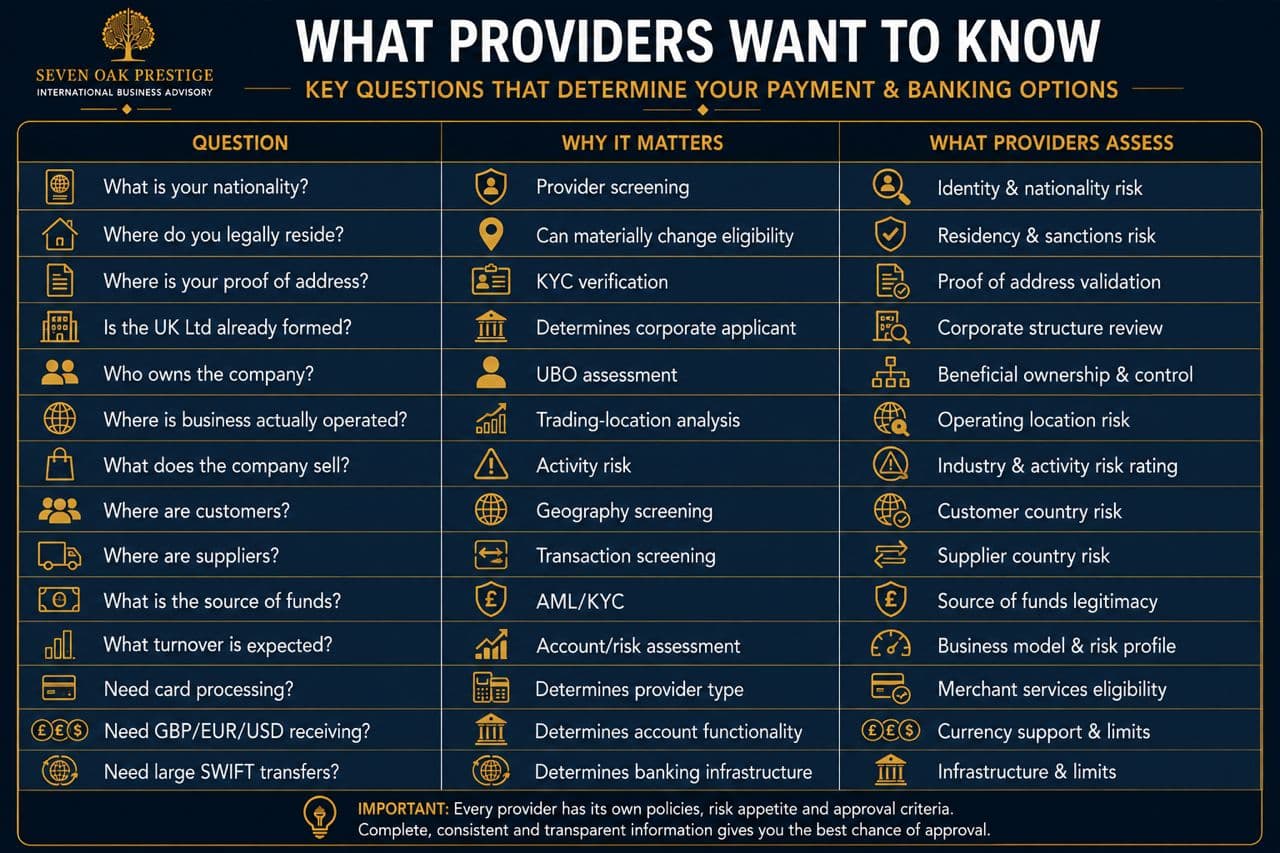
For Iraqi founders, banking should therefore be considered before or alongside incorporation, rather than after every other decision has already been made.
12. The Seven Oak Prestige Iraq Readiness Framework
Seven Oak Prestige is a premium UK advisory firm supporting international founders with company establishment, compliance readiness and financial-infrastructure preparation.
For more complex jurisdictions such as Iraq, we focus on six areas.
1. Residence
Where does the founder genuinely live?
2. Corporate structure
Who owns and controls the UK company?
3. KYC readiness
Can every relevant person document:
- identity;
- residence;
- ownership;
- source of funds?
4. Business model
Can the company clearly explain:
- what it sells;
- to whom;
- where;
- how customers pay?
5. Transaction profile
Are the:
- volumes;
- currencies;
- customer countries;
- supplier countries
understood?
6. Provider fit
Does the chosen provider actually fit the founder’s:
- residence;
- company;
- activity;
- financial requirements?
The goal is not simply:
“Get me an account.”
The goal is:
build financial infrastructure that fits the real company and can withstand compliance scrutiny.
Frequently Asked Questions
Is Wise available in Iraq?
Wise currently lists Iraq as an unsupported country. An Iraq-based founder should not rely on a UK registered office as a workaround for that restriction.
Does Stripe work directly in Iraq?
Iraq is not currently listed as a standard Stripe-supported merchant country.
Can I form a UK company and then use Stripe?
Potentially, depending on Stripe’s independent eligibility and verification assessment. UK incorporation does not guarantee Stripe approval.
Can an Iraqi resident use Payoneer?
Potentially in some cases. The route can depend on residence, company structure, business activity and Payoneer’s independent compliance review.
Can an Iraqi-owned UK company use Airwallex?
Potentially, subject to Airwallex’s current eligibility and KYC/KYB assessment. Airwallex verifies both the UK company and relevant directors/UBOs.
Can an Iraqi national living outside Iraq access more providers?
Potentially, yes. Current legal residence can materially change provider eligibility.
Is Iraqi nationality itself an automatic banking ban?
No universal rule means every provider must reject every Iraqi national. Eligibility depends on the institution, residence, sanctions screening, ownership, activity and other risk factors.
Are there alternatives if Wise or Stripe is unavailable?
Potentially. Specialist regulated banking or payment providers may consider some structures that mainstream fintechs do not.
Are specialist financial routes free?
Not necessarily. They can involve onboarding, account-opening, monthly or transaction fees.
Does paying the onboarding fee guarantee approval?
No, unless the provider’s contractual terms explicitly provide such a guarantee.
Does Seven Oak guarantee banking?
No. Financial institutions make their own final KYC, AML and risk decisions.
Does a UK company guarantee a UK bank account?
No.
How Seven Oak Prestige Supports Iraqi Founders
Seven Oak Prestige is a specialist UK advisory firm for international founders seeking more than basic company incorporation.
For Iraqi founders, support can include:
- UK Limited Company formation;
- company ownership and PSC preparation;
- Companies House identity-verification support;
- registered office arrangements;
- director service address;
- business-model review;
- KYC readiness;
- proof-of-address preparation;
- source-of-funds preparation;
- expected transaction-profile review;
- Payoneer route assessment where relevant;
- specialist banking/payment-route assessment where available;
- post-incorporation planning.
Our approach is particularly suited to cases where:
company formation
- ●
identity
- ●
KYC
- ●
banking readiness
- ●
cross-border compliance
need to work together from the outset.
Seven Oak Prestige does not guarantee approval from Stripe, Wise, Payoneer, Airwallex, banks, EMIs or specialist providers.
The financial institution makes the final decision.
Need Help Reviewing Your Iraq Banking & Payment Options?
Review My Iraq Banking Options
For Iraqi founders who already have a UK company and want to understand which mainstream or specialist financial routes may realistically fit their residence, ownership and business model.
Start My UK Company With Banking Readiness in Mind
For Iraqi founders who have not yet incorporated and want the banking and payment position considered before the company structure is finalized.
Continue Through the Iraq–UK Business Hub
UK company formation
How to Start a UK Company from Iraq — Complete 2026 Guide
UK business banking
UK Business Bank Account for Iraqi Residents — 2026 Complete Guide
Companies House verification
Companies House Identity Verification for Iraqi Residents — 2026 Guide
Wise Business
Wise Business for UK Companies — 2026 Guide
Stripe
Stripe for UK Companies — Complete 2026 Guide
Non-resident banking
UK Business Banking for Non-Residents — Banks, Fintechs & Eligibility
E-commerce
UK E-Commerce Company for Non-Residents — Setup, VAT & Payments
Final Takeaway
For Iraqi founders, the question should not simply be:
“Which fintech accepts a UK company?”
The better sequence is:
Nationality
↓
Current legal residence
↓
Business model
↓
UK company structure
↓
KYC and source of funds
↓
Provider eligibility
↓
Specialist alternatives where appropriate
↓
Application
For founders resident in Iraq, mainstream options are significantly narrower.
For Iraqi nationals legally resident outside Iraq, more routes may become available depending on the residence jurisdiction and provider.
A UK company can provide a legitimate international corporate structure.
But it should never be used as a fictional geographic workaround.
The strongest structure is one where:
the company
- ●
founder residence
- ●
business activity
- ●
website
- ●
source of funds
- ●
transactions
all tell the same truthful story.
About the Author
Isaac Jackson
Founder & Managing Director — Seven Oak Prestige Ltd
Isaac Jackson has 3+ years of hands-on experience supporting international entrepreneurs with UK company formation and business-establishment matters.
Seven Oak Prestige has supported close to 100 UK company formation and establishment cases, including international founders requiring support with company structure, Companies House requirements, KYC preparation, banking readiness and cross-border operational planning.
Editorial Methodology
This guide is prepared using a combination of:
- primary provider sources;
- current regulatory and market research;
- practical international-founder experience;
- ongoing editorial review.
We prioritise official information from financial providers and UK regulatory sources when confirming eligibility, restrictions, identity requirements and onboarding processes.
Because banking and fintech policies can change — particularly for jurisdictions subject to enhanced compliance review — provider-specific information is periodically reviewed and updated where necessary.
Last reviewed: 1 September 2026
Editorial Disclaimer
This guide provides general educational and business-establishment information.
It does not constitute personalised:
- banking advice;
- legal advice;
- sanctions advice;
- tax advice;
- investment advice;
- regulated financial advice.
Financial institutions conduct their own independent:
- KYC;
- AML;
- sanctions screening;
- risk assessment.
Eligibility can change.
A UK company does not guarantee access to any banking or payment provider.
Specialist alternatives may involve additional onboarding costs and enhanced due diligence.
Primary Official Sources Reviewed
Wise — Country Availability
Used to confirm Wise’s current treatment of unsupported jurisdictions and Iraq-related availability.
Wise — Business Verification
Used to assess the distinction between company registration, business activity and operating/trading information.
Stripe — Global Availability
Used to confirm that Iraq is not currently listed as a standard supported Stripe merchant jurisdiction.
Airwallex — UK Company Verification Requirements
Used to confirm the identity, residential-address, director and UBO information Airwallex can require for UK company onboarding.
Companies House / GOV.UK
Used for the UK company, director, PSC and identity-verification framework applicable to non-resident founders.