
UK Subsidiary for Indian Companies | Setup, Tax & FEMA 2026

How to Set Up a UK Subsidiary for an Indian Company in 2026
An Indian company can establish a UK subsidiary by incorporating a separate UK Limited Company owned wholly or partly by the Indian parent.
This article focuses specifically on the subsidiary route — a UK Limited Company owned by an Indian company — rather than a personally owned UK company or a UK establishment of the Indian parent.
For an established Indian business entering Britain, a subsidiary can provide a clear structure for UK contracts, employees, banking, customers and long-term operations.
But incorporation is only one part of the process.
The Indian parent may also need to consider:
- FEMA and RBI Overseas Investment rules;
- ODI reporting and funding;
- UK Corporation Tax;
- transfer pricing;
- intercompany agreements;
- banking and KYC;
- VAT or EORI where relevant;
- employees and immigration;
- sponsor licensing if overseas staff will work in the UK.
For the broader India incorporation framework, read our UK Company Formation from India — Complete 2026 Guide
1. Can an Indian Private Limited Company Own a UK Subsidiary?
Yes.
An Indian private limited company can generally own shares in a UK Limited Company, subject to the applicable Indian overseas-investment framework.
A common structure is:
Indian Parent Company
↓
UK Limited Company
↓
UK customers, contracts, employees and operations
If the Indian parent owns all the shares, the UK company would normally be described as a wholly owned subsidiary.
The UK subsidiary is legally separate from its Indian shareholder.
That distinction matters for contracts, liabilities, accounting, banking and group structure.
2. What Is a UK Subsidiary?
A UK subsidiary is usually a UK-incorporated company controlled by another company.
For an Indian business, that may mean:
Indian Pvt Ltd → owns → UK Ltd
The UK subsidiary can:
- enter contracts in its own name;
- employ staff;
- invoice customers;
- hold its own business accounts;
- register for UK taxes where required;
- own assets;
- establish a visible UK commercial presence.
The Indian parent remains the shareholder, but the subsidiary has its own legal identity.
3. UK Subsidiary or UK Establishment: Which Is Better?
For a long-term UK operation, a subsidiary is often the cleaner structure. A UK establishment may still make sense in specific cases.
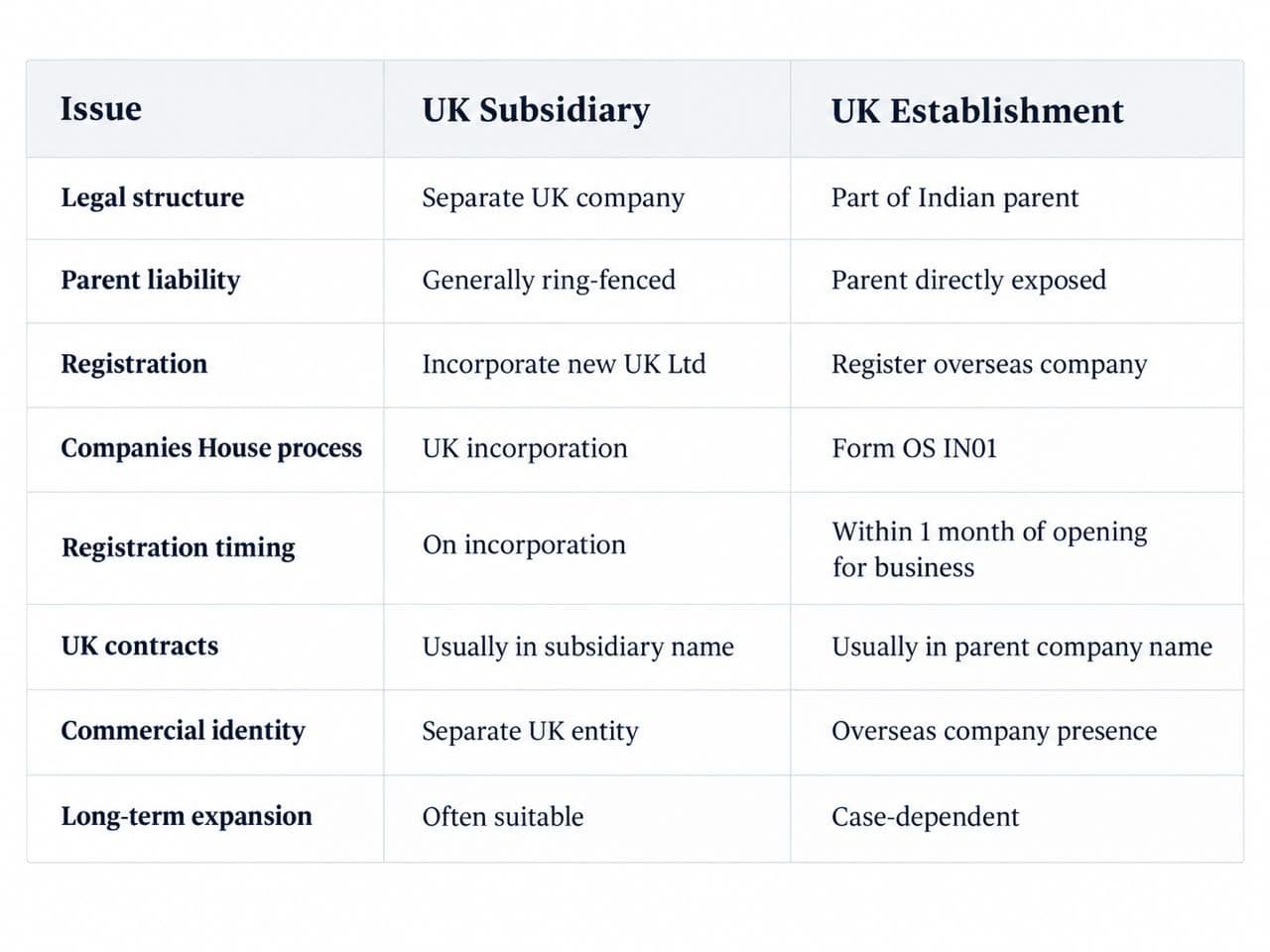
Companies House uses the term UK establishment for a place of business or branch of an overseas company in the UK.
Where an overseas company opens a UK establishment, it must generally register it with Companies House using form OS IN01 within one month of opening for business. The current registration fee for a UK establishment is £124.
Quick answer
If the Indian business wants a separate UK operating company, a subsidiary is generally the structure to examine first.
4. How Is a UK Subsidiary Registered?
Usually by incorporating a private company limited by shares with Companies House.
The incorporation normally requires:
- company name;
- Registered Office;
- director details;
- shareholder details;
- share structure;
- PSC information;
- SIC code;
- memorandum and articles.
The current Companies House online incorporation fee is £100.
Companies House normally processes standard online incorporation applications within 24 hours, although complex applications can take longer.
For the wider cost structure, read our UK Company Formation Cost from India
5. Who Should Own the UK Subsidiary?
The ownership should reflect the real commercial structure.
A common arrangement is:
Indian Pvt Ltd — 100% shareholder → UK Ltd
This is different from the Indian founders personally owning the UK company.
That choice can affect:
- FEMA/ODI reporting;
- ownership and control;
- intercompany transactions;
- future investment;
- group accounting;
- dividends;
- restructuring;
- exit planning.
If the UK operation genuinely belongs to the Indian parent company, personal ownership should not be chosen simply because it appears easier at incorporation.
For a wider structural comparison, read our Indian Private Limited vs UK Limited Company — 2026 Comparison
6. Does the Indian Parent Need FEMA or RBI Compliance?
Potentially yes. UK incorporation and Indian overseas-investment compliance are separate processes.
Where an Indian entity acquires or funds a foreign subsidiary, the transaction can fall within India’s Overseas Investment framework.
Depending on the circumstances, the process can involve:
- an Authorised Dealer bank;
- Overseas Direct Investment reporting;
- a UIN for the foreign entity;
- financial commitment reporting;
- ongoing reporting;
- Annual Performance Report requirements.
The key point is simple:
Registering the UK company with Companies House does not replace FEMA or RBI compliance in India.
For the detailed India-side framework, read our FEMA & RBI Rules for Indian Founders with a UK Company
7. How Should the Indian Parent Fund the UK Subsidiary?
Decide the funding structure before transferring money.
Possible routes can include:
- equity investment;
- additional capital;
- permitted intercompany lending;
- other compliant financial commitments.
The correct route depends on the ownership structure and applicable Indian Overseas Investment rules.
Avoid transferring funds first and trying to determine later whether the payment was:
- share capital;
- a loan;
- reimbursement;
- a service payment;
- another intercompany transfer.
The banking, accounting and regulatory records should tell the same story.
8. Does the UK Subsidiary Pay UK Corporation Tax?
A UK-incorporated subsidiary will generally be within the UK corporate tax system.
A UK-incorporated company is generally UK tax resident, although dual-residence and treaty issues may still need to be considered where another jurisdiction also treats the company as resident.
For an India–UK group, additional issues may include:
- transfer pricing;
- management fees;
- intercompany service charges;
- royalties;
- loans;
- dividends;
- permanent-establishment questions;
- Indian tax treatment;
- POEM considerations.
FEMA compliance does not determine tax residence or tax liability.
For the dedicated India tax analysis, read our UK Company Tax for Indian Residents — POEM & DTAA 2026
9. Do You Need Intercompany Agreements?
Often yes, particularly when money, services, goods or intellectual property move between the parent and subsidiary.
Examples include:
- Indian parent provides software development;
- UK subsidiary performs UK sales;
- parent licences intellectual property;
- subsidiary pays management fees;
- parent lends money to the subsidiary;
- subsidiary purchases goods from India;
- staff costs are recharged between companies.
These relationships should be documented clearly.
Vague transfers described only as “support” or “expenses” can create unnecessary tax, accounting and banking questions.
10. Can the UK Subsidiary Open a UK Business Account?
Potentially yes, but incorporation does not guarantee approval.
Banks and fintech providers may review:
- the Indian parent;
- UBOs;
- directors;
- ownership structure;
- business model;
- website;
- expected turnover;
- customer countries;
- supplier countries;
- source of funds;
- purpose of the UK subsidiary.
A clearly documented parent–subsidiary structure can make the commercial rationale easier to explain.
For banking specifically, read our UK Business Bank Account for Indian Residents.
11. Can the UK Subsidiary Hire Employees?
Yes.
A UK subsidiary can employ workers in Britain subject to normal UK employment, PAYE, tax and right-to-work requirements.
If the employee already has the right to work in the UK, sponsorship may not be required.
If the company wants to bring workers from India or another overseas location to work in Britain, immigration and sponsor-licence requirements become a separate consideration.
12. Does a UK Subsidiary Automatically Get a Sponsor Licence?
No.
A sponsor licence is a separate Home Office authorisation.
Simply forming a UK company does not mean it can immediately sponsor overseas workers.
The employer must:
- apply under the appropriate sponsor route;
- meet Home Office eligibility requirements;
- provide the required evidence;
- maintain sponsor compliance;
- obtain the licence before sponsoring qualifying workers.
This distinction is important:
UK company formation and UK immigration sponsorship are two separate processes.
13. What If the Indian Company Wants to Send Staff to Establish the UK Operation?
The UK Expansion Worker route may be relevant where the overseas company is establishing a UK presence and the UK operation has not yet started active trading.
Home Office guidance requires the overseas business to be currently active and trading overseas.
It generally must also have been trading overseas for at least three years, although exceptions exist for certain businesses. The sponsor must demonstrate credible plans to establish a UK trading presence within two years.
The worker must also meet the separate visa requirements, including having a valid Certificate of Sponsorship and satisfying the relevant role, salary and overseas-employment conditions.
A UK subsidiary or another qualifying UK footprint can form part of the expansion structure.
However:
If the UK operation is already actively trading, UK Expansion Worker is generally not the appropriate route.
Other Global Business Mobility routes or the Skilled Worker route may need to be considered depending on the circumstances.
A sponsor licence must be obtained before the business can sponsor an eligible worker under the relevant route.
14. Does the UK Subsidiary Need VAT or EORI?
Only if its activities require them.
VAT can depend on factors including:
- UK taxable sales;
- goods held in the UK;
- imports;
- customer location;
- marketplaces;
- business model.
An EORI number may be required where the UK subsidiary imports or exports goods.
A SaaS subsidiary should not automatically be treated the same way as an Amazon seller or importer.
15. Example: Indian SaaS Company Expanding to the UK
A UK subsidiary can create a separate UK-facing sales and operating entity.
Example:
Indian SaaS Parent
↓
UK Subsidiary
↓
UK / international customers
The UK subsidiary may handle:
- UK contracts;
- invoicing;
- partnerships;
- local banking;
- UK sales staff;
- customer relationships.
The Indian parent may continue providing development, technology or IP-related services under appropriately documented intercompany arrangements.
For the specialist guide, read our UK Company for Indian SaaS, AI & Technology Founders — 2026 Guide
16. Example: Indian E-Commerce or Export Company
A UK subsidiary can become the UK-facing commercial entity, but VAT and customs still need separate review.
Example:
Indian Manufacturer / Exporter
↓
UK Subsidiary
↓
Amazon / Shopify / UK distributors
Important questions include:
- who owns the inventory;
- who imports the goods;
- who is importer of record;
- whether VAT registration is required;
- whether an EORI is required;
- where goods are warehoused;
- how payments are collected;
- how intercompany pricing works.
For the wider commercial structure, read our UK Company for Indian Amazon, E-Commerce & Exporters — 2026 Guide
17. Example: Indian Pharma, MedTech or Life-Sciences Company
A UK subsidiary can support UK commercial expansion, but incorporation does not replace sector-specific regulation.
The UK company may support:
- commercial partnerships;
- contracting;
- distribution;
- UK staff;
- research relationships;
- market-entry activity.
However, regulated medicines, devices and healthcare activities may require separate licences, registrations or specialist advice.
Read our UK Company for Indian Pharma, MedTech & Life-Sciences Founders
18. How Much Does a UK Subsidiary Cost?
The Companies House online incorporation fee is currently £100.
But £100 is not the full cost of establishing an Indian company’s UK operation.
Depending on the structure, additional costs may include:
- Registered Office;
- Director Service Address;
- Companies House identity verification;
- accounting;
- banking preparation;
- VAT registration;
- EORI;
- intercompany documentation;
- Indian FEMA/ODI advice;
- UK and Indian tax advice;
- sponsor-licence or immigration support.
The incorporation fee should therefore not be confused with the total cost of UK market entry.
For a broader formation-cost breakdown, read our UK Company Formation Cost from India
19. What Is the Step-by-Step Process?
Structure the parent–subsidiary relationship before incorporating.
- Confirm the commercial reason for UK expansion.
- Decide between a subsidiary and UK establishment.
- Confirm who should own the UK company.
- Review FEMA/ODI requirements.
- Determine the funding route.
- Select directors and identify PSCs.
- Establish suitable UK address arrangements.
- Incorporate the UK Limited Company.
- Complete applicable Companies House identity requirements.
- Arrange accounting and tax setup.
- Prepare banking/KYC documentation.
- Document intercompany relationships.
- Register for VAT/EORI if required.
- Review employment and immigration requirements.
- Begin UK operations when the structure is ready.
20. What Are the Most Common UK Subsidiary Mistakes?
The biggest mistake is treating the subsidiary as nothing more than a Companies House registration.
Common problems include:
- incorporating before reviewing FEMA;
- choosing personal ownership when the Indian parent should own the company;
- transferring funds without clear documentation;
- mixing parent and subsidiary transactions;
- failing to document intercompany services;
- assuming banking approval is automatic;
- ignoring transfer pricing;
- confusing Registered Office with trading premises;
- assuming a sponsor licence comes with incorporation;
- starting UK Expansion Worker planning after the UK operation has already begun actively trading.
Planning the structure before incorporation can prevent avoidable ownership, banking, FEMA and immigration problems later.
If your Indian company is deciding between a subsidiary and a UK establishment, Seven Oak Prestige can help review the UK corporate setup before incorporation.
21. UK Subsidiary Checklist for Indian Companies
India Side
- Parent-company approval
- Ownership structure
- FEMA / ODI assessment
- Authorised Dealer bank
- Funding route
- Reporting requirements
UK Corporate Side
- Company name
- Shareholder
- Directors
- PSCs
- Registered Office
- SIC codes
- Companies House identity requirements
Operational Side
- Business account
- Accounting
- Contracts
- Intercompany agreements
- VAT / EORI
- Payroll
- Employees
- Sponsor / immigration requirements where applicable
22. Frequently Asked Questions
Can an Indian Pvt Ltd own 100% of a UK company?
Yes, potentially.
A UK company can have an Indian corporate shareholder, subject to the applicable Indian overseas-investment rules.
Is a UK subsidiary a separate legal entity?
Yes.
The subsidiary has its own legal identity and is separate from its Indian parent shareholder.
Is a subsidiary better than a UK establishment?
Often for long-term expansion, but not always.
A subsidiary creates a separate UK company. A UK establishment remains part of the overseas parent.
Does setting up a UK subsidiary require RBI approval?
Not automatically in every case.
The appropriate Indian route depends on the investment, ownership, sector and Overseas Investment framework. The FEMA/ODI position should be reviewed before funding.
Does a UK subsidiary need a UK-resident director?
A standard UK private limited company generally does not require a UK-resident director.
Can the Indian parent fund the UK subsidiary?
Yes, potentially.
The funding must comply with applicable Indian overseas-investment and reporting requirements.
Can the subsidiary sponsor Indian employees?
Potentially, but not simply because it has been incorporated.
It must first obtain the appropriate sponsor licence and satisfy the relevant Home Office requirements.
Can the UK Expansion Worker route be used?
Potentially, where the overseas company is establishing a UK presence and the UK operation has not yet begun active trading.
The sponsor and worker must separately satisfy the applicable requirements.
Does a subsidiary guarantee a UK bank account?
No.
Banks and fintechs conduct their own eligibility, KYC and risk assessments.
Does every UK subsidiary need VAT registration?
No.
VAT depends on the company’s actual activities and circumstances.
23. Should Your Indian Company Set Up a UK Subsidiary?
A subsidiary is worth serious consideration where the Indian company intends to build a genuine, long-term UK operation.
It may be particularly relevant where the business wants to:
- contract directly with UK customers;
- establish local banking;
- employ UK staff;
- build a UK sales operation;
- develop local partnerships;
- hold stock;
- create a permanent commercial presence;
- potentially sponsor qualifying personnel in future.
If the business is only testing demand from India, establishing a UK company may not always need to be the first step.
Unsure whether a subsidiary or UK establishment fits your expansion?
Seven Oak Prestige can help review the UK corporate structure before incorporation.
24. Professional UK Subsidiary Setup Support
Seven Oak Prestige supports Indian businesses with the UK corporate side of establishing a subsidiary.
Our support can include:
- UK subsidiary incorporation;
- ownership structure;
- Registered Office;
- Director Service Address;
- Companies House processes;
- identity-verification support;
- banking-readiness preparation;
- VAT/EORI assistance;
- post-incorporation support.
We do not provide Indian FEMA/ODI, Indian tax, UK tax, immigration or regulated-sector legal advice.
Where those areas arise, the business should obtain advice from an appropriately qualified professional.
Discuss Your UK Expansion
View UK Company Formation Services
Talk to Seven Oak Prestige on WhatsApp
25. About the Author
Isaac Jackson — Founder & Managing Director, Seven Oak Prestige Ltd
Isaac Jackson has more than three years of hands-on experience supporting international founders and overseas businesses with UK company formation, Companies House processes, corporate structuring, compliance preparation and banking readiness.
His work focuses particularly on helping non-resident founders and overseas companies understand the practical requirements of establishing a credible UK business presence.
26. Editorial Methodology
This guide was prepared and reviewed using:
- current Companies House incorporation guidance;
- current Companies House overseas-company and UK-establishment guidance;
- RBI Overseas Investment rules and directions;
- current HMRC corporate tax principles;
- current Home Office sponsor and Global Business Mobility guidance;
- Seven Oak Prestige’s India-focused UK business content architecture;
- recurring questions from Indian businesses considering UK expansion.
The article is designed to distinguish clearly between:
UK corporate establishment
and
Indian overseas-investment, tax and regulatory considerations.
Last reviewed: 7 September 2026
27. Important Disclaimer
This guide provides general educational information only.
It does not constitute legal, tax, immigration, investment, accounting or FEMA advice.
Seven Oak Prestige Ltd provides UK corporate-establishment, company-formation and business-readiness support.
Where a proposed structure involves Indian FEMA/ODI, Indian tax, UK tax, immigration, employment law or regulated-sector issues, appropriately qualified professional advice should be obtained.
Rules can change and the correct position depends on the facts of each business.
28. Related Guides for Indian Businesses
UK Company Formation from India — Complete 2026 Guide
The main guide to establishing a UK company from India.
FEMA & RBI Rules for Indian Founders with a UK Company
For ODI, LRS, UIN, APR and India-side overseas-investment compliance.
UK Company Tax for Indian Residents — POEM & DTAA 2026
For UK Corporation Tax, Indian tax residence, POEM and double-taxation considerations.
UK Business Bank Account for Indian Residents
For business banking, fintech eligibility, KYC and banking readiness.
Indian Private Limited vs UK Limited Company
For businesses and founders comparing Indian and UK corporate structures.
UK Company for Indian SaaS, AI & Technology Founders
For Indian technology businesses expanding internationally.
UK Company for Indian Amazon, E-Commerce & Exporters
For exporters, marketplace sellers and e-commerce businesses.
UK Company for Indian Pharma, MedTech & Life-Sciences Founders
For Indian regulated-sector businesses considering a UK presence.