
UK Company for Indian Amazon, E-commerce & Exporters | 2026

UK Ltd vs Indian Company, Amazon UK, Shopify, UK–India CETA, VAT, EORI, Customs, Importer of Record, Banking, FEMA/RBI & Product Compliance
Last reviewed : 01 October 2026
Indian entrepreneurs can now reach British customers through Amazon, Shopify, wholesale distribution, direct exports and international marketplaces without necessarily establishing a UK company first.
That creates an important question:
Should an Indian e-commerce seller, manufacturer or exporter use an Indian company, establish a UK Limited Company, or create an Indian-parent/UK-subsidiary structure?
There is no universal answer.
An Indian company can export directly to Britain.
An Indian founder can personally own a UK Ltd.
An established Indian company can establish a UK subsidiary.
An Amazon seller can store inventory in Britain.
A D2C brand can ship individual orders from India.
And a manufacturer can use a UK company as its British sales, import and distribution arm.
These structures create different consequences for:
- FEMA/RBI;
- UK VAT;
- customs;
- EORI;
- importer of record;
- Amazon FBA;
- banking;
- UK–India CETA;
- rules of origin;
- product compliance;
- UK and Indian tax.
If you have already determined that a UK entity has a genuine commercial role in your business, explore our UK company formation service for Indian residents for incorporation, statutory address and post-formation support.
If you are still deciding whether you need a UK company at all, continue with the comparison Indian Pvt Ltd vs UK Limited Company.
Quick Answer: Does an Indian Seller Need a UK Company?
No, not automatically.
If your existing Indian business remains the legal seller and you are exporting from India, an Indian entity may be sufficient.
A UK company becomes more relevant when Britain moves from being merely a destination for sales to becoming a genuine operating market.
The structure should follow the business.
Do not form a UK company simply because someone says Amazon requires one.
Amazon itself confirms that Indian businesses can sell on Amazon UK without first establishing a UK company.
India → UK E-commerce Structure Decision Matrix
Indian sellers and exporters should compare four main routes before deciding whether to establish a UK company.
Route 1 — Indian Company Sells Directly to UK Customers
Best suited to: businesses testing the UK market or continuing to operate primarily from India.
Typical model: products are exported from India and the Indian business remains the legal seller.
UK company required? Not necessarily.
Key issues to assess: UK VAT, customs, importer of record, EORI, product compliance, marketplace requirements, Indian export obligations and returns.
Route 2 — Founder-Owned UK Limited Company
Best suited to: an Indian founder building a standalone UK or international e-commerce business.
Typical model: the UK Ltd acts as the seller and may operate through Amazon, Shopify, wholesale or other international sales channels.
Key issues to assess: FEMA/RBI, ownership and funding, VAT, EORI, banking, payment providers, UK tax and operational structure.
Route 3 — Indian Parent With UK Subsidiary
Best suited to: an established Indian manufacturer, exporter or business making Britain a genuine operating market.
Typical model: the Indian parent handles manufacturing or Indian export operations while the UK subsidiary performs functions such as importation, UK inventory, local sales, distribution or contracts.
Key issues to assess: overseas investment, intercompany funding, transfer pricing, customs valuation, VAT, banking, accounting and UK/Indian tax.
Route 4 — Third-Party UK Import / Market-Entry Solution
Best suited to: Indian businesses that want to test or access the UK market without immediately establishing their own UK company.
Typical model: a third-party UK service provider performs specified functions such as importation, customs handling, warehousing, fulfilment, returns or other local market-entry support.
UK company required? Not necessarily, depending on the arrangement.
Potential advantages: reduced initial UK corporate administration, outsourced import or fulfilment infrastructure and the ability to test UK demand before establishing a permanent local company.
Key limitations to assess: the Indian business does not automatically gain its own UK legal entity, and the arrangement can affect control over inventory, customer relationships, payments, VAT, returns, brand operations and long-term UK infrastructure.
Before choosing this route, establish clearly:
- who is the legal seller;
- who owns the inventory;
- who acts as importer of record;
- who invoices the customer;
- who receives customer or marketplace payments;
- whose VAT registration is relevant;
- who carries product and contractual responsibilities;
- who manages returns and customer data; and
- how the business can later migrate to its own UK operation.
The Practical Rule
If Britain is mainly a destination for occasional sales, an additional UK company may be unnecessary.
If Britain is becoming a genuine operating market involving recurring inventory, distribution, contracts, employees or a dedicated British operation, owning a UK entity becomes easier to justify commercially.
A third-party UK import or market-entry arrangement can provide another route where a business wants local infrastructure without immediately establishing its own UK company.
The correct structure should follow the actual commercial model.
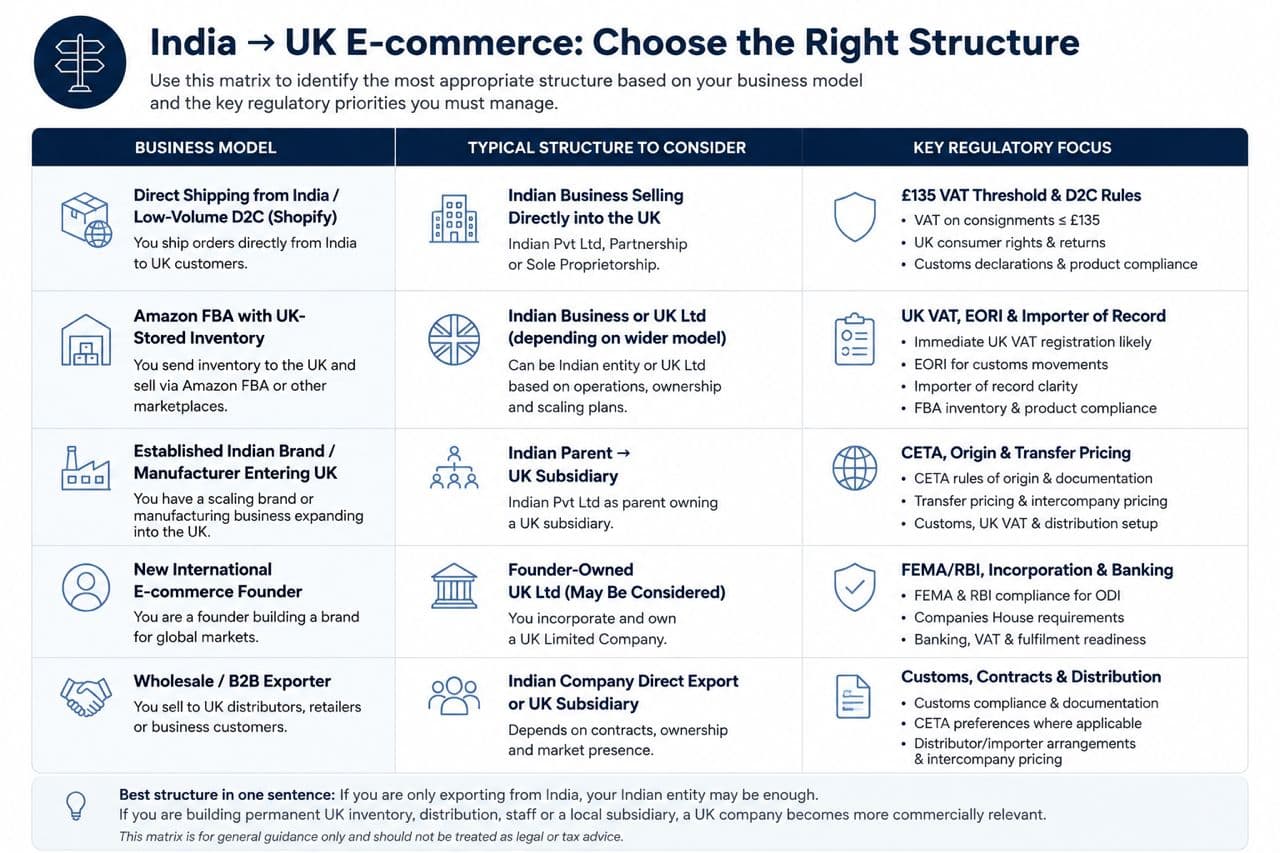
This matrix is a decision aid, not a universal legal or tax recommendation.
1. The Four Main Routes Indian Sellers Should Compare
Structure 1 — Indian Company Sells Directly Into the UK
Indian Pvt Ltd
↓
Amazon / Shopify / UK Customer
The Indian company remains the actual seller.
This can be appropriate where:
- products continue to be exported from India;
- Britain is still being tested as a market;
- there is no permanent UK operating entity;
- the marketplace accepts the Indian company;
- the Indian company already has established accounts, banking and export infrastructure.
This avoids creating a second company solely for appearances.
However, direct export does not mean the business can ignore:
- UK VAT;
- customs;
- importer-of-record responsibilities;
- product regulation;
- UK consumer law.
The selling entity may still have UK obligations.
Structure 2 — Indian Founder Personally Owns a UK Ltd
Indian Resident Founder
↓
UK Ltd
↓
UK & Global Customers
This structure can make sense where the founder is building a standalone international business.
Potential use cases include:
- Amazon;
- Shopify;
- international D2C;
- wholesale;
- global consumer brands.
But the Indian resident must separately consider India’s foreign-exchange and overseas-investment framework.
The fact that Companies House permits the ownership structure does not remove FEMA/RBI considerations.
For the detailed Indian side, use Seven Oak’s dedicated FEMA & RBI Rules for Indian Founders Owning UK Companies guide.
Structure 3 — Indian Parent Owns a UK Subsidiary
Indian Pvt Ltd
↓
UK Ltd Subsidiary
↓
UK Customers / Inventory / Distribution
This is often the most commercially coherent structure for an established Indian business expanding into Britain.
The Indian entity might continue to handle:
- manufacturing;
- Indian staff;
- supply-chain operations;
- exports.
The UK entity might handle:
- imports;
- local stock;
- Amazon;
- UK sales;
- wholesale customers;
- British distribution;
- returns.
This tells a clear commercial story:
“An established Indian company has expanded into Britain through its UK subsidiary.”
It also introduces additional issues around:
- transfer pricing;
- intercompany invoicing;
- customs valuation;
- group accounting;
- funding
For established Indian businesses considering this structure , read our UK Subsidiary for Indian Companies - Complete 2026 Guide
Structure 4 — Third-Party UK Import / Market-Entry Solution
Indian Business
↓
Third-Party UK Import / Market-Entry Provider
↓
UK Inventory / Fulfilment / Customers
There is another route that does not require the Indian business to establish its own UK company immediately.
Depending on the provider and contractual arrangement, a third-party UK business may perform specified functions such as:
- importer-of-record services;
- customs coordination;
- UK warehousing;
- fulfilment;
- returns;
- marketplace support; or
- other local operating functions.
This can be useful where an Indian manufacturer, brand or e-commerce business wants to test UK demand before committing to its own British corporate infrastructure.
However, this model should not be treated as equivalent to owning a UK subsidiary.
Before using a third-party arrangement, establish clearly:
Who is the legal seller?
Who owns the inventory at each stage?
Who acts as importer of record?
Who invoices the customer?
Who receives the payment?
Whose VAT registration is relevant to the transaction?
Who carries contractual and product responsibilities?
Who controls returns and customer data?
What happens if the Indian business later wants to operate independently in Britain?
For some businesses, outsourcing these functions can provide an efficient way to test the UK market without immediately establishing another company.
For others, particularly where UK revenue, inventory, contracts and distribution become substantial, owning a UK operating company may provide greater long-term control and a clearer corporate structure.
The correct comparison is therefore not always simply:
Indian company vs UK company.
A business may need to compare:
direct export through the Indian company;
a founder-owned UK Ltd;
an Indian-parent/UK subsidiary;
or
a third-party UK import and market-entry arrangement.
2. When a UK Ltd Is Probably Unnecessary
A UK company may add little value where:
- UK sales are still tiny;
- orders are shipped occasionally from India;
- no UK inventory is held;
- there are no British employees;
- there is no local distribution;
- no UK wholesale or contracting requirement exists;
- the Indian business already operates effectively as the exporter.
Creating another company then adds:
- Companies House administration;
- annual accounts;
- Corporation Tax compliance;
- banking;
- address costs;
- other ongoing obligations.
The objective should never be:
“Form a UK company because it is easy.”
The question should be:
“What problem does the UK company solve?”
3. When a UK Ltd Becomes Commercially Stronger
A British company becomes much easier to justify where the business has several of these characteristics:
- permanent UK inventory;
- UK fulfilment;
- British wholesale accounts;
- UK staff;
- local commercial contracts;
- local returns;
- meaningful British revenue;
- a dedicated UK P&L;
- a genuine British subsidiary strategy.
At that point the UK Ltd stops being simply a registration and begins functioning as an operating company.
4. FEMA and RBI: The Indian Layer
For an Indian resident, UK incorporation is only one side of the transaction.
The acquisition or funding of an overseas company can fall within India’s overseas-investment framework.
Depending on the circumstances, the analysis can involve:
- individual vs corporate investor;
- ownership percentage;
- control;
- investment amount;
- remittance route;
- ODI classification;
- reporting.
Therefore:
Companies House approval does not automatically mean the Indian ownership or funding route has been correctly handled.
Keep the formation guide focused on formation.
Use the dedicated FEMA/RBI pillar for the detailed Indian overseas-investment analysis.
5. Indian Export Compliance Still Applies
A UK Ltd does not erase Indian export obligations.
Where goods physically leave India, the Indian exporter may need to consider:
- IEC;
- commercial invoice;
- packing documentation;
- customs/export records;
- shipping documentation;
- certificate of origin where relevant;
- product-specific permissions.
The exporter and importer should both be identified before the shipment begins.
6. UK–India CETA: A Major Change for Indian Exporters in 2026
The UK–India Comprehensive Economic and Trade Agreement (CETA) entered into force on 15 July 2026.
The UK Government states that 99% of Indian goods entering the UK are now either duty-free or benefit from reduced tariffs under the agreement.
For Indian manufacturers, e-commerce businesses and exporters, this can materially affect:
- landed cost;
- retail pricing;
- marketplace margins;
- wholesale competitiveness; and
- the commercial case for exporting directly from India.
Some product categories can benefit particularly strongly. Amazon’s current India-to-UK guidance highlights zero-duty opportunities for qualifying categories including textiles, home furnishings and carpets under the new trade framework.
This creates an important structural point:
CETA can change the company-structure calculation as well as the customs calculation.
Where qualifying Indian goods can enter Britain with substantially reduced or zero customs duty, direct export from India may become more commercially attractive for some businesses.
A tariff advantage is therefore not, by itself, a reason to establish a UK company.
In some cases, it can strengthen the commercial case for testing Britain through the existing Indian business before creating additional UK corporate infrastructure.
However, one dangerous assumption should be avoided:
“99% coverage means my particular product is automatically duty-free.”
It does not.
The applicable tariff treatment depends on matters including:
- commodity classification;
- the applicable tariff commitment;
- product-specific rules;
- origin;
- manufacturing or processing; and
- the evidence required to support preferential treatment.
The commercial opportunity is significant, but eligibility should be assessed product by product.
7. Rules of Origin
Rules of origin determine whether goods qualify as originating in India or the UK for preferential treatment under CETA.
A product shipped from India is not automatically Indian-origin simply because India is the country of export.
For example:
Components originating in another country
↓
Assembly or processing in India
↓
Export to Britain
Whether the finished product qualifies for preferential treatment depends on the applicable origin rule and the processing performed.
Before claiming CETA preference, establish:
Commodity classification
What is the correct commodity code for the product?
Product-specific origin rule
What must the product satisfy to qualify as originating?
Manufacturing process
What manufacturing or processing actually occurs in India?
Origin of inputs
Where do significant materials or components originate?
Supporting evidence
Can the required origin evidence be produced and retained?
CETA can improve the economics of India-to-UK trade, but preferential treatment should be claimed only where the relevant requirements are actually satisfied.
8. Customs Classification
Every physical product should be classified correctly before import.
The commodity code affects:
- customs duty;
- CETA preference;
- restrictions;
- import documentation;
- product requirements.
Do not simply copy another seller’s commodity code.
A:
- cosmetic;
- spice;
- garment;
- electrical product;
- supplement
can each have very different import requirements.
9. Who Is the Importer of Record?
This is one of the most important India→UK structural decisions.
Ask:
Who legally imports the goods into Great Britain?
Depending on the commercial arrangement, this might be:
- the UK Ltd;
- UK distributor;
- British customer;
- another eligible importer.
The importer can become responsible for:
- customs declarations;
- duty;
- import VAT;
- customs records.
The answer should be decided before the shipment leaves India.
10. Amazon FBA Does Not Make Amazon Your Import Structure
FBA solves fulfilment.
It does not automatically solve importation.
A typical flow may look like:
Indian manufacturer/exporter
↓
freight
↓
UK customs
↓
importer
↓
Amazon fulfilment center
↓
consumer
For the complete FBA mechanics, use Seven Oak’s dedicated Amazon FBA UK for Non-Residents guide .
11. EORI
A business involved in customs movements into or out of Great Britain may need an EORI.
Do not confuse:
Companies House number
with:
VAT registration number
with:
EORI
They serve different purposes.
Seven Oak Prestige provides dedicated where appropriate.
12. UK VAT: The Most Common Area of Confusion
One of the most common statements international sellers hear is:
“You do not need UK VAT until your revenue reaches the normal threshold.”
That can be wrong for an overseas seller.
HMRC distinguishes non-established taxable persons from ordinary UK-established businesses. A non-established business making taxable UK supplies can face VAT registration obligations without relying on the ordinary domestic threshold in the same way.
The VAT analysis should therefore ask:
- Where is the seller established?
- Where are the goods when sold?
- Is the sale direct?
- Is an online marketplace involved?
- What is the value of the consignment?
- Who imports the goods?
13. UK-Stored Inventory Changes the VAT Position
Suppose an Indian seller owns stock stored in:
- Amazon UK;
- a British 3PL;
- a UK warehouse.
Those goods are already inside Britain when the customer buys them.
That differs materially from shipping the order directly from India.
HMRC has specific VAT rules for overseas sellers whose goods are located in the UK at the time of sale, including special deemed-supplier rules for qualifying marketplace transactions.
For an FBA seller, inventory location is therefore a fundamental VAT question.
14. Direct Sales From India and the £135 Rule
Suppose your Indian company sells through Shopify and ships individual orders directly from India to UK consumers.
For qualifying consignments with an intrinsic value of £135 or less, UK VAT is generally collected at the point of sale under the applicable low-value import rules.
Different treatment generally applies above £135, when normal customs and import-VAT procedures become relevant.
This distinction is essential for:
- Shopify;
- WooCommerce;
- direct D2C;
- other independent stores.
15. Online Marketplace VAT
Marketplace-facilitated sales can operate differently.
For qualifying low-value imports through online marketplaces, the marketplace can become responsible for collecting and accounting for VAT.
Marketplace rules can also apply where an overseas seller owns goods already located in Britain.
This means:
Amazon VAT
is not automatically identical to:
Shopify VAT.
And:
stock in India
is not equivalent to:
stock stored in Britain.
16. Amazon UK From India
Amazon Global Selling allows Indian businesses to access international marketplaces, including Britain.
That means:
An Indian seller does not universally require a UK Ltd simply to sell through Amazon UK.
Amazon itself provides India→UK export and shipping guidance for Indian sellers.
A UK company should therefore be established where it makes commercial sense—not because someone claims it is a universal Amazon requirement.
17. Direct Export vs Amazon FBA
Direct export
India
→
individual UK customer
Can be suitable for:
- market testing;
- lower volume;
- higher-value products;
- businesses without local inventory.
FBA / UK inventory
India
→
bulk shipment
→
UK inventory
→
UK customer
Can improve:
- delivery speed;
- customer experience;
- scalability;
- local returns.
But it adds:
- VAT;
- importation;
- EORI;
- customs;
- storage;
- working capital.
18. Shopify and D2C
Shopify gives the seller greater control over:
- brand;
- pricing;
- marketing;
- customer data;
- customer relationship.
But it also increases direct responsibility for:
- VAT;
- returns;
- consumer terms;
- payments;
- fraud;
- chargebacks.
The legal seller should be clear.
If the website says the seller is UK Ltd, while invoices come from the Indian company and banking belongs to another entity, the structure becomes unnecessarily confusing.
19. TikTok and Other Marketplaces
A UK company does not automatically create marketplace eligibility.
Platforms conduct their own:
- KYC;
- seller checks;
- fulfilment requirements;
- local-operating assessments.
For TikTok-specific requirements, use Seven Oak’s dedicated TikTok Shop UK for Non-Residents guide
20. Fulfilment and Returns
Indian sellers generally have three broad options.
Direct shipping from India
Lower initial UK infrastructure but potentially slower delivery.
Amazon FBA
Useful where Amazon is the main channel.
Independent UK 3PL
Useful where the same inventory serves:
- Amazon;
- Shopify;
- TikTok;
- wholesale customers.
Returns should be planned at the same time.
Before launch, ask:
Where does a UK customer return the product?
Returning every order to India may be commercially impractical.
21. Product Compliance
Company registration does not approve the product.
Different requirements can apply to:
- food;
- textiles;
- cosmetics;
- supplements;
- toys;
- electrical equipment;
- medical devices.
The correct sequence is:
product
→
regulatory analysis
→
import structure
→
marketplace
not:
form UK Ltd
→
assume product can be sold.
22. Product-Specific Considerations
Food, Spices and Rice
Indian food exporters may need to consider:
- labelling;
- allergens;
- ingredients;
- food-safety requirements;
- border controls;
- customs classification;
- origin.
CETA preference does not remove food-safety obligations.
Textiles and Apparel
Relevant issues can include:
- fibre/content labelling;
- origin;
- customs;
- VAT;
- consumer returns.
Cosmetics
Cosmetics operate under dedicated UK product rules and should not be treated as ordinary consumer goods.
Supplements and Health Products
Classification, ingredients and marketing claims need careful consideration.
Medical and Pharmaceutical Products
These deserve separate specialist analysis.
Medicines, medical devices and regulated healthcare products should not be treated as ordinary Amazon merchandise.
23. Indian Manufacturer → UK Subsidiary
For established Indian manufacturers, this can be one of the strongest structures.
Indian Manufacturer
↓
UK Subsidiary
↓
Amazon / Wholesale / UK Distribution
The Indian company may perform:
- manufacturing;
- Indian staffing;
- sourcing;
- export operations.
The UK company may perform:
- import;
- stock ownership;
- local sales;
- distribution;
- UK contracting.
This creates a much clearer corporate story than forming an unrelated British company solely for marketplace access.
24. Intercompany Transactions
Where the Indian parent sells inventory to the UK subsidiary, document:
- product;
- quantity;
- price;
- invoice;
- payment terms;
- ownership transfer;
- Incoterms where relevant.
Do not choose an artificial transfer price simply to move profit.
Intercompany pricing can affect:
- customs valuation;
- transfer pricing;
- Corporation Tax;
- Indian tax.
For deeper tax analysis, use Seven Oak’s UK Company Tax for Indian Residents guide.
25. Banking and Payments
A UK Ltd does not automatically guarantee:
- a UK bank account;
- Wise;
- Revolut;
- Airwallex;
- Stripe;
- another payment provider.
Providers can assess:
- Indian director residence;
- business activity;
- ownership;
- source of funds;
- suppliers;
- countries involved;
- website;
- expected turnover.
A marketplace business should also be able to explain its financial flow clearly.
For example:
Amazon customer payments
↓
Amazon settlement
↓
UK company account
↓
Indian manufacturer / freight / advertising / tax
For the detailed banking subject, use Seven Oak’s UK Business Bank Account for Indian Residents guide.
26. FEMA/RBI and Source of Funds Must Be Consistent
The banking narrative and the regulatory narrative should agree.
If the founder tells the bank:
“I invested personal funds into my UK company.”
there should also be a legitimate Indian remittance/investment route supporting that explanation.
Likewise, if an Indian company owns the UK subsidiary, the ownership and funding should be properly documented.
Consistency matters across:
- Companies House;
- banking;
- Indian investment reporting;
- accounting;
- tax.
27. UK and Indian Tax
A UK Ltd can have UK Corporation Tax obligations.
The Indian founder can separately have Indian tax obligations.
Relevant India issues can potentially include:
- dividends;
- salary;
- foreign assets;
- foreign income;
- POEM.
This article should not become another tax pillar.
Use the dedicated UK Company Tax for Indian Residents: Corporation Tax, Indian Tax, POEM & Double Taxation guide for the detailed treatment.
28. Landed Cost Determines Whether the Business Is Actually Profitable
Indian manufacturing cost is not the true cost of a UK sale.
Calculate:
manufacturing
+
packaging
+
Indian logistics
+
freight
+
insurance
+
customs duty
+
import-VAT cash-flow
+
UK storage
+
fulfilment
+
marketplace/payment fees
+
advertising
+
returns
=
True commercial cost
29. Simple Unit Economics Example
Suppose:
- manufacturing: £8
- freight allocation: £2
- customs/duty: £1
- fulfilment/storage: £4
- marketplace/payment fees: £5
- advertising: £5
- returns allowance: £2
Approximate commercial cost:
£27
If the selling price is £31.99, the true margin is far smaller than comparing the selling price only with the £8 factory cost.
This calculation should happen before committing substantial inventory.
30. Import VAT and Cash Flow
Import VAT can create significant working-capital pressure for inventory businesses.
Eligible VAT-registered businesses can in appropriate circumstances use Postponed VAT Accounting, which allows import VAT to be accounted for through the VAT Return rather than necessarily being paid upfront and recovered later.
The availability and correct use of PVA should be assessed as part of the import/VAT structure.
Seven Oak provides UK VAT registration support where appropriate.
CETA Can Also Change the UK Company Decision
The lower tariff environment created by UK–India CETA can make direct export from India more commercially attractive for certain qualifying products.
That does not mean a UK company becomes unnecessary in every case. UK inventory, distribution, local contracts, wholesale relationships, returns, employees and long-term operating plans can still justify a British entity.
But it reinforces an important principle:
The decision to establish a UK company should be based on the commercial role the company will perform — not simply on the ability to incorporate or access Amazon UK.
For some Indian exporters, the stronger first step may be to test British demand through the existing Indian business and establish UK corporate infrastructure only when the operating model justifies it.
31. When a UK Ltd Is Overkill
A UK company may be unnecessary where:
- Britain remains a small test market;
- the Indian company already handles exports;
- stock remains outside the UK;
- the marketplace accepts the Indian business;
- there is no local operation.
A good adviser should be willing to tell a founder:
“You may not need another company yet.”
That builds more trust than forcing every business into incorporation.
32. When a UK Ltd Is the Stronger Candidate
A UK company becomes significantly more compelling when:
- UK revenue becomes material;
- UK inventory is permanent;
- local distribution is established;
- British employees are hired;
- wholesale customers require local contracting;
- local returns are necessary;
- the UK becomes a strategic operating market.
For established Indian companies, a UK subsidiary may be more coherent than an unrelated founder-owned UK company.
33. Documents to Prepare
Corporate
- Indian company records where applicable;
- UK incorporation documents;
- director/shareholder information;
- PSC information.
India export
- IEC where required;
- export invoices;
- customs documentation;
- origin evidence where relevant.
UK import
- importer details;
- EORI;
- VAT review;
- customs arrangements.
Product and operations
- compliance documents;
- supplier/manufacturer agreements;
- marketplace information;
- warehouse/3PL agreement.
34. Recommended India → UK Setup Sequence
Step 1
Define the actual business model.
Step 2
Choose Indian company vs founder-owned UK Ltd vs UK subsidiary.
Step 3
Review FEMA/RBI implications.
Step 4
Establish the UK entity if commercially justified.
Step 5
Identify the Indian exporter.
Step 6
Determine commodity code and CETA eligibility.
Step 7
Review rules of origin.
Step 8
Identify importer of record.
Step 9
Obtain EORI where required.
Step 10
Determine VAT treatment.
Step 11
Confirm product compliance.
Step 12
Establish banking/payment infrastructure.
Step 13
Arrange FBA, 3PL or direct fulfilment.
Step 14
Arrange returns.
Step 15
Calculate landed cost.
Step 16
Complete marketplace verification and begin trading.
India → UK E-commerce Readiness Checklist
Before committing substantial inventory:
- Seller entity confirmed
- India vs UK structure decided
- Ownership established
- FEMA/RBI considered
- Indian exporter identified
- IEC considered
- Commodity code confirmed
- CETA eligibility checked
- Rules of origin reviewed
- Importer of record identified
- GB EORI considered
- VAT reviewed
- £135 rules understood where relevant
- Marketplace/direct VAT distinguished
- Product compliance confirmed
- Banking prepared
- Fulfilment arranged
- Returns arranged
- Landed cost calculated
- Accounting/tax process prepared
Common Mistakes Indian Sellers Make
1. Assuming Amazon requires a UK Ltd
It does not universally.
2. Creating a UK company before deciding ownership
Determine whether the founder or Indian parent should own it first.
3. Ignoring FEMA/RBI
Indian overseas-investment requirements remain separate from UK incorporation.
4. Shipping FBA stock before understanding VAT
UK-held stock changes the VAT analysis.
5. Assuming the normal VAT threshold always applies
It may not for a non-established seller.
6. Applying Amazon VAT logic to Shopify
Marketplace and direct-sale VAT can differ.
7. Assuming Amazon is automatically importer of record
Fulfilment and import responsibility are not the same.
8. Ignoring EORI
Customs infrastructure should be prepared before import.
9. Assuming CETA makes everything duty-free
Rules of origin still apply.
10. Ignoring product compliance
Company incorporation does not legalise the product.
11. Calculating margin from factory price alone
Use landed cost.
12. Making undocumented India→UK intercompany transfers
Related companies should operate with real commercial records.
13. Assuming a UK Ltd guarantees banking or Stripe
Financial providers make separate decisions.
14. Ignoring India/UK tax interaction
Company jurisdiction does not eliminate the founder’s home-country obligations.
Frequently Asked Questions
Do I need a UK company to sell on Amazon UK from India?
No. Indian businesses can potentially sell through Amazon Global Selling without establishing a UK Ltd solely for marketplace access. A UK company may still be useful where it performs a genuine operating role.
Can my Indian company sell directly into Britain?
Potentially, yes, subject to the relevant customs, VAT, marketplace and product requirements.
Can an Indian resident own a UK Ltd?
Generally yes, while also considering India’s applicable overseas-investment rules.
Should my Indian company own my UK company?
Potentially, especially where an established Indian company is establishing a genuine British subsidiary.
Do I need UK VAT for Amazon FBA?
UK VAT obligations can arise where an overseas seller holds stock in Britain. The exact treatment can also depend on whether the customer sale occurs through an online marketplace.
Does the normal VAT threshold apply to Indian sellers?
Not necessarily. Non-established taxable persons can be subject to different registration rules.
What is the £135 VAT rule?
For qualifying low-value goods sold into Great Britain while located overseas, special VAT-at-point-of-sale rules apply. Marketplace and direct-sale responsibilities can differ.
Is Amazon the importer of record?
Do not assume so. Import responsibility should be determined separately from fulfilment.
Do I need an EORI?
Potentially, where the relevant entity imports goods through Great Britain.
Does CETA mean Indian exports are duty-free?
Not automatically. Preferential treatment depends on the tariff schedule and applicable rules of origin.
Can I sell through Shopify from India?
Potentially. Direct-sale VAT, customs, consumer law, payments and returns should be considered.
Can I use the same UK Ltd for Amazon and Shopify?
Potentially, where that company genuinely acts as seller across both channels.
Can I use TikTok Shop through a UK Ltd?
A UK Ltd alone does not guarantee TikTok eligibility.
Can I sell Indian spices or rice in the UK?
Potentially, but food-specific customs, safety, labelling and border rules can apply.
Can I sell cosmetics?
Potentially, subject to UK cosmetics requirements.
What about supplements?
Classification, ingredients, labelling and health claims require review.
Can I sell medicines as ordinary e-commerce products?
No. Medicines and regulated healthcare products require specialist regulatory analysis.
Can my Indian company sell inventory to its UK subsidiary?
Potentially. Intercompany transactions should be properly documented and transfer-pricing/customs implications considered.
Does a UK Ltd guarantee a bank account?
No.
Does a UK Ltd guarantee Stripe, Wise, Revolut or Airwallex?
No. Each provider conducts its own onboarding and risk assessment.
Can India tax the founder or UK company?
Potentially, depending on the facts. Indian personal tax, foreign-asset reporting and POEM can require analysis.
Is a UK Ltd always better than an Indian Pvt Ltd?
No.
What is normally stronger for an established Indian manufacturer?
Where Britain is becoming a genuine operating market, an Indian parent → UK subsidiary structure can be commercially coherent.
What is normally stronger for a new international seller?
A founder-owned UK Ltd may be considered where there is a real global/UK operating rationale, subject to FEMA/RBI, tax, banking and other considerations.
How Seven Oak Prestige Supports Indian E-commerce Businesses & Exporters
Seven Oak Prestige supports Indian founders, manufacturers and established businesses creating a genuine UK business presence.
Depending on the engagement, assistance can include:
- UK Limited Company formation;
- Indian-parent / UK-subsidiary establishment;
- shareholder/director structuring;
- UK registered office;
- director service address;
- Companies House identity-verification support;
- banking readiness;
- VAT registration;
- EORI registration;
- post-incorporation support.
For deeper specialist issues, continue through the India knowledge cluster:
UK company formation from India
→ general incorporation
FEMA/RBI guide
→ overseas ownership and funding
UK Company Tax for Indian Residents
→ Corporation Tax, Indian tax, POEM and double taxation
UK Business Bank Account for Indian Residents
→ banking preparation
Stripe, Wise & Airwallex for Indian Founders
→ payment-provider readiness
Amazon FBA UK for Non-Residents
→ detailed Amazon operating model
UK E-commerce Company for Non-Residents
→ broader international e-commerce structure
TikTok Shop UK for Non-Residents
→ TikTok-specific operating requirements
Final Takeaway
The correct India→UK e-commerce structure is not:
UK company
↓
Amazon
↓
sell
It is:
Indian founder or business
↓
Indian company vs UK Ltd decision
↓
FEMA/RBI
↓
Indian export compliance
↓
CETA / rules of origin
↓
importer of record
↓
EORI
↓
VAT
↓
product compliance
↓
FBA / 3PL / direct fulfilment
↓
banking & payments
↓
UK customers
↓
UK + Indian tax
↓
profitable international expansion
A UK company becomes valuable when it performs a genuine commercial function within that chain.
It should not exist simply because Companies House makes incorporation accessible.
Ready to Build Your UK E-commerce Business From India?
Start My UK E-commerce Company
For established manufacturers, exporters and Indian brands entering Britain:
Discuss My India → UK Export Expansion
About the Author
Isaac Jackson
Founder & Managing Director — Seven Oak Prestige Ltd
Isaac Jackson supports international founders and overseas businesses establishing and operating UK companies, including founders requiring support with company formation, statutory addresses, Companies House administration, KYC preparation, compliance coordination and banking readiness.
Seven Oak Prestige Ltd
Company Registration No. 16903092
Registered Office: 124 City Road, London EC1V 2NX, United Kingdom
Editorial Methodology
This guide was prepared using a compliance-first and decision-focused methodology.
For UK company formation, Companies House, VAT, customs and international-trade matters, Seven Oak Prestige reviews relevant primary and authoritative sources, including current GOV.UK, HMRC and Companies House guidance where applicable.
For marketplace-specific matters, relevant first-party platform guidance is reviewed where available. For this guide, that includes Amazon’s published information for Indian businesses selling into the UK.
The article also considers the practical questions that international founders commonly encounter when deciding whether a UK company has a genuine commercial role in their business.
Information is organised around the decisions a founder or overseas company must make, including:
- whether a UK entity is necessary;
- which ownership structure may fit the operating model;
- who sells, exports and imports the goods;
- where inventory is held;
- how VAT and customs may interact with the structure;
- how banking and payment-provider requirements remain separate from incorporation; and
- when specialist professional advice should be obtained.
We do not treat company incorporation as evidence that banking, marketplace, VAT, customs or product-regulatory approval will automatically follow.
Last reviewed: 01 October 2026
Important Disclaimer
This guide provides general information for Indian founders, e-commerce businesses, manufacturers and exporters considering UK market entry.
It does not constitute legal, tax, customs, investment, FEMA/RBI, accounting or product-regulatory advice.
Requirements can vary according to the ownership structure, products, transaction flows, inventory location, fulfilment model, marketplace, countries involved and individual circumstances.
Seven Oak Prestige provides company formation, corporate administration and related business-support services. Where specialist legal, tax, customs, accounting, Indian regulatory or product-compliance advice is required, businesses should obtain advice from an appropriately qualified professional in the relevant jurisdiction.
Company incorporation does not guarantee approval from a bank, payment provider, marketplace, tax authority or other third party.
Primary Official Sources Reviewed
This guide was reviewed against relevant primary and first-party sources, including:
- GOV.UK — UK–India Comprehensive Economic and Trade Agreement (CETA), including trade-in-goods and rules-of-origin provisions.
- HM Revenue & Customs (HMRC) — VAT registration requirements for overseas and non-established businesses.
- HM Revenue & Customs (HMRC) — VAT treatment of overseas goods sold directly to UK customers and through online marketplaces.
- GOV.UK / HMRC — EORI registration and customs-establishment guidance.
- GOV.UK — UK import and customs guidance.
- Amazon Global Selling India — current guidance for Indian businesses exporting and selling to customers in the United Kingdom.
- Amazon UK — marketplace VAT, fulfilment and product-compliance guidance where relevant.
Official guidance and marketplace requirements can change. Readers should check the latest applicable requirements before making significant investment, tax, customs, regulatory or operational decisions.