
Indian Private Limited vs UK Limited Company: Which Is Better for Global Founders in 2026?

For an Indian entrepreneur building a SaaS company, technology consultancy, e-commerce brand or internationally focused service business, choosing where to incorporate is not simply an administrative decision.
It determines the legal framework around the business, how ownership is structured, where statutory filings are made, how foreign investment rules apply, which payment infrastructure may be available, how profits are taxed and how easily the company can evolve as customers, investors and operations become international.
An Indian Private Limited Company and a UK Private Limited Company are both credible corporate structures.
Neither is universally better.
The right choice depends on a more important question:
Where will the business actually operate, generate revenue, make decisions and build long-term economic substance?
For a founder primarily building and operating in India, an Indian Private Limited Company may provide the most coherent structure.
For a founder building an internationally oriented company whose clients, contracts and commercial activity are predominantly outside India, a UK Limited Company can provide a comparatively streamlined corporate structure.
But establishing a UK company does not remove an Indian resident from Indian regulation.
An Indian resident acquiring or funding a UK company may still need to consider FEMA, RBI Overseas Investment rules, ODI, LRS, Indian foreign-asset reporting and tax-residence considerations.
This guide provides a practical 2026 comparison for Indian founders deciding between the two structures.
Important: This guide is general information, not Indian or UK legal or tax advice. Corporate structure should be determined using the founder’s actual residence, activities, ownership, funding, customers and future expansion plans.
Executive Summary
An Indian Private Limited Company and a UK Private Limited Company solve different problems.
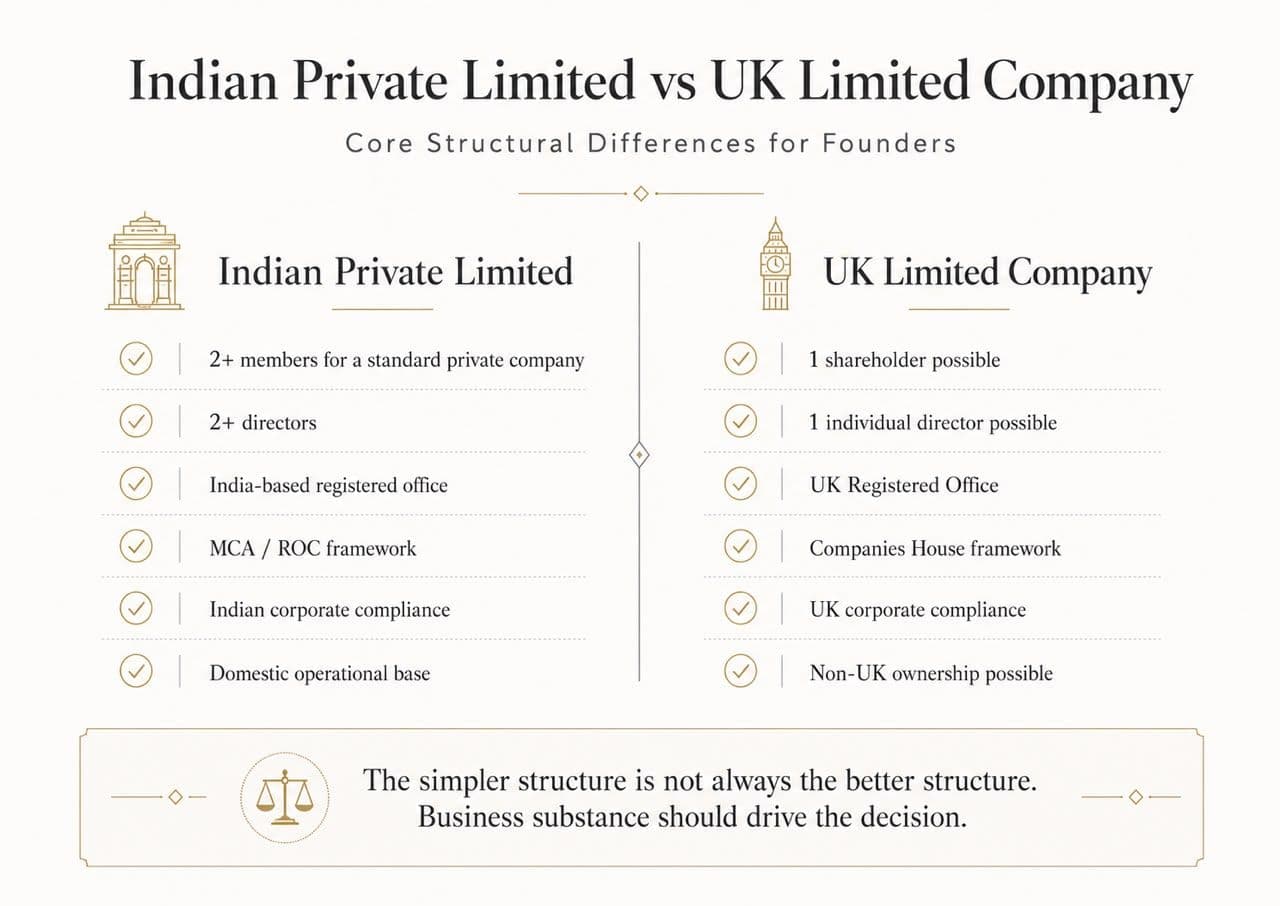
Under India’s Companies Act 2013, a standard private company generally requires at least two members and two directors, and every company must have at least one director who satisfies the statutory India-stay requirement.
A UK private company limited by shares can have one shareholder and one individual director. The shareholder can also be the director. Companies House does not impose a general requirement that the director live in the United Kingdom, although the company must maintain an appropriate UK registered office.
For 2026, Companies House charges £100 for digital incorporation and £50 for the digital Confirmation Statement fee.
However, these differences should not lead to the simplistic conclusion that:
UK company = international
Indian company = local
An Indian Private Limited Company can trade internationally and use international-payment infrastructure. Stripe, for example, currently supports international payments for eligible Indian businesses, although new Stripe India accounts remain invitation-only and exports carry additional onboarding and regulatory requirements.
Likewise, a UK company does not automatically receive Stripe, Wise, Airwallex or a UK bank account. Financial institutions perform independent eligibility, KYC, AML and business-risk assessments. Wise explicitly states that overseas-owned UK companies may be eligible subject to verification and acceptable-use requirements.
The real structural decision is therefore about fit, not prestige.
Indian Private Limited vs UK Limited Company at a Glance
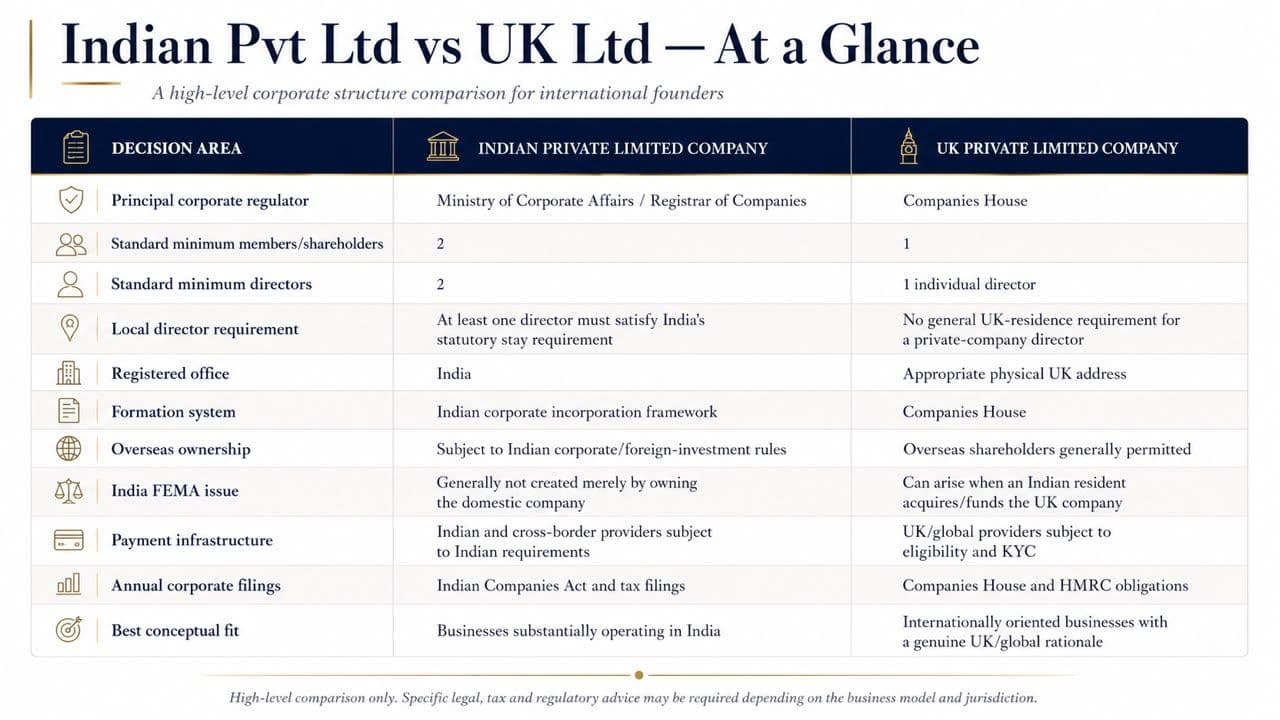
The UK company is structurally lighter in some respects, but that does not automatically mean the total compliance burden is lower for an Indian resident.
A founder can end up with obligations in both countries.
1. The Wrong Way to Make This Decision
A surprising number of founders begin with questions such as:
Which country is cheaper?
or:
Where can I get Stripe?
Those questions matter, but they are not the right starting point.
Corporate structure should begin with the business.
Ask:
- Where are your customers?
- Where are the founders physically managing the business?
- Where are employees located?
- Where will contracts be signed and performed?
- Where will intellectual property sit?
- Where will investors enter?
- Will the business require Indian banking infrastructure?
- Will the business raise overseas capital?
- Will it create subsidiaries?
- Will goods move through India or Britain?
- Will the founder remain resident in India?
- Is the UK company intended to be an operating company or merely a holding company?
The entity should follow the commercial model.
The commercial model should not be manufactured around whichever incorporation jurisdiction appears easiest.
2. Indian Private Limited Company: What It Actually Is
An Indian Private Limited Company is incorporated under India’s Companies Act 2013.
Section 3 of the Act provides that a private company can be formed by two or more persons, while Section 149 requires a private company to have at least two directors. The Act also requires at least one director to satisfy the prescribed India-stay requirement.
The structure is particularly natural where:
- the founder and management team are in India;
- employees are primarily in India;
- Indian customers form an important part of the market;
- Indian investors will participate;
- Indian banking is central;
- local contracts and procurement dominate;
- the company expects to build substantive operations in India.
It is not inherently an inferior structure for international business.
An Indian company can export services, receive international payments and operate globally.
The more accurate distinction is that it remains an Indian corporate and regulatory vehicle, even while it trades internationally.
3. UK Private Limited Company: What It Actually Is
A UK private company limited by shares is registered with Companies House.
It can have one shareholder, and a private company must have at least one director who is an individual.
That makes structures such as this possible:
Indian Founder
↓ 100% shareholder
UK Limited Company
with the same founder also serving as director.
The company must maintain an appropriate physical registered office in the UK jurisdiction in which it is registered. Companies House states that this address must be capable of receiving company correspondence appropriately and will appear publicly on the register.
For Indian entrepreneurs, a UK company can be commercially attractive where the business is genuinely international and expects to work extensively with overseas:
- customers;
- suppliers;
- software platforms;
- payment providers;
- strategic partners;
- investors.
However, the UK company’s British incorporation does not erase the founder’s Indian regulatory position.
That is one of the most important distinctions in this guide.
For the full incorporation journey, see our UK Company Formation from India guide.
4. Which Company Is Easier to Own as a Solo Founder?
This is one area where the UK structure has a clear structural advantage.
A standard Indian private company requires at least two members and two directors. India does separately recognize a One Person Company, but that is a different legal structure with its own rules.
A UK company limited by shares can have:
- one shareholder;
- one director;
- with that individual holding both positions.
For a solo software developer, consultant or early-stage SaaS founder, that can make the UK governance structure comparatively straightforward.
But corporate simplicity should not be confused with total regulatory simplicity.
If that sole shareholder is a person resident in India for FEMA purposes, acquiring the unlisted UK shares can bring the Indian Overseas Investment framework into the picture.
We examine that distinction in detail in our Indian Founder’s Guide to FEMA, RBI and Overseas Investment Rules for UK Companies.
5. Does a UK Company Require a UK-Resident Director?
For a standard UK private company, Companies House does not impose a general requirement that the director reside in Britain.
At least one director must be an individual.
This means an Indian resident can potentially act as the director of their UK company without appointing a nominee UK-resident director merely for incorporation.
That is significantly different from India’s statutory governance framework, under which every company must have at least one director satisfying the India-stay requirement.
However, founders should not draw another incorrect conclusion:
“I do not need a UK-resident director, therefore the company has no UK substance or management considerations.”
Company-law requirements, tax residence, banking onboarding and commercial substance are separate issues.
6. Registered Office: India vs United Kingdom
Both structures require proper registered-office arrangements under their respective corporate frameworks.
For a UK company, Companies House requires the registered office to:
- be a physical UK address;
- be in the same UK jurisdiction in which the company is registered;
- qualify as an appropriate address;
- allow correspondence to reach someone acting for the company.
That address appears on the public register.
An Indian founder cannot simply use their Mumbai, Delhi, Bengaluru or Hyderabad home address as the registered office of a company registered in England and Wales.
This is why professional registered-office services are frequently used by international founders.
But there is another distinction.
A Registered Office is not automatically the same as:
- a Director Service Address;
- a Virtual Business Address;
- an actual place of management;
- an operational office.
Those concepts should not be blurred merely because they all contain the word “address.”
7. Privacy: Is a UK Company More Private?
Not in the broad sense sometimes suggested by formation marketing.
UK companies operate through a public corporate register.
Certain information about companies, officers and ownership is publicly accessible.
However, Companies House distinguishes between a director’s service address, which is public, and their usual residential address, which is generally held privately.
A professional service address can therefore be useful for a founder who does not want their residential address to become the publicly displayed correspondence address.
That is a legitimate privacy advantage.
But it should not be marketed as:
“UK companies are private.”
They are not.
Corporate transparency is a central feature of the UK regime, and Companies House’s recent reforms have strengthened identity and register-integrity requirements further.
8. Companies House Identity Verification Changes the UK Formation Process
The UK formation landscape changed materially from 18 November 2025.
Identity verification is now a legal requirement for directors and PSCs, with new directors required to satisfy the applicable identity requirements as part of incorporation or appointment and existing directors moving through the transition timetable.
Individuals can verify through:
- GOV.UK One Login; or
- an Authorized Corporate Service Provider, known as an ACSP.
Companies House currently states that GOV.UK One Login can use a biometric passport from any country, among other supported identity documents. But that does not mean a biometric passport is the only possible verification pathway because ACSP verification is also available.
This is why claims such as:
“Indian founders must have a biometric passport or cannot form a company”
are too simplistic.
Indian founders should instead understand which verification route applies to them.
For a detailed walkthrough, read our Companies House Identity Verification for Indian Residents guide.
9. Incorporation Speed: Which Structure Is Faster?
UK digital incorporation can be operationally quick.
Companies House states that it aims to process most online filings within 24 hours, although an individual application can still require additional review or be rejected if information is incomplete or inconsistent.
That makes the UK particularly attractive to founders who value a digitally oriented incorporation process.
But I would not make the comparison:
UK = 24 hours guaranteed
India = 7–10 days guaranteed
Neither side should be reduced to an absolute timeline.
Indian incorporation timing can vary according to:
- name approval;
- documentation;
- signatures;
- filing quality;
- foreign shareholders/directors;
- regulator processing;
- professional preparation.
Likewise, UK incorporation can take longer when Companies House requires review.
The better conclusion is:
The UK incorporation process is comparatively streamlined for simple private-company structures, but founders should plan around regulatory acceptance rather than marketing promises.
10. Cost: Is the UK Company Cheaper?
The answer depends on what you count.
As of August 2026, Companies House charges:
- £100 digital incorporation;
- £50 digital Confirmation Statement fee.
That is transparent.
But those are only government filing costs.
An Indian founder may additionally need:
- Registered Office;
- Director Service Address;
- mail handling;
- business address;
- identity-verification assistance;
- accounting;
- tax advice;
- banking readiness;
- VAT or EORI assistance;
- annual compliance.
The cheapest legal entity is not necessarily the cheapest operating structure.
We cover the full first-year calculation in The True Cost of UK Company Formation from India (2026 Guide).
11. A Freshness Gap We See in Formation Content
This point matters because many entrepreneurs rely on articles that rank highly but are not maintained carefully.
Companies House increased its digital Confirmation Statement fee from £34 to £50 on 1 February 2026.
Yet some 2026 company-formation guides still display the old £34 amount.
That may appear like a minor £16 discrepancy.
It is actually a useful warning:
When comparing international company-formation information, always check whether regulatory and statutory data has been updated against the regulator itself.
For high-stakes decisions, freshness matters.
12. International Payments: The Comparison Is More Nuanced Than Most Articles Suggest
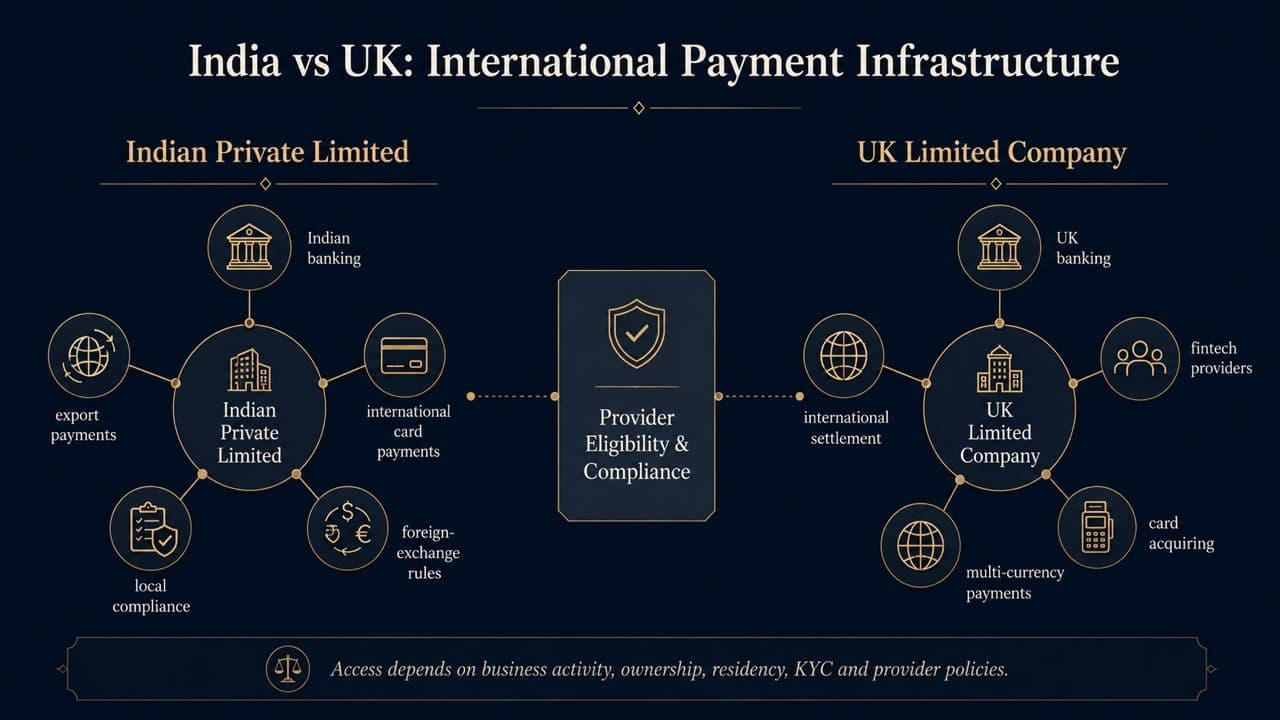
This is probably the area most distorted by online marketing.
You may encounter claims such as:
“Indian companies cannot use global payments.”
or:
“UK companies get unrestricted Stripe, Wise and Airwallex.”
Neither statement is accurate.
Stripe India
Stripe currently states that new accounts in India are invite-only and that it is focusing on a select number of businesses with international-expansion use cases.
However, eligible Stripe India businesses can accept international payments in more than 135 currencies, subject to export-onboarding requirements. Stripe requires additional export information and, depending on the activity, IEC and transaction-purpose information.
So:
Stripe India is restricted in onboarding, but international payments are not inherently unavailable.
That is the accurate position.
13. What Changes With a UK Company?
A UK company operates within a different provider ecosystem.
For example, Wise states that UK limited companies, including some overseas-owned UK businesses, may be able to apply for Wise Business subject to:
- eligibility;
- verification;
- business activity;
- account purpose;
- ownership information;
- acceptable-use rules.
That is commercially meaningful.
But the words “may be able to apply” matter.
A Certificate of Incorporation is not a financial-services passport.
Providers may examine:
- where directors live;
- where the business actually operates;
- registered and trading addresses;
- business model;
- website;
- expected payments;
- source of funds;
- ownership;
- customer geography;
- restricted activities.
Wise itself explains that it may request registration information, addresses, online presence and details of directors and owners as part of business verification.
The sophisticated conclusion is therefore:
A UK company may provide access to a different international financial ecosystem, but provider access remains conditional rather than automatic.
14. Stripe UK vs Stripe India: Is This a Reason to Form in Britain?
It can be a factor.
It should not be the entire corporate strategy.
Stripe’s current India position makes the distinction relevant: new Indian Stripe accounts are invitation-only, whereas the UK is an established Stripe-supported market.
That can make a genuinely UK/international business structure commercially interesting to certain SaaS and e-commerce founders.
But a founder should not form a UK company purely as a workaround for a service provider.
Why?
Because the business then inherits:
- UK corporate obligations;
- Companies House identity requirements;
- UK accounting;
- potential Corporation Tax obligations;
- address requirements;
- financial-provider KYC;
- and, for an Indian resident investor, potential FEMA/ODI obligations.
The question should therefore be:
Does a UK company fit the business as a whole?
not:
Can I create one to get Stripe?
15. Wise India vs Wise UK: Another Important Difference
Wise’s product availability also varies by country.
Wise’s India service currently supports international business payment functionality, including receiving payments for Indian businesses, with incoming foreign-currency amounts converted and transferred to the verified Indian bank account under the relevant service model.
Wise UK’s business offering provides a different range of capabilities for eligible businesses. Wise also states that overseas-owned UK companies may be supported subject to its checks.
This is a good example of why corporate jurisdiction matters commercially.
But it is also why the statement:
“UK company = Wise guaranteed”
should never appear in serious advisory content.
16. Banking Is Not Company Formation
This distinction deserves its own section.
A company registrar determines whether a company exists.
A bank or fintech determines whether it wishes to establish a financial relationship with that company.
Those are different decisions.
A UK company can be perfectly valid at Companies House and still be:
- asked for additional banking documentation;
- subject to enhanced due diligence;
- restricted by a provider’s country policy;
- declined because of business activity;
- declined because of operational inconsistencies.
Before approaching providers, founders should ensure that:
- the website reflects the declared business;
- corporate records are coherent;
- customer and supplier geographies make sense;
- expected turnover is realistic;
- source-of-funds information is available;
- registered and trading addresses are correctly described.
Our UK Business Bank Account for Indian Residents guide explains this in detail.
For the broader preparation framework, see the UK Business Banking Readiness Assessment.
17. FEMA Is the Part Many UK Formation Websites Miss
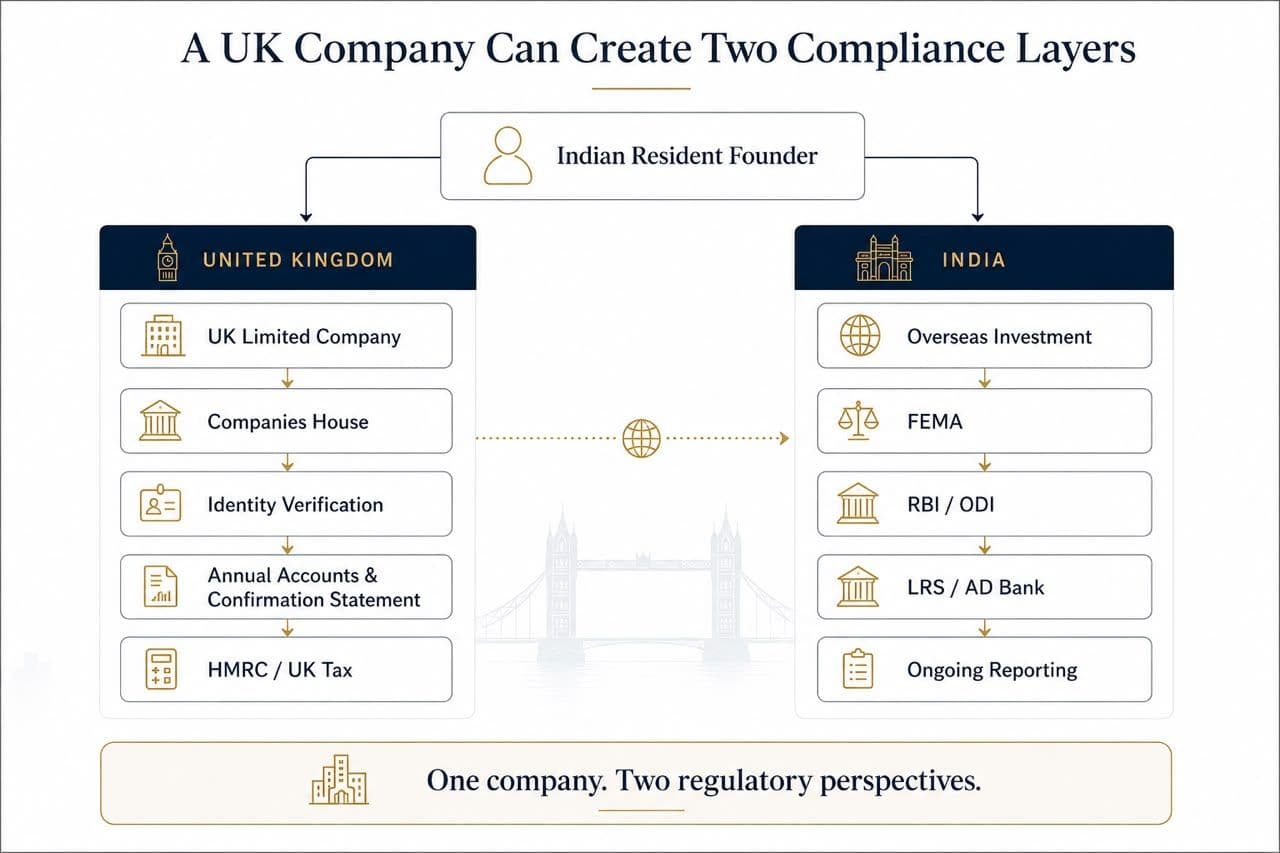
Suppose an entrepreneur living in Bengaluru creates a UK company.
Companies House may allow the incorporation.
That does not answer the Indian question:
How does an Indian resident legally acquire and fund the overseas company?
India’s Overseas Investment framework distinguishes overseas investment categories and places conditions on resident individuals investing abroad. RBI’s current directions state that resident individuals may make overseas investment in accordance with Schedule III of the Overseas Investment Rules.
An acquisition of unlisted equity capital in a foreign company can constitute Overseas Direct Investment (ODI).
A typical UK private limited company is unlisted.
For an Indian resident shareholder, this can therefore become a FEMA/RBI issue rather than simply a Companies House transaction.
This is one of the biggest reasons we do not recommend choosing a jurisdiction purely on the basis of incorporation speed.
18. UK Incorporation Does Not Remove Indian Overseas-Investment Compliance
Consider this simple structure:
Indian Resident Founder
↓
100% UK Limited Company
From a UK perspective, it may be an ordinary one-shareholder company.
From the Indian perspective, questions can include:
- FEMA residence;
- ODI classification;
- permitted investment structure;
- Liberalised Remittance Scheme;
- designated Authorized Dealer bank;
- reporting;
- UIN;
- Annual Performance Report;
- foreign-asset disclosure.
The UK’s relatively straightforward incorporation process therefore does not make the overall India-to-UK structure compliance-free.
Our full FEMA, RBI and Overseas Investment Rules for UK Companies guide covers that framework step by step.
19. Indian Company vs UK Company for a SaaS Founder
Now the comparison becomes commercially useful.
Imagine an Indian SaaS founder building software for customers in the US, UK and Europe.
Indian Private Limited may make sense when:
- the engineering team is in India;
- core management is in India;
- investors expect an Indian company;
- Indian payroll is substantial;
- domestic banking is central;
- Indian operations are the economic centre of the company.
UK Limited may merit consideration when:
- the customer base is predominantly international;
- commercial contracting is centred internationally;
- the founder has a genuine UK/global commercial rationale;
- UK-facing payment infrastructure matters;
- future expansion is expected through the UK entity;
- the founder understands the India-side overseas-investment requirements.
Neither answer should be selected based solely on Stripe.
20. What About a SaaS Founder With an Indian Development Team?
This is where the decision becomes more sophisticated.
A UK company may contract with customers internationally while software development takes place in India.
But that raises questions such as:
- Who employs the developers?
- Is there an Indian subsidiary?
- Are developers independent contractors?
- Where is intellectual property created?
- Who owns that IP?
- What agreements exist between the entities?
- Does transfer pricing become relevant?
- Where are management decisions taken?
Once the structure contains both UK and Indian operations, the decision is no longer:
UK Ltd vs Indian Pvt Ltd
It becomes:
How should the international group be structured?
That requires coordinated corporate and tax planning.
21. Indian Private Limited vs UK Limited for Consultants and Agencies
For a consulting, development or marketing agency, the analysis is often simpler.
An Indian Private Limited Company may be appropriate where the team, management and majority of operations remain in India.
A UK company may be useful where the founder is building an internationally positioned consulting business with overseas contracts and genuinely expects the British entity to function as the contracting company.
However, the founder should still consider:
- where services are physically performed;
- Indian tax residence;
- FEMA investment obligations;
- banking;
- VAT where relevant;
- UK Corporation Tax;
- management location.
A UK certificate does not convert an economically Indian business into an economically British business by itself.
22. Indian Private Limited vs UK Limited for E-Commerce
E-commerce introduces another set of factors.
An Indian seller may need to consider:
- inventory location;
- marketplace country;
- VAT;
- customs;
- EORI;
- fulfilment;
- returns;
- merchant acquiring;
- payment settlement;
- suppliers;
- consumer regulation.
If goods are physically stored and sold in Britain, a UK company may offer operational advantages in certain structures.
But if the business remains fundamentally India-based and merely sells abroad, creating a UK company may add another layer rather than simplify the existing one.
The location of goods and customers can matter more than the company name on the website.
23. Which Structure Is Better for Amazon UK Sellers?
There is no automatic answer.
An Amazon UK seller should evaluate:
- whether stock will be stored in the UK;
- VAT registration;
- import arrangements;
- EORI;
- fulfilment model;
- marketplace requirements;
- supplier location;
- banking;
- payment settlement.
A UK company can be useful where there is a genuine UK operating model.
But an entrepreneur should not assume:
“Amazon UK requires me to create a UK Ltd.”
The correct entity depends on the marketplace arrangement and tax/customs structure.
24. Which Structure Is Better for Raising Investment?
This is another area where simplistic claims should be avoided.
Some international investors may be more familiar with particular corporate jurisdictions.
But investors do not fund companies simply because they are registered in Britain.
They evaluate:
- founders;
- product;
- traction;
- IP;
- ownership;
- cap table;
- governance;
- market;
- legal structure;
- tax;
- regulatory risk.
For a venture-backed founder, the more important question is often:
Where should the eventual parent company sit?
That decision should be made with legal and tax advisers before restructuring becomes expensive.
25. Can an Indian Company Own a UK Company?
Potentially, yes, subject to the applicable Indian overseas-investment framework.
That produces a different structure:
Indian Private Limited Company
↓
UK Subsidiary
This can be commercially logical where an established Indian company wants to expand into Britain while keeping the Indian entity as the parent.
It may be preferable where:
- the Indian company already owns the technology;
- employees remain there;
- the original business has traction;
- Indian investors already hold shares;
- the UK company functions as an overseas operating subsidiary.
This is fundamentally different from:
Indian Founder Personally
↓
UK Company
The investor, compliance framework and future group architecture are different.
26. Should an Indian Founder Put the UK Company Above the Indian Company?
This is where founders should become particularly careful.
A proposed structure such as:
Indian Founder
↓
UK HoldCo
↓
Indian Operating Company
is not merely a UK formation exercise.
It can raise:
- FEMA/ODI issues;
- overseas-control considerations;
- subsidiary restrictions;
- tax questions;
- valuation;
- share-exchange mechanics;
- Indian company-law issues.
RBI’s Overseas Investment framework specifically contains rules affecting resident individuals, control and foreign entities with subsidiaries or step-down subsidiaries.
Do not create a UK holding company first and seek structural advice afterwards.
For a multi-tier structure, planning should come before incorporation.
27. Tax: A UK Company Does Not Mean “No Indian Tax”
This is another dangerous internet myth.
The company may have UK tax responsibilities.
The founder may have Indian personal tax responsibilities.
And the company itself may require analysis under India’s Place of Effective Management (POEM) rules where management is effectively exercised from India.
Therefore, incorporating abroad should not be presented as:
“Move the company to Britain and pay less tax.”
The correct tax analysis can involve:
- company residence;
- founder residence;
- salary;
- dividends;
- source of income;
- permanent establishment;
- transfer pricing;
- treaty relief;
- foreign-asset disclosure.
The legal place of incorporation is only one component.
28. Place of Effective Management: A Crucial Issue for Remote Founders
Consider this fact pattern:
- UK company;
- sole shareholder in India;
- sole director in India;
- all strategy decided in India;
- contracts negotiated from India;
- company operations controlled from India.
The corporate certificate says “United Kingdom.”
The management facts may tell a more complicated story.
For founders running everything remotely from India, POEM should therefore be understood before assuming that UK incorporation determines the company’s entire tax-residence position.
A Registered Office in London is not the same thing as management taking place in London.
29. Compliance Burden: Which Is Easier?
The UK often feels administratively lighter at the incorporation stage.
But the full compliance burden depends on the founder.
A UK company can involve:
- Companies House filings;
- identity verification;
- Confirmation Statement;
- annual accounts;
- HMRC obligations;
- Corporation Tax;
- VAT where applicable;
- overseas-investment compliance in India;
- Indian personal tax disclosures.
An Indian Private Limited Company can involve:
- Companies Act compliance;
- director requirements;
- statutory records;
- tax filings;
- GST where applicable;
- audit and accounting obligations;
- other sector-specific requirements.
This means a UK company can be simpler corporately but more complex cross-border for an Indian resident.
That is the nuance missing from many “UK vs India” comparison articles.
30. Public Credibility: Does a UK Company Look More International?
Sometimes commercially, yes.
“Ltd” and a UK Companies House record are familiar to many international customers.
Britain has a long-established corporate and legal system.
But credibility cannot be manufactured through jurisdiction alone.
International clients increasingly check:
- website quality;
- company records;
- leadership;
- customer evidence;
- addresses;
- LinkedIn presence;
- contracts;
- reviews;
- business history.
A UK company with a weak website, inconsistent activity and no credible operating footprint can appear less convincing than a professionally run Indian company with real customers and audited history.
Jurisdiction supports credibility.
It does not replace it.
31. When an Indian Private Limited Company Is Probably the Better Choice
A domestic Indian company deserves serious preference where most of the following are true:
- founders remain in India;
- management is primarily in India;
- employees are in India;
- the main market is India;
- Indian investment is expected;
- Indian contracts dominate;
- domestic payment infrastructure is sufficient;
- there is no strong commercial rationale for a UK entity.
In this situation, creating a foreign company solely because it looks international may add unnecessary complexity.
32. When a UK Limited Company May Be the Better Strategic Fit
A UK company may deserve consideration where:
- the business is international by design;
- a substantial share of customers will be overseas;
- the founder expects to contract globally through the UK entity;
- the UK is part of a genuine expansion strategy;
- the founder wants a relatively lean shareholder/director structure;
- UK/international payment infrastructure is commercially relevant;
- the founder is willing to comply with both UK and applicable Indian obligations.
Notice the language:
may be the better fit.
Not:
is always better.
That’s an important distinction.
33. When You May Need Both
For a growing business, the answer may eventually be:
both.
For example:
Indian Pvt Ltd
→ Indian development and operations
plus
UK Ltd
→ UK/international commercial activity
or an appropriate parent/subsidiary structure.
Once two entities exist, however, founders should expect more sophisticated questions:
- intercompany agreements;
- transfer pricing;
- IP ownership;
- invoicing;
- service agreements;
- funding;
- governance;
- tax residence.
A two-company structure should solve a genuine commercial problem.
It should not be created simply because two companies sound more international than one.
34. Seven Oak Prestige — Indian Founder Structure Decision Framework
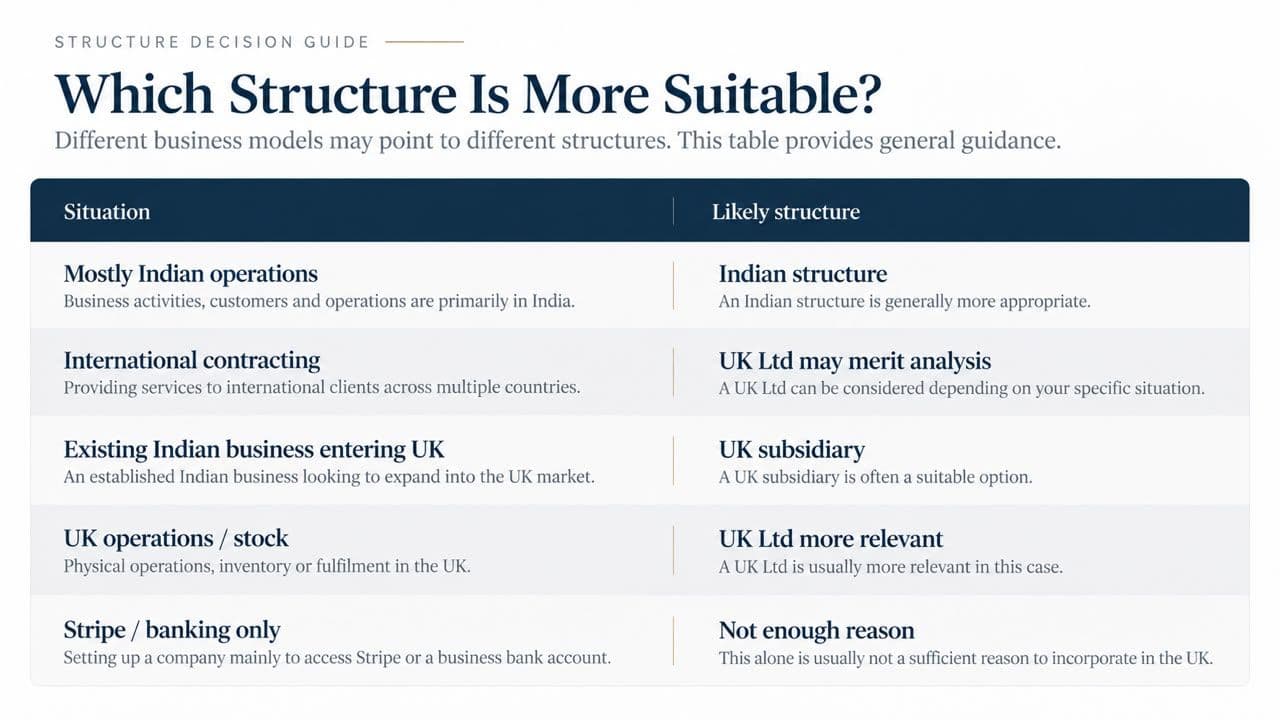
Which Structure Should an Indian Founder Examine First?
There is no universal winner between an Indian Private Limited Company and a UK Limited Company.
A useful starting point is to identify where the business actually operates, where its customers are located, how it earns revenue and whether there is a genuine commercial reason for having a UK entity.
Solo Consultant Serving Mostly Indian Clients
Structure to examine first: Indian structure
If most clients, management and economic activity remain in India, an Indian structure may be the more natural starting point.
A UK company should not be added simply to make the business appear more international.
Freelancer Serving Mainly UK or US Clients
Structure to examine first: UK Limited Company may be worth analysing
A UK Ltd can merit consideration where the freelancer has a genuinely international client base and intends to use the UK company as the real contracting business.
However, an Indian resident must still consider relevant Indian tax, FEMA and overseas-investment requirements.
SaaS Founder With International Customers
Structure to examine first: Compare UK Ltd and Indian Private Limited based on the operating model
Look particularly at:
- where management takes place;
- where the development team is located;
- ownership of intellectual property;
- expected investors;
- customer geography;
- payment infrastructure;
- Indian and UK tax considerations.
A SaaS business should not select its jurisdiction solely because one payment provider appears easier to access.
For a deeper analysis, see our UK Company for Indian SaaS, AI & Technology Founders.
Existing Indian Company Expanding Into Britain
Structure to examine first: UK subsidiary
Where an established Indian company already has operations, employees, assets or intellectual property in India, establishing a UK subsidiary may be more coherent than having the founder personally create an unrelated UK company.
The group structure, ownership, FEMA/ODI requirements, tax and governance should be reviewed before incorporation.
See our UK Subsidiary for Indian Companies — 2026 Guide.
Amazon or E-Commerce Seller Exporting From India
Structure to examine first: Indian entity may be sufficient initially
Selling internationally does not automatically require a UK Limited Company.
The decision depends on factors including:
- where stock is located;
- where goods are imported;
- Amazon fulfilment arrangements;
- VAT;
- EORI;
- suppliers;
- payment settlement;
- customer geography.
A UK company becomes more relevant where the business develops genuine UK operations rather than merely selling to UK customers.
For the specialist analysis, read UK Company for Indian Amazon, E-Commerce & Exporters.
Business Holding Stock, Warehousing or Operating Locally in the UK
Structure to examine first: UK Limited Company becomes more relevant
A genuine UK operational footprint can strengthen the commercial rationale for establishing a UK entity.
Examples can include:
- UK warehousing;
- local fulfilment;
- UK employees;
- UK premises;
- significant UK supplier relationships;
- substantial UK customer operations.
VAT, customs, EORI and tax implications should still be assessed separately.
Founder Wants a UK Company Mainly for Stripe, Wise or Banking
Structure to examine first: Do not choose the jurisdiction on this basis alone
A UK company does not guarantee approval from:
- Stripe;
- Wise;
- Revolut;
- Airwallex;
- a UK bank;
- another payment provider.
Each provider performs its own eligibility, KYC, AML and business-risk assessment.
The company structure should remain commercially sensible even if the preferred provider declines the application.
For banking specifically, see our UK Business Bank Account for Indian Residents.
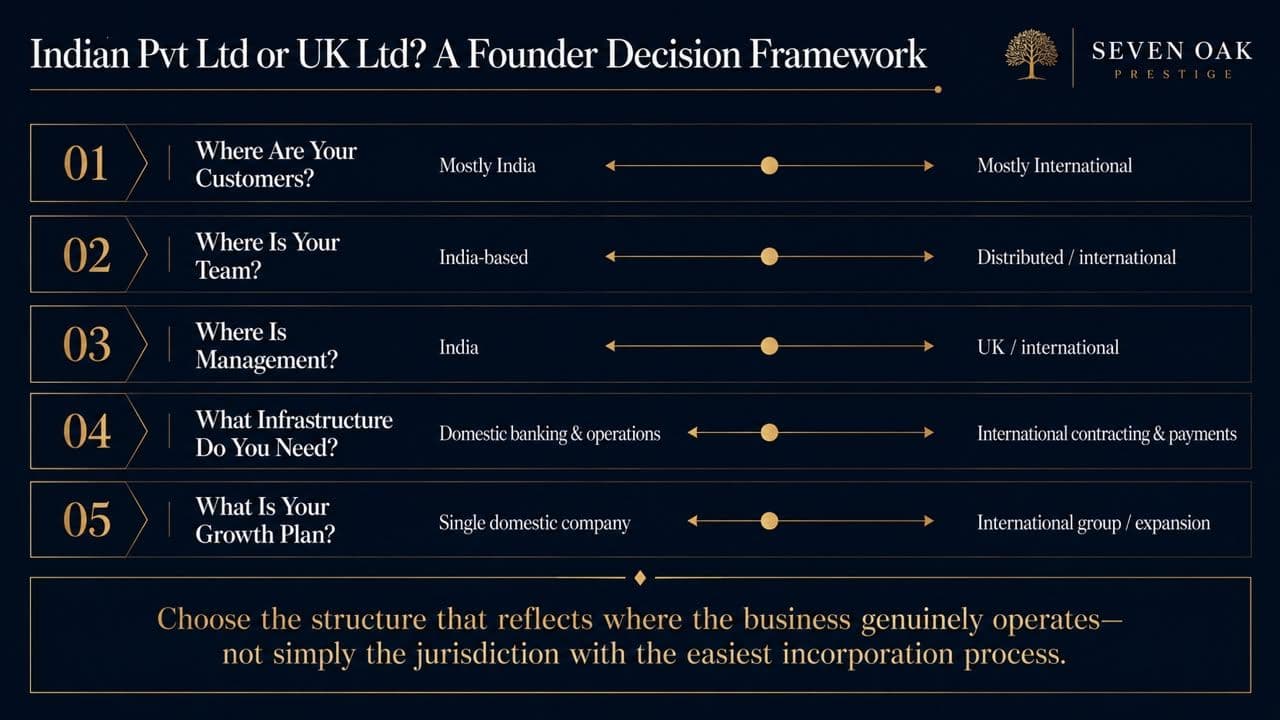
Then Test the Decision Against the Business
Before choosing either structure, assess the following factors.
Customers
Mostly India:
An Indian Private Limited Company gains weight.
Mostly international:
A UK Limited Company merits stronger consideration, provided there is a genuine commercial rationale.
Team
Primarily India-based:
An Indian company may be operationally more natural.
Distributed or international:
The decision becomes more balanced.
Management
Major decisions remain in India:
Indian tax and regulatory consequences still require consideration even if the company is incorporated in the UK.
Payments
Domestic Indian payments dominate:
Indian infrastructure may be more natural.
International subscription or card revenue dominates:
Compare the UK and Indian payment-provider ecosystems, but do not base the corporate structure solely on provider availability.
Capital
Primarily Indian investors:
An Indian structure may be simpler.
International institutional investment planned:
Obtain appropriate structuring advice before determining the parent jurisdiction.
Group Structure
One operating company:
Either structure may work depending on the facts.
Multiple companies or international subsidiaries:
FEMA, tax, ownership and governance should be reviewed before establishing the parent or subsidiary structure.
35-A Founder Should Not Choose a UK Ltd for These Reasons Alone
Do not create a UK company simply because:
“It takes 24 hours.”
“Stripe will approve me.”
“Wise will approve me.”
“UK companies pay less tax.”
“Nobody can see my information.”
“FEMA does not apply outside India.”
“International investors only fund UK companies.”
All of those statements can produce poor structural decisions.
A corporate structure should survive even if:
- your preferred payment provider rejects you;
- the tax position changes;
- a bank requests additional documents;
- your customer geography changes.
That is what makes a structure strategic rather than opportunistic.
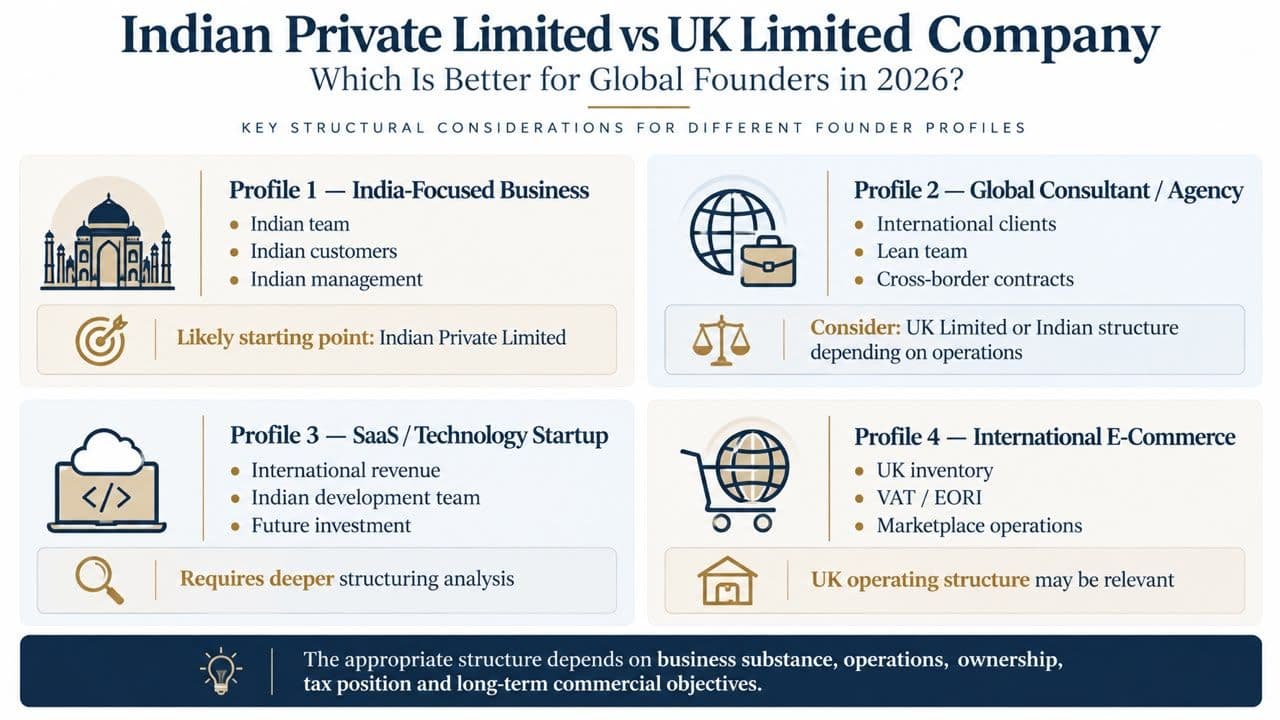
36. A Practical Example: Indian SaaS Founder
Profile
Founder in Bengaluru.
Customers: 80% US and Europe.
Team: four engineers in India.
Founder wants subscription payments and may raise capital later.
Indian Pvt Ltd option
Advantages may include:
- natural base for Indian team;
- direct Indian payroll;
- straightforward domestic operational substance;
- no overseas investment merely to create the primary company.
Potential challenges:
- payment-provider availability and export requirements;
- international investor structuring later;
- cross-border commercial setup.
UK Ltd option
Potential advantages:
- one-director/one-shareholder structure;
- UK corporate contracting;
- access to a different fintech ecosystem subject to provider approval.
Additional considerations:
- FEMA/ODI;
- UK accounting;
- Companies House;
- UK tax;
- management from India;
- Indian foreign-asset reporting.
Conclusion: Neither structure should be chosen from the payment-provider question alone.
37. A Practical Example: Indian Digital Consultant
Profile
One founder.
No staff.
Clients in London, Dubai and Singapore.
Low operational complexity.
This founder may find the UK’s one-director/one-shareholder structure attractive.
But if they remain a person resident in India, they must still consider the Indian overseas-investment and tax implications.
The apparent simplicity of the UK corporate structure therefore exists alongside a second layer of cross-border compliance.
38. A Practical Example: Indian E-Commerce Founder
Profile
Founder in Mumbai.
Products manufactured in India.
Stock to be held in UK fulfilment centres.
Sales through Amazon UK and Shopify.
Here the analysis expands beyond incorporation.
Issues may include:
- importation;
- EORI;
- VAT;
- fulfilment;
- customs;
- inventory ownership;
- marketplace KYC;
- payment processing;
- remittance of profits.
A UK company may make commercial sense.
But the correct decision requires analysis of the supply chain, not simply company-registration price.
39. The Seven Oak Prestige Position
We do not believe every Indian entrepreneur needs a UK company.
That would be poor advice.
The UK can be an excellent jurisdiction for the right international business.
But the value lies in matching the structure to the founder’s actual objectives.
Before formation, we therefore encourage founders to understand:
- their business model;
- ownership;
- UK address needs;
- Companies House identity verification;
- banking readiness;
- Indian FEMA implications;
- future tax and compliance requirements.
Formation should be the beginning of a professionally structured business, not the end of the conversation.
40. Indian Pvt Ltd vs UK Ltd: Final Comparison
Choose an Indian Private Limited Company when:
Your operational center is India and your business primarily needs an Indian corporate vehicle.
Consider a UK Limited Company when:
Your business has a credible international commercial rationale for operating through the UK and you are prepared for UK and applicable India-side compliance.
Consider a dual/group structure when:
There are genuine operations in both jurisdictions and the business is sufficiently mature to justify additional tax, accounting and governance complexity.
The best jurisdiction is not the country with the shortest incorporation form.
It is the jurisdiction — or combination of jurisdictions — that most accurately reflects how the business will actually operate.
Frequently Asked Questions
Is a UK Limited Company better than an Indian Private Limited Company?
Not universally.
A UK company can offer a simpler director/shareholder structure and a different international financial-services ecosystem, while an Indian Private Limited Company can be the more natural structure for businesses substantially operating, employing and managing from India.
The correct choice depends on the business.
Can an Indian resident own 100% of a UK company?
UK company law permits a company limited by shares to have one shareholder, who can own 100% of the company.
An Indian resident must separately consider India’s FEMA and Overseas Investment rules regarding the acquisition and funding of the foreign company.
Does a UK Ltd require two directors?
No.
A private company must have at least one director, and at least one director must be an individual.
Does an Indian Private Limited Company require two directors?
A standard private company requires at least two directors under Section 149 of the Companies Act 2013.
Does an Indian Private Limited Company require two shareholders?
Section 3 provides for formation of a private company by two or more persons. A One Person Company is a separate private-company form.
Do I need to live in Britain to own a UK company?
No general UK-residence requirement applies merely because you are the shareholder or director of a standard private company.
The company itself needs an appropriate UK registered office.
Can I open Stripe with a UK company if I live in India?
A UK company does not guarantee Stripe approval.
Provider onboarding remains separate from company formation and may involve verification of the business, directors, ownership, activity and other risk factors.
Is Stripe available for Indian companies?
Yes, but new Stripe accounts in India are currently invitation-only. Eligible Indian businesses can accept international payments subject to Stripe’s India export requirements.
Can an Indian company receive international payments?
Yes.
The claim that Indian companies cannot receive international payments is incorrect. Providers such as Stripe and Wise offer cross-border capabilities to eligible Indian businesses under their respective regulatory and product frameworks.
Does a UK company automatically get Wise Business?
No.
Wise states that overseas-owned UK companies may be eligible, subject to verification, eligibility and acceptable-use rules.
Does an Indian founder need FEMA compliance for a UK company?
Potentially, yes.
Where a person resident in India acquires or funds a foreign company’s equity, India’s Overseas Investment framework can apply.
Which structure is better for SaaS?
It depends on where the founders, development team, management, customers and investors are located.
International payment access is one consideration, but it should not determine the entire corporate structure.
Which structure is better for Amazon UK?
A UK company may be appropriate for certain UK operating models, but inventory, VAT, customs, EORI, fulfilment and marketplace requirements should be analysed together.
Is a UK company more private?
Not broadly.
The UK maintains a public company register. A director’s service address is public, while their usual residential address is generally protected from ordinary public inspection.
Can I manage my UK company entirely from India?
A UK company can have an India-resident director, but managing the company substantially from India can create Indian regulatory and tax questions that should be reviewed professionally.
Related Guides for Indian Entrepreneurs
Building the right structure requires understanding more than incorporation itself.
UK Company Formation from India
A complete guide to establishing a UK Limited Company while living in India, including ownership, Registered Office requirements, Companies House compliance and the post-formation journey.
Read the UK Company Formation from India Guide →
The True Cost of UK Company Formation from India
Understand the £100 Companies House incorporation fee, address costs, annual maintenance and the differences between basic formation and a more complete non-resident setup.
Read the UK Company Formation from India Cost Guide →
Companies House Identity Verification for Indian Residents
Learn how identity verification works for Indian directors and PSCs, including verification routes, personal codes and document preparation.
Read the Companies House Identity Verification Guide →
FEMA, RBI and Overseas Investment Rules for UK Companies
Our detailed compliance guide explains ODI, LRS, Authorized Dealer banks, UIN, APR, funding and the Indian regulatory implications of owning a UK company.
Read the FEMA & RBI Guide for Indian Founders →
UK Business Bank Account for Indian Residents
Understand how banks and fintech providers assess Indian-owned UK companies, what documentation may be requested and how to prepare before applying.
Read the UK Business Bank Account for Indian Residents →
UK Business Banking Readiness Assessment
Explore the Seven Oak Prestige framework for corporate identity, documentation, digital presence, financial readiness and governance before approaching financial institutions.
Explore the UK Business Banking Readiness Assessment →
Final Thoughts
There is no credible universal answer to the question:
“Is an Indian Private Limited Company or UK Limited Company better?”
The UK structure is attractive because it can be comparatively lean: one shareholder, one individual director, digital Companies House administration and access to a substantial international corporate and financial ecosystem.
The Indian Private Limited Company has a different advantage: it places a business whose founders, management, employees and operations are genuinely Indian inside the corporate framework naturally designed for that activity.
The mistake is treating jurisdiction as a shortcut.
A UK company should not be created solely because Stripe India is currently invitation-only.
An Indian company should not automatically be rejected simply because the founder wants international customers.
The strongest structure is the one that remains commercially and legally coherent after you add:
- customers;
- employees;
- banking;
- taxes;
- investment;
- subsidiaries;
- regulatory reporting.
For some Indian founders, that will be an Indian Private Limited Company.
For others, it will be a UK Limited Company.
For more mature businesses, it may eventually be a carefully planned international group containing both.
The objective is not to own the most internationally recognizable certificate of incorporation.
It is to build the right corporate infrastructure for the business you intend to become.
Planning an International Business from India?
Seven Oak Prestige supports Indian founders establishing and operating UK companies as part of a genuine international business strategy.
Our UK services include:
- UK Limited Company Formation
- Registered Office Address
- Director Service Address
- Virtual Business Address
- Companies House Identity Verification Support
- Corporate Compliance Support
- Business Banking & Fintech Readiness
- Enhanced KYC Documentation Support
- VAT & EORI Assistance
- International Business Advisory
Starter — £199
Essential UK incorporation for founders who already have suitable UK address arrangements.
Prestige — £299
A more complete setup for non-resident founders requiring a UK Registered Office, Director Service Address, mail handling and compliance support.
Elite — £399
Designed for international founders requiring wider operational, banking, fintech, KYC and business-readiness support.
The £100 Companies House digital incorporation fee is included in all three packages.
Unsure Which Structure Fits Your Business?
Speak with Seven Oak Prestige before incorporating.
We can help you assess the UK formation and operational side of the proposed structure and identify areas where specialist Indian FEMA, tax or legal advice should be obtained before implementation.
Email: contact@sevenoakprestige.com
WhatsApp: +44 7447 488755
UK Office: +44 2045 780726
Seven Oak Prestige Ltd
UK Company Formation • Corporate Compliance • International Business Advisory
Regulatory note: Seven Oak Prestige provides UK corporate formation, compliance and business-readiness services. We do not act as an Indian law firm, Chartered Accountant or Authorized Dealer bank. Indian FEMA, RBI and tax consequences should be confirmed with appropriately qualified Indian professionals where applicable
About the Author
Isaac Jackson
Founder & Managing Director — Seven Oak Prestige Ltd
Isaac Jackson has 3+ years of hands-on experience supporting international entrepreneurs with UK company formation, Companies House compliance and business-establishment matters.
Seven Oak Prestige has supported close to 100 UK company formation and establishment cases, including non-resident founders requiring assistance with company structures, UK address infrastructure, identity verification, banking readiness and post-incorporation preparation.