
UK Company Formation Cost from India: 2026 Fees & Costs

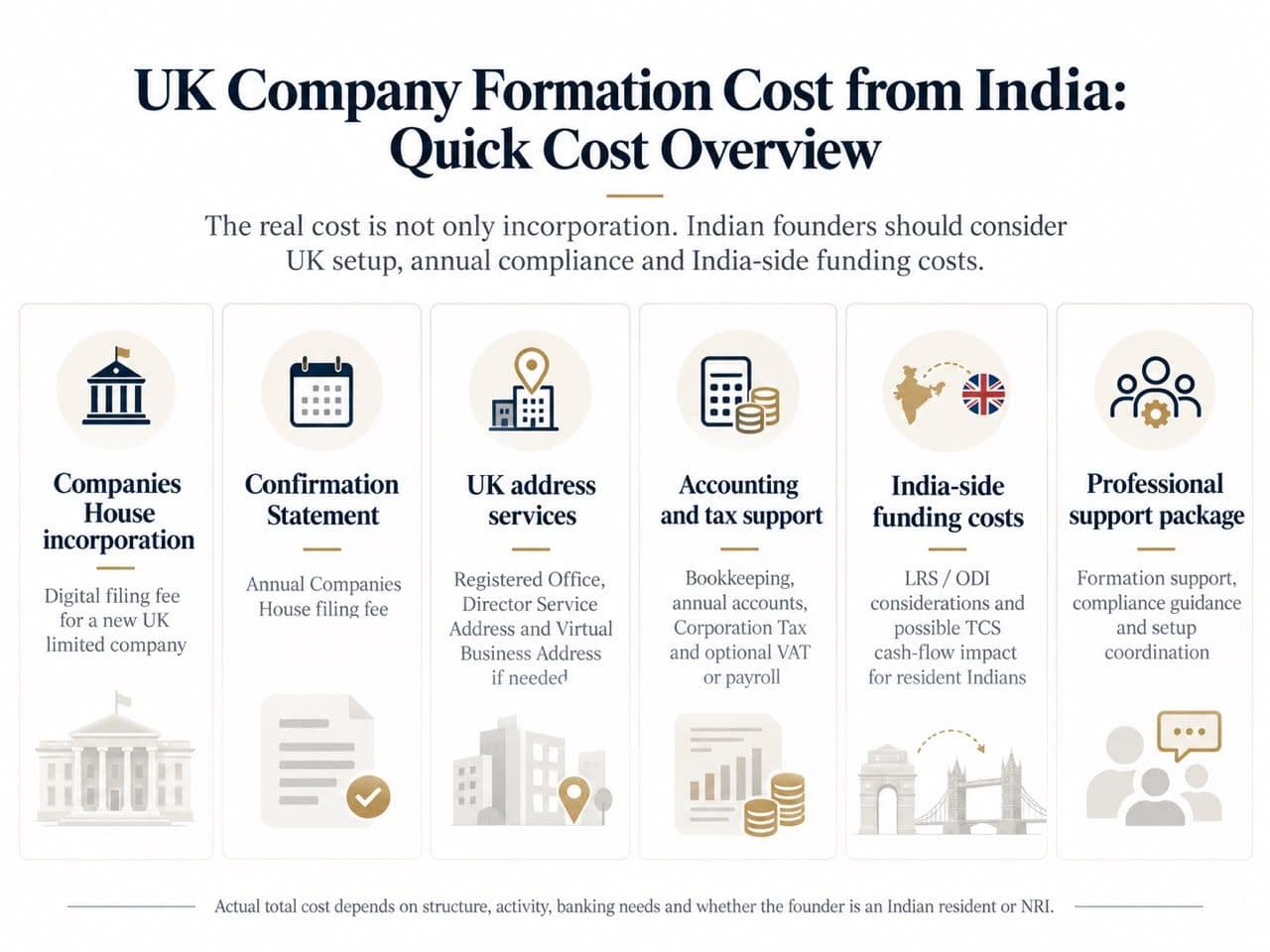
How Much Does It Cost to Register a UK Company from India in 2026?
The official Companies House fee to incorporate a UK private limited company online is currently:
£100
That is the government incorporation fee.
It is not necessarily the full cost of setting up and maintaining a UK company from India.
An Indian founder may also need to budget for:
- a UK Registered Office;
- a Director Service Address;
- mail handling;
- Companies House identity-verification assistance;
- professional formation support;
- accounting;
- Confirmation Statements;
- VAT or EORI where relevant;
- banking-readiness assistance;
- India-side FEMA, ODI or tax advice where required;
- and, where money is remitted from India under LRS, potential TCS cash-flow implications.
Companies House currently charges £100 for online incorporation, £124 for paper incorporation, £156 for same-day software incorporation, and £50 for the first digital Confirmation Statement filed in each 12-month payment period. These fees have applied since 1 February 2026.
So the useful question is not simply:
How much does it cost to create the company?
It is:
What will my particular UK company cost to establish properly and maintain from India?
That is what this guide explains.
Quick Cost Summary for Indian Residents
Companies House Incorporation
Online: £100
Paper: £124
Same-day software filing: £156
These are government fees for creating the legal company.
Confirmation Statement
Digital: £50
Paper: £110
You only pay the annual fee with the first Confirmation Statement filed in each 12-month payment period.
UK Registered Office
Cost: provider-dependent
Every UK company needs an appropriate UK Registered Office. It must be a physical UK address in the same UK jurisdiction in which the company is registered.
Director Service Address
Cost: provider-dependent
This is separate from the Registered Office and can be useful where an overseas director does not want their residential address displayed publicly as the service address.
Companies House Identity Verification
The GOV.UK One Login identity-verification route is free of charge.
An Authorised Corporate Service Provider may charge separately for professional verification or assistance.
Accounting
Cost: depends on business activity and transaction volume
A simple consulting company may have a relatively low accounting burden.
An e-commerce business, VAT-registered company, payroll business or multi-currency operation can cost considerably more to administer.
India-Side Remittance and TCS
For resident individuals using LRS:
- no TCS is required where aggregate LRS remittances do not exceed ₹10 lakh in the financial year;
- for remittances for purposes other than education or medical treatment, TCS is currently 20% of the amount above ₹10 lakh.
TCS is not necessarily a permanent extra 20% cost; it is tax collected at source and may be available as tax credit subject to the applicable tax rules.
LRS Limit
A resident individual may currently remit up to an overall USD 250,000 per financial year under the Liberalised Remittance Scheme for permitted current and capital-account transactions.
Other LRS remittances made during the same financial year reduce the remaining available amount.
Seven Oak Prestige Packages
Starter: £199
Prestige: £299
Elite: £399
Seven Oak includes the Companies House filing within its package pricing. Current package scope and renewal pricing are explained later in this guide.
Are you an NRI or OCI rather than resident in India?
The resident-individual LRS and ODI rules discussed in this article should not automatically be applied to you. FEMA treatment depends on residential status, not simply nationality.
1. The £100 Companies House Fee Is Not the Total Cost
The £100 online fee creates the legal company.
Once Companies House accepts the incorporation, the company exists as a separate legal entity.
But that £100 does not automatically provide:
- a professional Registered Office;
- a Director Service Address;
- business-address services;
- mail scanning;
- accounting;
- VAT registration;
- EORI registration;
- banking assistance;
- a bank or EMI account;
- Stripe;
- FEMA or ODI advice;
- Indian tax advice;
- or ongoing administration.
That distinction matters particularly for a founder operating remotely from India.
A founder living in Britain may already have suitable infrastructure available.
An Indian founder may need to arrange part of that infrastructure separately.
So think about cost in three stages:
Legal creation
The company is incorporated.
Operational setup
The company gets the addresses, banking preparation and other infrastructure actually needed.
Ongoing maintenance
The company continues to meet its accounting, Companies House, tax and renewal obligations.
2. Current Companies House Fees in 2026
The current official fees for a standard UK private company include:
Online incorporation
£100
Paper incorporation
£124
Same-day software incorporation
£156
Digital Confirmation Statement
£50
Paper Confirmation Statement
£110
Companies House increased the digital incorporation fee from £50 to £100 and the digital Confirmation Statement fee from £34 to £50 from 1 February 2026.
That matters because some third-party information published before or around the change still shows the old £34 Confirmation Statement amount.
For a founder comparing services today, the correct question is:
Does the provider’s advertised price already include the £100 Companies House fee, or is it added later?
3. Government Fee vs Formation Provider Fee
These are different.
Government fee
The Companies House fee pays for the statutory incorporation.
Formation-provider fee
A provider may charge for services such as:
- preparation of the incorporation;
- review of the company structure;
- Companies House submission;
- Registered Office;
- Director Service Address;
- mail handling;
- KYC onboarding;
- identity-verification support;
- banking-readiness assistance;
- post-incorporation guidance.
So one provider advertising £20 and another charging £200 or £400 may not be selling the same service.
A low price is not automatically poor value.
A higher price is not automatically better.
The useful comparison is:
What is actually included, what will I still need afterwards, and what will renew after 12 months?
4. Which Costs Are Mandatory, Optional or Business-Specific?
Not every founder needs the same things.
Core company costs and obligations
These can include:
Incorporation
The legal company must be created.
Registered Office
Every UK company needs an appropriate UK Registered Office.
Confirmation Statement
The company normally files at least one Confirmation Statement during each annual review period. The current digital fee is £50.
Annual accounts
Companies have continuing accounting and filing obligations.
Corporation Tax compliance
Relevant according to the company’s activities and circumstances.
Identity verification
Directors and relevant PSCs are subject to Companies House identity-verification requirements. For a new company, the personal code for each director is required as part of the registration filing.
Common but not universally required services
Depending on the founder:
- Director Service Address;
- mail scanning;
- Virtual Business Address;
- professional formation support;
- compliance reminders;
- banking-readiness assistance.
Business-specific costs
Depending on activity:
- VAT;
- EORI;
- payroll;
- customs;
- import/export administration;
- marketplace requirements;
- regulated licences;
- UK–India tax advice;
- FEMA/ODI professional assistance.
A consultant and an Amazon seller should not be given the same cost estimate.
5. First-Year Cost vs Year-Two Cost
This is one of the most important comparisons on the page.
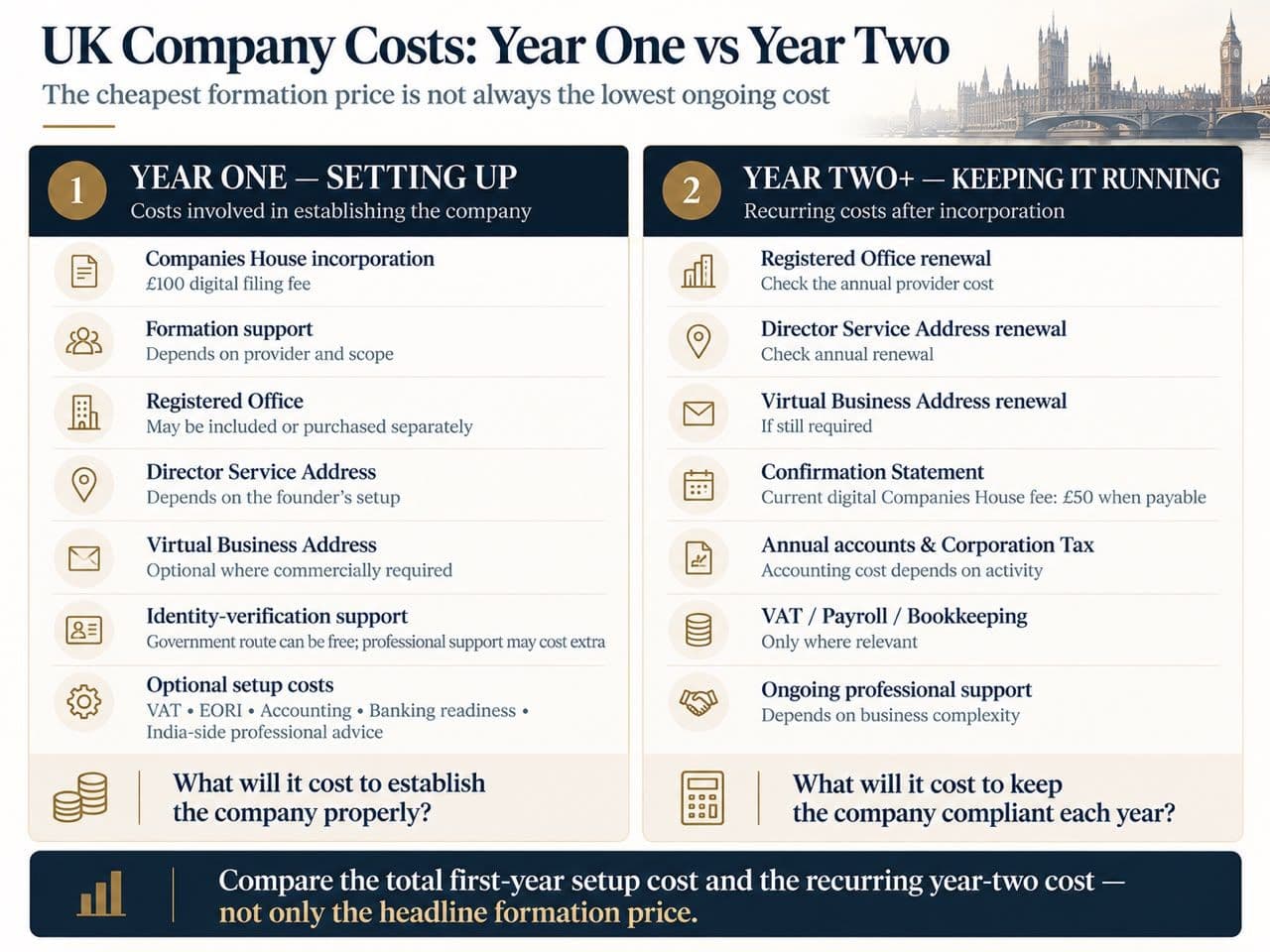
Year One: Establishing the Company
A founder may need to pay for:
- Companies House incorporation;
- formation support;
- Registered Office;
- Director Service Address;
- Virtual Business Address;
- identity-verification assistance;
- initial accounting setup;
- VAT or EORI where relevant;
- banking-readiness support;
- India-side advice where required.
Year Two and Beyond: Maintaining the Company
Costs can include:
- Registered Office renewal;
- Director Service Address renewal;
- Virtual Business Address renewal;
- Confirmation Statement;
- annual accounts;
- Corporation Tax compliance;
- VAT returns;
- payroll;
- bookkeeping;
- ongoing professional support.
The lowest first-year headline price is therefore not necessarily the lowest long-term cost.
Compare setup cost and renewal cost together.
6. What Does the Cost Look Like for Different Indian Founders?

There is no single realistic total.
Indian Consultant or Digital Agency
A consultant in Bengaluru selling services internationally may mainly need:
- incorporation;
- Registered Office;
- Director Service Address where relevant;
- accounting;
- Confirmation Statement;
- banking preparation.
VAT, EORI and customs services may not automatically be relevant.
Typical cost profile: relatively lean.
Indian SaaS, AI or Technology Founder
A SaaS company may need:
- incorporation;
- UK address infrastructure;
- accounting;
- banking and payment preparation;
- possible VAT analysis;
- India-side FEMA/tax review;
- potential IP or developer-structure advice.
See our UK Company for Indian SaaS, AI & Technology Founders guide.
Typical cost profile: moderate and structure-dependent.
Indian Amazon, E-Commerce or Export Business
An e-commerce business storing or importing goods may additionally face:
- VAT;
- EORI;
- customs;
- marketplace requirements;
- product compliance;
- inventory/accounting complexity.
See our UK Company for Indian Amazon, E-Commerce & Exporters guide.
Typical cost profile: potentially higher.
Existing Indian Company Establishing a UK Subsidiary
An Indian Pvt Ltd or LLP establishing a UK subsidiary may need:
- UK incorporation;
- corporate ownership documentation;
- UK addresses;
- banking;
- group accounting;
- transfer-pricing support where relevant;
- Indian overseas-investment compliance;
- UK payroll where staff are hired.
See our UK Subsidiary for Indian Companies guide.
Typical cost profile: materially broader than a basic founder formation.
7. How Much Does a UK Registered Office Cost?
There is no government-set market price for Registered Office services.
Professional providers set their own pricing.
The service becomes relevant because every UK company needs an appropriate physical UK address in the same jurisdiction where the company is registered.
When comparing providers, ask:
- Is the Registered Office included?
- For how long?
- Is statutory mail included?
- Is scanning included?
- What is the renewal price?
- Is renewal automatic?
The last question is particularly important.
A provider may advertise a low first-year package but charge substantially more for the address after 12 months.
8. Do You Need a Director Service Address?
A Director Service Address is not the same thing as the Registered Office.
The Registered Office belongs to the company.
The Director Service Address is the public correspondence address associated with the director.
Companies House requires directors to provide both a service address and their usual residential address, but the usual residential address is generally not shown publicly.
For an Indian founder who does not want their home address used as the public service address, a professional service-address arrangement can therefore be useful.
It should be priced separately when comparing formation packages.
9. Does Companies House Identity Verification Cost Money?
Not necessarily.
The Companies House verification service using GOV.UK One Login is free of charge.
Once successfully verified, the individual receives an 11-character personal code. The same personal code is used for the person’s relevant Companies House roles.
Professional support may still attract a fee where a founder uses an ACSP or requires assistance with the process.
So ask formation providers:
Is identity verification itself included, or are you only providing guidance?
For Indian-specific identity-verification requirements, see our Companies House Identity Verification for Indian Residents guide.
10. Accounting Is One of the Main Recurring Costs
The £100 incorporation fee does not include accounting.
Accounting costs depend heavily on the company.
Factors include:
- turnover;
- transaction volume;
- bookkeeping quality;
- VAT;
- payroll;
- multiple currencies;
- marketplaces;
- inventory;
- group-company relationships;
- international transactions.
A low-volume consulting company can be relatively straightforward.
A high-volume e-commerce company can require much more work.
This is why a responsible cost guide should not state that every UK company has the same annual accounting cost.
11. India-Side Costs: FEMA, ODI, LRS and TCS
For an Indian-resident founder, one of the biggest budgeting mistakes is looking only at UK costs.
Acquiring or funding a UK company may also fall within India’s overseas-investment framework.
Two figures deserve particular attention.
USD 250,000 LRS limit
A resident individual currently has an overall USD 250,000 per financial year limit under the Liberalised Remittance Scheme for permitted current and capital-account transactions.
It is an aggregate limit.
If part of the allowance has already been used for other LRS remittances during the financial year, the remaining amount is reduced accordingly.
This is particularly relevant where the UK company will need substantial funding rather than only nominal share capital.
TCS above ₹10 lakh
For LRS remittances, no TCS is currently required where aggregate remittances do not exceed ₹10 lakh.
For remittances for purposes other than education or medical treatment, TCS is currently 20% of the amount exceeding ₹10 lakh.
Simple cash-flow example
Suppose qualifying LRS remittances during the financial year total:
₹15 lakh
Amount above the threshold:
₹5 lakh
TCS at 20% on that excess:
₹1 lakh
That can create a meaningful cash-flow requirement.
However, TCS should not be described as a permanent additional 20% cost. It is tax collected at source and may generally be claimed as tax credit subject to the relevant tax rules.
Other India-side professional costs
Depending on the founder’s circumstances, additional professional costs can arise for:
- FEMA/ODI advice;
- AD-bank coordination;
- overseas-investment reporting;
- Indian tax advice;
- historic regularisation.
These are separate from UK incorporation fees.
For the detailed compliance framework, read our FEMA & RBI Rules for Indian Founders with a UK Company guide.
12. Are You an NRI or OCI?
This article primarily addresses individuals resident in India.
An Indian passport alone does not determine FEMA residential status.
An NRI or OCI holder based abroad may have a materially different remittance and overseas-investment position from a resident Indian individual.
Do not automatically apply the resident-individual LRS rules in this article if you are living outside India.
13. Does Banking Increase the Cost?
Potentially.
But banking is separate from company incorporation.
A UK company does not automatically receive:
- a traditional bank account;
- Revolut Business;
- Wise Business;
- Airwallex;
- Payoneer;
- Stripe.
Financial institutions independently assess the applicant and the business.
Banking-readiness assistance may involve:
- business-profile review;
- ownership documentation;
- source-of-funds preparation;
- expected transaction information;
- website/business-model review;
- application support.
That is professional assistance, not a Companies House fee.
For the detailed banking question, read our UK Business Bank Account for Indian Residents guide.
14. Do All Indian Founders Need VAT or EORI?
No.
These should not be included automatically in every cost estimate.
VAT
VAT depends on matters such as:
- business activity;
- turnover;
- customer location;
- goods vs services;
- where supplies take place.
EORI
EORI is particularly relevant where the company is involved in certain customs and import/export activities.
An Indian software consultant can therefore have a very different VAT/EORI profile from an Amazon seller importing stock into Britain.
15. How Should an Indian Founder Compare Formation Packages?
Before paying, ask:
- Is the £100 Companies House fee included?
- Is the Registered Office included?
- Is the Director Service Address included?
- Is a Virtual Business Address included?
- How long are address services included?
- What are the year-two renewal prices?
- What does identity-verification support actually include?
- What does banking assistance actually include?
- Is accounting included?
- Are VAT or EORI separate?
- Are there automatic renewals?
The correct package is not automatically the cheapest or the most expensive.
It is the one that provides the infrastructure you actually need.
Want to Know Your Real First-Year UK Company Cost?
Seven Oak Prestige can help you identify which UK formation, address and establishment services are relevant to your particular business before you pay for services you may not need.
Discuss my India–UK setup on WhatsApp
16. Seven Oak Prestige Packages and Renewal Costs
Seven Oak Prestige currently offers three levels of support.
The first-year package price and year-two address renewals should be considered separately.
Starter — £199
For founders who mainly need incorporation and already have suitable UK address arrangements.
Current scope includes:
- UK company formation;
- Companies House filing;
- digital company documents;
- key compliance reminders.
Starter does not automatically include the Registered Office, Director Service Address or Virtual Business Address contained in higher packages.
Relevant optional renewal prices if those services are later purchased
Registered Office: £59/year
Director Service Address: £35/year
Virtual Business Address: £150/year
Only purchase the services your structure actually requires.
Prestige — £299
Designed for many non-resident founders who need UK statutory-address infrastructure.
Includes:
- everything in Starter;
- Registered Office for 12 months;
- Director Service Address for 12 months;
- eligible mail handling and scanning according to service scope;
- annual compliance support according to package scope.
Current year-two address renewals
Registered Office: £59/year
Director Service Address: £35/year
Combined current address renewal: £94/year
The Companies House Confirmation Statement, accounting and other business-specific services remain separate unless expressly stated otherwise.
Elite — £399
Designed for founders requiring broader establishment support.
Includes:
- everything in Prestige;
- Virtual Business Address for 12 months;
- enhanced identity-verification support;
- high-priority support;
- direct banking/EMI assistance where applicable;
- compliance assistance according to package scope.
Current year-two address renewals
Registered Office: £59/year
Director Service Address: £35/year
Virtual Business Address: £150/year
Combined current address renewal: £244/year
Again, this does not include accounting, Companies House filing fees or other services unless specifically included.
17. What Does “Banking Assistance” Actually Mean?
This deserves clear wording.
Seven Oak’s banking assistance can include, according to scope:
- reviewing the business profile;
- preparing the founder for provider questions;
- identifying likely documentation;
- helping organise ownership and KYC information;
- supporting application preparation;
- coordinating with suitable providers where available.
It does not mean that Seven Oak can guarantee:
- a bank account;
- an EMI account;
- Revolut;
- Wise;
- Stripe;
- Payoneer;
- Airwallex;
- or any other third-party approval.
Final approval always remains with the provider. Seven Oak’s live pricing pages state the same principle.
18. What Will Renew After the First Year?
A good formation-cost comparison should include renewals before the founder pays.
Seven Oak’s current year-two address pricing is:
Registered Office
£59/year
Director Service Address
£35/year
Virtual Business Address
£150/year
These amounts are currently published on Seven Oak’s live formation page.
Other recurring costs can include:
- £50 digital Confirmation Statement fee;
- accounting;
- Corporation Tax compliance;
- VAT;
- payroll;
- bookkeeping;
- professional advice.
Always distinguish between:
package renewal
and:
government or third-party ongoing costs
They are not the same thing.
19. UK Company Cost Checklist for Indian Founders
Before incorporating, budget across five categories.
Government
£100 digital incorporation
£50 digital Confirmation Statement when payable
UK Infrastructure
Registered Office
Director Service Address where relevant
Virtual Business Address where commercially required
Mail handling
Professional Support
Formation assistance
Accounting
Identity-verification assistance
Tax advice where required
India Side
FEMA/ODI review where relevant
LRS capacity
TCS cash-flow impact
AD-bank/reporting support where necessary
Indian tax advice
Business-Specific
VAT
EORI
Payroll
Customs
Marketplace compliance
Banking readiness
Sector-specific licences
If you identify these categories before incorporating, there should be far fewer unexpected costs later.
Frequently Asked Questions
How much does it cost to register a UK company from India in 2026?
Companies House currently charges £100 for online incorporation. The total setup cost can be higher where the founder needs UK address services, formation assistance, accounting, banking preparation or India-side professional advice.
Is £100 the complete cost of a UK company?
No. It is the government incorporation fee.
What is the paper incorporation fee?
£124.
How much is same-day incorporation?
Companies House currently charges £156 for same-day software incorporation.
How much is the Confirmation Statement?
The current digital fee is £50.
Is the old £34 Confirmation Statement fee still correct?
No. The digital fee increased to £50 from 1 February 2026.
Do I need a UK Registered Office?
Yes. Every UK company must maintain an appropriate Registered Office in its UK jurisdiction.
Can I use my Indian home address as the Registered Office?
No. The Registered Office must be a physical address in the relevant UK jurisdiction.
Does Companies House identity verification cost money?
The GOV.UK One Login verification service is free. An ACSP may separately charge for professional services.
Does every Indian-owned UK company need VAT?
No. VAT depends on the company’s activities and circumstances.
Does every company need an EORI number?
No. EORI is primarily relevant to certain customs and import/export activities.
Does the £100 incorporation fee include accounting?
No.
Does incorporation include a business bank account?
No.
Does a UK company guarantee Wise, Revolut or Stripe?
No. Each provider performs its own eligibility and risk assessment.
Does TCS apply when funding a UK company from India?
For resident individuals remitting under LRS, TCS may apply depending on total annual remittances and purpose. For non-education/non-medical remittances, the current rate is 20% of the amount above the ₹10 lakh aggregate threshold.
What is the LRS limit?
The current overall limit is USD 250,000 per financial year for a resident individual, subject to the permitted-use rules and amounts already remitted during the year.
What if I am an NRI?
Do not automatically apply the resident-individual LRS rules. FEMA treatment depends on residential status.
Final Takeaway
The headline UK company-formation cost is simple:
£100
That creates the legal company through standard digital incorporation.
But the realistic cost of operating a UK company from India has several layers.
Government costs
Incorporation and continuing Companies House filing fees.
UK infrastructure
Registered Office, service address and related address services.
Professional costs
Formation assistance, accounting, identity verification and other support.
Business-specific costs
VAT, EORI, customs, payroll or marketplace compliance where relevant.
India-side costs
FEMA/ODI professional support and, where significant amounts are remitted under LRS, possible TCS cash-flow implications.
So the useful question is not:
What is the cheapest UK company formation price?
It is:
What will my particular company cost to establish properly and maintain after incorporation?
For an Indian consultant, that cost can remain relatively lean.
For a SaaS company, Amazon seller or Indian parent establishing a UK subsidiary, the cost profile may be materially broader.
Ready to Establish Your UK Company?
If you already know that a UK company is appropriate for your business, review Seven Oak Prestige’s dedicated:
UK Company Formation for Indian Residents
Or discuss your expected setup cost directly
Related Guides
UK Company for Indian Residents: Rules, FEMA & Process (2026)
FEMA & RBI Rules for Indian Founders with a UK Company
UK Business Bank Account for Indian Residents
Indian Private Limited vs UK Limited Company
UK Company Tax for Indian Residents — POEM & DTAA
UK Company for Indian SaaS, AI & Technology Founders
UK Company for Indian Amazon, E-Commerce & Exporters
UK Subsidiary for Indian Companies
About the Author
Isaac Jackson
Founder & Managing Director — Seven Oak Prestige Ltd
Isaac Jackson works with international founders and overseas businesses establishing UK companies, including founders requiring support with company formation, statutory addresses, Companies House administration, KYC preparation, compliance coordination and banking readiness.
Seven Oak Prestige Ltd
Company Registration No. 16903092
Registered Office: 124 City Road, London EC1V 2NX, United Kingdom
Editorial Methodology
Last reviewed: 25 September 2026
This guide was reviewed against current primary guidance from:
- Companies House;
- GOV.UK;
- Reserve Bank of India;
- Income Tax Department of India.
We also reviewed current India-focused search results to identify the questions and cost comparisons Indian founders are currently being shown.
Date-sensitive figures — particularly Companies House fees, TCS thresholds, LRS limits and Seven Oak package/renewal prices — should be reviewed when official rules or service pricing change.
Approximate rupee conversions are intentionally not fixed throughout this guide because GBP/INR exchange rates change continuously.
Important Disclaimer
This article provides general educational information about UK company costs and India–UK cross-border considerations.
It is not personalised:
- Indian legal advice;
- FEMA advice;
- RBI advice;
- UK or Indian tax advice;
- investment advice;
- banking advice.
Seven Oak Prestige provides UK company-establishment and related support. India-specific legal, FEMA or tax matters may require advice from an appropriately qualified Indian professional.