
UK Business Bank Account for Indian Residents - 2026 Guide

How to Open a UK Business Bank Account from India in 2026
Banks, Wise, Revolut, Airwallex, KYC, Proof of Address, UK Business Presence and Banking Readiness for Indian Founders
An Indian resident can legally own and direct a UK Limited Company without becoming a UK resident.
But owning the company and obtaining business banking are two separate processes.
That distinction is the most important point in this guide.
A Certificate of Incorporation from Companies House proves that your UK company legally exists.
It does not automatically entitle the company to:
- a UK high-street bank account;
- Wise Business;
- Revolut Business;
- Airwallex;
- another EMI or fintech account;
- Stripe or another payment-processing platform.
Every financial institution decides independently whether it wants to onboard the business.
For Indian founders, that means the real question is not simply:
“Can an Indian resident open a UK business bank account?”
The better question is:
“Which banking route fits my UK company, Indian residency, business model, operating footprint and expected transactions — and can I provide the evidence the provider requires?”
That is what this guide explains.
If you have not formed the company yet, begin with our UK Company Formation from India: Complete 2026 Guide.
Quick Answer: Can an Indian Resident Open a UK Business Bank Account?
Potentially, yes.
However, there is no universal UK rule requiring every bank or fintech to accept an Indian-resident director.
Providers determine their own:
- supported countries;
- director-residency rules;
- business-location requirements;
- restricted industries;
- KYC standards;
- AML controls;
- risk appetite.
In practice, an Indian resident with a UK Ltd may have several possible routes:
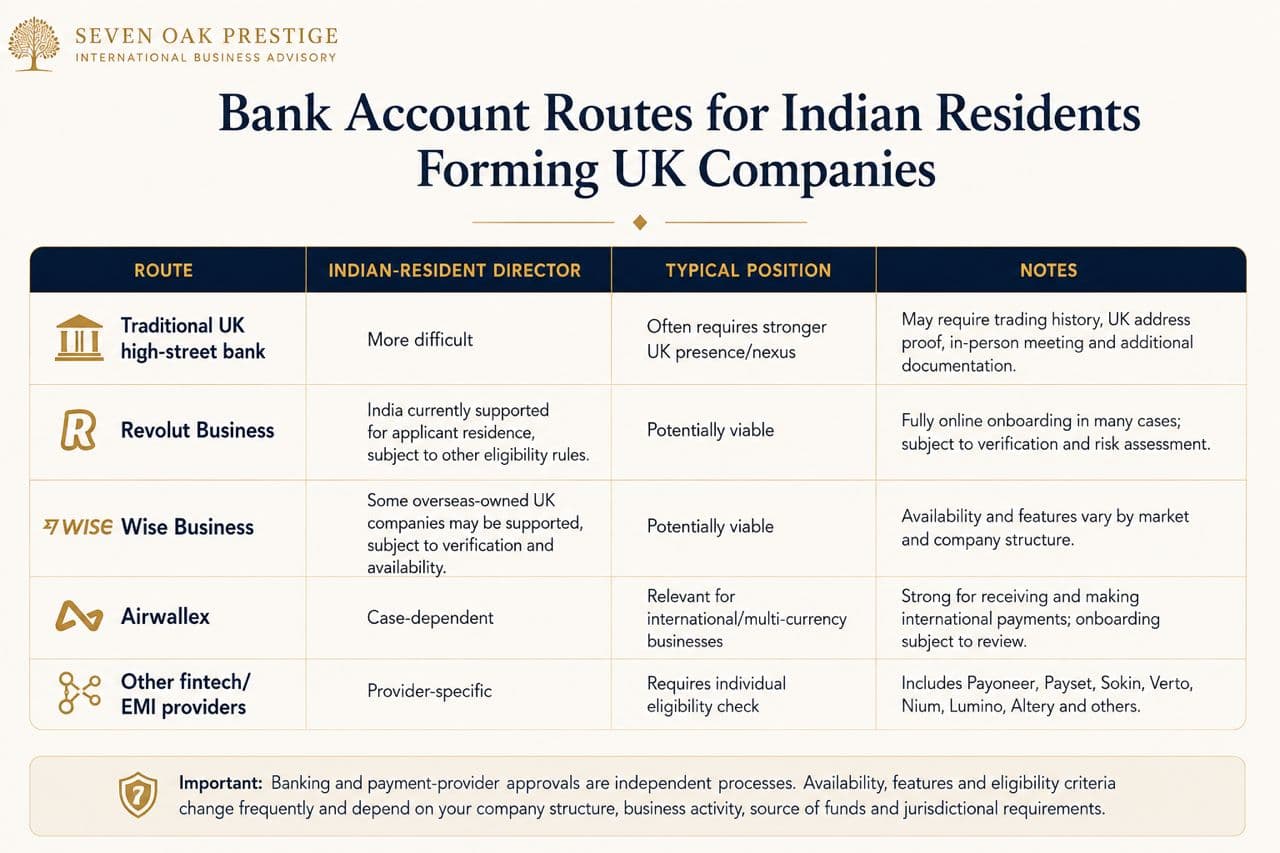
No provider should be treated as guaranteed.
1. UK Company Formation Is Not UK Banking Approval
This is where many Indian founders make their first strategic mistake.
Companies House asks whether the legal requirements for incorporation have been satisfied.
A financial institution asks a much broader set of questions:
- Who owns the company?
- Who controls it?
- Where do those people live?
- Where is the business actually operated?
- What does the company sell?
- Who are its customers?
- Who are its suppliers?
- Where will money come from?
- Where will money go?
- How much will move through the account?
- What is the source of the initial funding?
- Is the business activity consistent with its website and incorporation records?
- Does the provider support the applicant’s residence and industry?
These are different assessments.
That is why:
UK company incorporated successfully
does not automatically mean:
UK business account approved successfully.
Our UK Business Banking Readiness Assessment is built around this distinction.
2. Why Banking Can Be Harder for Indian Non-Resident Directors
There is nothing unusual about an Indian entrepreneur owning a UK company.
The additional banking difficulty comes from the cross-border profile.
A typical application may involve:
UK company
↓
Indian-resident director/shareholder
↓
customers in UK / US / EU
↓
suppliers or development team in India
↓
GBP / EUR / USD transactions
This gives the financial institution more information to assess than a simple:
UK company + UK-resident owner + UK customers + UK transactions
Business.gov.uk explains that businesses based outside Britain can face additional checks on directors, owners and foreign investors.
That does not mean the profile is unacceptable.
It means the business needs to be understandable.
3. Bank, EMI and Payment Processor: They Are Not the Same Thing
This is one of the biggest weaknesses in many banking comparison articles.
They use the word “bank” for several different types of financial infrastructure.
Indian founders should understand the distinction.
Traditional Bank
A bank can generally provide products such as:
- current accounts;
- deposits;
- lending;
- overdrafts;
- credit;
- broader relationship banking.
Examples include major UK high-street institutions.
Electronic Money Institution / Fintech Account
An EMI or similar financial provider may provide:
- GBP account details;
- transfers;
- multi-currency balances;
- cards;
- FX;
- payment functionality.
But the legal structure and protection of funds can differ from a traditional bank account.
Wise, for example, explicitly describes Wise Business as an international account/payment service rather than simply presenting it as a traditional bank account. Wise’s own non-resident comparison describes it as an FCA-regulated e-money service provider.
Payment Processor
A provider such as Stripe primarily helps businesses accept customer payments.
That does not make it a replacement for the company’s main operational account.
This means asking:
“Wise or Stripe?”
can be the wrong question.
A business may require both because they solve different problems.
For the detailed comparison, read Stripe, Wise & Airwallex for Indian Founders: UK Company vs Indian Company.
4. Traditional UK Bank vs Fintech for an Indian Resident
For Indian-resident founders, this distinction is particularly important.
Traditional UK bank
A traditional bank may be appropriate where the business has:
- genuine UK operations;
- UK employees;
- UK premises;
- meaningful UK turnover;
- local commercial relationships;
- stronger UK substance.
Business.gov.uk says that opening a full UK business bank account for an overseas company can involve additional checks and may take considerably longer. Its guidance suggests a process involving a UK business plan, supporting information, and potentially a UK meeting with the bank.
That is very different from incorporating a £100 UK Ltd online.
Fintech / international financial platform
For a newly established international UK company with a non-resident director, digital providers may sometimes provide a more realistic starting point.
But again:
digital does not mean automatic.
The provider still performs onboarding.
5. Current 2026 Provider Landscape for Indian-Resident UK Company Owners
Here is the more useful way to compare the market.
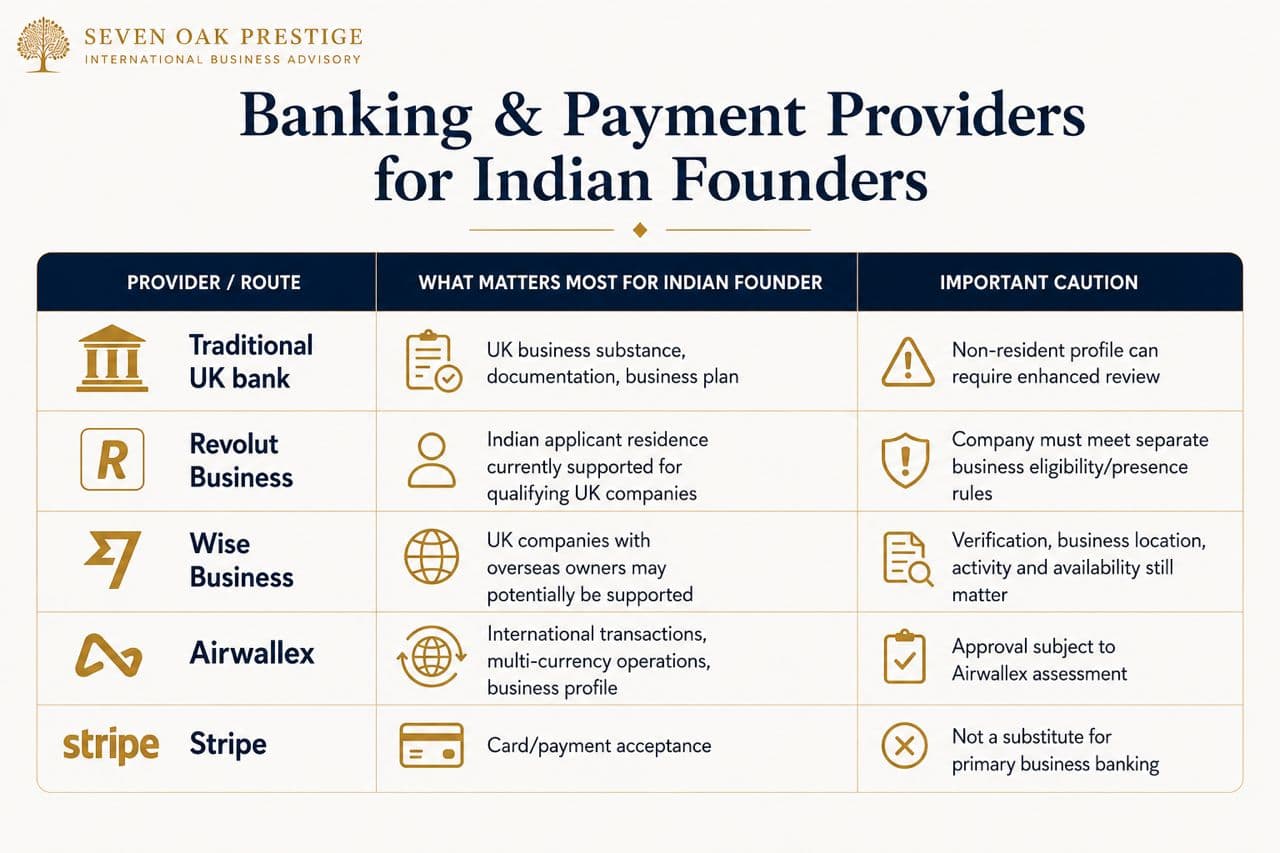
This is much more accurate than saying:
“These are the five easiest banks.”
There is no universally easiest provider.
6. Revolut Business for Indian Residents: An Important 2026 Change
This is one of the most commercially important developments for Indian founders.
Revolut’s current UK Business eligibility guidance lists India as a supported country of residence for applicants of eligible businesses registered in the UK or EEA.
That means the old blanket statement:
“An Indian resident cannot apply for Revolut Business for a UK company”
is no longer accurate.
However, this does not mean:
“Every Indian resident with a UK company will get Revolut.”
Revolut also states that the company must be registered and able to prove physical presence in the United Kingdom or EEA, and it applies separate requirements relating to legal type, activities and eligibility.
So the correct 2026 answer is:
India is currently an eligible applicant-residence country for qualifying Revolut Business applications involving UK companies, but the company must independently satisfy Revolut’s business, presence and compliance requirements.
That nuance matters.
We have a dedicated guide covering this in depth:
Revolut Business for Indian Residents with a UK Company: 2026 Eligibility Guide
7. Does a UK Registered Office Prove “Physical Presence”?
Not necessarily.
This is another area where founders can misinterpret terminology.
A UK Limited Company must have a Registered Office.
But a Registered Office is a statutory correspondence address.
It does not automatically mean:
- employees work there;
- management sits there;
- customers visit there;
- the company has a staffed operational office;
- the financial provider will regard it as sufficient business presence.
Different institutions define:
- registered address;
- trading address;
- operating address;
- physical presence;
differently.
Never tell a provider that your Registered Office is your operational premises unless that is factually true.
For financial onboarding, truthful address classification is more important than trying to make the company appear more British than it actually is.
8. Wise Business for an Indian Resident With a UK Company
Wise is one of the strongest brands appearing in searches around non-resident business banking.
Its current UK guidance says that some overseas-owned UK companies may be able to apply, subject to verification, eligibility and acceptable-use rules.
Wise’s UK/EEA business-verification process can request:
- company name;
- company type;
- registration number;
- registered address;
- trading address;
- business activity;
- website;
- expected volumes;
- sending and receiving countries;
- source of business funds;
- beneficial-owner details;
- director details;
- applicant identity.
This demonstrates a critical principle:
The Certificate of Incorporation is only one part of the Wise assessment.
Wise also states that registered and trading addresses can be in different countries, although the trading address may need to be verified.
That can be especially relevant to an Indian founder whose:
- UK company is registered in England;
- statutory address is in London;
- actual day-to-day operations occur from India.
The application should reflect that reality accurately.
9. Wise India and Wise UK Company Accounts Should Not Be Confused
Wise now also offers India-specific business functionality for qualifying Indian businesses and freelancers.
For example, Wise’s India materials discuss receiving international payments into India and, depending on the account/product, receiving foreign-currency payment details.
That is a different question from:
“Can my UK Limited Company owned by an Indian resident obtain Wise Business?”
The legal entity matters.
An:
Indian sole proprietor
is not the same applicant as a:
UK Limited Company owned by an Indian resident.
Always apply using the correct legal entity.
10. Airwallex for Indian-Owned UK Companies
Airwallex is not merely a conventional UK current account.
Its UK business-account platform combines functionality such as:
- multi-currency accounts;
- international transfers;
- local account details;
- FX;
- corporate cards;
- expense management;
- payment capabilities.
This can make it relevant for:
- SaaS businesses;
- digital agencies;
- international consulting;
- e-commerce;
- companies receiving and paying in multiple currencies.
Airwallex’s current UK pricing also shows that pricing can depend on plan and account activity rather than one universal “free” or “paid” label.
Again, suitability depends on the business.
11. What Documents Should an Indian Founder Prepare?
Exact requirements vary by provider, but a strong banking file commonly includes several layers.
Company documents
Potentially:
- Certificate of Incorporation;
- company number;
- Articles of Association;
- shareholding information;
- director details;
- PSC information;
- Companies House filings.
Personal KYC
Potentially:
- passport;
- Indian residential proof of address;
- selfie/liveness verification;
- date of birth;
- tax residence details.
Business evidence
Potentially:
- website;
- contracts;
- invoices;
- business plan;
- supplier agreements;
- client agreements;
- marketplace profile;
- software/platform evidence;
- regulatory licences where relevant.
Financial information
Potentially:
- expected monthly turnover;
- expected transaction size;
- currencies;
- countries receiving funds from;
- countries sending payments to;
- source of initial capital;
- existing bank statements;
- previous company accounts.
Do not submit documents merely because you have them.
Submit what the provider requests, accurately and consistently.
12. Proof of Indian Residential Address
The fact that your company has a UK Registered Office does not eliminate the need to prove where you personally live.
If you live in:
- Mumbai;
- Delhi;
- Bengaluru;
- Hyderabad;
- Pune;
- Chennai;
your KYC profile should reflect your genuine residential address.
Depending on the provider, accepted evidence may include:
- bank statement;
- utility bill;
- government correspondence;
- other recognised address documents.
A common avoidable problem is providing:
Indian residential address in the application
but
a document showing a different address.
That creates additional verification work.
The objective should be consistency, not cosmetic presentation.
13. Source of Funds: Where Is the Money Coming From?
Providers frequently need to understand how a new UK company is funded.
Possible legitimate sources include:
- founder savings;
- existing business income;
- shareholder capital;
- retained profits from another company;
- documented loan;
- investment funding.
The supporting evidence should correspond with the explanation.
For an Indian founder, this also needs to make sense from the India side.
If the explanation is:
“I funded my UK company from my personal Indian savings,”
the company, banking and relevant India-side regulatory records should not tell contradictory stories.
For the overseas-investment framework, use our Indian Founder’s Guide to FEMA, RBI and Overseas Investment Rules.
14. Source of Wealth Is Different From Source of Funds
These terms are related but not identical.
Source of Funds
Where the specific money involved in the transaction/application came from.
Example:
₹5 lakh transferred from the founder’s savings account as company capital.
Source of Wealth
How the person accumulated their broader wealth.
Example:
- salary;
- business ownership;
- sale of an asset;
- inheritance;
- investment returns.
A provider may request one or both depending on the risk profile.
15. Expected Transactions: One of the Most Important Sections of an Application
A banking application should tell a commercially coherent story.
Suppose an Indian SaaS founder tells the provider:
- expected monthly turnover: £15,000;
- clients: United States and UK;
- payments: subscription revenue;
- expenses: AWS, contractors in India, software;
- average payment: £300;
- currencies: GBP and USD.
That is understandable.
Compare that with:
“International business, worldwide customers, £100,000 per month.”
with no explanation.
The second profile creates more questions.
A strong transaction description should answer:
Who pays you?
↓
Why do they pay you?
↓
How much?
↓
How often?
↓
Where are they located?
↓
Where does your company spend the money?
16. Your Website Is Part of the Banking File
For digital businesses in particular, the website often becomes part of the provider’s understanding of the company.
It should ideally make clear:
- legal/business name where appropriate;
- what the company does;
- product or service;
- target customers;
- contact method;
- geographic scope;
- terms/privacy information where relevant.
A provider may become confused if:
Companies House: IT consultancy
application: e-commerce
website: crypto investment platform
These inconsistencies matter much more than whether the website has expensive design.
17. SIC Code and Banking Description Should Not Contradict Each Other
The SIC code is not a complete banking description.
But it forms part of the corporate record.
For example:
SIC: software development
Website: SaaS analytics platform
Bank description: subscription software sold to SMEs
That can be coherent.
Compare:
SIC: management consultancy
Website: online gaming platform
Bank application: cryptocurrency payments
The more contradictions a reviewer must resolve, the more difficult the application can become.
18. Why UK Business Account Applications Are Declined or Delayed
There is rarely one universal reason.
Common issues include:
1. Unsupported applicant residency
The provider does not serve directors/applicants living in India.
2. Unsupported business activity
The industry falls outside the institution’s risk appetite.
3. Insufficient operating presence
The company does not satisfy the provider’s business-location requirements.
4. Weak proof of address
The document is missing the person’s address, expired, inconsistent or unsupported.
5. Unclear business model
The provider cannot understand how the company makes money.
6. Website mismatch
The public business presence does not match the application.
7. Unclear source of funds
The origin of capital cannot be adequately explained.
8. Unrealistic transaction profile
Expected turnover/transaction sizes do not correspond with the stage of the business.
9. High-risk countries or counterparties
Transaction geography can alter the institution’s risk assessment.
10. Complex ownership
Multiple entities, nominees, trusts or opaque shareholders can lead to additional checks.
11. Missing supporting evidence
The business claims activity that cannot yet be demonstrated.
12. Inconsistent information
Different answers appear across the website, Companies House, KYC documents and application.
This topic is important enough that we cover it separately in our guide to why UK business banking applications get rejected.
19. A Decline Does Not Mean “Your Company Is Bad”
Financial providers have different risk appetites.
A business rejected by Provider A may potentially fit Provider B.
That does not mean the correct strategy is:
Apply randomly to ten institutions.
Repeated applications with inconsistent information can create unnecessary complexity.
A better strategy is:
understand the rejection
↓
correct any genuine issue
↓
identify providers aligned with the actual profile
↓
apply consistently and truthfully
20. Never Change Facts Just to Fit the Provider
This is critical.
Do not claim:
- UK residency when you live in India;
- a UK trading office when you only have a Registered Office;
- UK staff that do not exist;
- customers you do not have;
- transaction volumes unsupported by your business;
- a different business model just because it looks lower-risk.
That can create serious KYC and compliance problems.
Banking readiness means presenting the business clearly.
It does not mean manufacturing a lower-risk version of the business.
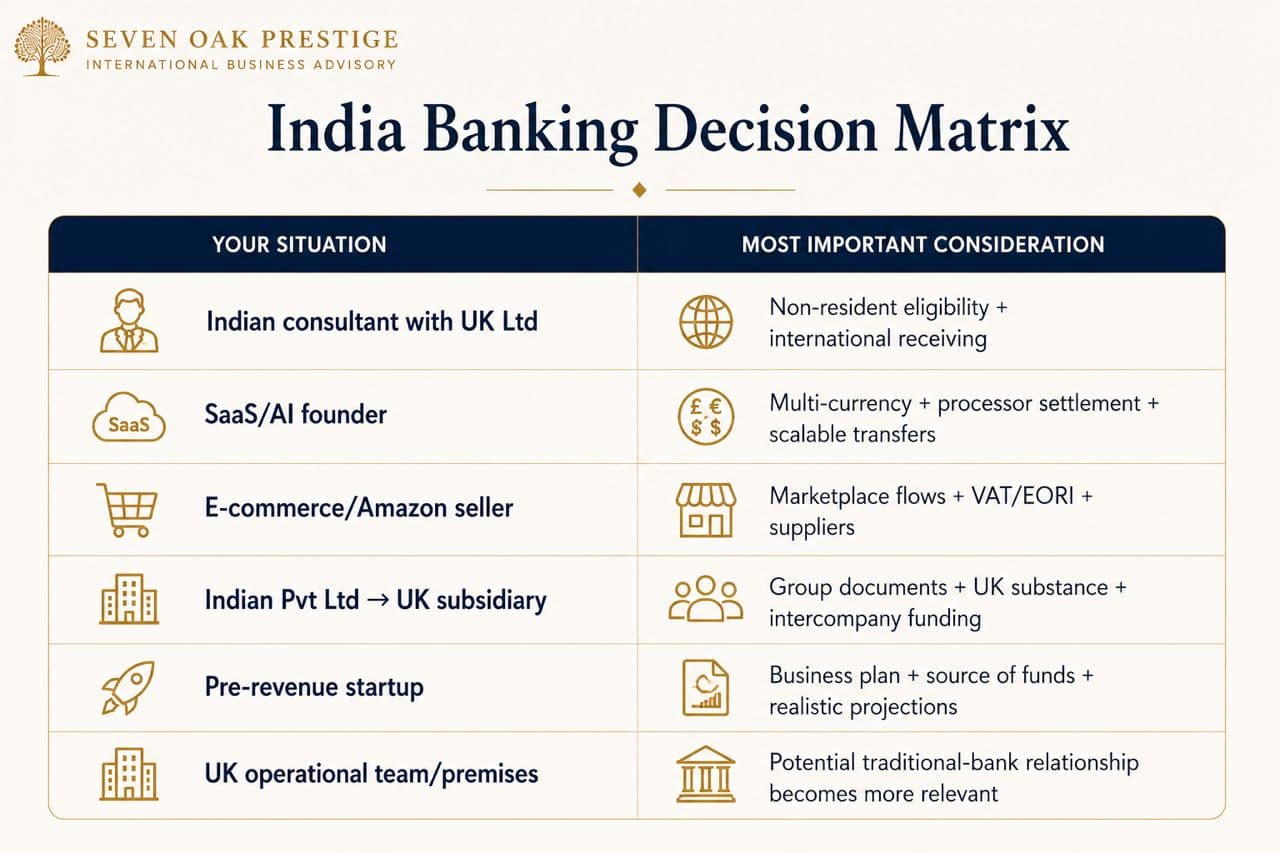
21. Which Banking Route Fits Different Indian Founders?
This is where provider lists become less useful than business-model analysis.
Indian consultant / agency founder
Typical profile:
- UK Ltd;
- director lives in India;
- B2B clients in UK/US/EU;
- relatively simple transfers;
- low inventory risk.
Priorities:
- GBP/USD/EUR receiving;
- transfers to India;
- accounting integration;
- low FX cost.
Possible route:
International fintech/EMI may be more realistic initially than a high-street relationship bank, subject to eligibility.
Indian SaaS / AI founder
Typical flow:
International customers
↓
Stripe/payment processor
↓
UK company financial account
↓
cloud infrastructure / Indian developers / contractors
Priorities:
- multi-currency;
- subscription settlement;
- card/expense functionality;
- scalable international transfers;
- credible transaction documentation.
Read UK Company for Indian SaaS, AI & Technology Founders.
Indian Amazon / e-commerce founder
Typical profile:
- marketplace settlements;
- UK inventory;
- suppliers;
- freight;
- VAT;
- EORI;
- potentially larger payment flows.
Banking review may involve:
- marketplaces;
- supplier geography;
- inventory;
- transaction volumes;
- customs activity.
Read UK Company for Indian Amazon, E-Commerce & Exporters.
Existing Indian Pvt Ltd establishing a UK subsidiary
This is a different profile.
Structure:
Indian parent company
↓
UK subsidiary
The institution may request:
- Indian parent documents;
- group ownership;
- financial statements;
- source of investment;
- board documentation;
- ultimate beneficial-owner information;
- reason for UK expansion;
- expected intercompany transactions.
For this profile, a traditional banking relationship may become more realistic where there is genuine UK substance, but onboarding can also be more document-heavy.
22. UK Registered Office vs Trading Address
Indian founders should distinguish these from the beginning.
Registered Office
The statutory address recorded at Companies House.
Director Service Address
The public correspondence address for the director.
Trading / Operating Address
Where the business actually operates.
If the founder works from Bengaluru, the operational address may genuinely be in India even though the UK company has a Registered Office in London.
Some financial providers accept cross-border operating structures.
Others impose stricter rules.
The correct approach is to disclose the structure accurately.
23. Do You Need to Travel to the UK?
Not simply to own a UK company.
However, banking can be different.
Some traditional full-service bank account processes for overseas companies can involve an in-person UK meeting or mandate process, according to current Business.gov.uk guidance.
Digital financial providers may offer remote onboarding.
Do not therefore assume:
UK company can be formed remotely
means
every UK bank account can also be opened remotely.
They are different systems.
24. Does Having UK Customers Improve Banking Eligibility?
It can help explain the commercial reason for the UK structure, but it does not guarantee approval.
A provider may ask:
Why does this Indian-controlled business need a UK company/account?
Possible legitimate explanations can include:
- UK customer contracts;
- UK subsidiary operations;
- marketplace trading;
- UK employees;
- UK suppliers;
- international expansion;
- multi-currency commercial requirements.
The stronger the commercial logic, the easier the structure can be to understand.
But never invent UK activity.
25. What if the Company Has No Customers Yet?
A newly incorporated company may genuinely be pre-revenue.
That is not automatically problematic.
But the founder should be able to explain:
- what the company will do;
- target customer;
- expected launch/trading timeline;
- business model;
- source of initial funds;
- expected first-year turnover;
- planned countries;
- relevant experience.
A credible early-stage business plan can be more useful than pretending the company already trades.
26. How Much Turnover Should You Declare?
The truthful expected amount.
Not:
- the highest number that makes the business look impressive;
- an artificially low number intended to look safer.
If the company reasonably expects:
£5,000–£10,000 per month
say that.
If an established Indian parent company expects:
£1 million annually
and can support that projection, the application should reflect that.
Consistency matters.
27. UK Business Banking and FEMA/RBI Must Tell the Same Story
This is a major India-specific information advantage over generic competitors.
Suppose the UK bank application says:
“The shareholder will invest £20,000 from India into the UK company.”
That is not merely a banking statement.
It can also intersect with Indian overseas-investment rules.
Likewise, if:
Indian Pvt Ltd → owns UK subsidiary
the ownership, remittance and corporate records should align.
The banking narrative should never contradict the FEMA/RBI narrative.
Read our complete FEMA, RBI & Overseas Investment Guide for UK Companies
28. Banking and UK–India Tax Structure Should Also Be Consistent
Payments can reveal the economic reality of the business.
Examples:
- director salary;
- dividends;
- intercompany fees;
- royalties;
- contractor payments;
- shareholder loans.
These should be supported by the correct accounting/tax treatment.
Do not create transaction descriptions after the fact just to make transfers easier.
For the tax layer, use UK Company Tax for Indian Residents: Corporation Tax, POEM & Double Taxation.
29. The Banking-Readiness Framework
Before applying, Seven Oak looks at five broad areas.
1. Corporate readiness
- legal entity active;
- ownership clear;
- directors correct;
- SIC/activity coherent;
- addresses properly classified.
2. KYC readiness
- valid identification;
- accurate residential address;
- UBO information;
- source-of-funds evidence.
3. Business-model readiness
- clear commercial description;
- customer profile;
- supplier profile;
- website;
- transaction logic.
4. Financial readiness
- expected turnover;
- expected currencies;
- average transaction size;
- funding source;
- existing financial evidence where relevant.
5. Provider fit
- applicant residence supported;
- business country supported;
- industry supported;
- required operating presence satisfied;
- functionality matches the business.
Banking readiness cannot guarantee approval.
Its purpose is to reduce avoidable weaknesses before the application reaches a compliance team.
30. Indian Founder Banking-Readiness Checklist
Before submitting an application, answer:
Identity
- Is your passport valid?
- Can you prove your actual Indian residential address?
- Does every document use the same legal name?
Company
- Is the company active?
- Is ownership correctly recorded?
- Are PSCs/directors current?
- Does the SIC code broadly match the actual activity?
Business
- Is the business description specific?
- Is the website live and coherent?
- Can you explain customer geography?
- Can you explain supplier geography?
Money
- What is the initial source of funds?
- What monthly turnover do you expect?
- What is the normal transaction size?
- Which currencies?
- Which countries?
UK nexus
- Why did you establish a UK company?
- Where is the business operated?
- Do you have UK customers, staff, premises or suppliers?
- If not, can you explain the commercial purpose honestly?
Provider
- Does it accept Indian-resident applicants?
- Does it support the company’s business activity?
- Does it require physical UK presence?
- Does it support the currencies/payment rails you need?
If these answers are unclear before the application, the banking file is probably not ready.
31. Should You Choose Wise or Revolut?
There is no universal answer.
Wise may be attractive where:
- international transfers dominate;
- multi-currency receiving is important;
- FX efficiency matters;
- the business wants international account infrastructure.
Revolut may be attractive where:
- the UK company satisfies its eligibility/presence rules;
- app-based financial management matters;
- cards and broader business features matter;
- the Indian-resident applicant meets current supported-country rules.
The correct choice depends on:
- business model;
- director residence;
- actual operating presence;
- currencies;
- expected volumes;
- product requirements.
You may also decide that both providers solve different functions.
32. Is Revolut Now the Best Option for Indian Founders?
Not automatically.
Its inclusion of India among supported applicant residences is important.
But “supported country” is only one eligibility layer.
The company still needs to satisfy Revolut’s other conditions.
Therefore, Seven Oak would not describe Revolut as:
guaranteed
or
best for every Indian founder.
The more accurate description is:
a significantly more relevant 2026 option for eligible Indian-resident founders than it was under older residency restrictions.
33. Is Wise Better Than a UK Bank?
That is the wrong comparison for many companies.
Wise and a traditional UK bank can solve different needs.
A company may begin with international fintech infrastructure and later establish a traditional relationship bank once it develops:
- larger turnover;
- UK employees;
- UK premises;
- borrowing needs;
- investor requirements;
- local banking relationships.
Business.gov.uk itself notes that fintech accounts can serve as an interim or alternative arrangement while companies pursue full traditional banking.
34. What if Wise or Revolut Rejects the Company?
First determine whether:
- the business is outside eligibility;
- documentation was insufficient;
- information was inconsistent;
- the activity is restricted;
- the geographic profile is outside risk appetite;
- the provider simply decided not to onboard the company.
Then decide whether there is anything legitimate to correct.
Do not submit a second application with different facts merely to obtain a different outcome.
Where the provider’s policy simply does not fit your company, choose a provider whose criteria better align with the real profile.
35. Do Not Form a UK Company Only to Get a Bank Account
This deserves a direct answer.
If the only reason for establishing the company is:
“I heard I can get Wise / Revolut / Stripe,”
the structure may be backwards.
The sequence should be:
business objective
↓
company structure
↓
tax/regulatory consequences
↓
financial infrastructure
not:
desired fintech account
↓
create company around it
A financial provider can change its policy at any time.
Your company should make commercial sense without depending on one platform.
36. Banking for Indian SaaS Founders
SaaS founders often need a stack rather than one provider:
Stripe
for card/subscription collection
- ●
Wise / Revolut / Airwallex / banking provider
for holding and moving funds
- ●
Indian bank account
for India-side expenses or distributions
- ●
accounting system
for reconciliation
That is why a “best bank” list is insufficient.
The correct architecture depends on:
- customer currencies;
- settlement currencies;
- contractor locations;
- cloud expenses;
- investor plans;
- expected transaction size.
37. Banking for Indian E-Commerce Founders
E-commerce companies frequently require deeper financial-flow analysis.
Example:
Amazon customer purchase
↓
Amazon marketplace settlement
↓
UK company financial account
↓
supplier / freight / advertising / VAT / customs payments
Banks and fintechs may want to understand:
- marketplace;
- seller account;
- supplier countries;
- product type;
- transaction volume;
- fulfilment model.
For the sector-specific setup, use our UK Company for Indian Amazon, E-Commerce & Exporters.
38. Banking for an Indian Company Expanding Into the UK
An established Indian company creating a UK subsidiary should not necessarily use the same banking approach as an individual freelancer.
The bank may assess:
- group structure;
- Indian parent accounts;
- audited financial statements;
- existing banking relationship;
- beneficial owners;
- directors;
- UK expansion plan;
- intercompany funding;
- projected UK turnover.
Where the group already banks with an international institution in India, Business.gov.uk suggests considering whether that banking relationship can support UK expansion.
This can be more appropriate than treating the UK subsidiary as an isolated startup.
39. How Long Does UK Business Banking Take?
There is no universal timeline.
Digital providers may review straightforward applications relatively quickly.
Revolut says it aims to review submitted information within 24 hours, although complex applications or requests for further information can extend the process.
Traditional overseas-company banking can take much longer.
Business.gov.uk indicates that full UK bank-account arrangements for overseas companies can take four weeks to three months depending on the circumstances.
So never build your entire launch date around the assumption:
“The account will definitely open tomorrow.”
40. How Seven Oak Prestige Supports Indian Founders
Seven Oak Prestige is a UK-based advisory firm, not an Indian intermediary forwarding your case to another UK provider.
Indian founders work directly with the UK-side advisory firm supporting their UK setup.
Our banking-readiness work can include:
- provider-fit assessment;
- review of company activity;
- business-description preparation;
- KYC-document review;
- residential-address document review;
- ownership consistency;
- transaction-profile preparation;
- source-of-funds narrative;
- website/business-profile consistency;
- supporting-document checklist;
- application-readiness review.
The objective is not to manipulate a provider’s decision.
It is to make sure the application accurately and coherently represents the real business.
Final approval always belongs to the financial institution.
41. What Seven Oak Does Not Promise
We do not promise:
- guaranteed account approval;
- guaranteed Revolut;
- guaranteed Wise;
- guaranteed Airwallex;
- guaranteed Stripe;
- guaranteed high-street banking;
- circumvention of provider eligibility rules.
That distinction is important.
A serious banking adviser should improve readiness, not sell certainty they do not control.
Frequently Asked Questions
Can an Indian citizen open a UK business bank account?
Potentially, yes. Citizenship alone is not the only factor. The provider can assess residence, company jurisdiction, activity, ownership, business location and risk profile.
Can an Indian resident open a UK business bank account without living in Britain?
Potentially. Some financial providers support non-UK-resident directors, while many traditional banks impose stronger UK-residency or business-presence requirements.
Does a UK Ltd guarantee a UK bank account?
No.
Can an Indian resident apply for Revolut Business in 2026?
Revolut currently lists India as a supported applicant country of residence for qualifying UK/EEA business applications, subject to its other eligibility and physical-presence requirements.
Can an Indian resident use Wise Business for a UK company?
Wise says some overseas-owned UK companies may be able to apply, subject to eligibility, verification and acceptable-use rules. The actual application remains case-specific.
Is Wise a UK bank?
Wise Business is not the same as a traditional UK high-street bank account. Wise describes itself as providing regulated money/e-money services.
Is Revolut a bank in the UK?
Revolut’s UK business arrangements are evolving, including migration of eligible business customers to Revolut Bank UK Ltd. Product/legal status should always be checked against current Revolut documentation at application time.
Do I need a UK Registered Office?
A UK Ltd needs an appropriate UK Registered Office. But a statutory Registered Office does not automatically satisfy every financial provider’s trading-address or physical-presence requirement.
Can I use my UK Registered Office as my trading address?
Only if it genuinely meets the provider’s definition and reflects reality. Do not misrepresent a mail/address service as an operational office.
Can my trading address be in India?
Some providers permit registered and trading addresses in different countries. Wise explicitly says this can be possible, subject to address verification and available services.
What proof of address should I prepare in India?
Requirements vary, but bank statements, utilities and other recognised address evidence are common. Use the document type the provider specifically requests.
Will a bank accept Aadhaar as proof of address?
Do not assume it will. Each provider publishes or communicates accepted-document requirements.
Do I need a UK-resident director?
Not to incorporate a UK Ltd. Banking providers can nevertheless have separate residency requirements.
Should I appoint a nominee UK director just to obtain banking?
That can create major governance, control, tax and compliance consequences. A director should not be appointed merely as a cosmetic banking workaround.
Is banking easier with a UK office?
A genuine UK operational presence can materially change how the business is perceived, but provider requirements still apply.
How long can business banking take?
Digital applications can sometimes be reviewed quickly. Traditional banking for international companies can take weeks or longer.
What happens if my application is rejected?
Understand the reason where possible, correct genuine deficiencies and reassess provider fit. Do not fabricate a different profile.
Can Seven Oak guarantee approval?
No. Seven Oak can support banking readiness and application preparation, but the provider alone makes the onboarding decision.
India Banking Decision Matrix
Before Applying: The 10-Point Indian Founder Test
You should be able to explain, in one coherent file:
- Who owns the UK company?
- Where does the owner/director actually live?
- What exactly does the company sell?
- Why is the company established in the UK?
- Where are customers located?
- Where are suppliers or contractors located?
- Where does the initial capital come from?
- What monthly transaction volume is expected?
- What currencies and countries will be involved?
- Why does the chosen provider fit those needs?
If all ten answers align with:
- Companies House;
- KYC documents;
- website;
- contracts;
- FEMA/RBI position;
- tax/accounting records;
your application is much easier for a compliance reviewer to understand.
That is the core of banking readiness.
Continue Through the India–UK Knowledge Hub
If you are still deciding whether to establish the company:
UK Company Formation from India — Complete 2026 Guide
If you want to understand formation costs:
UK Company Formation Cost from India — 2026 Fees
For Revolut specifically:
Revolut Business for Indian Residents with a UK Company
For payment infrastructure:
Stripe, Wise & Airwallex for Indian Founders
For Indian overseas-investment rules:
FEMA, RBI & Overseas Investment Rules for UK Companies
For India–UK tax:
UK Company Tax for Indian Residents: Corporation Tax, POEM & Double Taxation
For technology businesses:
UK Company for Indian SaaS, AI & Technology Founders
For online sellers:
UK Company for Indian Amazon, E-Commerce & Exporters
Final Takeaway
For an Indian resident, opening a UK business account is possible in the right circumstances, but it should never be treated as an automatic consequence of UK incorporation.
The strongest approach is to think in five layers:
1. Company eligibility
Is the UK Ltd properly structured and active?
2. Personal eligibility
Does the provider accept an applicant living in India?
3. Business eligibility
Does the provider support the company’s activity?
4. Geographic eligibility
Does the business meet operating-address or physical-presence rules?
5. Compliance readiness
Can the founder document ownership, activity, source of funds and expected transactions?
For some Indian founders, Revolut Business may now be a materially stronger option because India is currently included among supported applicant residences for qualifying UK companies.
For others, Wise, Airwallex or another international financial provider may align better with the actual transaction profile.
And for an established Indian company entering Britain with employees, premises and meaningful UK operations, a traditional UK banking relationship may ultimately make more sense.
There is therefore no credible answer to:
“Which UK bank is easiest for Indians?”
The better question is:
“Which provider is eligible for my real business profile, and what evidence do I need to make that profile understandable?”
That is the difference between chasing accounts and building a banking-ready company.
Need Help Preparing Your UK Company for Business Banking?
Review My Banking Readiness
For Indian founders who already have a UK company and want their corporate information, KYC documents, business description, transaction profile and provider fit reviewed before applying.
Start My UK Company & Banking Preparation
For Indian founders who have not yet incorporated and want to structure the UK company with banking readiness considered from the beginning.
About the Author
Isaac Jackson
Founder & Managing Director — Seven Oak Prestige Ltd
Isaac Jackson has 3+ years of hands-on experience supporting international entrepreneurs with UK company formation and business-establishment matters.
Seven Oak Prestige has supported close to 100 UK company formation and establishment cases, including non-resident founders requiring assistance with company structure, Companies House requirements, KYC documentation and business-banking readiness.
Editorial Methodology
This guide is prepared using a combination of primary regulatory and provider sources, current market research, practical international-founder experience, and ongoing editorial review.
We prioritize official information from organisations such as GOV.UK, Companies House, HMRC and the relevant financial or payment providers when confirming eligibility, fees, compliance requirements and operational rules.
We also review recurring questions faced by Indian and other non-resident founders so the guide addresses the issues that matter in practice, including company structure, KYC, proof of address, banking readiness, source of funds and cross-border compliance.
Because banking, fintech and regulatory policies can change, material provider-specific information is reviewed periodically and updated where necessary.
Last reviewed: 31 August 2026
Editorial Disclaimer
This guide provides general educational information and does not constitute banking, legal, tax, investment or regulatory advice.
Financial institutions apply independent eligibility, KYC, AML, sanctions, credit and risk-management rules.
Provider availability can change without notice.
Nothing in this article guarantees that a financial institution will accept a particular individual or company.
Seven Oak Prestige can support company establishment and banking-readiness preparation, but final onboarding decisions are made solely by the relevant bank, EMI, fintech or payment provider.
India-side FEMA, ODI, LRS, tax and regulatory matters may require advice from appropriately qualified Indian professionals.
Primary Sources Reviewed
Revolut Business — Eligible Countries and Territories
Revolut currently lists India as an eligible applicant country of residence for qualifying UK/EEA business applications and separately requires qualifying business presence.
Revolut Business — General Eligibility
Covers active-company, legal-entity, residence and unsupported-industry requirements.
Wise — UK Business Verification
Explains verification of company details, registered/trading addresses, activities, volumes, source of funds, owners and directors.
Wise — UK Business Eligibility
States that some overseas-owned UK companies may be able to use Wise Business subject to eligibility and verification.
Wise — Business Address Verification
Confirms that registered and trading addresses can in some circumstances be in different countries, subject to verification and product availability.
Business.gov.uk — UK Business Bank Accounts for Overseas Companies
Explains additional checks, traditional-bank processes, supporting information, UK business plans and potential in-person requirements for international companies.
Airwallex UK — Business Account & Pricing
Explains its multi-currency business-account capabilities, transfers, cards, FX and current pricing structure.