
Revolut Business for Indian Residents with a UK Company: Eligibility, Documents & Onboarding Guide 2026
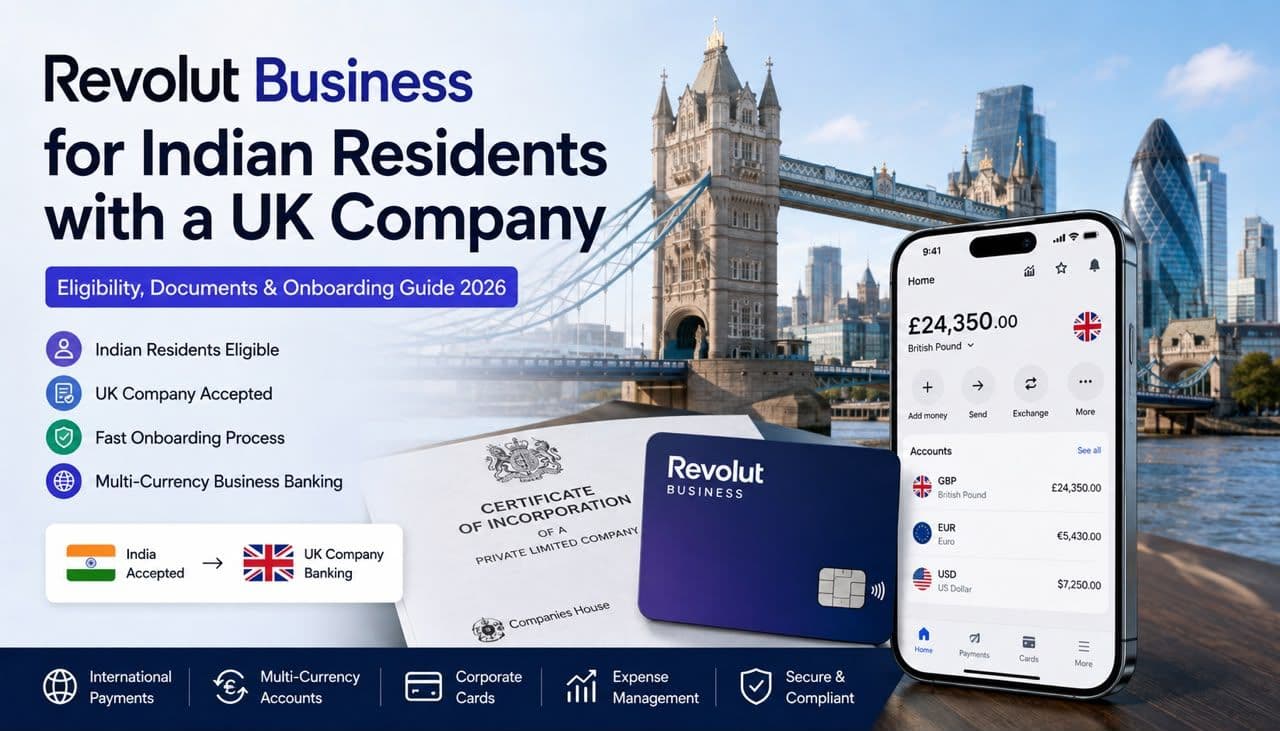
For Indian entrepreneurs building an international business through a UK Limited Company, incorporation is only the beginning.
One of the first practical questions is:
Can an Indian resident open a Revolut Business account for a UK company?
Yes, potentially. Revolut Business currently lists India as a supported country of residence for applicants to eligible companies registered in the United Kingdom or European Economic Area (EEA).
This means an Indian resident does not necessarily need to live in the UK or Europe for Revolut Business to be an option. However, the company and applicant must still satisfy Revolut’s wider eligibility, verification and onboarding requirements.
Revolut may review the company’s business activity, corporate structure, operating presence, identity information and supporting commercial evidence as part of the application.
A UK Certificate of Incorporation therefore establishes the company’s legal existence. It does not by itself establish eligibility for, or approval of, a Revolut Business account.
This guide explains what Indian founders should prepare before applying, including company eligibility, operating-presence requirements, business evidence, ownership verification and onboarding.
If you are still preparing your UK company and want professional support with the setup, explore our UK company formation service for Indian residents.
Quick Answer: Can an Indian Resident Apply for Revolut Business?
Yes, potentially. Revolut Business currently lists India among the supported countries of residence for applicants to eligible companies registered in the UK or EEA.
However, applicant residence is only one part of eligibility. Revolut currently states that the company must be registered and able to prove its physical presence in the UK or EEA. The business must also satisfy Revolut’s wider eligibility, activity, verification and onboarding requirements.
Indian residence being supported does not mean that every Indian-owned UK company will qualify.
Official Revolut Business eligibility guidance: check eligibity .
1. Why Revolut Business Is Relevant to Indian Founders
Indian entrepreneurs increasingly establish UK companies to operate businesses such as:
- SaaS;
- software development;
- AI companies;
- consulting;
- digital agencies;
- professional services;
- e-commerce;
- import/export;
- recruitment;
- international trading businesses.
For these founders, the challenge is rarely just:
“How do I register the company?”
They also need to think about:
- receiving international payments;
- holding GBP, EUR and other currencies;
- paying international suppliers;
- issuing company cards;
- managing expenses;
- converting currencies;
- maintaining professional business financial infrastructure.
Revolut Business positions itself as a broader business-finance platform rather than simply an account for receiving GBP.
The Revolut Business presentation provided to Seven Oak Prestige highlights multi-currency accounts, transfers, corporate cards, expense management, currency exchange, payment acceptance and other financial-management functionality.
Feature availability, pricing and limits depend on the applicable plan and terms.
2. Can You Apply While Living in India?
Potentially, yes.
This is one of the most important points for Indian entrepreneurs.
The applicant does not automatically need to live in the UK simply because the company is incorporated there.
Revolut’s current eligibility guidance specifically includes India among the supported countries of residence for applicants of eligible UK/EEA companies.
That means an Indian founder should normally disclose their real Indian residence.
Do not attempt to make the applicant appear UK-resident if that is not true.
Avoid:
- declaring a UK registered office as your personal residence;
- using another person’s UK residential address;
- claiming that you physically operate from London if you actually operate from India;
- providing inconsistent address information across applications.
A legitimate non-resident company should be presented as exactly that:
a UK company owned or managed by an international founder.
3. Does Having a UK Company Guarantee Revolut Approval?
No.
This distinction is essential.
There are two separate processes:
Companies House
Determines whether the company can be incorporated under UK company law.
Revolut Business
Determines whether it is willing and able to provide the business with an account under its own eligibility, KYC, AML and risk policies.
Therefore:
UK company incorporated ≠ Revolut account approved
A responsible company-formation adviser should never guarantee third-party banking approval.
4. What Documents Does Revolut Business Request?
Revolut states that applicants can be asked for several categories of documentation during onboarding.
The precise request can vary depending on the company and application.
The main documentation includes the following.
Identity Verification
Revolut requires personal identity verification as part of Business onboarding. The exact documents and verification steps can depend on the applicant and the circumstances of the application.
Applicants should therefore follow the document requirements shown during their Revolut Business application rather than assuming that one document list applies to every case.
Indian founders should ensure that their:
- full legal name is consistent;
- date of birth is correct;
- residential information is accurate;
- identity documents are valid and legible;
- information is consistent across the application and supporting documents.
Companies House identity verification is a separate process from Revolut Business identity verification.
5. Certificate of Incorporation or Business Registration Evidence
Revolut may request evidence that the business is properly incorporated.
For a UK Limited Company, this can include the company’s incorporation information.
The following information should remain consistent:
- company name;
- company number;
- incorporation details;
- directors;
- shareholders;
- registered information.
This sounds straightforward, but consistency becomes extremely important during financial onboarding.
6. Proof of Business Activity
This is one of the most important parts of the application.
Revolut specifically gives examples of evidence that may help demonstrate what the company actually does, including:
- a website;
- supplier contract;
- sales invoice;
- corresponding bank statement;
- other appropriate commercial evidence.
This tells us something important:
Revolut is not only verifying that the company exists. It also wants to understand whether there is a credible business behind it.
A strong business profile therefore matters.
7. Why a Professional Website Can Help
A website can help a compliance reviewer understand:
- what the business sells;
- who the customers are;
- where it operates;
- how it generates revenue;
- what type of transactions should be expected.
The website should align with the information provided during onboarding.
Revolut’s current guidance also states that a website submitted as evidence should be complete and up to date, clearly describe the business activity and explain the products or services offered. A website that is still under construction should not be relied upon as proof of business activity.
For example:
Revolut application
B2B software development and SaaS services.
Website
Should reasonably reflect software, SaaS or related services.
Not:
Cryptocurrency investment and trading services.
when the application says something completely different.
This principle applies across almost every serious business-account application:
consistency creates credibility.
8. What If the Company Is Newly Incorporated and Has No Sales Yet?
A newly formed company may naturally have limited trading history.
That does not mean information should be invented.
Where appropriate, the founder may be able to provide other evidence explaining the genuine proposed business activity, depending on what Revolut requests.
Examples might include:
- website;
- supplier agreement;
- customer agreement;
- business plan or commercial information where requested;
- evidence of existing business relationships;
- realistic explanation of the company’s intended activity.
Never create a fake invoice or artificial contract merely to make a new company appear operational.
9. Proof of Operating Address
Revolut may request proof of the company’s operating address.
This is particularly important for Indian founders.
A UK company can have several addresses, and they do not all mean the same thing.
Registered Office
The statutory address registered with Companies House.
Director Service Address
Used for certain director correspondence.
Business Address
Can be used for commercial correspondence depending on the arrangement.
Operating Address
Where business activity is actually carried out or managed.
An Indian founder should not automatically describe a London registered-office service as their physical office.
Important: A UK Registered Office Is Not Automatically Proof of Physical Presence
Indian founders should not assume that purchasing a UK Registered Office, Director Service Address or mail-handling service automatically satisfies Revolut’s physical-presence requirement.
These address services perform specific corporate and correspondence functions. Whether a particular address or supporting evidence satisfies Revolut’s onboarding requirements is determined by Revolut based on the circumstances of the application.
The company’s actual operating arrangements should therefore be described accurately.
10. Directors and Major Shareholders
Revolut may request a document listing:
- company directors;
- major shareholders;
- major shareholders or beneficial owners meeting Revolut’s applicable ownership/control threshold
Revolut’s current guidance generally focuses on significant ownership or control around the 25% threshold. The precise verification requirements presented during onboarding should be followed.
This is part of understanding who ultimately owns and controls the business.
For a simple one-founder company:
Indian founder
→ Director
→ 100% shareholder
The structure is easy to understand.
For multiple founders:
Founder A — 60%
Founder B — 40%
Revolut may need to verify both significant owners.
For detailed guidance on ownership structures :How to Structure Shares and Directors in a UK Ltd as a Non-Resident Founder
11. Does a Complicated Shareholding Structure Make Onboarding Harder?
Not automatically.
But complexity can create additional verification work.
For example:
UK Ltd
↓
owned by another foreign company
↓
which is owned by several individuals
can require more documentation than:
UK Ltd
↓
100% owned by one Indian founder
This does not mean complex structures are wrong.
It simply means:
ownership should have a genuine commercial purpose and be transparent.
12. How Long Does Revolut Business Take to Review an Application?
There is no single guaranteed onboarding time for every Revolut Business application.
Revolut states on some onboarding guidance that it aims to review submitted information within 24 hours. However, individual verification stages can take longer, and current UK guidance states that certain business, identity and nature-of-business verification processes can take up to five business days.
Additional information or documents can also extend the process.
Indian founders should therefore treat any 24-hour figure as an indication rather than a guaranteed account-opening time.
Do not plan critical business payments around an assumed approval date until the account has actually been approved and activated.
13. What Can Cause Additional Revolut Questions?
Additional verification does not automatically mean something is wrong.
A reviewer may need more information where:
- the company is very new;
- the activity is unclear;
- ownership is complicated;
- the website does not explain the business;
- documents do not match;
- expected turnover needs clarification;
- operating-address information needs verification;
- supplier/customer countries require clarification;
- transaction flows are unusual or complex.
The best response is generally:
clear + truthful + supported by evidence
—not trying to find a wording that hides the true business.
14. What Should an Indian Founder Prepare Before Applying?
Before beginning the application, prepare the business properly.
Company documents
- Certificate of Incorporation
- Companies House details
- director information
- shareholder information
- ownership structure
Personal information
- valid identity documentation
- accurate Indian residential details
- residence documentation where applicable
Business evidence
- professional website
- business email address
- supplier/customer contracts where available
- invoices where available
- relevant transaction evidence where applicable
Operating information
- actual operating address
- business activity
- customer countries
- supplier countries
- expected turnover
- expected transaction values
- currencies required
This is what we mean by banking readiness.
15. Banking Readiness Is Not About Finding “Safe Answers”
A common mistake is to approach financial onboarding like a test where the goal is to find the answer the provider wants to hear.
That is the wrong approach.
A business-account application should accurately explain:
- what the company does;
- who owns it;
- where it operates;
- where money comes from;
- where money goes;
- what customers pay for.
The safest application is usually the one that is:
truthful, coherent and properly documented.
For a broader comparison of business-banking options available to Indian founders, read:
UK Business Banking for Indian Residents — Complete 2026 Guide
16. Revolut Business vs Other Providers for Indian Founders
Revolut should not automatically be treated as the only possible option.
Depending on the company, founders may also research other business-finance or payment providers.
The appropriate solution depends on:
- business activity;
- founder residence;
- transaction volume;
- currencies;
- target markets;
- payment requirements;
- customer profile;
- supplier profile.
The important strategic change is that Indian residence itself is no longer automatically a barrier to applying for Revolut Business for an eligible UK/EEA company.
That makes Revolut materially more relevant to Indian founders than it may have been previously.
17. What Can Revolut Business Provide?
According to Revolut Business materials supplied to Seven Oak Prestige, the platform includes a broader suite of business-finance capabilities.
These can include, depending on plan and eligibility:
- multi-currency accounts;
- international transfers;
- currency exchange;
- corporate cards;
- expense management;
- bill payments;
- payment acceptance;
- financial-management tools.
The objective is to centralise more of the company’s financial operations within one environment.
18. Multi-Currency Accounts
International businesses frequently deal with several currencies.
For example, an Indian-owned UK company may:
- invoice a British customer in GBP;
- receive a European payment in EUR;
- invoice a US client in USD;
- pay an international contractor in another currency.
Multi-currency functionality can simplify these flows.
But founders should always review:
- applicable plan allowances;
- exchange rates;
- transfer fees;
- receiving-account details;
- country availability.
19. International Transfers and FX
Cross-border payment costs can become significant for international companies.
Revolut Business provides international-transfer and currency-exchange functionality, subject to plan allowances and terms.
For a company with clients and suppliers in different countries, this can potentially reduce operational friction.
However, price should not be the only consideration.
Also evaluate:
- supported currencies;
- transaction limits;
- supplier countries;
- accounting integrations;
- business needs.
20. Corporate Cards and Expense Management
Growing companies may need cards for:
- founders;
- employees;
- travel;
- advertising;
- subscriptions;
- business purchases.
Revolut Business also provides expense-management functionality.
For companies with teams, this can help separate:
personal spending
from
company spending
and create better financial controls.
21. Payment Acceptance
Depending on eligibility and product availability, Revolut Business also provides payment-acceptance tools.
This may be particularly relevant to:
- SaaS companies;
- online businesses;
- e-commerce;
- service businesses;
- companies invoicing international customers.
However, payment acceptance and business-account approval should still be treated according to the applicable Revolut product terms.
22. Seven Oak Prestige’s Dedicated Revolut Business Contact
Seven Oak Prestige now has access to a dedicated Revolut Business relationship contact for eligible client cases.
The Revolut Business material provided to us describes the relationship objective as including:
- building a trusted banking-partner relationship;
- acting as a direct point of contact;
- supporting client onboarding;
- supporting account-management queries.
This creates an additional communication route for eligible Seven Oak Prestige clients.
It does not change who makes the final approval decision.
Revolut remains responsible for:
- KYC;
- AML;
- eligibility;
- risk assessment;
- documentation;
- approval;
- ongoing account monitoring.
23. What Does the Dedicated Contact Mean for a Client?
The practical value is not:
“Seven Oak Prestige guarantees Revolut approval.”
It is:
Eligible clients can receive coordinated onboarding support through Seven Oak Prestige’s dedicated Revolut Business relationship contact.
This can be useful where:
- the client needs clarification about onboarding;
- Revolut requests additional information;
- there is an account-management query;
- the client requires guidance understanding the next step.
The client’s documents and explanations must still be accurate.
24. Already Have a UK Company?
If you already have a UK Ltd, you may not need to create another company.
Instead, first review whether your existing structure is ready for financial onboarding.
Check:
- Companies House information;
- director details;
- shareholder details;
- website;
- business activity;
- operating address;
- business documentation;
- expected transactions.
Where the company has changed activities since incorporation, ensure that the information being provided remains current and accurate.
25. Don’t Have a UK Company Yet?
If you are still deciding whether to establish a UK Ltd, do not create the company solely because you want Revolut.
Start with the business model.
Consider:
- What does the business sell?
- Who are the customers?
- Which countries will it serve?
- Who will own the company?
- Where will it be managed?
- What banking/payment infrastructure will be needed?
- What tax obligations may arise?
- What Indian regulatory requirements apply?
For the complete process, read our UK Company Formation from India — Complete 2026 Guide
26. What About FEMA and RBI Rules?
Opening a Revolut Business account does not remove Indian foreign-exchange obligations.
An Indian resident acquiring ownership in a UK company may separately need to consider:
- FEMA;
- Overseas Investment Rules;
- ODI;
- LRS where relevant;
- reporting requirements;
- funding documentation.
Banking approval and FEMA compliance are not the same thing.
Read: FEMA, RBI, ODI & LRS Rules for Indian Residents Owning a UK Company
27. What About UK and Indian Tax?
Likewise, successfully opening a Revolut Business account does not determine the tax position.
An Indian resident with a UK company may need to consider:
- UK Corporation Tax;
- Indian personal tax;
- dividends;
- foreign asset reporting;
- POEM;
- permanent establishment;
- double taxation;
- foreign tax credit.
Read our dedicated tax pillar UK Company Tax for Indian Residents: Corporation Tax, Indian Tax, POEM & Double Taxation Explained — 2026 Guide
28. What About the Cost of Setting Up the UK Company?
The banking account should not be evaluated separately from the wider cost of becoming operational.
An Indian founder may need to budget for:
- Companies House registration;
- registered office;
- director service address;
- business address;
- compliance;
- accounting;
- VAT/EORI where applicable;
- banking readiness.
For the cost see our guide The True Cost of UK Company Formation from India — 2026 Price Guide
29. Companies House Identity Verification
Indian directors and PSCs should also understand the UK’s current Companies House identity-verification framework.
This is separate from Revolut KYC.
Completing Revolut’s video verification does not automatically complete Companies House identity verification.
Likewise, completing Companies House verification does not automatically satisfy Revolut.
Read: Companies House Identity Verification for Indian Residents — 2026 Compliance Guide
30. Common Revolut Business Mistakes to Avoid
Assuming a UK company guarantees approval
It does not.
Misrepresenting Indian residence
Always disclose residence accurately.
Confusing the registered office with the operating address
They can be different.
Having no credible explanation of the business
The company should be understandable.
Submitting an inconsistent website
Website and application should align.
Creating fake documents
Never fabricate invoices, contracts or trading history.
Hiding ownership
Directors and significant owners should be properly disclosed.
Giving unrealistic turnover projections
Forecasts should have a reasonable basis.
Changing the business activity just to appear lower-risk
Describe the real activity.
Assuming additional questions mean rejection
Requests for information can be part of normal onboarding.
31. Revolut Business Readiness Checklist for Indian Founders
Before applying:
- UK company is incorporated and active
- business activity is clearly defined
- applicant’s Indian residence is accurately disclosed
- identity document is valid
- Certificate of Incorporation is available
- directors are correctly recorded
- shareholders above 25% can be identified
- ownership structure is transparent
- professional website is available
- business email is active
- genuine commercial evidence is available where relevant
- operating address can be explained
- customer countries are known
- supplier countries are known
- expected turnover is realistic
- expected transaction sizes are realistic
- currencies required are understood
- Companies House information matches the application
Frequently Asked Questions
Can an Indian resident open Revolut Business for a UK company?
Potentially, yes. India is currently listed as a supported applicant residence country for eligible UK/EEA companies.
Do I need to move to the UK?
No, not simply to be eligible as an applicant. Indian residence is currently supported for eligible UK/EEA company applications.
Can a newly incorporated UK company apply?
Potentially, provided it satisfies Revolut’s eligibility and documentation requirements.
Does having a UK Ltd guarantee approval?
No.
What documents does Revolut ask for?
Main categories can include identity verification, incorporation evidence, proof of business activity, operating-address evidence and documentation showing directors and significant shareholders.
Does Revolut require a video selfie?
Identity verification can include a video selfie.
Does Revolut require proof of business activity?
Yes, this can form part of onboarding.
What can prove business activity?
Examples given by Revolut include a website, supplier contract and sales invoice supported by a matching bank statement, among other evidence.
Does Revolut need proof of operating address?
It can be required as part of onboarding.
Does Revolut check shareholders?
Yes. Significant shareholders can need to be identified.
What shareholder percentage is significant?
Revolut’s current guidance focuses on major shareholders and beneficial owners around the 25% ownership or control threshold. Applicants should follow the specific corporate-structure requirements presented during onboarding.
Does a Seven Oak Prestige UK Registered Office automatically satisfy Revolut’s physical-presence requirement?
No. A Registered Office is a statutory company address. Revolut independently determines whether the company has provided sufficient evidence of physical presence for its Business eligibility requirements.
How long does Revolut Business onboarding take?
Revolut says it aims to review information within 24 hours of submission, although times can vary depending on the complexity of the application.
Is India currently a supported country of residence for Revolut Business applicants?
Yes. Revolut currently lists India as a supported residence for applicants to eligible UK and EEA companies. This does not remove the company’s other eligibility and verification requirements.
Can Revolut ask for additional information?
Yes.
Is a website compulsory?
The specific evidence required depends on the application, but a website is one example Revolut gives for demonstrating business activity.
Can a supplier contract be used?
It is one example of evidence Revolut may accept to understand the company’s activity.
Can a sales invoice be used?
Yes, and Revolut specifically refers to a sales invoice with a matching bank statement as one example of business-activity evidence.
Can I use my registered office as my operating address?
Only if that genuinely reflects the operating arrangement and satisfies Revolut’s requirements. A registered-office service should not automatically be described as physical operating premises.
Can Seven Oak Prestige guarantee Revolut approval?
No.
What support does Seven Oak Prestige provide?
For eligible cases, Seven Oak Prestige can support company establishment, banking readiness and coordination through its dedicated Revolut Business relationship contact.
Does the dedicated contact bypass compliance?
No. Revolut retains complete control over compliance and approval decisions.
Does Revolut approval mean my FEMA position is compliant?
No. FEMA/RBI requirements are separate.
Does Revolut approval determine where I pay tax?
No. Tax is a separate matter.
Should I form a UK company only to get Revolut?
No. The UK company should have a genuine commercial purpose.
Continue Your India UK Business Journey
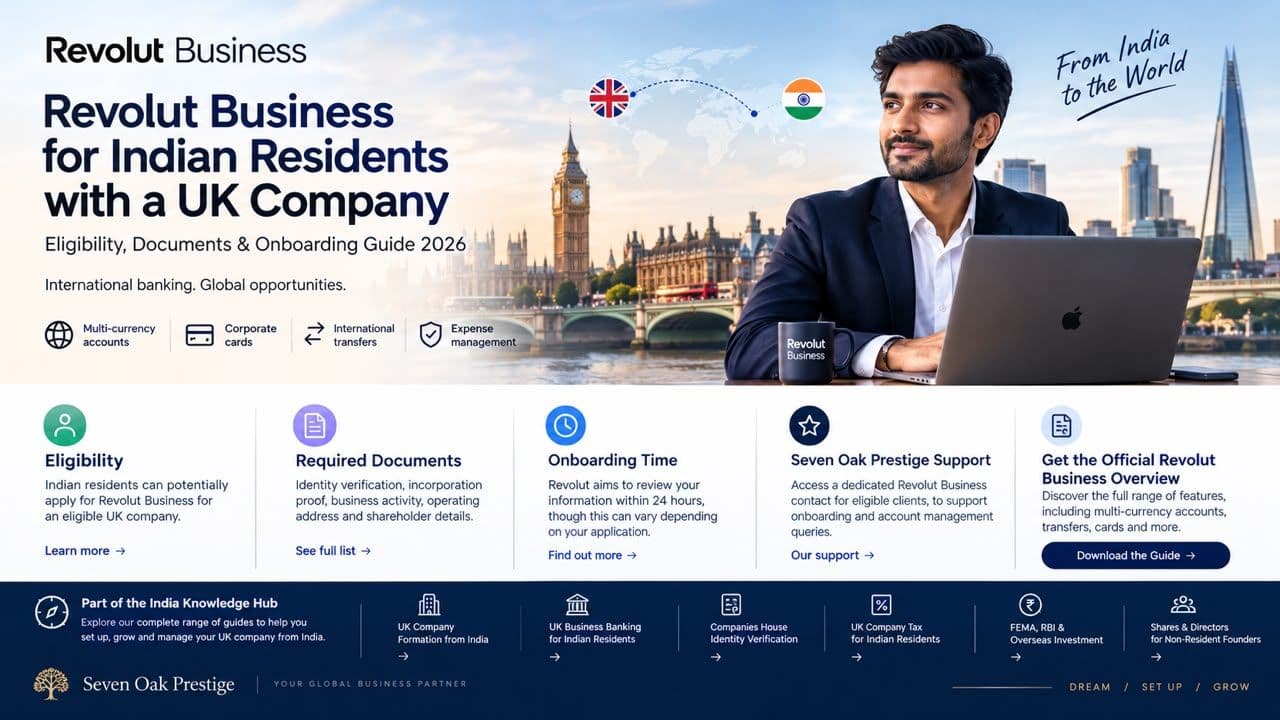
This Revolut guide forms part of the wider Seven Oak Prestige India Knowledge Hub.
UK Company Formation from India
Learn how an Indian resident can establish and structure a UK Limited Company.
UK Company Formation Cost from India
Understand the government, address, compliance and operational costs involved.
UK Business Banking for Indian Residents
Compare the wider banking-readiness considerations for international founders.
FEMA, RBI, ODI & LRS
Understand India’s overseas-investment and foreign-exchange framework.
UK Company Tax for Indian Residents
Understand the tax consequences of owning and managing a UK company while living in India.
Companies House Identity Verification
Understand the UK identity-verification requirements for directors and PSCs.
Shares & Directors
Understand ownership, control and governance.
Together, these resources answer the full journey:
Can I form the company?
→ What will it cost?
→ How should I own and structure it?
→ How do FEMA and RBI rules apply?
→ How will the UK company be taxed?
→ How do I prepare for business banking?
→ Can Revolut Business be an option?
Preparing Your UK Company for Revolut Business?
Seven Oak Prestige supports international founders with:
- UK company formation;
- corporate structuring;
- Companies House compliance;
- registered and business address services;
- banking readiness;
- VAT and EORI support;
- eligible Revolut Business onboarding coordination.
For Indian residents, Revolut Business can now represent another potential banking option for an eligible UK company.
But the strongest application starts with a properly prepared business.
Discuss My Revolut Business Readiness
About the Author
Isaac Jackson
Founder & Managing Director — Seven Oak Prestige Ltd
Isaac Jackson supports international founders and overseas businesses establishing and operating UK companies, including founders requiring support with company formation, statutory addresses, Companies House administration, KYC preparation, compliance coordination and banking readiness.
Seven Oak Prestige Ltd
Company Registration No. 16903092
Registered Office: 124 City Road, London EC1V 2NX, United Kingdom
Editorial Methodology
This guide is prepared using current public guidance from Revolut Business and relevant UK regulatory and company-information sources, together with Seven Oak Prestige’s practical experience supporting international founders with UK company formation, compliance preparation and business-banking readiness.
Provider eligibility, onboarding requirements and documentation standards can change. We therefore distinguish between UK company-registration requirements and the separate eligibility, KYC, AML and risk-assessment processes applied by Revolut Business.
This article was last reviewed on 30 September 2026.
Important Disclaimer
This guide provides general information for international founders and does not constitute legal, tax, financial, investment or regulated banking advice.
Seven Oak Prestige Ltd can assist with UK company formation, compliance coordination and business-banking readiness, but Revolut independently determines account eligibility, verification requirements and approval. Nothing in this guide guarantees that an applicant or company will be accepted by Revolut Business.
Indian residents should obtain appropriate professional advice where necessary regarding FEMA, RBI, overseas-investment, tax or other India-specific regulatory obligations.