
Companies House Identity Verification for Indian Residents - 2026 Guide
Companies House Identity Verification for Indian Residents: 2026 Guide
If you live in India and are forming, directing, owning or controlling a UK company, identity verification is now part of the Companies House compliance process.
Since 18 November 2025, identity verification requirements have been phased in for company directors and people with significant control, known as PSCs. The date did not create one universal deadline for everyone: Companies House introduced a transition system in which the actual due date depends on the person’s role and circumstances.
For Indian founders, the key point is simple:
You can complete Companies House identity verification without travelling to the UK.
There are two main routes:
- verify directly through GOV.UK One Login; or
- ask an Authorised Corporate Service Provider (ACSP) to verify you.
Companies House currently allows the direct online route to use a biometric passport from any country, which can include an eligible Indian passport. An ACSP can also verify an individual while they are outside the UK.
If you have not yet formed your UK company and want the incorporation and identity-verification requirements coordinated from the outset, explore our UK company formation service for Indian residents.
Quick Answer
Companies House Identity Verification for Indian Residents: At a Glance
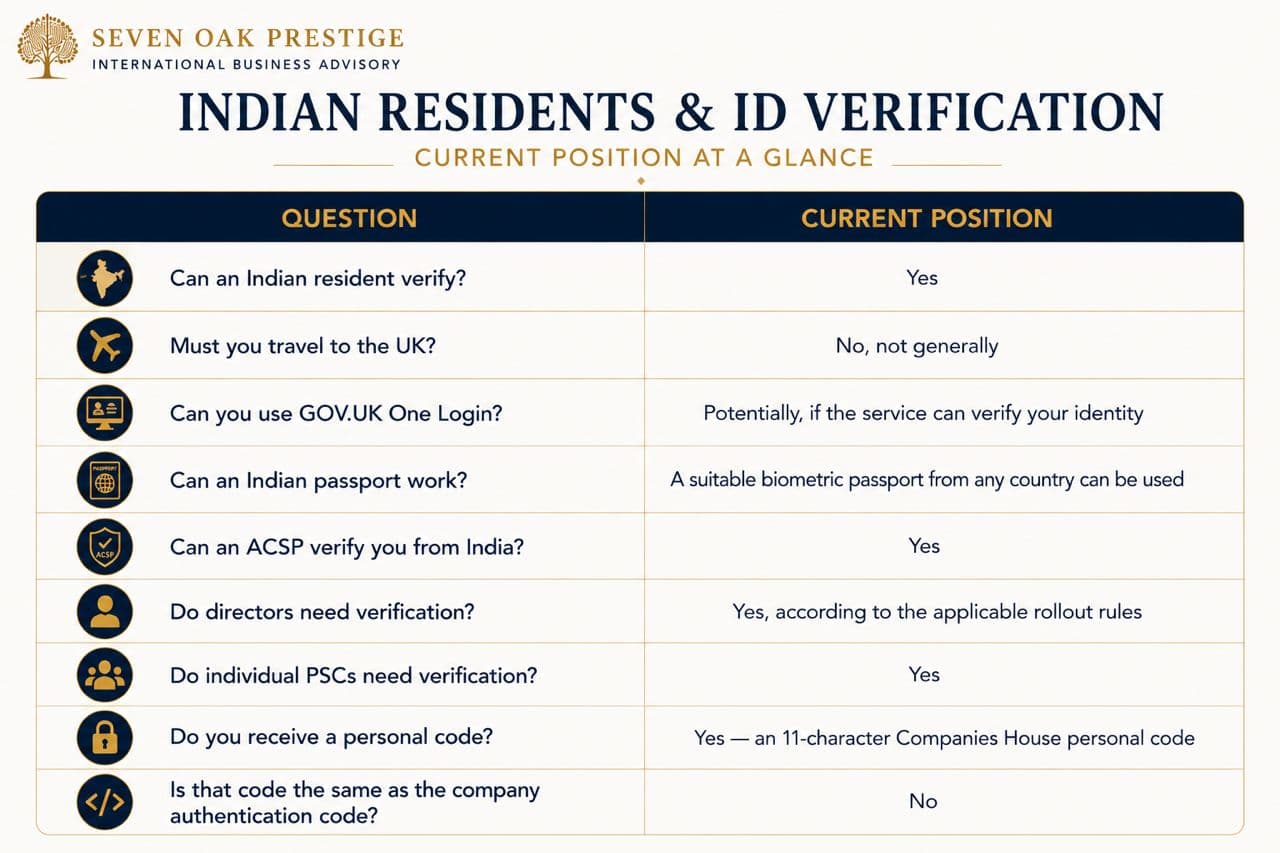
Do I need identity verification?
Yes, if you fall within a role for which Companies House identity verification is required, including an individual director or PSC.
Can I complete it from India?
Yes. The process can normally be completed remotely. You do not generally need to travel to the UK.
Can I use an Indian passport?
A suitable biometric Indian passport can potentially be used through the GOV.UK One Login route because Companies House accepts biometric passports from any country, subject to successful verification.
Can I use an ACSP instead?
Yes. An Authorised Corporate Service Provider can verify an individual for Companies House where its verification requirements are satisfied.
Do directors need verification?
Yes. New and existing directors are within the mandatory identity-verification regime.
Do individual PSCs need verification?
Yes. Individual PSCs must verify and provide their personal code within the applicable period.
Do I verify separately for every company?
Normally, no. Identity verification is generally completed once. The same personal code can then be used to connect your verified identity to the relevant roles and companies.
Does verification guarantee company registration or banking approval?
No. Identity verification is one Companies House requirement. Incorporation and banking eligibility remain separate processes.
1. Who Needs to Verify Their Identity?
For a typical UK private limited company owned from India, the most important categories are:
Directors
New and existing directors fall within the identity-verification regime.
People with Significant Control — PSCs
An individual may be a PSC if, for example, they:
- own more than 25% of the company’s shares;
- control more than 25% of voting rights;
- can appoint or remove a majority of directors; or
- otherwise exercise significant influence or control.
An Indian founder who owns 100% of a UK Ltd and is also its director will therefore usually have two company roles:
director + PSC
but only one personal identity.
2. If You Are Both Director and PSC, Do You Verify Twice?
Usually, no.
Companies House verifies the individual rather than creating a separate identity for every role.
Once verified, you receive a single personal code.
You can then use the same code to connect your verified identity to the different roles you hold. Companies House specifically states that the same personal code is used each time an individual needs to confirm that they are verified, including where they are a director of multiple companies.
The important distinction is:
Identity verification happens once
but
the verified identity may need to be linked separately to each company role.
3. The Two Main Verification Routes From India
Indian residents generally have two practical routes.
Route 1 — GOV.UK One Login
This is the direct Companies House route.
Companies House says GOV.UK One Login can use:
- a biometric passport from any country;
- a UK photo driving licence;
- a UK biometric residence permit;
- a UK biometric residence card;
- a UK Frontier Worker permit.
For an Indian resident, the passport route is normally the most relevant.
Route 2 — Authorised Corporate Service Provider
An ACSP is a Companies House-authorised agent that is also subject to UK AML supervision.
An ACSP must be registered with Companies House as an authorised agent and supervised by a UK Anti-Money Laundering supervisory body.
Examples can include:
- accountants;
- solicitors;
- company-service providers;
- other appropriately supervised professionals.
Companies House confirms that ACSP verification can be completed from any country.
4. Can You Use an Indian Passport?
Potentially, yes.
Companies House does not restrict the passport route to British passports.
Its current guidance says GOV.UK One Login can use a:
biometric passport from any country.
That can include a suitable Indian biometric passport.
However, there is an important distinction:
Eligible document type
does not mean
automatic successful verification.
The digital service still needs to successfully read the document and match the individual.
If it cannot, an ACSP may be the more practical alternative.
5. What If GOV.UK One Login Does Not Work?
A failed or unavailable One Login route does not necessarily mean you cannot satisfy the Companies House requirement.
Companies House expressly provides the ACSP alternative for individuals who cannot use the direct route.
Depending on the circumstances, sensible next steps can include:
- checking that your personal information exactly matches the ID;
- checking that the passport/document is suitable;
- following the One Login support process;
- using a registered ACSP instead.
The key is not to manipulate information to make the system accept you.
Your name, date of birth and identity evidence should remain accurate and consistent.
6. How ACSP Verification Works
An ACSP does not simply send Companies House a copy of your passport.
The agent must meet the Companies House identity-verification standard and conduct appropriate checks.
Companies House requires authorised agents to establish that:
- the identity information belongs to a real person;
- the evidence is valid;
- the evidence relates to the individual being verified;
- the required verification standard has been met.
The ACSP must also retain the required verification records.
An Indian founder using an ACSP may therefore be asked for a combination of:
- passport;
- residential-address information;
- date of birth;
- email address;
- additional supporting identification;
- digital identity or liveness checks.
The exact evidence depends on the verification method used by the ACSP.
7. What Is the Companies House Personal Code?
After verification, Companies House issues an 11-character personal code.
The code belongs to the individual, not to the company.
This distinction is important because one Indian founder may have:
- one personal code;
- several UK companies;
- several directorships;
- several PSC roles.
The same personal code can be used across those relevant roles.
8. Personal Code vs Company Authentication Code
These are two different Companies House credentials and should not be confused.
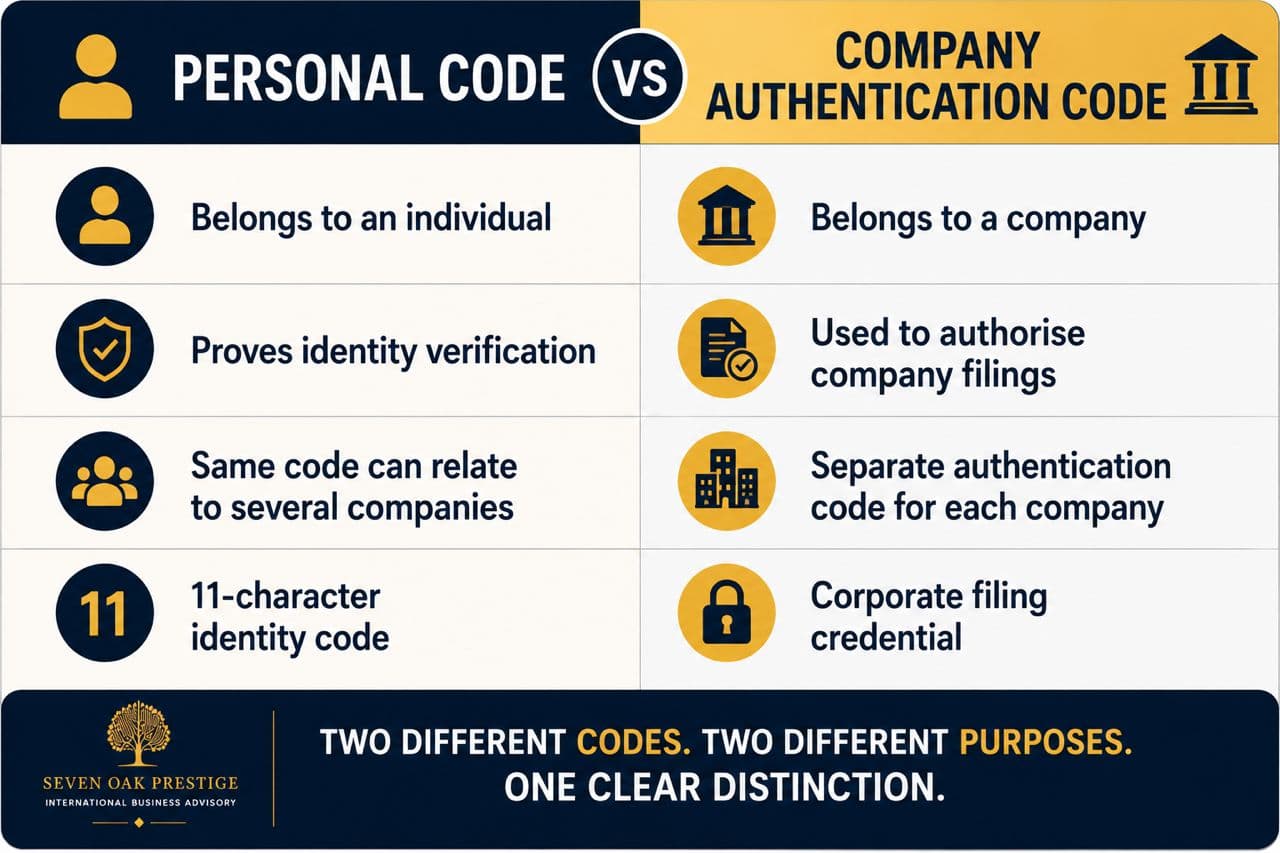
Companies House Personal Code
Belongs to: an individual.
Purpose: confirms that the individual has completed Companies House identity verification.
Format: an 11-character personal code.
Used for: connecting the verified individual to relevant roles, including director and PSC roles.
Multiple companies: the same individual normally uses the same personal code across the relevant companies and appointments.
Company Authentication Code
Belongs to: a company.
Purpose: acts as a company filing credential for certain Companies House online services.
Used for: authorising relevant filings made for that particular company.
Multiple companies: each company has its own authentication code.
The key distinction
Personal code = verified individual.
Authentication code = company filing credential.
A founder who controls several UK companies may therefore have one personal identity code but separate company authentication codes for each company.
Companies House confirms that the personal code is an 11-character identifier belonging to the individual rather than the company and that the same personal code is reused when confirming verified status for relevant appointments.
9. When Does a New Indian Director Need the Code?
For someone becoming a director after mandatory verification began, the position is relatively straightforward.
Companies House states that a person becoming a director from 18 November 2025 onwards needs to provide their personal code:
- when being appointed; or
- when incorporating a new company.
For a new company with more than one director, the incorporation process may therefore require the personal code for each director.
A simplified workflow is:
Verify identity
↓
Receive personal code
↓
Prepare director and company details
↓
Submit incorporation
↓
Companies House considers the filing
Identity verification is therefore a prerequisite in the modern formation workflow, but it does not itself create the company.
10. What About Existing Directors?
Existing directors use the transition system.
Companies House says an existing director must provide their personal code as part of the company’s next Confirmation Statement during the transition period.
The Confirmation Statement must include:
- each director’s personal code; and
- a confirmation that each director has verified their identity.
Companies House says it will not accept the Confirmation Statement until the relevant directors have completed identity verification.
This means an Indian founder with an existing company should not leave verification until the last moment.
11. How PSC Verification Works
A Person with Significant Control, or PSC, must verify their identity and provide their Companies House personal code.
Every individual PSC has an applicable 14-day period in which the required personal code and verification statement must be provided.
The timing depends on the PSC’s circumstances.
If You Are Both a Director and PSC of the Same Company
If you are both a director and PSC of the same UK company, you still verify your identity only once and receive one personal code.
However, the code must be provided separately for each role.
For your director role:
Provide your personal code through the company’s Confirmation Statement.
For your PSC role:
Provide your personal code separately through the Companies House service for PSC identity-verification details.
Your 14-day PSC period begins on the day after the company’s Confirmation Statement date.
Filing the Confirmation Statement early does not change the dates of this PSC verification period.
If You Are a PSC but Not a Director of the Same Company
If you were already registered as a PSC before 18 November 2025 and you are not also a director of that company, your 14-day period falls within the first 14 days of your birth month.
For example, if your birthday is 24 February, your PSC period runs from 1 February to 14 February.
This is separate from the Confirmation Statement timetable used for directors.
If You Became a New PSC After 18 November 2025
If you become a PSC after 18 November 2025, you can provide your personal code when you are first added to the Companies House register or within the applicable 14-day period after being added.
Companies House advises PSCs to check the register for the specific dates applying to them.
Important: Director and PSC Requirements Are Separate
Being both a director and PSC does not mean completing two separate identity checks.
Normally:
one individual → one identity verification → one personal code
But that personal code may need to be provided separately for:
director role → Confirmation Statement
and
PSC role → PSC identity-verification service
So an Indian founder who is both sole director and 100% shareholder should not assume that providing the code for the director role automatically completes the PSC requirement.
That last point is explicitly supported by Companies House: even after the code has been supplied as a director on the Confirmation Statement, it must still be supplied for the PSC role.
One tiny wording precision: Companies House’s main guidance currently says a new PSC may provide the code when first added or within 14 days of being added; its January explainer describes the period by reference to the direction letter. For a durable article, I prefer the main GOV.UK formulation above.
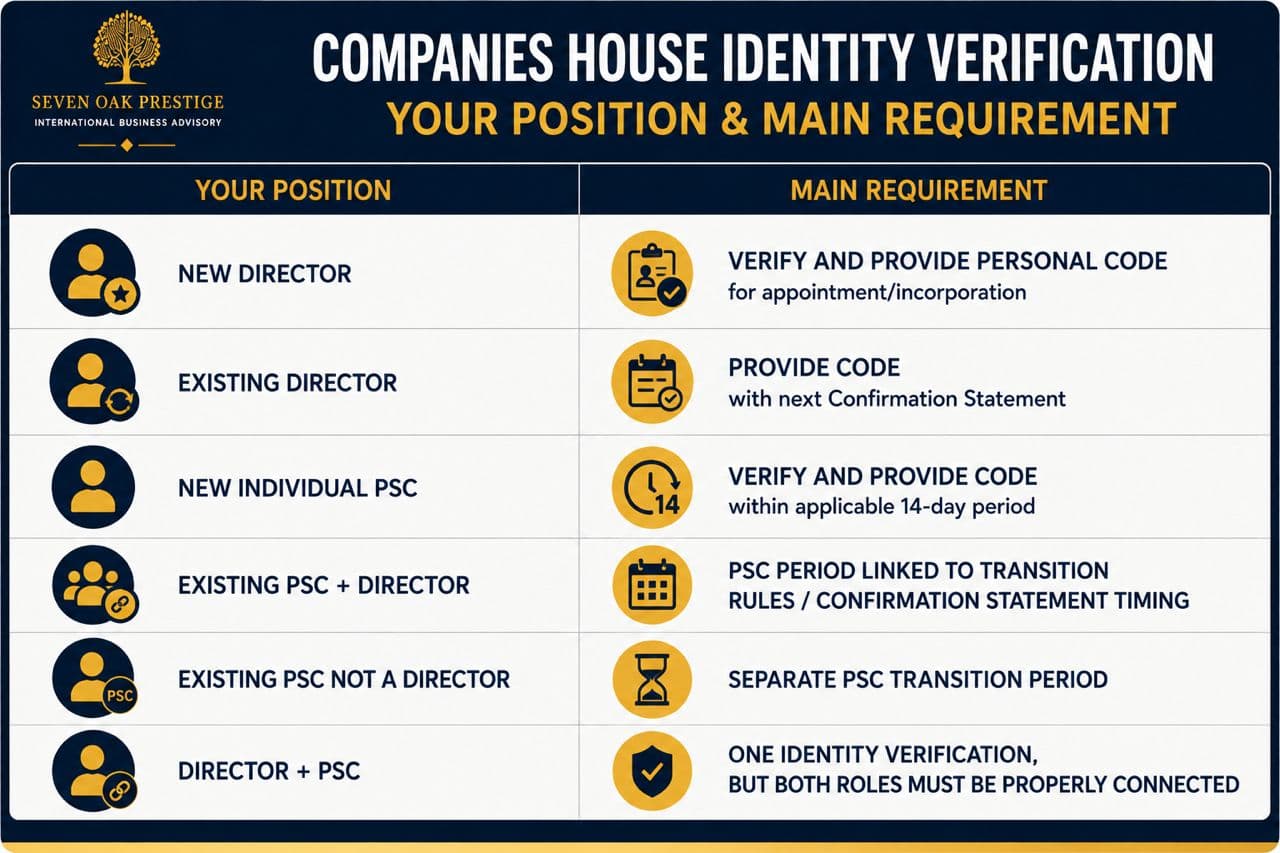
12. Director vs PSC: Simple 2026 Matrix
Your Companies House requirement depends on the role you hold and when you started that role.
New Director
Main requirement:
Verify your identity and provide your personal code as part of the director appointment or new-company incorporation process.
Existing Director
Main requirement:
Verify your identity and provide your personal code through the company’s relevant Confirmation Statement.
New Individual PSC
Main requirement:
Verify your identity and provide your personal code when first added to the register or within the applicable 14-day period.
Existing PSC Who Is Also a Director
Main requirement:
Complete the director requirement through the Confirmation Statement and provide the personal code separately for the PSC role during the applicable 14-day PSC period.
Existing PSC Who Is Not a Director
Main requirement:
Provide the personal code during the first 14 days of the PSC’s birth month, subject to the applicable Companies House transition rules.
Director Who Is Also a PSC
Main requirement:
Identity verification itself is generally completed once, but the personal code must be connected separately to the director and PSC roles.
Companies House allows individuals to check the register for the specific identity-verification dates applying to their roles.
13. Indian Residential Address vs UK Company Address
Identity verification concerns the person.
The Registered Office concerns the company.
These should not be blurred.
If you genuinely live in Bengaluru, Mumbai, Delhi or another Indian location, your personal verification information should reflect your real residential circumstances.
A London Registered Office does not mean the director lives in London.
Similarly, a professional Director Service Address is a public correspondence address and should not be represented as a residential address unless that is factually true.
For a full explanation of UK statutory addresses, read our Registered Office vs Director Service Address guide.
14. Common Verification Problems for Indian Founders
The biggest problems are often not nationality-related. They are data-consistency problems.
Different versions of the name
Indian documents can sometimes show:
- initials;
- middle names;
- different spacing;
- surname/given-name ordering differences.
Where possible, use your legal identity information consistently with the document being relied upon.
Incorrect date of birth
Companies House says a personal code may fail to connect where the date of birth on its records does not match the details linked to the verified identity.
Incorrect personal code
A simple transcription error can prevent the identity from linking correctly.
Wrong email address
Where an ACSP verifies someone, Companies House sends the individual’s personal code to the email address supplied by the ACSP. Companies House specifically tells agents to ensure that address is correct.
Assuming one person’s verification covers everyone
It does not.
If there are two directors, each individual must satisfy their own identity-verification requirement.
15. Example: One Indian Founder Owning 100%
Consider:
Indian resident
↓
100% shareholder
↓
sole director
↓
PSC
This person is both:
- director;
- PSC.
They normally verify their identity once and receive one personal code.
The code is then used for the relevant director and PSC processes.
This is one of the simplest UK-company verification structures.
16. Example: Two Indian Co-Founders
Suppose:
Founder A — 60%
Founder B — 40%
and both are directors.
Because both hold more than 25% of the shares, both are normally individual PSCs as well.
That means:
Founder A
→ separate verification
→ personal code A
Founder B
→ separate verification
→ personal code B
Neither founder’s identity verification covers the other.
17. Example: Indian Owner With a UK-Resident Director
Suppose an Indian resident owns 100% of the shares but appoints a UK-resident individual as director.
The Indian shareholder may still be the PSC.
The fact that the director lives in the UK does not remove the Indian owner’s PSC verification obligations.
This is one reason appointing a UK-based director should not be treated as a cosmetic workaround for regulatory requirements.
18. Does Identity Verification Change Your Immigration or Tax Status?
No.
Companies House verification does not:
- make an Indian resident a UK resident;
- grant a UK visa;
- establish UK tax residence;
- change Indian tax residence;
- automatically create banking eligibility.
It is a corporate-register identity requirement.
Tax is a separate issue. For that, see our UK Company Tax for Indian Residents — POEM & DTAA 2026 Guide.
Likewise, Indian overseas-investment rules are separate. Read our FEMA, RBI & Overseas Investment Guide for UK Companies.
19. Companies House Verification Is Not Banking KYC
A founder can be fully verified by Companies House and still be declined by a bank or fintech.
The two processes answer different questions
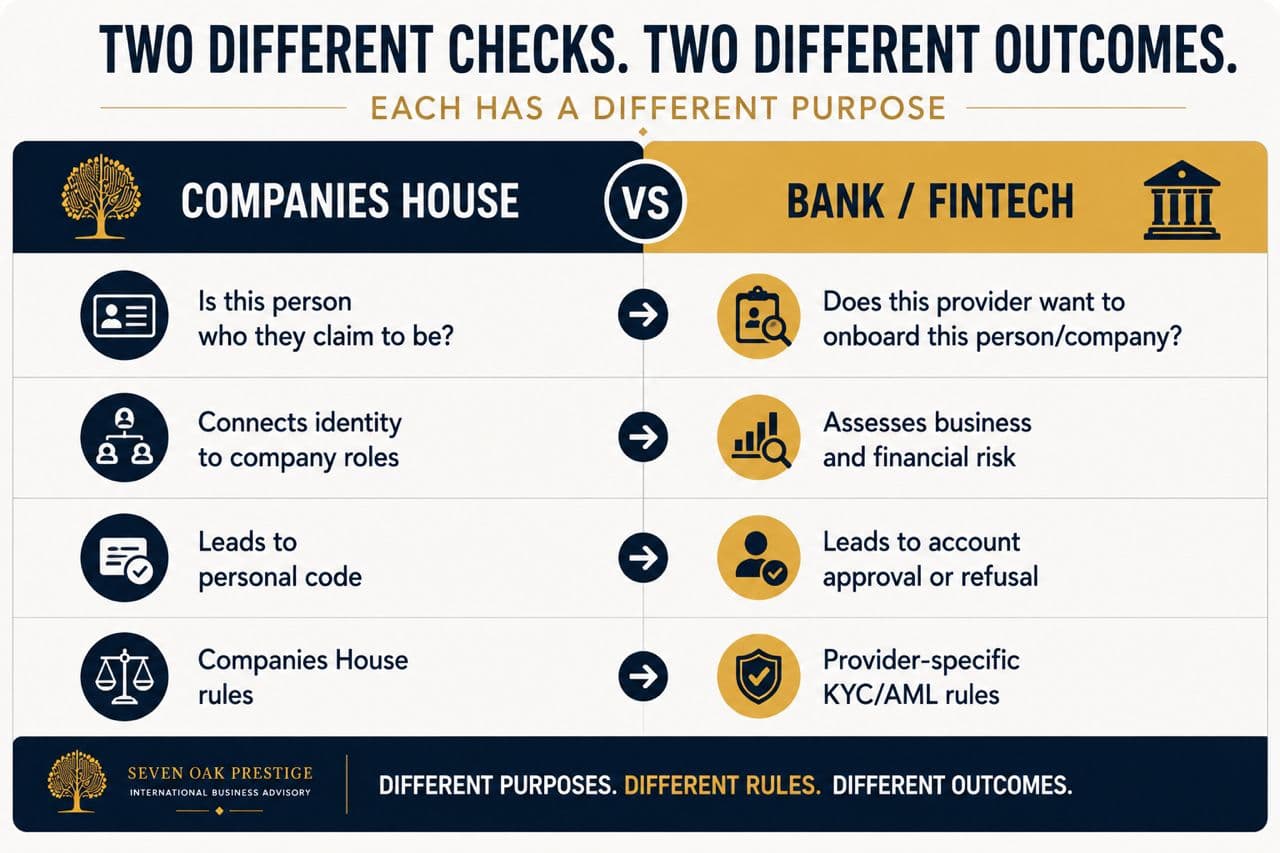
Banking providers may separately assess:
- business activity;
- source of funds;
- customer geography;
- transaction volumes;
- beneficial ownership;
- residential address;
- operating presence.
For that subject, read our UK Business Bank Account for Indian Residents — 2026 Guide.
20. Is Companies House Verification Free?
The direct GOV.UK One Login route is free. Companies House has consistently presented its direct identity-verification service as a free route.
An ACSP may charge a professional fee for carrying out verification.
That means:
government verification route
and
professional verification service
should be priced separately.
For the wider cost of establishing a UK company from India, see our UK Company Formation Cost from India — 2026 Fees Guide.
21. What Happens If You Do Not Verify on Time?
If you do not comply with the applicable identity-verification requirements on time, Companies House states that you may be committing an offence and may face prosecution, a court fine or a financial penalty.
Non-compliance can also prevent certain Companies House actions. For example, an unverified person cannot be appointed as a new director or register a new company, and a company cannot file its Confirmation Statement where the required directors have not completed identity verification.
Companies House also states that a note may be displayed against the individual’s name on the public register where the requirements are not met.
22. Recommended Checklist for Indian Founders
Before starting verification, check:
Your identity
- legal name matches your ID;
- date of birth is correct;
- passport is valid/suitable;
- personal email address is accurate.
Your Companies House role
- director;
- PSC;
- both;
- director/PSC of more than one UK company.
Your route
- GOV.UK One Login; or
- registered ACSP.
If the company already exists
- check your verification due date;
- check the next Confirmation Statement date;
- confirm which directors and PSCs still need to comply.
After verification
- save the personal code securely;
- ensure the correct date of birth is associated with the code;
- use the code for every relevant role/company;
- complete any separate PSC submission within its applicable period.
23. How Seven Oak Prestige Supports Indian Founders
Seven Oak Prestige supports Indian founders with UK company formation, Companies House compliance preparation and the practical coordination of identity-verification requirements.
Depending on your circumstances, we can help you:
- understand whether you need to verify as a director, PSC or both;
- prepare the information required before verification;
- identify the appropriate verification route;
- coordinate identity-verification assistance where required;
- understand how your personal code must be used for your company roles;
- prepare for incorporation or director appointment;
- coordinate relevant Confirmation Statement and PSC requirements; and
- understand the next compliance steps after incorporation.
Where verification is carried out through an Authorised Corporate Service Provider, the identity check must be completed by an ACSP registered with Companies House. Seven Oak Prestige does not represent itself as the verifying ACSP unless expressly stated for a particular service arrangement.
We do not alter identity information, fabricate documentation or attempt to bypass Companies House controls. Our role is to help founders navigate the process accurately and understand what is required at each stage.
Frequently Asked Questions
Can an Indian resident verify their identity for Companies House?
Yes. Indian residents can potentially verify directly through GOV.UK One Login or through an ACSP.
Can I use an Indian passport?
Companies House currently allows a biometric passport from any country for the relevant GOV.UK One Login route, subject to successful digital verification.
Must I travel to the UK?
Not generally. Companies House states that ACSP verification can be carried out from any country.
What is the Companies House personal code?
It is an 11-character code issued to an individual after identity verification.
Is the personal code unique to one company?
No. It belongs to the individual and can be used for multiple relevant company roles.
Is it the same as the company authentication code?
No.
Do directors need identity verification?
Yes, according to the mandatory rollout and applicable due dates.
Do individual PSCs need verification?
Yes.
If I am both a director and PSC, do I need two identity checks?
Generally, the identity itself is verified once, but the verified identity must be properly connected to both roles.
When must a new director verify?
A new director appointed from 18 November 2025 onwards needs to provide their personal code as part of the appointment or incorporation process.
When must an existing director verify?
Existing directors generally provide their personal code with the company’s next Confirmation Statement during the transition period.
How long does a PSC have?
Every individual PSC has an applicable 14-day period in which to provide their personal code and verification statement. The start date depends on the circumstances.
What if GOV.UK One Login cannot verify me?
You may be able to use an ACSP instead.
Is direct Companies House verification free?
Yes. The direct GOV.UK One Login route is free.
Can an ACSP charge me?
Yes. An ACSP may charge for its professional verification service.
Does verification guarantee UK company registration?
No. The incorporation filing itself must still satisfy Companies House requirements.
Does Companies House verification guarantee a UK bank account?
No. Banking providers conduct independent KYC and risk assessments.
Continue Through the India–UK Knowledge Hub
For the complete formation process:
UK Company Requirements for Indian Residents
For formation costs:
UK Company Formation Cost from India — 2026 Fees
For business banking:
UK Business Bank Account for Indian Residents
For UK–India tax:
UK Company Tax for Indian Residents — POEM & DTAA 2026
For India-side overseas-investment rules:
FEMA, RBI & Overseas Investment Rules for UK Companies
Final Takeaway
For an Indian resident, Companies House identity verification is now a normal part of setting up and maintaining a UK company.
The practical journey is:
Verify your identity
through GOV.UK One Login or an ACSP
↓
Receive your 11-character personal code
↓
Use that code to connect your verified identity to your director and/or PSC roles
↓
Complete the relevant incorporation, appointment, Confirmation Statement or PSC process by the correct deadline
The most important points are:
- you do not normally need to travel to Britain;
- a suitable biometric Indian passport can potentially be used for the direct online route;
- an ACSP can verify you remotely from India;
- the personal code belongs to the individual, not the company;
- director and PSC timing rules are different;
- identity verification does not replace banking KYC, tax analysis or FEMA compliance.
For Indian founders, the process is therefore manageable — but it needs to be completed accurately and at the right stage of the company lifecycle.
Need Help With Companies House Identity Verification?
GET HELP WITH IDENTITY VERIFICATION
For Indian residents who need help understanding the correct Companies House verification route, personal-code requirements and how verification fits into an existing UK company.
START MY UK COMPANY WITH VERIFICATION SUPPORT
For Indian founders who have not yet incorporated and want company formation, director/PSC requirements and identity-verification coordination handled as one process.
About the Author
Isaac Jackson
Founder & Managing Director — Seven Oak Prestige Ltd
Isaac Jackson supports international founders and overseas businesses establishing and operating UK companies, including founders requiring support with company formation, statutory addresses, Companies House administration, KYC preparation, compliance coordination and banking readiness.
Seven Oak Prestige Ltd
Company Registration No. 16903092
Registered Office: 124 City Road, London EC1V 2NX, United Kingdom
Editorial Methodology
This guide is prepared using a combination of primary Companies House and GOV.UK sources, current regulatory research, practical international-founder experience and ongoing editorial review.
We prioritise official Companies House guidance when confirming verification routes, accepted identification, personal-code requirements, director and PSC deadlines and Confirmation Statement obligations.
We also review recurring questions raised by Indian and other non-resident founders so the guide addresses the practical issues they are most likely to encounter when completing UK company identity verification remotely.
Because Companies House implementation guidance continues to evolve, material regulatory information is reviewed periodically and updated when necessary.
Last reviewed: 30 September 2026
Editorial Disclaimer
This guide provides general educational information about Companies House identity verification and should not be treated as personalised legal, regulatory, tax, immigration, banking or AML advice.
The exact process and deadline depend on the individual’s role, verification status and company circumstances. Companies House guidance should be checked where a filing deadline or unusual ownership structure is involved.
Primary Official Sources Reviewed
Companies House — Verify Your Identity
Confirms the GOV.UK One Login route and accepted identity documents, including biometric passports from any country.
Companies House — When You Need to Verify
Explains current requirements for directors, PSCs and new company registrations.
Companies House — Personal Codes
Confirms the 11-character personal code, how it is used and that one individual uses the same code across relevant company roles.
Companies House — ACSP Verification
Explains how authorised agents can verify an individual’s identity and that the process can be completed from any country.
Companies House — PSC Verification
Explains the 14-day PSC period and how personal codes are submitted.
Companies House — Confirmation Statements
Confirms the relationship between director identity verification, personal codes and the company’s Confirmation Statement.