
UK Company Tax for Indian Residents: POEM & DTAA 2026

UK Company Tax for Indian Residents: POEM, DTAA and Foreign-Asset Reporting
Last reviewed: 25 September 2026
Yes, an Indian resident can generally own a UK Limited Company without becoming a UK resident. But the UK incorporation certificate does not decide the company’s complete tax position.
A UK company may have its own UK Corporation Tax obligations, while its Indian shareholder or director may separately have Indian tax, foreign-asset and foreign-income reporting obligations.
If the company’s real strategic decisions or substantial business activity are centred in India, further questions can arise around:
- Place of Effective Management — POEM
- corporate tax residence
- Permanent Establishment — PE
- the UK–India Double Taxation Convention
- Schedule FA
- Schedule FSI
- Schedule TR
- Foreign Tax Credit and Form 67
- salary and dividends
The key question is therefore not simply:
Where was the company incorporated?
It is:
Where is the company genuinely managed, where is its business carried on, and what income or assets does the Indian founder personally have?
If you are still deciding whether the UK company structure itself is appropriate, start with UK Company for Indian Residents: Rules, FEMA & Process. That guide owns the wider formation decision; this article focuses specifically on tax.
Quick Answer
Can an Indian resident own a UK Limited Company?
Generally, yes. But ownership, company management and personal income are three different tax questions.
Does a UK Limited Company pay UK Corporation Tax?
A UK-resident company is generally subject to UK Corporation Tax on its taxable profits. For the 2026 financial year, the small-profits rate is 19% for qualifying companies with profits below £50,000, the main rate is 25% above £250,000, and Marginal Relief can apply between those limits. The thresholds can be affected by associated companies and short accounting periods.
Does managing a UK company from India automatically make it Indian tax resident?
No.
However, Indian corporate residence can become relevant where the foreign company’s Place of Effective Management is in India. Indian tax guidance defines POEM by reference to where the key management and commercial decisions necessary for the business as a whole are, in substance, made.
Does the ₹50 crore threshold mean a small UK company is completely protected from POEM?
The current Income Tax Department guidance states that POEM provisions/guidelines do not apply to a foreign company whose gross turnover or receipts are ₹50 crore or less in the relevant financial year. That should not be expanded into a claim that every India-side tax, PE, business-presence or personal-reporting issue disappears below that level.
Can India tax the company even if it remains UK tax resident?
Potentially. A separate Permanent Establishment question can arise if the UK enterprise has sufficient taxable business presence in India. POEM and PE are different tests.
Must an Indian founder disclose their UK company shares?
Potentially, yes. Schedule FA includes foreign equity interests and financial interests in entities outside India for relevant Indian residents. Non-residents and residents but not ordinarily resident are treated differently.
Need help establishing the UK side correctly?
Seven Oak Prestige can assist with the UK establishment side, including company formation, Registered Office arrangements, Director Service Address, Companies House administration, identity-verification support, KYC preparation and banking-readiness coordination.
Seven Oak does not provide personalised Indian tax opinions. Where POEM, PE, Schedule FA, foreign tax credit, transfer pricing or treaty residence is relevant, the UK structure should be coordinated with an appropriately qualified India-side tax professional.
Discuss your India–UK company setup on WhatsApp
1. Start by Separating Three Different Tax Questions
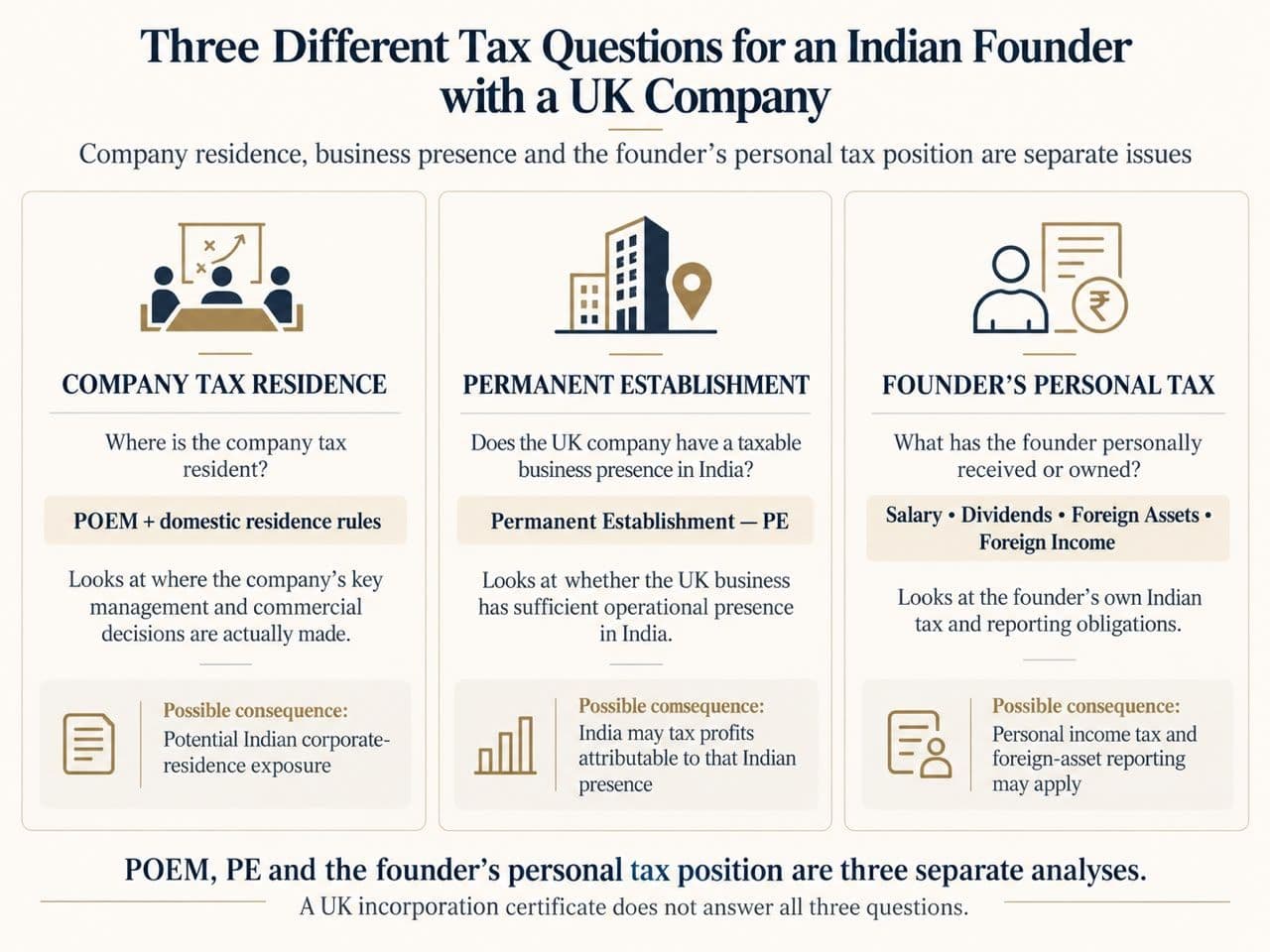
A founder researching “UK company tax from India” can easily mix together three different issues.
Company Tax Residence
Question: Where is the company tax resident?
Main concept: POEM and domestic residence rules.
Possible consequence: The UK company may face Indian corporate-residence exposure if the relevant residence tests are met.
Permanent Establishment
Question: Does the UK company have a taxable business presence in India?
Main concept: Permanent Establishment, or PE.
Possible consequence: India may be able to tax profits attributable to that Indian business presence.
Founder’s Personal Tax
Question: What has the founder personally received or owned?
Main concept: Salary, dividends, interest, foreign assets and foreign-source income.
Possible consequence: The founder may have separate Indian personal-tax and reporting obligations.
These are three different tax questions. POEM, PE and the founder’s personal tax position should not be treated as interchangeable.
2. UK Corporation Tax for the UK Company
For most ordinary trading UK companies, Corporation Tax begins with the company’s taxable profits, not its revenue.
For the financial year beginning 1 April 2026:
Small-profits rate: 19%
Main rate: 25%
Marginal Relief: potentially available between the lower and upper limits.
The published profit limits are £50,000 and £250,000, but those limits can be reduced where the company has associated companies or a short accounting period.
So neither of these statements is safe:
“UK companies always pay 19%.”
or
“UK companies always pay 25%.”
The correct rate depends on the company’s circumstances.
Also distinguish:
Revenue
minus allowable expenses and tax adjustments
= taxable profit
A company receiving £100,000 does not necessarily have £100,000 of taxable profit.
For Indian founders budgeting the entire structure rather than just tax, see UK Company Formation Cost from India.
3. Can a UK Company Become Tax Resident in India?
Indian corporate-residence rules can potentially apply to a foreign company where its Place of Effective Management is in India.
The Income Tax Department defines POEM as the place where the key management and commercial decisions necessary for the conduct of the company’s business as a whole are, in substance, made.
That means tax residence is not determined simply by the company having:
- a British incorporation certificate;
- a London Registered Office;
- a UK bank account;
- a UK telephone number;
- a British domain name;
- board minutes carrying a UK address.
Those facts can exist while important management decisions are actually being taken elsewhere.
For the Indian founder, the practical question becomes:
Who really makes the important decisions, and where are those decisions actually made?
4. What POEM Means in Practice
POEM is about substantive high-level management, not every routine business action.
Facts that may be relevant can include where decisions are made about:
- overall business strategy;
- major commercial contracts;
- financing;
- budgets;
- senior personnel;
- significant investments;
- entry into new markets;
- major operational commitments.
Imagine a founder who:
- lives permanently in India;
- owns all shares in the UK Ltd;
- is its only director;
- decides all strategy from India;
- approves major contracts from India;
- controls financing from India;
- directs the company’s principal commercial decisions from India.
That fact pattern deserves a different analysis from a company where genuine management authority and substantive commercial decision-making exist outside India.
The test is fact-sensitive.
Changing the location written on a board minute does not automatically change where the decision was really made.
5. The ₹50 Crore POEM Threshold
This point should be stated carefully.
CBDT guidance says POEM provisions/guidelines do not apply to a foreign company whose turnover or gross receipts are ₹50 crore or less in a financial year. Current Income Tax Department material repeats that threshold.
For founders, the practical point is useful.
But it should not be rewritten as:
“Every UK company below ₹50 crore is completely outside Indian tax risk.”
That is too broad.
Other questions can still exist independently, including:
- Permanent Establishment;
- Indian-source income;
- individual shareholder tax;
- foreign-asset reporting;
- foreign income;
- related-party transactions.
So the safe principle is:
Apply the ₹50 crore threshold to the POEM framework it addresses, rather than using it as a blanket exemption from all India–UK tax analysis.
6. POEM, Permanent Establishment and Founder Tax Are Not the Same
This distinction is especially important for AI, SaaS, consulting and founder-led companies operating remotely.
POEM asks:
Where is the company effectively managed?
It is a corporate-residence question.
Permanent Establishment asks:
Does the foreign enterprise have sufficient taxable business presence in the other country?
That can arise even if the company itself does not become resident there.
Founder tax asks:
What income or assets does the individual personally have?
That is the shareholder/director’s own tax position.
The UK–India treaty contains PE provisions covering fixed places of business and specified agency arrangements, among other circumstances. It also makes clear that mere ownership or control between companies does not by itself create a PE.
Therefore:
POEM ≠ PE ≠ shareholder personal tax.
Do not use the three terms interchangeably.
7. When Managing a UK Company from India Deserves Review
There is no single sentence that turns remote management into a tax conclusion.
Instead, look at the factual pattern.
Questions worth reviewing include:
Management
Where does the founder usually make major strategic decisions?
Contracts
Where are important customer or supplier agreements negotiated and approved?
People
Are employees, contractors or senior decision-makers working in India?
Premises
Does the business operate from a fixed commercial location in India?
Authority
Does somebody in India habitually exercise authority over significant contracts or business commitments?
Operations
Where is the substantive work generating the business income actually performed?
Group structure
Is an Indian company providing staff, technology, management or other services to the UK company?
One fact by itself rarely tells the whole story.
For example:
Working from India does not automatically prove POEM or PE.
But a structure where the founder, management, personnel, decision-making and core economic activity are overwhelmingly located in India deserves professional review rather than being ignored because the invoice carries a UK company name.
For technology businesses where Indian development teams are common, see UK Company for Indian SaaS, AI & Technology Founders.
8. A UK Registered Office Is Not Tax Substance
A UK company must maintain an appropriate Registered Office.
That address serves an important Companies House function.
It does not, by itself, prove that:
- strategic management occurs there;
- directors work there;
- employees operate there;
- contracts are negotiated there;
- commercial decisions are made there.
Therefore:
Registered Office ≠ Place of Effective Management.
Similarly, a Virtual Business Address can be useful commercially without proving where substantive management takes place.
This distinction is important because international founders sometimes assume that purchasing a UK address changes their tax-residence position.
It does not automatically do so.
For the company-law distinction between addresses, use Registered Office vs Director Service Address.
9. What If Both India and the UK Treat the Company as Resident?
This is where the UK–India Double Taxation Convention becomes especially important.
It is outdated to say:
“If both countries consider the company resident, POEM automatically decides which country wins.”
The treaty has been modified by the Multilateral Instrument.
For a dual-resident person other than an individual, the competent authorities of India and the UK are to endeavour to determine treaty residence by mutual agreement, having regard to factors including:
- Place of Effective Management;
- place of incorporation or constitution;
- other relevant circumstances.
If no agreement is reached, treaty relief is not automatically available except to the extent and in the manner the competent authorities agree.
That is a significant point.
It means founders should aim to avoid creating an unnecessary dual-residence problem rather than assuming the treaty will automatically solve it afterwards.
10. The Indian Founder’s Own Tax and Reporting Position
The company’s tax does not replace the founder’s personal tax analysis.
An Indian founder may potentially receive:
- salary;
- directors’ remuneration;
- dividends;
- interest;
- another type of payment.
Each category can have different treatment.
Use this sequence:
UK company earns income
↓
UK company calculates its own taxable profit
↓
company pays or retains value according to company law/accounting
↓
founder analyses the personal tax consequence of anything actually received
This is why:
£100,000 company revenue ≠ £100,000 personal income.
At the same time, the founder may have foreign-asset disclosure requirements even where no dividend has yet been paid.
11. Schedule FA, Schedule FSI, Schedule TR and Form 67
These items are related but they do different jobs.
Schedule FA — Foreign Assets
Schedule FA is used for relevant foreign assets and foreign interests.
Income Tax Department guidance expressly includes:
- foreign depository accounts;
- foreign custodian accounts;
- foreign equity and debt interests;
- financial interests in entities outside India;
- certain signing-authority accounts;
- other foreign assets.
Therefore, ownership of shares in a UK company can be relevant to Schedule FA for an applicable Indian resident.
However, Schedule FA generally need not be completed by someone who is non-resident or resident but not ordinarily resident — RNOR.
Schedule FSI — Foreign Source Income
Schedule FSI is used to report relevant income accruing or arising from sources outside India for residents.
Schedule TR — Tax Relief
Schedule TR summarises relief claimed in India for foreign taxes paid and reflects information reported through Schedule FSI.
Form 67 — Foreign Tax Credit
Where a resident taxpayer claims Foreign Tax Credit under Rule 128, Form 67 provides the prescribed information.
The Income Tax Department states that the credit is allowed subject to the taxpayer furnishing the required particulars in Form 67 within the prescribed timeline.
So:
Foreign Tax Credit is not something to assume happens automatically because the UK and India have a tax treaty.
Reporting and procedural requirements matter.
12. Dividends, Salary and Retained Profits
These three situations should not be mixed.
Dividends
A dividend is a distribution made by the company to its shareholder from legally available profits.
For an Indian resident shareholder, receipt of a UK company dividend can create an Indian personal-tax and reporting question.
The UK–India treaty contains specific dividend provisions, but the correct domestic and treaty treatment depends on the facts and should not be reduced to a universal headline rate.
Salary
Salary is remuneration for work.
Relevant factors can include:
- where work is physically performed;
- employment relationship;
- payroll obligations;
- Indian personal tax;
- applicable treaty provisions.
A transfer from the company to the founder should not simply be labelled “salary” after the fact without appropriate records and treatment.
Retained profits
A company can retain after-tax profits rather than distribute everything to its shareholder.
That means:
Company profit does not automatically become the founder’s personal cash.
But leaving profits in the company does not by itself eliminate questions about:
- company residence;
- PE;
- foreign-asset reporting;
- FEMA/ODI.
For the overseas-investment side rather than tax, use FEMA & RBI Rules for Indian Founders with a UK Company.
13. Four Common Indian-Founder Structures
Different structures produce different questions.
Scenario A — Indian Consultant Personally Owns the UK Ltd
Structure
Indian resident individual
↓
UK Limited Company
↓
International clients
Main questions
- Where are the company’s important decisions made?
- Where does the founder physically perform the work?
- Does an Indian business presence exist?
- What does the founder receive: salary, dividend or something else?
- Have foreign shares and foreign income been reported correctly?
Important clarification
Living and working from India does not automatically establish that the UK company is Indian-resident or that a PE exists.
It does, however, create facts worth reviewing rather than assuming that UK incorporation settles the tax position.
Scenario B — Indian SaaS Founder
Structure
Indian founder
↓
UK Ltd
↓
International SaaS customers
Development may still happen largely in India.
Main questions
- Where is strategy controlled?
- Who owns or licenses the IP?
- Where is development performed?
- Is there an Indian team or entity?
- Are there related-party payments?
- Could POEM or PE questions arise?
For the complete operational structure, use UK Company for Indian SaaS, AI & Technology Founders.
Scenario C — Indian Amazon or E-Commerce Founder
Structure
Indian founder/business
↓
UK Ltd
↓
Amazon / Shopify / UK inventory / customers
Main questions
- Where is management?
- Where is inventory?
- Who imports the products?
- Does UK VAT apply?
- What income does the founder receive?
- Does the business have meaningful operations in India and/or the UK?
For the operating model, use UK Company for Indian Amazon, E-Commerce & Exporters.
Scenario D — Indian Pvt Ltd Owns the UK Company
Structure
Indian Private Limited Company
↓
UK Limited Company subsidiary
↓
UK customers / employees / operations
This is no longer simply a personally owned founder structure.
Questions may include:
- UK Corporation Tax;
- Indian overseas-investment rules;
- intercompany transactions;
- transfer pricing;
- group accounting;
- management;
- PE;
- treaty treatment.
For this structure, use UK Subsidiary for Indian Companies.
If the founder has not yet decided between an Indian Pvt Ltd and a UK Ltd, use Indian Private Limited vs UK Limited Company.
14. Already Running Your UK Company Entirely from India?
Do not automatically assume the structure is wrong.
But do not assume it is safe merely because Companies House accepted it either.
Review the actual facts.
Company
- When was it incorporated?
- What is its turnover?
- What are its taxable profits?
- What does the business actually do?
Management
- Who makes strategic decisions?
- Where are those decisions made?
- Where are significant contracts approved?
Operations
- Where do employees and contractors work?
- Is there an Indian office or fixed business location?
- Does anyone in India regularly negotiate or conclude significant business?
Founder
- Where is the shareholder tax-resident?
- Is the founder ROR, RNOR or non-resident for relevant Indian purposes?
- Has the founder received salary?
- Has the founder received dividends?
Reporting
- Have UK shares been considered for Schedule FA?
- Has foreign-source income been reported appropriately?
- Has foreign tax credit been claimed?
- Was Form 67 required?
Group relationships
- Is there an Indian company providing services to the UK Ltd?
- Are there intercompany invoices?
- Do transfer-pricing questions arise?
Then separate the outcome into three questions:
1. Corporate residence — POEM
2. Indian business presence — PE
3. Founder personal tax/reporting
That is much more useful than simply asking:
“Do I pay tax in Britain or India?”
The answer may involve both jurisdictions, different taxpayers and different income streams.
15. Practical India–UK Tax Review Checklist
Before operating a UK company from India, review the following.
UK company
What profit does the company expect to make?
Does it have associated companies?
Has UK Corporation Tax been considered correctly?
Management
Who makes the key strategic decisions?
Where are those decisions actually made?
India operations
Does the UK company have staff, contractors or premises in India?
Does anyone in India habitually negotiate or approve important contracts?
Founder
What is the founder’s Indian residential status?
Does the founder receive salary, dividends or other payments?
Foreign assets
Are the UK shares reportable in Schedule FA?
Are foreign bank accounts or signing authority relevant?
Foreign income
Does Schedule FSI apply?
Does Schedule TR apply?
Is Form 67 required for Foreign Tax Credit?
Group structure
Is an Indian company trading with the UK company?
Are related-party transactions commercially documented?
FEMA
Was the UK investment/funding handled correctly under India’s overseas-investment framework?
For that last question, use the dedicated FEMA and RBI guide .
Frequently Asked Questions
Does a UK Ltd owned by an Indian resident pay UK tax?
A UK-resident company is generally subject to UK Corporation Tax on its taxable profits. The 2026 rates are 19% for qualifying small profits and 25% at the main rate, with Marginal Relief potentially applying between the published limits.
Can an Indian resident own a UK Limited Company?
Generally, yes. Ownership is a separate question from company tax residence, Indian overseas-investment rules and the founder’s own tax position.
For the full ownership/formation framework, use UK Company requirement for Indian Residents
What is POEM?
POEM is the place where the key management and commercial decisions necessary for the company’s business as a whole are, in substance, made.
Does living in India automatically make my UK company Indian tax resident?
No. The analysis depends on the facts and applicable POEM rules.
Is a UK Registered Office proof that the company is managed in Britain?
No. A statutory address does not by itself establish substantive management.
Does the ₹50 crore threshold mean there is no tax risk below ₹50 crore?
No. The threshold concerns the POEM framework described by CBDT. Other tax, PE and reporting questions can exist separately.
What is the difference between POEM and PE?
POEM concerns where the company is tax resident.
PE concerns whether an enterprise has sufficient taxable business presence in another jurisdiction.
They are separate concepts.
Can a UK company have a PE in India?
Potentially, depending on facts such as fixed business presence, services and certain agency activities. The UK–India treaty contains detailed PE rules.
What happens if both India and the UK consider the company resident?
The current treaty does not simply allocate a dual-resident company automatically according to POEM. The competent authorities are to endeavour to determine treaty residence by mutual agreement, considering POEM, place of incorporation and other relevant factors.
Must an Indian resident report shares in a UK company?
Relevant Indian residents can have Schedule FA reporting obligations for foreign equity and financial interests. Residence category matters, including whether the individual is RNOR or non-resident.
What is Schedule FSI?
It reports relevant foreign-source income for residents.
What is Schedule TR?
Schedule TR summarises relief claimed in India for taxes paid outside India.
What is Form 67?
Form 67 is used to furnish the prescribed information when an eligible resident taxpayer claims Foreign Tax Credit under Rule 128.
Does the UK–India treaty mean I cannot be taxed twice?
The treaty contains mechanisms for allocating taxing rights and relieving eligible double taxation, but relief depends on the applicable facts, treaty provisions and procedural requirements. It should not be treated as an automatic “pay tax only once anywhere” rule.
How Seven Oak Prestige Can Help
Seven Oak Prestige supports Indian founders and businesses with the UK side of company establishment and administration.
Depending on the engagement, support can include:
- UK Limited Company formation;
- Indian-parent / UK-subsidiary setup;
- Registered Office;
- Director Service Address;
- Companies House administration;
- Companies House identity-verification support;
- KYC preparation;
- banking-readiness coordination;
- VAT or EORI support where relevant;
- post-incorporation coordination.
Seven Oak Prestige does not provide personalised Indian tax opinions.
If your circumstances involve POEM, Permanent Establishment, Schedule FA, Form 67, Foreign Tax Credit, transfer pricing or treaty residence, the UK company setup should be coordinated with an appropriately qualified tax professional.
Discuss your India–UK company setup
Related India Guides
UK Company Formation for Indian Residents
Use this when the main question is whether and how an Indian resident can establish the company.
UK Company for Indian Residents: Rules, FEMA & Process
FEMA / ODI / LRS
Use this for the India-side ownership and overseas-investment framework.
FEMA & RBI Rules for Indian Founders with a UK Company
Cost
Use this for Companies House fees, first-year costs, renewals and India-side budgeting.
UK Company Formation Cost from India
Banking
Use this for bank/fintech eligibility, KYC and banking readiness.
UK Business Bank Account for Indian Residents
Indian company vs UK Ltd
Use this when the founder has not decided which jurisdiction/structure should be primary.
Indian Private Limited vs UK Limited Company
Indian parent → UK subsidiary
Use this for established Indian companies expanding into Britain.
UK Subsidiary for Indian Companies
SaaS, AI and technology
Use this for software, IP, Indian development teams, investors and SaaS operations.
UK Company for Indian SaaS, AI & Technology Founders
Amazon, e-commerce and exports
Use this for inventory, VAT, EORI, imports and e-commerce operations.
UK Company for Indian Amazon, E-Commerce & Exporters
About the Author
Isaac Jackson
Founder & Managing Director, Seven Oak Prestige Ltd
Isaac Jackson supports international founders and overseas businesses with UK company formation, Companies House administration, statutory address arrangements, KYC preparation, compliance coordination and post-incorporation establishment.
This article is an educational guide to the India–UK company-tax questions founders commonly encounter. It is not a tax opinion.
Personalised Indian tax, POEM, PE, treaty, foreign-asset, transfer-pricing and Foreign Tax Credit advice should be obtained from an appropriately qualified professional.
Seven Oak Prestige Ltd
Company Registration No. 16903092
Registered Office: 124 City Road, London EC1V 2NX, United Kingdom
Editorial Methodology
Last reviewed: 25 September 2026
This article was reviewed against current primary material including:
- HMRC Corporation Tax rates and allowances;
- current Indian corporate-residence and POEM guidance;
- CBDT POEM guidance and the ₹50 crore threshold;
- Income Tax Department Schedule FA guidance;
- Income Tax Department Schedule FSI and Schedule TR guidance;
- Rule 128 and Form 67 guidance;
- the UK–India Double Taxation Convention as modified by the Multilateral Instrument.
The current UK–India treaty text confirms that a dual-resident entity is dealt with through competent-authority mutual agreement, taking account of POEM, incorporation and other relevant factors, rather than through an automatic POEM-only tie-breaker.
The Income Tax Department currently confirms the foreign-company POEM framework and the ₹50 crore threshold.
Schedule FA guidance expressly includes foreign equity and financial interests, while the Income Tax Department distinguishes Schedule FSI, Schedule TR and Form 67 for foreign-source income and Foreign Tax Credit.
HMRC confirms the 2026 Corporation Tax structure used in this guide.
Correction and Update Policy
Cross-border tax rules can change.
Seven Oak Prestige reviews this guide when material changes occur to:
- UK Corporation Tax;
- Indian corporate-residence guidance;
- POEM;
- the UK–India tax treaty;
- foreign-asset reporting;
- Foreign Tax Credit rules.
Where a material factual correction becomes necessary, the article should be updated and the Last reviewed date changed accordingly.
Important Disclaimer
This article provides general educational information only.
It is not personalised:
- Indian tax advice;
- UK tax advice;
- legal advice;
- treaty advice;
- POEM advice;
- Permanent Establishment advice;
- transfer-pricing advice;
- FEMA advice;
- investment advice.
Tax residence, POEM, Permanent Establishment, foreign-asset disclosure and Foreign Tax Credit depend on the taxpayer’s actual circumstances.
Seven Oak Prestige Ltd provides UK company-formation and business-establishment support. Where specialist India-side analysis is required, obtain advice from an appropriately qualified professional.