
Stripe, Wise & Airwallex for Indian Founders - UK vs India 2026

Stripe, Wise & Airwallex for Indian Founders: UK Company vs Indian Company
For Indian founders selling internationally, the most useful question is not simply:
Which is best — Stripe, Wise or Airwallex?
These platforms perform different functions.
The more important question is:
Should your international payment infrastructure operate through an Indian company or a UK Limited Company — and which provider actually fits the way your business earns, holds and moves money?
That distinction matters because the legal entity behind an application affects the provider’s onboarding and regulatory framework.
An Indian company applying for Stripe India is not entering exactly the same onboarding environment as a UK Limited Company applying through Stripe’s UK framework.
However, incorporating a UK company does not make the Indian connection disappear.
A provider may still assess:
- where the director lives;
- where the shareholders and beneficial owners live;
- where the company is actually managed;
- what the business sells;
- where customers are located;
- where funds come from;
- expected transaction volumes;
- website and business evidence.
The correct principle is therefore:
A UK company can change the provider framework. It does not guarantee Stripe, Wise or Airwallex approval.
If you are still deciding whether a UK entity makes commercial sense, begin with our UK Company Formation from India — Complete 2026 Guide.
Quick Answer
For Indian founders, Stripe, Wise and Airwallex should not be compared as though they perform the same job.
Stripe
Primarily designed around:
- online card payments;
- checkout;
- payment processing;
- subscriptions;
- billing.
Wise Business
Primarily useful for:
- receiving international business payments;
- multi-currency balances;
- currency conversion;
- international transfers;
- supplier and contractor payments.
Airwallex
Combines several financial functions, including:
- multi-currency business accounts;
- international transfers;
- FX;
- company cards;
- expense management;
- payment acceptance.
A business may legitimately use more than one provider.
For example:
Stripe
↓
Customer checkout and subscription payments
Wise or Airwallex
↓
Receiving, holding, converting and moving international funds
But the company structure should come first.
Do not create a UK company solely because you believe it will “unlock Stripe”.
The UK entity should have a genuine commercial role even if one particular fintech later changes its eligibility policy.
Stripe vs Wise vs Airwallex: What Each One Actually Does
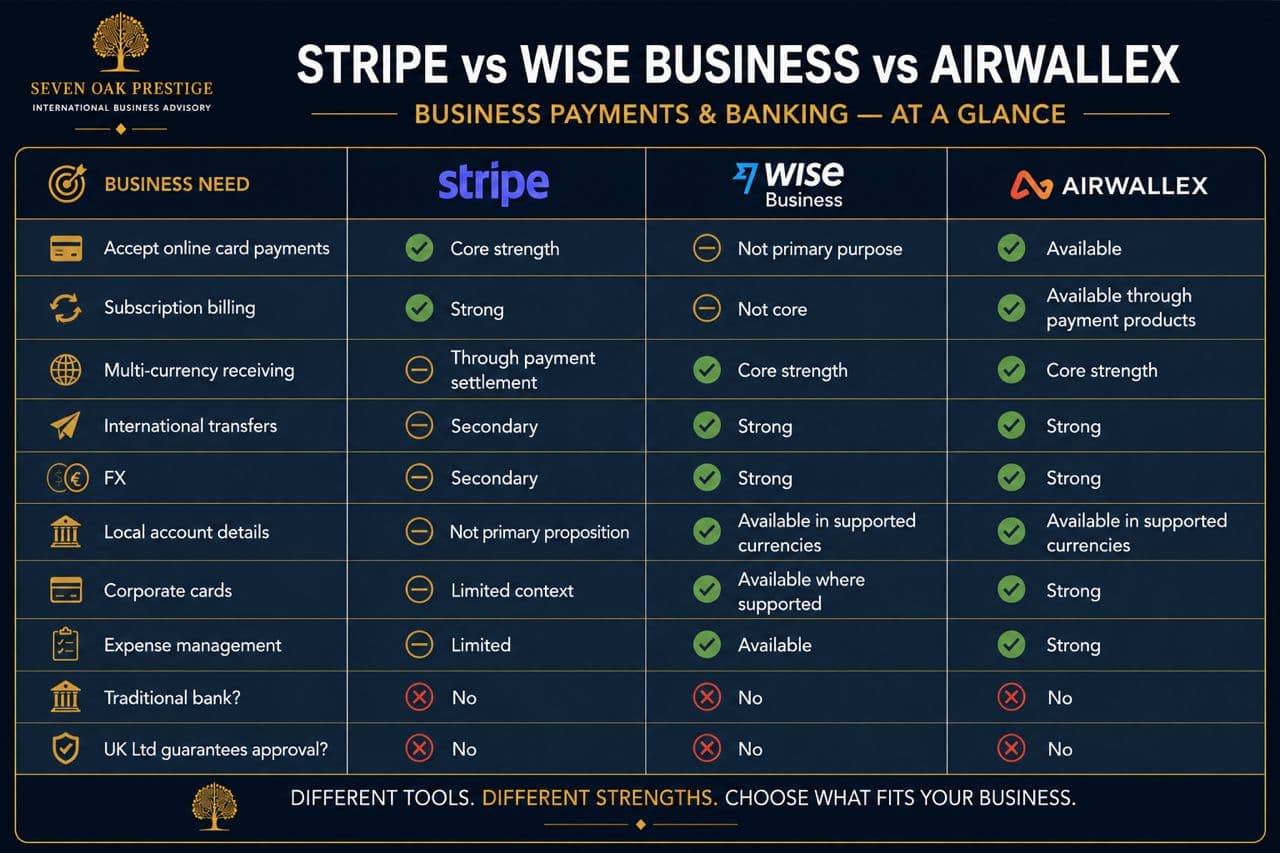
Wise currently lists a £50 setup fee for its UK Business offering that includes the relevant receiving/account-details functionality. Airwallex’s current UK Explore plan is £19 per month excluding VAT, or £0 where the qualifying £10,000 monthly deposit or balance condition is met. Transactional charges can apply separately.
1. Why Indian Founders Compare Stripe, Wise and Airwallex
Many Indian businesses become international very early.
A SaaS founder in Bengaluru, an AI company in Hyderabad, a consultancy in Mumbai or an e-commerce business in Delhi may serve customers in:
- the United States;
- the United Kingdom;
- the European Union;
- the UAE;
- Singapore;
- Australia;
- Canada.
That can create requirements such as:
- accepting international cards;
- recurring subscriptions;
- receiving USD, GBP and EUR;
- paying overseas contractors;
- paying suppliers;
- reducing FX friction;
- receiving marketplace settlements;
- managing international company expenses.
The mistake is assuming one provider must solve every layer.
Usually, it does not.
A better payment architecture starts by asking:
- What does the business sell?
- How do customers pay?
- Which currencies are received?
- Which currencies are spent?
- Where are customers and suppliers located?
- Which legal entity signs the contracts?
- Which provider is best suited to each financial function?
2. Indian Company vs UK Company: Decide This Before Choosing the Provider
This is the central decision.
If you operate through an Indian company
The legal applicant remains an Indian entity.
Depending on the activity and provider, the business may need to address India-specific:
- KYC;
- banking;
- foreign-exchange rules;
- RBI requirements;
- export considerations;
- taxation;
- reporting obligations.
If you operate through a UK Limited Company
The provider application is made in the name of the UK company.
But the founder’s Indian residence remains relevant.
A typical structure may look like:
UK Limited Company
↓
Indian-resident director
↓
Indian-resident shareholder / PSC
↓
International customers
This is not inherently problematic.
What matters is accuracy and consistency.
A UK company changes the legal applicant. It does not change the truth about who owns, manages and operates the business.
For Indian residents considering ownership of a foreign company, the company structure should also be assessed alongside FEMA, RBI and Overseas Investment rules.
3. Stripe India in 2026
Stripe’s current onboarding model in India differs materially from its standard self-service model in several other markets.
Stripe states that new Indian accounts are currently invite-only. Businesses in India cannot simply complete ordinary public signup and instead need to request an invitation. Stripe says it is currently supporting a limited number of businesses, with a focus on international expansion.
For an Indian business seeking international-payment capability, Stripe may request information including:
- identification details;
- company information;
- website or app-store information;
- business description;
- bank details;
- Import Export Code where applicable;
- RBI transaction purpose information where relevant.
The important conclusion is:
Stripe is available in India, but new onboarding is currently selective rather than fully open self-service.
4. Stripe India KYC Changed in 2026
There is another important development for Indian founders.
Stripe states that, from 1 January 2026, revised RBI Payment Aggregator requirements introduced liveness checks for new users onboarding to Stripe in India.
Stripe conducts this through a live video KYC process after the invited applicant has submitted the initial required information.
This means the comparison should not be simplified into:
Stripe India = difficult
versus:
Stripe UK = easy.
The better comparison is:
Different entity + different jurisdiction + different regulatory framework + different onboarding requirements.
5. What Changes When an Indian Founder Uses a UK Company?
Suppose an Indian resident establishes:
ABC Technologies Ltd
in England and Wales.
The company — rather than an Indian entity — is now the legal applicant for the relevant UK provider account.
That changes the corporate onboarding context.
But providers can still review:
- the Indian-resident director;
- beneficial ownership;
- residential addresses;
- source of funds;
- actual operating location;
- customer geography;
- business activity.
For a UK entity, information submitted to a provider should also be consistent with Companies House records.
That means information such as:
- company name;
- company number;
- directors;
- PSCs;
- registered office;
- ownership;
- business activity
should not conflict with the financial-provider application.
A Certificate of Incorporation proves that the company exists.
It does not compel a provider to approve the business.
6. A UK Company Changes the Application Context — Not the Founder’s Identity
This is particularly important for Indian founders.
Consider this entirely plausible structure:
UK company
but:
- sole director lives in India;
- shareholder lives in India;
- founder manages the business from India;
- software development happens in India;
- initial capital originates from India;
- customers are international.
There is no need to disguise those facts.
Do not:
- claim UK personal residence when you live in India;
- describe a registered office as your personal residence;
- invent UK employees;
- describe a mail-handling address as a staffed operating office;
- alter the business model simply because you believe another description will look safer.
The strongest KYC application is normally the one where:
Companies House
- ●
ownership
- ●
website
- ●
business description
- ●
addresses
- ●
transactions
all tell the same story.
7. Your Website Is Part of the Fintech Application
Indian founders often focus on corporate documents and underestimate the importance of their website.
For an online business, the website helps the provider understand:
- what the company sells;
- who its customers are;
- pricing;
- subscription model;
- delivery model;
- refunds;
- contact information;
- legal business identity.
For example:
Companies House: ABC Technologies Ltd
Stripe application: ABC Technologies Ltd
Website brand: AlphaAI
Website footer: no reference to ABC Technologies Ltd
Terms: another company name
A trading brand can legitimately differ from the legal company name.
But the relationship should be clear.
For fintech onboarding:
Transparency is stronger than cosmetic complexity.
8. What Indian Founders Should Prepare Before Applying Through a UK Company
There is no single universal document pack.
Providers can request different evidence depending on the company and risk profile.
However, an Indian founder should generally be prepared to demonstrate the following.
Corporate identity
- company name;
- company number;
- Certificate of Incorporation;
- registered office;
- directors;
- shareholders and PSCs;
- genuine business activity.
Personal KYC
- valid identification;
- genuine Indian residential address;
- proof of address where requested;
- ownership information.
Business evidence
- website;
- business-domain email;
- clear description of products or services;
- terms and privacy information where relevant;
- refund/cancellation policy where relevant;
- customer geography;
- supplier geography;
- invoices, contracts or supporting evidence where available.
Financial profile
- expected monthly turnover;
- average transaction size;
- currencies;
- source of initial capital;
- source of ongoing business funds;
- expected sending countries;
- expected receiving countries.
The practical rule is:
Prepare first. Apply second.
9. Wise Business for an Indian Founder With a UK Company
Wise performs a substantially different role from Stripe.
For an internationally active UK company, Wise Business can be relevant for:
- receiving international payments;
- supported local account details;
- multi-currency balances;
- currency conversion;
- international transfers;
- supplier payments;
- contractor payments.
Wise’s current UK/EEA verification guidance shows that it can ask about business activity, expected monthly volumes, sending and receiving countries, source of business funds, beneficial owners, directors and personal identification of the account holder.
That leads to an important distinction:
Wise is not verifying only the incorporation certificate. It is verifying the business behind the company.
For the broader account-opening analysis, read our UK Business Bank Account for Indian Residents — 2026 Guide.
10. Registered Address and Trading Address Matter With Wise
A UK registered office and the location from which the business is genuinely operated are not necessarily the same thing.
Wise’s verification framework distinguishes between registered-address and trading/business information, and it may ask for a separate trading address where applicable.
This is another reason not to create artificial UK presence.
If the founder genuinely operates from India:
- use the legitimate Indian residential information where requested;
- correctly identify the UK company’s registered office;
- describe the actual operating model accurately.
A London registered office does not automatically make the Indian director a London resident.
11. Wise Business UK Cost in 2026
Wise currently lists:
Registration: Free
Full Wise Business feature setup: £50 one-time setup fee
Its current UK pricing page describes this as the setup charge for the complete Wise Business feature set, including relevant account-details functionality.
Additional charges can apply to:
- transfers;
- currency conversion;
- certain international payment routes;
- other account features.
So the correct statement is not simply:
“Wise Business is free.”
A more accurate description is:
Registration can be free, while setup and transactional charges apply depending on the features and transactions used.
12. Airwallex for Indian Founders Using a UK Company
Airwallex sits somewhere between payment infrastructure, multi-currency financial operations and spend management.
Its current UK Explore offering includes:
- business accounts;
- local account details in 20+ currencies;
- international transfers;
- FX;
- company and employee cards;
- expense-management functionality.
This can make it particularly relevant for:
- SaaS;
- AI and technology;
- e-commerce;
- global-service companies;
- businesses paying international contractors;
- import/export;
- companies with meaningful FX needs.
But again:
Product fit does not equal guaranteed eligibility.
13. Airwallex UK Pricing in 2026
Airwallex’s current UK Explore plan is:
£19 per month excluding VAT
or:
£0 per month
where the company either:
- deposits at least £10,000 equivalent during the monthly subscription period; or
- holds the required minimum £10,000 equivalent wallet balance at the relevant period end.
Airwallex confirms that separate transaction charges for items such as FX, transfers and payment processing can still apply.
So it would also be inaccurate to describe Airwallex simply as:
“free”
or:
“£19 per month.”
The actual cost depends on the plan conditions and usage.
14. What Airwallex Checks for a UK Company
Airwallex requires UK companies to complete KYC/KYB verification.
Its current UK documentation indicates that a limited company can be asked for:
- incorporation documents;
- company constitutional documents;
- identity and residential-address information for directors;
- identity and residential-address information for UBOs;
- liveness verification for the authorised applicant.
Where ownership is not easily identifiable, additional ownership documentation may also be required.
Again, the same principle applies:
The UK company is the legal customer, but the provider looks through the company to understand the people and activity behind it.
15. Which Provider Fits Which Indian Founder?
There is no universal winner.
The right payment stack depends on the business model.
Indian SaaS or AI founder
Typical needs:
- subscriptions;
- online card payments;
- international customers;
- USD/GBP/EUR;
- contractor payments;
- FX.
A possible architecture might be:
Stripe
→ subscriptions and checkout
plus
Wise or Airwallex
→ receiving, FX and international operations
For the company-structure side, see our UK Company for Indian SaaS, AI & Technology Founders.
Indian consultant or agency
Typical needs:
- international invoices;
- B2B payments;
- multi-currency receiving;
- international transfers;
- lower dependency on card processing.
For a consultant invoicing corporate clients directly, an international receiving and FX solution may sometimes be more important than sophisticated card checkout.
Wise or Airwallex may therefore play a larger role than Stripe.
Indian e-commerce founder
Typical needs:
- checkout;
- card payments;
- refunds;
- supplier payments;
- international currencies;
- marketplace settlements.
Stripe may be important at checkout.
Wise or Airwallex may still be useful behind the business for:
- FX;
- treasury;
- supplier transfers;
- operational expenses.
See our UK Company for Indian Amazon, E-Commerce & Exporters.
Existing Indian Pvt Ltd expanding internationally
An established Indian company may already have:
- business banking;
- financial statements;
- turnover history;
- employees;
- customers;
- tax records.
The more important question can therefore become:
Should the international activity remain in the Indian company, operate through a UK subsidiary, or use another structure?
That should be decided before choosing the payment provider.
For a deeper entity comparison, read Indian Private Limited vs UK Limited Company: Which Structure Fits an Indian Founder?.
What About Revolut Business?
Revolut Business can also be relevant for some Indian founders with UK companies.
It is intentionally not included in the main Stripe–Wise–Airwallex comparison because this guide is designed around three distinct payment-stack roles:
- payment processing;
- multi-currency receiving and transfers;
- broader international financial operations.
For the current India-specific Revolut analysis, read our Revolut Business for Indian Residents With a UK Company — 2026 Guide
16. Indian Company vs UK Ltd: Practical Decision Matrix
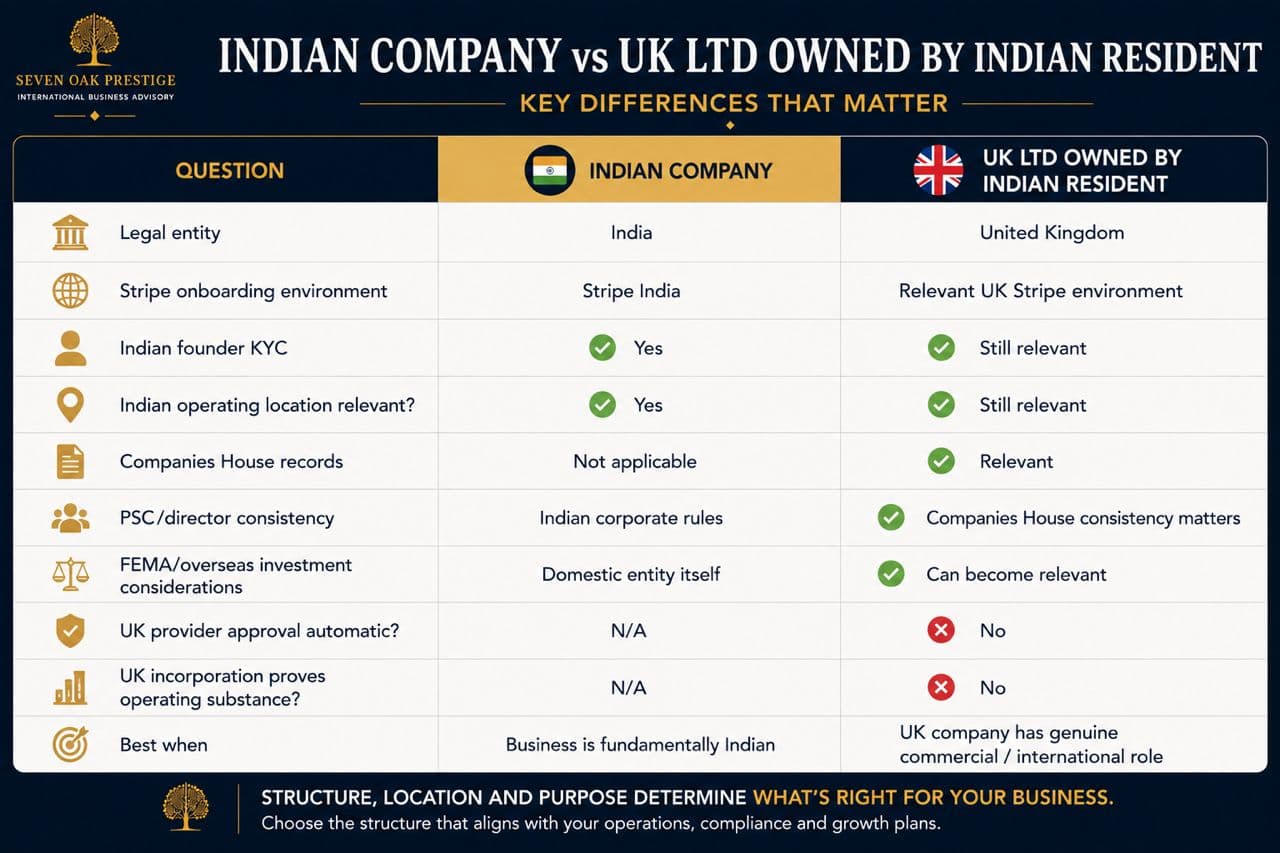
There is no universal winner.
17. Do Not Choose the Company Jurisdiction Around One Provider
This is one of the most important points in the guide.
The weak sequence is:
I want Stripe
↓
Someone told me UK Stripe is easier
↓
Form UK company
↓
Work out tax, FEMA and banking later
The stronger sequence is:
Where are my customers?
↓
Where is the business actually managed?
↓
Which entity should contract with customers?
↓
What tax and regulatory consequences follow?
↓
Which payment providers fit that entity?
Provider policy can change.
Your company structure should still make commercial sense if Stripe, Wise or Airwallex changes its rules later.
18. UK Company Does Not Mean UK-Only KYC
A common misconception is that once the company is British, the onboarding becomes entirely UK-based.
That is not how international KYC normally works.
A provider can still ask:
- where directors live;
- where beneficial owners live;
- where the company is operated;
- where staff or contractors are located;
- where funds originate;
- which countries send money;
- which countries receive money.
The correct objective is:
UK legal company
- ●
truthful Indian founder information
- ●
clear international business model
not:
UK appearance at all costs.
19. FEMA, RBI and Indian Tax Still Matter
A UK company can provide a genuine international corporate structure.
It does not remove India-side obligations.
Where an Indian resident owns or funds a foreign company, the structure may interact with:
- FEMA;
- Overseas Investment rules;
- remittance requirements;
- Indian tax;
- foreign-asset reporting.
For the regulatory side, read our FEMA, RBI & Overseas Investment Rules for Indian Founders With UK Companies.
For the tax side, see our UK Company Tax for Indian Residents — POEM & UK–India DTAA Guide.
The payment stack should align with the legal and tax structure rather than contradict it.
20. Banking and Payment Processing Are Different
Stripe, Wise, Airwallex and traditional business banking are not interchangeable.
A business may require several distinct layers.
Payment processing
Used to collect:
- card payments;
- checkout payments;
- subscriptions.
Account infrastructure
Used to:
- receive transfers;
- hold operational funds;
- manage currencies.
FX
Used to convert money between currencies.
Banking relationship
May be required for broader company operations.
Accounting
Used to reconcile all of the above.
A strong payment stack can therefore involve several providers without unnecessarily duplicating their functions.
21. Cost Comparison at a Glance
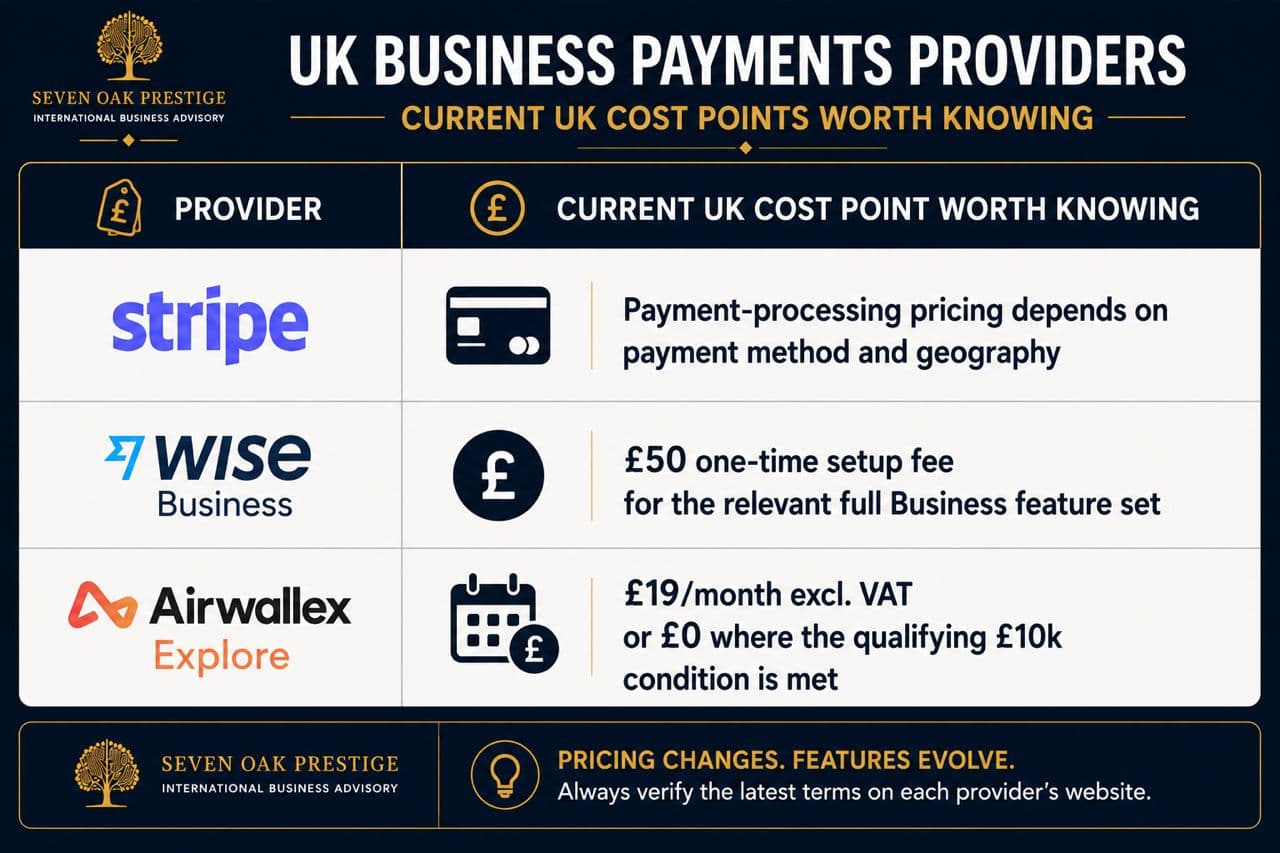
These are not prices for equivalent products.
Wise is not Stripe.
Stripe is not Airwallex.
The cheapest provider is irrelevant if it does not solve the company’s main financial need.
22. Indian Founder Payment-Readiness Checklist
Before applying to Stripe, Wise, Airwallex or another provider, confirm the following.
Company
☐ Correct legal entity
☐ Directors correctly recorded
☐ Ownership / PSC records correct
☐ Business activity coherent
☐ Registered address accurate
Founder
☐ Genuine residential address
☐ Valid identification
☐ Proof of address available where required
☐ Ownership information consistent
Website
☐ Product or service clearly explained
☐ Relationship between brand and legal company clear
☐ Contact information available
☐ Terms and privacy information where appropriate
☐ Refund/cancellation information where appropriate
Transactions
☐ Expected monthly turnover understood
☐ Average payment size understood
☐ Customer countries identified
☐ Supplier countries identified
☐ Currencies identified
☐ Source of initial funds understood
Provider fit
☐ Need card processing?
☐ Need subscriptions?
☐ Need local receiving details?
☐ Need FX?
☐ Need supplier transfers?
☐ Need corporate cards?
☐ Need expense management?
If those answers are unclear, do not begin with the fintech application.
Begin with the business architecture.
23. When an Indian-Company-Led Setup May Make More Sense
An Indian-company-led structure may remain appropriate where:
- the business is fundamentally managed and operated through India;
- the existing Indian company already serves the commercial purpose;
- the necessary payment providers support the required activities;
- there is no independent reason to create a foreign entity.
A UK company should not be added simply to make the business look more international.
24. When a UK-Company-Led Setup May Make More Sense
A UK Ltd may deserve consideration where:
- the UK entity has a genuine contractual role;
- customers or counterparties benefit commercially from dealing with a UK company;
- the founder wants genuine UK corporate infrastructure;
- the business is expanding internationally;
- ownership, tax and FEMA implications have been considered;
- the company is not being incorporated only to access a payment provider.
There is no rule that every internationally focused Indian founder should create a UK company.
The correct structure depends on the real business.
How Seven Oak Prestige Supports Indian Founders
Seven Oak Prestige is a UK-based advisory firm supporting Indian founders directly with UK company establishment, banking readiness and cross-border operational preparation.
Depending on the engagement, support can include:
- UK company formation;
- ownership and PSC preparation;
- Companies House requirements;
- identity verification;
- registered-office arrangements;
- business-activity structuring;
- KYC readiness;
- expected transaction-profile preparation;
- supporting-document preparation;
- banking and payment-provider readiness;
- post-incorporation planning.
We do not guarantee approval from Stripe, Wise, Airwallex, Revolut or any other financial provider.
Each provider conducts its own KYC/AML and risk assessment.
The objective is to ensure that the company, business activity and supporting information are coherent before the application reaches a compliance team.
Frequently Asked Questions
Can an Indian founder use Stripe?
Potentially. New Stripe India accounts are currently invite-only, and Stripe says it is presently supporting a limited number of businesses with a focus on international expansion.
Can a UK company owned by an Indian resident apply for Stripe?
Potentially, subject to Stripe’s UK eligibility, verification and risk requirements. UK incorporation does not guarantee approval.
Is Stripe India the same as Stripe UK?
It is the same global provider, but the legal merchant entity, jurisdiction and onboarding requirements differ.
Does forming a UK Ltd automatically unlock Stripe?
No.
Can an Indian resident use Wise Business with a UK company?
Potentially, subject to Wise’s current eligibility and verification requirements. Wise can review the business, directors, beneficial owners, addresses, activity, source of funds and expected usage.
How much does Wise Business UK cost?
Wise currently lists a £50 one-time setup fee for the relevant full Business feature set. Transaction and conversion charges can apply separately.
How much does Airwallex UK cost?
Airwallex’s current Explore plan is £19 per month excluding VAT or £0 where its qualifying £10,000 deposit/balance condition is met. Separate transaction charges can still apply.
Is Airwallex a traditional bank?
No. Airwallex is a financial technology platform providing multi-currency account, payment, FX, transfer, card and spend-management infrastructure.
Should I use Stripe or Wise?
They solve different problems. Stripe is primarily payment processing; Wise is primarily international receiving, currency conversion and transfers.
Should I form a UK company because Stripe India is invite-only?
Not solely for that reason. A UK company should have a genuine commercial role independent of one payment provider.
Does a UK registered office make me a UK resident?
No. The company’s registered office and the founder’s personal residential address are separate facts.
Continue Through the India–UK Business Hub
Company formation
UK Company Formation from India — Complete 2026 Guide
Business banking
UK Business Bank Account for Indian Residents — 2026 Guide
Revolut
Revolut Business for Indian Residents With a UK Company — 2026 Guide
FEMA and RBI
FEMA, RBI & Overseas Investment Rules for Indian Founders With UK Companies
UK–India tax
UK Company Tax for Indian Residents — POEM & UK–India DTAA
SaaS, AI and technology
UK Company for Indian SaaS, AI & Technology Founders
E-commerce and exports
UK Company for Indian Amazon, E-Commerce & Exporters
Indian Pvt Ltd vs UK Ltd
Indian Private Limited vs UK Limited Company
Final Takeaway
For Indian founders, Stripe, Wise and Airwallex should not be treated as three interchangeable banking apps.
They solve different parts of the financial infrastructure.
The better decision sequence is:
Business model
↓
Indian company or UK company
↓
ownership / FEMA / tax implications
↓
payment-processing requirements
↓
multi-currency and FX requirements
↓
provider selection
↓
KYC and onboarding
For some Indian founders, the Indian company remains the appropriate structure.
For others, a genuine UK Ltd can provide useful international corporate infrastructure.
But the UK company should never exist simply because someone promised:
“UK company = Stripe approved.”
The stronger question is:
Which legal entity genuinely fits my business, and which payment providers fit that entity?
That is the approach Seven Oak Prestige uses when helping internationally focused founders prepare their UK business structure and payment infrastructure.
Need Help Reviewing Your India–UK Payment Structure?
Review My Payment & Banking Setup
For Indian founders who already have a company and want to review their Stripe, Wise, Airwallex or wider international-payment structure before applying.
Start My UK Company With Payment Readiness in Mind
For Indian founders who have not yet incorporated and want ownership, company structure, KYC, banking and payment-provider requirements considered from the beginning.
About the Author
Isaac Jackson
Founder & Managing Director — Seven Oak Prestige Ltd
Isaac Jackson has 3+ years of hands-on experience supporting international entrepreneurs with UK company formation and business-establishment matters.
Seven Oak Prestige has supported close to 100 UK company formation and establishment cases, including non-resident founders requiring support with company structure, identity verification, KYC preparation, banking readiness and international payment infrastructure.
Editorial Methodology
This guide is prepared using a combination of primary provider sources, current regulatory and market research, practical international-founder experience and ongoing editorial review.
We prioritise official information published by Stripe, Wise and Airwallex when confirming current onboarding conditions, pricing, product functionality and verification requirements.
We also review recurring questions raised by Indian founders so the guide addresses the practical decisions that matter most, including:
- Indian company vs UK company;
- payment processing;
- international receiving;
- FX;
- KYC;
- beneficial ownership;
- genuine residential addresses;
- international transaction flows.
Because fintech eligibility, onboarding procedures and pricing can change, material provider-specific information is periodically reviewed and updated where necessary.
Last reviewed: 1 September 2026
Editorial Disclaimer
This guide provides general educational and business-establishment information.
It does not constitute personalised:
- banking advice;
- payment-services advice;
- legal advice;
- tax advice;
- FEMA advice;
- investment advice.
Stripe, Wise, Airwallex, Revolut and other financial providers:
- set their own eligibility criteria;
- conduct independent KYC/AML checks;
- may request additional documentation;
- can change product availability;
- can change pricing;
- make their own final onboarding decisions.
A UK company does not guarantee access to any financial provider.
Indian residents considering ownership, funding or management of a foreign company may need advice from appropriately qualified Indian tax, legal or regulatory professionals.
Primary Official Sources Reviewed
Stripe — India Account Onboarding
Used to verify the current invite-only position for new Indian Stripe accounts and India-specific onboarding information.
Stripe — India Video KYC
Used to confirm the 1 January 2026 liveness/video-KYC requirement for new Indian Stripe onboarding.
Wise Business — UK Pricing
Used to confirm the current £50 UK Business setup-fee position.
Wise — UK/EEA Business Verification
Used to confirm the current verification framework covering business activity, transaction volumes, countries, source of funds, directors and beneficial owners.
Airwallex — UK Pricing
Used to confirm the current Explore £19/£0 pricing structure and £10,000 waiver conditions.
Airwallex — UK Company Verification
Used to confirm current KYC documentation concerning UK companies, directors, beneficial owners and authorised applicants.