
UK Company for Indian Pharma & MedTech | 2026 Guide

UK market entry, subsidiaries, Companies House, MHRA, medical devices, medicines, digital health, CETA, FEMA/ODI, VAT and regulatory readiness for Indian businesses
Last reviewed : 02 October 2026
India is one of the world’s major pharmaceutical, biotechnology and medical-technology centres. For Indian pharmaceutical manufacturers, MedTech businesses, diagnostics companies, biotech groups, HealthTech founders and life-sciences organisations, the United Kingdom can provide an important route for international expansion.
But entering the UK successfully involves considerably more than registering a UK Limited Company.
An Indian business can generally establish a UK company or UK subsidiary. The more important question is what the UK entity will actually do.
Will it contract with UK customers? Import or distribute products? Employ staff? Hold inventory? Support regulatory responsibilities? Develop partnerships? Operate healthcare services? Or provide a commercial presence while manufacturing and core operations remain in India?
That distinction matters because the corporate structure and the regulatory pathway are separate.
A pharmaceutical company importing medicines from India may face MHRA licensing and medicines requirements that do not apply to an ordinary software business.
A medical-device manufacturer may require a UK Responsible Person without necessarily needing its own UK subsidiary solely for that purpose.
A diagnostic platform or clinical software product may fall within medical-device regulation depending on its intended purpose.
A business providing regulated healthcare activities in England may need Care Quality Commission registration.
And an established Indian company creating a UK subsidiary must also consider ownership, funding, FEMA/ODI, intercompany arrangements, tax and banking.
The right starting question is therefore not simply:
“Can an Indian pharmaceutical or MedTech business register a UK company?”
Generally, it can.
The better question is:
“What role will the UK company perform, and does that role genuinely require our own UK entity?”
This guide explains how to make that decision before incorporation and how the UK corporate structure fits around product regulation, market access, banking, tax, importation and ongoing compliance.
Quick Answer: Should an Indian Pharma or MedTech Business Set Up a UK Company?
Potentially — but the decision should follow the business model.
A UK company can make commercial sense where an Indian pharmaceutical, MedTech, diagnostics, biotech or HealthTech business needs its own British operating platform for UK contracts, direct sales, employees, distribution, partnerships, inventory or long-term market development.
But a UK company may not be necessary at the beginning where the business can enter Britain through an appropriate distributor, UK Responsible Person, commercial partner or another third-party market-entry arrangement.
For an established Indian business, another important decision is whether the UK entity should be owned by the Indian parent rather than personally by its founders.
A UK-resident director is not generally required for an ordinary private company limited by shares, but the company must satisfy the applicable Companies House requirements, including an appropriate Registered Office and identity-verification requirements for relevant individuals.
The current standard online Companies House incorporation fee is £100, and Companies House says online applications are usually registered within 24 hours, although processing can take longer in some cases.
Most importantly:
UK incorporation creates the corporate vehicle. It does not itself authorise the company to sell medicines, place medical devices on the UK market, conduct regulated clinical research or provide regulated healthcare activities.
That distinction should shape the entire market-entry strategy.
The Four-Layer UK Life Sciences Entry Test
Before deciding whether to establish a UK company, work through four separate layers.
Layer 1 — Product or Activity
What exactly is entering the UK market?
A medicine, medical device, IVD, software or AI product, research activity and healthcare service can each create different requirements.
Do not choose the corporate structure from a broad description such as “pharma”, “MedTech” or “HealthTech”.
Layer 2 — Regulatory Permission or Role
Determine which regulatory permissions, registrations or responsible parties may apply to the actual activity.
Depending on the business, this can involve matters such as MHRA requirements, a UK Responsible Person, medicines licensing, medical-device registration, CQC registration or clinical-research requirements.
These requirements are separate from Companies House incorporation.
Layer 3 — Commercial Route
How will the business actually reach the UK market?
Will the Indian business sell through a distributor?
Will it import directly?
Will a UK entity contract with customers?
Will it employ staff or hold inventory?
Is the target the private market, NHS, research partnerships, licensing or another route?
Layer 4 — Corporate Structure
Only after the first three layers are understood should the business determine whether the appropriate model is:
Indian business operating without its own UK subsidiary
Founder-owned UK Limited Company
or
Indian parent → UK subsidiary
The corporate structure should support the regulatory and commercial model rather than being created first and given a purpose afterwards.
Seven Oak Principle
Product → Permission → Commercial Route → Corporate Structure
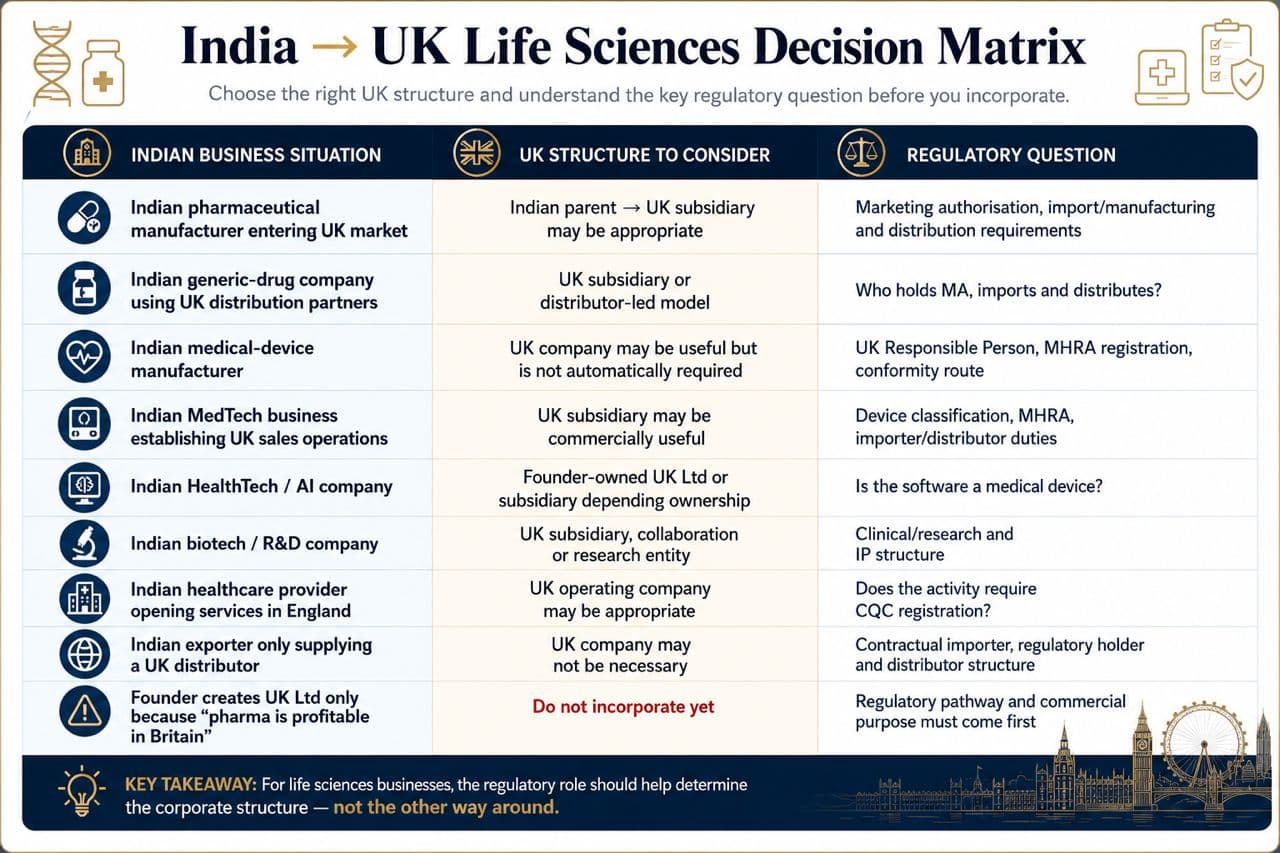
India → UK Life Sciences Decision Matrix
Indian Pharmaceutical Manufacturer
Possible UK role: UK subsidiary for contracting, importation, distribution or wider commercial operations.
Separate questions: medicines authorisation, manufacturing/import licensing, wholesale distribution, supply-chain responsibilities and applicable MHRA requirements.
UK company automatically required? No. Determine the actual regulatory and commercial role first.
Indian Medical-Device Manufacturer
Possible UK role: direct UK commercial operation, distribution, employees, warehousing or contracting.
Separate questions: device classification, conformity, MHRA registration, UK Responsible Person and importer/distributor responsibilities.
UK company automatically required? No. An overseas manufacturer may use an appropriate UK Responsible Person without owning a UK subsidiary solely for that purpose.
Indian Diagnostics / IVD Business
Possible UK role: UK commercial entity, distribution operation or wider market-entry platform.
Separate questions: IVD classification, applicable conformity and registration requirements, UK Responsible Person where required and supply-chain responsibilities.
UK company automatically required? Not necessarily.
Indian HealthTech / AI Company
Possible UK role: UK contracting, sales, partnerships, employees and international expansion.
Separate questions: whether the software’s intended purpose causes it to fall within medical-device regulation.
UK company automatically required? Not necessarily. Ordinary healthcare software and Software as a Medical Device should not be treated as the same regulatory model.
Indian Biotech / Research Business
Possible UK role: R&D collaboration, commercial partnerships, IP arrangements, research operations or clinical-development activity.
Separate questions: clinical-trial requirements, IP ownership, research agreements and applicable regulatory responsibilities.
UK company automatically required? It depends on the actual UK activity.
Indian Healthcare Provider
Possible UK role: operating clinics, diagnostics or other healthcare services in England.
Separate questions: whether the intended services are regulated activities requiring CQC registration and appropriate operational arrangements.
UK company automatically required? Corporate structure and healthcare authorisation are separate decisions.
Decision Rule
Form the UK company because it has a defined commercial function — not simply because the business wants to “enter the UK.”
Then display the existing image immediately underneath.
If you have already determined that your business needs its own UK entity, explore our UK company formation service for Indian residents for incorporation, statutory-address services, current packages and practical setup support.
If an existing Indian company will own the British operation, our UK Subsidiary for Indian Companies — 2026 Guide explains the parent–subsidiary structure, ownership, funding and cross-border considerations in greater detail.
1. Why the UK Matters for Indian Life Sciences Businesses
The UK can provide Indian pharmaceutical, MedTech, biotech and HealthTech businesses with access to a major life-sciences ecosystem spanning research, private healthcare, the NHS, universities, investors, distributors and international commercial partners.
Indian-owned businesses already have a substantial UK presence, including across manufacturing and pharmaceutical sectors.
The UK–India commercial relationship also changed materially on 15 July 2026, when the UK–India Comprehensive Economic and Trade Agreement entered into force.
For life-sciences companies, however, market opportunity does not remove regulatory requirements.
The commercial question is therefore not simply whether Britain is an attractive market.
It is whether the Indian business has a viable UK route and what corporate structure best supports that route.
2.UK–India CETA: Why It Matters for Pharma and MedTech
The UK–India Comprehensive Economic and Trade Agreement entered into force on 15 July 2026 and liberalises tariffs across a broad range of qualifying trade between the two countries. The agreement also contains product-specific tariff schedules and rules of origin that determine whether particular goods qualify for preferential treatment.
For Indian pharmaceutical, medical-device and life-sciences exporters, this can improve the commercial economics of certain UK trade flows.
But preferential tariff treatment is product-specific.
A business should establish:
the correct commodity classification;
the applicable UK tariff commitment;
whether the product satisfies the relevant rules of origin;
and
what evidence is required to support preferential treatment.
CETA also supports greater UK–India cooperation around trade and conformity assessment. For example, Indian conformity-assessment bodies can apply for accreditation and approval to assess relevant products against applicable UK regulatory requirements, subject to the relevant accreditation and approval processes.
What CETA Does Not Mean
CETA does not mean:
Indian regulatory approval = automatic UK regulatory approval
or
preferential tariff treatment = permission to place a regulated product on the UK market.
Trade treatment and product authorisation remain different systems.
An Indian medicine may still require the applicable medicines regulatory pathway.
An Indian medical device may still require the applicable conformity, registration and UK Responsible Person arrangements.
3. First Decision: What Exactly Is Your Product or Service?
Before forming the UK entity, identify the regulatory category.
This is especially important in life sciences because companies often describe themselves broadly as:
- healthcare;
- pharma;
- biotech;
- medical technology;
- digital health.
Regulators do not operate on marketing terminology.
They look at the actual product, intended purpose and activity.
The business may fall principally into one of the following categories.
A. Medicines
Prescription medicines, generic medicines, OTC medicinal products, biologics and other medicinal products.
B. Medical Devices
Examples may include diagnostic equipment, surgical devices, monitoring products and certain healthcare technologies.
C. In Vitro Diagnostics
Certain tests, analyzers and diagnostic products.
D. Software / AI as a Medical Device
Some clinical software and AI systems can themselves fall within the medical-device framework. MHRA specifically recognizes that software and AI may be regulated as medical devices or IVDs.
E. Healthcare Services
Companies actually providing regulated health or social-care activities in England can enter an entirely different regulatory framework involving the CQC.
F. Research / Clinical Trials
Biotech, pharmaceutical and research companies sponsoring UK clinical trials face separate requirements.
The classification should be established before the business designs its regulatory roadmap and before it decides what role, if any, its own UK company needs to perform.
This is Layer 1 of the Four-Layer UK Life Sciences Entry Test: identify the product or activity before choosing the structure.
No additional expansion.
4. Founder-Owned UK Ltd or Indian-Parent UK Subsidiary?
This is one of the most important structural decisions.
Option 1 — Founder-Owned UK Limited Company
Example:
Indian founder
↓
UK Ltd
This may be relevant where:
- the UK project is genuinely new;
- it is separate from an existing Indian company;
- the IP, contracts and operations are intended to belong to the new UK entity.
However, if the founder already operates a significant Indian pharmaceutical or MedTech business, separating the UK operation personally from the Indian company may create questions around:
- intellectual property;
- product ownership;
- licences;
- supply agreements;
- related-party transactions;
- transfer pricing;
- control.
It should therefore have a genuine commercial explanation.
Where a founder-owned UK company is genuinely the appropriate structure, our UK Company Formation for Indian Residents service explains current packages, required documents and the incorporation process.
Option 2 — Indian Parent → UK Subsidiary
Example:
Indian Pvt Ltd / Indian pharmaceutical company
↓
100% or controlled UK subsidiary
↓
UK market operations
For an established Indian manufacturer or healthcare group, this may be the more natural structure.
The UK company can potentially become the British operating arm while the Indian parent continues manufacturing, R&D or other operations in India.
Indian overseas investment rules must still be considered.
The Reserve Bank of India’s overseas-investment framework permits eligible Indian entities to make Overseas Direct Investment subject to the applicable Overseas Investment Rules, Regulations, reporting requirements and financial-commitment conditions.
For the specialist India-side rules, use Seven Oak Prestige’s:
FEMA & RBI Rules for UK Companies Owned by Indian Founders
UK Subsidiary for Indian Companies — 2026 Guide for Comparison .
Option 3 — Enter the UK Without Your Own Company Initially
Sometimes the appropriate first step is not to establish a UK subsidiary.
Depending on the product and commercial model, an Indian business may initially use appropriate third-party arrangements for functions such as:
regulatory representation;
importation;
distribution;
warehousing;
commercial partnerships;
or market development.
For example, an overseas medical-device manufacturer may appoint an appropriate UK Responsible Person without establishing its own UK subsidiary solely for that function.
The contracts and regulatory arrangements should establish clearly:
who owns the product;
who imports it;
who holds applicable regulatory responsibilities;
who invoices customers;
who controls inventory;
and who carries the relevant commercial obligations.
If UK activity later develops to the point where direct contracts, employees, inventory, distribution or a permanent commercial platform are justified, the business can reassess whether its own UK subsidiary is appropriate.
Key principle: more corporate structure is not automatically better market entry.
5. Companies House Formation Requirements
Keep the existing requirements list.
Replace the fee sentence with:
The current Companies House fee for standard online incorporation is £100. Companies House states that online registrations are usually completed within 24 hours, although processing may take longer in some circumstances.
Then use the informational pillar, not money page:
For a detailed explanation of the incorporation requirements, see UK Company Requirements for Indian Residents.
6. Companies House Identity Verification
Companies House identity verification became mandatory for relevant roles from 18 November 2025.
A person receives an 11-character personal code after successfully verifying their identity. The code belongs to the individual rather than to a particular company and can be reused when that person needs to confirm their verified status for different company roles.
A person becoming a director from 18 November 2025 must provide the personal code as part of the appointment filing or when incorporating a company.
Existing directors provide their personal code in connection with the company’s relevant Confirmation Statement during the transition arrangements.
People with Significant Control have separate requirements and applicable 14-day periods for providing their personal code.
For Indian founders, see:
Companies House Identity Verification for Indian Residents
7. Choosing the Correct SIC Code
Life sciences businesses should avoid choosing a generic SIC code without analyzing the genuine activity.
Potential classifications depend on whether the UK company will perform activities such as:
- pharmaceutical manufacturing;
- pharmaceutical wholesale;
- research and development;
- medical-device distribution;
- software development;
- healthcare services.
The SIC code does not itself grant regulatory permission.
For example:
Selecting a pharmaceutical manufacturing SIC code does not create an MHRA manufacturing licence.
Similarly:
Registering a healthcare company at Companies House does not create CQC authorization.
Companies House registration identifies the company.
Sector regulators determine whether regulated activities may actually be conducted.
8. Medicines: A Separate Regulatory Layer
A UK company does not itself authorise an Indian pharmaceutical business to manufacture, import, wholesale or place medicines on the UK market.
Depending on the product and proposed activity, separate requirements can arise around marketing authorisation, manufacturing or importation, wholesale distribution, pharmacovigilance and the wider medicines supply chain.
MHRA guidance confirms, for example, that manufacturing, assembling or importing human medicines can require a manufacturer’s licence, while wholesale supply can require a wholesale distribution authorisation. Import requirements depend on the product, origin and activity.
The corporate principle is therefore:
UK company incorporation creates the legal entity. It does not create pharmaceutical regulatory permission.
Where specialist medicines authorisation or licensing is required, the business should use appropriately qualified pharmaceutical regulatory professionals.
Seven Oak Prestige can support the UK corporate foundation around that specialist work but does not replace it.
9. Medical Devices and the UK Responsible Person
Medical devices and IVDs operate under a different regulatory framework from medicines.
An overseas manufacturer placing devices on the Great Britain market may need an appropriate UK Responsible Person to perform specified regulatory responsibilities.
That does not mean the overseas manufacturer must establish its own UK subsidiary solely to satisfy the UK Responsible Person requirement.
The separate corporate question is whether the Indian business needs its own UK entity for commercial functions such as direct contracting, employees, warehousing, distribution or long-term operations.
Seven Oak Prestige does not provide UK Responsible Person regulatory representation. Where that service is required, it should be handled by an appropriate specialist provider.
10. Software, AI and Digital Health
Not every healthcare software product is a medical device.
However, software and AI can fall within medical-device regulation depending on their intended purpose and functionality.
A scheduling, administration or practice-management platform can therefore have a different regulatory position from software intended to analyse clinical information or influence diagnosis or treatment.
Indian HealthTech founders should establish that classification before assuming that an ordinary SaaS corporate model is sufficient.
For the wider technology-company structure, see UK Company for Indian SaaS, AI & Technology Founders.
11. Clinical Trials and Research
Indian biotech, pharmaceutical and research businesses conducting UK clinical activity operate within a separate clinical-trials framework.
The amended UK Clinical Trials Regulations took full effect on 28 April 2026. Applications submitted on or after that date are subject to the amended regime, while transitional rules apply to earlier applications.
Where the Indian business is a Contract Research Organisation (CRO), sponsor, investigator or research partner, its precise responsibilities depend on the trial and role.
Clinical-trial sponsorship and regulatory compliance are specialist areas outside Seven Oak Prestige’s company-formation scope.
Where UK clinical research is central to the project, establish the regulatory model first and design the corporate structure around it.
12. Healthcare Services and the CQC
Selling a pharmaceutical or medical-device product is different from providing healthcare.
An Indian healthcare group intending to operate a clinic, diagnostic service, treatment service or another regulated healthcare activity in England should determine whether Care Quality Commission registration is required.
Companies House incorporation does not replace CQC registration.
The proposed activity, operating model and applicable regulatory requirements should therefore be established before the UK company is treated as operational.
13. Regulatory Approval and NHS Market Access Are Different
Regulatory permission and commercial market access are not the same thing.
Depending on the product, MHRA requirements, NICE assessment and NHS procurement can represent different stages of the UK journey.
Regulatory approval does not itself create an NHS contract.
For Indian life-sciences businesses targeting NHS customers, the corporate entity should therefore sit inside a wider market-entry strategy covering both the applicable regulatory pathway and the eventual commercial route.
Key Distinction
Companies House → corporate existence
MHRA or relevant regulator → applicable regulatory permission
NICE → relevant health-technology assessment
NHS procurement → commercial purchasing route
These layers should not be treated as interchangeable.
14. UK Responsible Person for Indian Manufacturers
This is one of the most important distinctions for Indian MedTech companies.
MHRA states that a medical-device manufacturer based outside the UK must appoint a UK Responsible Person when placing devices on the Great Britain market.
Therefore, an Indian medical-device manufacturer does not automatically need to create its own UK subsidiary merely because it needs a UK Responsible Person.
A qualifying third-party UKRP arrangement may be possible.
But an Indian business may still choose a UK subsidiary for commercial reasons such as:
- direct UK sales;
- employees;
- contracting;
- warehousing;
- local distribution;
- NHS procurement;
- investor presence;
- broader UK operations.
This is exactly why regulatory structure and corporate structure should be analyzed separately.
15. Banking for Pharma, MedTech and Healthcare Companies
Companies House registration and business-bank approval are separate decisions.
A UK pharmaceutical, MedTech, diagnostics, biotech or healthcare company can face more detailed onboarding questions than a simpler consulting or service business because the financial provider may need to understand not only who owns the company, but also how the regulated or cross-border activity will actually operate.
Depending on the business model, a provider may ask for evidence such as:
- the ownership and group structure;
- details of the Indian parent company;
- Companies House documents;
- the purpose of the UK entity;
- the company website;
- product or service information;
- applicable regulatory licences or registrations;
- customer, supplier or distributor relationships;
- expected transaction volumes and countries;
- source of funds;
- anticipated payments between the Indian parent and UK company; and
- an explanation of the UK supply chain.
For an Indian-parent UK subsidiary, consistency is particularly important.
The ownership structure, business description, website, expected transactions, source of funding and regulatory position should tell the same commercial story.
For example, if the UK company is described as a pharmaceutical distributor, the banking application should be consistent with who supplies the products, who imports them, where they are stored, what the UK company invoices for and what regulatory permissions apply to its actual role.
A UK company should therefore not be incorporated with a vague business description and only later attempt to construct a banking narrative around it.
Banking readiness should follow the real operating model.
For further preparation, see our UK Business Bank Account for Indian Residents — 2026 Guide and UK Business Banking Readiness Assessment.
Bank-account approval remains the independent decision of the selected provider based on its eligibility, KYC, AML and risk requirements.
16. UK Tax and Indian Tax
An Indian-owned UK company can create tax and reporting considerations in both jurisdictions.
The UK company may need to consider matters including:
- UK Corporation Tax;
- accounting and annual filing obligations;
- related-party transactions;
- transfer pricing;
- payments between the UK company and Indian parent;
- dividends;
- royalties and intellectual-property payments;
- management or service charges;
- permanent-establishment questions; and
- the UK–India Double Taxation Convention.
For the 2026 UK financial year, the main Corporation Tax rate is 25%, while qualifying companies with profits of £50,000 or less may fall within the 19% small-profits rate. Marginal Relief can apply between the thresholds, and those thresholds can be affected by associated companies.
For an Indian pharmaceutical or MedTech group, the intercompany structure deserves particular attention.
If the Indian parent manufactures the product, owns the intellectual property or provides R&D, management or technical services while the UK subsidiary sells or supports the British market, the commercial arrangements between the two companies should be properly documented and should reflect what each entity actually does.
The existence of a UK subsidiary does not, by itself, make the Indian parent a UK permanent establishment. Equally, businesses should not assume that having two separate incorporated companies resolves every cross-border tax question. The UK–India tax treaty contains specific permanent-establishment rules that depend on the actual facts and activities.
India-side considerations can also arise around overseas ownership, funding, reporting and the treatment of income or transactions involving the UK entity.
For the wider analysis, see UK Company Tax for Indian Residents: Corporation Tax, POEM & Double Taxation — 2026 Guide.
Key principle: the corporate structure, commercial activity, intercompany agreements and tax position should tell the same story.
Seven Oak Prestige does not provide specialist UK–India tax advice. Where the structure creates material cross-border tax or transfer-pricing questions, advice should be obtained from appropriately qualified tax professionals.
17. Intellectual Property
For pharmaceutical, biotech, diagnostics, medical-device and HealthTech businesses, intellectual property can be one of the most valuable assets in the entire group.
The ownership position should therefore be considered before the UK subsidiary begins signing contracts, developing products, licensing technology or carrying out research.
Important questions can include:
- Who owns the existing patents?
- Who owns the trade marks?
- Who owns the software and source code?
- Who owns clinical, technical or proprietary know-how?
- Which company funds future R&D?
- Who will own newly created intellectual property?
- Will the UK company own the IP or receive a licence to use it?
- Will royalties or other intercompany payments arise?
- Are appropriate assignments, licences and intercompany agreements required?
This is particularly important where the Indian parent already owns established products or technology.
Creating a UK subsidiary does not automatically transfer those assets to the British company.
If the UK entity needs rights to market, distribute, develop or commercially exploit the parent’s technology, the legal and commercial relationship should be properly documented.
The UK–India CETA includes an intellectual-property chapter covering areas including patents, trade marks, designs, trade secrets and enforcement, but treaty protection does not replace the company’s own IP assignments, licences or contractual arrangements.
For life-sciences groups, the corporate structure and IP structure should therefore be designed together rather than treated as unrelated decisions.
18. India → UK Example Structures
There is no single UK structure that suits every Indian life-sciences business.
The correct model depends on the product, regulatory role, commercial route and purpose of the UK operation.
Example A — Indian Pharmaceutical Manufacturer
Indian pharmaceutical parent
↓
Manufacturing / R&D in India
↓
UK subsidiary
↓
Defined UK regulatory and commercial role
↓
Appropriate licensed supply chain
↓
Private, wholesale or NHS-facing market as applicable
This structure may be appropriate where the UK company has a genuine British operating function rather than existing only as a registration certificate.
Its precise regulatory role must still be established separately.
Example B — Indian Medical-Device Manufacturer
Indian manufacturer
↓
UK Responsible Person where required
↓
Applicable conformity and MHRA requirements
↓
UK importer / distributor
↓
UK customers
The manufacturer does not automatically need to own a UK subsidiary solely because a UK Responsible Person is required.
A UK company can be considered separately where direct contracting, employees, warehousing, distribution or wider UK operations justify it.
Example C — Indian HealthTech or AI Business
Indian founders or Indian parent
↓
UK company where commercially justified
↓
UK contracts / partnerships / employees
↓
Software classification assessment
↓
Medical-device requirements where applicable
↓
Private healthcare, NHS or other commercial route
The critical question is whether the technology is ordinary healthcare software or whether its intended purpose brings it within medical-device regulation.
Example D — Indian Healthcare Group
Indian healthcare parent
↓
UK operating subsidiary
↓
UK staff / premises / service model
↓
CQC assessment and registration where applicable
↓
UK healthcare operations
Companies House registration and healthcare-service authorisation remain separate.
The Structural Lesson
These examples begin with different products and commercial objectives, so they produce different UK structures.
That is why the correct sequence remains:
Product → Permission → Commercial Route → Corporate Structure
19. Recommended India → UK Market-Entry Sequence
For an Indian pharmaceutical, MedTech, biotech, diagnostics or HealthTech business, the following sequence reduces the risk of creating a UK company before its role has been properly defined.
Step 1 — Define the UK Commercial Objective
Establish what the business actually wants to achieve in Britain.
Is the objective to export, distribute, sell directly, employ staff, conduct R&D, license technology, provide healthcare, work with the NHS or establish a permanent British operation?
Step 2 — Classify the Product or Activity
Determine whether the business involves:
medicine;
medical device;
IVD;
software or AI;
healthcare service;
clinical research;
or another life-sciences activity.
Step 3 — Identify the Regulatory Role and Permissions
Establish which regulatory bodies, licences, registrations, responsible parties or specialist requirements may apply.
This should happen before assuming that Companies House incorporation solves the market-entry problem.
Step 4 — Determine the Commercial Route
Decide how the product or service will actually reach the UK customer.
For example:
direct sales;
distributor;
importer;
private healthcare;
NHS;
research partnership;
licensing;
or another commercial arrangement.
Step 5 — Choose the Corporate Structure
Compare the realistic options:
Indian business without its own UK subsidiary
vs
Founder-owned UK Limited Company
vs
Indian parent → UK subsidiary
The company should have a defined function within the commercial model.
Step 6 — Review FEMA / ODI and Funding
Where an Indian entity will own or fund the UK company, review the applicable Indian overseas-investment and reporting requirements before money is transferred or the ownership structure is finalised.
Step 7 — Determine Intellectual-Property Ownership
Establish who owns existing IP, what rights the UK company needs and how future IP will be treated.
Step 8 — Prepare the Companies House Structure
Confirm:
company name;
director;
shareholder;
PSC;
share structure;
SIC code;
Registered Office;
registered email address;
and applicable identity-verification requirements.
Step 9 — Incorporate the UK Company
Once the role of the entity and its ownership structure are sufficiently clear, complete incorporation.
Step 10 — Complete the Applicable Regulatory Work
Depending on the activity, this may involve specialist work relating to medicines, medical devices, UK Responsible Person arrangements, clinical trials, CQC or other sector requirements.
Step 11 — Map Importation and the Supply Chain
Where physical products move from India to Britain, establish:
who exports;
who imports;
who owns the inventory;
where goods are stored;
who distributes;
whether an EORI is required;
the VAT position;
and the applicable customs arrangements.
A GB EORI is generally relevant to businesses moving goods through Great Britain customs, but the correct registration and customs position depends on who actually carries out the customs activity.
Step 12 — Prepare Banking and Operational Readiness
Prepare a coherent evidence set covering ownership, funding, business activity, regulatory position, counterparties and expected transactions before approaching financial providers.
Step 13 — Establish Ongoing Compliance
Coordinate the company’s continuing:
Companies House;
accounting;
tax;
banking;
customs;
and applicable sector-regulatory obligations.
The objective is not simply to form a UK company.
It is to establish a UK operation whose corporate, regulatory and commercial structure works together.
20. Common Mistakes Indian Life Sciences Businesses Should Avoid
Forming the UK Company Before Defining Its Role
A certificate of incorporation is not a market-entry strategy.
Better approach: establish the product, regulatory role and commercial route first.
Assuming Companies House Registration Means Regulatory Approval
Companies House creates the corporate entity. It does not provide medicines, medical-device, clinical-research or healthcare authorisation.
Better approach: map corporate and sector-regulatory requirements separately.
Assuming Indian Regulatory Approval Automatically Carries into Britain
Indian approval does not itself establish the applicable UK regulatory position.
Better approach: identify the relevant UK pathway for the specific product or activity.
Assuming CETA Removes Regulatory Requirements
CETA can improve trading conditions for qualifying goods but does not replace applicable product regulation.
Better approach: analyse tariff treatment and regulatory market access separately.
Forming a UK Company Simply Because a UK Responsible Person Is Required
A UK Responsible Person requirement does not itself mean an overseas medical-device manufacturer must own a UK subsidiary.
Better approach: determine the regulatory-representation requirement first, then separately decide whether your own UK company has a commercial purpose.
Creating a UK Subsidiary When an Appropriate Third-Party Route Could Initially Be Sufficient
More corporate structure is not automatically better market entry.
Better approach: compare direct establishment with appropriate distributor, importer, regulatory-representation and commercial-partner models before incorporating.
Failing to Define the Importer
For businesses moving products from India into Britain, uncertainty about who imports the goods can affect customs, VAT, regulatory and contractual responsibilities.
Better approach: map the complete supply chain before commercial shipments begin.
Confusing Regulatory Approval with NHS Market Access
Regulatory permission and commercial procurement are different layers.
Better approach: design the route backwards from the intended customer and procurement pathway.
Ignoring FEMA / ODI Before the Indian Parent Funds the UK Company
An Indian parent company’s overseas investment should not be treated solely as a UK incorporation matter.
Better approach: establish the applicable India-side ownership, funding and reporting position before implementation.
Moving Intellectual Property Without Proper Documentation
A new UK subsidiary does not automatically own the Indian parent’s patents, software, trade marks or know-how.
Better approach: document ownership, licences, assignments and relevant intercompany arrangements.
Treating HealthTech as Ordinary SaaS Without Checking the Intended Purpose
Some healthcare software can fall within medical-device regulation.
Better approach: establish product classification before relying on an ordinary SaaS market-entry model.
Starting Regulated Healthcare Activity Without Assessing CQC Requirements
Companies House incorporation does not authorise regulated healthcare activities in England.
Better approach: determine whether CQC registration applies before operations begin.
21. Pre-Incorporation Checklist for Indian Pharma & MedTech Businesses
Use this checklist before treating incorporation as the first step.
Corporate Structure
☐ UK commercial objective defined
☐ UK company genuinely required
☐ Founder-owned Ltd vs Indian-parent subsidiary assessed
☐ Third-party market-entry alternatives considered where relevant
☐ Shareholding structure documented
☐ Director identified
☐ PSC identified
☐ FEMA / ODI implications reviewed where applicable
☐ Funding route considered
☐ IP ownership and licensing position reviewed
Companies House
☐ Proposed company name checked
☐ Appropriate SIC code selected
☐ Registered Office arranged
☐ Director Service Address considered
☐ Registered email address prepared
☐ Director and shareholder information prepared
☐ PSC information prepared
☐ Relevant identity verification completed
☐ Companies House personal codes available where required
Regulatory
☐ Product or service classified
☐ Applicable UK regulatory pathway identified
☐ Medicines authorisation requirements assessed where relevant
☐ Manufacturing/import licensing assessed where relevant
☐ Wholesale-distribution requirements assessed where relevant
☐ Medical-device/IVD conformity and registration assessed where relevant
☐ UK Responsible Person requirement assessed where relevant
☐ Software/AI medical-device classification considered where relevant
☐ Clinical-trial requirements assessed where relevant
☐ CQC requirements assessed where healthcare services are planned
☐ Specialist regulatory adviser identified where required
Trade and Operations
☐ UK commercial route defined
☐ Exporter identified
☐ Importer identified
☐ Distributor identified where applicable
☐ Inventory ownership established
☐ Warehousing model established
☐ CETA eligibility and rules of origin considered where relevant
☐ Customs classification reviewed
☐ EORI requirements assessed
☐ VAT position assessed
☐ Supply and distribution agreements considered
Commercial Readiness
☐ UK business model clearly documented
☐ Website accurately reflects the intended activity
☐ Product or service documentation available
☐ Regulatory evidence available where applicable
☐ Customer / supplier / distributor relationships documented where available
☐ Banking evidence prepared
☐ Source of funds documented
☐ Expected transaction countries and volumes understood
☐ NHS/private-market/distributor route identified
☐ Ongoing accounting, tax, corporate and regulatory responsibilities planned
A business does not need every box to result in a UK subsidiary.
The purpose of the checklist is to determine which structure is justified and what must happen before that structure becomes operational.
needs to do.
22. VAT, EORI and Importation
For Indian pharmaceutical, MedTech, diagnostics and other life-sciences businesses moving physical products into Great Britain, incorporation is only one part of the operational setup.
The business must also establish how VAT, customs, EORI and import responsibilities apply to its actual supply chain.
These questions should be addressed before commercial shipments begin.
VAT Registration
A UK company is not automatically VAT registered simply because it has been incorporated.
Whether and when VAT registration is required depends on the company’s circumstances, including where it is established, the supplies it makes and the applicable UK VAT rules.
For businesses established outside the UK, different registration rules can apply, so the normal UK VAT registration threshold should not automatically be assumed to resolve the position.
For an Indian-parent UK subsidiary, the VAT analysis should follow what the UK company will actually do rather than simply the fact that it has an Indian shareholder.
EORI Registration
An Economic Operators Registration and Identification (EORI) number is used for customs purposes.
A business undertaking relevant customs activities involving Great Britain may need a GB EORI number.
VAT registration and EORI registration are separate.
A business can therefore require an EORI for customs purposes without the EORI itself determining whether that business must be VAT registered.
Define the Importer Before Shipping
For an Indian life-sciences business sending products into Britain, one of the most important questions is:
Who is actually importing the goods?
The commercial and supply-chain arrangements should establish:
who exports from India;
who imports into Great Britain;
who is responsible for customs declarations;
who owns the inventory at importation;
who pays customs duty and import VAT;
where the products are stored;
who distributes them;
and
which entity invoices the UK customer.
Do not assume that creating a UK subsidiary automatically answers all of these questions.
The importer, seller, distributor and regulatory-responsibility holder may perform different roles depending on the structure.
Import VAT
Import VAT can arise when goods enter the UK.
Where the applicable conditions are met, a VAT-registered business importing goods it owns may be able to account for import VAT using postponed VAT accounting, rather than paying the VAT at the border and recovering it later.
The appropriate treatment depends on the actual import arrangement and VAT position.
Customs Duty and UK–India CETA
The UK–India CETA can provide preferential tariff treatment for qualifying goods, but preferential treatment is not automatic merely because goods originate from India.
The business must consider matters including:
commodity classification;
the applicable tariff commitment;
rules of origin;
and
the evidence required to claim preferential treatment.
Even where customs duty is reduced or eliminated, other requirements can remain.
Regulated Products Create an Additional Layer
For medicines, medical devices, IVDs and other regulated products, customs clearance does not itself establish regulatory permission to place the product on the British market.
Depending on the activity, separate requirements may apply around medicines licences, medical-device registration, a UK Responsible Person, conformity requirements or other sector-specific obligations.
This is why the importer and regulatory roles should be mapped together rather than treated as unrelated administrative tasks.
Key Distinction
EORI → customs identification
VAT registration → tax registration
Import VAT → VAT arising in connection with imported goods
Customs duty → tariff treatment of imported goods
Product regulation → permission and responsibilities relating to the regulated product
These elements can interact, but they are not interchangeable.
Practical Sequence
For an Indian pharmaceutical or MedTech business importing into Great Britain, the practical order is:
Define the supply chain
↓
Identify the importer
↓
Determine customs and EORI requirements
↓
Establish the VAT and import-VAT position
↓
Check CETA eligibility where relevant
↓
Complete applicable product-regulatory requirements
↓
Begin commercial importation
Seven Oak Prestige can support VAT registration and EORI registration where appropriate as part of the wider UK corporate setup.
Specialist tax, customs and pharmaceutical or medical-device regulatory advice should be obtained where the circumstances require it
Frequently Asked Questions
Can an Indian pharmaceutical or MedTech business own a UK company?
Yes. An Indian individual or an Indian company can generally own shares in a UK private limited company. There is no general requirement for the shareholder of an ordinary UK private company to be UK resident.
Where an existing Indian company will own the UK entity, however, the business should also consider the applicable Indian overseas-investment, funding, reporting and tax requirements.
Should the UK company be founder-owned or owned by the Indian parent?
It depends on the commercial reality.
A founder-owned UK company may make sense where the British project is genuinely separate from the existing Indian business.
Where the UK operation is an extension of an established Indian pharmaceutical, MedTech or life-sciences company, an Indian-parent UK subsidiary may provide a clearer group structure for ownership, contracts, funding, intellectual property and commercial operations.
The structure should have a genuine commercial rationale rather than being selected simply because one route appears easier to incorporate.
Does a UK Limited Company need a UK-resident director?
Not generally.
A private company limited by shares must have at least one natural-person director, but there is no general Companies House requirement for that director to reside in the UK.
The company must, however, satisfy the applicable UK Registered Office and Companies House requirements.
Does the company need a UK address?
Yes. A UK company must maintain an appropriate Registered Office in the UK jurisdiction in which it is incorporated.
Directors must also provide the required service-address and residential-address information to Companies House.
Seven Oak Prestige can provide Registered Office and Director Service Address services depending on the package selected.
Do Indian directors need Companies House identity verification?
Yes, where the applicable Companies House identity-verification requirements apply to their role.
For new company registrations, Companies House requires the personal code for each director as part of the registration filing. Existing directors provide their code through the relevant Confirmation Statement process, while People with Significant Control have separate requirements and applicable 14-day periods.
For the detailed India-specific process, see Companies House Identity Verification for Indian Residents.
Does forming a pharmaceutical UK company allow it to sell medicines?
No.
Companies House incorporation creates the legal company. It does not itself provide pharmaceutical marketing authorisation, manufacturing, importation, wholesale-distribution or other medicines permissions.
The regulatory requirements depend on the product and what the UK business will actually do.
Does an Indian medical-device manufacturer need a UK company?
Not simply because it wants to place a device on the Great Britain market.
Where the manufacturer is based outside the UK, MHRA guidance requires it to appoint a single UK Responsible Person for its devices before placing them on the Great Britain market. The UK Responsible Person takes responsibility for specified matters including device registration.
Whether the Indian manufacturer should also establish its own UK company is a separate commercial decision based on matters such as direct contracting, employees, inventory, distribution and long-term UK operations.
What is a UK Responsible Person?
A UK Responsible Person is the UK-based person or organisation appointed by a medical-device manufacturer established outside the UK to carry out specified responsibilities in relation to placing devices on the Great Britain market.
It is a regulatory role, not simply a Registered Office or company-formation service.
Seven Oak Prestige does not provide UK Responsible Person regulatory representation.
Does appointing a UK Responsible Person mean we need a UK subsidiary?
No.
The requirement to appoint a UK Responsible Person and the decision to establish your own UK subsidiary are separate.
An Indian manufacturer may be able to use an appropriate independent UK Responsible Person without owning a UK subsidiary solely for that purpose.
Can an Indian HealthTech or AI company simply use a normal SaaS structure?
Not always.
The corporate structure may resemble that of another technology company, but the product’s intended purpose must also be considered.
Software intended for certain medical purposes can fall within medical-device regulation. Ordinary business software and Software as a Medical Device should therefore not automatically be treated as the same regulatory model.
Do the 2026 UK clinical-trial rules affect Indian pharmaceutical and biotech businesses?
Potentially, where the business conducts activities falling within the UK clinical-trials framework.
The amended UK Clinical Trials Regulations took full effect on 28 April 2026. Sponsors, investigators and organisations carrying out delegated trial-related activities must comply with the applicable framework and relevant guidance.
Clinical-trial regulatory work is separate from company incorporation and should be handled with appropriate specialist expertise.
Does a UK healthcare company automatically need CQC registration?
No. The relevant question is whether the business will carry on a regulated activity within the scope of the Care Quality Commission regime in England.
A company operating activities requiring registration must address those requirements separately from Companies House incorporation.
Does MHRA approval mean a product can automatically be sold to the NHS?
No.
Product regulation, health-technology assessment and NHS procurement should not be treated as the same process.
Depending on the product and route to market, different regulatory, assessment, commissioning or procurement requirements may apply.
Does the UK–India CETA remove regulatory requirements for Indian pharmaceutical or MedTech products?
No.
The UK–India CETA entered into force on 15 July 2026, but preferential trade treatment and product regulation remain separate issues.
The agreement can improve trading conditions for qualifying goods and contains measures affecting areas such as customs and conformity assessment, but businesses must still satisfy the applicable UK regulatory requirements.
Does an Indian parent company need to consider FEMA or ODI when establishing a UK subsidiary?
Potentially, yes.
Where an Indian company acquires or funds an overseas subsidiary, Indian overseas-investment rules, reporting requirements and the method of funding should be considered alongside the UK incorporation process.
These India-side requirements should be reviewed under the applicable Indian framework rather than treated as a Companies House matter.
Does a UK pharma or MedTech company need VAT registration?
Not automatically simply because it has been incorporated.
VAT registration depends on the business’s actual circumstances, including its establishment, supplies, turnover and cross-border activities. Different considerations can apply to overseas businesses and imported goods.
For an importing life-sciences business, the VAT analysis should follow the real supply chain rather than the certificate of incorporation.
Does the company need an EORI number?
A business undertaking relevant customs activities involving Great Britain may require a GB EORI number.
EORI and VAT registration are separate. The appropriate customs position depends on which entity is actually importing or otherwise carrying out the relevant customs activity.
Can Seven Oak Prestige obtain MHRA, UKRP or CQC approval for us?
Seven Oak Prestige supports the UK corporate and operational foundation of the expansion.
This can include company formation, UK subsidiary setup, statutory address services, Companies House requirements, identity-verification support, VAT and EORI registration support, KYC preparation, banking readiness and relevant post-incorporation coordination.
Seven Oak Prestige does not replace specialist pharmaceutical, medical-device, clinical-trial, UK Responsible Person or healthcare-regulatory professionals.
Where specialist regulated work is required, the appropriate qualified provider should be engaged.
How Seven Oak Prestige Supports India → UK Life Sciences Expansion
Seven Oak Prestige supports Indian founders, manufacturers and overseas businesses with the UK corporate and operational foundation of international expansion.
Depending on the project and service selected, support can include:
UK Limited Company formation
Indian parent → UK subsidiary setup
Director, shareholder and PSC preparation
Companies House identity-verification support
Registered Office
Director Service Address
Virtual Business Address where appropriate
VAT registration support
EORI registration support
Banking readiness and application support
KYC preparation
Post-incorporation coordination
Our role is deliberately separated from specialist sector regulation.
Where the business requires pharmaceutical authorisation, medical-device regulatory representation, UK Responsible Person services, clinical-trial support, CQC advice or another specialist regulated service, the appropriate qualified professional should be engaged.
The Seven Oak Approach
Understand the product or activity
↓
Identify the regulatory role
↓
Define the commercial route
↓
Choose the corporate structure
↓
Complete Companies House requirements
↓
Coordinate specialist requirements where necessary
↓
Prepare the operational foundation
↓
Enter the UK market with a structure designed for its actual purpose
Final Takeaway
For an Indian pharmaceutical, MedTech, biotech, diagnostics or HealthTech business, establishing a UK company can be strategically valuable — but only where that company has a clearly defined commercial purpose.
An established Indian manufacturer may benefit from an Indian-parent UK subsidiary where it needs a genuine British operating platform.
A medical-device manufacturer using an independent UK Responsible Person and distributor may not need its own UK subsidiary initially.
A HealthTech company must distinguish ordinary software from software that may fall within medical-device regulation.
A healthcare operator must separate Companies House incorporation from any CQC requirements applying to regulated services.
And a pharmaceutical company must design its corporate vehicle around the wider medicines, importation, distribution and market-access architecture.
The central principle is:
Product → Permission → Commercial Route → Corporate Structure
The UK company is the legal platform.
The regulatory, operational and commercial model determines what that platform actually needs to do.
Planning Your India → UK Life Sciences Expansion?
Ready to Establish Your UK Company?
If you have already determined that your pharmaceutical, MedTech, biotech, diagnostics or HealthTech business needs its own UK entity, review our UK Company Formation for Indian Residents service for current packages, required documents and the incorporation process.
UK Company Formation for Indian Residents
START MY UK COMPANY
Existing Indian Company Expanding into Britain?
If an existing Indian pharmaceutical, MedTech, biotech or healthcare company is considering a UK subsidiary or needs to determine how the British corporate structure should fit around a more complex market-entry plan, Seven Oak Prestige can discuss the proposed structure before incorporation.
DISCUSS MY INDIA → UK EXPANSION
Related India Guides
UK Company Formation for Indian Residents
For founders and businesses ready to review formation packages, required documents and practical UK setup.
UK Subsidiary for Indian Companies — 2026 Guide
For established Indian businesses considering an Indian-parent → UK-subsidiary structure.
UK Company Requirements for Indian Residents
For the wider incorporation, ownership, director and Companies House requirements.
FEMA & RBI Rules for Indian Founders with a UK Company
For India-side overseas ownership, investment and funding considerations.
Companies House Identity Verification for Indian Residents
For director and PSC identity-verification requirements and personal codes.
UK Business Bank Account for Indian Residents
For banking eligibility, evidence and onboarding considerations.
UK Company Tax for Indian Residents: POEM & Double Taxation
For the principal UK–India tax and management/control considerations.
UK Company for Indian SaaS, AI & Technology Founders
For technology businesses whose activities do not require the same life-sciences regulatory framework.
About the Author
Isaac Jackson
Founder & Managing Director — Seven Oak Prestige Ltd
Isaac Jackson supports international founders and overseas businesses establishing and operating UK companies, including founders requiring support with company formation, statutory addresses, Companies House administration, KYC preparation, compliance coordination and banking readiness.
Seven Oak Prestige Ltd
Company Registration No. 16903092
Registered Office: 124 City Road, London EC1V 2NX, United Kingdom
Editorial Approach
Seven Oak Prestige publishes practical guidance for international founders and overseas businesses establishing, operating and expanding through UK companies.
For regulated sectors such as pharmaceuticals, medical devices, digital health and healthcare, our editorial approach distinguishes the corporate structure from the separate regulatory permissions that may be required before a business can lawfully conduct particular activities.
A UK company should not be presented as a substitute for MHRA, CQC, medicines, medical-device, clinical-research, tax, customs or other specialist requirements.
Where a UK company may not yet be necessary, this guide says so.
Our objective is to help international businesses understand where UK company formation fits within the wider commercial structure rather than presenting incorporation as the answer to every market-entry problem.
Editorial Methodology
This guide was developed specifically for Indian pharmaceutical, MedTech, diagnostics, biotech, HealthTech and life-sciences businesses evaluating UK market entry.
The analysis separates four questions:
1. What product or activity is entering the UK?
2. What regulatory permissions or responsible roles may apply?
3. What commercial route will the business use?
4. What corporate structure is required to support that model?
Regulatory and corporate claims are reviewed against relevant primary sources including GOV.UK, Companies House, the Medicines and Healthcare products Regulatory Agency and other applicable UK public authorities.
For example, current Companies House guidance distinguishes the personal-code requirements applying to directors and PSCs; MHRA guidance requires overseas medical-device manufacturers to appoint a UK Responsible Person for the Great Britain market; and the amended UK Clinical Trials Regulations took full effect on 28 April 2026.
The guide also reflects the UK–India CETA, which entered into force on 15 July 2026.
India-side overseas-investment, FEMA/ODI, tax and other jurisdiction-specific considerations are distinguished from UK corporate formation and should be reviewed under the applicable Indian framework.
Last reviewed: 2 October 2026
Important Disclaimer
This guide provides general information and does not constitute legal, pharmaceutical-regulatory, medical-device, healthcare-regulatory, tax, accounting, customs, investment, FEMA/RBI or immigration advice.
Seven Oak Prestige provides UK company formation, corporate administration and related business-support services.
Specialist regulated or jurisdiction-specific matters should be reviewed by appropriately qualified professionals where required.
Regulatory requirements depend on the product, activity, supply chain and circumstances of the business and may change.
UK incorporation does not guarantee regulatory approval, banking approval, NHS access, procurement success or acceptance by any regulator, financial institution or other third party.
Primary Official Sources Reviewed
Use this as the final section. These should be clickable source names, not raw URLs dumped into the article.
Companies House — When You Need to Verify Your Identity
Current guidance on identity-verification requirements for directors and PSCs.
Companies House identity-verification guidance
Companies House — Personal Codes for Identity Verification
Current guidance on personal codes, directors, appointments and PSC 14-day periods.
Companies House personal-code guidance
MHRA — Register Medical Devices to Place on the Market
Official Great Britain device-registration guidance, including requirements applying to overseas manufacturers and UK Responsible Persons.
MHRA medical-device registration guidance
MHRA — Clinical Trials for Medicines: Apply for Approval in the UK
Current guidance under the amended Clinical Trials Regulations effective from 28 April 2026.
MHRA clinical-trials guidance
Department for Business and Trade — UK–India Comprehensive Economic and Trade Agreement
Official treaty material. The agreement entered into force on 15 July 2026.
UK–India CETA official text
Department for Business and Trade — UK–India CETA Customs and Trade Facilitation
Official provisions concerning customs procedures and trade facilitation.
UK–India CETA customs chapter
Department for Business and Trade — National Treatment of Conformity Assessment Bodies with India
Official guidance on the CETA arrangements allowing Indian conformity-assessment bodies to seek accreditation and approval to assess relevant goods against UK requirements.
UK–India conformity-assessment guidance