
Dormant UK Company for Non-Residents | 2026 Filing Guide

Dormant UK Company for Non-Resident Owners: What You Still Have to File
A UK Limited Company can remain registered even if it has not started trading or has temporarily stopped operating.
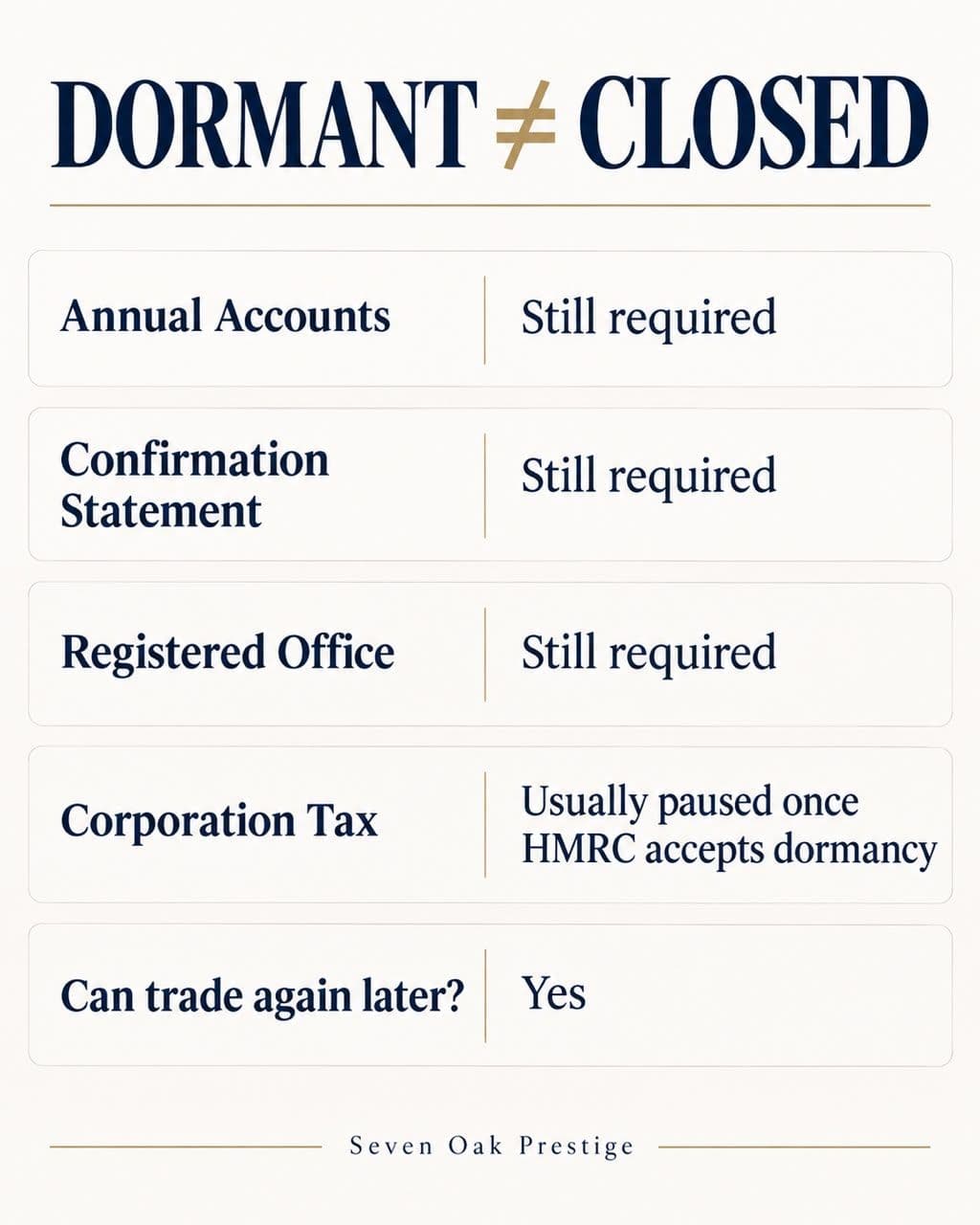
But dormant does not mean closed — and it does not mean there is nothing left to file.
This commonly affects international founders who incorporated a UK company:
- before launching;
- while waiting for banking or payment infrastructure;
- for a future UK expansion;
- before an e-commerce or SaaS project was ready;
- or for a business that has temporarily stopped trading.
The key complication is that Companies House and HMRC do not use exactly the same dormancy test.
For Companies House, dormancy generally depends on whether the company had any significant accounting transactions during the financial year. HMRC looks at whether the company is trading or receiving other income for Corporation Tax purposes.
So the first question should always be:
Dormant for Companies House, HMRC — or both?
Quick Answer
A dormant UK company normally still needs to:
File annual accounts
Dormant companies remain subject to Companies House accounts requirements.
File a Confirmation Statement
Every company, including dormant and non-trading companies, must file at least once during each annual review cycle.
Maintain a valid Registered Office
The company remains on the register and still needs an official correspondence address.
Keep company information current
Director, PSC, address and other statutory information must still be maintained.
For Corporation Tax, the position can be lighter. Once HMRC has been told that a company is dormant, it generally does not need to pay Corporation Tax or submit further Company Tax Returns unless HMRC issues another notice requiring one.
1. Dormant for Companies House vs Dormant for HMRC
This is the distinction most founders need to understand.
Dormant for Companies House
Companies House considers a company dormant where it has had no significant accounting transactions during the financial year.
Certain transactions are specifically ignored, including:
- Companies House filing fees;
- late-account filing penalties;
- money paid for subscriber shares when the company was incorporated.
A company that qualifies may usually file simplified dormant accounts.
Dormant for Corporation Tax
HMRC can treat a company as dormant where, for example, it:
- has not yet started trading;
- has stopped trading;
- has no other taxable income.
These are related concepts, but they are not identical.
A company can therefore require closer review rather than relying simply on:
“We made no profit.”
No profit does not automatically mean dormant.
2. What Does It Cost to Keep a Dormant UK Company?
This is one of the most practical questions for an overseas founder.
A dormant company can be inexpensive to maintain, but it is not completely cost-free.
Dormant Accounts
Companies House filing fee: normally no separate filing fee.
You may still choose to pay an accountant or company-services provider to prepare and file the accounts.
Confirmation Statement
Current digital Companies House fee: £50 per 12-month payment period.
Registered Office
Cost: depends on your provider.
A dormant company still needs an appropriate Registered Office. For an overseas owner, professional mail handling can also be important because official correspondence continues.
Professional Support
Accounting, company-secretarial, Registered Office, compliance or filing assistance can create separate provider fees.
So the government cost of maintaining a straightforward dormant company may be low, but a non-resident founder should also budget for any professional infrastructure needed to keep the company properly administered.
3. What Must a Dormant Company Still File?
Two Companies House obligations are particularly important.
Annual Accounts
Dormant companies still file annual accounts.
Where the company qualifies as dormant and small, it may file simplified dormant accounts with reduced disclosure requirements.
A dormant company does not automatically need to appoint an accountant. If you are unsure whether the filings are simple enough to manage yourself, see our guide to accounting support for non-resident-owned UK companies
For most private companies, later annual accounts are normally due 9 months after the accounting reference period ends.
First accounts can follow different rules, so check the actual deadline on the company’s Companies House record.
For the broader timetable, see UK Company Compliance Calendar 2026 for Non-Resident Directors.
Confirmation Statement
Dormancy does not remove the Confirmation Statement requirement.
Companies House says every company, including dormant and non-trading companies, must file one at least annually. The filing can be made up to 14 days after the review period ends.
4. What Happens If a Dormant Company Misses Its Filings?
Dormant status does not protect the company from enforcement.
Late accounts can result in Companies House penalties, and persistent filing failures can create more serious compliance problems.
A missing Confirmation Statement can also lead to financial penalties and ultimately the company being struck off the register.
For an overseas director, the practical lesson is simple:
Do not stop monitoring a company simply because it has stopped trading.
5. Do You Need to Tell HMRC the Company Is Dormant?
Usually, yes, where the company has stopped trading or has not yet begun taxable activity.
If HMRC has already issued a Notice to Deliver a Company Tax Return, the company must still deal with that return for the relevant period.
Once HMRC has been told the company is dormant, it generally does not need to pay Corporation Tax or submit another Company Tax Return unless HMRC issues another notice.
For UTR, Corporation Tax and online HMRC access, see HMRC Business Tax Account for Non-Resident UK Companies.
6. Does a Dormant Company Still Need a Registered Office?
Yes.
Dormancy does not remove the Registered Office requirement.
This matters particularly for overseas directors because the company can continue receiving:
- Companies House correspondence;
- HMRC letters;
- filing reminders;
- authentication-code correspondence;
- compliance communications.
A dormant company can therefore fall into difficulty simply because the founder assumes there is “nothing happening” and stops monitoring official mail.
For the address distinction, see Registered Office vs Director Service Address for Non-Residents.
If you do not have your own UK premises, see UK Company Formation Without Your Own UK Address.
Keeping a UK Company Dormant While Living Overseas?
Seven Oak Prestige can support international founders with Registered Office administration, Companies House records and compliance preparation while a UK company remains inactive.
Discuss My UK Company Compliance
7. What Transactions Can Affect Dormant Status?
This is where founders should be careful.
Companies House only gives a narrow list of transactions that do not count as significant transactions.
Ordinary business transactions can therefore affect whether dormant accounts remain appropriate.
Examples worth reviewing include:
- customer payments;
- supplier payments;
- software subscriptions;
- accounting or consultancy costs;
- bank fees;
- rent;
- payroll;
- dividends;
- interest or other income.
Do not assume a transaction is harmless just because the amount is small.
Likewise, do not assume that paying a company-related cost personally automatically preserves dormant status. The underlying accounting treatment can matter.
Where the company has incurred ordinary expenses or received money, an accountant should confirm whether dormant accounts remain appropriate.
8. Can a Dormant Company Have a Bank Account?
Yes, but the existence of the account is not the main issue.
The important question is:
What transactions are taking place through it?
For example, receiving income or incurring ordinary bank charges can create accounting activity that needs to be considered.
There is also a separate operational issue.
Banks and payment providers may periodically review:
- account activity;
- company information;
- KYC documentation;
- directors and ownership;
- declared business activity.
So even when the company remains dormant from a Companies House or HMRC perspective, an overseas founder should keep banking and KYC information current.
A dormant company should not simply be abandoned operationally.
9. Does a Dormant Company Still Need Companies House Identity Verification?
Dormancy does not remove directors or PSCs from the Companies House identity-verification regime.
Where identity verification applies, the relevant personal-code requirements can still apply.
For the full process, see Companies House Identity Verification for Non-Residents — Complete 2026 Guide.
For timing, see Companies House ID Verification Deadline — Check Your Real Date.
10. Do You Still Need the Company Authentication Code?
Yes, where you need to make relevant online Companies House filings.
The company authentication code is separate from the director’s identity-verification personal code.
For example, the current Confirmation Statement service requires company filing credentials and can also require directors’ identity-verification information.
If you have lost your company filing credential, see Companies House Authentication Code | Lost, Request & Replace Guide 2026.
This becomes particularly relevant when an overseas owner only discovers the code is missing shortly before an accounts or Confirmation Statement deadline.
11. What Happens to VAT and PAYE?
These systems need to be considered separately.
VAT
HMRC says that if a VAT-registered company becomes dormant and does not intend to trade again, it must deregister for VAT within 30 days.
If it intends to restart trading, it should continue submitting nil VAT returns while dormant.
Dormancy therefore does not automatically cancel VAT registration.
PAYE
If the company employs people and does not plan to restart trading during the current tax year, HMRC says the PAYE scheme should be closed.
This is why “make the company dormant” should not be treated as one universal switch affecting every government system automatically.
12. What If the Company Has Never Traded?
This is common among non-resident founders.
A company may have been incorporated but never:
- sold anything;
- received customer revenue;
- employed staff;
- begun active commercial operations.
In that situation, it may qualify as dormant for both Companies House and HMRC, depending on its actual transactions.
But the founder should still monitor:
annual accounts
Confirmation Statement
Registered Office correspondence
director and PSC information
identity verification
company filing access
Dormant does not mean forgotten.
13. What If the Company Traded Before Becoming Dormant?
That requires more care.
The company may still need to deal with obligations relating to its earlier trading period, including:
- trading accounts;
- Corporation Tax;
- a Company Tax Return;
- VAT obligations;
- PAYE;
- outstanding creditors or liabilities.
Dormancy does not erase obligations that arose while the company was active.
If HMRC has already requested a Company Tax Return, that notice must still be addressed.
14. How Do You Restart a Dormant Company?
A dormant company can trade again.
Once activity restarts, the founder should review:
- Corporation Tax registration or reactivation;
- accounting records;
- annual accounts;
- Company Tax Returns;
- VAT;
- PAYE;
- banking and payment-provider information.
The company’s SIC code should also be reviewed when genuine trading begins. Companies House currently uses 99999 for a dormant company and 74990 for a non-trading company, but those classifications may no longer reflect the company once it starts carrying on an active business. See our UK SIC codes for non-resident companies for how to review and update the classification.
Companies House does not require a separate notification merely because a dormant company starts trading again. Its subsequent accounts will reflect that it is no longer dormant.
15. Should You Keep the Company Dormant or Close It?
This is ultimately a commercial decision.
Keeping It Dormant May Make Sense If:
- you expect to use it again;
- you want to preserve the existing company;
- the company name or history has value;
- UK expansion is only delayed;
- reopening later would be easier than forming another company.
Closing It May Make More Sense If:
- the project has been permanently abandoned;
- there is no realistic future use;
- you no longer want annual filing obligations;
- all assets, liabilities and tax matters can be properly resolved.
What Does Voluntary Strike-Off Cost?
The current Companies House digital voluntary strike-off fee is £13.
Before applying, company assets need to be dealt with properly.
Companies House warns that once the company is dissolved, its bank account will be frozen and remaining money or other assets can pass to the Crown.
So do not close a company while leaving:
- cash in its bank account;
- valuable domain names;
- intellectual property;
- refunds owed to it;
- other company assets
without first addressing them appropriately.
A future dedicated guide can cover the full overseas strike-off process. This article deliberately keeps dissolution as a decision point rather than turning into a second article about closing companies.
16. Seven Oak Prestige — Dormant Company Checklist for Overseas Owners
1. Has the Company Actually Started Trading?
No: review whether dormancy applies.
Yes: active-company accounting and tax requirements may apply.
2. Has the Company Received Income?
Check:
- sales;
- bank interest;
- investment income;
- other receipts.
3. Has the Company Incurred Ordinary Costs?
Check:
- subscriptions;
- suppliers;
- accountant fees;
- rent;
- payroll;
- bank charges.
If yes, do not assume dormant accounts remain appropriate.
4. Has HMRC Been Told?
Where appropriate, make sure HMRC knows the company is dormant.
Never ignore an existing Notice to Deliver a Company Tax Return.
5. Are Companies House Filings Up to Date?
Check:
- annual accounts;
- Confirmation Statement;
- director information;
- PSC information.
6. Is Your Registered Office Still Monitored?
Official correspondence continues even while the business is inactive.
7. Do You Still Have Filing Access?
Make sure you have the company authentication code and the relevant directors’ personal codes where required.
8. Are You Actually Going to Use the Company Again?
If not, compare the ongoing cost and administration of dormancy with voluntary strike-off.
17. How Seven Oak Prestige Supports Non-Resident Company Owners
Seven Oak Prestige supports international founders with the corporate administration and compliance preparation involved in maintaining a UK Limited Company from overseas.
Depending on the service required, support can include:
- Registered Office;
- Director Service Address;
- official correspondence handling under the relevant service;
- Companies House assistance;
- identity-verification support;
- company-information updates;
- Confirmation Statement support;
- dormant-company compliance coordination;
- VAT and EORI assistance;
- coordination with accountants and specialist advisers;
- preparation for restarting company activity;
- banking and payment-readiness support.
For a non-resident owner, managing a dormant company is not simply about filing two pages of accounts.
It is about deciding whether to maintain, restart or close the company while keeping the corporate record properly administered.
Seven Oak Prestige does not provide personalised tax opinions where specialist accounting or tax advice is required.
Own a Dormant UK Company From Overseas?
If your company is not trading but you need help organising its Registered Office, Companies House filings, company records or wider compliance preparation, Seven Oak Prestige can assist with the corporate administration side.
Discuss My Dormant UK Company
Frequently Asked Questions
Does a dormant UK company still need to file accounts?
Yes. Dormant companies remain required to file annual accounts with Companies House. Qualifying dormant companies can usually file simplified dormant accounts.
Does a dormant company need a Confirmation Statement?
Yes. Companies House requires dormant and non-trading companies to continue filing Confirmation Statements.
How much does it cost to keep a dormant UK company?
The current online Confirmation Statement fee is £50 per payment period. You may also have Registered Office, accounting or professional-service costs depending on how the company is managed.
Does a dormant company pay Corporation Tax?
Usually not while HMRC accepts it as dormant and it has no taxable activity. Further Company Tax Returns are generally not required unless HMRC issues another notice.
Can a dormant company receive money?
Ordinary business income can affect dormant status. Interest or other income can also affect the HMRC position. Do not assume a company remains dormant after receiving money.
Can a dormant company have a bank account?
Yes, but activity through the account can affect dormancy. The transactions matter more than simply having the account.
Can a dormant company pay Companies House fees?
Certain Companies House filing fees are specifically excluded from significant accounting transactions when determining Companies House dormancy.
Does a dormant company still need a Registered Office?
Yes. Dormancy does not remove the Registered Office requirement.
Can a dormant company start trading again?
Yes. HMRC and the company’s accounting position should be updated when business activity resumes.
Is a dormant company the same as a dissolved company?
No. A dormant company still exists. A dissolved company has been removed from the register.
How much does it cost to close a dormant company?
The current Companies House online voluntary strike-off fee is £13. Before dissolution, company assets, liabilities and tax matters should be dealt with properly.
About the Author
Isaac Jackson — Founder & Managing Director, Seven Oak Prestige Ltd
Isaac Jackson has more than three years of professional experience supporting international founders with UK company formation, Companies House processes, statutory-address solutions, compliance preparation and banking readiness.
His work focuses on practical issues faced by founders establishing and maintaining UK companies while living outside the United Kingdom.
Editorial Methodology
Last reviewed: 14 September 2026
This guide was prepared following review of current Companies House, HMRC and GOV.UK guidance covering:
- Companies House dormancy;
- Corporation Tax dormancy;
- dormant accounts;
- Confirmation Statements;
- Registered Office obligations;
- VAT and PAYE treatment;
- restarting company activity;
- voluntary strike-off;
- Companies House fees.
It was also reviewed against Seven Oak Prestige’s existing content to preserve distinct search intent.
The page’s primary role is:
to help an overseas owner understand what remains required when a UK company is inactive — and whether keeping it dormant still makes commercial sense.
Important Disclaimer
This guide provides general educational information only and does not constitute accounting, legal or tax advice.
Whether a company qualifies as dormant depends on its actual activities and transactions.
Companies House and HMRC use different tests, and seemingly minor activity can affect the position.
Where a company has traded previously, receives income, incurs ordinary expenses, holds assets, remains VAT registered or has an uncertain tax position, obtain advice from an appropriately qualified accountant or tax adviser.
Related Guides
UK Company Compliance Calendar 2026 for Non-Resident Directors
Track annual accounts, Confirmation Statements, Corporation Tax and recurring filing deadlines.
HMRC Business Tax Account for Non-Resident UK Companies
For UTR, Government Gateway and Corporation Tax administration.
Companies House Authentication Code | Lost, Request & Replace Guide 2026
Useful when a dormant-company owner needs filing access.
Companies House Identity Verification for Non-Residents
For directors and PSCs who still need to complete identity verification.
Companies House ID Verification Deadline
Check when personal codes must be provided.
Registered Office vs Director Service Address for Non-Residents
Explains why official correspondence still matters when the company is dormant.
UK Company Formation Without Your Own UK Address
For overseas founders who do not maintain their own UK premises.
What Happens After You Register a UK Company as a Non-Resident?
The broader post-incorporation sequence.
UK Company Director Duties for Non-Residents
Explains why director responsibility continues even where the company is inactive.