
Companies House Authentication Code | Lost, Request & Replace Guide 2026
What Is a Companies House Authentication Code and What If You Lose It?
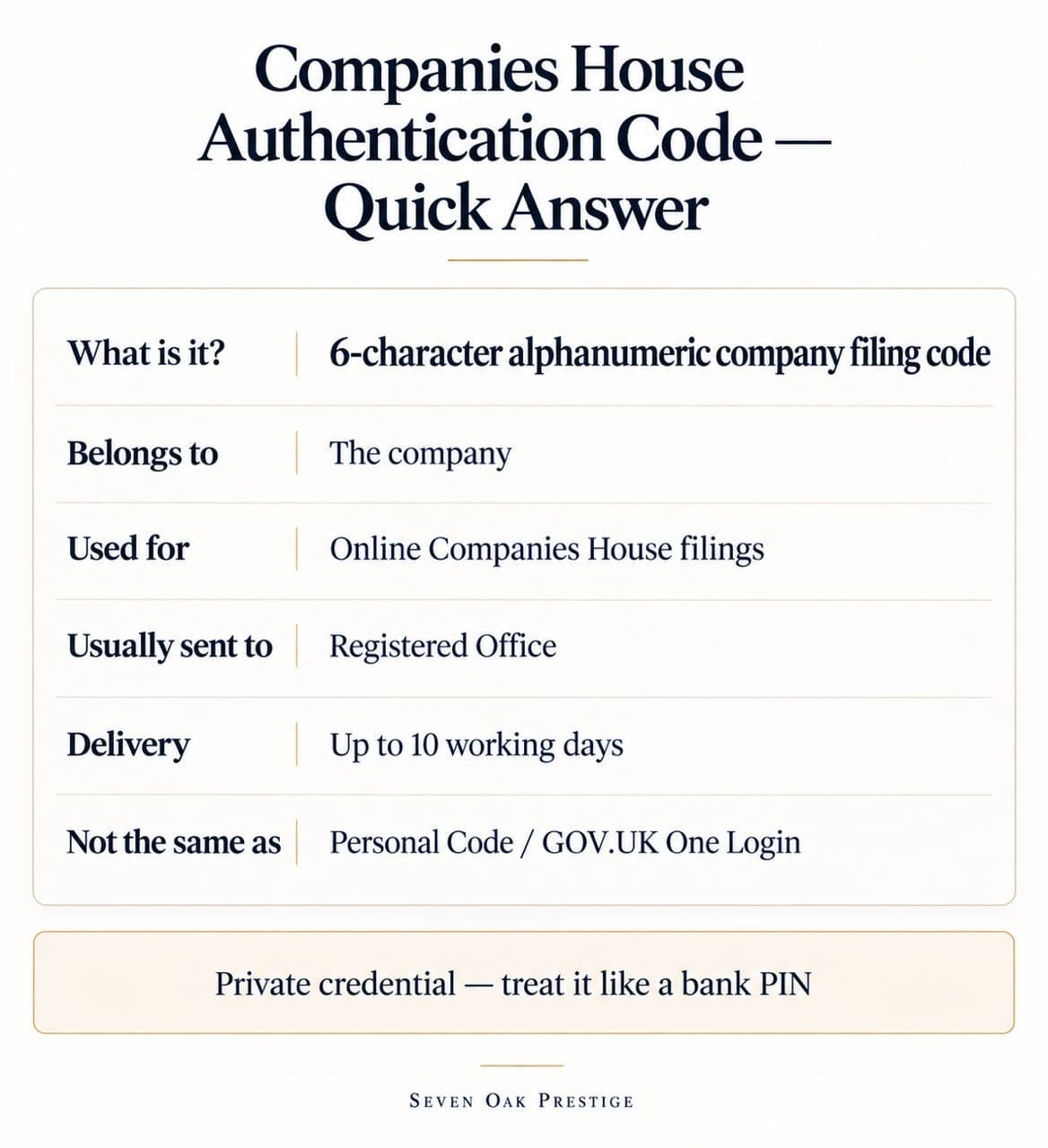
A Companies House authentication code is a 6-character alphanumeric code issued to a company.
It is used to authorize information filed online with Companies House and is treated as the electronic equivalent of a company officer’s signature.
For an international founder, the important distinction is this:
The authentication code belongs to the company. The Companies House personal code belongs to the individual.
They are not interchangeable.
You may encounter the authentication code when filing:
- a Confirmation Statement;
- annual accounts;
- director or officer changes;
- Registered Office changes;
- certain share-related information;
- other company information online.
Companies House also uses other credentials, including GOV.UK One Login and personal identity-verification codes, while HMRC uses separate credentials such as Government Gateway.
That can make the process confusing for founders managing a UK company from overseas.
This guide explains exactly which credential does what, how to request or recover your authentication code, what to do if you cannot access your Registered Office and when you should change the code.
For the wider post-incorporation process, see What Happens After You Register a UK Company as a Non-Resident?.
Quick Answer
What is it?
A 6-character company-specific code used to authorize online Companies House filings.
Who does it belong to?
The company.
Where is it normally sent?
The company’s Registered Office.
How long can standard delivery take?
Companies House advises allowing up to 10 working days.
Can Companies House email it?
No.
Can Companies House tell you the code by phone?
No.
Can you change it?
Yes.
Is it the same as the Companies House personal code?
No.
Does GOV.UK One Login replace it?
No.
Seven Oak Prestige — Do Not Confuse These Company Credentials
Company Authentication Code
Length: 6 characters
Belongs to: The company
Purpose: Authorizes online Companies House filings
Normally delivered to: Registered Office
Keep secure: Yes
Companies House Personal Code
Length: 11 characters
Belongs to: The individual
Purpose: Confirms that a director or PSC has completed Companies House identity verification
Not the same as: Company authentication code
Companies House confirms that the personal code is personal to the verified individual rather than to the company.
For the complete identity-verification process, see Companies House Identity Verification for Non-Residents — Complete 2026 Guide.
GOV.UK One Login
Belongs to: The individual user
Purpose: Signs the user into supported GOV.UK and Companies House services
Not: The company’s filing authorisation code
From 13 October 2025, WebFiling users have needed to connect their WebFiling account to GOV.UK One Login. Companies House may still require each company’s authentication code to confirm that the user is authorised to file for that company.
Government Gateway
Main purpose: HMRC online services
Not: A Companies House authentication code
Companies House states that Government Gateway cannot be used to send Companies House information online.
For the HMRC side, see HMRC Business Tax Account for Non-Resident UK Companies.
Company filing → Authentication Code
Identity verification → Personal Code
Companies House sign-in → GOV.UK One Login
HMRC access → Government Gateway
1. What Is the Companies House Authentication Code Used For?
The authentication code helps Companies House establish that the person submitting information online is authorised to file for the company.
Companies House describes it as the electronic equivalent of a company officer’s signature.
You may need it when using:
- Companies House WebFiling;
- the Find and update company information service;
- supported Companies House filing services;
- commercial filing software.
For example, the current online Confirmation Statement process requires the company authentication code.
The current Companies House service for filing certain accounts also requires the company authentication code.
The code should therefore be treated as a private filing credential, not as ordinary public company information.
2. Is the Authentication Code the Same as the Company Number?
No.
These two numbers perform completely different functions.
Company Registration Number
Public: Yes
Purpose: Identifies the legal company on the Companies House register.
Authentication Code
Public: No
Purpose: Authorises online filings for the company.
A company number may appear on:
- incorporation documents;
- invoices;
- contracts;
- websites;
- public Companies House records.
The authentication code should not.
3. Where Do You Find Your Companies House Authentication Code?
The answer depends on how the company was formed and who currently manages its filings.
If You Registered Directly
Companies House normally sends the authentication code by post to the company’s Registered Office.
If a code already exists and you request it again, Companies House can send a reminder of the existing code.
If You Used a Formation Agent
The agent may have received or stored the code during incorporation.
Check:
- your incorporation documents;
- client portal;
- company secretarial records;
- secure correspondence from the provider.
Do not assume that an old formation agent still holds the current code if it has subsequently been changed.
If Your Accountant Handles Companies House Filings
Your accountant may know the current code if you previously authorised them to file for the company.
Only trusted people who genuinely need filing access should hold it.
4. What If You Lose Your Companies House Authentication Code?
You can request the code again.
Companies House sends authentication codes by post.
It does not provide them by email or over the phone.
The main Companies House guidance currently says delivery can take up to 10 working days.
That creates an important practical rule:
Do not wait until a Confirmation Statement or accounts deadline to discover that you no longer have the code.
Companies House itself warns companies not to leave requesting the authentication code until accounts are due.
For the wider filing schedule, use UK Company Compliance Calendar 2026 for Non-Resident Directors.
Managing Your UK Company From Overseas?
If you cannot access company correspondence, are unsure which Companies House credential you need, or need help organising your UK company records, Seven Oak Prestige can assist with Registered Office, Companies House and compliance preparation.
Discuss My UK Company Compliance →
5. What If You Cannot Access the Registered Office?
This is one of the most important differences between an ordinary UK-company guide and a guide written specifically for non-resident directors.
The authentication code is normally sent to the Registered Office.
For an overseas founder, that can create a practical problem if:
- the Registered Office provider is no longer active;
- correspondence has not been forwarded;
- the founder changed address provider;
- the company’s mail is not being monitored;
- a former agent controlled the company records.
Companies House provides a separate service that can, in eligible cases, send the authentication code to an active officer’s home address instead of the Registered Office.
The current service cannot be used if the company:
- filed a document online during the previous 30 days;
- is not based in the UK;
- is not a limited company or LLP;
- is dissolved.
The officer must also have their current home address recorded with Companies House.
Companies House currently says to allow around 10 working days for delivery to the officer’s home address.
The service does not display or let you update the residential address being used.
That makes accurate Companies House records especially important.
For the full distinction between company and director addresses, read Registered Office vs Director Service Address for Non-Residents.
If you do not personally have UK premises, also see UK Company Formation Without Your Own UK Address.
6. Why Registered Office Mail Matters More for Non-Resident Directors
A Registered Office is not simply an address placed on Companies House during incorporation.
It is the company’s official legal correspondence address.
For international founders, this can include important mail from:
- Companies House;
- HMRC;
- other official bodies.
If correspondence is not monitored, the director may not discover important information until a filing or compliance issue has already developed.
This is one reason Seven Oak Prestige treats Registered Office and mail handling as part of ongoing company administration rather than simply an incorporation formality.
The company can be managed from overseas, but the director should still maintain reliable access to company correspondence.
7. Can You Change the Authentication Code?
Yes.
Companies House allows the authentication code to be changed through WebFiling.
Once changed, the previous authentication code no longer works. Anyone authorised to file for the company must use the new code.
Companies House advises choosing a code that is not easy to guess.
The change can be particularly useful where the current code is known by somebody who no longer needs filing access.
8. When Should You Consider Changing It?
Changing the code may be sensible when:
- you change accountant;
- you change formation agent;
- you change company-secretarial provider;
- a former employee knew the code;
- someone who is no longer authorised still has access;
- you believe the code was compromised;
- you discover unexpected Companies House filings.
Companies House specifically advises changing the authentication code where someone you no longer trust knows it.
Practical offboarding rule
When ending a relationship with an accountant, agent or other person who previously filed for the company:
- decide whether they still need filing authority;
- change the authentication code if appropriate;
- give the new code only to the advisers who remain authorised;
- review the company’s recent filing history.
This is a simple but important corporate-security step.
9. What If Someone Else Knows Your Authentication Code?
Treat the situation seriously.
Companies House recommends treating the authentication code with the same care as a bank-card PIN.
A sensible response is:
Step 1 — Change the Code
Replace it through the relevant Companies House service.
Step 2 — Review Recent Filings
Check the company’s public filing history for anything unexpected.
Step 3 — Review Who Has Access
Identify accountants, advisers, employees or former providers who know the code.
Step 4 — Restrict Future Access
Only share the replacement code with trusted people who genuinely need filing authority.
Companies House will not phone you and ask for your company authentication code.
Never disclose it to an unsolicited caller claiming to be Companies House.
10. Can an Accountant or Formation Agent Use Your Authentication Code?
Yes.
An accountant, company secretary, formation agent or other trusted adviser can use the authentication code where you authorise them to file for the company.
Companies House acknowledges that other people can file on behalf of a company and that they will need the updated code if it changes.
This does not mean the code should be widely distributed.
It should not be:
- published;
- placed in public documents;
- shared with unknown service providers;
- left permanently with former advisers who no longer act for the company.
For broader director responsibility, read UK Company Director Duties for Non-Residents.
11. Authentication Code vs Personal Code: Which One Do You Need?
This is where many directors now become confused.
The answer is that both may be relevant to the same filing, but they perform different jobs.
Company Authentication Code
Authorises the filing for the company.
Companies House Personal Code
Confirms the identity-verification status of the relevant individual.
For the current Confirmation Statement process, Companies House says the company needs its authentication code and that directors may also need to provide their personal codes.
So:
Identity verification does not replace the company authentication code.
For the full identity-verification process, use Companies House Identity Verification for Non-Residents.
If your question is specifically when the personal code must be provided, read Companies House ID Verification Deadline — Check Your Real Date 2026.
12. Does GOV.UK One Login Replace the Authentication Code?
No.
The two systems answer different questions.
GOV.UK One Login
Question: Who is the user signing in?
Authentication Code
Question: Is this user authorized to file for this company?
From 13 October 2025, Companies House Web Filing users have needed to connect their Web Filing account to GOV.UK One Login.
Companies House also says users may need to enter each company’s authentication code to confirm they remain authorized to file for that company.
You do not need to verify your identity merely to connect Web Filing to GOV.UK One Login.
That gives us three separate concepts:
Sign in
→ GOV.UK One Login
Authorize company filing
→ Company authentication code
Prove individual identity verification
→ Companies House personal code
These should not be confused.
13. What About the Find and Update Company Information Service?
Companies House is continuing to move its services toward GOV.UK One Login.
In August 2026, Companies House announced that GOV.UK One Login would become the main sign-in option for the Find and update company information service, with new users required to use One Login.
That change concerns sign-in.
It does not make the company authentication code or the identity-verification personal code the same thing.
For non-resident founders managing multiple company credentials, the safest approach is to treat each credential according to its own purpose.
14. Is Government Gateway the Same as the Authentication Code?
No.
Government Gateway belongs to the HMRC side of company administration.
It can be used for supported HMRC services such as:
- Corporation Tax;
- VAT;
- PAYE;
- other business taxes where applicable.
Companies House specifically states that Government Gateway cannot be used to send Companies House information online.
A founder may therefore legitimately have:
GOV.UK One Login
→ sign-in to supported government services
Companies House authentication code
→ company filing authority
Companies House personal code
→ identity verification
Government Gateway credentials
→ HMRC services
For HMRC access, read HMRC Business Tax Account for Non-Resident UK Companies.
15. Common Authentication Code Mistakes
Mistake 1 — Confusing It With the Personal Code
Authentication code = company filing authority.
Personal code = individual identity verification.
Mistake 2 — Waiting Until the Filing Deadline
The authentication code arrives by post and can take time.
Request it early.
Mistake 3 — Expecting Companies House to Email It
Companies House does not provide the company authentication code by email or phone.
Mistake 4 — Treating It Like the Public Company Number
Your CRN is public.
Your authentication code is private.
Mistake 5 — Leaving It With a Former Adviser
If someone who is no longer authorised still knows the code, consider changing it.
Mistake 6 — Assuming GOV.UK One Login Replaced It
One Login manages user sign-in.
The authentication code continues to authorise company filing.
Mistake 7 — Ignoring Registered Office Mail
For a non-resident director, important company credentials and official correspondence may be sent to the Registered Office.
Make sure that mail reaches you.
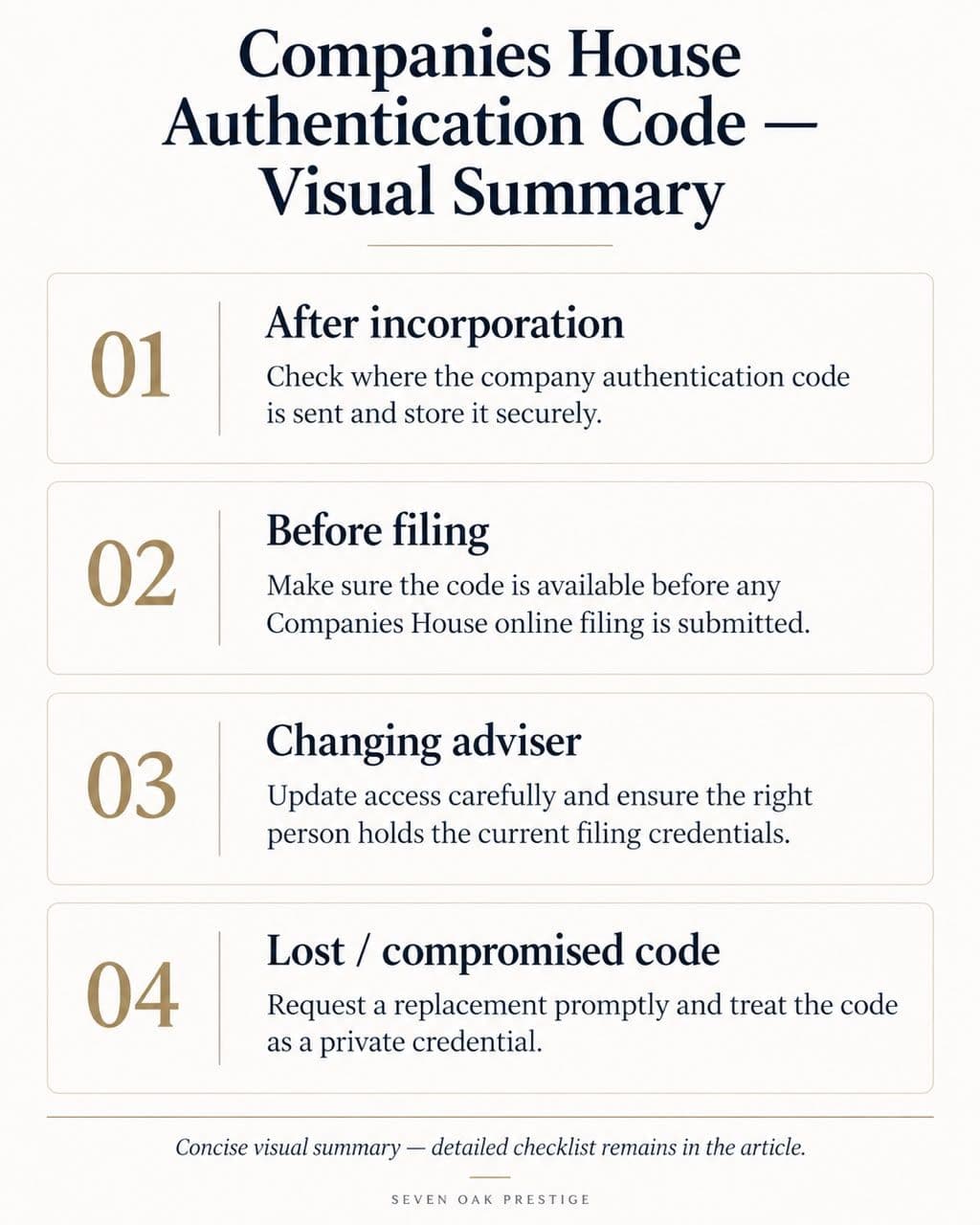
16. Seven Oak Prestige Authentication Code Checklist for Non-Resident Directors
Use this as a practical company-record check.
Immediately After Incorporation
Check: Where will the authentication code be received?
Check: Is the Registered Office service active?
Check: Who is responsible for monitoring company mail?
Action: Store the code securely once received.
Before a Companies House Filing
Check: Do you have the current authentication code?
Check: Does the filing also require directors’ personal codes?
Check: Can you still access your WebFiling / Companies House account?
Action: Resolve missing access before the deadline.
When Changing Accountant or Agent
Check: Does the former provider know the authentication code?
Check: Do they still need authority to file?
Action: Change the code if appropriate.
Action: Give the new code only to authorised filers.
If You Lose Registered Office Access
Check: Can you still receive official company post?
Check: Is the officer’s home address held by Companies House current?
Check: Are you eligible for the home-address authentication-code service?
Action: Allow sufficient delivery time.
If You Think the Code Has Been Compromised
Action: Change the code.
Action: Review the company’s recent filing history.
Action: Review who retains filing access.
Action: Investigate anything unexpected.
17. How Seven Oak Prestige Supports Non-Resident Directors
Seven Oak Prestige supports international founders with the corporate infrastructure and compliance preparation involved in establishing and maintaining a UK Limited Company from overseas.
Depending on the service required, support can include:
- UK company formation;
- Registered Office;
- Director Service Address;
- official correspondence handling under the applicable service;
- Companies House processes;
- identity-verification support;
- company-information updates;
- post-incorporation compliance preparation;
- VAT and EORI assistance;
- banking and payment-readiness support;
- coordination with accountants and specialist advisers where appropriate.
For an international founder, good company administration means keeping several systems properly organized:
Companies House records
statutory addresses
company mail
filing credentials
identity verification
HMRC administration
and
banking/compliance documentation
Seven Oak Prestige can support the corporate and administrative side of that process.
We do not replace the statutory responsibilities of the company’s directors.
Lost Your Authentication Code or Unable to Access Your UK Company Mail?
If you manage a UK Limited Company from overseas and need help organizing your Registered Office, Companies House records, identity-verification process or wider company compliance preparation, speak with Seven Oak Prestige.
Discuss My UK Company Compliance →
Frequently Asked Questions
What is a Companies House authentication code?
It is a 6-character alphanumeric code issued to a company and used to authorize online Companies House filings. Companies House describes it as the electronic equivalent of a company officer’s signature.
How many characters is the Companies House authentication code?
Six characters, using letters and numbers.
Is the authentication code the same as the company number?
No.
The company registration number identifies the company publicly.
The authentication code is a private filing credential.
Is the authentication code the same as the Companies House personal code?
No.
The company authentication code belongs to the company.
The personal code is an 11-character code belonging to an individual after identity verification.
How long does the authentication code take to arrive?
Companies House advises allowing up to 10 working days for standard delivery of an authentication code.
The separate home-address service currently says around 10 working days.
Can Companies House email my authentication code?
No.
Companies House says it cannot send the code by email or provide it over the phone.
Can I receive the code at my home address?
In eligible circumstances, an active officer can request the company authentication code at their home address rather than the Registered Office. The service has specific eligibility conditions.
Can my accountant use the authentication code?
Yes, if you authorize and trust them to file for the company.
Should I change the authentication code when I change accountants?
It may be sensible if the previous accountant still knows the code and is no longer authorized to file for the company.
Once the code is changed, the previous code no longer works.
Does GOV.UK One Login replace the authentication code?
No.
GOV.UK One Login is used for sign-in.
The authentication code remains relevant for proving authority to file for a company.
Do I need an authentication code for a Confirmation Statement?
For the online service, Companies House requires the company authentication code. Directors may also need their personal identity-verification codes.
Does identity verification replace the authentication code?
No.
Identity verification concerns the individual director or PSC.
The company authentication code authorizes filings for the company.
About the Author
Isaac Jackson — Founder & Managing Director, Seven Oak Prestige Ltd
Isaac Jackson has more than three years of professional experience supporting international founders with UK company formation, Companies House processes, statutory-address solutions, compliance preparation and banking readiness.
His work focuses on the practical challenges faced by founders establishing and operating UK companies while living outside the United Kingdom.
Editorial Methodology
Last reviewed: 13 September 2026
This guide was reviewed against current primary Companies House and GOV.UK guidance covering:
- company authentication codes;
- Web Filing;
- GOV.UK One Login;
- home-address authentication-code requests;
- Companies House personal codes;
- Confirmation Statement filing;
- online accounts filing;
- identity verification;
- company-information updates.
The article was also reviewed against Seven Oak Prestige’s existing content to preserve distinct search intent.
Its purpose is specifically to answer:
What is the company authentication code, how does an overseas director obtain or protect it, and how is it different from the other Companies House and HMRC credentials now used in 2026?
It is intentionally separate from Seven Oak Prestige’s identity-verification content, which owns questions about:
- who must verify;
- personal codes;
- directors and PSCs;
- ID-verification documents;
- ACSP verification;
- verification deadlines.
Important Disclaimer
This guide provides general educational information and does not constitute legal, accounting or company-secretarial advice.
Companies House systems, filing methods, eligibility conditions and online services can change.
Always check the current Companies House guidance before relying on a filing procedure or delivery timeframe.
Seven Oak Prestige Ltd provides UK company formation, statutory-address services, Companies House assistance, compliance preparation and related corporate-support services.
The directors of a company remain responsible for ensuring the company meets its legal and filing obligations.
Related Guides
Companies House Identity Verification for Non-Residents — Complete 2026 Guide
Use this when the issue concerns the 11-character personal code, verification documents or the identity-verification process.
Companies House ID Verification Deadline — Check Your Real Date 2026
Use this when the question is when a director or PSC must provide their personal code.
UK Company Compliance Calendar 2026 for Non-Resident Directors
Track Confirmation Statements, annual accounts, Corporation Tax and other company deadlines.
Registered Office vs Director Service Address for Non-Residents
Explains where company correspondence is sent and why Registered Office access matters.
UK Company Formation Without Your Own UK Address
Useful for overseas founders who do not personally own or rent UK premises.
What Happens After You Register a UK Company as a Non-Resident?
The broader post-incorporation checklist.
UK Company Director Duties for Non-Residents
Explains what remains the director’s responsibility even when an accountant or agent handles filings.
HMRC Business Tax Account for Non-Resident UK Companies
Explains why Government Gateway, UTR and HMRC access are separate from Companies House filing credentials.