
What Does Ltd Mean in the UK? Simple Guide | 2026
What Does “Ltd” Mean in the UK?
Ltd means “Limited”.
In the UK, “Ltd” at the end of a company name normally tells you that the business is a private limited company.
For example:
Example Trading Ltd
The company is legally separate from its owners. For a typical private company limited by shares, shareholders’ liability is generally limited to the amount unpaid on the shares they hold.
That is the simple definition.
For international founders, however, a few details matter — particularly because “Ltd” does not mean exactly the same thing in every country.
Quick Answer
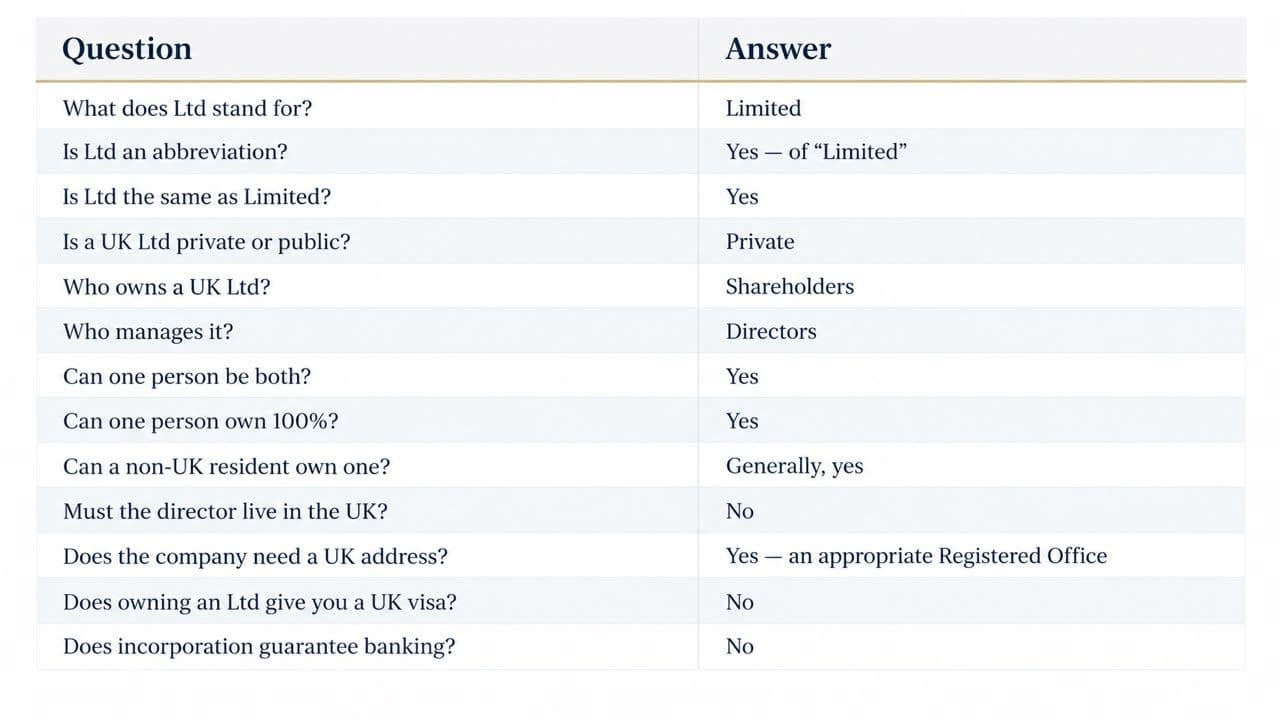
If you are already considering forming one while living overseas, read our UK Company Formation for Non-Residents — Complete 2026 Guide.
1. What Does “Limited” Actually Mean?
The word Limited refers to limited liability.
A UK Limited Company is legally separate from its shareholders.
This means the company can, in its own name:
- own assets;
- enter contracts;
- receive income;
- employ people;
- owe money;
- hold liabilities.
For a normal private company limited by shares, a shareholder’s liability is generally limited to the amount unpaid on their shares.
Simple example
You own 100 fully paid shares in:
ABC Technology Ltd
If the company later experiences financial difficulties, you are not ordinarily responsible for all of its debts simply because you are a shareholder.
However, limited liability is not absolute in every situation. Personal guarantees, fraud or separate personal liabilities can create different outcomes.
The important principle is:
the company and its owners are legally separate.
2. Who Owns and Runs a UK Ltd?
The distinction is simple:
Shareholders own the company.
Directors manage the company.
The same person can hold both roles.
For example:
One founder
→ 100% shareholder
→ sole director
→ usually also a Person with Significant Control — PSC
This is a common structure for founder-owned UK companies.
A director does not need to own shares, and a shareholder does not automatically have to be a director.
If you need the detailed explanation, see our How to Structure Shares and Directors in a UK Ltd as a Non-Resident Founder.
3. Is “Ltd” the Same as “Limited”?
Yes.
For a UK private limited company:
Example Consulting Ltd
and
Example Consulting Limited
indicate the same type of private company status.
“Ltd” is simply the shorter form of “Limited”.
There is no higher legal status created by writing “Limited” in full.
Once incorporated, however, the company should use its correct registered name where company law requires it.
4. Is a UK Ltd Private or Public?
A UK Ltd is a private company.
A UK public limited company normally uses:
PLC
That distinction becomes particularly important for international founders because company suffixes do not mean the same thing everywhere.
5. UK Ltd vs Indian “Limited”: A Very Important Difference
This is one of the biggest terminology differences for Indian founders.
In the United Kingdom
A private company normally uses:
Limited
or
Ltd
Example:
Global Technology Ltd
In India
A private company normally uses:
Private Limited
while a public company normally uses:
Limited.
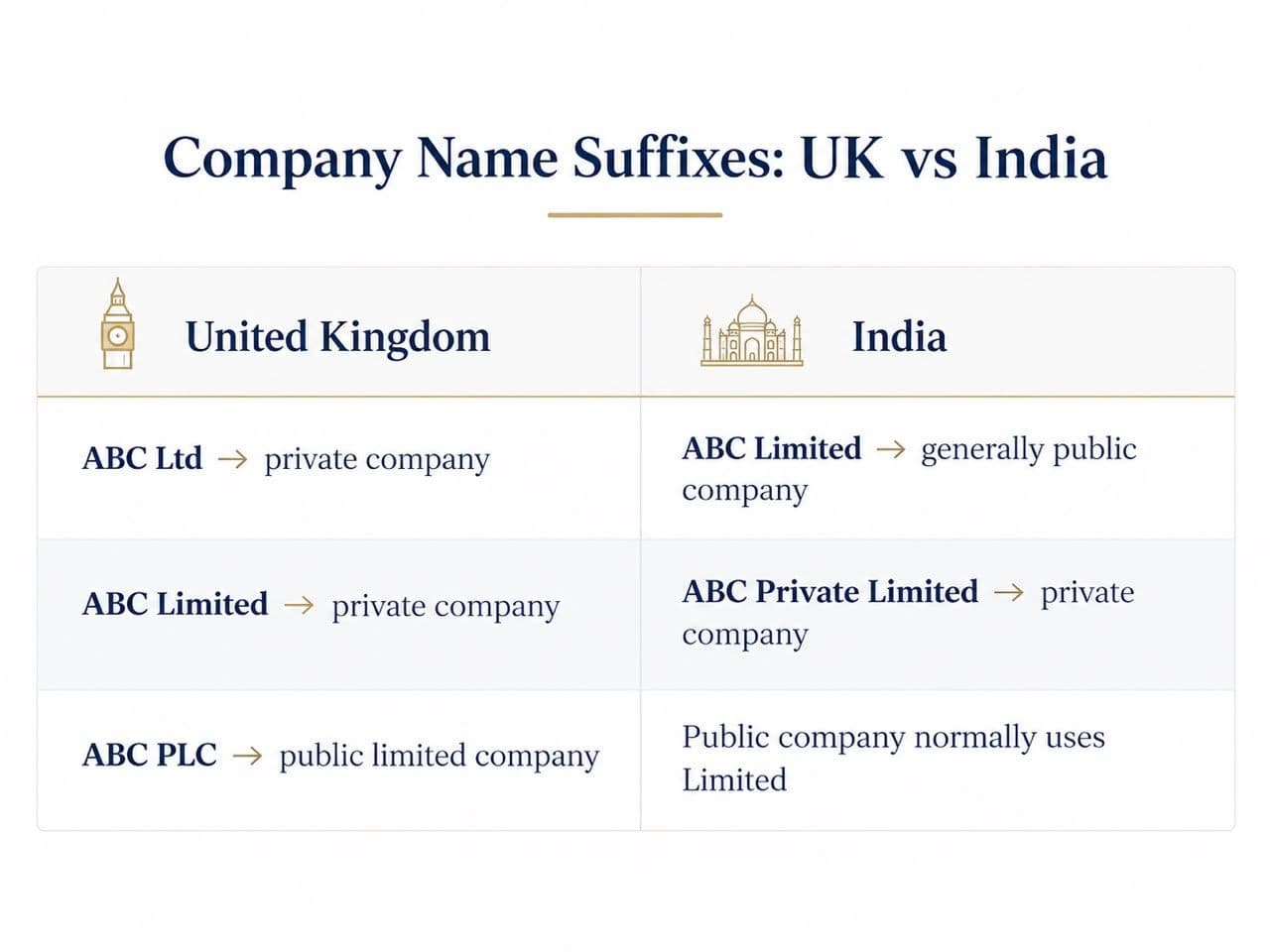
So an Indian founder should not assume that a British company ending in “Ltd” is a public company.
In the UK, “Ltd” normally indicates a private limited company.
Is a UK Ltd the Same as an Indian Private Limited Company?
No.
They are formed under different legal, regulatory and tax systems.
But at a high level, an Indian Private Limited Company is the more relevant comparison with a UK private Ltd than an Indian public Limited Company.
If you are based in India, continue with our How to Start a UK Company from India — Complete 2026 Guide.
If you are deciding specifically between the two jurisdictions, read Indian Private Limited vs UK Limited Company.
6. Can a Non-Resident Own a UK Ltd?
Generally, yes.
A shareholder does not ordinarily need to live in the United Kingdom.
Directors of an ordinary UK private company also do not generally have to be UK residents.
That means someone living in:
- India;
- UAE;
- France;
- United States;
- Canada;
- Saudi Arabia;
- Singapore;
- or another country;
can potentially own and direct a UK Limited Company.
However, the company itself must maintain an appropriate UK Registered Office.
Your own home does not need to be in Britain.
For the full process, see UK Company Formation for Non-Residents — Complete 2026 Guide.
7. What Does Owning a UK Ltd NOT Automatically Give You?
This is particularly important for international founders.
Registering a UK Limited Company does not automatically give you:
UK residence or a visa
A British company can be owned by someone who continues to live overseas.
Company ownership and UK immigration permission are separate matters.
A UK bank account
Banks, EMIs and fintech providers conduct their own eligibility, KYC, KYB and risk assessments.
Stripe, Wise, Revolut or another payment provider
A Companies House Certificate of Incorporation does not guarantee financial-provider approval.
A UK operating office
Your Registered Office is a statutory company address. It is not automatically your physical trading premises or personal residence.
A particular tax result
The company’s tax obligations and the founder’s personal obligations in their country of residence must be considered separately.
For Indian residents, owning or funding a foreign company can also create India-side overseas-investment obligations. See our FEMA & RBI Rules for Indian Founders with a UK Company.
8. Which Business Structure Should You Actually Choose?
Understanding what Ltd means is straightforward.
Choosing the right business structure is a separate question.
A UK Ltd is only one possible structure.
Depending on your circumstances, you may also encounter:
- UK LLP;
- sole trader;
- partnership;
- or, for international comparisons, a US LLC.
These structures should not be treated as interchangeable simply because some of them provide limited liability.
The right structure depends on factors such as:
- where you live;
- where the business operates;
- ownership;
- number of founders;
- tax treatment;
- investor plans;
- liability;
- banking;
- future expansion.
Next guide: UK Ltd vs LLC vs LLP — Which Structure Should a Non-Resident Founder Choose?
That comparison should be used when you are moving from:
“What does Ltd mean?”
to:
“Which structure is actually right for me?”
If you already know that a UK Limited Company is the structure you want and simply need the incorporation process, continue instead with our UK Company Formation for Non-Residents — Complete 2026 Guide.
9. Are You Based in India?
For Indian founders, understanding “Ltd” is only the first step.
A UK company may be legally straightforward to incorporate, but an Indian resident should separately consider:
- FEMA;
- RBI Overseas Investment rules;
- funding of the foreign company;
- India-side reporting;
- tax;
- banking;
- where the business will actually operate.
The UK company should make sense commercially — not simply look international.
Start with the India-specific pillar:
UK Company Formation for Indian Residents
Then use the specialist guides where relevant:
How to Start a UK Company from India — Complete 2026 Guide
Indian Private Limited vs UK Limited Company
FEMA & RBI Rules for Indian Founders with a UK Company
UK Business Bank Account for Indian Residents
UK Company Formation Cost from India
Frequently Asked Questions
What is the full form of Ltd?
Ltd means “Limited”.
It is an abbreviation of the word Limited.
What does Ltd mean after a company name?
In the UK, it normally indicates that the business is a private limited company.
The company has a separate legal identity and its members’ liability is limited according to its structure.
Is Ltd private or public in the UK?
Private.
A UK public limited company normally uses PLC.
Is Ltd the same as Limited?
Yes.
“Ltd” is simply the abbreviated form of “Limited”.
Does Ltd mean the same thing in India?
No.
In India, a private company normally uses Private Limited, while a public company normally uses Limited.
In the UK, Ltd normally identifies a private limited company.
Is a UK Ltd the same as an Indian Pvt Ltd?
No.
They are incorporated under different countries’ laws.
However, an Indian Private Limited Company is a more appropriate high-level comparison with a UK private Ltd than an Indian public Limited Company.
Can an Indian citizen own a UK Ltd?
Generally, yes.
UK company law does not ordinarily require shareholders or directors to live in Britain.
Indian residents should separately consider applicable FEMA/RBI, tax and reporting requirements.
Can a foreigner own 100% of a UK Ltd?
Generally, yes.
A UK private company limited by shares can have a single overseas shareholder.
Does a UK Ltd need a UK director?
No.
At least one director must be an individual, but directors do not generally have to reside in the UK.
Does Ltd mean my personal assets can never be at risk?
No.
Limited liability generally separates shareholders from ordinary company liabilities, but it is not absolute in every situation.
Personal guarantees and separate personal wrongdoing or liabilities can produce different outcomes.
Ready for the Next Step?
If you are still deciding which legal structure fits your business, continue with our upcoming comparison:
UK Ltd vs LLC vs LLP — Which Structure Should a Non-Resident Founder Choose?
If you have already decided on a UK Limited Company, Seven Oak Prestige supports international founders with:
- UK company formation;
- Registered Office;
- Director Service Address;
- Companies House processes;
- identity-verification support;
- compliance preparation;
- banking and payment readiness.
Banking, payment-provider, tax and immigration outcomes remain subject to separate requirements and cannot be guaranteed.
About the Author
Isaac Jackson — Founder & Managing Director, Seven Oak Prestige Ltd
Isaac Jackson has more than three years of hands-on experience supporting international founders with UK company formation, Companies House processes, address solutions, compliance preparation and banking readiness.
His work includes helping overseas founders understand UK company structures and the distinction between incorporation, ownership, compliance and operational readiness.
Editorial Methodology
Last reviewed: 9 September 2026
This guide was reviewed against current Companies House and GOV.UK guidance concerning UK private limited companies, directors, shareholders, company names and Registered Office requirements.
The India section was also reviewed against Indian company-law terminology to distinguish correctly between a UK Ltd, an Indian Private Limited Company and an Indian public Limited Company.
The article intentionally owns the narrow search intent:
“What does Ltd mean?”
Detailed questions about company formation, India-specific regulation and structural comparisons are linked or signposted rather than reproduced here.
Important Disclaimer
This guide provides general educational information and does not constitute legal, tax, financial, accounting or immigration advice.
UK incorporation should be considered separately from personal tax residence, overseas-investment obligations, immigration permission, banking eligibility and payment-provider approval.
International founders should also consider applicable requirements in their country of residence.
Related Guides
- UK Company Formation for Non-Residents — Complete 2026 Guide
- UK Ltd vs LLC vs LLP: Which Is Best for Non-Residents? 2026
- How to Start a UK Company from India — Complete 2026 Guide
- Indian Private Limited vs UK Limited Company
- FEMA & RBI Rules for Indian Founders with a UK Company
- UK Business Bank Account for Indian Residents