
UK Tax Identification Number for Non-Resident Companies | TIN, UTR & CRN

Which UK Tax Identification Number Does a Non-Resident-Owned Company Need?
A UK company can have several official identifiers.
The number required in a field labelled “TIN” — Tax Identification Number — depends on the context.
The company’s UTR is the HMRC reference used for Corporation Tax administration.
The Company Registration Number — CRN identifies the legal entity at Companies House and is treated as the relevant TIN for a UK-resident company in certain specific HMRC international-reporting regimes.
A VAT number, EORI number and Companies House personal code all serve different purposes.
For an international founder, the first questions should therefore be:
- Is the form asking about the company or an individual?
- Which country’s tax residence is being reported?
- Is the form dealing with Corporation Tax, VAT, customs, CRS/FATCA, platform reporting or ordinary KYC?
- Does the institution specify the identifier or format it expects?
If the form is unclear, do not guess.
Ask the requesting institution which identifier and tax jurisdiction it expects before submitting the information.
HMRC’s CRS guidance defines a TIN as the identifier assigned to an account holder by the tax administration in the account holder’s jurisdiction of tax residence. Separately, HMRC’s Digital Platform Reporting guidance specifically states that for UK-resident companies, the TIN in that regime will be the CRN. Those two rules should not be incorrectly collapsed into one universal rule.
If you are still at the company-formation stage, continue to UK Company Formation for Non-Residents — Complete 2026 Guide.
Quick Answer: Does a UK Limited Company Have a TIN?
A UK Limited Company has official identifiers that can be used for different tax, corporate and reporting purposes.
There is not one company number that should automatically be entered into every field labelled “TIN.”
Depending on the context, you may encounter:
Company Registration Number — CRN
Issued by Companies House.
Company UTR
Issued by HMRC for Corporation Tax administration.
VAT Registration Number
Only where the company is VAT registered.
EORI Number
Used for customs purposes.
Personal TIN
Relates to an individual director, shareholder or controlling person’s tax residence rather than the company.
Companies House Personal Code
Used for identity verification, not tax identification.
The correct answer therefore depends on who is asking and why.
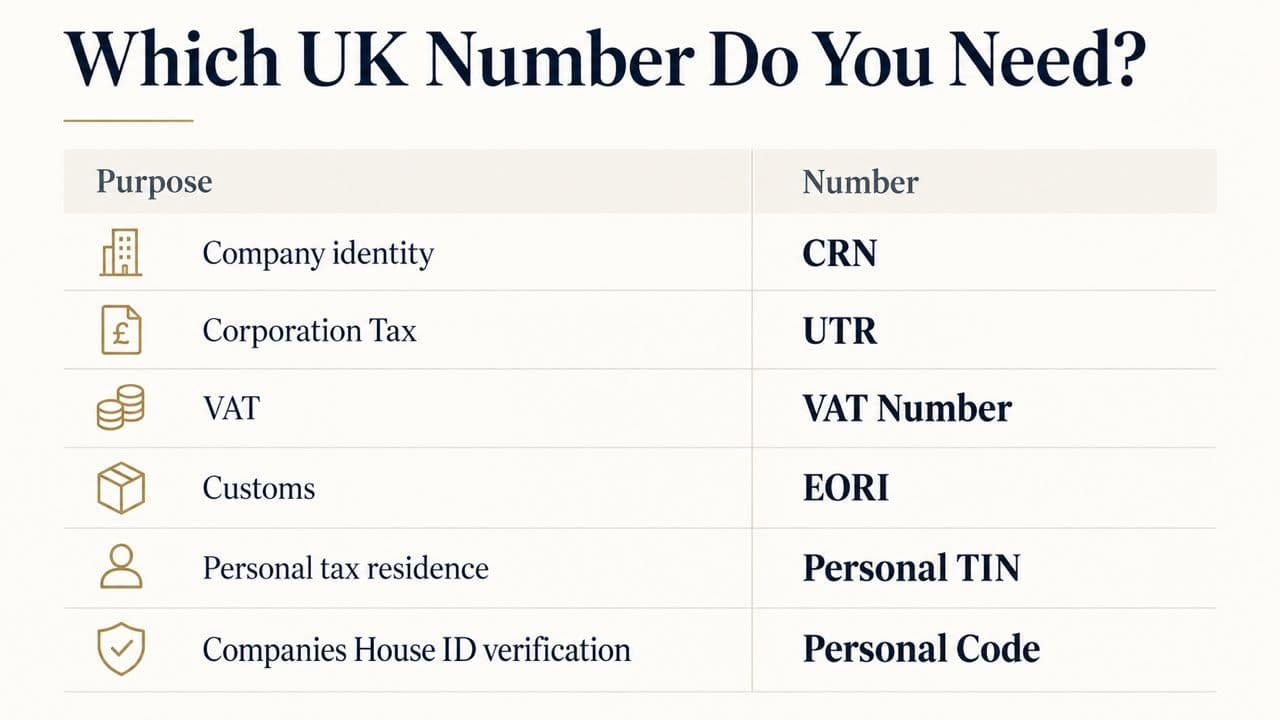
Seven Oak Prestige — Which UK Number Should You Provide?
Use this framework before completing a tax, banking or compliance form.
The Form Asks for the Company Number or Legal Entity Number
Usually relevant identifier: Company Registration Number — CRN
Issued by: Companies House
Purpose: Identifies the legal company on the UK corporate register.
This is the number created when the company is incorporated.
It is not the company’s Corporation Tax UTR.
HMRC Asks for the Company’s Corporation Tax Reference
Usually relevant identifier: Company UTR
Issued by: HMRC
Purpose: Identifies the company’s Corporation Tax record.
HMRC currently requires the company’s 10-digit UTR when Corporation Tax services are added to the Business Tax Account.
For the full process, see HMRC Business Tax Account for Non-Resident UK Companies.
A Specific International-Reporting Regime Asks for a TIN
Relevant identifier: Follow the rules of that specific reporting regime.
In HMRC’s current Digital Platform Reporting guidance, a UK-resident company’s TIN is the Company Registration Number — CRN.
This does not mean:
“CRN is automatically the correct TIN for every bank, tax form or international reporting system.”
The reporting regime matters.
A Bank or Financial Institution Asks for a TIN
Do not automatically enter the UTR or CRN.
First identify:
- whether the account belongs to the company;
- whether the question concerns a controlling person;
- the relevant jurisdiction of tax residence;
- whether the form is a CRS/FATCA self-certification;
- whether the provider gives country-specific TIN instructions.
HMRC confirms that financial institutions can request an entity’s tax residence status and tax identification number and may separately request information about controlling persons.
If the bank’s terminology is unclear, ask which identifier and jurisdiction it expects before submitting the self-certification.
The Form Specifically Asks for a VAT Number
Relevant identifier: VAT Registration Number
Issued by: HMRC
Applies only if: The company is VAT registered.
Do not enter a VAT number merely because it is tax-related.
Use it when the form specifically requests VAT registration information or the relevant reporting rules identify it as the required number.
The Form Asks for a Customs Identifier
Relevant identifier: EORI
Purpose: Customs identification.
An EORI identifies an economic operator for customs purposes.
It is not the company’s Corporation Tax reference and should not normally be entered into a generic TIN field.
HMRC’s EORI application process itself distinguishes the EORI from identifiers such as the UTR and VAT number.
The Bank Asks for the Director or Controlling Person’s TIN
This is a different taxpayer.
The relevant identifier will normally depend on the individual’s jurisdiction of tax residence.
HMRC states that where an individual is tax resident outside the UK, the account provider may request the TIN issued by that other country’s tax authority.
Do not automatically use:
- the company’s UTR;
- the company’s CRN;
- the company’s VAT number.
Companies House Asks for a Personal Code
Relevant identifier: Companies House personal code
Purpose: Identity verification.
Not: A tax identifier.
Companies House currently describes the personal code as an 11-character code belonging to the individual, not to the company.
For the full process, see Companies House Identity Verification for Non-Residents — Complete 2026 Guide.
Do Not Confuse These UK Numbers
The easiest way to remember the distinction is:
Company identity
→ Company Registration Number — CRN
Corporation Tax record
→ Company UTR
VAT registration
→ VAT Registration Number
Customs
→ EORI
Individual tax residence
→ Personal TIN from the relevant jurisdiction
Companies House identity verification
→ Personal code
These numbers may all exist at the same time.
They are not interchangeable.
1. What Is a Company Registration Number — CRN?
The Company Registration Number identifies the legal corporate entity registered at Companies House.
It is created when the company is incorporated and remains connected to that company throughout its life.
It is used extensively for:
- Companies House filings;
- corporate identification;
- company searches;
- contracts and business documentation;
- certain regulatory and reporting processes.
The CRN is not the same thing as the company UTR.
It is also important not to overstate its role as a TIN.
HMRC’s July 2026 Digital Platform Reporting guidance specifically says that for a UK-resident company within that reporting regime, the TIN will be the CRN.
That is a specific reporting rule.
It should not be generalised into:
“Every organisation asking for the company’s TIN wants the CRN.”
2. What Is a Company UTR?
A company UTR is generally a 10-digit HMRC reference used to administer the company’s Corporation Tax record.
HMRC requires it when adding Corporation Tax services to the company’s Business Tax Account.
The UTR is different from:
- CRN;
- VAT number;
- EORI;
- Companies House personal code.
For a newly incorporated company, HMRC correspondence containing Corporation Tax information is sent to the company’s Registered Office.
Current HMRC guidance says that where the UTR has not arrived 15 working days after company registration, the company can use HMRC’s online process to request it.
Because HMRC procedures can change, founders should always check the current HMRC guidance rather than relying only on an old article or checklist.
For more detail, see HMRC Business Tax Account for Non-Resident UK Companies.
3. Is the Company UTR the UK’s Official TIN?
There is no single answer that applies to every context.
The company UTR is the HMRC reference used for Corporation Tax administration.
However, HMRC identifies the CRN as the relevant TIN for a UK-resident company in certain international-reporting regimes, including its current Digital Platform Reporting guidance.
HMRC’s general CRS guidance takes a broader approach.
It defines the TIN as the identifier assigned to the account holder by the tax administration in the account holder’s jurisdiction of tax residence.
Therefore:
Do not take a rule from one international reporting regime and assume that every bank, platform or foreign tax form follows exactly the same definition.
This is the central distinction international founders should understand.
4. Why Can Different Forms Ask for Different Tax Numbers?
Because the systems are trying to identify different legal or tax relationships.
Companies House
Identifies the legal company.
Relevant identifier: CRN.
Corporation Tax
HMRC identifies the company’s Corporation Tax record.
Relevant identifier: company UTR.
VAT
Identifies a VAT registration.
Relevant identifier: VAT Registration Number.
Customs
Identifies an economic operator for customs.
Relevant identifier: EORI.
CRS or Other International Reporting
The reporting institution may need:
- tax residence;
- TIN;
- company/entity information;
- controlling-person information.
The correct identifier depends on the applicable rules.
This is why the same number should not simply be copied into every form.
5. What Should You Do When a Foreign Bank Asks for a TIN?
Start with the wording of the form.
First: Who Is the Form Asking About?
Is it asking about:
the company
or
the director, shareholder or controlling person?
Those are different taxpayers.
Second: Which Tax Jurisdiction Is Being Reported?
HMRC’s CRS guidance says the relevant TIN is tied to the account holder’s jurisdiction of tax residence.
Third: What Type of Form Is It?
Look for references to:
- CRS;
- FATCA;
- tax self-certification;
- KYC;
- company registration;
- Corporation Tax;
- VAT.
Ordinary KYC and international tax self-certification are not necessarily asking the same question.
Fourth: Does the Provider Give a Format?
For example, the form may specify:
- number of digits;
- letters and numbers;
- issuing country;
- type of taxpayer.
That can help identify the intended reference.
Fifth: Ask If It Is Still Unclear
If the provider does not explain which UK identifier it requires:
Ask the bank or platform to confirm the identifier and tax jurisdiction it expects before submitting the form.
HMRC warns that account holders should ensure information supplied to account providers about residence and TIN is correct and complete.
That makes clarification preferable to guessing.
6. Company TIN vs Director or Controlling-Person TIN
A UK company and its founder are separate persons for many legal and tax purposes.
That means one banking application can legitimately ask for several different identifiers.
For example:
Company
May require:
- CRN;
- company UTR;
- relevant entity TIN under the applicable reporting regime.
Director or Controlling Person
May require:
- personal tax jurisdiction;
- personal TIN from that jurisdiction;
- date of birth;
- residential address.
A founder should therefore not assume:
“My company is British, so every tax field should contain a UK number.”
The individual founder’s tax residence is a separate question.
7. Nationality, Residence and Company Incorporation Are Different
This distinction is particularly important for international founders.
A person may be:
Indian citizen
but
tax resident in the UAE
while owning:
a UK Limited Company.
Those three facts answer different questions.
Nationality does not automatically determine tax residence.
The company’s country of incorporation does not automatically determine the director’s personal tax residence.
And the company’s Registered Office does not represent the founder’s residential address.
HMRC’s CRS guidance notes that entities can, depending on domestic rules, potentially be resident in more than one jurisdiction where incorporation and management/control are in different places. From 1 January 2026, its CRS guidance also requires entity account holders self-certifying tax residence to declare all applicable jurisdictions rather than relying on treaty tie-breaker rules for the self-certification.
Where an entity’s tax residence is uncertain, specialist tax advice may be necessary.
Important Note on “UK-Resident Company”
When this article refers to a UK-resident company in relation to a specific HMRC reporting rule, it means the status used by that particular HMRC guidance or reporting regime.
It should not be assumed solely because:
- the company is incorporated in Britain;
- it has a UK Registered Office;
- its director lives overseas;
- its bank account is in the UK.
Tax residence can require a separate analysis.
This article does not determine a company’s tax residence.
8. Are VAT and EORI Numbers TINs?
They are official business identifiers, but they perform specific functions.
VAT Registration Number
Purpose: VAT administration.
Use it when:
- the form specifically asks for VAT;
- the relevant reporting rules specify VAT identification.
Do not automatically substitute it for another requested TIN.
EORI
Purpose: Customs identification.
Use it for relevant customs and import/export processes.
Do not normally enter an EORI into a general TIN field.
HMRC itself requires separate information such as a UTR and VAT details when relevant during the EORI application process, illustrating that these identifiers serve different functions.
9. Is the Companies House Personal Code a TIN?
No.
The Companies House personal code belongs to the individual who completed identity verification.
Companies House currently describes it as an 11-character code personal to you, not your company.
It is used for Companies House identity-verification processes.
It does not replace:
- a company UTR;
- CRN;
- VAT number;
- EORI;
- an individual’s personal tax number.
If you need to determine when your code must be used, see Companies House Identity Verification Deadline — Check Your Real Date.
10. Practical Example: Indian Founder With a UK Company
Consider an international founder who operates a UK Limited Company while living in India.
The founder may have several different identifiers.
UK Company CRN
Issued by: Companies House
Purpose: Corporate identification.
UK Company UTR
Issued by: HMRC
Purpose: Corporation Tax administration.
UK VAT Number
Only if: The company is VAT registered.
Companies House Personal Code
Belongs to: The verified individual.
Purpose: Companies House identity verification.
Founder Personal TIN
Depends on: The founder’s actual tax-residence jurisdiction and the relevant form.
The required personal identifier should not be inferred from nationality alone.
For example, an Indian citizen living elsewhere may not necessarily have the same tax-residence answer as an Indian resident.
Now imagine the bank asks:
“Company TIN”
The founder should determine the relevant reporting regime and the bank’s instructions.
If the next section asks:
“Controlling Person TIN”
that is potentially asking about the founder personally and may therefore require a different jurisdiction and identifier.
This is why the answer:
“Just use the UTR everywhere”
can be unsafe.
For Indian founders specifically, also see our FEMA/RBI Rules for UK Companies Owned by Indian Residents guide before structuring cross-border ownership.
11. What Should You Do When the Form Is Unclear?
Use this Seven Oak decision sequence.
Step 1 — Identify the Person or Entity
Is the question about:
- company;
- director;
- shareholder;
- controlling person?
Step 2 — Identify the Tax Jurisdiction
Which jurisdiction’s tax residence is being reported?
Step 3 — Identify the Purpose
Is the field related to:
- Corporation Tax;
- CRS/FATCA;
- VAT;
- customs;
- corporate registration;
- ordinary KYC?
Step 4 — Check the Required Format
Look for:
- character length;
- letters/numbers;
- country code;
- example format.
Step 5 — Check the Provider’s Instructions
Use the provider’s own guidance where available.
Step 6 — Ask Before Guessing
If the field remains ambiguous:
Ask the institution to confirm which identifier and tax jurisdiction it expects.
That is especially important where the form is a formal tax-residence self-certification.
12. Common UK TIN Mistakes International Founders Should Avoid
Mistake 1: Entering the Company UTR Every Time You See “TIN”
The UTR is central to Corporation Tax.
It is not automatically the answer in every international-reporting context.
Mistake 2: Assuming the CRN Is the Universal UK Company TIN
HMRC uses the CRN as the relevant TIN for UK-resident companies in certain reporting regimes.
That specific rule should not be generalised to all forms.
Mistake 3: Confusing Company and Personal TINs
An individual controlling person’s TIN can be completely different from the company’s identifiers.
Mistake 4: Using the VAT Number Because It Looks Like a Tax ID
VAT registration has a specific purpose.
Mistake 5: Using the EORI Number
EORI is primarily a customs identifier.
Mistake 6: Using the Companies House Personal Code
The personal code is for identity verification, not taxation.
Mistake 7: Using Nationality Instead of Tax Residence
Citizenship and tax residence are not automatically the same thing.
Mistake 8: Guessing on a Bank Self-Certification
If the institution’s wording is unclear, request clarification.
13. Which UK Company Numbers Should You Keep Secure?
An overseas founder should maintain an organised record of the relevant identifiers.
Company Registration Number
Keep with your incorporation records.
Company UTR
Keep with HMRC and Corporation Tax records.
Government Gateway Credentials
Protect these securely.
An accountant should normally use the appropriate HMRC agent-authorisation route rather than simply using your credentials.
Corporation Tax Activation Information
Keep securely where applicable.
VAT Registration Number
Maintain with VAT records.
EORI
Maintain with customs and logistics records.
Companies House Personal Code
This belongs to the individual.
Treat it as sensitive information.
For the broader compliance schedule, see UK Company Compliance Calendar 2026 for Non-Resident Directors.
14. How Seven Oak Prestige Supports Non-Resident Founders
Seven Oak Prestige supports international founders with the corporate infrastructure and compliance preparation involved in establishing and operating a UK Limited Company from overseas.
Depending on the service required, support can include:
- UK company formation;
- Registered Office;
- Director Service Address;
- Companies House processes;
- identity-verification support;
- post-incorporation compliance preparation;
- VAT and EORI assistance;
- banking and payment-readiness preparation;
- coordination with accountants or other specialist advisers where appropriate.
For international founders, one practical challenge is ensuring that information remains consistent across:
Companies House
HMRC
banks and fintech providers
payment processors
and
international compliance forms.
Seven Oak Prestige can help founders identify and organise existing company information and supporting documents.
We do not determine a client’s personal tax residence or provide a personalised tax opinion on which identifier must be reported under a specific cross-border tax regime.
Where a form involves tax residence or international tax reporting, the requesting institution or an appropriately qualified tax adviser should confirm the appropriate treatment.
Need Help Organising Your UK Company Documents for a Bank, Platform or Adviser?
Seven Oak Prestige can help you organise the corporate information and supporting documents relating to your UK company before onboarding or compliance review.
Discuss your UK company setup and compliance preparation with Seven Oak Prestige.
Frequently Asked Questions
What is a UK Tax Identification Number?
A TIN is an identifier used by a tax jurisdiction or reporting system to identify a taxpayer.
For a UK company, the required number depends on the context.
The company UTR is used for Corporation Tax administration, while the CRN is treated as the relevant TIN for UK-resident companies in certain specific HMRC international-reporting regimes.
Does a UK Limited Company Have a TIN?
A UK Limited Company has several official identifiers, including a Company Registration Number and company UTR.
Which identifier should be provided as a TIN depends on the requesting institution and reporting framework.
Is the Company UTR the Same as the TIN?
Not necessarily.
The company UTR is the HMRC reference used for Corporation Tax administration.
In certain international-reporting guidance, HMRC treats the CRN as the relevant TIN for a UK-resident company.
Do not generalise that treatment to every form.
Is the Company Number the Same as the UTR?
No.
The CRN identifies the company at Companies House.
The UTR identifies the company’s Corporation Tax record with HMRC.
What Should I Do If a Bank’s TIN Field Is Unclear?
Check whether the field concerns:
- the company;
- an individual controlling person;
- Corporation Tax;
- VAT;
- CRS/FATCA;
- another international-reporting regime.
If the form does not explain the required identifier, ask the bank to confirm the number and tax jurisdiction it expects before submitting the form.
Can a Bank Ask for Both Company TIN and Controlling-Person TIN?
Yes.
HMRC guidance for entity accounts explains that providers may request information about both an entity and the persons who control it.
Those questions may require different identifiers.
Can I Use My VAT Number as the Company TIN?
Do not automatically assume so.
Use the VAT number where the form specifically asks for VAT information or where the relevant reporting instructions say that it is the required identifier.
Is an EORI Number a TIN?
An EORI is principally a customs identifier.
It should not normally be entered as the company’s general tax identifier.
Is the Companies House Personal Code a TIN?
No.
The personal code is used for Companies House identity verification and belongs to the verified individual.
Does Owning a UK Company Make Me Personally UK Tax Resident?
No.
Company ownership or directorship does not by itself determine an individual’s personal UK tax residence.
Tax residence should be assessed separately.
About the Author
Isaac Jackson — Founder & Managing Director, Seven Oak Prestige Ltd
Isaac Jackson has more than three years of professional experience supporting international founders with UK company formation, Companies House processes, statutory-address solutions, compliance preparation and banking readiness.
His work focuses on practical challenges faced by founders establishing and operating UK companies from overseas.
Editorial Methodology
Last reviewed: 12 September 2026
This guide was prepared following review of current primary HMRC, Companies House and GOV.UK guidance, including:
- HMRC International Exchange of Information Manual — IEIM902310: What Information Has to Be Collected?, updated 31 July 2026;
- HMRC International Exchange of Information Manual — IEIM402040: Tax Identification Number — CRS, updated 31 July 2026;
- HMRC guidance on Automatic Exchange of Information for account holders;
- HMRC guidance on adding Corporation Tax services to a Business Tax Account;
- Companies House guidance on personal codes for identity verification;
- GOV.UK guidance for EORI registration;
- HMRC guidance concerning entity tax residence for CRS reporting.
The article was also audited against Seven Oak Prestige’s existing content on:
- UK company formation for non-residents;
- HMRC Business Tax Accounts;
- Companies House identity verification;
- Registered Office requirements;
- post-incorporation compliance;
- the UK company compliance calendar.
Its primary role is deliberately narrow:
to help international founders understand which UK identifier a form may actually be requesting when it asks for a TIN.
It does not attempt to determine the reader’s tax residence or replace personalised tax advice.
Important Disclaimer
This guide provides general educational information only and does not constitute tax, legal or accounting advice.
The correct identifier to provide can depend on:
- the requesting institution;
- the relevant reporting framework;
- whether the request concerns a company or individual;
- the jurisdiction of tax residence;
- the wording of the form;
- applicable tax rules.
A company’s place of incorporation, Registered Office and the director’s personal residence should not be treated as interchangeable answers to tax-residence questions.
If a bank, platform, tax authority or other institution’s request is unclear, ask that institution to confirm the identifier and jurisdiction it requires.
Where company or personal tax residence is uncertain, seek advice from an appropriately qualified tax professional.
Related Guides
HMRC Business Tax Account for Non-Resident UK Companies
Best next guide when the reader specifically needs help understanding the company UTR, Government Gateway and Corporation Tax access.
UK Company Formation for Non-Residents — Complete 2026 Guide
Main formation pillar for international founders.
What Happens After You Register a UK Company as a Non-Resident?
Post-incorporation checklist covering HMRC, Companies House, banking and practical setup.
UK Company Compliance Calendar 2026 for Non-Resident Directors
Reference resource for accounts, Confirmation Statements, Corporation Tax and recurring compliance deadlines.
Companies House Identity Verification for Non-Residents
Explains why the Companies House personal code is separate from company tax identifiers.
Companies House Identity Verification Deadline — Check Your Real Date
For directors and PSCs who need to determine when their personal code must be provided.
Registered Office vs Director Service Address for Non-Residents
Explains why the Registered Office is not the founder’s residential address and where official correspondence is received.
FEMA/RBI Rules for UK Companies Owned by Indian Residents
Natural next step for the Indian-founder scenario and cross-border ownership questions.